• Login / Join
  • About
  • •
  • Contact
  • •
  • Advertising
bustler logo
bustler logo
  • News
  • Competitions
  • Events
  • Bustler is powered by Archinect
  • Sign up for Bustler's Email Newsletters

  • Follow these Bustler feeds:

  • Search

    Search in

  • Submit

    What are you submitting?

    News Pitch
    Competition
    Event
  • Login / Join
  • News|Competitions|Events
  • Search
    | Submit
    | Follow
  • Search in

    What are you submitting?

    News Pitch
    Competition
    Event

    Follow these Bustler feeds:

  • About|Contact|Advertising
  • Login / Join

Lifecycle Building Challenge 2

Registration Deadline:  Monday, Jun 16, 20086:40 AMEDT

Submission Deadline:  Friday, Aug 1, 20086:40 AMEDT

Call for Entries!
Lifecycle Building Challenge 2
designing this building and the next
www.lifecyclebuilding.org

LBC2 is a national competition - open to students and professionals - that challenges creative minds to develop lifecycle building strategies to facilitate deconstruction and building material reuse.

Lifecycle building - also known as design for deconstruction - is the design of building materials, components, information systems, and management practices to create buildings that facilitate and anticipate future changes to and eventual adaptation or dismantling for recovery of all systems, components, and materials.

LBC2 is sponsored by the Environmental Protection Agency (U. S. EPA) and the American Institute of Architects (AIA).


Some outstanding examples from Lifecycle Building Challenge 2007:

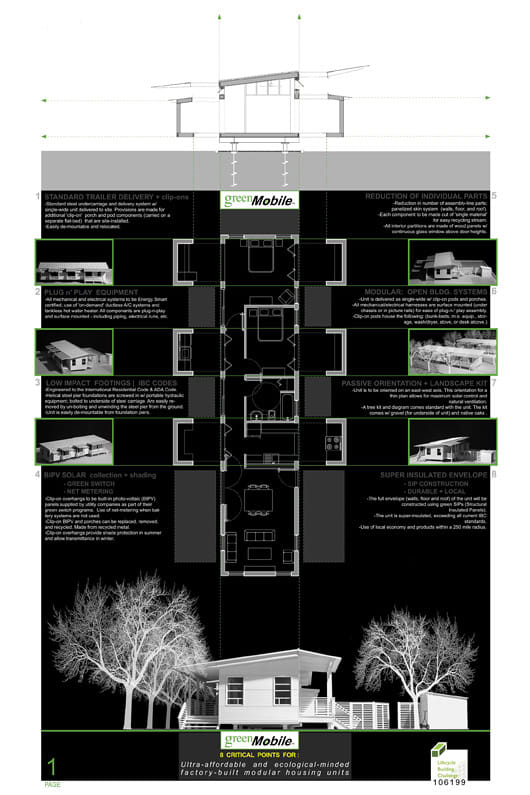
GreenMobile
Factory-built housing Units for SE USA Adaptable mobile home unit for disaster relief and permanent use
Michael Berk - Mississippi State University School of Architecture
image

The GreenMobile â„¢ envisions affordable, factory-built energy efficient mobile home units that meet International Residential Code for housing with structurally-sound foundations, demountable for easy relocation, and can function in a place with a limited infrastructure or no utility grid in-place. They can be used for immediate disaster relief housing (including first responders) and later converted to permanent housing. This project will incorporate systematic strategies for growth and change as family structures also grow and change. “Pre-fabricated plug-in” rooms, plug-in porches, and surface mounted wiring are also featured in this design.


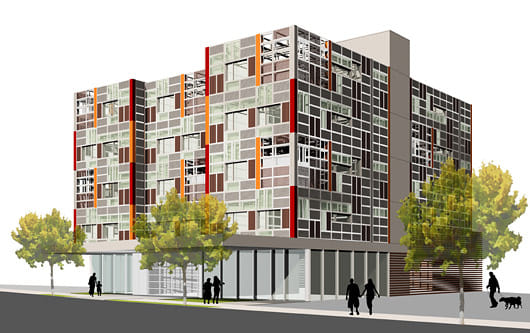
Transformative Multi-family Housing
Shape shifting residential and office space
Koji Saida, Mimi Sullivan, Hyun Joo Choi, Keiko Ito - Architects at Saida + Sullivan Design Partners
image

The transformative multi-family housing is a mixed use project with 12 residential units and one retail space on the ground level. By standardizing all the building components and using a simple connection system, the entire building’s components can be easily deconstructed, reused and recycled. Housing which standardizes all the building components using a simple connection system. By exchanging some standardized wall panels, a 2 bedroom unit transforms into a 3 bedroom unit and by removing all non bearing walls, the three residential units which are grouped as typical can be transformed into an office use.


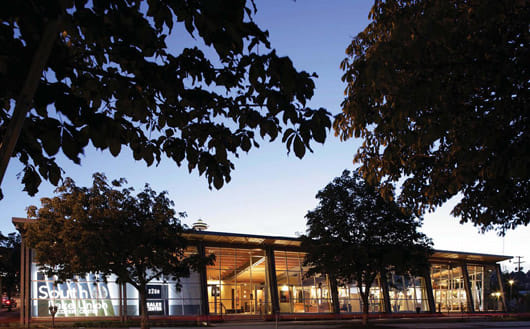
Pavilion in the Park
Building that separates into four modules and can be moved by truck
David Miller - The Miller|Hull Partnership
image

The 11,100 square foot Pavilion in the Park’s entire structure is designed for future transportation, reassembly and reuse in a new location. The building’s parts separate at three integrated joints to break into four separate modules that can be moved on trucks by surface street. The building sits lightly on the land atop short concrete piers allowing the grade and vegetation to run uninterrupted beneath. Gangway ramps with integrated hinged joints, allow the ramps to adapt to the topography of future locations.

Share

  • Follow

    0 Comments

  • Comment as :

Lifecycle Building Challenge 2

Register: Mon, Jun 16, 2008

Submit: Fri, Aug 1, 2008

Call for Entries: 2026 Brick in Architecture Awards

Register/Submit: Fri, Sep 25, 2026

N.Y.C. Groceries Branding and Design RFP

Register/Submit: Tue, Jun 30, 2026

Study Architecture Student Showcase 2026

Register/Submit: Mon, Jul 6, 2026

International Urban Project Award 2026

Register/Submit: Sat, Aug 1, 2026

International Design Competition for Pohang Museum

Register: Tue, Jul 21, 2026

Submit: Mon, Sep 7, 2026

Open Call: 13 White Houses

Register/Submit: Sun, Aug 2, 2026

New York High Falls Riverfront Market

Register: Wed, Jul 29, 2026

Submit: Mon, Jan 18, 2027

A House for Marilyn Monroe

Register: Sat, Aug 1, 2026

Submit: Tue, Aug 4, 2026

Sign up for Bustler's Email Newsletters

Open Access: Exploring 130 Years of American Design

Register/Submit: Sun, Jun 28, 2026

2026 Vega Digital Awards: Season 2

Register: Wed, Sep 16, 2026

Submit: Fri, Sep 18, 2026

Open Call: Architectural Essay Writing, 7th Cycle: 'Thresholds of Movement'

Register/Submit: Mon, Aug 31, 2026

Envision Resilience National Design Studio Grant

Register/Submit: Fri, Jun 19, 2026

BIGFIELDS STUDENTS PRIZE 2026

Register/Submit: Mon, Aug 31, 2026

CCC Emerging Design Awards 2026

Register/Submit: Tue, Jun 30, 2026

Valli Wine Tasting Room

Register: Thu, Jul 30, 2026

Submit: Mon, Feb 15, 2027

Next page » Loading

Lifecycle Building Challenge 2

Registration Deadline:  Monday, Jun 16, 20086:40 AMEDT

Submission Deadline:  Friday, Aug 1, 20086:40 AMEDT

Share

Related

regional ● national

Call for Entries!
Lifecycle Building Challenge 2
designing this building and the next
www.lifecyclebuilding.org

LBC2 is a national competition - open to students and professionals - that challenges creative minds to develop lifecycle building strategies to facilitate deconstruction and building material reuse.

Lifecycle building - also known as design for deconstruction - is the design of building materials, components, information systems, and management practices to create buildings that facilitate and anticipate future changes to and eventual adaptation or dismantling for recovery of all systems, components, and materials.

LBC2 is sponsored by the Environmental Protection Agency (U. S. EPA) and the American Institute of Architects (AIA).


Some outstanding examples from Lifecycle Building Challenge 2007:

GreenMobile
Factory-built housing Units for SE USA Adaptable mobile home unit for disaster relief and permanent use
Michael Berk - Mississippi State University School of Architecture

image

The GreenMobile â„¢ envisions affordable, factory-built energy efficient mobile home units that meet International Residential Code for housing with structurally-sound foundations, demountable for easy relocation, and can function in a place with a limited infrastructure or no utility grid in-place. They can be used for immediate disaster relief housing (including first responders) and later converted to permanent housing. This project will incorporate systematic strategies for growth and change as family structures also grow and change. “Pre-fabricated plug-in” rooms, plug-in porches, and surface mounted wiring are also featured in this design.


Transformative Multi-family Housing
Shape shifting residential and office space
Koji Saida, Mimi Sullivan, Hyun Joo Choi, Keiko Ito - Architects at Saida + Sullivan Design Partners

image

The transformative multi-family housing is a mixed use project with 12 residential units and one retail space on the ground level. By standardizing all the building components and using a simple connection system, the entire building’s components can be easily deconstructed, reused and recycled. Housing which standardizes all the building components using a simple connection system. By exchanging some standardized wall panels, a 2 bedroom unit transforms into a 3 bedroom unit and by removing all non bearing walls, the three residential units which are grouped as typical can be transformed into an office use.


Pavilion in the Park
Building that separates into four modules and can be moved by truck
David Miller - The Miller|Hull Partnership

image

The 11,100 square foot Pavilion in the Park’s entire structure is designed for future transportation, reassembly and reuse in a new location. The building’s parts separate at three integrated joints to break into four separate modules that can be moved on trucks by surface street. The building sits lightly on the land atop short concrete piers allowing the grade and vegetation to run uninterrupted beneath. Gangway ramps with integrated hinged joints, allow the ramps to adapt to the topography of future locations.

Share

  • Follow

    0 Comments

  • Comment as :

Promoted Competitions

Valli Wine Tasting Room

Register by Thu, Jul 30, 2026

Submit by Mon, Feb 15, 2027

100,000 € Prize / Buildner's Unbuilt Award 2026

Register by Thu, Jul 9, 2026

Submit by Tue, Oct 20, 2026

50,000€ Prize / Mujassam Watan Urban Sculpture Challenge #8

Register by Thu, Jul 23, 2026

Submit by Thu, Aug 27, 2026

Kinderspace: Architecture for Children's Development competition / Edition #4

Register by Thu, Jun 18, 2026

Submit by Mon, Nov 30, 2026

Portugal Long Table Restaurant

Register by Wed, Jul 8, 2026

Submit by Mon, Jan 11, 2027

2026 Fall 2x8 Exhibition and Scholarship Program

Register by Mon, Sep 14, 2026

Submit by Mon, Oct 19, 2026

Kingspan MICROHOME 2026

Register by Wed, Sep 30, 2026

Submit by Mon, Nov 2, 2026

Open Call: 13 White Houses

Register/Submit by Sun, Aug 2, 2026

Museum of Emotions / Edition #8

Register by Thu, Jun 18, 2026

Submit by Mon, Jul 20, 2026

Underbridge / Edition #2

Register by Thu, Jul 16, 2026

Submit by Mon, Oct 19, 2026

Re:Form - New Life for Old Spaces / Edition #3

Register by Thu, Jul 2, 2026

Submit by Mon, Oct 12, 2026

Pavilion Atlas 2026

Register by Wed, Sep 16, 2026

Submit by Mon, Oct 19, 2026

Next page » Loading