Architectures of finance from the Great Depression to the Subprime Meltdown
Wednesday, Sep 10, 20085:28 AM — Monday, Dec 22, 20086:28 AMEDT
| Cambridge, MA - MIT Museum Compton Gallery
Architectures of finance from the Great Depression to the Subprime Meltdown
An exhibition by Damon Rich and the Center for Urban Pedagogy (CUP)
Commissioned by the Center for Advanced Visual Studies (CAVS)
September 9–December 21, 2008
Exhibition at MIT Museum explores relationship of finance and architecture
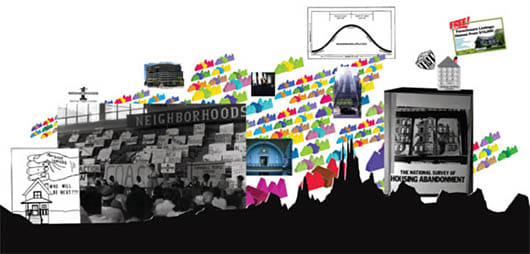 CAMBRIDGE, Massachusetts – The Center for Advanced Visual Studies and the MIT Museum are pleased to announce Red Lines, Death Vows, Foreclosures, Risk Structures: Architectures of finance from the Great Depression to the Subprime Meltdown, an exhibition by designer Damon Rich and the Center for Urban Pedagogy (CUP) that will open September 9 at 5:30 PM and run through December 21. An installation of models, photographs, videos, and drawings, Red Lines immerses visitors in a landscape of pulsing capital and liquidated buildings, exploring the relation between finance and architecture.
During a year-long residence at MIT's Center for Advanced Visual Studies, Rich surveyed the darkening realm of real estate markets: foreclosures, pro-formas, chains of title, block busting, exploding ARMs, and the obscure history of the mortgage, Old French for "death vow." Working with MIT students and volunteers, he traveled to Washington, DC to visit and interview representatives of the Mortgage Bankers Association and the Comptroller of the Currency. In Chicago, Rich and Meg Rotzel of CAVS created a video with the National Training and Information Center about the anti-redlining movement of the 1970s and the democratic reforms it brought to banking. In Boston, Rich hung out with mortgage brokers at bars. These interviews, photographs, napkin sketches, and yellowed clippings provide the material for the work in the exhibition.
In the resulting installation, the head of Frederick Babcock, pioneer appraiser, gazes over a scattered field of diminished Detroit houses, still showing damage from 1960s real estate scandals. Looming behind Babcock, the flicker of a neon sign – BUY LOW SELL HIGH – reveals a barrier shaped by the spikes and troughs of the 20th century's prime rate, the sharp line between lenders and borrowers. Projected videos haunt the gallery with the apparitions of financial engineers, federal regulators, and anti-foreclosure activists.
Today, what has become known as the Subprime Meltdown continues to spread, pushing people out of homes, wasting neighborhoods, bankrupting institutions, and threatening global economic crisis. Red Lines aims to broaden and enrich the urgent conversation about how our society finances its living environments. Through public programs, contributions to the curriculum at MIT, and off-site works like the educational video Predatory Tales produced with Lawrence Community Works of Lawrence, Massachusetts, Red Lines offers multiple sites where new dialogues about these crucial topics can begin.
MIT Museum Compton Gallery
Building 10-150, 77 Massachusetts Avenue, Cambridge, MA
Open Monday–Friday 9:30 am–5:00 pm
Admission is free and open to the public
web.mit.edu/museum/exhibitions/compton.html
Damon Rich is an urban designer working at the grisly intersection of design, policy, and the public. His exhibitions use video, sculpture, graphics, and photography to investigate the political economy of the built environment. His work has been exhibited internationally at venues including the Storefront for Art and Architecture and SculptureCenter (New York City), the Haus der Kulturen der Welt (Berlin), Galerie für Zeitgenössische Kunst (Liepzig), the Venice Architecture Biennale, and Netherlands Architecture Institute (Rotterdam). In 1997, he founded the Center for Urban Pedagogy (CUP), a nonprofit organization dedicated to helping people understand and change the places they live. In 2007, Rich was selected as a Loeb Fellow in Advanced Environmental Studies by the Harvard Graduate School of Design.
The Center for Urban Pedagogy (CUP) is a Brooklyn-based nonprofit organization that produces creative education about places and how they change. CUP began working in 1997 and was incorporated in 2001. CUP facilitates collaborations between advocates, architects, artists, city workers, educators, policy makers, residents, and students to investigate the built environment. By examining spaces as they are, CUP imagines how they could be different and how residents can participate in shaping them. Investigations begin with questions about how communities work: Who built public housing? How are prisons designed? Where does garbage go? Why are there abandoned buildings? Project participants use a research-based, design-driven process to develop inventive tools for community participation and change. CUP projects take many forms: architectural proposals, board games, comic books, exhibitions, films and videos, maps, models, posters, walking tours and workshops. CUP distributes its work through community-based organizations, education and design institutions, public installations, television shows and free programs. CUP projects are executed by a network of participants supported by CUP's staff, board of directors, and volunteers. Visit www.anothercupdevelopment.org to learn more.
The Center for Advanced Visual Studies (CAVS) is an artist-in-residence program at the Massachusetts Institute of Technology (MIT) and a portal for artists to tap into the resources of one of the most important research institutions in the world. CAVS provides an integrating structure that helps resident artists engage the MIT community and the greater public in cross-disciplinary collaborations. Visit www.cavs.mit.edu to learn more.
CAMBRIDGE, Massachusetts – The Center for Advanced Visual Studies and the MIT Museum are pleased to announce Red Lines, Death Vows, Foreclosures, Risk Structures: Architectures of finance from the Great Depression to the Subprime Meltdown, an exhibition by designer Damon Rich and the Center for Urban Pedagogy (CUP) that will open September 9 at 5:30 PM and run through December 21. An installation of models, photographs, videos, and drawings, Red Lines immerses visitors in a landscape of pulsing capital and liquidated buildings, exploring the relation between finance and architecture.
During a year-long residence at MIT's Center for Advanced Visual Studies, Rich surveyed the darkening realm of real estate markets: foreclosures, pro-formas, chains of title, block busting, exploding ARMs, and the obscure history of the mortgage, Old French for "death vow." Working with MIT students and volunteers, he traveled to Washington, DC to visit and interview representatives of the Mortgage Bankers Association and the Comptroller of the Currency. In Chicago, Rich and Meg Rotzel of CAVS created a video with the National Training and Information Center about the anti-redlining movement of the 1970s and the democratic reforms it brought to banking. In Boston, Rich hung out with mortgage brokers at bars. These interviews, photographs, napkin sketches, and yellowed clippings provide the material for the work in the exhibition.
In the resulting installation, the head of Frederick Babcock, pioneer appraiser, gazes over a scattered field of diminished Detroit houses, still showing damage from 1960s real estate scandals. Looming behind Babcock, the flicker of a neon sign – BUY LOW SELL HIGH – reveals a barrier shaped by the spikes and troughs of the 20th century's prime rate, the sharp line between lenders and borrowers. Projected videos haunt the gallery with the apparitions of financial engineers, federal regulators, and anti-foreclosure activists.
Today, what has become known as the Subprime Meltdown continues to spread, pushing people out of homes, wasting neighborhoods, bankrupting institutions, and threatening global economic crisis. Red Lines aims to broaden and enrich the urgent conversation about how our society finances its living environments. Through public programs, contributions to the curriculum at MIT, and off-site works like the educational video Predatory Tales produced with Lawrence Community Works of Lawrence, Massachusetts, Red Lines offers multiple sites where new dialogues about these crucial topics can begin.
MIT Museum Compton Gallery
Building 10-150, 77 Massachusetts Avenue, Cambridge, MA
Open Monday–Friday 9:30 am–5:00 pm
Admission is free and open to the public
web.mit.edu/museum/exhibitions/compton.html
Damon Rich is an urban designer working at the grisly intersection of design, policy, and the public. His exhibitions use video, sculpture, graphics, and photography to investigate the political economy of the built environment. His work has been exhibited internationally at venues including the Storefront for Art and Architecture and SculptureCenter (New York City), the Haus der Kulturen der Welt (Berlin), Galerie für Zeitgenössische Kunst (Liepzig), the Venice Architecture Biennale, and Netherlands Architecture Institute (Rotterdam). In 1997, he founded the Center for Urban Pedagogy (CUP), a nonprofit organization dedicated to helping people understand and change the places they live. In 2007, Rich was selected as a Loeb Fellow in Advanced Environmental Studies by the Harvard Graduate School of Design.
The Center for Urban Pedagogy (CUP) is a Brooklyn-based nonprofit organization that produces creative education about places and how they change. CUP began working in 1997 and was incorporated in 2001. CUP facilitates collaborations between advocates, architects, artists, city workers, educators, policy makers, residents, and students to investigate the built environment. By examining spaces as they are, CUP imagines how they could be different and how residents can participate in shaping them. Investigations begin with questions about how communities work: Who built public housing? How are prisons designed? Where does garbage go? Why are there abandoned buildings? Project participants use a research-based, design-driven process to develop inventive tools for community participation and change. CUP projects take many forms: architectural proposals, board games, comic books, exhibitions, films and videos, maps, models, posters, walking tours and workshops. CUP distributes its work through community-based organizations, education and design institutions, public installations, television shows and free programs. CUP projects are executed by a network of participants supported by CUP's staff, board of directors, and volunteers. Visit www.anothercupdevelopment.org to learn more.
The Center for Advanced Visual Studies (CAVS) is an artist-in-residence program at the Massachusetts Institute of Technology (MIT) and a portal for artists to tap into the resources of one of the most important research institutions in the world. CAVS provides an integrating structure that helps resident artists engage the MIT community and the greater public in cross-disciplinary collaborations. Visit www.cavs.mit.edu to learn more.

Share
0 Comments
Comment as :