• Login / Join
  • About
  • •
  • Contact
  • •
  • Advertising
bustler logo
bustler logo
  • News
  • Competitions
  • Events
  • Bustler is powered by Archinect
  • Sign up for Bustler's Email Newsletters

  • Follow these Bustler feeds:

  • Search

    Search in

  • Submit

    What are you submitting?

    News Pitch
    Competition
    Event
  • Login / Join
  • News|Competitions|Events
  • Search
    | Submit
    | Follow
  • Search in

    What are you submitting?

    News Pitch
    Competition
    Event

    Follow these Bustler feeds:

  • About|Contact|Advertising
  • Login / Join

Middle School Students Win School of the Future Design Contest

By Bustler Editors|

Thursday, May 14, 2009

In March 2009, Bustler reported on students from Imago Dei Middle School, Tucson, AZ, winning the regional School of the Future Student Design Competition. Now, the Council of Educational Facility Planners International (CEFPI) announced the Imago Dei students as winners of the national 2009 Award of Excellence during an award ceremony in Washington, DC.
image

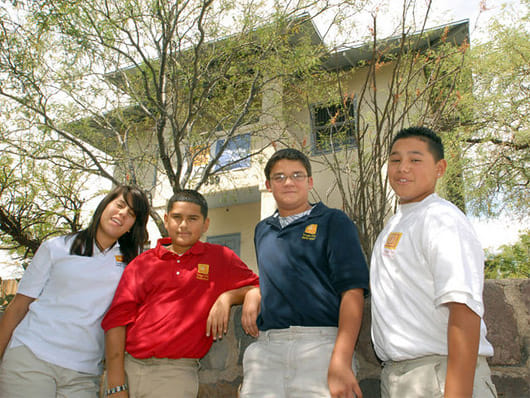
Imago Dei Middle School students (from left) Monique Andrade, 13, Sergio Acosta, 12, Riley Breedlove, 12, and Anthony Barcelo, 12, won an award in the School of the Future Design Competition. (Photo: Xavier Gallegos/Tucson Citizen

“Successful schools build successful communities.” said Sue Robertson, CEFPI president. “Today’s students, tomorrow’s green builders, are committed to creating healthy, high performing schools and communities. Let’s supply them with all the tools they need to improve the places where children learn. And then, let’s really listen to them—because they have some really good ideas!”

Middle school students across the country participated in the School of the Future Competition which is sponsored by the Council of Educational Facility Planners International and the National Association of Realtors® along with the U.S. Department of Energy, the U.S. Environmental Protection Agency, the American Institute of Architects, the American Federation of Teachers, the National Education Association and more than 30 organizations and private companies.

The annual competition challenges teams to think creatively as they design tomorrow’s green schools to enhance learning, conserve resources, be environmentally responsive and engage the surrounding community. The multidisciplinary solution requires students to submit a project model made from recycled materials, a narrative description and short video or PowerPoint documenting the planning process and project rationale.
image

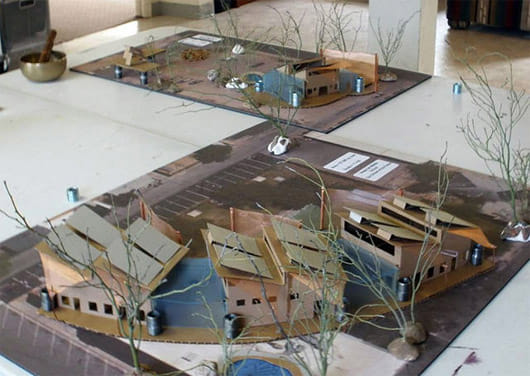
A close-up of part of the design for an innovative, eco-friendly school building. (Courtesy of Imago Dei Middle School)

The Award of Excellence went to Imago Dei Middle School, Tucson, AZ, with Explorer Middle School, Everett, WA capturing second place. Seneca Middle School, Macomb, MI and The Gereau Center, Rocky Mount, VA, tied for third place. Awards of commendation were presented to Lyme-Old Lyme Middle School, Old Lyme, CT and Charles Hart Middle School, Washington, DC.

Imago Dei received $2,000 for their first-place project which demonstrated a truly integrated green design approach. Community first was evident in their innovative sustainable design. Deeply engaged with the community, the students chose an abandoned neighborhood site to construct their school using recycled building materials from a vacant building. The students created their own bricks for the project, utilizing the available sand and materials onsite. Exchanging ideas with students in France and Mali, the project promoted collaboration on a global scale, articulating their proclamation, “The world is our classroom.”

The $1,500 second place prize went to Explorer Middle School for their very holistic presentation. The students focused on cooperative learning and clearly worked as a team, incorporating technology, colors and lighting that would reach all learners: visual, auditory and kinesthetic. They conducted comprehensive research and demonstrated resourceful use of green building principles in their project which included a wetland, composting areas and grey water recycling as well as the use of recycled jeans for insulation. Sports fields were shared with the community who also enjoyed access to the school’s computer labs, gym, library and auditorium.

Awards of $1,000 went to Seneca Middle School and The Gereau Center for their third place projects. Leading edge technology was key to the Seneca Middle School team, who issued “I-Touch” computers to every student and created “smart glass” room dividers, “smart bricks” and a student “smart card” containing a GPS chip for building access. Academic innovations included expanding and contracting classrooms to accommodate team teaching and provide for growth in student population. Methodically integrating the site features, Seneca’s green design also incorporated rainwater gardens, solar panels and wind turbines.

The Gereau Center students responded to real issues in their lives and developed useful and creative solutions, designing a school responsive to the basic human needs of its users – safety, nutrition, indoor air quality, and comfort. Reflecting the local environment, the school’s sustainable roof and shell mirrored the surrounding Blue Ridge Mountains. An “Educational Power Strip” had the capability to grow along with student population and the needs of the community. The Gereau Center integrated green building principles through the use of recycled materials, geothermal heating and air conditioning, solar hot water heaters and triple pane glass.

Lyme-Old Lyme Middle School and Charles Hart Middle School each received $500 for their outstanding projects. The Lyme-Old Lyme students expressed a strong grasp of sustainable concepts. The focal point of their design was a geodesic dome, housing a roof deck area. Unique “Pedal Power” bicycles located on the roof deck area supplied the building’s electricity. Demonstrating a strong sense of social responsibility and community engagement, the students developed recycling, composting and other green programs that impacted their local community and beyond.

The students at Charles Hart Middle School incorporated safety and security into their design. Use of a green roof, bio walls and recycled denim ensured a healthy environment with good indoor air quality. The building’s green roof served as an outdoor classroom for the study of biology and ecology, including a garden to grow plants for the school’s landscaping and organic vegetables for their cafeteria. A second green roof housed the football field, with a swimming pool located beneath.

The Council of Educational Facility Planners International (CEFPI) is the only professional organization whose principal purpose is improving the places where children learn. CEFPI embraces a diverse group of professionals with one single goal – building healthy, safe, high performance schools that enhance student and teacher performance and support culture and community vitality. To learn more, visit www.cefpi.org.

Related

washington ● usa ● tucson ● student ● school of the future ● school ● imago dei ● cefpi ● arizona

Share

  • Follow

    0 Comments

  • Comment as :

Middle School Students Win School of the Future Design Contest

Northwestern University selects 12-firm longlist to design new engineering building

New architecture and design competitions: Exploring 130 Years of American Design, Christo & Jeanne-Claude Center, 13 White Houses, and La Pyramide

Micro-architecture honored in latest Tiny House Architecture Competition

World’s most beautiful restaurants of 2026 chosen by Prix Versailles

Sponsored Post by Buildner

Design a wine tasting room in Italy! Valli Wine Tasting Room is launched!

10 can't-miss architecture & design events to see this June in London, Los Angeles, Chicago, San Francisco, Detroit, San Diego, Porto, and Barcelona

Sponsored Post by Buildner

Museum of Emotions / Edition #8 FINAL registration deadline is approaching!

Seven global projects make AR Public Awards shortlist 2026

Sign up for Bustler's Email Newsletters

Sponsored Post by Buildner

Design a slow-living restaurant in Portugal! Portugal Long Table Restaurant is launched!

World's best tall buildings honored at the CVU 2026 Award of Excellence

Sponsored Post by TWOPAGES

Final call: TWOPAGES X Design Contest 2026 submissions close June 5

Kengo Kuma & Paul Raff win Alberta national park visitor center competition with landscape-focused design

2026 Moira Gemmill and MJ Long prizes announced by W Awards

New architecture and design competitions: Kinderspace, Stewardson Keefe LeBrun Travel Grant, SMALL PROJECT BIG IMPACT, and Garden of University House, Bucharest

The Century of Gehry: New retrospective explores the late architect's work & collaborations

Next page » Loading

Middle School Students Win School of the Future Design Contest

By Bustler Editors|

Thursday, May 14, 2009

Share

Related

washington ● usa ● tucson ● student ● school of the future ● school ● imago dei ● cefpi ● arizona

In March 2009, Bustler reported on students from Imago Dei Middle School, Tucson, AZ, winning the regional School of the Future Student Design Competition. Now, the Council of Educational Facility Planners International (CEFPI) announced the Imago Dei students as winners of the national 2009 Award of Excellence during an award ceremony in Washington, DC.

image

Imago Dei Middle School students (from left) Monique Andrade, 13, Sergio Acosta, 12, Riley Breedlove, 12, and Anthony Barcelo, 12, won an award in the School of the Future Design Competition. (Photo: Xavier Gallegos/Tucson Citizen

“Successful schools build successful communities.” said Sue Robertson, CEFPI president. “Today’s students, tomorrow’s green builders, are committed to creating healthy, high performing schools and communities. Let’s supply them with all the tools they need to improve the places where children learn. And then, let’s really listen to them—because they have some really good ideas!”

Middle school students across the country participated in the School of the Future Competition which is sponsored by the Council of Educational Facility Planners International and the National Association of Realtors® along with the U.S. Department of Energy, the U.S. Environmental Protection Agency, the American Institute of Architects, the American Federation of Teachers, the National Education Association and more than 30 organizations and private companies.

The annual competition challenges teams to think creatively as they design tomorrow’s green schools to enhance learning, conserve resources, be environmentally responsive and engage the surrounding community. The multidisciplinary solution requires students to submit a project model made from recycled materials, a narrative description and short video or PowerPoint documenting the planning process and project rationale.

image

A close-up of part of the design for an innovative, eco-friendly school building. (Courtesy of Imago Dei Middle School)

The Award of Excellence went to Imago Dei Middle School, Tucson, AZ, with Explorer Middle School, Everett, WA capturing second place. Seneca Middle School, Macomb, MI and The Gereau Center, Rocky Mount, VA, tied for third place. Awards of commendation were presented to Lyme-Old Lyme Middle School, Old Lyme, CT and Charles Hart Middle School, Washington, DC.

Imago Dei received $2,000 for their first-place project which demonstrated a truly integrated green design approach. Community first was evident in their innovative sustainable design. Deeply engaged with the community, the students chose an abandoned neighborhood site to construct their school using recycled building materials from a vacant building. The students created their own bricks for the project, utilizing the available sand and materials onsite. Exchanging ideas with students in France and Mali, the project promoted collaboration on a global scale, articulating their proclamation, “The world is our classroom.”

The $1,500 second place prize went to Explorer Middle School for their very holistic presentation. The students focused on cooperative learning and clearly worked as a team, incorporating technology, colors and lighting that would reach all learners: visual, auditory and kinesthetic. They conducted comprehensive research and demonstrated resourceful use of green building principles in their project which included a wetland, composting areas and grey water recycling as well as the use of recycled jeans for insulation. Sports fields were shared with the community who also enjoyed access to the school’s computer labs, gym, library and auditorium.

Awards of $1,000 went to Seneca Middle School and The Gereau Center for their third place projects. Leading edge technology was key to the Seneca Middle School team, who issued “I-Touch” computers to every student and created “smart glass” room dividers, “smart bricks” and a student “smart card” containing a GPS chip for building access. Academic innovations included expanding and contracting classrooms to accommodate team teaching and provide for growth in student population. Methodically integrating the site features, Seneca’s green design also incorporated rainwater gardens, solar panels and wind turbines.

The Gereau Center students responded to real issues in their lives and developed useful and creative solutions, designing a school responsive to the basic human needs of its users – safety, nutrition, indoor air quality, and comfort. Reflecting the local environment, the school’s sustainable roof and shell mirrored the surrounding Blue Ridge Mountains. An “Educational Power Strip” had the capability to grow along with student population and the needs of the community. The Gereau Center integrated green building principles through the use of recycled materials, geothermal heating and air conditioning, solar hot water heaters and triple pane glass.

Lyme-Old Lyme Middle School and Charles Hart Middle School each received $500 for their outstanding projects. The Lyme-Old Lyme students expressed a strong grasp of sustainable concepts. The focal point of their design was a geodesic dome, housing a roof deck area. Unique “Pedal Power” bicycles located on the roof deck area supplied the building’s electricity. Demonstrating a strong sense of social responsibility and community engagement, the students developed recycling, composting and other green programs that impacted their local community and beyond.

The students at Charles Hart Middle School incorporated safety and security into their design. Use of a green roof, bio walls and recycled denim ensured a healthy environment with good indoor air quality. The building’s green roof served as an outdoor classroom for the study of biology and ecology, including a garden to grow plants for the school’s landscaping and organic vegetables for their cafeteria. A second green roof housed the football field, with a swimming pool located beneath.

The Council of Educational Facility Planners International (CEFPI) is the only professional organization whose principal purpose is improving the places where children learn. CEFPI embraces a diverse group of professionals with one single goal – building healthy, safe, high performance schools that enhance student and teacher performance and support culture and community vitality. To learn more, visit www.cefpi.org.

Share

  • Follow

    0 Comments

  • Comment as :

Archinect JobsArchinect Jobs

The Archinect Job Board attracts the world's top architectural design talents.

VIEW ALL JOBS POST A JOB

Project Designer (3-5 years)

Edmonds + Lee Architects

Project Designer (3-5 years)

San Francisco, CA, US

Architectural Project Manager - Multifamily

DAHLIN ARCHITECTURE | PLANNING | INTERIORS

Architectural Project Manager - Multifamily

Irvine, CA, US

Senior Designer - Residential Design

Laura U Design Collective

Senior Designer - Residential Design

Houston, TX, US

Senior Designer / Architect

NardiHaus

Senior Designer / Architect

Pasadena, CA, US

Architects with 4-10 Years' Experience

Adamson Associates, Inc.

Architects with 4-10 Years' Experience

Los Angeles, CA, US

Registered Architect

Advantage Point Group, Inc.

Registered Architect

Saint Paul, MN, US

Designer

HATCH ARCHITECTURE

Designer

Los Angeles, CA, US

Junior Architect

PRDG architecture + design

Junior Architect

New York, NY, US

Job Captain / Project Manager

Breland – Harper

Job Captain / Project Manager

Los Angeles, CA, US

Project Architect

Turpentine Design

Project Architect

Fuquay-Varina, NC, US

Next page » Loading