• Login / Join
  • About
  • •
  • Contact
  • •
  • Advertising
bustler logo
bustler logo
  • News
  • Competitions
  • Events
  • Bustler is powered by Archinect
  • Sign up for Bustler's Email Newsletters

  • Follow these Bustler feeds:

  • Search

    Search in

  • Submit

    What are you submitting?

    News Pitch
    Competition
    Event
  • Login / Join
  • News|Competitions|Events
  • Search
    | Submit
    | Follow
  • Search in

    What are you submitting?

    News Pitch
    Competition
    Event

    Follow these Bustler feeds:

  • About|Contact|Advertising
  • Login / Join

Horologion Commended in Piraeus Tower 2010 Competition

By Bustler Editors|

Thursday, Aug 26, 2010
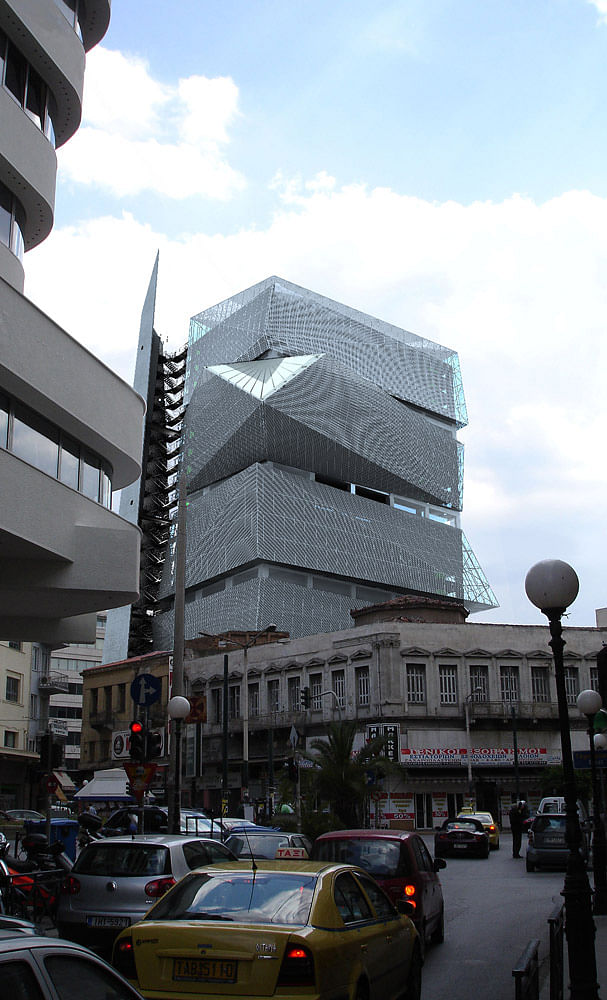
North Sundial

Athens-based firm architecture 112 have shared with us their entry "Horologion" that won the team a Commendation at the Greek competition Piraeus Tower 2010 – Changing the Face/Façades Reformation, organized by DUPONT and greekarchitects.gr.

architecture 112 are Stavros Martinos and Aris Ntalas, and project collaborators were Giannis Giannoutsos, Alexia Katsakiori and Vassiliki Gialia.

The Piraeus Tower was erected on the site of a 19th century Clock building that used to be a significant point of reference for the city and its inhabitants. The memory of this demolished landmark has not yet faded out entirely. In order to restitute its presence, we suggest the redesign of the Tower façade as a system of urban sundials.
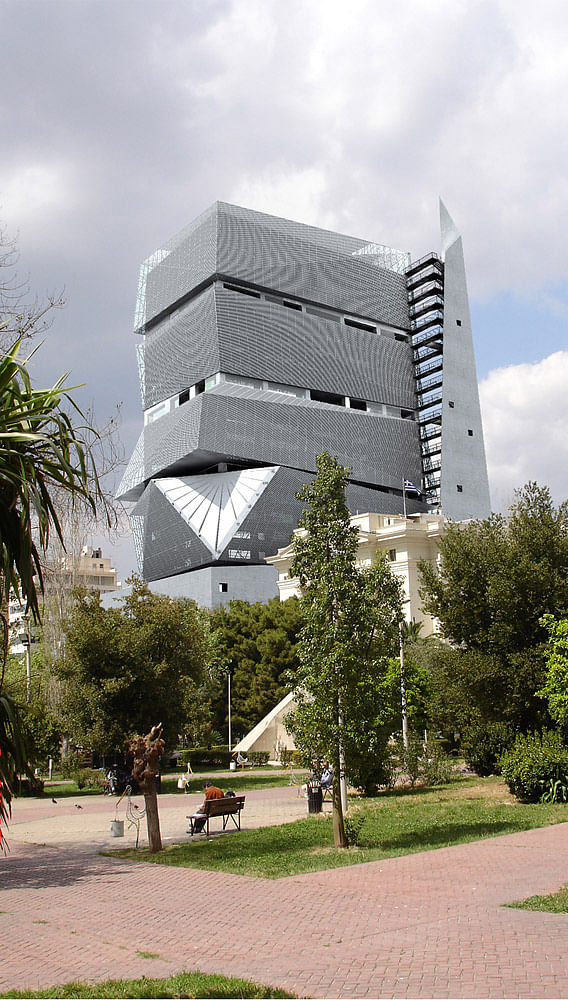
South Sundial

This way, the reminiscence of the old Clock will be activated on site, in order to enhance the landmark quality of the Piraeus Tower – not only in terms of size, but also in terms of character, through site-specific history.

Night South View

Sundials are landscape elements with infinite design potential: They are objects whose form encodes information such as geographic latitude, the angle of the sun towards the earth surface, and the four points of orientation. The shared ability to read the code in a particular sundial may contribute significantly to a sense of collective identity, and this is why sundials are often placed in prominent places at historical cities or sites.

Horologion, Perspective

The transcription of the sundial device into architecture brings out features such as time, sunlight, shadow, and its gradations during the day. The formerly solid and disproportionate mass of the old tower is divided into four convex faceted volumes that may assume the function of sundial during each of the year’s four seasons. Time, during the day, is read through the shadow the tower casts upon its own self. Specifically, each of the volumes is formulated into connected triangular faces, so that each time a convenient edge may act as gnomon upon the reclining face below. Every face will be shaded differently in the course of time, every day of the year. As a result, the massive building will have an ever changing appearance, but in a way that remains meaningful to the city.

Elevations

The analemmatic sundial formulated on the top corner of the tower facing North will be easily discernible, since its projection surface will be the only edge to receive a cast shadow. The rest of the edges will remain shaded in different tones of darkness. The same effect will appear on the bottom corner of the tower facing South, where the sundial becomes vertical.
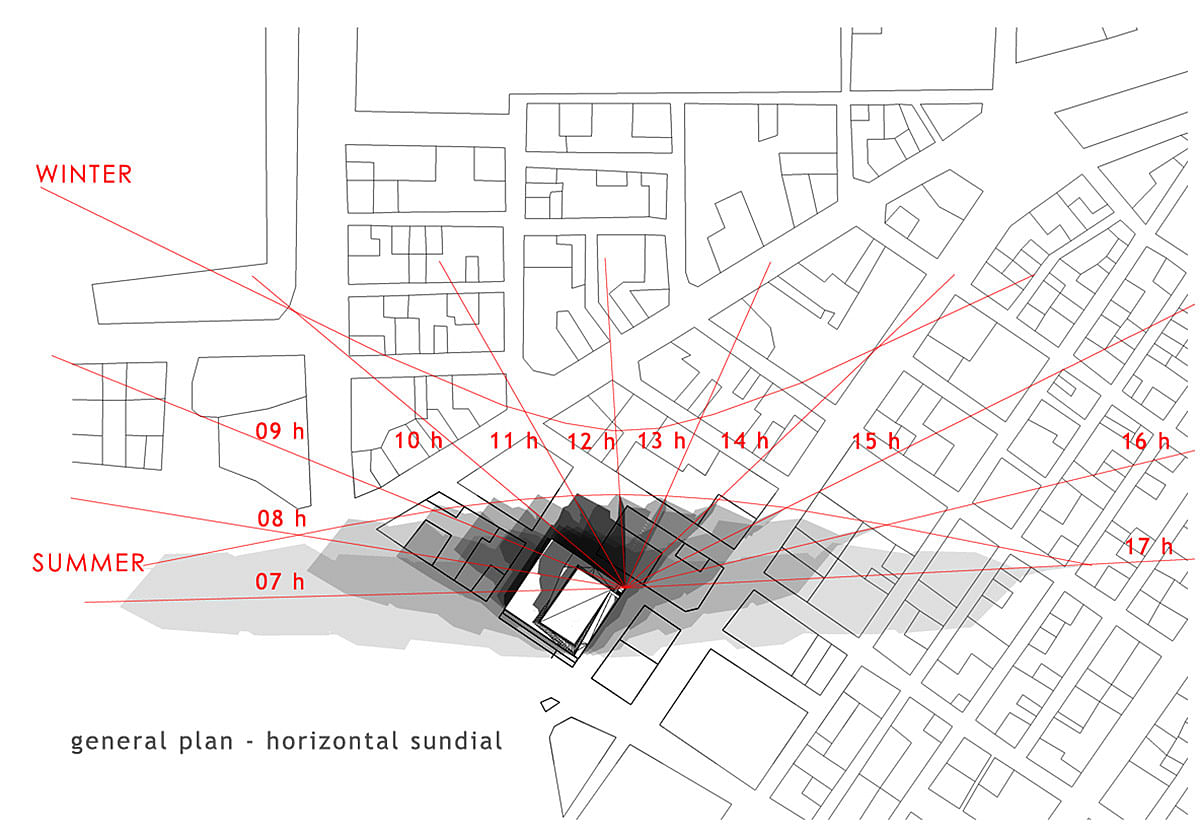
General Plan Horizontal Sundial

The required additional staircase is shaped into a tall pointed element that casts its shadow upon the surrounding cityscape, acting as gnomon of a horizontal dial. Casts of this latter gnomon edge upon the city may be explicitly marked by a network of urban elements, placed at the proper locations across Piraeus.

The architectural form resulting from such an idea looks cutting edge, and yet remains primitive in essence.

Section

Program

The Piraeus Tower is a typical office and retail building, with a cafeteria over the suspended socle and a restaurant on the top floor. The intervals between the four proposed volumes are meant to remain vacant, and occasionally house public uses, open to the city. The additional staircase and elevator will connect the surface of the city through the terrace to the public floors cutting through the body of the building.

Time Strip

Light effects

During the day, the appearance of the tower relies exclusively on natural sunlight and shadow. To maximize this effect, no other color is present but white. Materiality of the exterior skin has to take into consideration the reduction of reflectivity of large white surfaces under the sharp Greek sun. For this, it has to be textured. The contrasting smooth surface of the external gnomon might display a more absorbent hue, such as light grey.

At night, all edges of the tower are accentuated with white light coming from within. This preserves the characteristic geometry of the building. The intervals between the volumes are lit in a warmer color, such as yellow halogen, both to suggest their depth, as well as to better articulate the white volumes floating above and below. The gnomon wrapped around the additional staircase is lit in a warm colored hue on the inside, that might even change hues during the night, to suggest a particular softness of the architectural surface, where it comes to enclose the staircase and the tower.
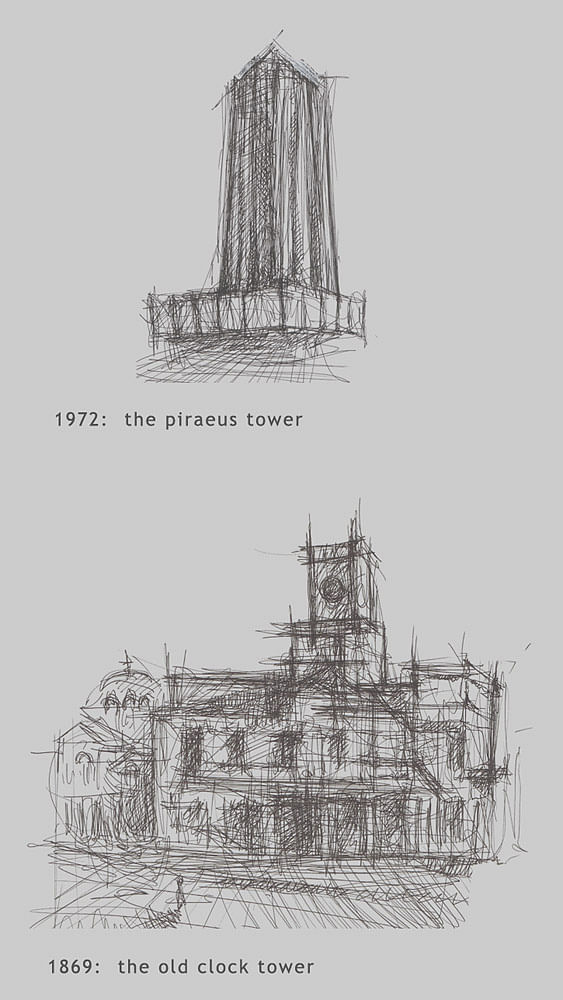
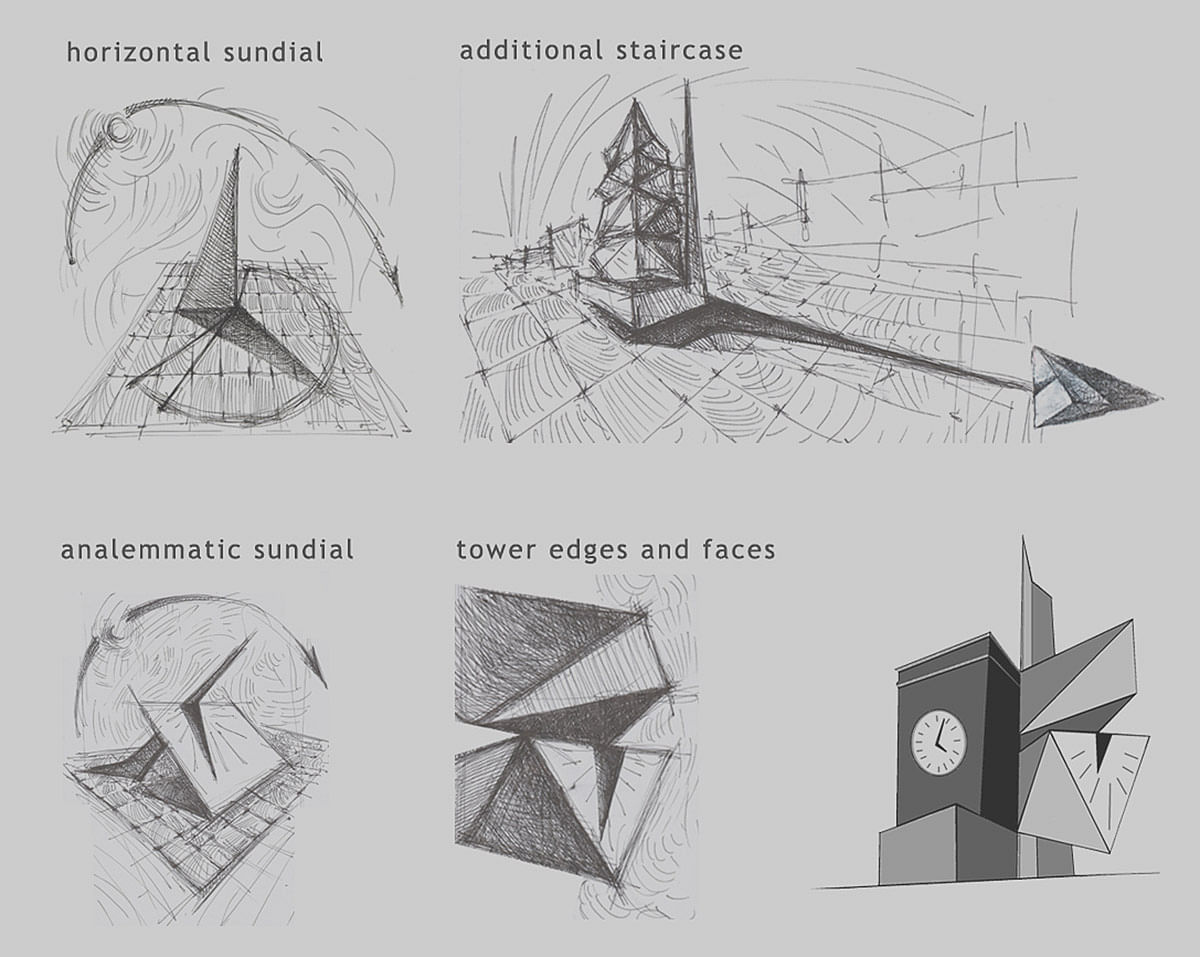
Sketches
Sketches

Related

athens ● europe ● greece ● high-rise ● tower ● piraeus tower ● piraeus tower 2010 competition ● horologion ● sundial ● architecture 112

Share

  • Follow

    0 Comments

  • Comment as :

Horologion Commended in Piraeus Tower 2010 Competition

World’s most beautiful commercial stores of 2026 selected by Prix Versailles

Sponsored Post by Buildner

Buildner’s Unbuilt Award 2026 advance registration deadline is approaching!

Eight innovative timber projects honored at 2026 Wood in Architecture Awards

Beautiful brick architecture honored at BRICK AWARD 26

Over $500,000 awarded to architectural discourse projects by Graham Foundation

Best in urban planning recognized at AIA Regional & Urban Design Award 2026

Sponsored Post by Buildner

Re:Form - New Life for Old Spaces / Edition #3 advance registration deadline is approaching!

New architecture and design competitions: IDEAS Awards, UIA-HYP CUP International Student Competition, Vancouver Tall Challenge, and Memorial to the Sixth Extinction

Sign up for Bustler's Email Newsletters

Best small projects chosen at AIA Small Project Award 2026

10 standout sustainable projects honored at AIA COTE Top Ten Award 2026

Best residential architecture of 2026 honored at AIA Housing Award

Best new interiors of 2026 chosen at AIA Interior Architecture Awards

Best global architecture honored at RIBA International Awards 2026

World’s most beautiful airports of 2026 chosen by Prix Versailles

New architecture and design competitions: Brick in Architecture Awards, Study Architecture Student Showcase, N.Y.C. Groceries, and New York High Falls Riverfront Market

Next page » Loading

Horologion Commended in Piraeus Tower 2010 Competition

By Bustler Editors|

Thursday, Aug 26, 2010

Share

North Sundial

Related

athens ● europe ● greece ● high-rise ● tower ● piraeus tower ● piraeus tower 2010 competition ● horologion ● sundial ● architecture 112

Athens-based firm architecture 112 have shared with us their entry "Horologion" that won the team a Commendation at the Greek competition Piraeus Tower 2010 – Changing the Face/Façades Reformation, organized by DUPONT and greekarchitects.gr.

architecture 112 are Stavros Martinos and Aris Ntalas, and project collaborators were Giannis Giannoutsos, Alexia Katsakiori and Vassiliki Gialia.

The Piraeus Tower was erected on the site of a 19th century Clock building that used to be a significant point of reference for the city and its inhabitants. The memory of this demolished landmark has not yet faded out entirely. In order to restitute its presence, we suggest the redesign of the Tower façade as a system of urban sundials.

South Sundial

This way, the reminiscence of the old Clock will be activated on site, in order to enhance the landmark quality of the Piraeus Tower – not only in terms of size, but also in terms of character, through site-specific history.

Night South View

Sundials are landscape elements with infinite design potential: They are objects whose form encodes information such as geographic latitude, the angle of the sun towards the earth surface, and the four points of orientation. The shared ability to read the code in a particular sundial may contribute significantly to a sense of collective identity, and this is why sundials are often placed in prominent places at historical cities or sites.

Horologion, Perspective

The transcription of the sundial device into architecture brings out features such as time, sunlight, shadow, and its gradations during the day. The formerly solid and disproportionate mass of the old tower is divided into four convex faceted volumes that may assume the function of sundial during each of the year’s four seasons. Time, during the day, is read through the shadow the tower casts upon its own self. Specifically, each of the volumes is formulated into connected triangular faces, so that each time a convenient edge may act as gnomon upon the reclining face below. Every face will be shaded differently in the course of time, every day of the year. As a result, the massive building will have an ever changing appearance, but in a way that remains meaningful to the city.

Elevations

The analemmatic sundial formulated on the top corner of the tower facing North will be easily discernible, since its projection surface will be the only edge to receive a cast shadow. The rest of the edges will remain shaded in different tones of darkness. The same effect will appear on the bottom corner of the tower facing South, where the sundial becomes vertical.

General Plan Horizontal Sundial

The required additional staircase is shaped into a tall pointed element that casts its shadow upon the surrounding cityscape, acting as gnomon of a horizontal dial. Casts of this latter gnomon edge upon the city may be explicitly marked by a network of urban elements, placed at the proper locations across Piraeus.

The architectural form resulting from such an idea looks cutting edge, and yet remains primitive in essence.

Section

Program

The Piraeus Tower is a typical office and retail building, with a cafeteria over the suspended socle and a restaurant on the top floor. The intervals between the four proposed volumes are meant to remain vacant, and occasionally house public uses, open to the city. The additional staircase and elevator will connect the surface of the city through the terrace to the public floors cutting through the body of the building.

Time Strip

Light effects

During the day, the appearance of the tower relies exclusively on natural sunlight and shadow. To maximize this effect, no other color is present but white. Materiality of the exterior skin has to take into consideration the reduction of reflectivity of large white surfaces under the sharp Greek sun. For this, it has to be textured. The contrasting smooth surface of the external gnomon might display a more absorbent hue, such as light grey.

At night, all edges of the tower are accentuated with white light coming from within. This preserves the characteristic geometry of the building. The intervals between the volumes are lit in a warmer color, such as yellow halogen, both to suggest their depth, as well as to better articulate the white volumes floating above and below. The gnomon wrapped around the additional staircase is lit in a warm colored hue on the inside, that might even change hues during the night, to suggest a particular softness of the architectural surface, where it comes to enclose the staircase and the tower.

Sketches
Sketches

Share

  • Follow

    0 Comments

  • Comment as :

Archinect JobsArchinect Jobs

The Archinect Job Board attracts the world's top architectural design talents.

VIEW ALL JOBS POST A JOB

Director of Interior Design

Payette

Director of Interior Design

Boston, MA, US

Designer III

Newman Architects

Designer III

New Haven, CT, US

Designer

Jayson Architecture

Designer

San Francisco, CA, US

Project Manager- Architecture

Thompson & Litton

Project Manager- Architecture

Radford, VA, US

Project Manager - Planning

DAHLIN Architecture | Planning | Interiors

Project Manager - Planning

Pleasanton, CA, US

Senior Architectural Designer, Ground Up - New York Office

Fogarty Finger

Senior Architectural Designer, Ground Up - New York Office

New York, NY, US

Advanced Architectural Designer

Selldorf Architects

Advanced Architectural Designer

New York, NY, US

Designer (Level 3)

KPMB

Designer (Level 3)

Cambridge, MA, US

Architectural Job Captain (AIA Level III)

Parallax Architecture and Planning

Architectural Job Captain (AIA Level III)

Culver City, CA, US

Design Technologist / BIM Lead

The American Housing Corporation

Design Technologist / BIM Lead

Austin, TX, US

Next page » Loading