• Login / Join
  • About
  • •
  • Contact
  • •
  • Advertising
bustler logo
bustler logo
  • News
  • Competitions
  • Events
  • Bustler is powered by Archinect
  • Sign up for Bustler's Email Newsletters

  • Follow these Bustler feeds:

  • Search

    Search in

  • Submit

    What are you submitting?

    News Pitch
    Competition
    Event
  • Login / Join
  • News|Competitions|Events
  • Search
    | Submit
    | Follow
  • Search in

    What are you submitting?

    News Pitch
    Competition
    Event

    Follow these Bustler feeds:

  • About|Contact|Advertising
  • Login / Join

Ball-Nogues' Santa Monica Cradle

By Bustler Editors|

Thursday, Sep 2, 2010
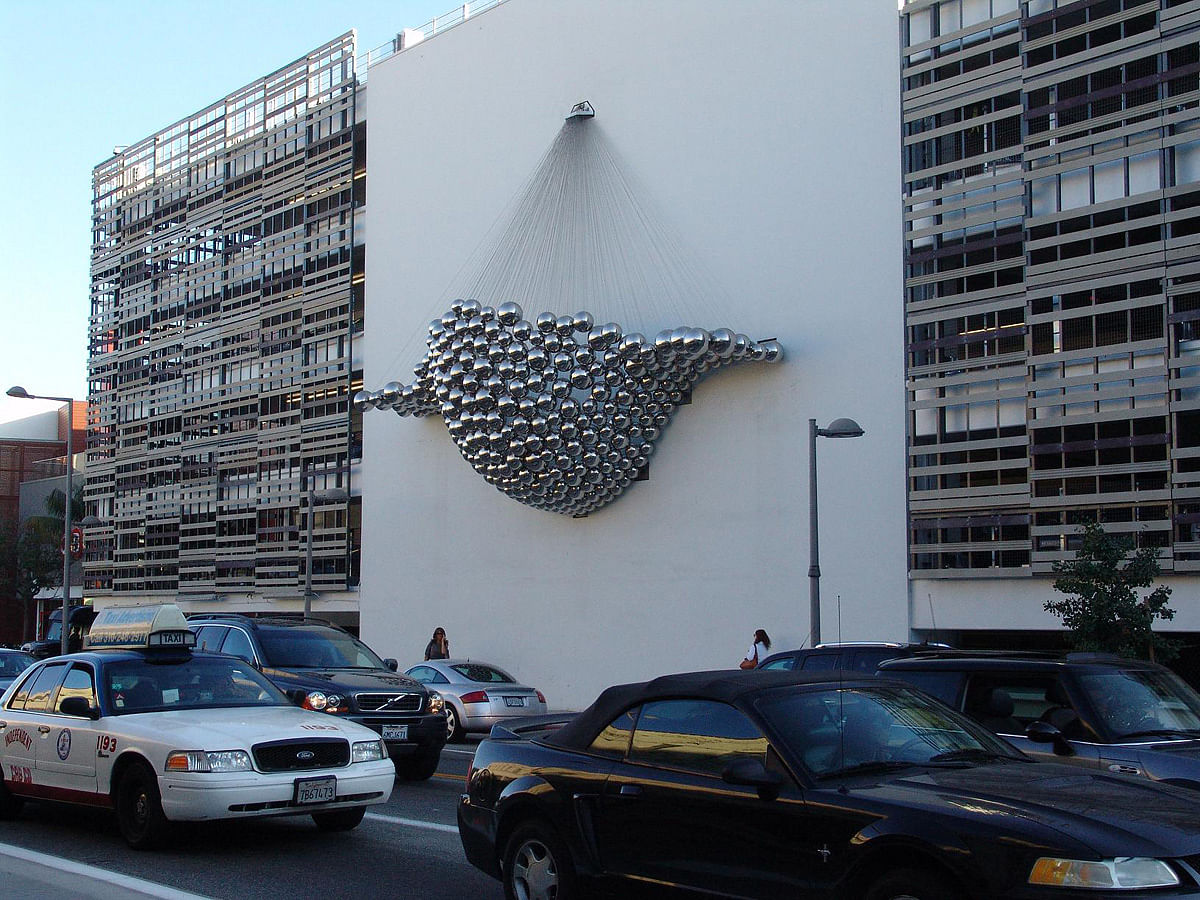
The Los Angeles-based studio of Ball-Nogues have recently completed their installation "Cradle" in Santa Monica, California. We asked partner Benjamin Ball a few questions about the piece.

Bustler: Was this project a commissioned win?

Benjamin Ball: We received a request for qualifications from the Santa Monica Cultural Affairs Division about doing a two dimensional public art work. The work was to be on one of the parking structures for the newly revamped Santa Monica Place. The building was is part of the complex originally designed by Frank Gehry in the late 70's or early 80's.  We were shortlisted for the project. The project is funded by percent for art - part of the capital improvements on the parking structures at Santa Monica Place. The commissioning process was not unlike most other percent for art projects offered by a municipality. Three or four other shortlisted artists submitted proposals. They chose ours for parking structure Seven and they chose a proposal by Anne Marie Karlsen for another parking structure closer to the beach.
Were firms invited to submit proposals?

I don't know if there were other "architects" per se. There were three or four other artists asked to submit proposals - I don't know if they were architects.
Could you provide a little backstory about the project?

We have been looking into ways of making structures that self form and are super redundant. A type of structure can yield a kind of "informal" arrangement of parts that can't be precisely modeled in a computer and that doesn't require tiny tolerances in order to fabricate it. We studied sphere packing (we probably could have called the project Package for reasons I will explain later). The spheres have to be packed in meat space - one can only approximate their relative positions using software . Software is good for designing the overall shape of the work and for visualization purposes . This is because each sphere is bit different in dimension than all of the others (a consequence of relatively high dimensional tolerances during the sphere manufacturing process). Also, the form work we made to "mold" the overall shape and whose parts were fabricated using numerically controlled machinery, once assembled,  would never match exactly what is in the computer - there are tiny discrepancies that occur during the assembly process. Because the location of each sphere influences the location of every other sphere, there is a very complex set of inputs - it would be pointless to attempt to model that. I think of the project as being a bit like poured concrete, where the concrete aggregate is really big (the size of the spheres). 
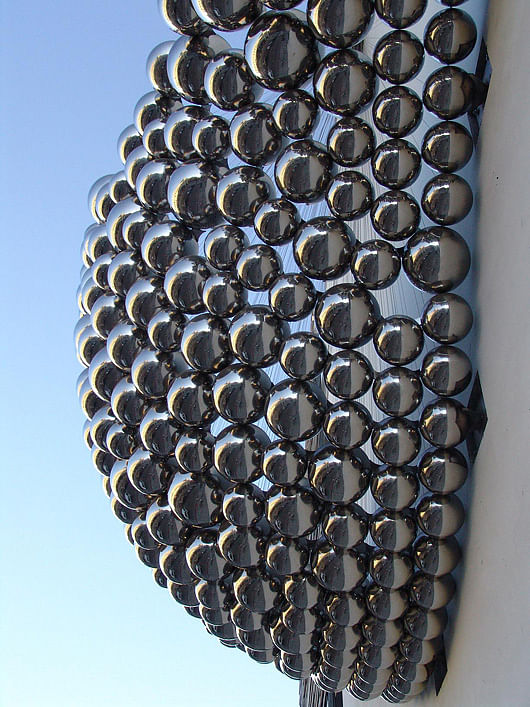
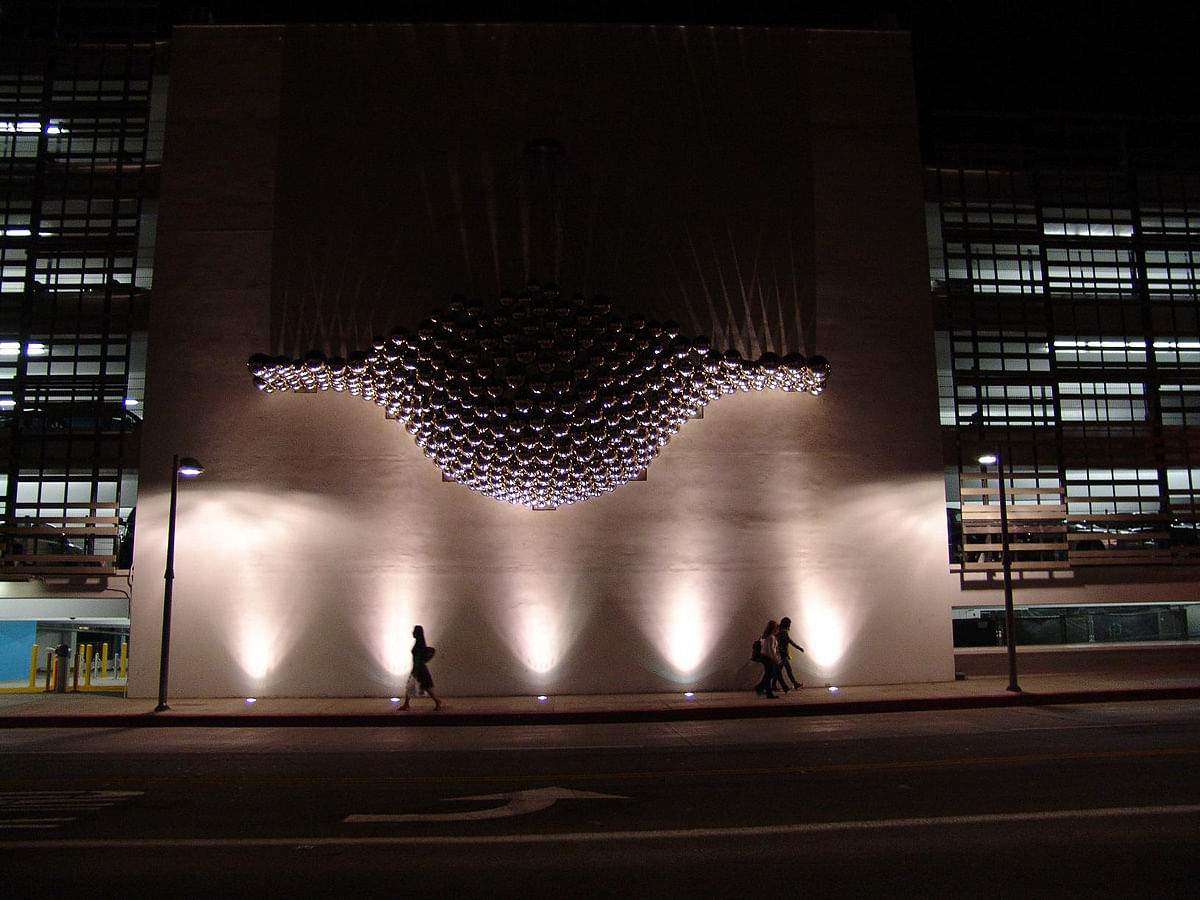
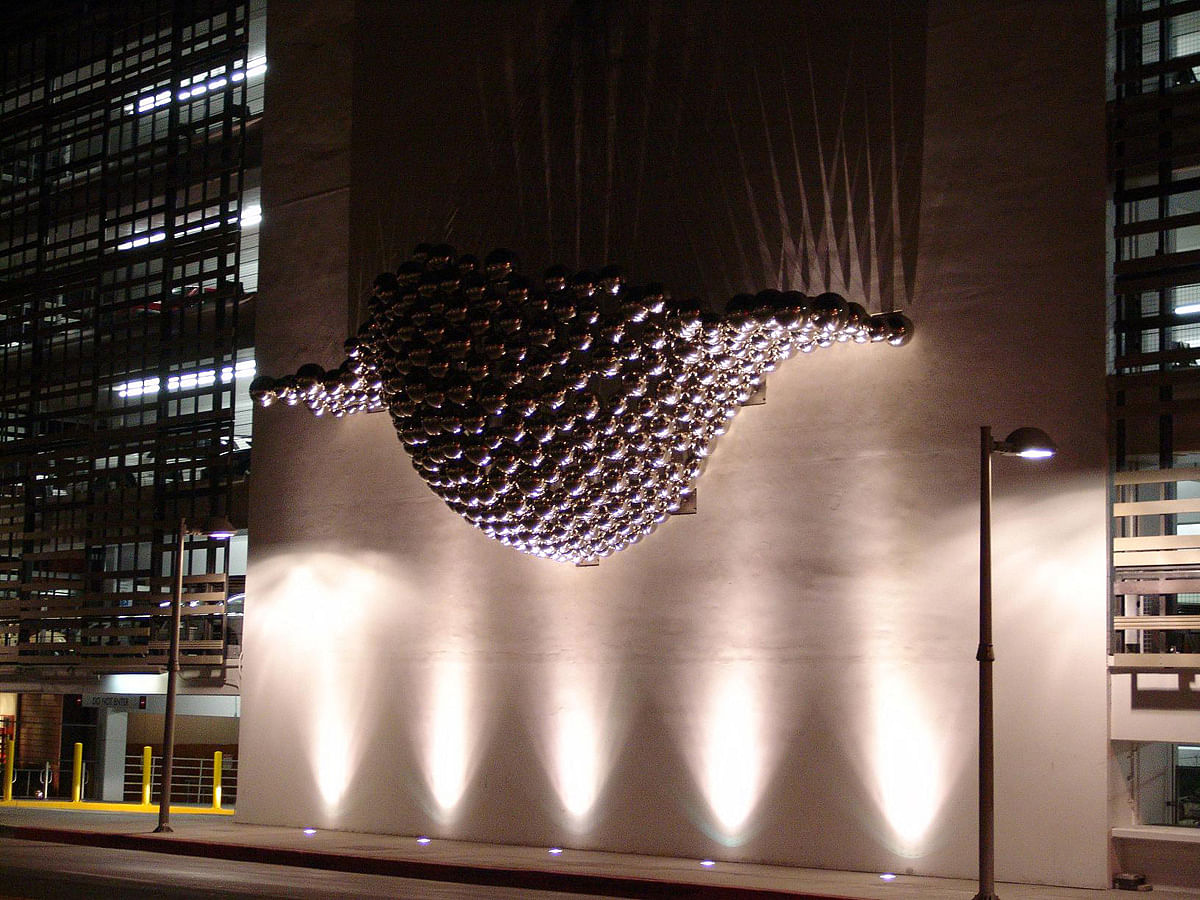
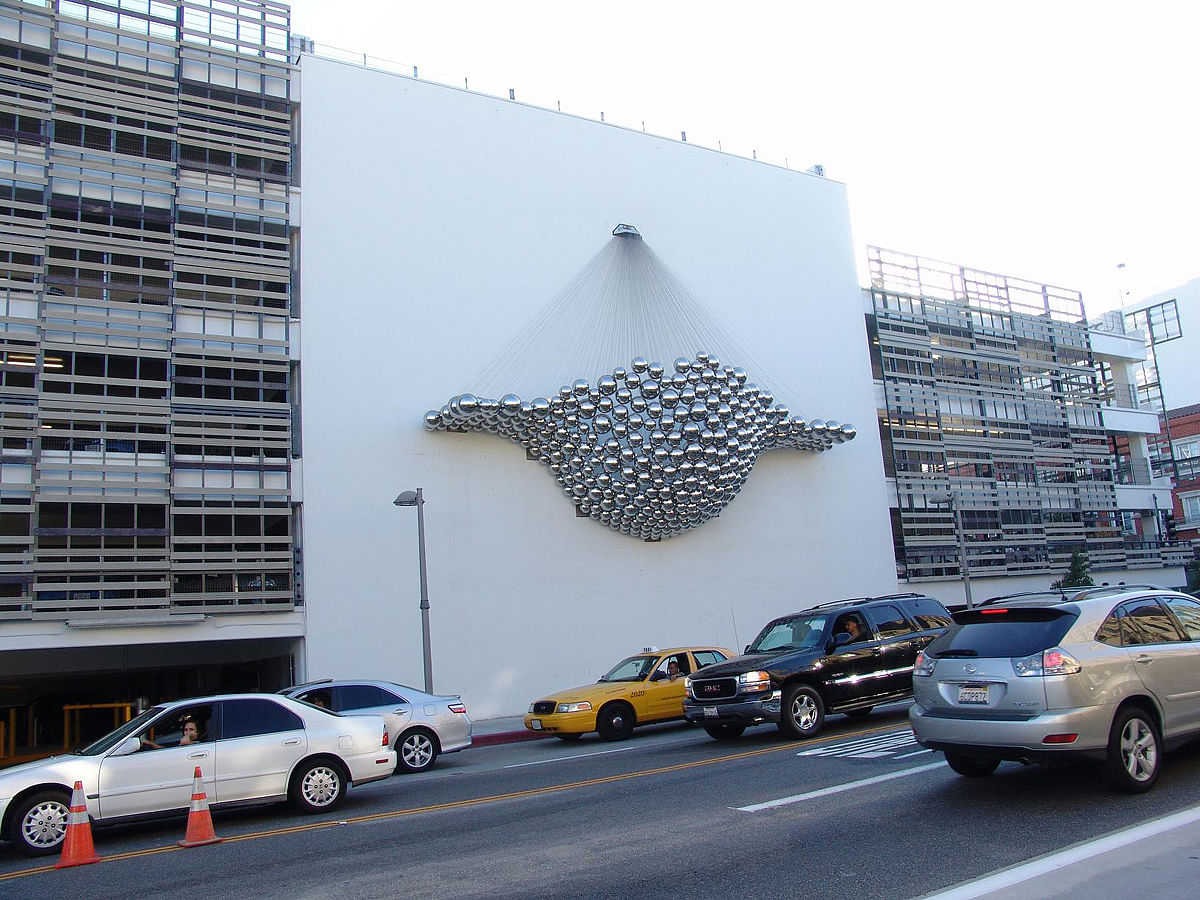
The project operates a bit like a giant Newton's Cradle - the toy that can be found on the desks of high rolling  corporate execs (at least in movies). The structure operates according to the same principles as the Newton's Cradle - the vertical loads are taken up by cables while each sphere is held in place laterally by neighboring spheres. Each ball has a single cable; collectively the cables attach to a massive bracket mounted to the wall.
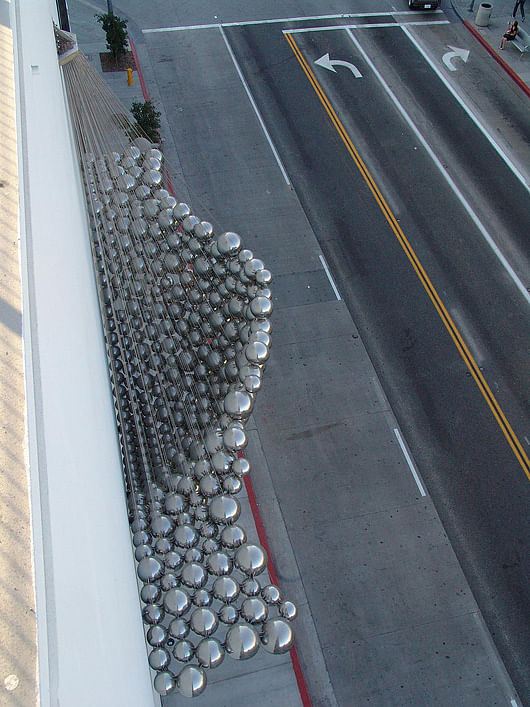
The sphere's are made of mirror polished stainless steel.  From close up, you can see within them hundreds of distorted images of yourself and the City; from afar, by capturing light the polished stainless steel take on the colors of the surroundings.

We wanted the overall shape to elicit quite a few things -   we thought it would be interesting to insert these into the Santa Monica urban landscape. On one hand it sort of looks like a big banana hammock and on the other it resembles the female reproductive system. Sometimes we think of it as a giant fly eye with hundreds of little lenses and at others its like sea foam or coral. Sometimes it an urban scaled wall sconce and at others, a kind of imaginary awning for an invisible storefront.

Related

steel ● santa monica ● installation ● balls ● ball nogues ● art

Share

  • Follow

    0 Comments

  • Comment as :

Ball-Nogues' Santa Monica Cradle

New architecture and design competitions: Exploring 130 Years of American Design, Christo & Jeanne-Claude Center, 13 White Houses, and La Pyramide

Micro-architecture honored in latest Tiny House Architecture Competition

World’s most beautiful restaurants of 2026 chosen by Prix Versailles

Sponsored Post by Buildner

Design a wine tasting room in Italy! Valli Wine Tasting Room is launched!

10 can't-miss architecture & design events to see this June in London, Los Angeles, Chicago, San Francisco, Detroit, San Diego, Porto, and Barcelona

Sponsored Post by Buildner

Museum of Emotions / Edition #8 FINAL registration deadline is approaching!

Seven global projects make AR Public Awards shortlist 2026

Sponsored Post by Buildner

Design a slow-living restaurant in Portugal! Portugal Long Table Restaurant is launched!

Sign up for Bustler's Email Newsletters

World's best tall buildings honored at the CVU 2026 Award of Excellence

Sponsored Post by TWOPAGES

Final call: TWOPAGES X Design Contest 2026 submissions close June 5

Kengo Kuma & Paul Raff win Alberta national park visitor center competition with landscape-focused design

2026 Moira Gemmill and MJ Long prizes announced by W Awards

New architecture and design competitions: Kinderspace, Stewardson Keefe LeBrun Travel Grant, SMALL PROJECT BIG IMPACT, and Garden of University House, Bucharest

The Century of Gehry: New retrospective explores the late architect's work & collaborations

Sponsored Post by Buildner

Rome Rain Rooms FINAL registration deadline is in 5 DAYS!

Next page » Loading

Ball-Nogues' Santa Monica Cradle

By Bustler Editors|

Thursday, Sep 2, 2010

Share

Related

steel ● santa monica ● installation ● balls ● ball nogues ● art

The Los Angeles-based studio of Ball-Nogues have recently completed their installation "Cradle" in Santa Monica, California. We asked partner Benjamin Ball a few questions about the piece.

Bustler: Was this project a commissioned win?

Benjamin Ball: We received a request for qualifications from the Santa Monica Cultural Affairs Division about doing a two dimensional public art work. The work was to be on one of the parking structures for the newly revamped Santa Monica Place. The building was is part of the complex originally designed by Frank Gehry in the late 70's or early 80's.  We were shortlisted for the project. The project is funded by percent for art - part of the capital improvements on the parking structures at Santa Monica Place. The commissioning process was not unlike most other percent for art projects offered by a municipality. Three or four other shortlisted artists submitted proposals. They chose ours for parking structure Seven and they chose a proposal by Anne Marie Karlsen for another parking structure closer to the beach.

Were firms invited to submit proposals?

I don't know if there were other "architects" per se. There were three or four other artists asked to submit proposals - I don't know if they were architects.

Could you provide a little backstory about the project?

We have been looking into ways of making structures that self form and are super redundant. A type of structure can yield a kind of "informal" arrangement of parts that can't be precisely modeled in a computer and that doesn't require tiny tolerances in order to fabricate it. We studied sphere packing (we probably could have called the project Package for reasons I will explain later). The spheres have to be packed in meat space - one can only approximate their relative positions using software . Software is good for designing the overall shape of the work and for visualization purposes . This is because each sphere is bit different in dimension than all of the others (a consequence of relatively high dimensional tolerances during the sphere manufacturing process). Also, the form work we made to "mold" the overall shape and whose parts were fabricated using numerically controlled machinery, once assembled,  would never match exactly what is in the computer - there are tiny discrepancies that occur during the assembly process. Because the location of each sphere influences the location of every other sphere, there is a very complex set of inputs - it would be pointless to attempt to model that. I think of the project as being a bit like poured concrete, where the concrete aggregate is really big (the size of the spheres). 

The project operates a bit like a giant Newton's Cradle - the toy that can be found on the desks of high rolling  corporate execs (at least in movies). The structure operates according to the same principles as the Newton's Cradle - the vertical loads are taken up by cables while each sphere is held in place laterally by neighboring spheres. Each ball has a single cable; collectively the cables attach to a massive bracket mounted to the wall.

The sphere's are made of mirror polished stainless steel.  From close up, you can see within them hundreds of distorted images of yourself and the City; from afar, by capturing light the polished stainless steel take on the colors of the surroundings.

We wanted the overall shape to elicit quite a few things -   we thought it would be interesting to insert these into the Santa Monica urban landscape. On one hand it sort of looks like a big banana hammock and on the other it resembles the female reproductive system. Sometimes we think of it as a giant fly eye with hundreds of little lenses and at others its like sea foam or coral. Sometimes it an urban scaled wall sconce and at others, a kind of imaginary awning for an invisible storefront.

Share

  • Follow

    0 Comments

  • Comment as :

Archinect JobsArchinect Jobs

The Archinect Job Board attracts the world's top architectural design talents.

VIEW ALL JOBS POST A JOB

Intermediate Architect/Designer

DXA Studio

Intermediate Architect/Designer

New York, NY, US

Intermediate Architect

NDKazalas Architecture PC

Intermediate Architect

New York, NY, US

Intermediate Architect (Advanced Revit User)

O'Neil Langan Architects

Intermediate Architect (Advanced Revit User)

New York, NY, US

Senior Interior Designer

IMC Architecture

Senior Interior Designer

Brooklyn, NY, US

Junior Architect

Elizabeth Roberts Architecture & Design

Junior Architect

Brooklyn, NY, US

Project Designer (3 to 5 years)

Swift Lee Office

Project Designer (3 to 5 years)

Los Angeles, CA, US

Architectural Associate/Junior Architect

Goldstone Architecture

Architectural Associate/Junior Architect

Bennington, VT, US

Intermediate Architect

IMC Architecture

Intermediate Architect

Brooklyn, NY, US

Senior Hospitality FF&E Designer

bonetti/kozerski architecture DPC

Senior Hospitality FF&E Designer

New York, NY, US

Intermediate Designer / Architect [5+ years experience]

RO | ROCKETT DESIGN

Intermediate Designer / Architect [5+ years experience]

Sausalito, CA, US

Next page » Loading