• Login / Join
  • About
  • •
  • Contact
  • •
  • Advertising
bustler logo
bustler logo
  • News
  • Competitions
  • Events
  • Bustler is powered by Archinect
  • Sign up for Bustler's Email Newsletters

  • Follow these Bustler feeds:

  • Search

    Search in

  • Submit

    What are you submitting?

    News Pitch
    Competition
    Event
  • Login / Join
  • News|Competitions|Events
  • Search
    | Submit
    | Follow
  • Search in

    What are you submitting?

    News Pitch
    Competition
    Event

    Follow these Bustler feeds:

  • About|Contact|Advertising
  • Login / Join

Lunar Cubit Wins 2010 Land Art Generator Design Competition

By Bustler Editors|

Wednesday, Jan 26, 2011
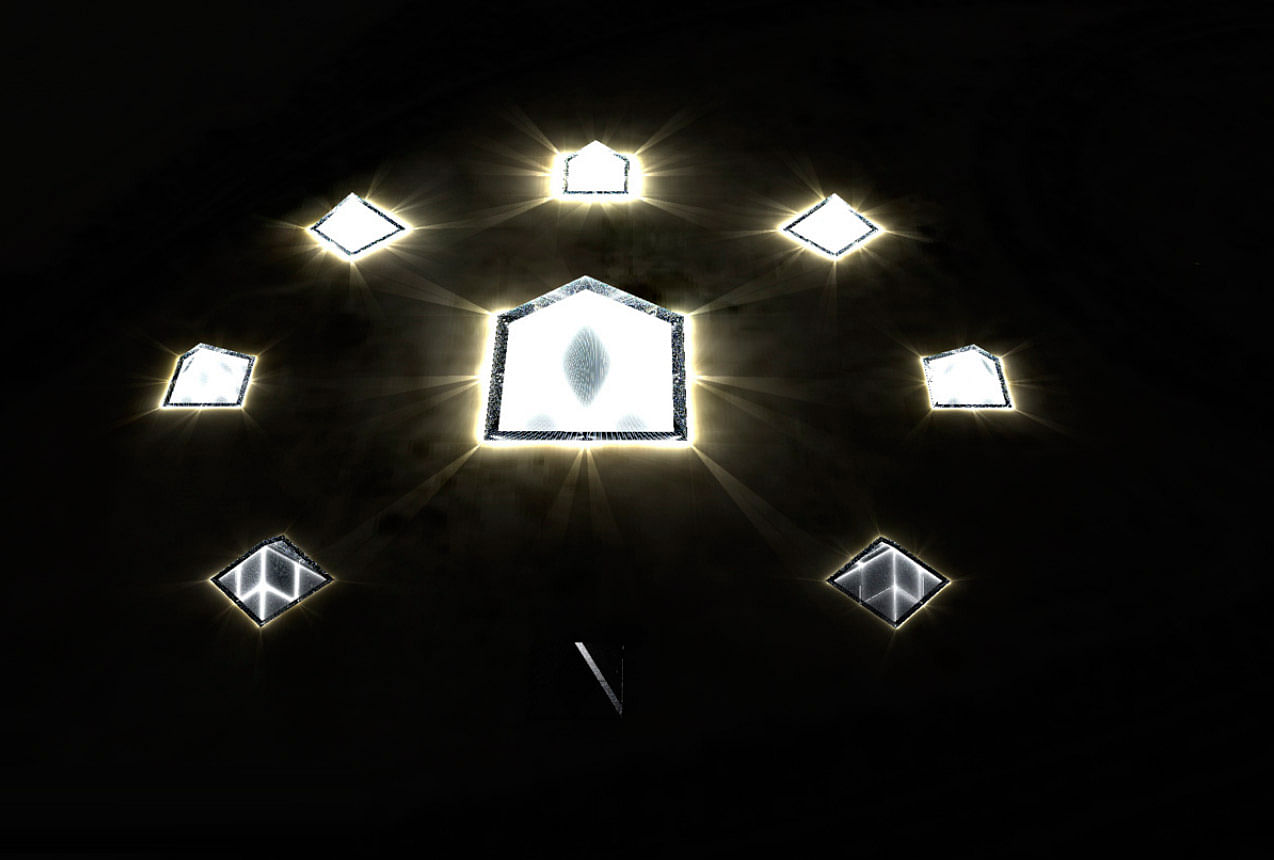
Winner of the 2010 UAE Design Competition for Energy-Generating Public Art: Lunar Cubit

The energy-generating public art installation Lunar Cubit has won the First Prize at the 2010 Land Art Generator Design Competition. Lunar Cubit illuminates in an inversely proportional relationship to the lunar cycle so that the work becomes most fully lit during the night of a new moon. Accompanying the center pyramid is a corresponding outer pyramid, marking the lunar phase like the hand of a clock; light forever rising and falling as the moon spins around earth.

The award ceremony took place last week, January 19th, in Abu Dhabi at the 2011 WORLD FUTURE ENERGY SUMMIT. Masdar sponsored the prize award and presented LAGI prominently at the Masdar exhibit stand.

Project Description from the Architects:

Lunar Cubit is a site specific proposal to be constructed in Abu Dhabi just outside Masdar City, the world’s first zero carbon metropolis once completed. Combining artistic vision with sustainable design and engineering, Lunar Cubit examines the nature of time through nightly contemplation of lunar phases and daily transformation of sunlight into electricity, powering up to 250 homes. Inspired by astronomy, quantum physics and the photoelectric effect, for which Einstein received the Nobel Prize in 1921, this work is open to the public, inviting a personal experience where one can literally reach out and touch a 1.74MW utility scale power plant, in the form of nine monolithic pyramids rising from the sands of Abu Dhabi.

Lunar means relating to or involving the moon and cubit is the name given to the oldest recorded units of length; employed though antiquity, the oldest cubit being the royal cubit, dating back to the Step Pyramid of Djoser circa 2,700 B.C.
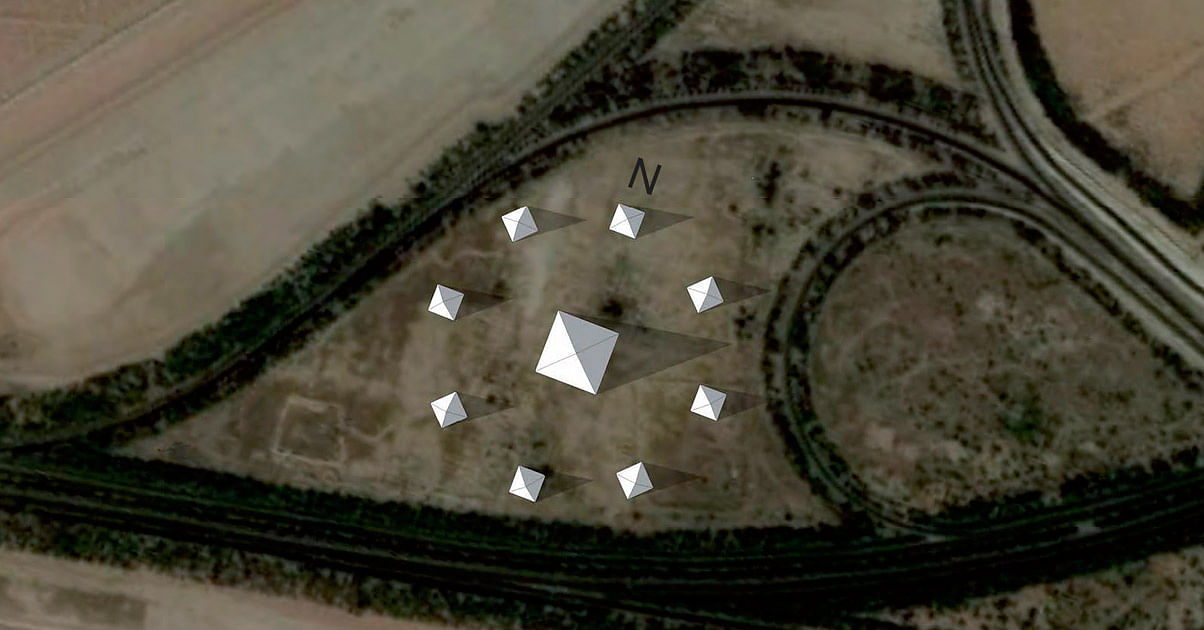
Rated capacity 1.74 MW, Lunar Cubit will generate enough electricity to power 250 homes

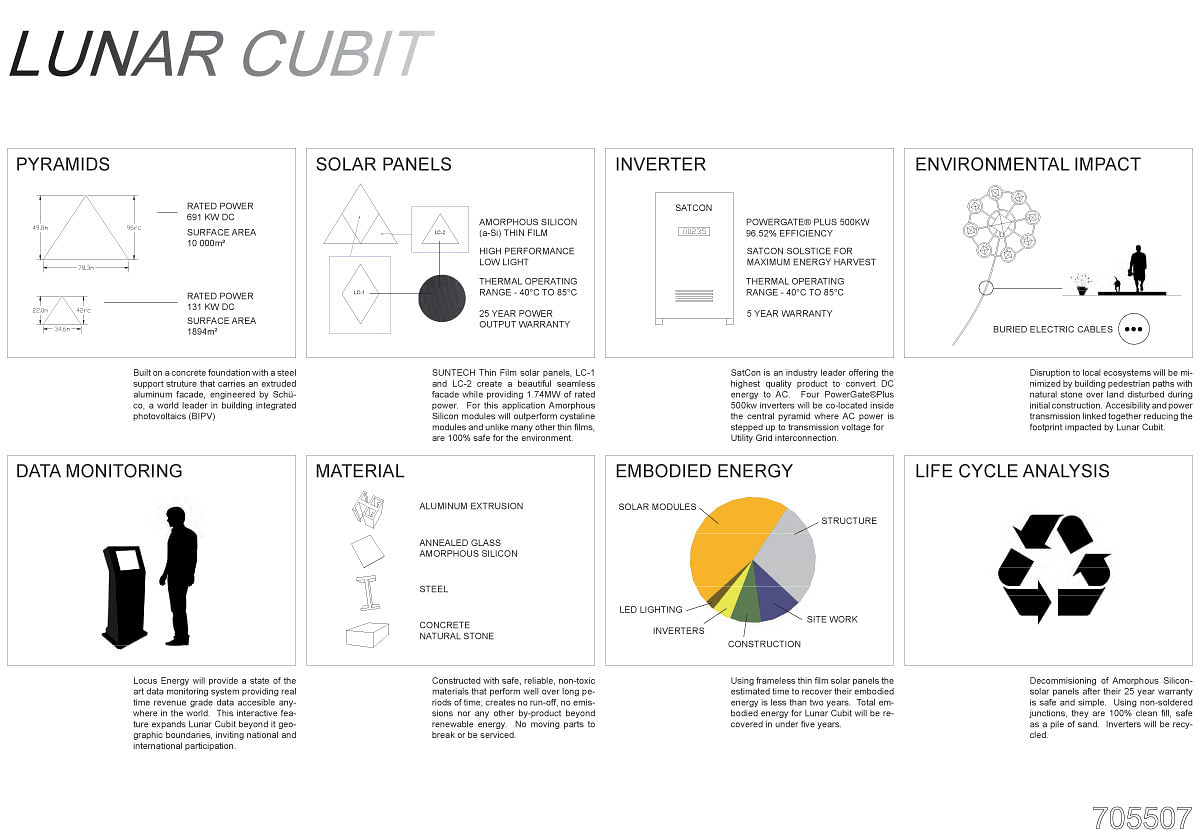
Lunar Cubit is a timekeeper, a monthly calendar, allowing viewers to measure time through the eight lunar phases represented by a ring of eight pyramids encircling one central pyramid. All nine are proportional to the Great Pyramid of Cheops in Giza and scaled using the royal cubit but they’re not made from stone; they’re made of glass and amorphous silicon, giving them the appearance of onyx polished to a mirror finish. Supported from within, the façade of the pyramids is neatly seamless, like the face of a skyscraper, crisp against the heavens, reaching from base to tip, unbroken except for two silver streaks like rays of light scribing each face into two equal triangles and one diamond. Using frameless solar panels reduces embodied energy by nearly 30%, reducing time to be energy positive from seven years to five years. Around the pyramids flow natural stone paths in a repeating pattern that mirrors buried electrical cables, conducting electrons from the outer pyramids to the central pyramid where inside they are transformed into AC energy and transmitted to the Utility Grid. Co-locating walking paths and conduit runs minimizes the footprint of disturbed land during the construction allowing the maximum amount of natural ecosystem to remain untouched.
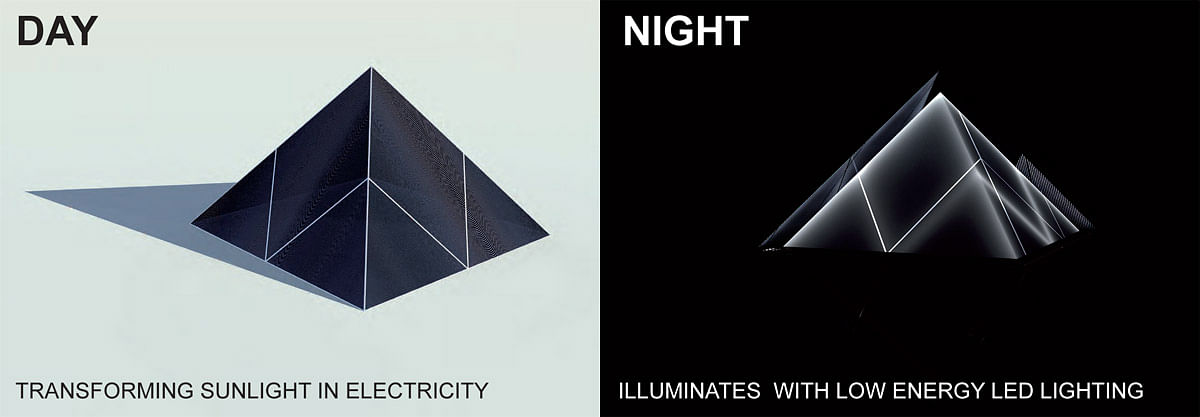
Day/Night scheme

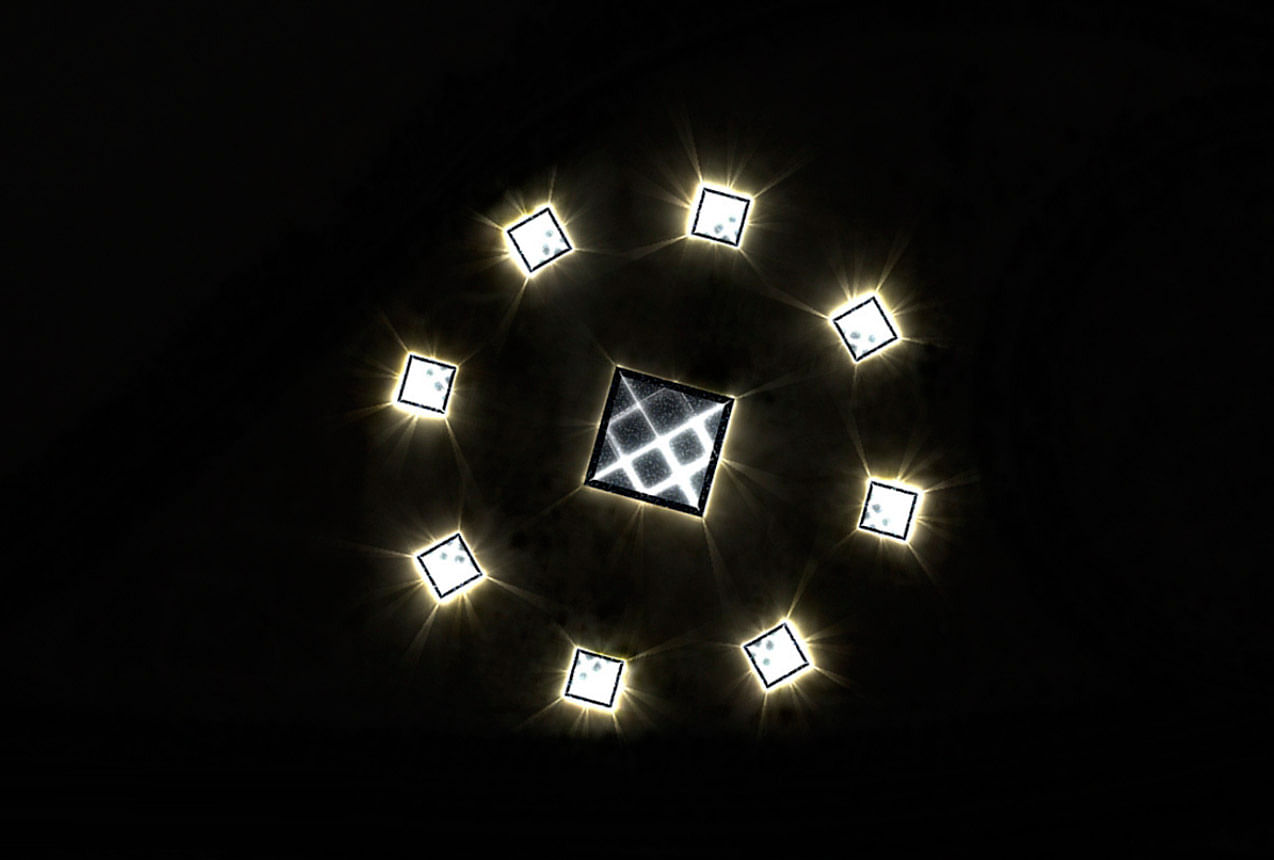
Nine pyramids resting on tan sand; encircled by distant trees; antiquity gilded with technology. Visitors are encouraged to walk amongst these clean power plants, beacons of science, rising to meet a hail of photons from 149 million kilometers away, traveling at the speed of light, to smash into electrons, jarring them free from their molecular bonds and channeling them into electricity. Day passes; a crown of shadows slides silently across the shrubs and sand as the sun rises and falls, moving across the sky and eventually disappearing below the horizon. Two pyramids begin to glow, rising in luminosity as twilight fades and the sky grows dark. Lunar Cubit illuminates inversely proportional to the lunar cycle and tonight is a new moon; white LED’s shine through thousands of tiny bands that are the cellular structure of amorphous silicon solar panels; creating a diffused glow that rises to become a solid pyramid of white light.
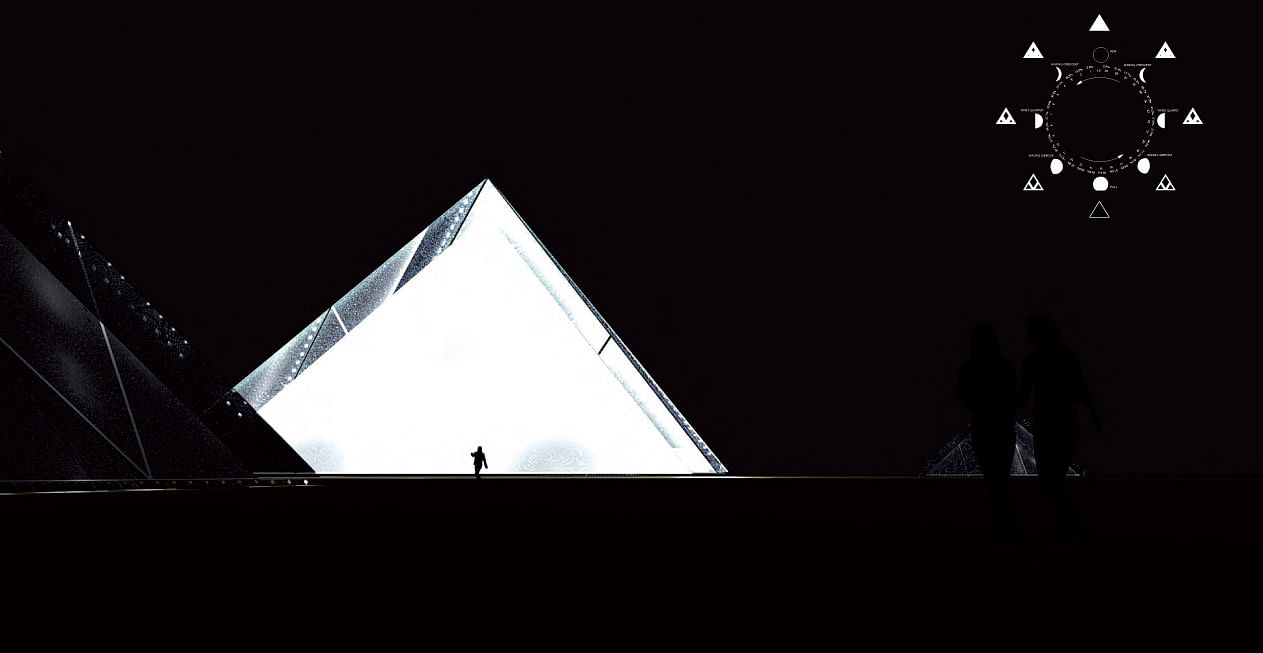
Looking east toward center pyramid on the night of a new moon

Accompanying the center pyramid is a corresponding outer pyramid, clearly marking the lunar phase like a number on the face of a clock. Inverted illumination creates a dance, an ebb and flow like the tides; pyramids of light reaching out to a hidden new moon and as the moon begins to shine, the pyramids recede, allowing moon light to fill the landscape. On the night of a full moon, only moonlight will trace a crown of silvery shadows across the desert floor until the following evening when the pyramids again begin to glow and the moon begins to fade; light forever rising and falling as the moon spins around earth, as the earth spins around the sun as the solar system spins around a massive black hole.
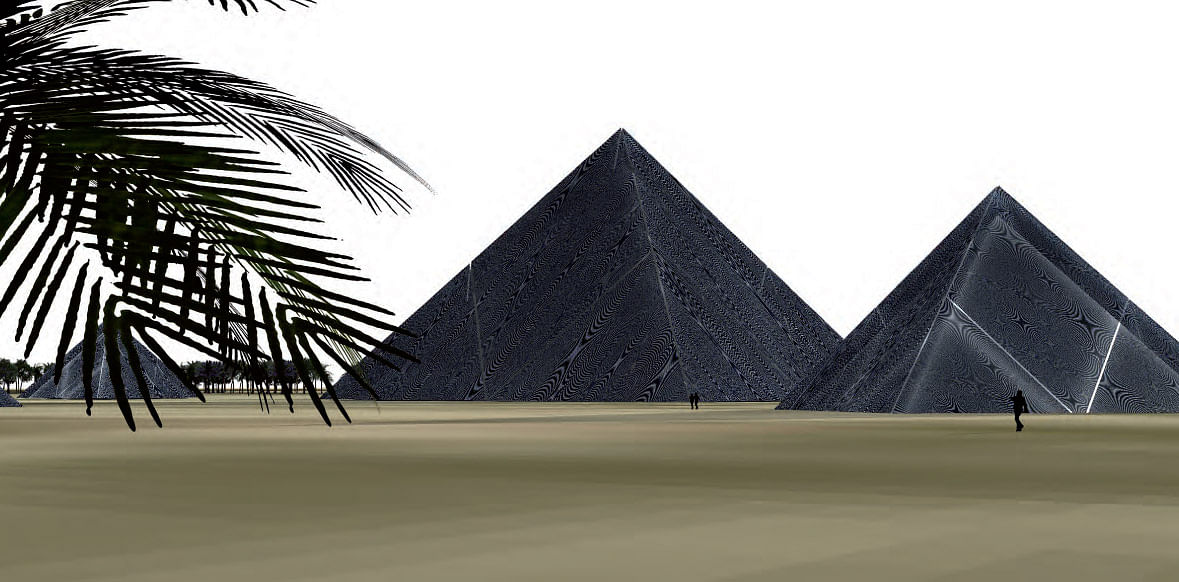
The pyramids at day

Located 5 kilometers from Abu Dhabi international airport, Lunar Cubit is visible from the air and creates a landmark, a destination for travelers to visit, relax and meditate. Nine pyramids form a ring matching near-bye road structures, forming a symbol of infinity. Lunar cubit serves as a reference, a familiar sight like Big Ben or the Empire States Building, safe, comfortable and timeless as the sun and moon.
Generating electricity for 250 homes, is a perfect complement to Masdar City, a symbol of imagination and sustainability. Harnessing the power of the internet to reach a wider audience, Lunar Cubit utilizes data monitoring, connecting the system’s output and usage to a website that anyone can visit and see live information; how much energy is being generated, how much is being used by the LED lighting, what are the weather conditions and details about the site.


Follow this link for a demonstration.

Art and renewable power generation are expanding frontiers. Our world is changing and the pace of change is accelerating rapidly. Lunar Cubit is a portal between past and future, combining art and energy, welcoming us to step into the future.
Lunar Cubit Team:

Robert Flottemesch, Artist - Sr. Engineer
Johanna Ballhaus, Landscape Design
Adrian P. De Luca, VP, Sales and Marketing
Jen DeNike, Artist

Images courtesy of Land Art Generator.

Related

sustainability ● sculpture ● pyramid ● middle east ● masdar ● lunar cubit ● installation ● art ● uae ● united arab emirates

Share

  • Follow

    0 Comments

  • Comment as :

Lunar Cubit Wins 2010 Land Art Generator Design Competition

Micro-architecture honored in latest Tiny House Architecture Competition

World’s most beautiful restaurants of 2026 chosen by Prix Versailles

Sponsored Post by Buildner

Design a wine tasting room in Italy! Valli Wine Tasting Room is launched!

10 can't-miss architecture & design events to see this June in London, Los Angeles, Chicago, San Francisco, Detroit, San Diego, Porto, and Barcelona

Sponsored Post by Buildner

Museum of Emotions / Edition #8 FINAL registration deadline is approaching!

Seven global projects make AR Public Awards shortlist 2026

Sponsored Post by Buildner

Design a slow-living restaurant in Portugal! Portugal Long Table Restaurant is launched!

World's best tall buildings honored at the CVU 2026 Award of Excellence

Sign up for Bustler's Email Newsletters

Sponsored Post by TWOPAGES

Final call: TWOPAGES X Design Contest 2026 submissions close June 5

Kengo Kuma & Paul Raff win Alberta national park visitor center competition with landscape-focused design

2026 Moira Gemmill and MJ Long prizes announced by W Awards

New architecture and design competitions: Kinderspace, Stewardson Keefe LeBrun Travel Grant, SMALL PROJECT BIG IMPACT, and Garden of University House, Bucharest

The Century of Gehry: New retrospective explores the late architect's work & collaborations

Sponsored Post by Buildner

Rome Rain Rooms FINAL registration deadline is in 5 DAYS!

UIA and UN Habitat unveil sustainability-focused winners for UIA 2030 Award

Next page » Loading

Lunar Cubit Wins 2010 Land Art Generator Design Competition

By Bustler Editors|

Wednesday, Jan 26, 2011

Share

Winner of the 2010 UAE Design Competition for Energy-Generating Public Art: Lunar Cubit

Related

sustainability ● sculpture ● pyramid ● middle east ● masdar ● lunar cubit ● installation ● art ● uae ● united arab emirates

The energy-generating public art installation Lunar Cubit has won the First Prize at the 2010 Land Art Generator Design Competition. Lunar Cubit illuminates in an inversely proportional relationship to the lunar cycle so that the work becomes most fully lit during the night of a new moon. Accompanying the center pyramid is a corresponding outer pyramid, marking the lunar phase like the hand of a clock; light forever rising and falling as the moon spins around earth.

The award ceremony took place last week, January 19th, in Abu Dhabi at the 2011 WORLD FUTURE ENERGY SUMMIT. Masdar sponsored the prize award and presented LAGI prominently at the Masdar exhibit stand.

Project Description from the Architects:

Lunar Cubit is a site specific proposal to be constructed in Abu Dhabi just outside Masdar City, the world’s first zero carbon metropolis once completed. Combining artistic vision with sustainable design and engineering, Lunar Cubit examines the nature of time through nightly contemplation of lunar phases and daily transformation of sunlight into electricity, powering up to 250 homes. Inspired by astronomy, quantum physics and the photoelectric effect, for which Einstein received the Nobel Prize in 1921, this work is open to the public, inviting a personal experience where one can literally reach out and touch a 1.74MW utility scale power plant, in the form of nine monolithic pyramids rising from the sands of Abu Dhabi.

Lunar means relating to or involving the moon and cubit is the name given to the oldest recorded units of length; employed though antiquity, the oldest cubit being the royal cubit, dating back to the Step Pyramid of Djoser circa 2,700 B.C.

Rated capacity 1.74 MW, Lunar Cubit will generate enough electricity to power 250 homes

Lunar Cubit is a timekeeper, a monthly calendar, allowing viewers to measure time through the eight lunar phases represented by a ring of eight pyramids encircling one central pyramid. All nine are proportional to the Great Pyramid of Cheops in Giza and scaled using the royal cubit but they’re not made from stone; they’re made of glass and amorphous silicon, giving them the appearance of onyx polished to a mirror finish. Supported from within, the façade of the pyramids is neatly seamless, like the face of a skyscraper, crisp against the heavens, reaching from base to tip, unbroken except for two silver streaks like rays of light scribing each face into two equal triangles and one diamond. Using frameless solar panels reduces embodied energy by nearly 30%, reducing time to be energy positive from seven years to five years. Around the pyramids flow natural stone paths in a repeating pattern that mirrors buried electrical cables, conducting electrons from the outer pyramids to the central pyramid where inside they are transformed into AC energy and transmitted to the Utility Grid. Co-locating walking paths and conduit runs minimizes the footprint of disturbed land during the construction allowing the maximum amount of natural ecosystem to remain untouched.

Day/Night scheme

Nine pyramids resting on tan sand; encircled by distant trees; antiquity gilded with technology. Visitors are encouraged to walk amongst these clean power plants, beacons of science, rising to meet a hail of photons from 149 million kilometers away, traveling at the speed of light, to smash into electrons, jarring them free from their molecular bonds and channeling them into electricity. Day passes; a crown of shadows slides silently across the shrubs and sand as the sun rises and falls, moving across the sky and eventually disappearing below the horizon. Two pyramids begin to glow, rising in luminosity as twilight fades and the sky grows dark. Lunar Cubit illuminates inversely proportional to the lunar cycle and tonight is a new moon; white LED’s shine through thousands of tiny bands that are the cellular structure of amorphous silicon solar panels; creating a diffused glow that rises to become a solid pyramid of white light.

Looking east toward center pyramid on the night of a new moon

Accompanying the center pyramid is a corresponding outer pyramid, clearly marking the lunar phase like a number on the face of a clock. Inverted illumination creates a dance, an ebb and flow like the tides; pyramids of light reaching out to a hidden new moon and as the moon begins to shine, the pyramids recede, allowing moon light to fill the landscape. On the night of a full moon, only moonlight will trace a crown of silvery shadows across the desert floor until the following evening when the pyramids again begin to glow and the moon begins to fade; light forever rising and falling as the moon spins around earth, as the earth spins around the sun as the solar system spins around a massive black hole.

The pyramids at day

Located 5 kilometers from Abu Dhabi international airport, Lunar Cubit is visible from the air and creates a landmark, a destination for travelers to visit, relax and meditate. Nine pyramids form a ring matching near-bye road structures, forming a symbol of infinity. Lunar cubit serves as a reference, a familiar sight like Big Ben or the Empire States Building, safe, comfortable and timeless as the sun and moon.

Generating electricity for 250 homes, is a perfect complement to Masdar City, a symbol of imagination and sustainability. Harnessing the power of the internet to reach a wider audience, Lunar Cubit utilizes data monitoring, connecting the system’s output and usage to a website that anyone can visit and see live information; how much energy is being generated, how much is being used by the LED lighting, what are the weather conditions and details about the site.

Follow this link for a demonstration.

Art and renewable power generation are expanding frontiers. Our world is changing and the pace of change is accelerating rapidly. Lunar Cubit is a portal between past and future, combining art and energy, welcoming us to step into the future.

Lunar Cubit Team:

Robert Flottemesch, Artist - Sr. Engineer
Johanna Ballhaus, Landscape Design
Adrian P. De Luca, VP, Sales and Marketing
Jen DeNike, Artist

Images courtesy of Land Art Generator.

Share

  • Follow

    0 Comments

  • Comment as :

Archinect JobsArchinect Jobs

The Archinect Job Board attracts the world's top architectural design talents.

VIEW ALL JOBS POST A JOB

Mid-Level Architect/Designer

Payette

Mid-Level Architect/Designer

Boston, MA, US

Business Development Manager

WORKac

Business Development Manager

New York, NY, US

Project Designer (3 to 5 years)

Swift Lee Office

Project Designer (3 to 5 years)

Los Angeles, CA, US

Intermediate Residential Architect

52XConsulting

Intermediate Residential Architect

New York, NY, US

Intermediate Architect

NDKazalas Architecture PC

Intermediate Architect

New York, NY, US

Job Captain (3-5 years experience)

Evan Raabe Architecture Studio

Job Captain (3-5 years experience)

Los Angeles, CA, US

Project Manager

VanderHorn Architects

Project Manager

Greenwich, CT, US

Architect

mani colaku architects

Architect

New York, NY, US

Project Architect/Job Captain

HLW International LLP

Project Architect/Job Captain

West Palm Beach, FL, US

Marketing Coordinator

Blair + Mui Dowd Architects

Marketing Coordinator

New York, NY, US

Next page » Loading