• Login / Join
  • About
  • •
  • Contact
  • •
  • Advertising
bustler logo
bustler logo
  • News
  • Competitions
  • Events
  • Bustler is powered by Archinect
  • Sign up for Bustler's Email Newsletters

  • Follow these Bustler feeds:

  • Search

    Search in

  • Submit

    What are you submitting?

    News Pitch
    Competition
    Event
  • Login / Join
  • News|Competitions|Events
  • Search
    | Submit
    | Follow
  • Search in

    What are you submitting?

    News Pitch
    Competition
    Event

    Follow these Bustler feeds:

  • About|Contact|Advertising
  • Login / Join

FLATCUT-ACADIA Digital Fabrication Winners Announced

By Bustler Editors|

Monday, Jul 18, 2011
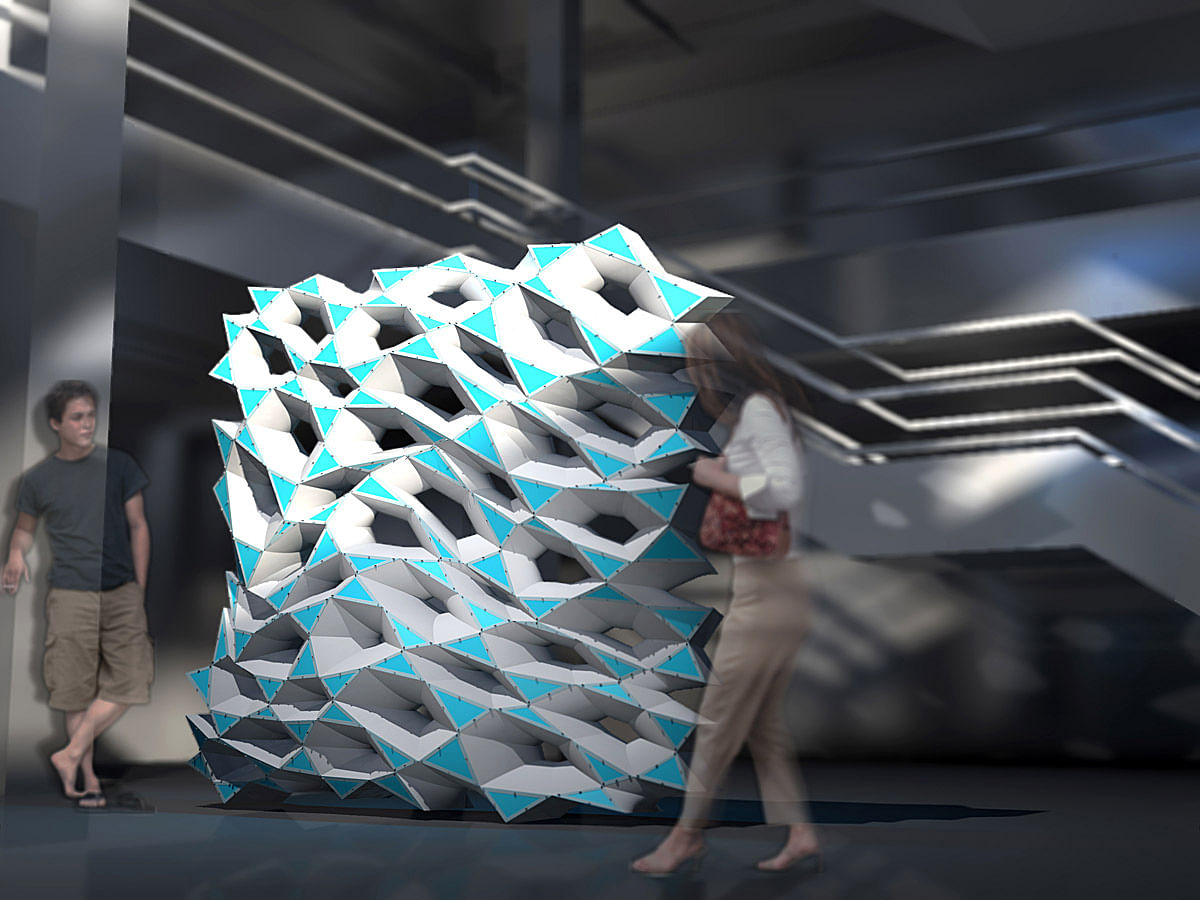
Detail from the winner in the PARTITION category “HYPERLAXITY: parabolic ligaments”

The Association for Computer Aided Design in Architecture (ACADIA), in collaboration with Brooklyn-based fabrication house FLATCUT_ have announced winners of this year’s ACADIA 2011 Design + Fabrication Competition.

The competition challenged designers to create new forms in the categories of furniture, partition and lighting using innovative materials and digital fabrications applications. The winners brought not only ingenuity to their designs, but a sense of beauty and functionality that excited the jury.

The final jury, which chose 3 winners from 15 finalists, included award-winning architects: Tod Williams of TWBTA, Chris Sharples of SHoP Architects, Tom Wiscombe of Emergent, Dror Benshetrit of Studio Dror and Thomas Christoffersen from BIG. FLATCUT Founder Tomer Ben-Gal served as technical advisor.

“I think the struggle between the process and the product is interesting,” said Tod Williams. “Largely the entrants were caught up in the issue of the process, but each of the winners was also thinking about what it would look like and be and feel in space; there was a sensual desire that was pushing it.”

“What is really exciting about this work for students and young practitioners, and all practitioners, is that it is making the whole process of making more accessible,” said Chris Sharples. “There is a sense of immediacy and a process about, how do I make this real? How do you bring it back to architecture and make these things come alive and become real through constructible operations and working with fabricators? This exercise speaks to that and there should be more like them.”

And these are the winners in their respective categories:

PARTITION: “HYPERLAXITY: parabolic ligaments”
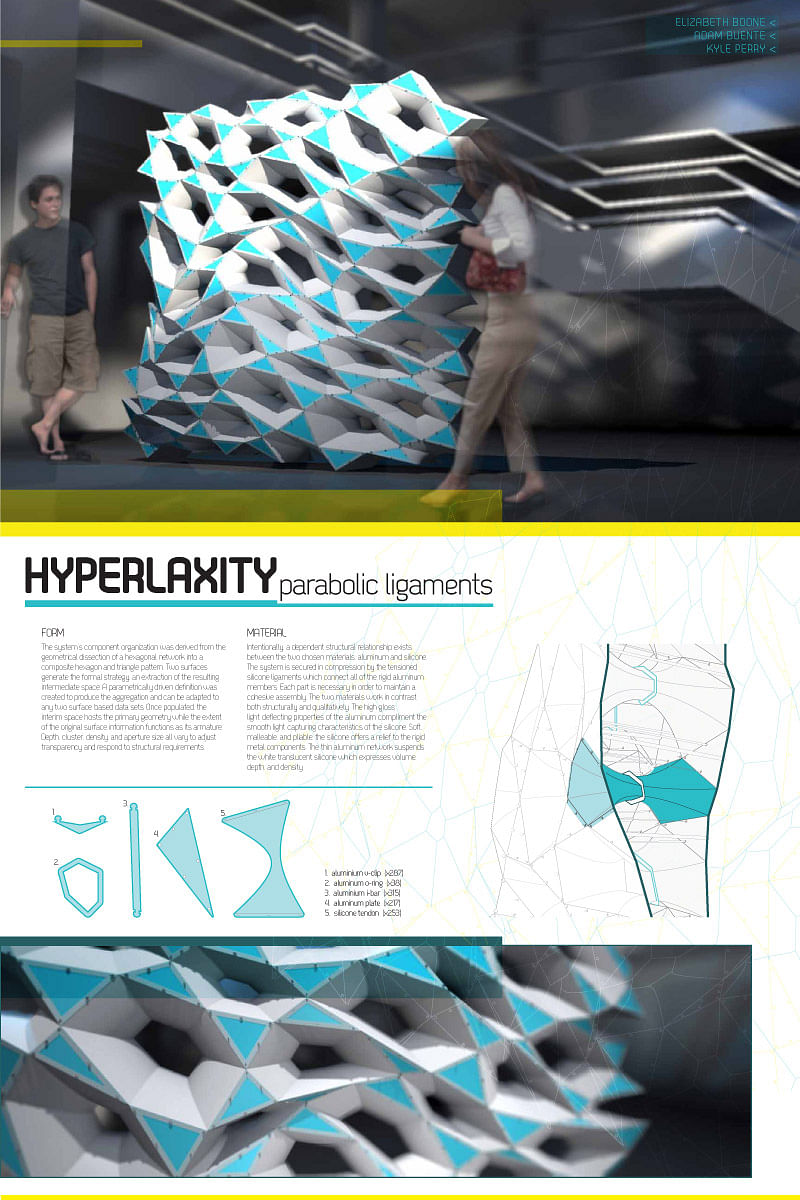
PARTITION Winner: “HYPERLAXITY: parabolic ligaments” by Elizabeth Boone with PROJECTiONE (Adam Buente and Kyle Perry)

“HYPERLAXITY: parabolic ligaments” is a non-modular partition system made from aluminum and silicone cut into a hexagonal and triangular pattern. The system is secured in compression by the tensioned silicone ligaments, which connect all of the rigid aluminum members. Each part is necessary in order to maintain a cohesive assembly. Hyperlaxity was the result of a collaboration between Elizabeth Boone (of SOM) and PROJECTiONE (pronounced Project One) a design/fabrication studio, started last year by Adam Buente and Kyle Perry.

“I like how technically the inner rings, together with the other shapes create different opposite hexagon forms,” said Dror Benshetrit. “It is has a quite beautiful self standing presence that is inherit in the structure. I also think in terms of pushing parametric design this is the most interesting entry.”


LIGHTING: LUMINESCENT LIMACON
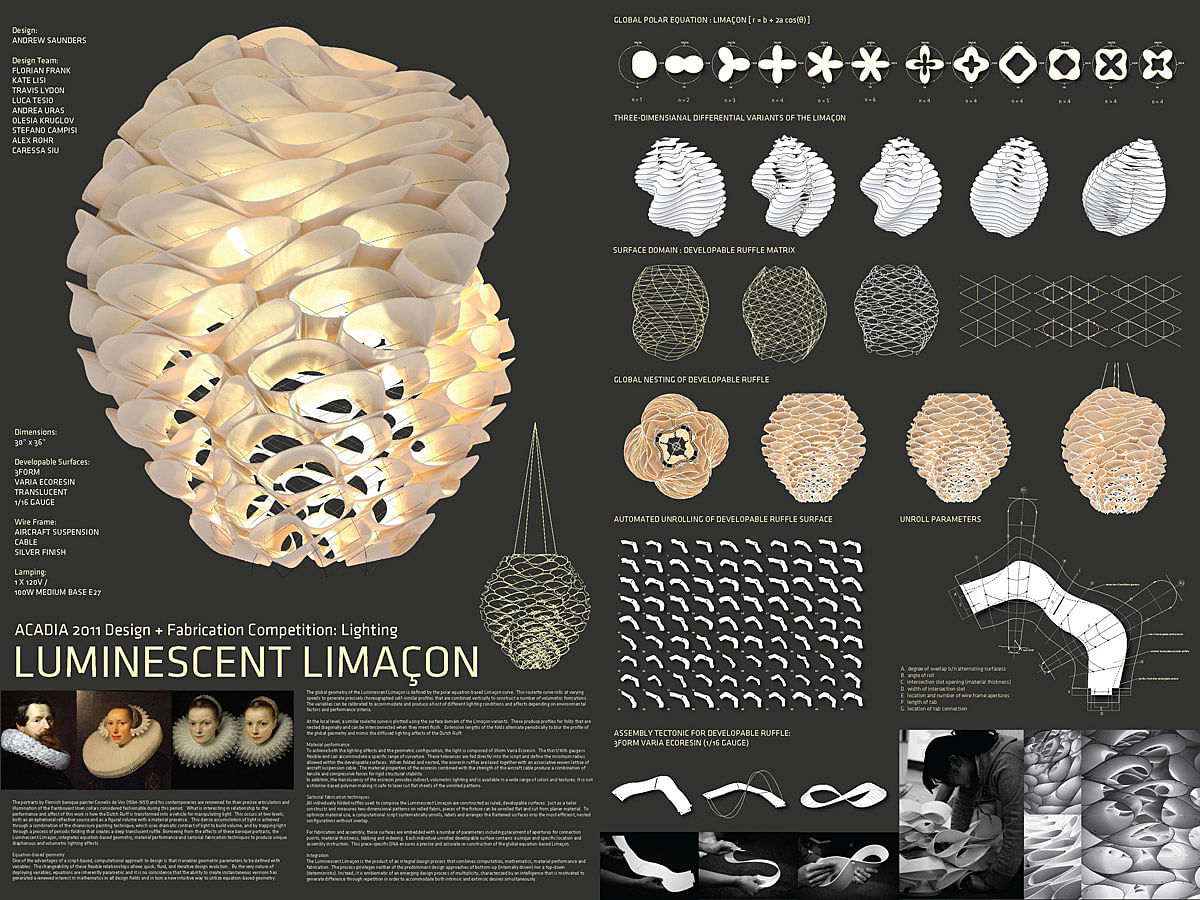
LIGHTING Winner: LUMINESCENT LIMACON by Andrew Saunders

LUMINESCENT LIMACON is a folded lighting design by Andrew Saunders, an Assistant Professor of Architecture at Rensselaer Polytechnic Institute in New York. The Luminescent Limacon is inspired partly from the Dutch Ruff, or flamboyant linen collars considered fashionable in 17th century Europe, as a vehicle for the manipulation of light. The light is the product of an integral design process that combines computation, mathematics, material performance and fabrication. To achieve both the lighting affects and the geometric configuration, the light is composed of 3form Ecoresin. When folded and nested, the ecoresin ruffles are laced together with an associative woven lattice of aircraft suspension cable, which, when combined produce a combination of tensile and compressive forces for rigid structural stability.

“The fineness of the line work of this thread that ties it together is really critical,” said Tom Wiscombe. “That it is two systems, one of a surface system and one of a kind of vector, is what I think together makes it look so beautiful and elegant, the pairing of those.”


FURNITURE: RECIP
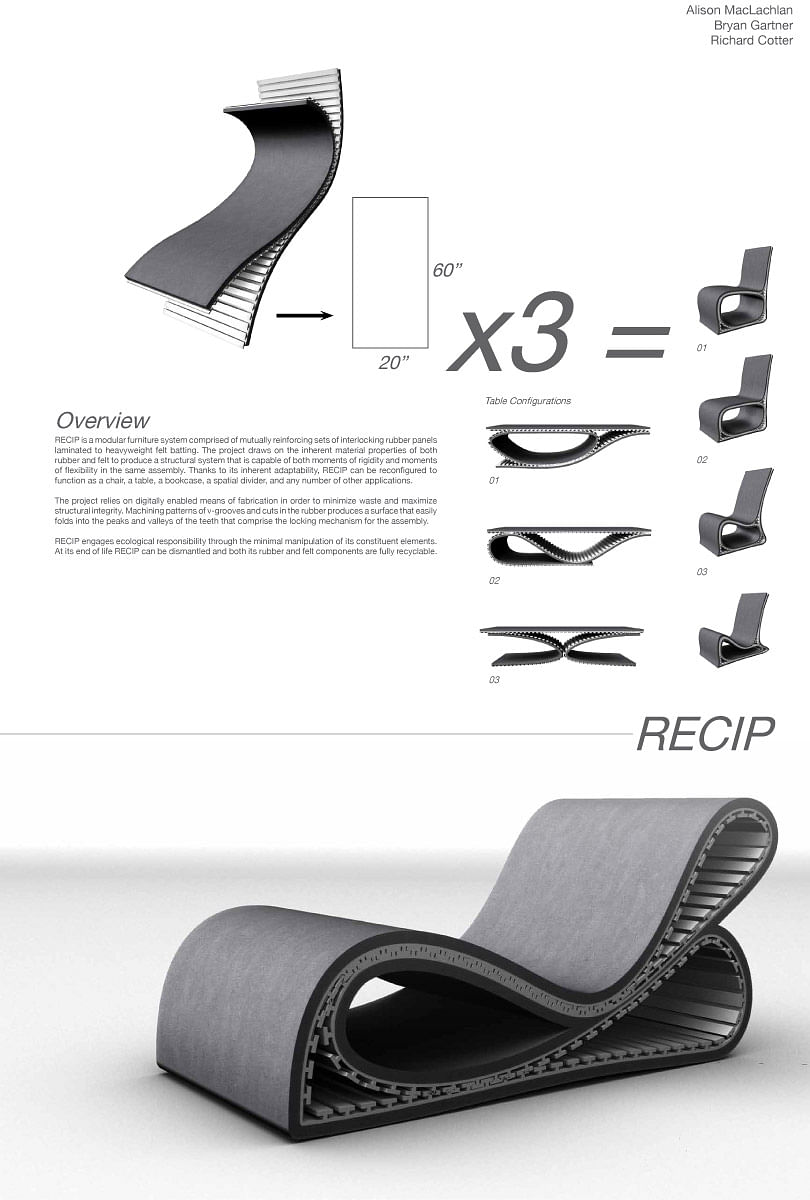
FURNITURE Winner: RECIP by Alison MacLachlan, Bryan Gartner and Richard Cotter

RECIP is a modular furniture system designed by Alison MacLachlan, Bryan Gartner and Richard Cotter, all students of the University of Calgary’s Faculty of Environmental Design, where the ACADIA 2011 conference is taking place. RECIP is comprised of mutually reinforcing sets of interlocking rubber panels laminated to heavyweight felt batting. The project draws on the inherent material properties of both rubber and felt to produce a structural system that is capable of both moments of rigidity and moments of flexibility in the same assembly. Thanks to its inherent adaptability, RECIP can be reconfigured to function as a chair, a table, a bookcase, or spatial divider.

“I think what attracted us [to RECIP] innately in a contemporary way the fusion of two different materials and the way they performed together,” said Tom Wiscombe. “It involved certain types of techniques, like fusing, melting and different modes of manufacturing rather than using a single known tooling process.”

The theme of this year’s ACADIA 2011 Conference is to explore integrative trajectories and areas of overlap that have emerged through computation between design, its allied disciplines of engineering and construction, and other fields, such as computer science, material science, mathematics and biology. FLATCUT_ chose to sponsor this year’s competition because they felt when exploring these areas of overlap, fabrication becomes a key component.

“We brought this idea to ACADIA because we wanted the opportunity to engage with this community of theorist and digital designer and have them begin to integrate materiality and fabrication into the nascent stage of the design process,” said Tomer Ben-Gal. “We wanted to push designers to take these new applications they’ve been trained in and use them to create something with human scale and functionality.

"For 30 years ACADIA has been a forum for the discussion of emerging forms of digital practice in architecture and we are happy to continue this long tradition by co-sponsoring this competition and exhibiting the winning designs,” said Jason S Johnson, Co-chair of the ACADIA 2011 Conference. “We would like to thank all the competition participants for contributing to this discourse and providing us with some great winning projects."

Images courtesy of ACADIA.

Related

partition ● lighting ● furniture ● flatcut_ ● fabrication ● digital design ● cad ● acadia

Share

  • Follow

    0 Comments

  • Comment as :

FLATCUT-ACADIA Digital Fabrication Winners Announced

Over $500,000 awarded to architectural discourse projects by Graham Foundation

Best in urban planning recognized at AIA Regional & Urban Design Award 2026

Sponsored Post by Buildner

Re:Form - New Life for Old Spaces / Edition #3 advance registration deadline is approaching!

New architecture and design competitions: IDEAS Awards, UIA-HYP CUP International Student Competition, Vancouver Tall Challenge, and Memorial to the Sixth Extinction

Best small projects chosen at AIA Small Project Award 2026

10 standout sustainable projects honored at AIA COTE Top Ten Award 2026

Best residential architecture of 2026 honored at AIA Housing Award

Best new interiors of 2026 chosen at AIA Interior Architecture Awards

Sign up for Bustler's Email Newsletters

Best global architecture honored at RIBA International Awards 2026

World’s most beautiful airports of 2026 chosen by Prix Versailles

New architecture and design competitions: Brick in Architecture Awards, Study Architecture Student Showcase, N.Y.C. Groceries, and New York High Falls Riverfront Market

SmithGroup’s ‘pioneering’ Philip Merrill Environmental Center wins AIA Twenty-five Year Award

Sponsored Post by Buildner

Museum of Emotions / Edition #8 FINAL registration deadline is in 5 DAYS!

Here are the winners of the 2026 AIA Architecture Awards

40 emerging architects and designers under 40 from Europe honored

Next page » Loading

FLATCUT-ACADIA Digital Fabrication Winners Announced

By Bustler Editors|

Monday, Jul 18, 2011

Share

Detail from the winner in the PARTITION category “HYPERLAXITY: parabolic ligaments”

Related

partition ● lighting ● furniture ● flatcut_ ● fabrication ● digital design ● cad ● acadia

The Association for Computer Aided Design in Architecture (ACADIA), in collaboration with Brooklyn-based fabrication house FLATCUT_ have announced winners of this year’s ACADIA 2011 Design + Fabrication Competition.

The competition challenged designers to create new forms in the categories of furniture, partition and lighting using innovative materials and digital fabrications applications. The winners brought not only ingenuity to their designs, but a sense of beauty and functionality that excited the jury.

The final jury, which chose 3 winners from 15 finalists, included award-winning architects: Tod Williams of TWBTA, Chris Sharples of SHoP Architects, Tom Wiscombe of Emergent, Dror Benshetrit of Studio Dror and Thomas Christoffersen from BIG. FLATCUT Founder Tomer Ben-Gal served as technical advisor.

“I think the struggle between the process and the product is interesting,” said Tod Williams. “Largely the entrants were caught up in the issue of the process, but each of the winners was also thinking about what it would look like and be and feel in space; there was a sensual desire that was pushing it.”

“What is really exciting about this work for students and young practitioners, and all practitioners, is that it is making the whole process of making more accessible,” said Chris Sharples. “There is a sense of immediacy and a process about, how do I make this real? How do you bring it back to architecture and make these things come alive and become real through constructible operations and working with fabricators? This exercise speaks to that and there should be more like them.”

And these are the winners in their respective categories:

PARTITION: “HYPERLAXITY: parabolic ligaments”

PARTITION Winner: “HYPERLAXITY: parabolic ligaments” by Elizabeth Boone with PROJECTiONE (Adam Buente and Kyle Perry)

“HYPERLAXITY: parabolic ligaments” is a non-modular partition system made from aluminum and silicone cut into a hexagonal and triangular pattern. The system is secured in compression by the tensioned silicone ligaments, which connect all of the rigid aluminum members. Each part is necessary in order to maintain a cohesive assembly. Hyperlaxity was the result of a collaboration between Elizabeth Boone (of SOM) and PROJECTiONE (pronounced Project One) a design/fabrication studio, started last year by Adam Buente and Kyle Perry.

“I like how technically the inner rings, together with the other shapes create different opposite hexagon forms,” said Dror Benshetrit. “It is has a quite beautiful self standing presence that is inherit in the structure. I also think in terms of pushing parametric design this is the most interesting entry.”


LIGHTING: LUMINESCENT LIMACON

LIGHTING Winner: LUMINESCENT LIMACON by Andrew Saunders

LUMINESCENT LIMACON is a folded lighting design by Andrew Saunders, an Assistant Professor of Architecture at Rensselaer Polytechnic Institute in New York. The Luminescent Limacon is inspired partly from the Dutch Ruff, or flamboyant linen collars considered fashionable in 17th century Europe, as a vehicle for the manipulation of light. The light is the product of an integral design process that combines computation, mathematics, material performance and fabrication. To achieve both the lighting affects and the geometric configuration, the light is composed of 3form Ecoresin. When folded and nested, the ecoresin ruffles are laced together with an associative woven lattice of aircraft suspension cable, which, when combined produce a combination of tensile and compressive forces for rigid structural stability.

“The fineness of the line work of this thread that ties it together is really critical,” said Tom Wiscombe. “That it is two systems, one of a surface system and one of a kind of vector, is what I think together makes it look so beautiful and elegant, the pairing of those.”


FURNITURE: RECIP

FURNITURE Winner: RECIP by Alison MacLachlan, Bryan Gartner and Richard Cotter

RECIP is a modular furniture system designed by Alison MacLachlan, Bryan Gartner and Richard Cotter, all students of the University of Calgary’s Faculty of Environmental Design, where the ACADIA 2011 conference is taking place. RECIP is comprised of mutually reinforcing sets of interlocking rubber panels laminated to heavyweight felt batting. The project draws on the inherent material properties of both rubber and felt to produce a structural system that is capable of both moments of rigidity and moments of flexibility in the same assembly. Thanks to its inherent adaptability, RECIP can be reconfigured to function as a chair, a table, a bookcase, or spatial divider.

“I think what attracted us [to RECIP] innately in a contemporary way the fusion of two different materials and the way they performed together,” said Tom Wiscombe. “It involved certain types of techniques, like fusing, melting and different modes of manufacturing rather than using a single known tooling process.”

The theme of this year’s ACADIA 2011 Conference is to explore integrative trajectories and areas of overlap that have emerged through computation between design, its allied disciplines of engineering and construction, and other fields, such as computer science, material science, mathematics and biology. FLATCUT_ chose to sponsor this year’s competition because they felt when exploring these areas of overlap, fabrication becomes a key component.

“We brought this idea to ACADIA because we wanted the opportunity to engage with this community of theorist and digital designer and have them begin to integrate materiality and fabrication into the nascent stage of the design process,” said Tomer Ben-Gal. “We wanted to push designers to take these new applications they’ve been trained in and use them to create something with human scale and functionality.

"For 30 years ACADIA has been a forum for the discussion of emerging forms of digital practice in architecture and we are happy to continue this long tradition by co-sponsoring this competition and exhibiting the winning designs,” said Jason S Johnson, Co-chair of the ACADIA 2011 Conference. “We would like to thank all the competition participants for contributing to this discourse and providing us with some great winning projects."

Images courtesy of ACADIA.

Share

  • Follow

    0 Comments

  • Comment as :

Archinect JobsArchinect Jobs

The Archinect Job Board attracts the world's top architectural design talents.

VIEW ALL JOBS POST A JOB

Project Manager

The Brooklyn Studio

Project Manager

Brooklyn, NY, US

Architectural Designer II

mdg | m-design group

Architectural Designer II

New York, NY, US

Architectural Designer / Junior Architect (1–3 Years Experience)

Andrew Magnes Architecture

Architectural Designer / Junior Architect (1–3 Years Experience)

Brooklyn, NY, US

Architectural Designer II

Studio AR&D Architects

Architectural Designer II

Los Angeles, CA, US

Junior Designer/Architect

O'Neill Rose Architects

Junior Designer/Architect

Brooklyn, NY, US

Intermediate Architect

GF55 Architects

Intermediate Architect

New York, NY, US

Architectural Designer Level 2

Arthur Chabon Architect

Architectural Designer Level 2

New York, NY, US

Junior Architect in nyc

Lara Apelian Studio

Junior Architect in nyc

New York, NY, US

Junior/Intermediate Architect

Archimaera Architecture

Junior/Intermediate Architect

New York, NY, US

Project Architect

The American Housing Corporation

Project Architect

Austin, TX, US

Next page » Loading