• Login / Join
  • About
  • •
  • Contact
  • •
  • Advertising
bustler logo
bustler logo
  • News
  • Competitions
  • Events
  • Bustler is powered by Archinect
  • Sign up for Bustler's Email Newsletters

  • Follow these Bustler feeds:

  • Search

    Search in

  • Submit

    What are you submitting?

    News Pitch
    Competition
    Event
  • Login / Join
  • News|Competitions|Events
  • Search
    | Submit
    | Follow
  • Search in

    What are you submitting?

    News Pitch
    Competition
    Event

    Follow these Bustler feeds:

  • About|Contact|Advertising
  • Login / Join

Busan Opera House Proposal by Orproject

By Bustler Editors|

Friday, Aug 19, 2011
Competition entry for the new Busan Opera House by Orproject (Image: Orproject)

Competition entries to the tremendously popular Busan Opera House competition keep pouring into our inbox these days. Here is another one of our favorites, the proposal "Anisotropia" designed by London-based studio Orproject. The design team included Ho-Ping Hsia, Christoph Klemmt, Rolando Rodriguez-Leal, Rajat Sodhi, Natalia Wrzask, and Christine Wu.

Project Description from the Architects:

A FROZEN PIECE OF MUSIC

Anisotropia, the design for the new Busan Opera House, is based on Klavierstück I, a composition for piano by Orproject director Christoph Klemmt. It is based on a twelve tone row which is repeated and altered by the different voices, in order to create complex rhythmic patterns.

Anisotropia becomes the physical manifestation of Klavierstück I, a frozen piece of music. The design for the Busan Opera House is based on a simple strip morphology instead of a twelve tone row, which creates the facade, structure and rhythm within itself, its repetition happening in space instead of time. Layers of the strips form the façade structure, and the shifting and alteration of these patterns results in the formation of complex architectural rhythms which are used to control the light, view and shading properties of the façade.
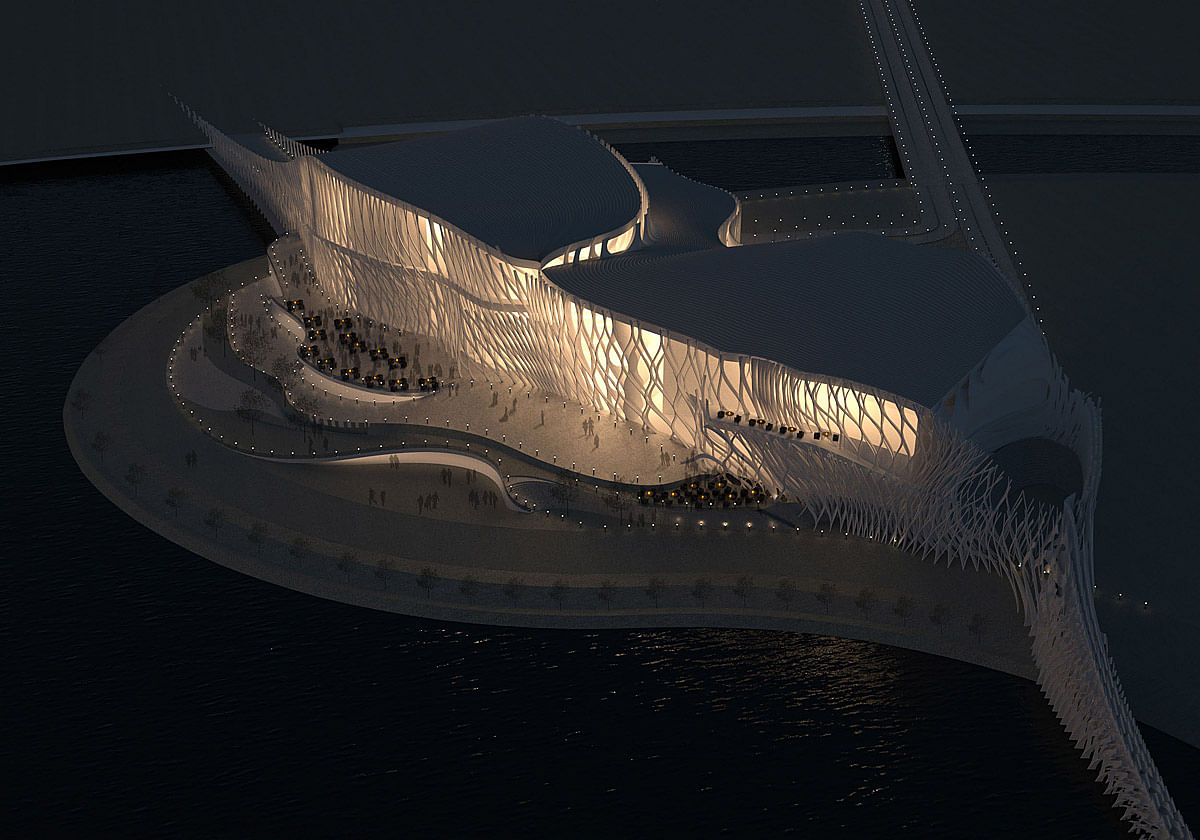
Exterior view, night (Image: Orproject)

SHIFTING TONES

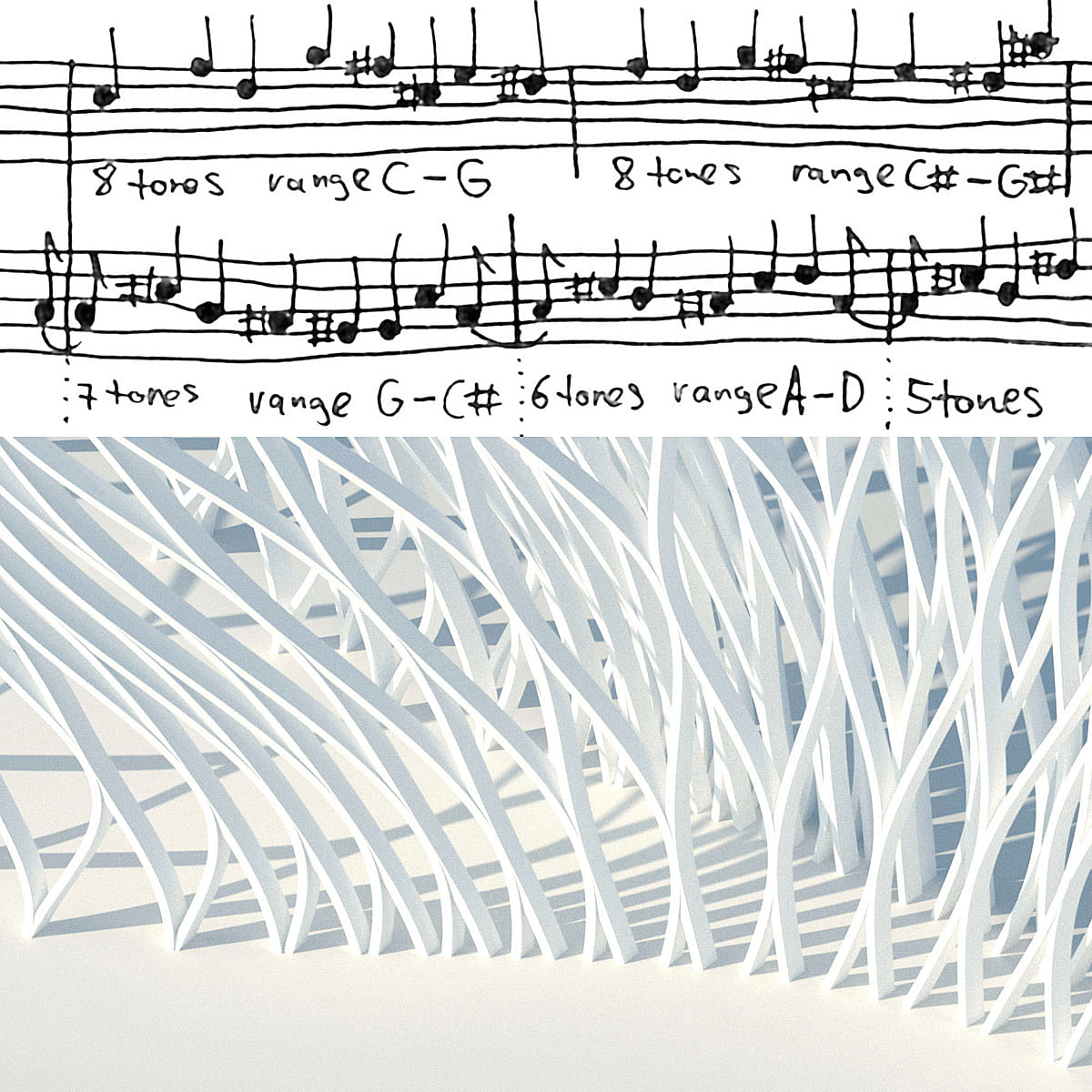
Klavierstück I uses a twelve tone row which starts with the lowest key of the piano. After its first cycle the row gets repeated, though shifted up by a halftone. However rather than translating up every tone by a halftone, only the lowest tone of the row is translated up by one octave. Like this the row remains the same, but its range has been shifted.

In the next repetition this shift continues, but the range now also gets reduced in its size: The lowest tone gets translated up by one octave again, and the second lowest tone gets dropped out, so that only the remaining eleven tones of the row are played. Instead of the twelve tones the range now only covers eleven tones, and also its length is reduced accordingly.

The range of the twelve tone row continues to be reduced and shifted upwards until only one tone is left in each repetition of the original row. Then the range grows again, and still moving upwards goes through further modulations: The different voices of the piece are starting to separate, the size of the different parallel ranges starts to diverge, they move around each other, until finally they grow together again, still moving up and their range fading out with the highest key of the piano.

Piano Piece No.1 is based on a simple row of the twelve tones, but by shifting and translating its range of influence, complex and continuously evolving rhythmic patterns are generated and turned into a floating field of sound.
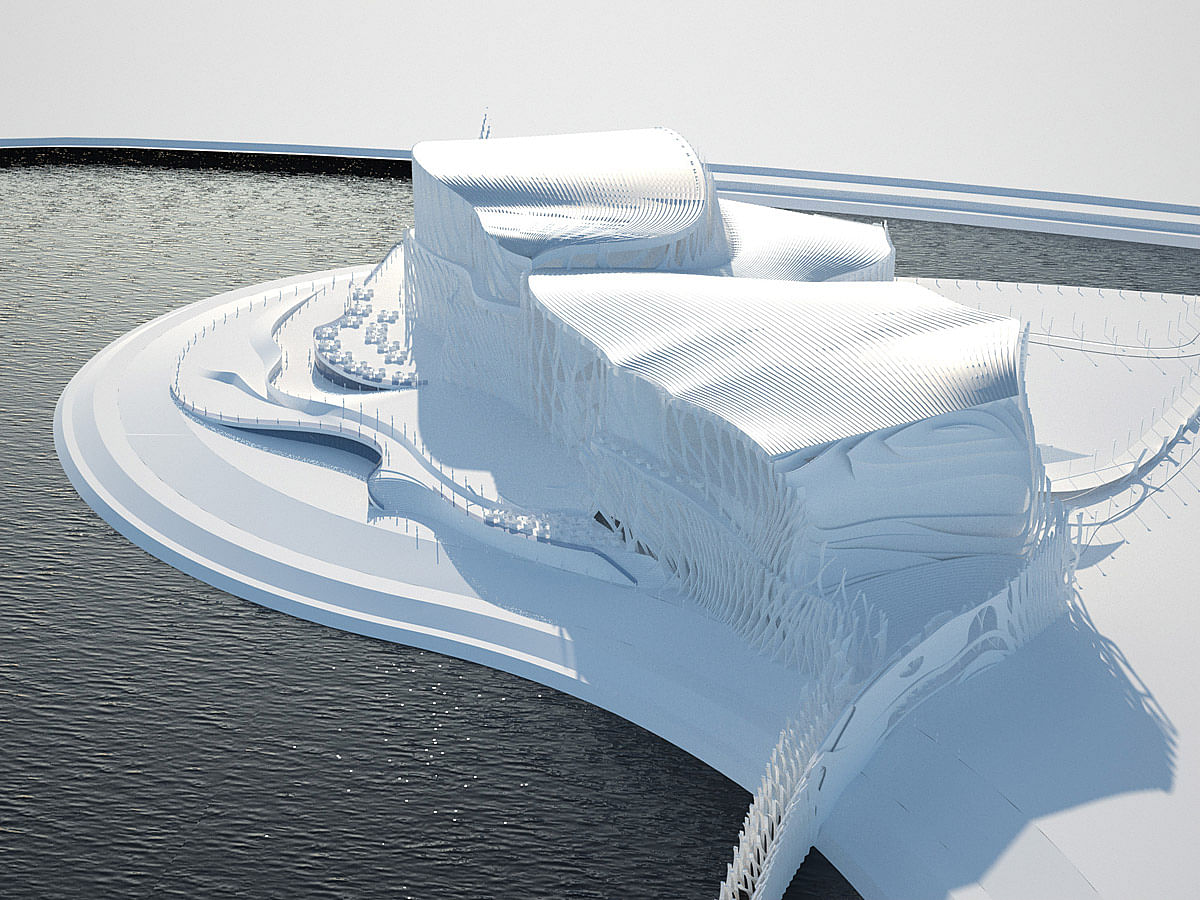
Exterior view, day (Image: Orproject)

STRUCTURE AND LIGHT

The proposed façade structure becomes the physical manifestation of Klavierstück I. Instead of on a twelve tone row, it is based on a strip morphology made from curved steel sections that creates the facade, structure and rhythm within itself. The repetition of the lamella happens in space, instead of the repetition in time of the twelve tone row. Parallel layers of the strips form the façade structure, and the alteration of its patterns results in architectural rhythms which are used to control the light, view and shading properties of the façade.

The façade structure starts to flow from the sea, where its different layers are aligned and appear to be one. (See image "Façade Detail 1") Then slowly the layers start to repeat at different intervals, resulting in a shift between them, the alignment breaks up, and a varied field of the façade rhythms begins to emerge. (Façade Detail 2)

The façade structure is altered in the length of its repetition, but also the orientation and the depth of the extrusions are manipulated in order to control the view and light, depending on the programmatic requirements on the inside of the building. (Façade Detail 3)

The flow of the façade layers is influenced by the programs which they enclose. As an effect of this the layers split up at certain points, and after forming a coherent system with the overlay of its rhythms, the individual layers separate and their individual patterns become visible. (Façade Detail 4)
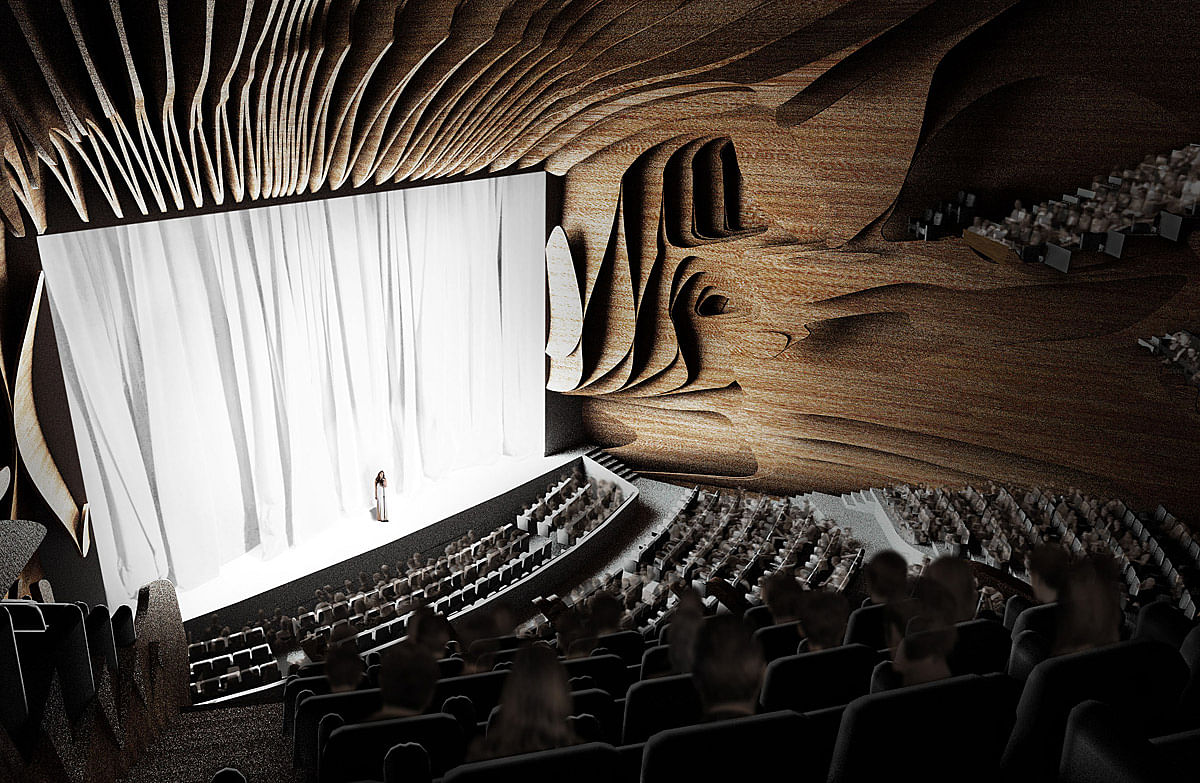
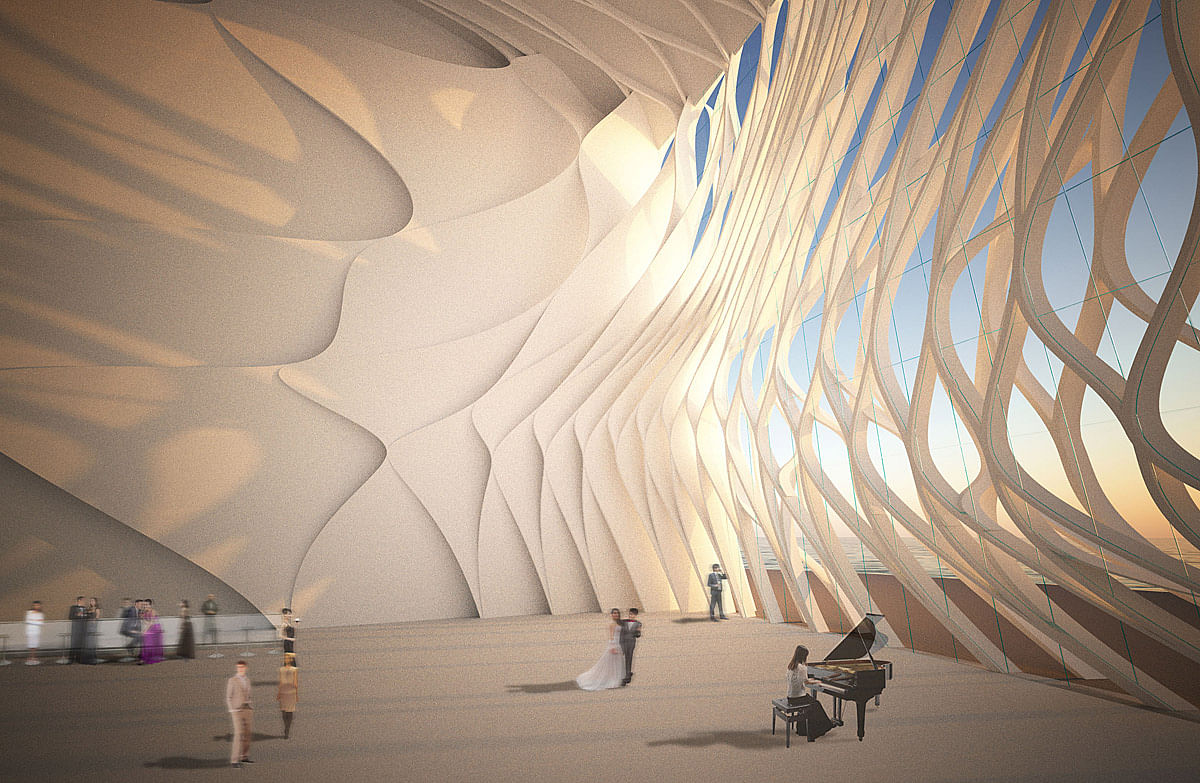
Interior view (Image: Orproject)

FLOW

The positioning of the façade walls has been developed according to a custom written flow simulation. The algorithm describes a flow that is influenced and altered by a set of deflectors, which each act according to the magnitude of their attraction and the area of their influence.

The distribution of the programmatic elements on the site is used as the deflector set that guides the flow of the rhythm lines which originate from the sea. On their way towards the city, the lines flow around the building elements such as the theatre and auditoriums, splitting up and being diverted by the deflectors.

In the musical composition the different voices converge again. For the building, the separate façade layers spread out towards the city, form the structure for a bridge, and then slowly fade out and disappear back into the ground.
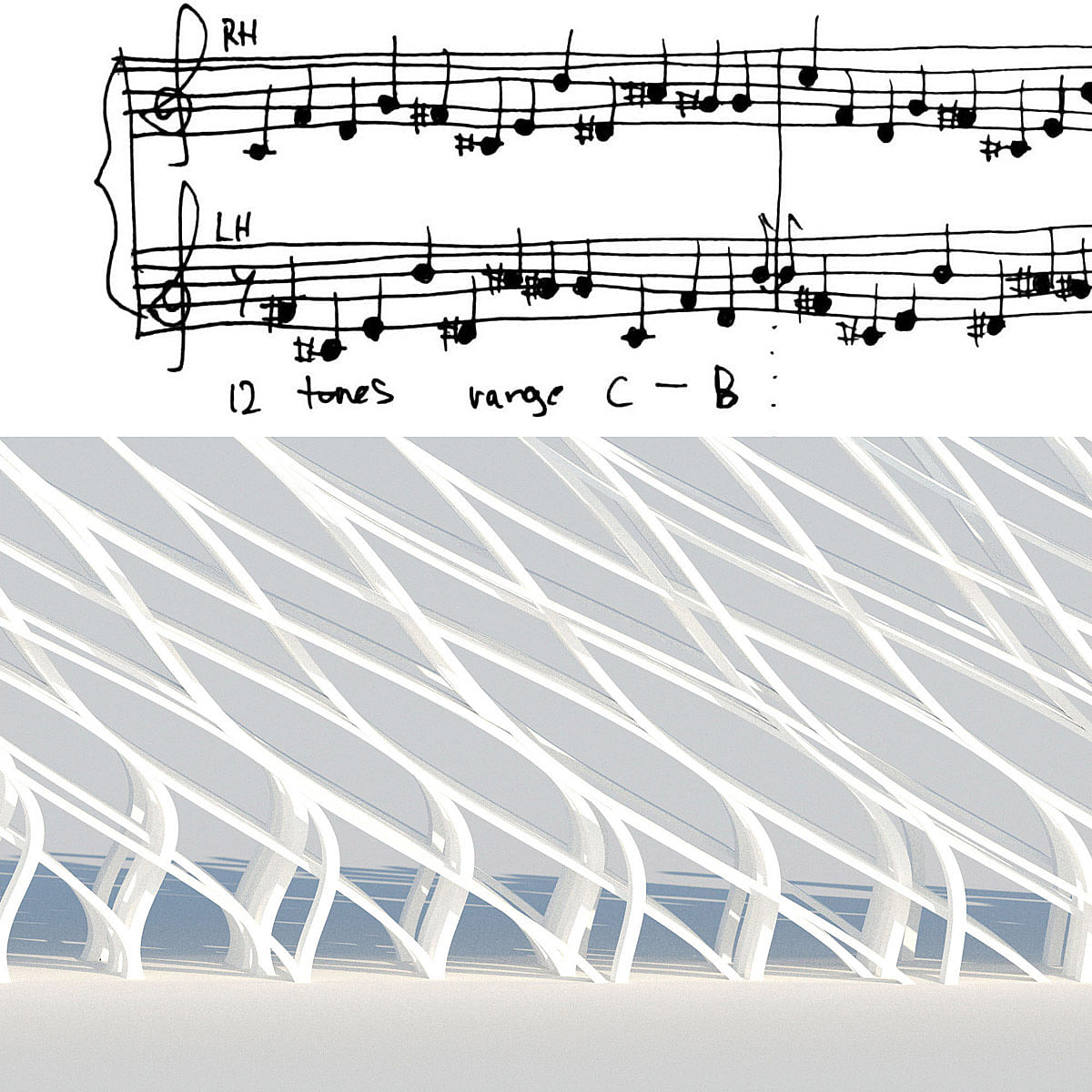
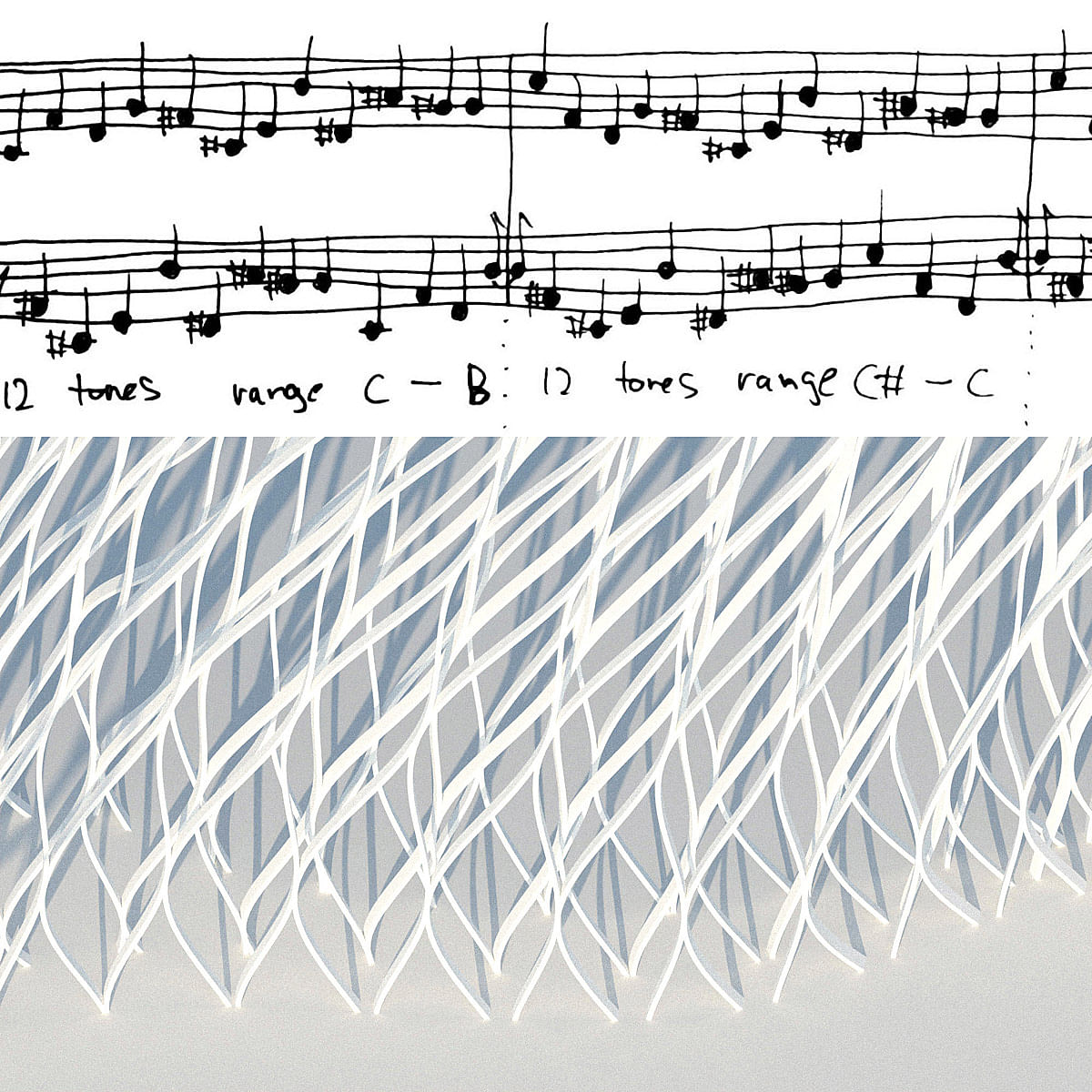
Façade Detail 1(Image: Orproject)
Façade Detail 2 (Image: Orproject)
Façade Detail 3 (Image: Orproject)
Façade Detail 4 (Image: Orproject)

Project Details:

Title: Anisotropia
Architects: Orproject
Design Team: Ho-Ping Hsia, Christoph Klemmt, Rolando Rodriguez-Leal, Rajat Sodhi, Natalia Wrzask, Christine Wu
Structural Engineers: Arup Structural Engineering, London
Theatre Consultants: Arup Theatre Consulting, Hong Kong

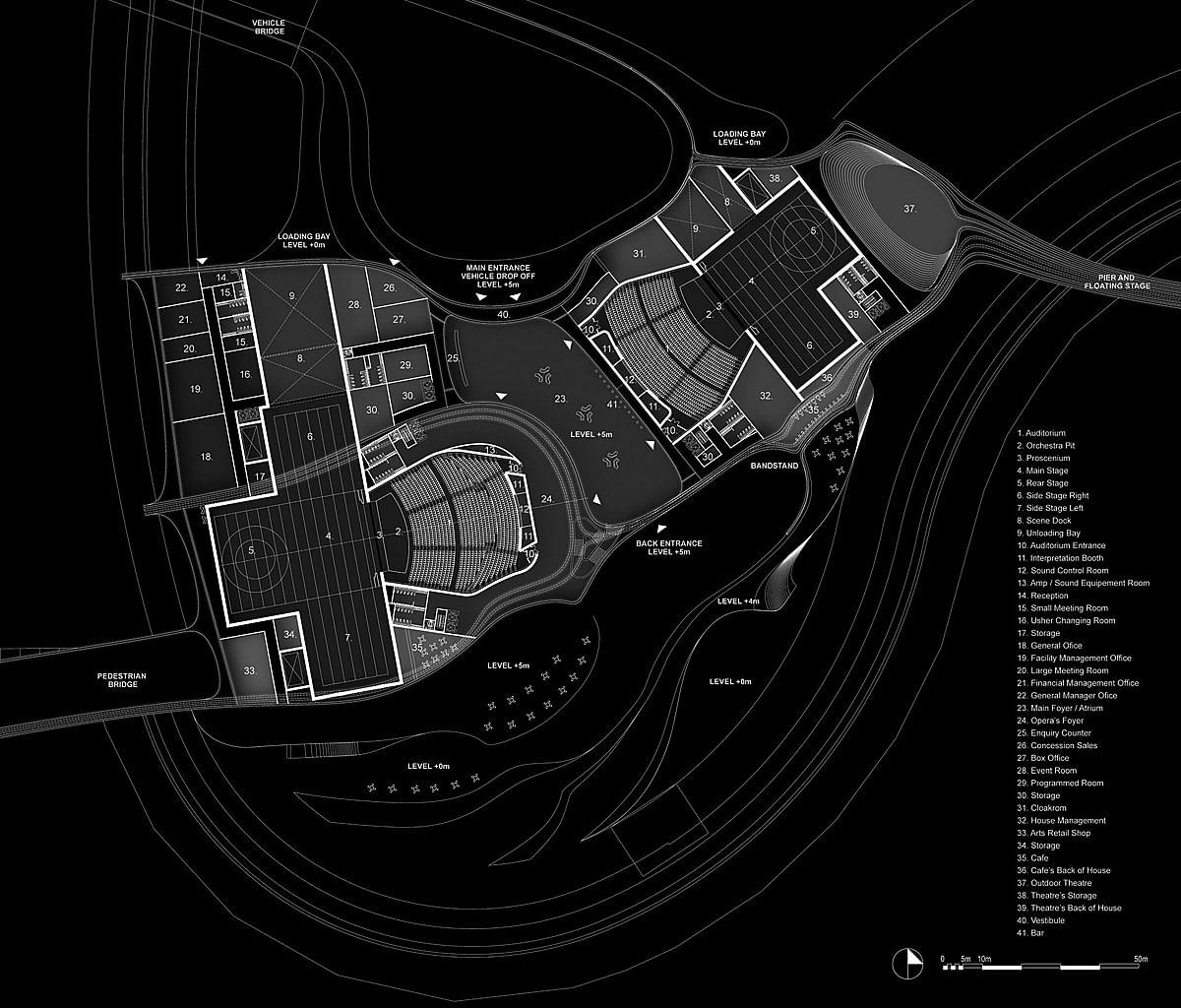
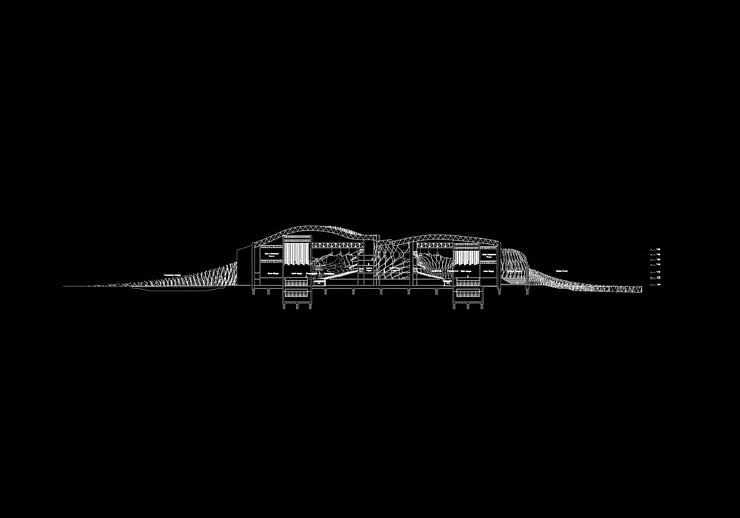
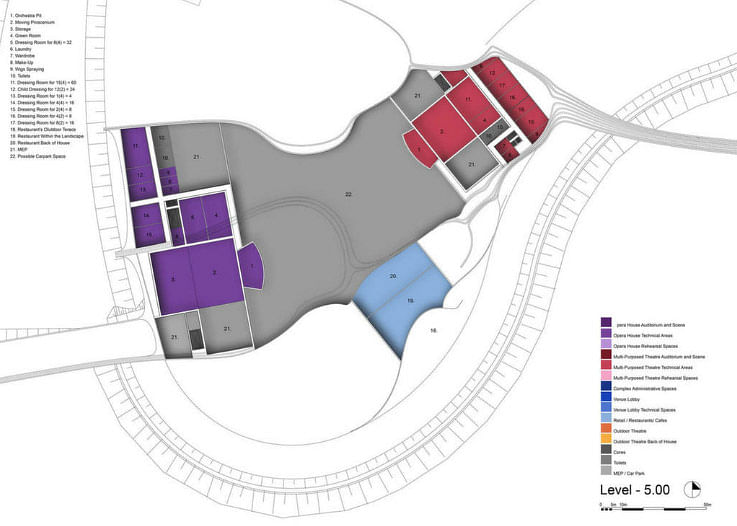
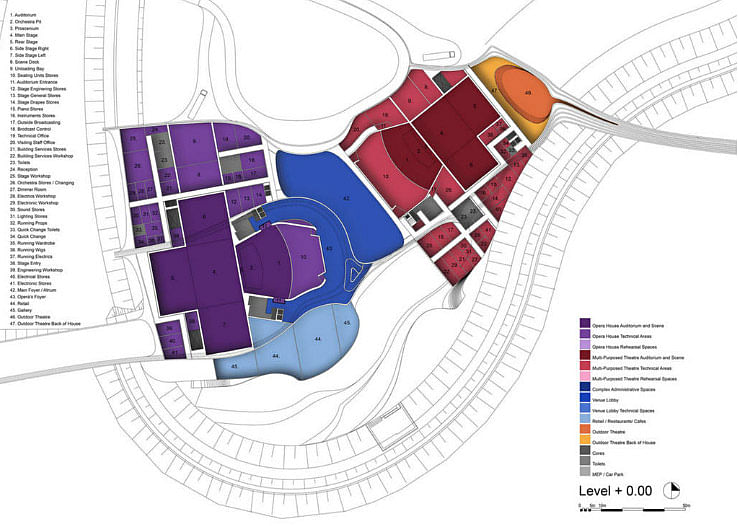
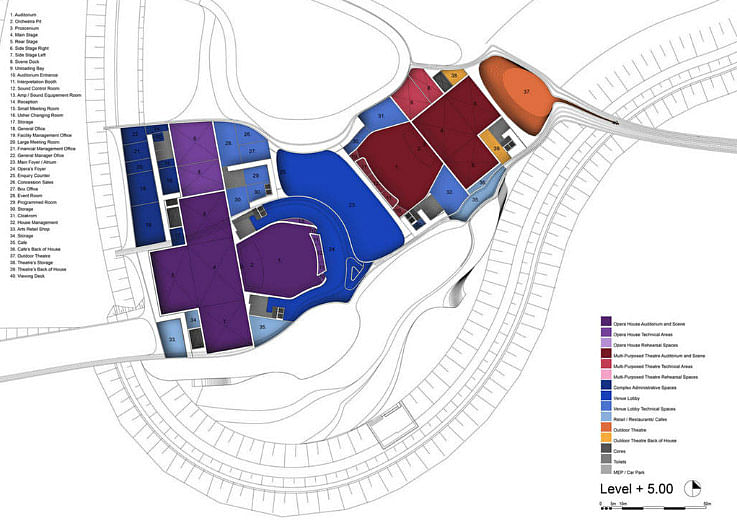
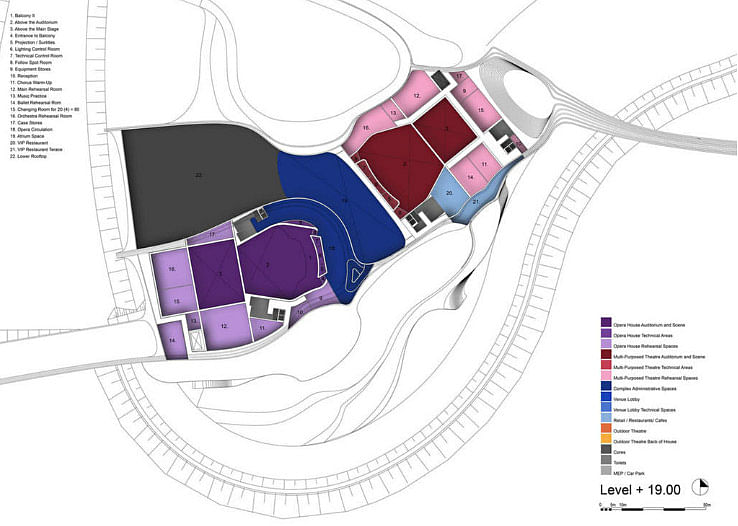
Find floor plans and a section of the "Anisotropia" proposal in the image gallery below.

Related

theater ● orproject ● opera house ● korea ● culture ● busan opera house ● busan ● asia

Share

  • Follow

    0 Comments

  • Comment as :

Busan Opera House Proposal by Orproject

Best new interiors of 2026 chosen at AIA Interior Architecture Awards

Best global architecture honored at RIBA International Awards 2026

World’s most beautiful airports of 2026 chosen by Prix Versailles

New architecture and design competitions: Brick in Architecture Awards, Study Architecture Student Showcase, N.Y.C. Groceries, and New York High Falls Riverfront Market

SmithGroup’s ‘pioneering’ Philip Merrill Environmental Center wins AIA Twenty-five Year Award

Sponsored Post by Buildner

Museum of Emotions / Edition #8 FINAL registration deadline is in 5 DAYS!

Here are the winners of the 2026 AIA Architecture Awards

40 emerging architects and designers under 40 from Europe honored

Sign up for Bustler's Email Newsletters

Northwestern University selects 12-firm longlist to design new engineering building

New architecture and design competitions: Exploring 130 Years of American Design, Christo & Jeanne-Claude Center, 13 White Houses, and La Pyramide

Micro-architecture honored in latest Tiny House Architecture Competition

World’s most beautiful restaurants of 2026 chosen by Prix Versailles

Sponsored Post by Buildner

Design a wine tasting room in Italy! Valli Wine Tasting Room is launched!

10 can't-miss architecture & design events to see this June in London, Los Angeles, Chicago, San Francisco, Detroit, San Diego, Porto, and Barcelona

Sponsored Post by Buildner

Museum of Emotions / Edition #8 FINAL registration deadline is approaching!

Next page » Loading

Busan Opera House Proposal by Orproject

By Bustler Editors|

Friday, Aug 19, 2011

Share

Competition entry for the new Busan Opera House by Orproject (Image: Orproject)

Related

theater ● orproject ● opera house ● korea ● culture ● busan opera house ● busan ● asia

Competition entries to the tremendously popular Busan Opera House competition keep pouring into our inbox these days. Here is another one of our favorites, the proposal "Anisotropia" designed by London-based studio Orproject. The design team included Ho-Ping Hsia, Christoph Klemmt, Rolando Rodriguez-Leal, Rajat Sodhi, Natalia Wrzask, and Christine Wu.

Project Description from the Architects:

A FROZEN PIECE OF MUSIC

Anisotropia, the design for the new Busan Opera House, is based on Klavierstück I, a composition for piano by Orproject director Christoph Klemmt. It is based on a twelve tone row which is repeated and altered by the different voices, in order to create complex rhythmic patterns.

Anisotropia becomes the physical manifestation of Klavierstück I, a frozen piece of music. The design for the Busan Opera House is based on a simple strip morphology instead of a twelve tone row, which creates the facade, structure and rhythm within itself, its repetition happening in space instead of time. Layers of the strips form the façade structure, and the shifting and alteration of these patterns results in the formation of complex architectural rhythms which are used to control the light, view and shading properties of the façade.

Exterior view, night (Image: Orproject)

SHIFTING TONES

Klavierstück I uses a twelve tone row which starts with the lowest key of the piano. After its first cycle the row gets repeated, though shifted up by a halftone. However rather than translating up every tone by a halftone, only the lowest tone of the row is translated up by one octave. Like this the row remains the same, but its range has been shifted.

In the next repetition this shift continues, but the range now also gets reduced in its size: The lowest tone gets translated up by one octave again, and the second lowest tone gets dropped out, so that only the remaining eleven tones of the row are played. Instead of the twelve tones the range now only covers eleven tones, and also its length is reduced accordingly.

The range of the twelve tone row continues to be reduced and shifted upwards until only one tone is left in each repetition of the original row. Then the range grows again, and still moving upwards goes through further modulations: The different voices of the piece are starting to separate, the size of the different parallel ranges starts to diverge, they move around each other, until finally they grow together again, still moving up and their range fading out with the highest key of the piano.

Piano Piece No.1 is based on a simple row of the twelve tones, but by shifting and translating its range of influence, complex and continuously evolving rhythmic patterns are generated and turned into a floating field of sound.

Exterior view, day (Image: Orproject)

STRUCTURE AND LIGHT

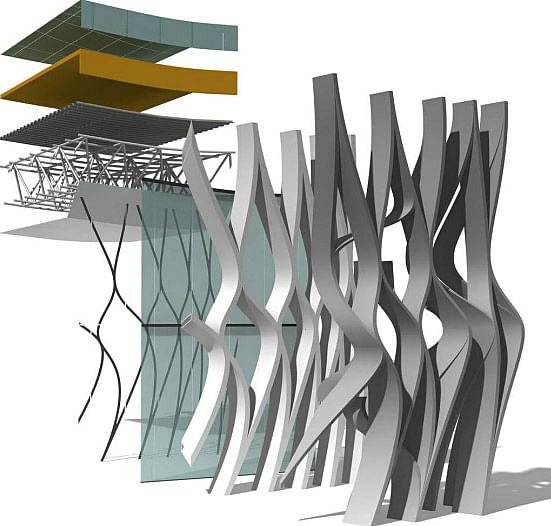
The proposed façade structure becomes the physical manifestation of Klavierstück I. Instead of on a twelve tone row, it is based on a strip morphology made from curved steel sections that creates the facade, structure and rhythm within itself. The repetition of the lamella happens in space, instead of the repetition in time of the twelve tone row. Parallel layers of the strips form the façade structure, and the alteration of its patterns results in architectural rhythms which are used to control the light, view and shading properties of the façade.

The façade structure starts to flow from the sea, where its different layers are aligned and appear to be one. (See image "Façade Detail 1") Then slowly the layers start to repeat at different intervals, resulting in a shift between them, the alignment breaks up, and a varied field of the façade rhythms begins to emerge. (Façade Detail 2)

The façade structure is altered in the length of its repetition, but also the orientation and the depth of the extrusions are manipulated in order to control the view and light, depending on the programmatic requirements on the inside of the building. (Façade Detail 3)

The flow of the façade layers is influenced by the programs which they enclose. As an effect of this the layers split up at certain points, and after forming a coherent system with the overlay of its rhythms, the individual layers separate and their individual patterns become visible. (Façade Detail 4)

Interior view (Image: Orproject)

FLOW

The positioning of the façade walls has been developed according to a custom written flow simulation. The algorithm describes a flow that is influenced and altered by a set of deflectors, which each act according to the magnitude of their attraction and the area of their influence.

The distribution of the programmatic elements on the site is used as the deflector set that guides the flow of the rhythm lines which originate from the sea. On their way towards the city, the lines flow around the building elements such as the theatre and auditoriums, splitting up and being diverted by the deflectors.

In the musical composition the different voices converge again. For the building, the separate façade layers spread out towards the city, form the structure for a bridge, and then slowly fade out and disappear back into the ground.
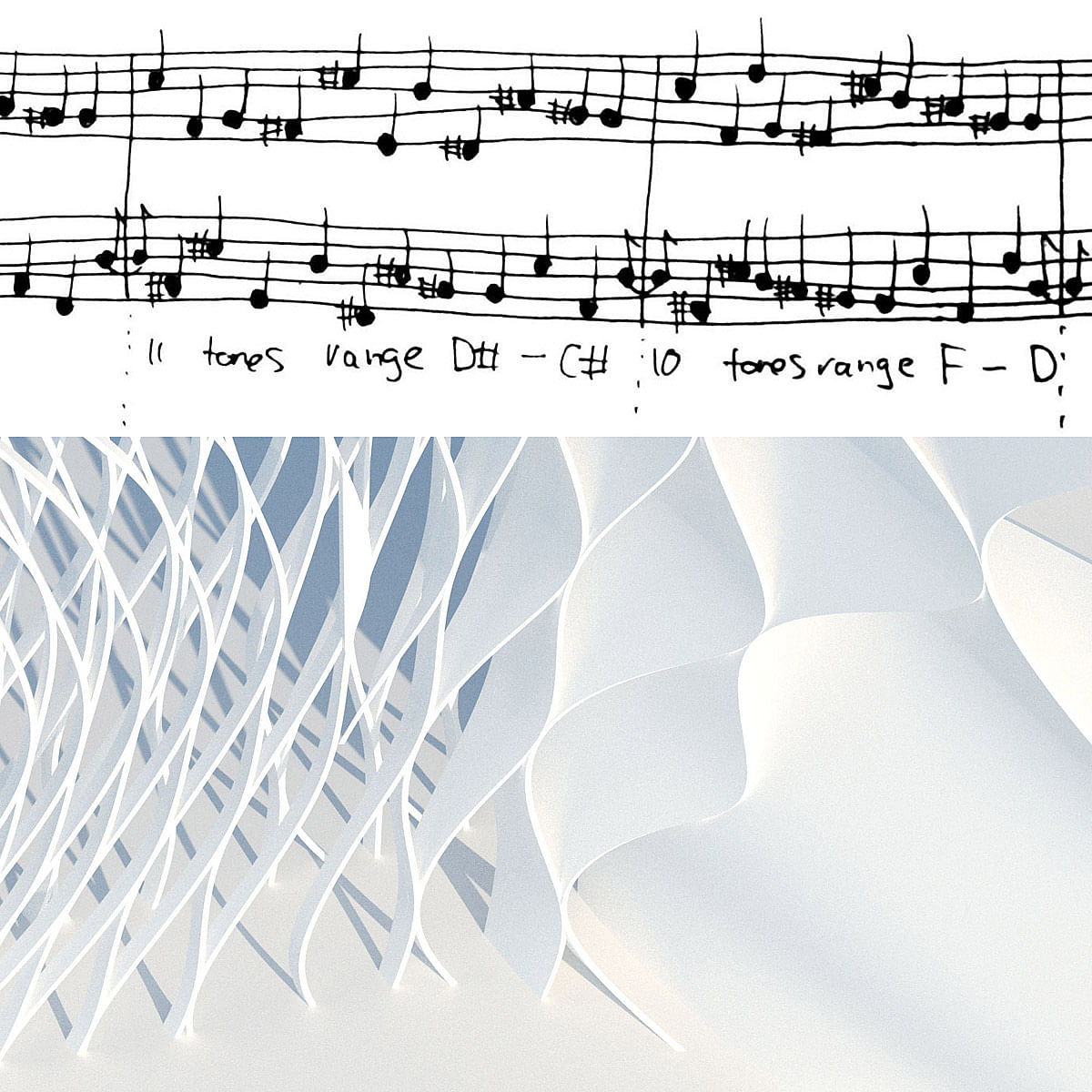
Façade Detail 1(Image: Orproject)
Façade Detail 2 (Image: Orproject)
Façade Detail 3 (Image: Orproject)
Façade Detail 4 (Image: Orproject)

Project Details:

Title: Anisotropia
Architects: Orproject
Design Team: Ho-Ping Hsia, Christoph Klemmt, Rolando Rodriguez-Leal, Rajat Sodhi, Natalia Wrzask, Christine Wu
Structural Engineers: Arup Structural Engineering, London
Theatre Consultants: Arup Theatre Consulting, Hong Kong

Find floor plans and a section of the "Anisotropia" proposal in the image gallery below.
Share

  • Follow

    0 Comments

  • Comment as :

Archinect JobsArchinect Jobs

The Archinect Job Board attracts the world's top architectural design talents.

VIEW ALL JOBS POST A JOB

Senior Hospitality FF&E Designer

bonetti/kozerski architecture DPC

Senior Hospitality FF&E Designer

New York, NY, US

Intermediate Designer

Rafael Viñoly Architects

Intermediate Designer

New York, NY, US

Architectural Designer II

Studio AR&D Architects

Architectural Designer II

Los Angeles, CA, US

Project Manager - Civic/Community

DAHLIN Architecture | Planning | Interiors

Project Manager - Civic/Community

Irvine, CA, US

Project Captain

Practice (formerly GGA+)

Project Captain

Pasadena, CA, US

Job Captain

Studio AR&D Architects

Job Captain

Los Angeles, CA, US

Architectural Designer (5-7 Years) - Commercial & Hospitality Focus

Pfeffer Torode Architecture

Architectural Designer (5-7 Years) - Commercial & Hospitality Focus

Nashville, TN, US

AutoCAD Drafter/Architectural Designer

Kari Whitman Interiors

AutoCAD Drafter/Architectural Designer

Boulder, CO, US

Junior Architect in nyc

Lara Apelian Studio

Junior Architect in nyc

New York, NY, US

Miami Senior Project Coordinator

BMA Architects

Miami Senior Project Coordinator

Miami, FL, US

Next page » Loading