• Login / Join
  • About
  • •
  • Contact
  • •
  • Advertising
bustler logo
bustler logo
  • News
  • Competitions
  • Events
  • Bustler is powered by Archinect
  • Sign up for Bustler's Email Newsletters

  • Follow these Bustler feeds:

  • Search

    Search in

  • Submit

    What are you submitting?

    News Pitch
    Competition
    Event
  • Login / Join
  • News|Competitions|Events
  • Search
    | Submit
    | Follow
  • Search in

    What are you submitting?

    News Pitch
    Competition
    Event

    Follow these Bustler feeds:

  • About|Contact|Advertising
  • Login / Join

Sou Fujimoto Selected to Design 2013 Serpentine Pavilion

By Bustler Editors|

Thursday, Feb 14, 2013
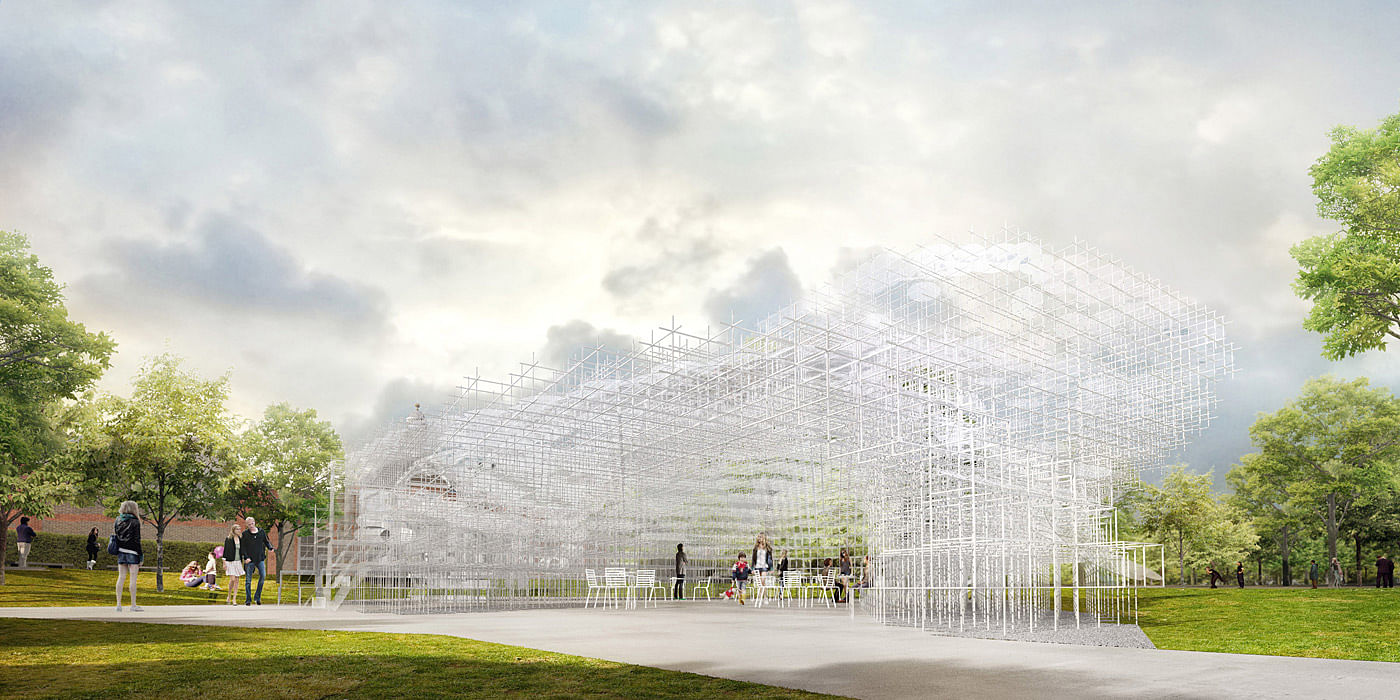
Serpentine Gallery Pavilion 2013, Designed by Sou Fujimoto, Exterior Indicative CGI © Sou Fujimoto Architects

Award-winning Japanese architect Sou Fujimoto was today announced as designer of the 2013 Serpentine Gallery Pavilion in London. He is the thirteenth and, at 41, youngest architect to accept the invitation to design a temporary structure for the Serpentine Gallery.

One of the most ambitious architectural programs of its kind worldwide, the Serpentine's annual Pavilion commission is a highly anticipated announcements on the cultural calendar. Past Pavilions have included designs by Herzog & de Meuron and Ai Weiwei (2012), Peter Zumthor, (2011), Jean Nouvel (2010), Kazuyo Sejima and Ryue Nishizawa, SANAA (2009), Frank Gehry (2008), the late Oscar Niemeyer (2003) and Zaha Hadid, who designed the inaugural structure in 2000.

Widely acknowledged as one of the most important architects coming to prominence worldwide, Sou Fujimoto is the leading light of an exciting generation of artists who are re-inventing our relationship with the built environment. Inspired by organic structures, such as the forest, the nest and the cave, Fujimoto's signature buildings inhabit a space between nature and artificiality. Fujimoto has completed the majority of his buildings in Japan, with commissions ranging from the domestic, such as Final Wooden House, T House and House N, to the institutional, such as the Musashino Art Museum and Library at Musashino Art University.

Occupying some 350 square-meters of lawn in front of the Serpentine Gallery, Sou Fujimoto's delicate, latticed structure of 20mm steel poles will have a lightweight and semi-transparent appearance that will allow it to blend, cloud-like, into the landscape and against the classical backdrop of the Gallery's colonnaded East wing. Designed as a flexible, multi-purpose social space – with a café sited inside – visitors will be encouraged to enter and interact with the Pavilion in different ways throughout its four-month tenure in London's Kensington Gardens.

Serpentine Gallery Pavilion 2013, Designed by Sou Fujimoto, Exterior Indicative CGI © Sou Fujimoto Architects

Fujimoto is the third Japanese architect to accept the invitation to design the Serpentine Gallery Pavilion, following Toyo Ito in 2002 and Kazuyo Sejima & Ryue Nishizawa of SANAA in 2009.

AECOM will be providing engineering and technical design services for the 2013 pavilion. This is the first Serpentine Gallery Pavilion for AECOM although David Glover, AECOM's global chief executive for building engineering, has worked on the designs for a majority of the pavilions to date.

Julia Peyton-Jones, Director, and Hans Ulrich Obrist, Co-Director, Serpentine Gallery, said: “We are thrilled to be working with one of the most fascinating architects in the world today. A visionary, who has conceived an extraordinary response to our invitation to design the Serpentine Gallery Pavilion, Sou Fujimoto has designed a structure that will enthral everyone that encounters it throughout the summer."

Sou Fujimoto © David Vintiner

Describing his design concept, Sou Fujimoto said: “For the 2013 Pavilion I propose an architectural landscape: a transparent terrain that encourages people to interact with and explore the site in diverse ways. Within the pastoral context of Kensington Gardens, I envisage the vivid greenery of the surrounding plant life woven together with a constructed geometry. A new form of environment will be created, where the natural and the man-made merge; not solely architectural nor solely natural, but a unique meeting of the two.

The Pavilion will be a delicate, three-dimensional structure, each unit of which will be composed of fine steel bars. It will form a semi-transparent, irregular ring, simultaneously protecting visitors from the elements while allowing them to remain part of the landscape. The overall footprint will be 350 square-meters and the Pavilion will have two entrances. A series of stepped terraces will provide seating areas that will allow the Pavilion to be used as a flexible, multi-purpose social space.

The delicate quality of the structure, enhanced by its semi-transparency, will create a geometric, cloud-like form, as if it were mist rising from the undulations of the park. From certain vantage points, the Pavilion will appear to merge with the classical structure of the Serpentine Gallery, with visitors suspended in space."

Related

united kingdom ● sou fujimoto ● serpentine pavilion ● pavilion ● london ● europe

Share

  • Follow

    0 Comments

  • Comment as :

Sou Fujimoto Selected to Design 2013 Serpentine Pavilion

UK’s best architecture honored at 2026 RIBA National Awards

World Architecture Festival: Explore the shortlisted finalists for 2026

New architecture and design competitions: Tiny Houses, A' Design Award, L A M P, and Walzwerk

Studio Gang receives 2026 AIA Chicago Firm Award for ‘conceptual rigor’

Ellen Peirson wins 2026 Wheelwright Prize for kitchens as ‘mineral landscapes’

Here are the winners of the 2026 AIA Los Angeles Board of Directors Awards

A proposal reusing decommissioned buses as mobile playgrounds wins the 2026 Davidson Prize

Carlo Ratti and Park Associati to redevelop Italian hospital by linking architecture and healing

Sign up for Bustler's Email Newsletters

Sponsored Post by Buildner

Mujassam Watan Urban Sculpture Challenge #8 FINAL registration deadline is approaching!

Excellence in sacred architecture reflected across the 2026 Faith & Form International Awards for Religious Architecture & Art winners

Sponsored Post by Buildner

Underbridge / Edition #2 advance registration deadline is approaching!

World’s most beautiful commercial stores of 2026 selected by Prix Versailles

Sponsored Post by Buildner

Buildner’s Unbuilt Award 2026 advance registration deadline is approaching!

Eight innovative timber projects honored at 2026 Wood in Architecture Awards

Beautiful brick architecture honored at BRICK AWARD 26

Next page » Loading

Sou Fujimoto Selected to Design 2013 Serpentine Pavilion

By Bustler Editors|

Thursday, Feb 14, 2013

Share

Serpentine Gallery Pavilion 2013, Designed by Sou Fujimoto, Exterior Indicative CGI © Sou Fujimoto Architects

Related

united kingdom ● sou fujimoto ● serpentine pavilion ● pavilion ● london ● europe

Award-winning Japanese architect Sou Fujimoto was today announced as designer of the 2013 Serpentine Gallery Pavilion in London. He is the thirteenth and, at 41, youngest architect to accept the invitation to design a temporary structure for the Serpentine Gallery.

One of the most ambitious architectural programs of its kind worldwide, the Serpentine's annual Pavilion commission is a highly anticipated announcements on the cultural calendar. Past Pavilions have included designs by Herzog & de Meuron and Ai Weiwei (2012), Peter Zumthor, (2011), Jean Nouvel (2010), Kazuyo Sejima and Ryue Nishizawa, SANAA (2009), Frank Gehry (2008), the late Oscar Niemeyer (2003) and Zaha Hadid, who designed the inaugural structure in 2000.

Widely acknowledged as one of the most important architects coming to prominence worldwide, Sou Fujimoto is the leading light of an exciting generation of artists who are re-inventing our relationship with the built environment. Inspired by organic structures, such as the forest, the nest and the cave, Fujimoto's signature buildings inhabit a space between nature and artificiality. Fujimoto has completed the majority of his buildings in Japan, with commissions ranging from the domestic, such as Final Wooden House, T House and House N, to the institutional, such as the Musashino Art Museum and Library at Musashino Art University.

Occupying some 350 square-meters of lawn in front of the Serpentine Gallery, Sou Fujimoto's delicate, latticed structure of 20mm steel poles will have a lightweight and semi-transparent appearance that will allow it to blend, cloud-like, into the landscape and against the classical backdrop of the Gallery's colonnaded East wing. Designed as a flexible, multi-purpose social space – with a café sited inside – visitors will be encouraged to enter and interact with the Pavilion in different ways throughout its four-month tenure in London's Kensington Gardens.

Serpentine Gallery Pavilion 2013, Designed by Sou Fujimoto, Exterior Indicative CGI © Sou Fujimoto Architects

Fujimoto is the third Japanese architect to accept the invitation to design the Serpentine Gallery Pavilion, following Toyo Ito in 2002 and Kazuyo Sejima & Ryue Nishizawa of SANAA in 2009.

AECOM will be providing engineering and technical design services for the 2013 pavilion. This is the first Serpentine Gallery Pavilion for AECOM although David Glover, AECOM's global chief executive for building engineering, has worked on the designs for a majority of the pavilions to date.

Julia Peyton-Jones, Director, and Hans Ulrich Obrist, Co-Director, Serpentine Gallery, said: “We are thrilled to be working with one of the most fascinating architects in the world today. A visionary, who has conceived an extraordinary response to our invitation to design the Serpentine Gallery Pavilion, Sou Fujimoto has designed a structure that will enthral everyone that encounters it throughout the summer."

Sou Fujimoto © David Vintiner

Describing his design concept, Sou Fujimoto said: “For the 2013 Pavilion I propose an architectural landscape: a transparent terrain that encourages people to interact with and explore the site in diverse ways. Within the pastoral context of Kensington Gardens, I envisage the vivid greenery of the surrounding plant life woven together with a constructed geometry. A new form of environment will be created, where the natural and the man-made merge; not solely architectural nor solely natural, but a unique meeting of the two.

The Pavilion will be a delicate, three-dimensional structure, each unit of which will be composed of fine steel bars. It will form a semi-transparent, irregular ring, simultaneously protecting visitors from the elements while allowing them to remain part of the landscape. The overall footprint will be 350 square-meters and the Pavilion will have two entrances. A series of stepped terraces will provide seating areas that will allow the Pavilion to be used as a flexible, multi-purpose social space.

The delicate quality of the structure, enhanced by its semi-transparency, will create a geometric, cloud-like form, as if it were mist rising from the undulations of the park. From certain vantage points, the Pavilion will appear to merge with the classical structure of the Serpentine Gallery, with visitors suspended in space."

Share

  • Follow

    0 Comments

  • Comment as :

Archinect JobsArchinect Jobs

The Archinect Job Board attracts the world's top architectural design talents.

VIEW ALL JOBS POST A JOB

Sr. Designer, Architecture - Residential

Roman and Williams Buildings and Interiors

Sr. Designer, Architecture - Residential

New York, NY, US

Project Manager

Cardello Architects

Project Manager

Westport, CT, US

Senior Project Manager, Interior Architecture & Design

Meshberg Group

Senior Project Manager, Interior Architecture & Design

Miami Beach, FL, US

Interior Design Project Manager

DAHLIN Architecture | Planning | Interiors

Interior Design Project Manager

Bellevue, WA, US

Project Architect

Studio AR&D Architects

Project Architect

Los Angeles, CA, US

Project Architect (5–10 Years Experience)

Stuart Basseches Architect

Project Architect (5–10 Years Experience)

Sag Harbor, NY, US

Designer

HATCH ARCHITECTURE

Designer

Los Angeles, CA, US

Studio Operations Manager

Obata Noblin Office

Studio Operations Manager

San Francisco, CA, US

Project Manager / Project Architect

Hudgins Design Group, Inc

Project Manager / Project Architect

Dana Point, CA, US

Architect

KieranTimberlake

Architect

Philadelphia, PA, US

Next page » Loading