• Login / Join
  • About
  • •
  • Contact
  • •
  • Advertising
bustler logo
bustler logo
  • News
  • Competitions
  • Events
  • Bustler is powered by Archinect
  • Sign up for Bustler's Email Newsletters

  • Follow these Bustler feeds:

  • Search

    Search in

  • Submit

    What are you submitting?

    News Pitch
    Competition
    Event
  • Login / Join
  • News|Competitions|Events
  • Search
    | Submit
    | Follow
  • Search in

    What are you submitting?

    News Pitch
    Competition
    Event

    Follow these Bustler feeds:

  • About|Contact|Advertising
  • Login / Join

Bernard Tschumi presents Grottammare Cultural Center, his first project in Italy

By Bustler Editors|

Thursday, Feb 28, 2013
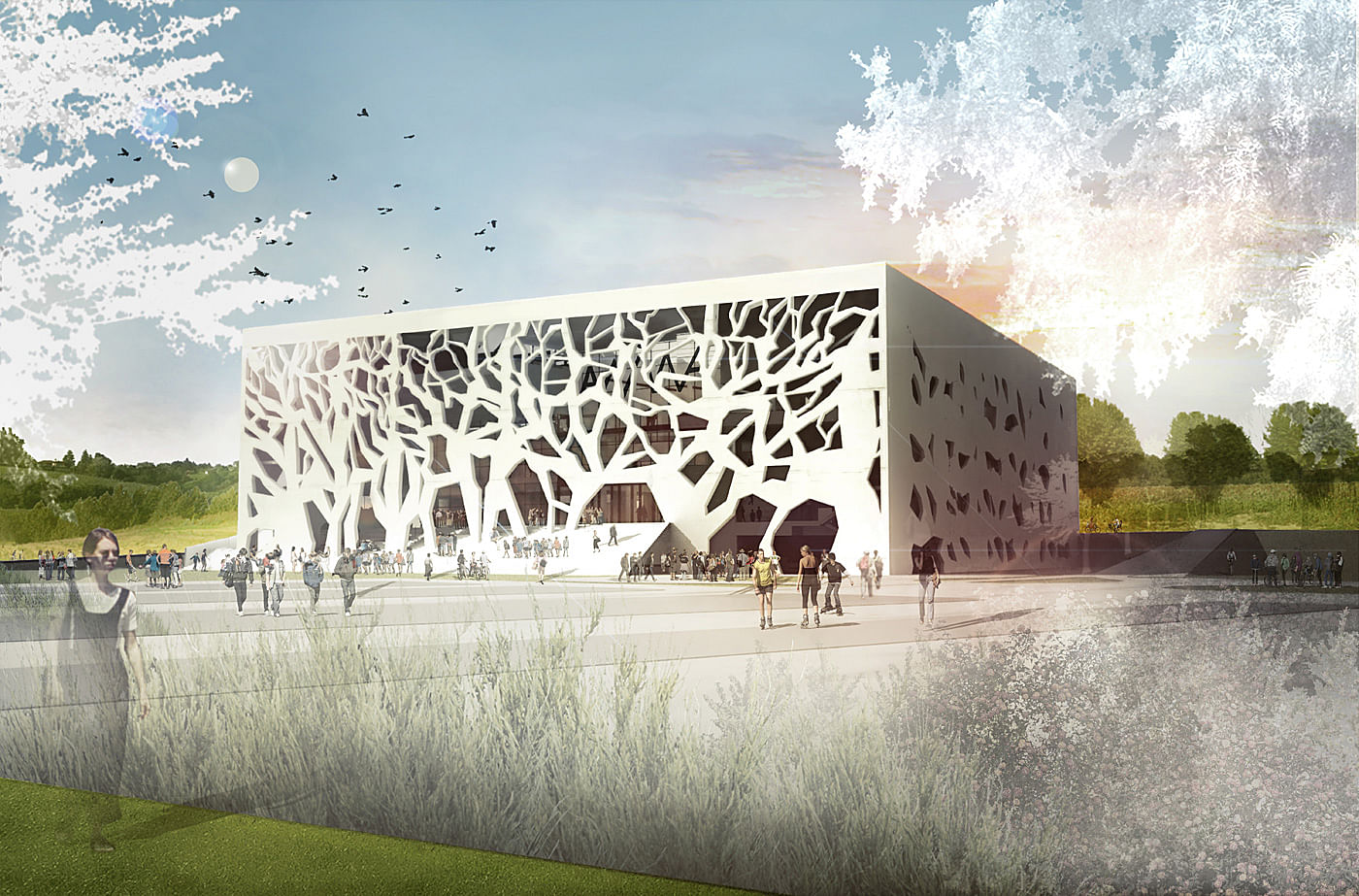
Bernard Tschumi Architects, ANIMA Cultural Center in Grottammare, Italy. General view.

Bernard Tschumi Architects has unveiled the schematic design for the firm's first work in Italy: ANIMA, a new cultural center in the city of Grottammare. The project has been commissioned by the Fondazione Cassa di Risparmio di Ascoli Piceno and the Municipality of Grottammare and is expected to be completed by 2016.

From the Official Press Release:

Unveiled on February 20, 2013, ANIMA is the first project by architect Bernard Tschumi in Italy. Commissioned by the Fondazione Cassa di Risparmio di Ascoli Piceno and by the Municipality of Grottammare, it is meant to generate stronger ties between the people and the territory, as well as to associate its image to the most diverse manifestations of culture in the form of a public center. The project, whose completion is scheduled for 2016, is a future point of reference, a generator of ideas in the area, both in the sense of a physical built structure but also figuratively inherent in its creative potential. Placed at the fringes of the urban fabric, between the sea and hills that characterize the landscape, the building is clearly visible and immediately accessible from the Adriatic highway. The spatial design is characterized by an exceptional flexibility, floor areas, structural systems, and vertical movement (stairs, elevators) organized in such a way that changing demands can be accommodated.
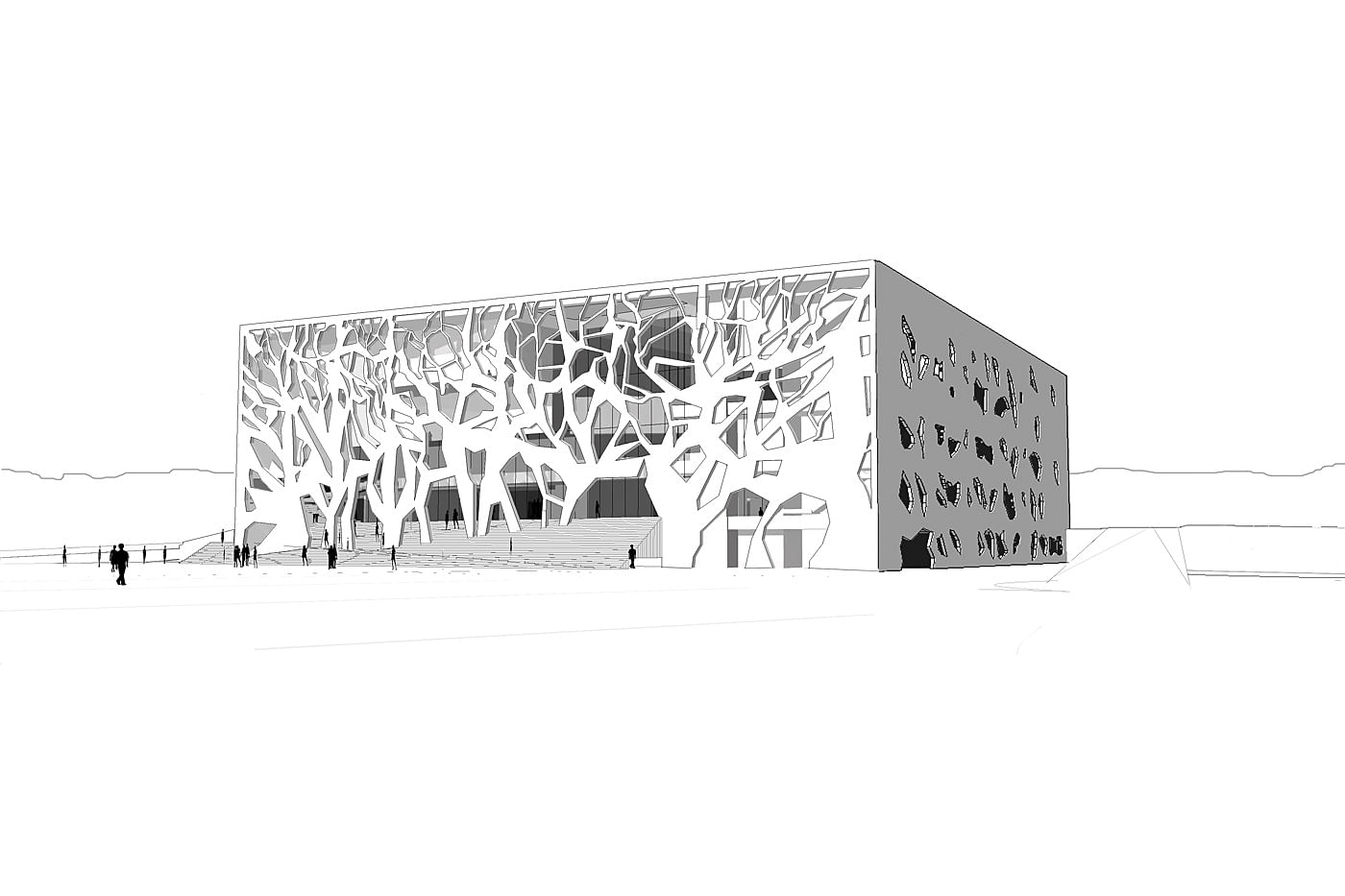
Bernard Tschumi Architects, ANIMA Cultural Center in Grottammare, Italy. General view.

The decision to entrust Bernard Tschumi with this task was based on his extensive and varied experience designing spaces intended for culture. The name of the project, ANIMA, is the result of a public referendum for an acronym of the following concepts: A for Art, N for Nature, I for Ideas, M for Music and A for Action. These are the “five souls” of the project, which Bernard Tschumi used to generate the artifact: an identity in constant flux. The building will be a catalyst for people’s interests, interaction and synergy, promoted by clients who understand architecture as a process rather than a final product. Vincenzo Marini Marini, president of the Fondazione Cassa di Risparmio di Acoli Piceno and Luigi Merli, Mayor of Grottammare, stated that “the basis for the commission of the project is expressed as a willingness to support and encourage the economic development of the community, as a process to strengthen people’s ties to the territory with which they identify, as a means to progress local knowledge and, finally, as a means to improve the qualitative and quantitative tourist flows in the area”.
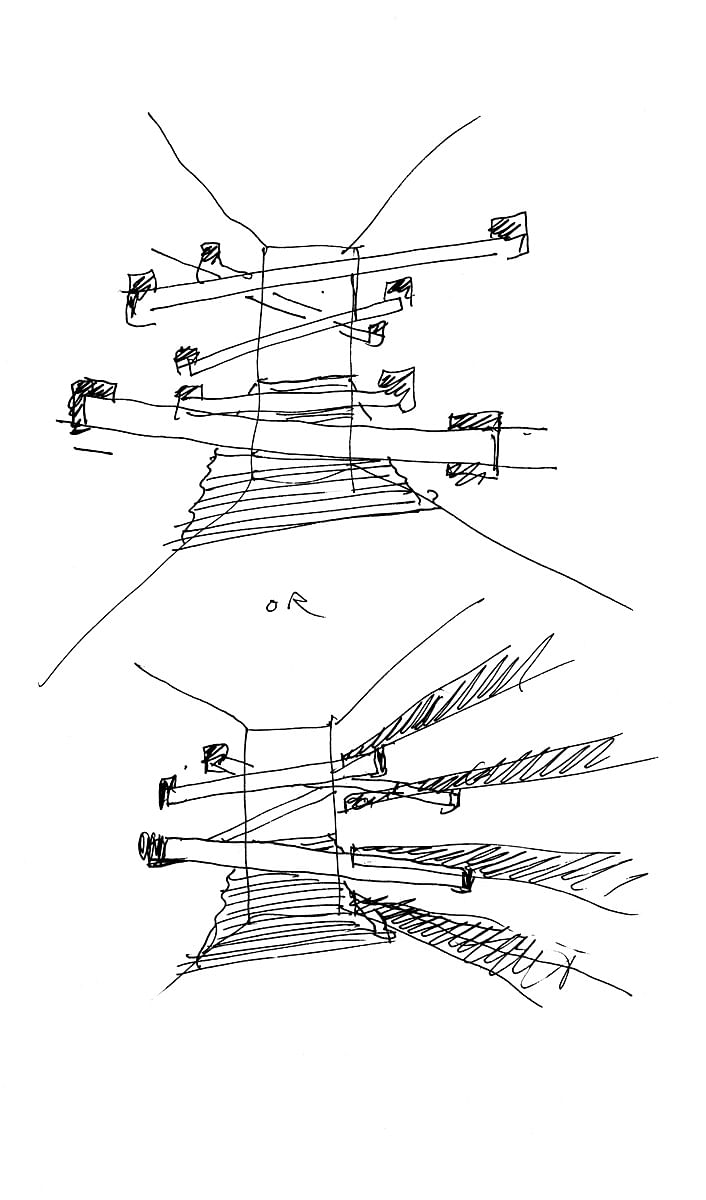
Bernard Tschumi Architects, ANIMA Cultural Center in Grottammare, Italy. The East courtyard with the elevated bridges (sketch by Bernard Tschumi).

The encounter, hospitality and gathering of cultures. The aim of ANIMA is to host the various forms of local culture that find expression through artistic, gastronomic and environmental means. The objective is to promote the encounter, interaction, and exchange through widespread activities: shows, exhibitions, conferences and workshops that describe the existing territory and envision its possibilities for the future. The project is thus configured as a dynamic space, in constant evolution, that will in essence never lack cultural significance, its temperament as mutable as the expressions that will find home in its interior. A point of excellence which will help generate activities, ANIMA will encourage community groups and foster local productivity, thus becoming an urban generator for the development of the area. A center of excellence and creativity of local resources is born.
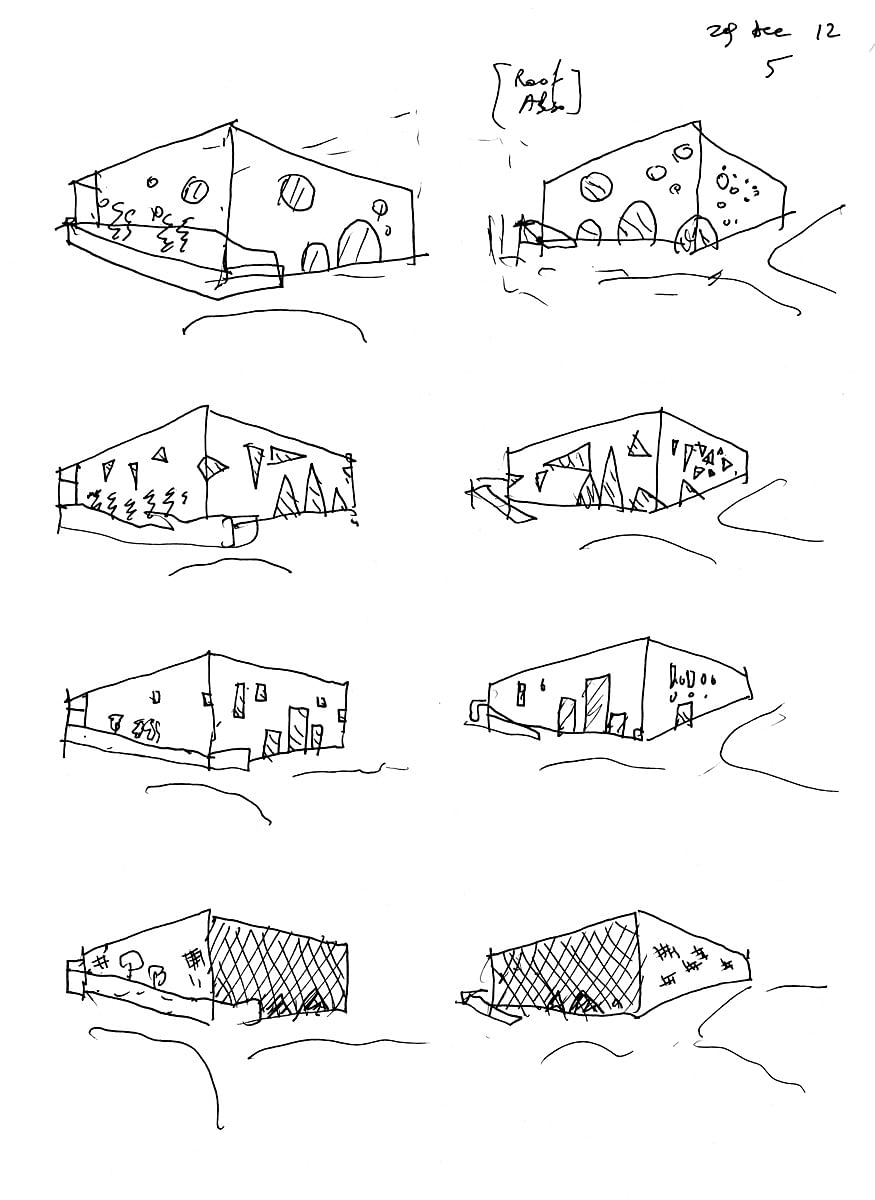
Bernard Tschumi Architects, ANIMA Cultural Center in Grottammare, Italy. Facade studies (sketch by Bernard Tschumi).

A perfect square and a permeable envelope. The surface area on which the building stands coincides with that of the small medieval center of Grottammare, which is little over 7,000 square meters. The project recalls the historic heart of the city not only in its size; it also refers to the concept of urbs. On the outside ANIMA is presented as one single entity with a strong presence; a compact body, a perfect square that in some ways alludes to the notion of enclosure and protection. However, at the same time, it conveys the image of an architectural space in a constant state of becoming. A reflection on the definition of facade is in fact what brought Bernard Tschumi to create an informal solution for the grand vertical surfaces that enclose the building. These walls find the strongest expression on the southern side where the building’s interior spaces are accessed. Seen from the outside, the volume is understood as a recognizable artifact that exists in light of the resources in the vicinity and finds resolution as a highly permeable and contextually receptive building.
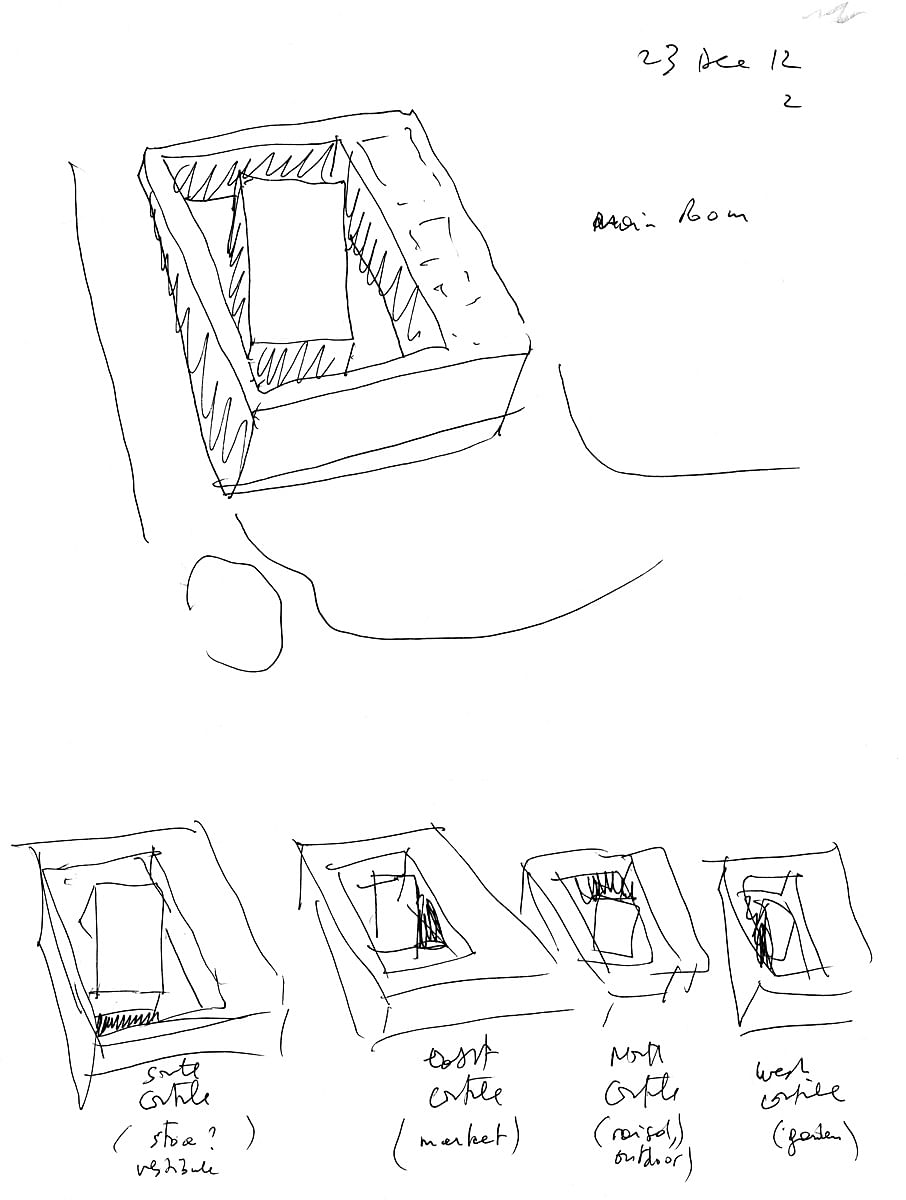
Bernard Tschumi Architects, ANIMA Cultural Center in Grottammare, Italy. General building strategy: the main room and the four courtyards (sketch by Bernard Tschumi).

The systems of courts and the main room. Upon entering the quadrangular body, the visitor finds himself in a space partly broken up: meaning it is understood as both interior and exterior. The complexity of the space is determined by the rotation of a large rectangular volume that occupies the center of the building and contains the main room with 1,500 seats, which are configured according to the varying capacity requirements. The rotation of the volume creates four large courtyards, the main room thus faces and can open up to, creating in the end a series of fluid and dynamic pathways, traversed by either the eye or the visitor. An articulate system of ramps permits movement, creating perspectives at varying heights each of which illustrates the new ways in which the space may be understood. Adjacent to the main hall, connected by a multiplicity of pathways, a series of laboratories, offices, the cafe and ancillary spaces that compose the rest of the building.
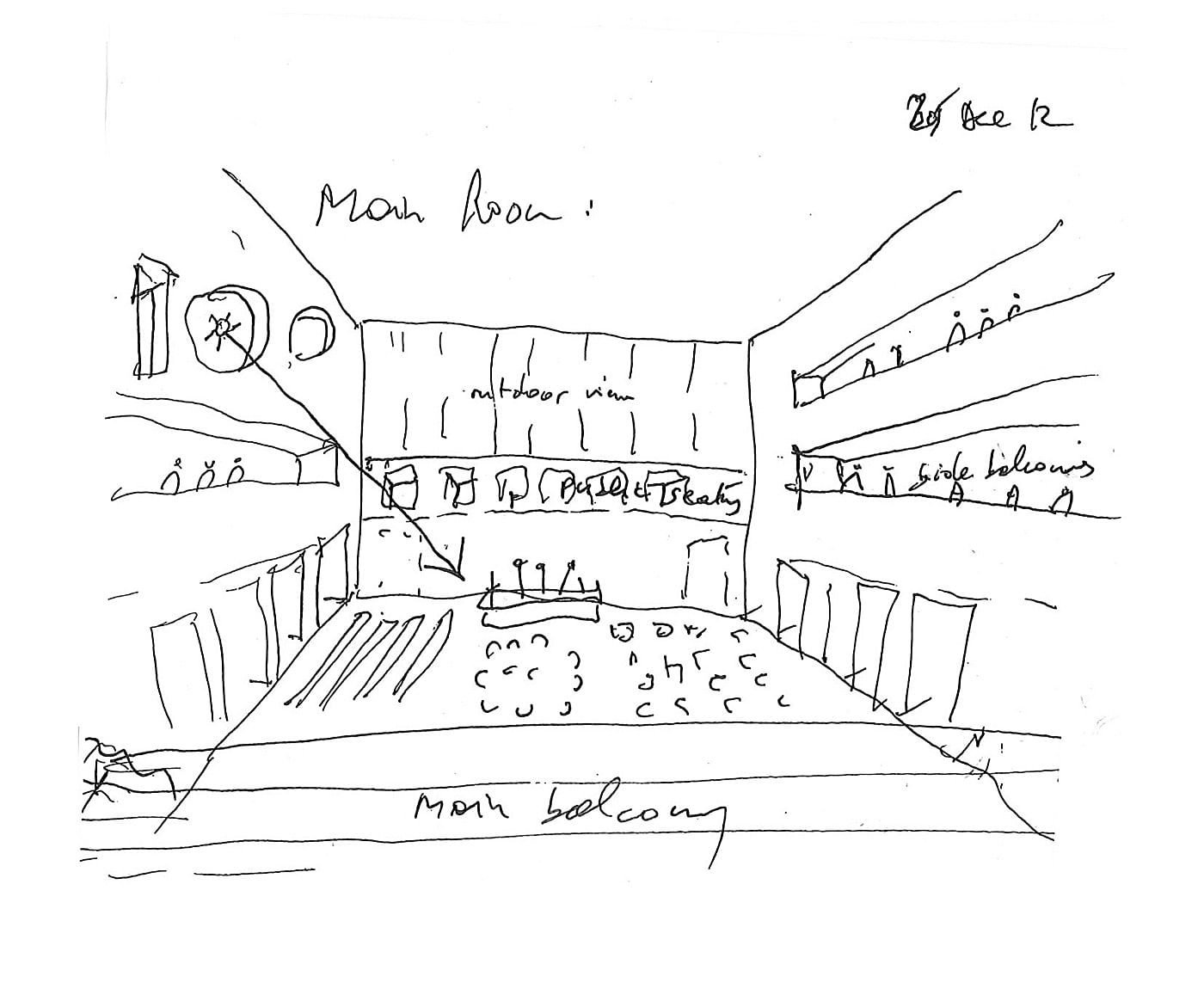
Bernard Tschumi Architects, ANIMA Cultural Center in Grottammare, Italy. The main room (sketch by Bernard Tschumi).

Bernard Tschumi, in his description of the project, states: “Could one design a facade without resorting to formal composition? Could one design a facade that would be neither abstract nor figurative, but formless, so to speak? Our motivation in raising these questions was both economic and cultural: At a time of economic crisis, to indulge in formal geometries made out of complex volumetric curves did not seem a responsible option. The time of “Iconism” seemed to be over, together with the arbitrary sculptural shapes of the recent past, often done without consideration for context, content, or budget.” With the presentation of the schematic design, the team of architects, coordinated by Alfonso Giancotti, have begun to undertake the next stages of the design process of ANIMA, whose construction is intended to start in approximately a year (early 2014).

Project Details:

Clients: Fondazione Cassa di Risparmio di Ascoli Piceno, Municipality of Grottammare
Sole project manager: Marco Marcucci - Municipality of Grottammare
Architect: Bernard Tschumi - BTA Bernard Tschumi Architects (New York)
General coordinator: Alfonso Giancotti / Studio Associato di Architettura Elia-Giancotti (Roma)
Structural engineer: Michele Tiberi / CAED International Srl (Roma)
Acoustic, lighting and multimedia system designer: Enrico Moretti / BIOBYTE Srl (Milano)
Electrical engineer: Alessandro Federici / Studio Tecnico ing. Alessandro Federici (Ascoli Piceno)
Mechanical and hydraulic engineer: Giuseppe Puglia / Studio Tecnico ing. Giuseppe Puglia (Ascoli Piceno)
Safety coordinator: Fabio Giannini / Studio di consulenza e progettazione ing. Fabio Giannini (Comunanza, AP)
Geologist: Vittorio Marucci / Studio Associato di Geologia e Geotecnica Marucci (Ascoli Piceno)
Surveyor: Antonio Morganti / Studio Tecnico Associato Morganti (Spinetoli, AP)
Communication consultant: Marco Brizzi / Image MEDIA AGENCY (Firenze)

Program: Cultural center

Dimensions
Site surface: 9,225 mq
Building surface: 7,190 mq
Covered surface: 6,150 mq
Maximum height: 30 m

Schedule
Project: 2012-2014
Groundbreaking (scheduled): 2014
Opening (scheduled): 2016

All images courtesy of Bernard Tschumi Architects.

Related

italy ● grottammare ● europe ● cultural center ● bernard tschumi architects ● bernard tschumi

Share

  • Follow

    0 Comments

  • Comment as :

Bernard Tschumi presents Grottammare Cultural Center, his first project in Italy

Eight innovative timber projects honored at 2026 Wood in Architecture Awards

Beautiful brick architecture honored at BRICK AWARD 26

Over $500,000 awarded to architectural discourse projects by Graham Foundation

Best in urban planning recognized at AIA Regional & Urban Design Award 2026

Sponsored Post by Buildner

Re:Form - New Life for Old Spaces / Edition #3 advance registration deadline is approaching!

New architecture and design competitions: IDEAS Awards, UIA-HYP CUP International Student Competition, Vancouver Tall Challenge, and Memorial to the Sixth Extinction

Best small projects chosen at AIA Small Project Award 2026

10 standout sustainable projects honored at AIA COTE Top Ten Award 2026

Sign up for Bustler's Email Newsletters

Best residential architecture of 2026 honored at AIA Housing Award

Best new interiors of 2026 chosen at AIA Interior Architecture Awards

Best global architecture honored at RIBA International Awards 2026

World’s most beautiful airports of 2026 chosen by Prix Versailles

New architecture and design competitions: Brick in Architecture Awards, Study Architecture Student Showcase, N.Y.C. Groceries, and New York High Falls Riverfront Market

SmithGroup’s ‘pioneering’ Philip Merrill Environmental Center wins AIA Twenty-five Year Award

Sponsored Post by Buildner

Museum of Emotions / Edition #8 FINAL registration deadline is in 5 DAYS!

Next page » Loading

Bernard Tschumi presents Grottammare Cultural Center, his first project in Italy

By Bustler Editors|

Thursday, Feb 28, 2013

Share

Bernard Tschumi Architects, ANIMA Cultural Center in Grottammare, Italy. General view.

Related

italy ● grottammare ● europe ● cultural center ● bernard tschumi architects ● bernard tschumi

Bernard Tschumi Architects has unveiled the schematic design for the firm's first work in Italy: ANIMA, a new cultural center in the city of Grottammare. The project has been commissioned by the Fondazione Cassa di Risparmio di Ascoli Piceno and the Municipality of Grottammare and is expected to be completed by 2016.

From the Official Press Release:

Unveiled on February 20, 2013, ANIMA is the first project by architect Bernard Tschumi in Italy. Commissioned by the Fondazione Cassa di Risparmio di Ascoli Piceno and by the Municipality of Grottammare, it is meant to generate stronger ties between the people and the territory, as well as to associate its image to the most diverse manifestations of culture in the form of a public center. The project, whose completion is scheduled for 2016, is a future point of reference, a generator of ideas in the area, both in the sense of a physical built structure but also figuratively inherent in its creative potential. Placed at the fringes of the urban fabric, between the sea and hills that characterize the landscape, the building is clearly visible and immediately accessible from the Adriatic highway. The spatial design is characterized by an exceptional flexibility, floor areas, structural systems, and vertical movement (stairs, elevators) organized in such a way that changing demands can be accommodated.

Bernard Tschumi Architects, ANIMA Cultural Center in Grottammare, Italy. General view.

The decision to entrust Bernard Tschumi with this task was based on his extensive and varied experience designing spaces intended for culture. The name of the project, ANIMA, is the result of a public referendum for an acronym of the following concepts: A for Art, N for Nature, I for Ideas, M for Music and A for Action. These are the “five souls” of the project, which Bernard Tschumi used to generate the artifact: an identity in constant flux. The building will be a catalyst for people’s interests, interaction and synergy, promoted by clients who understand architecture as a process rather than a final product. Vincenzo Marini Marini, president of the Fondazione Cassa di Risparmio di Acoli Piceno and Luigi Merli, Mayor of Grottammare, stated that “the basis for the commission of the project is expressed as a willingness to support and encourage the economic development of the community, as a process to strengthen people’s ties to the territory with which they identify, as a means to progress local knowledge and, finally, as a means to improve the qualitative and quantitative tourist flows in the area”.

Bernard Tschumi Architects, ANIMA Cultural Center in Grottammare, Italy. The East courtyard with the elevated bridges (sketch by Bernard Tschumi).

The encounter, hospitality and gathering of cultures. The aim of ANIMA is to host the various forms of local culture that find expression through artistic, gastronomic and environmental means. The objective is to promote the encounter, interaction, and exchange through widespread activities: shows, exhibitions, conferences and workshops that describe the existing territory and envision its possibilities for the future. The project is thus configured as a dynamic space, in constant evolution, that will in essence never lack cultural significance, its temperament as mutable as the expressions that will find home in its interior. A point of excellence which will help generate activities, ANIMA will encourage community groups and foster local productivity, thus becoming an urban generator for the development of the area. A center of excellence and creativity of local resources is born.

Bernard Tschumi Architects, ANIMA Cultural Center in Grottammare, Italy. Facade studies (sketch by Bernard Tschumi).

A perfect square and a permeable envelope. The surface area on which the building stands coincides with that of the small medieval center of Grottammare, which is little over 7,000 square meters. The project recalls the historic heart of the city not only in its size; it also refers to the concept of urbs. On the outside ANIMA is presented as one single entity with a strong presence; a compact body, a perfect square that in some ways alludes to the notion of enclosure and protection. However, at the same time, it conveys the image of an architectural space in a constant state of becoming. A reflection on the definition of facade is in fact what brought Bernard Tschumi to create an informal solution for the grand vertical surfaces that enclose the building. These walls find the strongest expression on the southern side where the building’s interior spaces are accessed. Seen from the outside, the volume is understood as a recognizable artifact that exists in light of the resources in the vicinity and finds resolution as a highly permeable and contextually receptive building.

Bernard Tschumi Architects, ANIMA Cultural Center in Grottammare, Italy. General building strategy: the main room and the four courtyards (sketch by Bernard Tschumi).

The systems of courts and the main room. Upon entering the quadrangular body, the visitor finds himself in a space partly broken up: meaning it is understood as both interior and exterior. The complexity of the space is determined by the rotation of a large rectangular volume that occupies the center of the building and contains the main room with 1,500 seats, which are configured according to the varying capacity requirements. The rotation of the volume creates four large courtyards, the main room thus faces and can open up to, creating in the end a series of fluid and dynamic pathways, traversed by either the eye or the visitor. An articulate system of ramps permits movement, creating perspectives at varying heights each of which illustrates the new ways in which the space may be understood. Adjacent to the main hall, connected by a multiplicity of pathways, a series of laboratories, offices, the cafe and ancillary spaces that compose the rest of the building.

Bernard Tschumi Architects, ANIMA Cultural Center in Grottammare, Italy. The main room (sketch by Bernard Tschumi).

Bernard Tschumi, in his description of the project, states: “Could one design a facade without resorting to formal composition? Could one design a facade that would be neither abstract nor figurative, but formless, so to speak? Our motivation in raising these questions was both economic and cultural: At a time of economic crisis, to indulge in formal geometries made out of complex volumetric curves did not seem a responsible option. The time of “Iconism” seemed to be over, together with the arbitrary sculptural shapes of the recent past, often done without consideration for context, content, or budget.” With the presentation of the schematic design, the team of architects, coordinated by Alfonso Giancotti, have begun to undertake the next stages of the design process of ANIMA, whose construction is intended to start in approximately a year (early 2014).

Project Details:

Clients: Fondazione Cassa di Risparmio di Ascoli Piceno, Municipality of Grottammare
Sole project manager: Marco Marcucci - Municipality of Grottammare
Architect: Bernard Tschumi - BTA Bernard Tschumi Architects (New York)
General coordinator: Alfonso Giancotti / Studio Associato di Architettura Elia-Giancotti (Roma)
Structural engineer: Michele Tiberi / CAED International Srl (Roma)
Acoustic, lighting and multimedia system designer: Enrico Moretti / BIOBYTE Srl (Milano)
Electrical engineer: Alessandro Federici / Studio Tecnico ing. Alessandro Federici (Ascoli Piceno)
Mechanical and hydraulic engineer: Giuseppe Puglia / Studio Tecnico ing. Giuseppe Puglia (Ascoli Piceno)
Safety coordinator: Fabio Giannini / Studio di consulenza e progettazione ing. Fabio Giannini (Comunanza, AP)
Geologist: Vittorio Marucci / Studio Associato di Geologia e Geotecnica Marucci (Ascoli Piceno)
Surveyor: Antonio Morganti / Studio Tecnico Associato Morganti (Spinetoli, AP)
Communication consultant: Marco Brizzi / Image MEDIA AGENCY (Firenze)

Program: Cultural center

Dimensions
Site surface: 9,225 mq
Building surface: 7,190 mq
Covered surface: 6,150 mq
Maximum height: 30 m

Schedule
Project: 2012-2014
Groundbreaking (scheduled): 2014
Opening (scheduled): 2016

All images courtesy of Bernard Tschumi Architects.

Share

  • Follow

    0 Comments

  • Comment as :

Archinect JobsArchinect Jobs

The Archinect Job Board attracts the world's top architectural design talents.

VIEW ALL JOBS POST A JOB

Project Manager

Payette

Project Manager

Boston, MA, US

Architect / Project Architect - Remote (U.S. Based)

Joseph David Associates

Architect / Project Architect - Remote (U.S. Based)

Design Director or Sr. Architect

b.hills architecture, P.C.

Design Director or Sr. Architect

Boise, ID, US

Studio Coordinator

Sarah Jacoby Architect

Studio Coordinator

Long Island City, NY, US

Project Manager - Planning

DAHLIN Architecture | Planning | Interiors

Project Manager - Planning

Pleasanton, CA, US

Senior Landscape Designer

Surfacedesign, Inc.

Senior Landscape Designer

San Francisco, CA, US

Senior Designer / Project Manager

Robert Young Architects

Senior Designer / Project Manager

New York, NY, US

Miami Senior Project Coordinator

BMA Architects

Miami Senior Project Coordinator

Miami, FL, US

Designer (Level 3)

KPMB

Designer (Level 3)

Cambridge, MA, US

Executive Assistant & Office Manager To Principal

Danny Forster & Architecture

Executive Assistant & Office Manager To Principal

New York, NY, US

Next page » Loading