• Login / Join
  • About
  • •
  • Contact
  • •
  • Advertising
bustler logo
bustler logo
  • News
  • Competitions
  • Events
  • Bustler is powered by Archinect
  • Sign up for Bustler's Email Newsletters

  • Follow these Bustler feeds:

  • Search

    Search in

  • Submit

    What are you submitting?

    News Pitch
    Competition
    Event
  • Login / Join
  • News|Competitions|Events
  • Search
    | Submit
    | Follow
  • Search in

    What are you submitting?

    News Pitch
    Competition
    Event

    Follow these Bustler feeds:

  • About|Contact|Advertising
  • Login / Join

Team UOW Australia Wins 2013 Solar Decathlon China

By Bustler Editors|

Thursday, Aug 15, 2013

The Illawarra Flame House

On Aug. 11, the Illawarra Flame House of Team UOW Australia (University of Wollongong and TAFE Illawarra Institute) won the 2013 Solar Decathlon China. Co-hosted by the U.S. Department of Energy and the National Energy Administration China, the competition challenged university teams to design, build, and operate solar-powered houses that are affordable, energy-efficient, and stylish. Participants included 22 teams from 35 universities, with students of over 35 nationalities in 13 countries.

Winner of the 2013 Solar Decathlon China: Illawarra Flame House by Team UOW Australia

As described by Team UOW, they built the world-class Illawarra Flame House to inspire the Australian community to embrace innovative sustainable retrofitting technology, and to make such technologies affordable and available for all. Through retrofitting, the history and original context of the existing building is preserved. The concept was inspired by the seasonal renewal and blossoming of the native Australian Illawarra Flame tree. And quite naturally (pardon the pun), most of the materials in the house and its landscape are reclaimed and recycled, such as the hardwood and the crushed terracotta roof tiles.

This year's competition was full of firsts. It is the first time in the competition's history that an Australian team made it to the finals and won with a never-submitted-before retrofitting home. It is also the first time the Decathlon was hosted in Asia, following on the success of the U.S. and European Solar Decathlons held biennially since 2002 and 2010 respectively. (Bustler has reported on a whole bunch of them in the past.)

Team UOW acquired 957.6 out of a possible 1,000 points. The Second place prize went to the E-Concave house of Team SCUT (South China University of Technology) at 951.8 points, while the Halo house of Team Sweden (Chalmers University of Technology) won third with 948.3 points.

The competition is a decathlon because the teams compete and are judged in 10 Contests that cover all aspects of housing design: Architecture, Market appeal, Engineering, Communications, Solar application, Thermal comfort, Hot water, Appliances, Home entertainment, and Energy balance.

Scroll down to learn more about the Illawarra Flame House and to see some projects from the competition.

Throughout the preparation for 2013 SD China, Team UOW documented their journey on their website and social media.

"The Illawarra Flame project name is inspired by the Illawarra Flame Tree, which is a species native to the eastern seaboard of Australia. This tree is not only a natural icon of our region, but it also resonates with our project in many other ways, including its spectacular transformation, to a profusion of red blossom when flowering in spring, mirroring the transformation of our retrofitted house."

"The fibro home is a distinctive expression of Australian domestic architecture. These houses were built in great numbers during the post-war period to a standard design, using a minimum of materials. They are ubiquitous to the suburban streets of Australia's capitals and regional centres."

"Team UOW has retained the essential architecture of the dwelling to ensure the retrofitted building will sit comfortably in the suburban environment and be socially accessible to the market. The basic building form and architectural features are determined by the existing building, and have been retained where possible to provide an affordable and practical solution to preserving existing housing stock, while reducing the waste associated with demolition. Certain features of the house have been modified to enhance the functionality of the layout, and to increase natural lighting, solar access and cross flow ventilation, to greatly improve the liveability of the home."

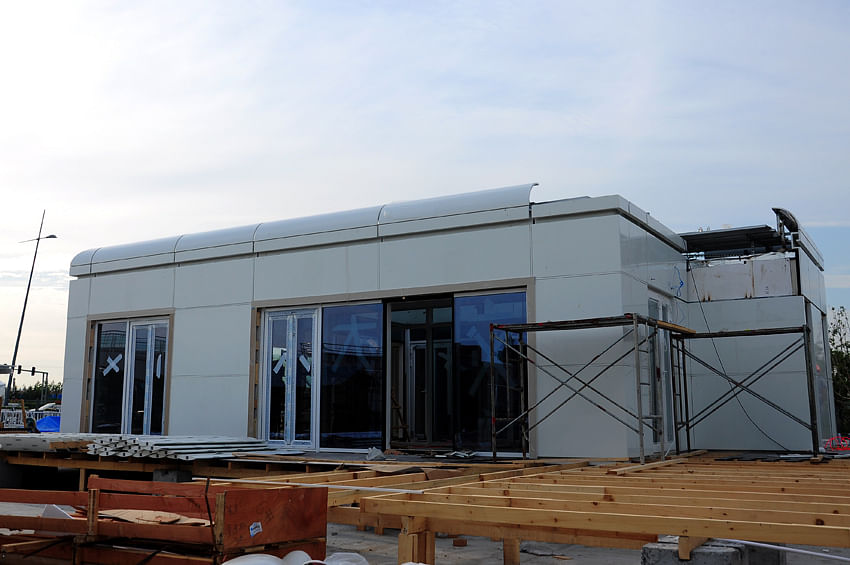
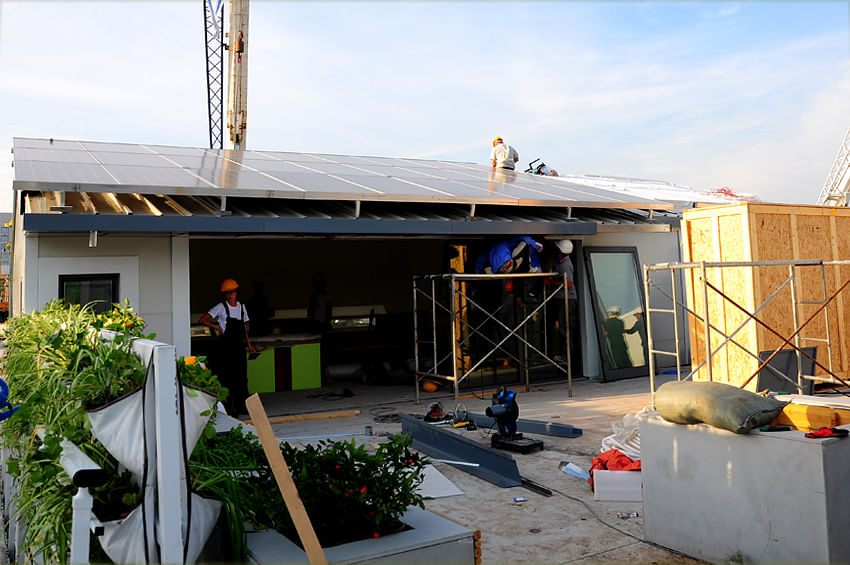
Team UOW constructing the house in Datong, China.

"The Illawarra Flame House took over a year to design and was initially constructed at TAFE Illawarra's Wollongong Campus over a 12-week period. Over 40 students from the University of Wollongong and TAFE Illawarra Institute helped to design and build the Illawarra Flame House. After being dismantled it was then reassembled at the University of Wollongong's Innovation Campus and unveiled to the public."

Retrofitting diagram for the Illawarra Flame House

"Team UOW Australia has chosen to design the retrofitted house to appeal to older clients nearing retirement. Many of these people are 'empty nesters' - parents whose children have moved on, and who no longer require the floor space of a large family home. The Illawarra Flame house is perfect for these clients looking to downsize while ensuring a clean energy future for their grandchildren. Design decisions have been made according to the principle of aging-in-place, to ensure that the house can be enjoyed by the client for as long as possible."

Team UOW
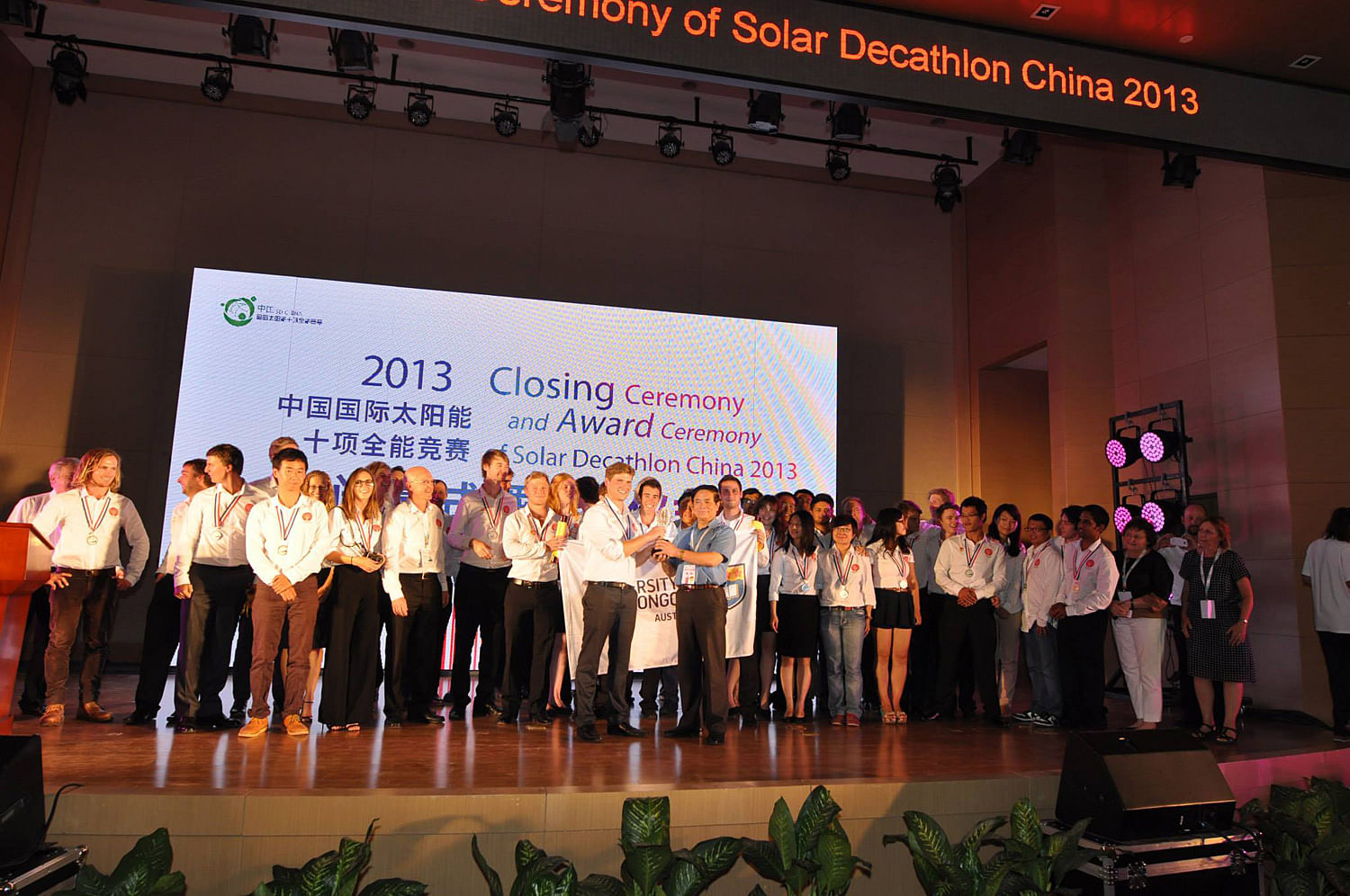
Team UOW accepting the First Prize award at the closing ceremony of 2013 SD China.

Scoring 957.6 out of a possible 1,000 points, Team UOW placed in first or second in 8 out of the 10 Contests.

Team UOW received first place in the Juried Contests of Architecture, Engineering, and Solar application. They also placed first in the Measured Contests of Energy Balance and Hot Water. They placed in second for Communications (J), Market Appeal (J), and Appliances (M).

For more details on the Illawarra Flame House, click here.

Photos and video courtesy of illawarraflame.com.au

Also, check out more of the other decathlon projects below!

Related

sustainability ● solar decathlon ● school ● event ● energy ● china ● australia

Share

  • Follow

    0 Comments

  • Comment as :

Team UOW Australia Wins 2013 Solar Decathlon China

Micro-architecture honored in latest Tiny House Architecture Competition

World’s most beautiful restaurants of 2026 chosen by Prix Versailles

Sponsored Post by Buildner

Design a wine tasting room in Italy! Valli Wine Tasting Room is launched!

10 can't-miss architecture & design events to see this June in London, Los Angeles, Chicago, San Francisco, Detroit, San Diego, Porto, and Barcelona

Sponsored Post by Buildner

Museum of Emotions / Edition #8 FINAL registration deadline is approaching!

Seven global projects make AR Public Awards shortlist 2026

Sponsored Post by Buildner

Design a slow-living restaurant in Portugal! Portugal Long Table Restaurant is launched!

World's best tall buildings honored at the CVU 2026 Award of Excellence

Sign up for Bustler's Email Newsletters

Sponsored Post by TWOPAGES

Final call: TWOPAGES X Design Contest 2026 submissions close June 5

Kengo Kuma & Paul Raff win Alberta national park visitor center competition with landscape-focused design

2026 Moira Gemmill and MJ Long prizes announced by W Awards

New architecture and design competitions: Kinderspace, Stewardson Keefe LeBrun Travel Grant, SMALL PROJECT BIG IMPACT, and Garden of University House, Bucharest

The Century of Gehry: New retrospective explores the late architect's work & collaborations

Sponsored Post by Buildner

Rome Rain Rooms FINAL registration deadline is in 5 DAYS!

UIA and UN Habitat unveil sustainability-focused winners for UIA 2030 Award

Next page » Loading

Team UOW Australia Wins 2013 Solar Decathlon China

By Bustler Editors|

Thursday, Aug 15, 2013

Share

The Illawarra Flame House

Related

sustainability ● solar decathlon ● school ● event ● energy ● china ● australia

On Aug. 11, the Illawarra Flame House of Team UOW Australia (University of Wollongong and TAFE Illawarra Institute) won the 2013 Solar Decathlon China. Co-hosted by the U.S. Department of Energy and the National Energy Administration China, the competition challenged university teams to design, build, and operate solar-powered houses that are affordable, energy-efficient, and stylish. Participants included 22 teams from 35 universities, with students of over 35 nationalities in 13 countries.

Winner of the 2013 Solar Decathlon China: Illawarra Flame House by Team UOW Australia

As described by Team UOW, they built the world-class Illawarra Flame House to inspire the Australian community to embrace innovative sustainable retrofitting technology, and to make such technologies affordable and available for all. Through retrofitting, the history and original context of the existing building is preserved. The concept was inspired by the seasonal renewal and blossoming of the native Australian Illawarra Flame tree. And quite naturally (pardon the pun), most of the materials in the house and its landscape are reclaimed and recycled, such as the hardwood and the crushed terracotta roof tiles.

This year's competition was full of firsts. It is the first time in the competition's history that an Australian team made it to the finals and won with a never-submitted-before retrofitting home. It is also the first time the Decathlon was hosted in Asia, following on the success of the U.S. and European Solar Decathlons held biennially since 2002 and 2010 respectively. (Bustler has reported on a whole bunch of them in the past.)

Team UOW acquired 957.6 out of a possible 1,000 points. The Second place prize went to the E-Concave house of Team SCUT (South China University of Technology) at 951.8 points, while the Halo house of Team Sweden (Chalmers University of Technology) won third with 948.3 points.

The competition is a decathlon because the teams compete and are judged in 10 Contests that cover all aspects of housing design: Architecture, Market appeal, Engineering, Communications, Solar application, Thermal comfort, Hot water, Appliances, Home entertainment, and Energy balance.

Scroll down to learn more about the Illawarra Flame House and to see some projects from the competition.

Throughout the preparation for 2013 SD China, Team UOW documented their journey on their website and social media.

"The Illawarra Flame project name is inspired by the Illawarra Flame Tree, which is a species native to the eastern seaboard of Australia. This tree is not only a natural icon of our region, but it also resonates with our project in many other ways, including its spectacular transformation, to a profusion of red blossom when flowering in spring, mirroring the transformation of our retrofitted house."

"The fibro home is a distinctive expression of Australian domestic architecture. These houses were built in great numbers during the post-war period to a standard design, using a minimum of materials. They are ubiquitous to the suburban streets of Australia's capitals and regional centres."

"Team UOW has retained the essential architecture of the dwelling to ensure the retrofitted building will sit comfortably in the suburban environment and be socially accessible to the market. The basic building form and architectural features are determined by the existing building, and have been retained where possible to provide an affordable and practical solution to preserving existing housing stock, while reducing the waste associated with demolition. Certain features of the house have been modified to enhance the functionality of the layout, and to increase natural lighting, solar access and cross flow ventilation, to greatly improve the liveability of the home."

Team UOW constructing the house in Datong, China.

"The Illawarra Flame House took over a year to design and was initially constructed at TAFE Illawarra's Wollongong Campus over a 12-week period. Over 40 students from the University of Wollongong and TAFE Illawarra Institute helped to design and build the Illawarra Flame House. After being dismantled it was then reassembled at the University of Wollongong's Innovation Campus and unveiled to the public."

Retrofitting diagram for the Illawarra Flame House

"Team UOW Australia has chosen to design the retrofitted house to appeal to older clients nearing retirement. Many of these people are 'empty nesters' - parents whose children have moved on, and who no longer require the floor space of a large family home. The Illawarra Flame house is perfect for these clients looking to downsize while ensuring a clean energy future for their grandchildren. Design decisions have been made according to the principle of aging-in-place, to ensure that the house can be enjoyed by the client for as long as possible."

Team UOW
Team UOW accepting the First Prize award at the closing ceremony of 2013 SD China.

Scoring 957.6 out of a possible 1,000 points, Team UOW placed in first or second in 8 out of the 10 Contests.

Team UOW received first place in the Juried Contests of Architecture, Engineering, and Solar application. They also placed first in the Measured Contests of Energy Balance and Hot Water. They placed in second for Communications (J), Market Appeal (J), and Appliances (M).

For more details on the Illawarra Flame House, click here.

Photos and video courtesy of illawarraflame.com.au

Also, check out more of the other decathlon projects below!

Share

  • Follow

    0 Comments

  • Comment as :

Archinect JobsArchinect Jobs

The Archinect Job Board attracts the world's top architectural design talents.

VIEW ALL JOBS POST A JOB

Intermediate Architect

IMC Architecture

Intermediate Architect

Brooklyn, NY, US

Interior Designer | Education & Institutional Work

Berliner Architects

Interior Designer | Education & Institutional Work

Culver City, CA, US

Designer

Jayson Architecture

Designer

San Francisco, CA, US

Job Captain

Field Architecture

Job Captain

Palo Alto, CA, US

Intermediate Residential Architect

52XConsulting

Intermediate Residential Architect

New York, NY, US

Intermediate Architect

NDKazalas Architecture PC

Intermediate Architect

New York, NY, US

Project Architect/Interior Designer

IMC Architecture

Project Architect/Interior Designer

Brooklyn, NY, US

Senior Hospitality FF&E Designer

bonetti/kozerski architecture DPC

Senior Hospitality FF&E Designer

New York, NY, US

Intermediate Designer - 3+ Years Experience (NY)

Cass Calder Smith

Intermediate Designer - 3+ Years Experience (NY)

New York, NY, US

Project Manager

Evan Raabe Architecture Studio

Project Manager

Los Angeles, CA, US

Next page » Loading