• Login / Join
  • About
  • •
  • Contact
  • •
  • Advertising
bustler logo
bustler logo
  • News
  • Competitions
  • Events
  • Bustler is powered by Archinect
  • Sign up for Bustler's Email Newsletters

  • Follow these Bustler feeds:

  • Search

    Search in

  • Submit

    What are you submitting?

    News Pitch
    Competition
    Event
  • Login / Join
  • News|Competitions|Events
  • Search
    | Submit
    | Follow
  • Search in

    What are you submitting?

    News Pitch
    Competition
    Event

    Follow these Bustler feeds:

  • About|Contact|Advertising
  • Login / Join

The Bartlett exhibiting award-winning "Innovation in Technology" projects now until Jan. 31

By Bustler Editors|

Thursday, Jan 23, 2014
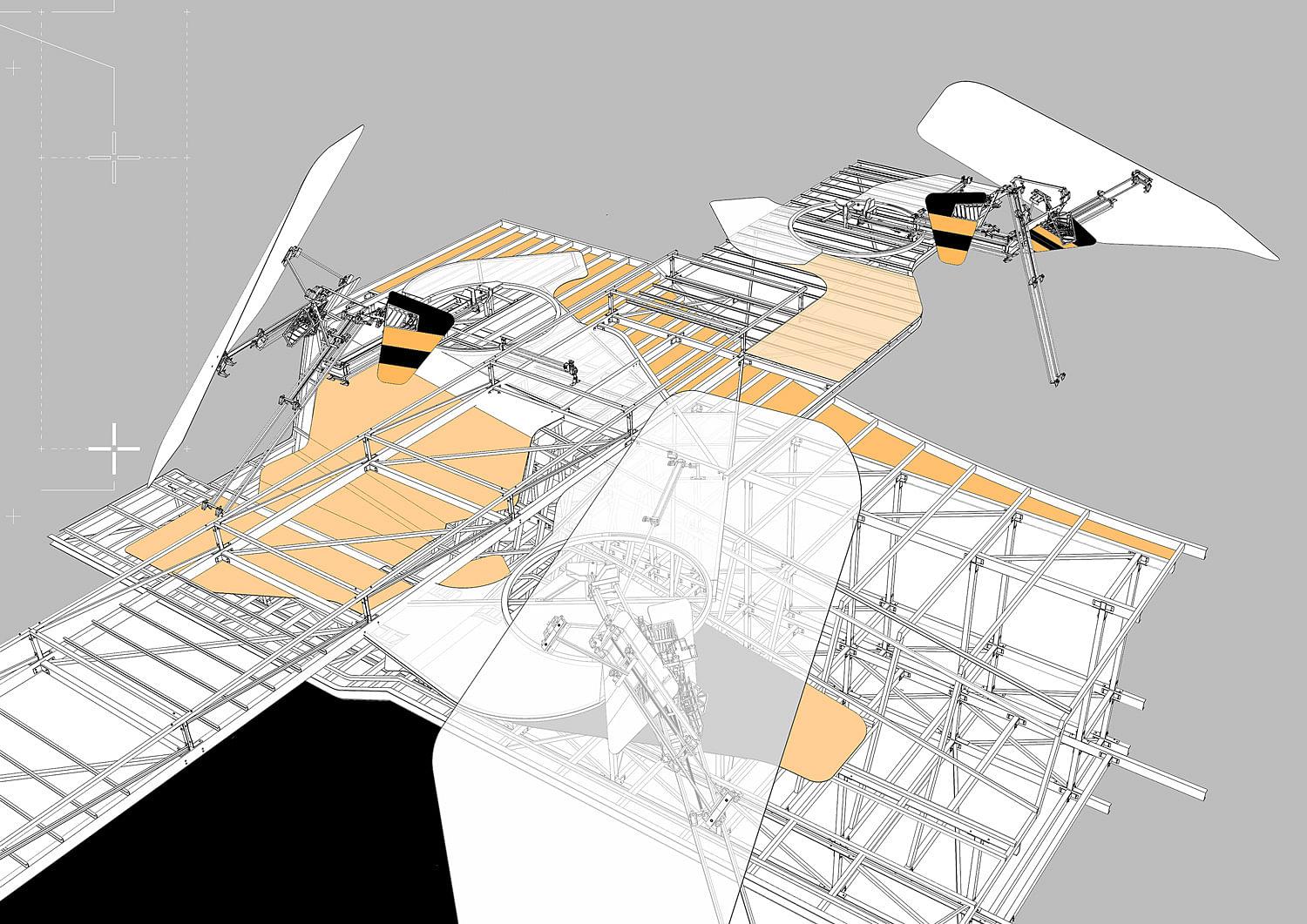
Superimposed Landscapes – Fragments of misperception by Andrew Walker. Image courtesy of The Bartlett School of Architecture

To any of our readers in the London area, you can still get a chance to stop by The Bartlett's Innovation in Technology Prizewinners' Exhibition at The Lobby Gallery now until next Friday, Jan. 31. The event is free and open to the public!

The exhibition highlights five award-winning projects all by students in The Bartlett's BSc and MArch Architecture programs. Each project includes drawings, models, and prototypes that apply and develop technological innovation in architecture.

If you can't attend the event in person, you can catch a glimpse of the featured projects below

Superimposed Landscapes – Fragments of misperception, 2013
Andrew Walker, MArch Architecture Year 4, 2013, Unit 14
Winner of the Design Realisation Prize

"A series of prototypical experiments attempt to hack into the perceptual relationship between surface and navigation. Drawing upon cybernetic concepts of feedback and the programming of ‘Finite State Machines’, these experiments utilise coding, electronics, audiovisual technology and rapid digital fabrication techniques. Through mirrors, cameras and projectors the prototypes capture a site, distort it, and reproject (overlay) the space with a warped version of itself, creating blurred visual oscillations of constructive and destructive interference patterns."

MAMM Pavilion. Image courtesy of The Bartlett School of Architecture

MAMM Pavilion, Medellín, Colombia, 2013
Unit 22, MArch Architecture, Years 4 & 5,
2013 Winner of the UCL Sir Andrew Taylor Prize

"Created on location in Colombia, MAMM Pavilion is a primary structure employing several technological and environmental design strategies to minimise land occupancy, waste, energy consumption and carbon emissions. The building is designed to adapt to the changing weather and environmental conditions of the city of Medellín and all materials and techniques used in construction would be sourced locally, including indigenous wood and guadua (Colombian bamboo). On show are a series of visualisations illustrating the project."
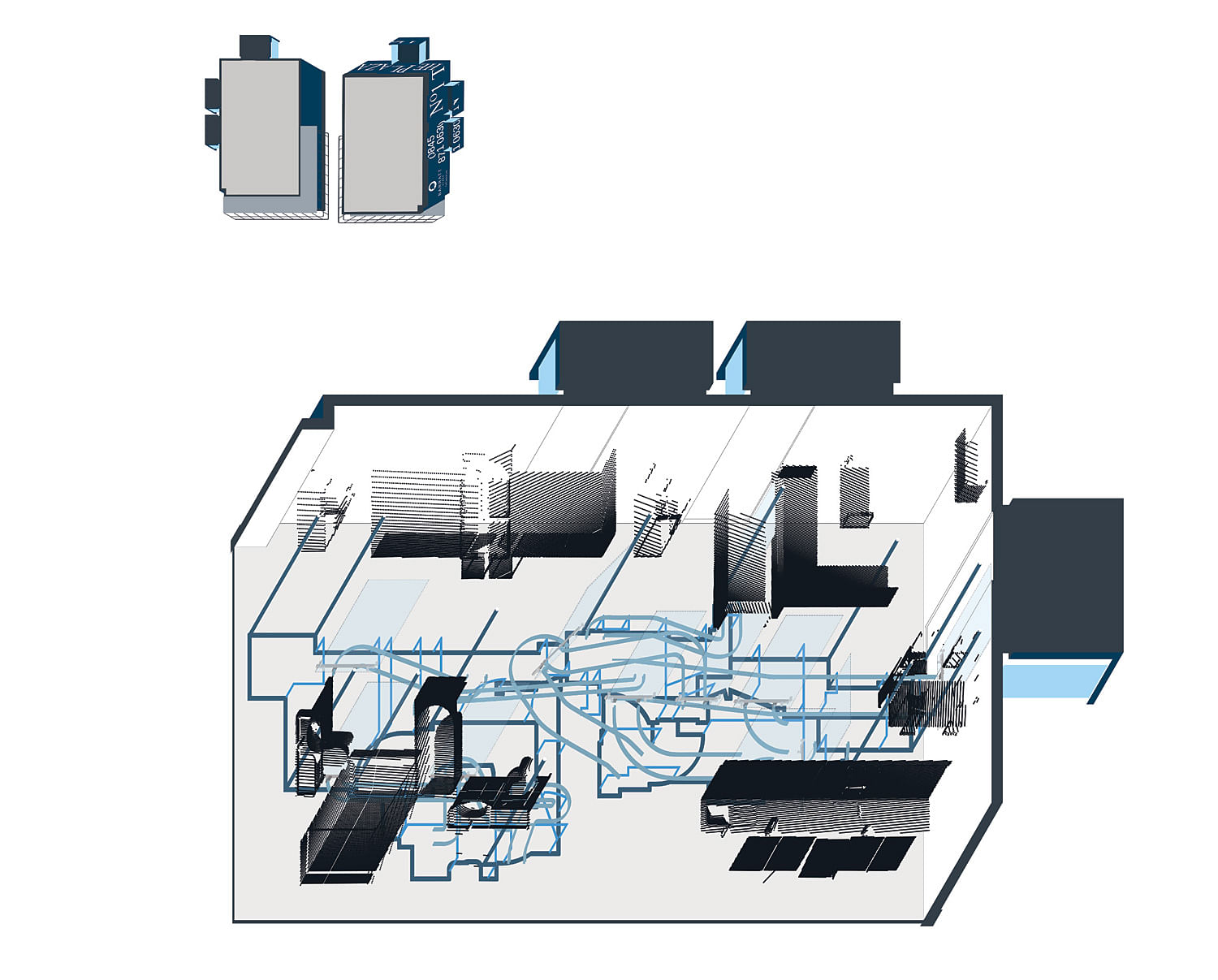
3D Lenticular Façade by Matthew Lyall. Image courtesy of The Bartlett School of Architecture

3D Lenticular Façade, 2014
Matthew Lyall, BSc Architecture, completed 2013, Unit 1
Winner of the Making Buildings Prize

"This project looks to develop the potential of 3D lenticular technology, which is often used to create ‘holograms’ on novelty items and greetings cards, on an architectural scale. The technology is imagined as a façade system that would change appearance in relation to viewer position and, as such, simulate motion parallax. A model aims to address technically how this might be achieved. It also seeks to identify with the language of objects that support images (billboards, street-signage, television sets)."
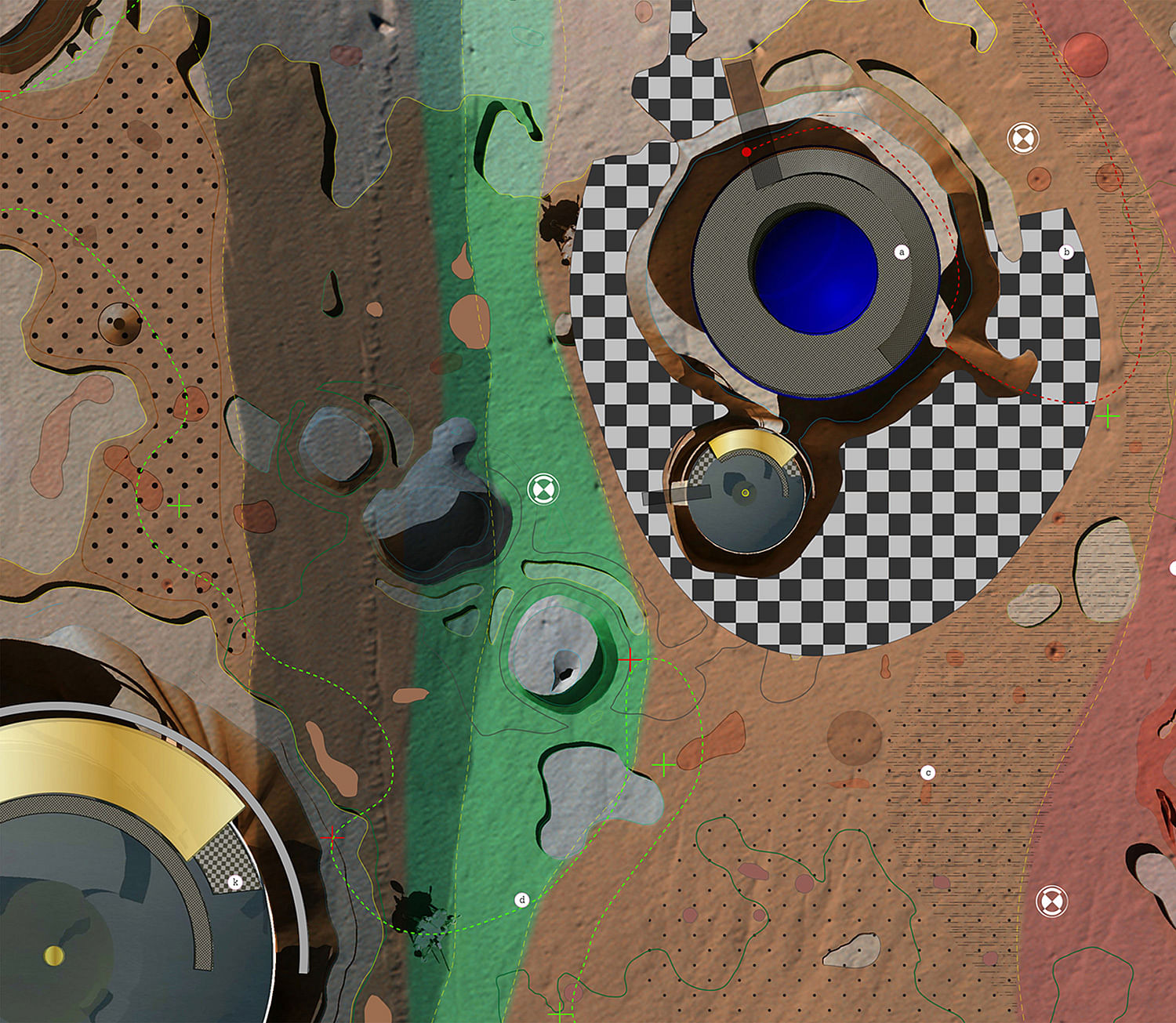
PEMY (Pre?Ecopoiesis Mars Yard) by Sonila Kadillari. Image courtesy of The Bartlett School of Architecture

PEMY (Pre‐Ecopoiesis Mars Yard), 2013 

Sonila Kadillari, MArch Architecture, completed 2013, Unit 11 
Winner of the Max Fordham Environmental Design Prize

"Through a series of drawings PEMY explores the topography, light and gravity simulations of the planet Mars in the terrestrial setting of Florida. A landscape reconstruction of Mars, PEMY uses a variety of scientific techniques to achieve the special environmental conditions of the planet. It functions as the main site for rover autonomous drive testing, temperature resistance and colour calibration, where the public can be exposed to and take part in a scientific landscape architectural instrument. 

PEMY aims to be a self-sufficient landscape instrument that generates its own electricity, using energy from a star to enable the simulation of another planet. It uses a heliostat to follow the sun and secondary reflectors that manipulate the light to simulate light and temperatures of Mars, and solar ponds located in the central voids of selected craters for back up electricity and energy supply after sunset hours.

The project is a proving ground for a new type of architecture, creating a bridge between science and public interest."
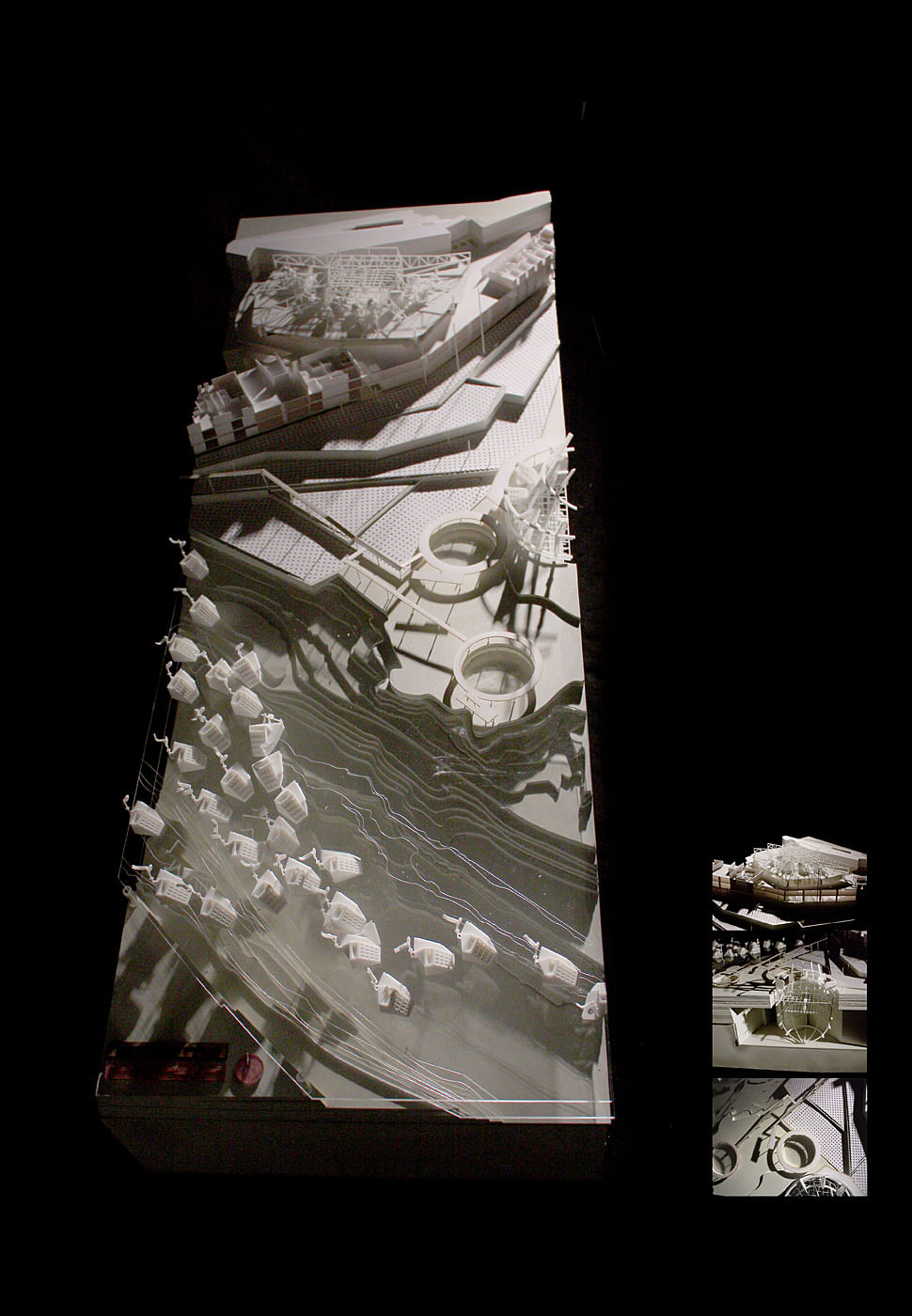
The Reward System by Yoonjin Kim. Image courtesy of The Bartlett School of Architecture

The Reward System, 2014
Yoonjin Kim, BSc Architecture, completed 2013, Unit 0
Winner of the UCL Environmental Design Prize

"This drawing project imagines a near future London shocked by the depletion of fuel energy. In response to this catastrophe the councils of London start to monetarise energy. Energy now buys you everything you need. Residents of the city earn ‘carbon tokens’ by saving energy in their homes, then exchange these for locally produced food. 

In response to this future scenario, and sited where the River Lea meets the Thames, a building is imagined as a new central hub for a London-wide agricultural cooperative. Members of the cooperative bring their produce to a weekly floating market, come to charge up batteries and collect free power in exchange for ‘carbon mileage’ earned by minimising the carbon footprint in their daily lives."

More details on the exhibition:

"Critical examination of technology and environmental sustainability is central to The Bartlett School of Architecture’s philosophical ethos and pedagogic agenda. Within the context of imaginative, speculative and visionary designs, technology subjects are explored in the broadest terms whilst they are supported by real and theoretical issues. 

Bob Sheil, Professor of Architecture and Design through Production and new Director of the School of Architecture, explains:  'We believe that the issues should be explored philosophically, socially, culturally and politically, and fully integrated into design practice. This holistic ethos can be seen throughout the teaching structure of the school, where technology is fully integrated with design from concept to proposition, and both are explored as experimental and polemic subjects.'"

Images courtesy of The Bartlett School of Architecture.

Related

technology ● sustainability ● student work ● school ● prizewinners ● london ● innovation ● exhibition ● europe ● environmental ● bartlett ● the bartlett ● united kingdom

Share

  • Follow

    0 Comments

  • Comment as :

The Bartlett exhibiting award-winning "Innovation in Technology" projects now until Jan. 31

Over $500,000 awarded to architectural discourse projects by Graham Foundation

Best in urban planning recognized at AIA Regional & Urban Design Award 2026

Sponsored Post by Buildner

Re:Form - New Life for Old Spaces / Edition #3 advance registration deadline is approaching!

New architecture and design competitions: IDEAS Awards, UIA-HYP CUP International Student Competition, Vancouver Tall Challenge, and Memorial to the Sixth Extinction

Best small projects chosen at AIA Small Project Award 2026

10 standout sustainable projects honored at AIA COTE Top Ten Award 2026

Best residential architecture of 2026 honored at AIA Housing Award

Best new interiors of 2026 chosen at AIA Interior Architecture Awards

Sign up for Bustler's Email Newsletters

Best global architecture honored at RIBA International Awards 2026

World’s most beautiful airports of 2026 chosen by Prix Versailles

New architecture and design competitions: Brick in Architecture Awards, Study Architecture Student Showcase, N.Y.C. Groceries, and New York High Falls Riverfront Market

SmithGroup’s ‘pioneering’ Philip Merrill Environmental Center wins AIA Twenty-five Year Award

Sponsored Post by Buildner

Museum of Emotions / Edition #8 FINAL registration deadline is in 5 DAYS!

Here are the winners of the 2026 AIA Architecture Awards

40 emerging architects and designers under 40 from Europe honored

Next page » Loading

The Bartlett exhibiting award-winning "Innovation in Technology" projects now until Jan. 31

By Bustler Editors|

Thursday, Jan 23, 2014

Share

Superimposed Landscapes – Fragments of misperception by Andrew Walker. Image courtesy of The Bartlett School of Architecture

Related

technology ● sustainability ● student work ● school ● prizewinners ● london ● innovation ● exhibition ● europe ● environmental ● bartlett ● the bartlett ● united kingdom

To any of our readers in the London area, you can still get a chance to stop by The Bartlett's Innovation in Technology Prizewinners' Exhibition at The Lobby Gallery now until next Friday, Jan. 31. The event is free and open to the public!

The exhibition highlights five award-winning projects all by students in The Bartlett's BSc and MArch Architecture programs. Each project includes drawings, models, and prototypes that apply and develop technological innovation in architecture.

If you can't attend the event in person, you can catch a glimpse of the featured projects below

Superimposed Landscapes – Fragments of misperception, 2013
Andrew Walker, MArch Architecture Year 4, 2013, Unit 14
Winner of the Design Realisation Prize

"A series of prototypical experiments attempt to hack into the perceptual relationship between surface and navigation. Drawing upon cybernetic concepts of feedback and the programming of ‘Finite State Machines’, these experiments utilise coding, electronics, audiovisual technology and rapid digital fabrication techniques. Through mirrors, cameras and projectors the prototypes capture a site, distort it, and reproject (overlay) the space with a warped version of itself, creating blurred visual oscillations of constructive and destructive interference patterns."

MAMM Pavilion. Image courtesy of The Bartlett School of Architecture

MAMM Pavilion, Medellín, Colombia, 2013
Unit 22, MArch Architecture, Years 4 & 5,
2013 Winner of the UCL Sir Andrew Taylor Prize

"Created on location in Colombia, MAMM Pavilion is a primary structure employing several technological and environmental design strategies to minimise land occupancy, waste, energy consumption and carbon emissions. The building is designed to adapt to the changing weather and environmental conditions of the city of Medellín and all materials and techniques used in construction would be sourced locally, including indigenous wood and guadua (Colombian bamboo). On show are a series of visualisations illustrating the project."

3D Lenticular Façade by Matthew Lyall. Image courtesy of The Bartlett School of Architecture

3D Lenticular Façade, 2014
Matthew Lyall, BSc Architecture, completed 2013, Unit 1
Winner of the Making Buildings Prize

"This project looks to develop the potential of 3D lenticular technology, which is often used to create ‘holograms’ on novelty items and greetings cards, on an architectural scale. The technology is imagined as a façade system that would change appearance in relation to viewer position and, as such, simulate motion parallax. A model aims to address technically how this might be achieved. It also seeks to identify with the language of objects that support images (billboards, street-signage, television sets)."

PEMY (Pre?Ecopoiesis Mars Yard) by Sonila Kadillari. Image courtesy of The Bartlett School of Architecture

PEMY (Pre‐Ecopoiesis Mars Yard), 2013 

Sonila Kadillari, MArch Architecture, completed 2013, Unit 11 
Winner of the Max Fordham Environmental Design Prize

"Through a series of drawings PEMY explores the topography, light and gravity simulations of the planet Mars in the terrestrial setting of Florida. A landscape reconstruction of Mars, PEMY uses a variety of scientific techniques to achieve the special environmental conditions of the planet. It functions as the main site for rover autonomous drive testing, temperature resistance and colour calibration, where the public can be exposed to and take part in a scientific landscape architectural instrument. 

PEMY aims to be a self-sufficient landscape instrument that generates its own electricity, using energy from a star to enable the simulation of another planet. It uses a heliostat to follow the sun and secondary reflectors that manipulate the light to simulate light and temperatures of Mars, and solar ponds located in the central voids of selected craters for back up electricity and energy supply after sunset hours.

The project is a proving ground for a new type of architecture, creating a bridge between science and public interest."

The Reward System by Yoonjin Kim. Image courtesy of The Bartlett School of Architecture

The Reward System, 2014
Yoonjin Kim, BSc Architecture, completed 2013, Unit 0
Winner of the UCL Environmental Design Prize

"This drawing project imagines a near future London shocked by the depletion of fuel energy. In response to this catastrophe the councils of London start to monetarise energy. Energy now buys you everything you need. Residents of the city earn ‘carbon tokens’ by saving energy in their homes, then exchange these for locally produced food. 

In response to this future scenario, and sited where the River Lea meets the Thames, a building is imagined as a new central hub for a London-wide agricultural cooperative. Members of the cooperative bring their produce to a weekly floating market, come to charge up batteries and collect free power in exchange for ‘carbon mileage’ earned by minimising the carbon footprint in their daily lives."

More details on the exhibition:

"Critical examination of technology and environmental sustainability is central to The Bartlett School of Architecture’s philosophical ethos and pedagogic agenda. Within the context of imaginative, speculative and visionary designs, technology subjects are explored in the broadest terms whilst they are supported by real and theoretical issues. 

Bob Sheil, Professor of Architecture and Design through Production and new Director of the School of Architecture, explains:  'We believe that the issues should be explored philosophically, socially, culturally and politically, and fully integrated into design practice. This holistic ethos can be seen throughout the teaching structure of the school, where technology is fully integrated with design from concept to proposition, and both are explored as experimental and polemic subjects.'"

Images courtesy of The Bartlett School of Architecture.

Share

  • Follow

    0 Comments

  • Comment as :

Archinect JobsArchinect Jobs

The Archinect Job Board attracts the world's top architectural design talents.

VIEW ALL JOBS POST A JOB

Marketing + Communications Specialist

Trahan Architects

Marketing + Communications Specialist

New York, NY, US

Intermediate Architect

O'Neill Rose Architects

Intermediate Architect

Brooklyn, NY, US

Senior Landscape Designer

Surfacedesign, Inc.

Senior Landscape Designer

San Francisco, CA, US

Interior Architect / Interior Designer

Annum Architects (formerly Ann Beha Architects)

Interior Architect / Interior Designer

Boston, MA, US

Studio Coordinator

Sarah Jacoby Architect

Studio Coordinator

Long Island City, NY, US

Architectural/Structural Drafter

New Beginnings Engineering

Architectural/Structural Drafter

Irvine, CA, US

Project Manager

The Brooklyn Studio

Project Manager

Brooklyn, NY, US

Architect

OBRA Architects

Architect

New York, NY, US

Job Captain / Designer

Heather Young Architects

Job Captain / Designer

Palo Alto, CA, US

Architect / Architectural Designer (3-5 years experience)

Resolution: 4 Architecture

Architect / Architectural Designer (3-5 years experience)

New York, NY, US

Next page » Loading