• Login / Join
  • About
  • •
  • Contact
  • •
  • Advertising
bustler logo
bustler logo
  • News
  • Competitions
  • Events
  • Bustler is powered by Archinect
  • Sign up for Bustler's Email Newsletters

  • Follow these Bustler feeds:

  • Search

    Search in

  • Submit

    What are you submitting?

    News Pitch
    Competition
    Event
  • Login / Join
  • News|Competitions|Events
  • Search
    | Submit
    | Follow
  • Search in

    What are you submitting?

    News Pitch
    Competition
    Event

    Follow these Bustler feeds:

  • About|Contact|Advertising
  • Login / Join

Wiel Arets Architects to design 'Am Hirschgarten' cluster in Munich

By Bustler Editors|

Monday, Mar 16, 2015
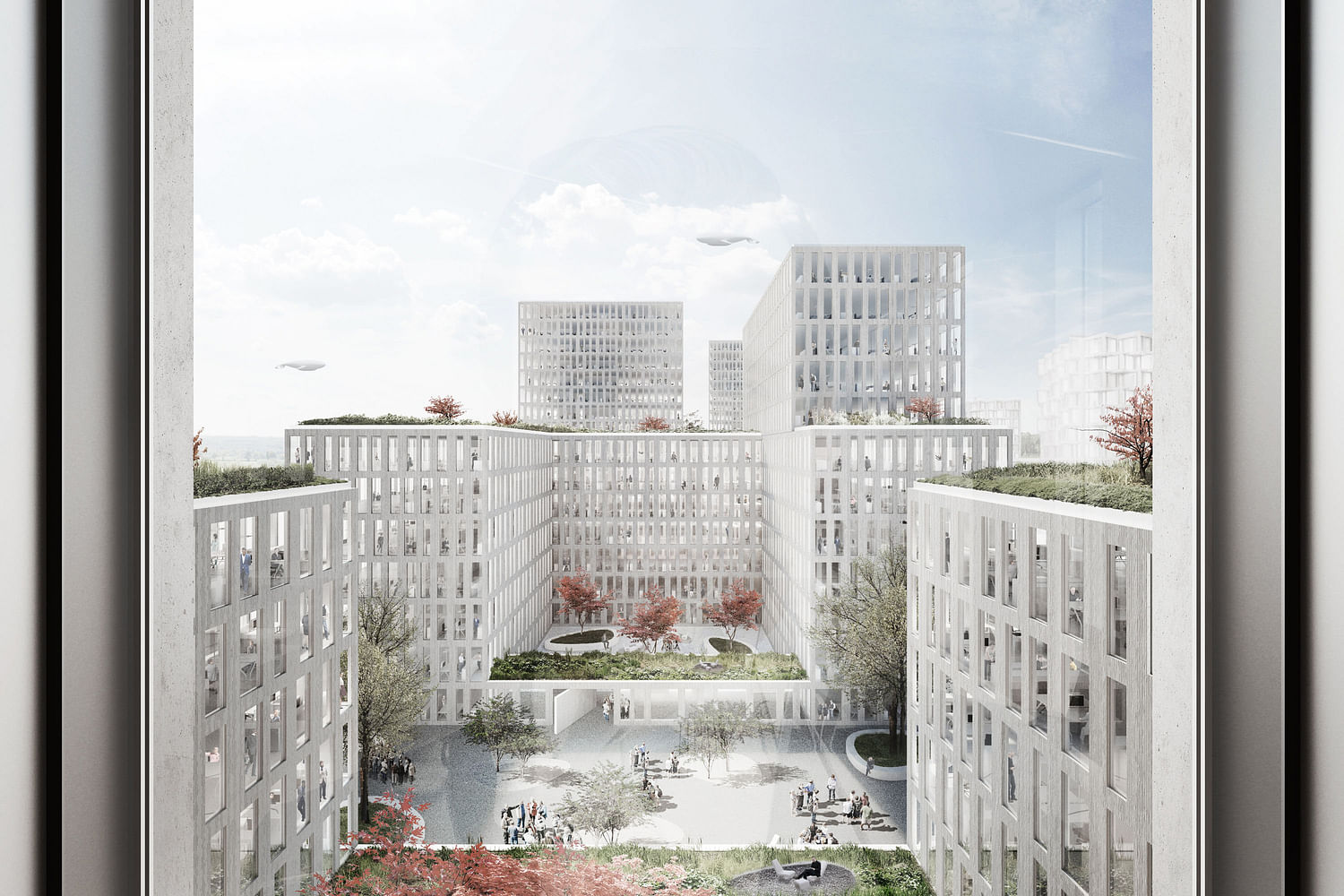
Image © Wiel Arets Architects.

Wiel Arets Architects announced today that they are the competition winners to design the Am Hirschgarten, a new campus-like cluster of four horseshoe-shaped buildings in Munich, Germany.

Rendered in WAA's signature style of sleek, window-clad facades, the project required economical, flexible, and of course, sustainable buildings that can accommodate possible program conversions in the future.

Check it out below.

Project description:

"Located on the western edge of Munich, near the Friedenheimer bridge, and adjacent to the light-rail lines that string throughout the city’s center, ‘Am Hirschgarten’ is a campus-like cluster of four buildings, each of which entails a tower, which rises from the base of every building’s plinth. The project’s urban planning requirements mandated economical, sustainable, and flexible buildings, whose programming could also accommodate a future conversion–for instance–into residential spaces. ‘Am Hirschgarten’ therefore constitutes four horseshoe-shaped buildings, each with a plinth of six to seven stories."
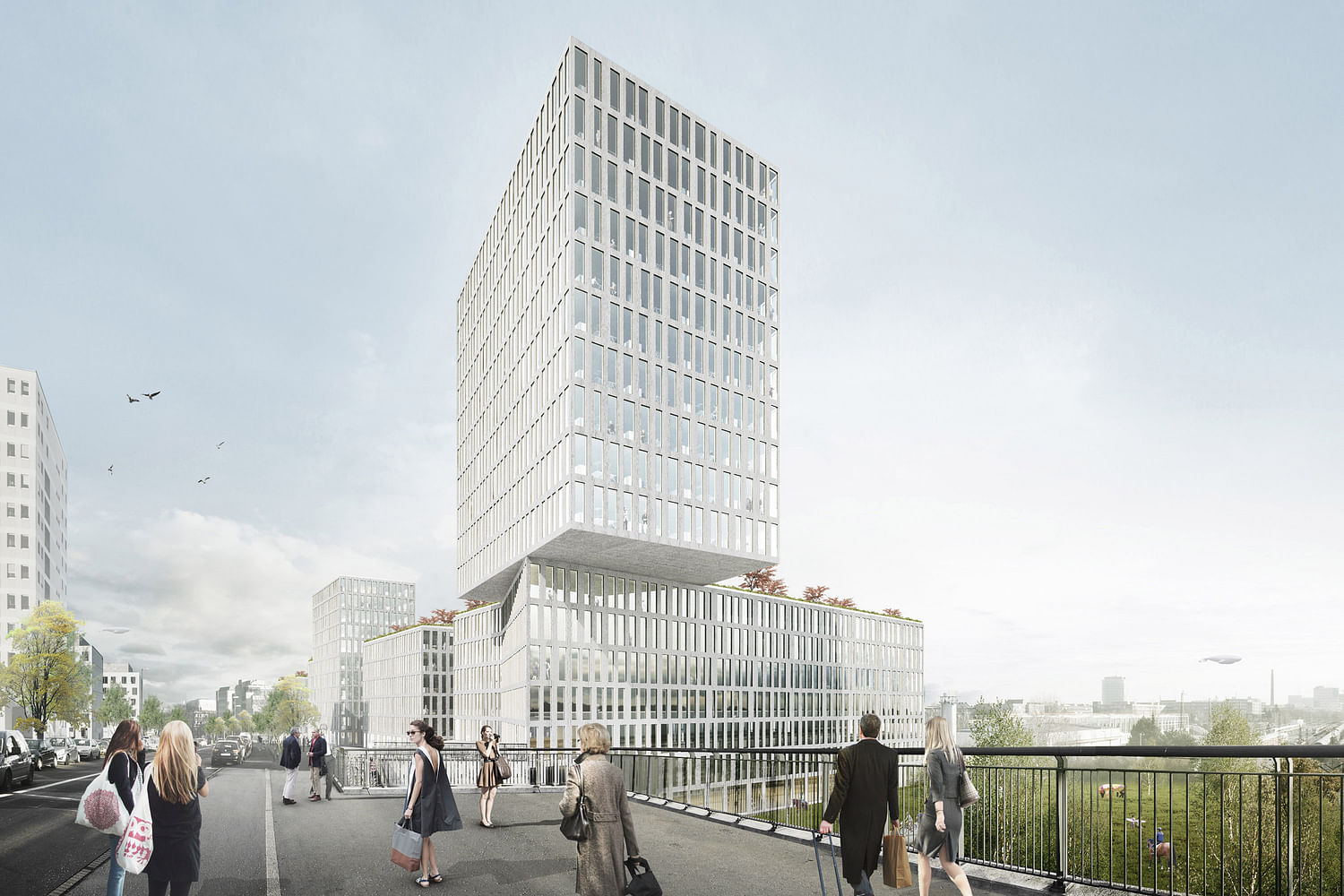
Image © Wiel Arets Architects.

"A tower rises from each plinth–the pinnacle of which is 17-stories; it prominently cantilevers from its plinth, which creates a landmark within the project. Only steps away from the ‘Hirschgarten’ station along the city’s light-rail lines, and just a few hundred meters from multiple stops along the city’s tram lines, this campus-like cluster of four buildings is able to be swiftly accessed, throughout the entire city."
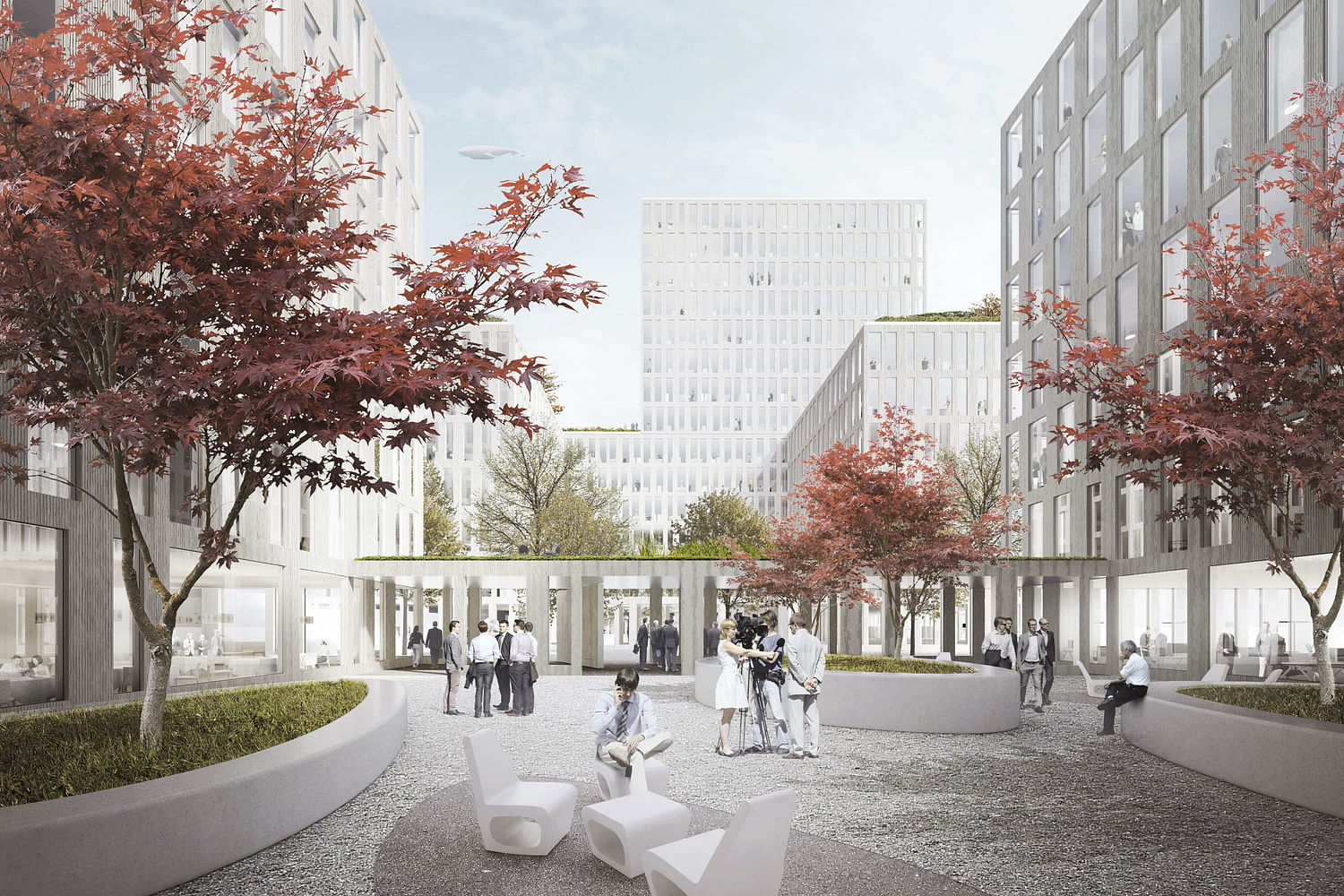
Image © Wiel Arets Architects.

"The courtyard of each building is offset from surrounding public space by a single story pergola; these pergolas are a buffer zone between public and semi-public exterior areas. Each is entered through a massive gate, which autonomously pivots open in accordance with office hours, for added security. Each building has a depth of around 18 m; this creates interior flexibility, and enables the office workspaces to be awash with abundant daylight. All entrances are oriented toward public roads; this maintains a semi-bucolic character in the spaces between these four buildings, and encourages pedestrian interaction.

Public programmatic spaces are located at ground level, which is also the location of the proposed hotel’s entrance. Where retail is absent, office space occupies; it can be scaled to expand or contract, in order to create individual offices, combined offices, or open offices–made possible by the 18 m depth of each building. The flexible interior spaces, and the compact cores, together with the meticulous placement of all glazing, holistically contribute to the project’s energy efficiency." 
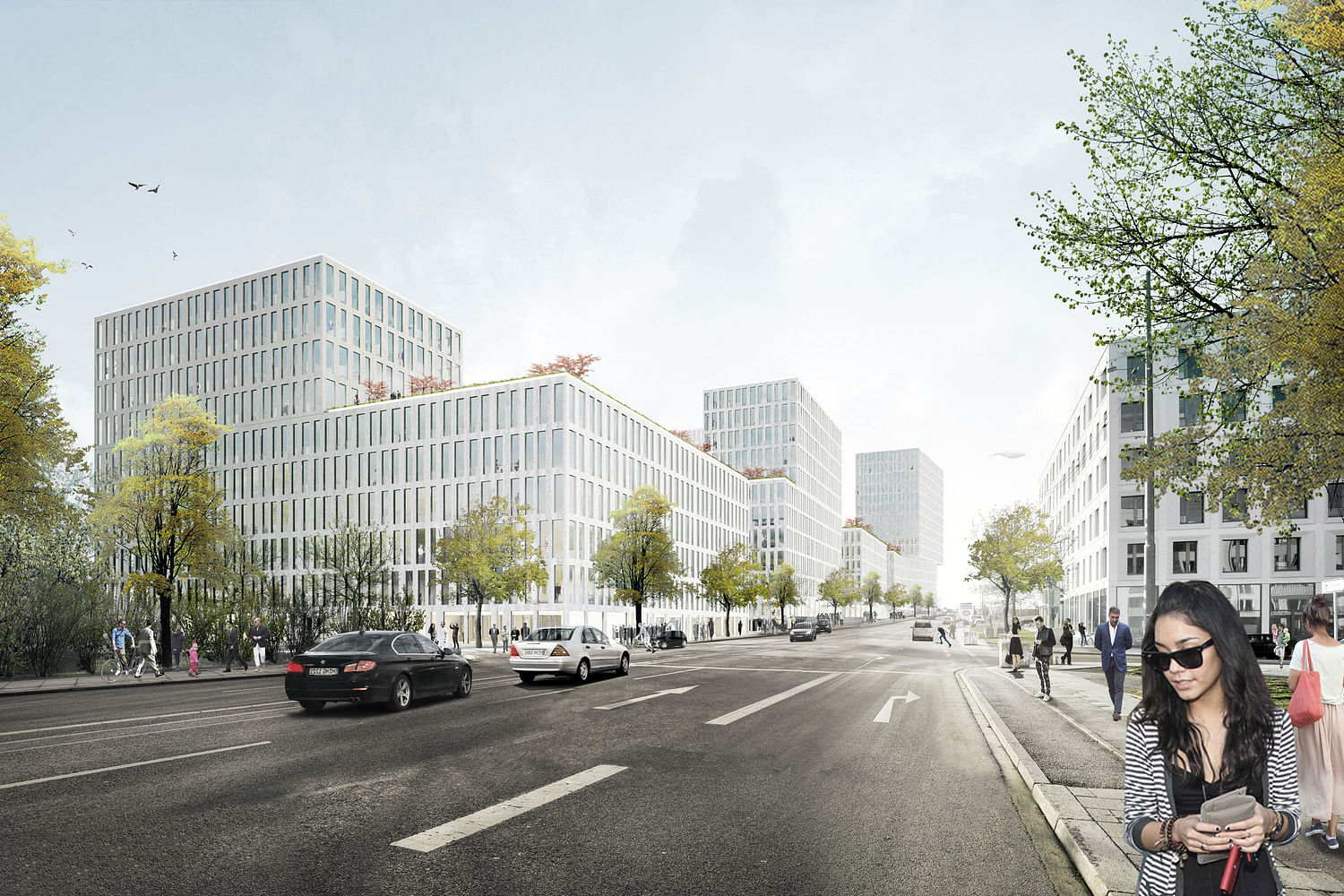
Image © Wiel Arets Architects.

"All of the parking garages are submerged, and two of the four buildings are connected underground via one of these garages, which increase the access, and sharing of utilities, between these four buildings. The project’s façade is to be comprised of concrete panels, with an ornamental surface-texture relief, which is anticipated to allow the entire project to subtly mirror the tactile qualities of its immediate environment.

Various sized floor-to-ceiling windows, some of which are operable, and some of which are fixed, further contribute to the high degree of interior flexibility. Glazing occupies half of the façade surface area, protected from solar gain by a computer-controlled algorithm, which can also be overridden by office employees, for added comfort. From the office interiors, inhabitants either look outward to Munich, or inward toward the semi-private courtyards–a view that entails overlooking multiple lusciously sprawling gardens, which will take root atop the roof of each plinth."
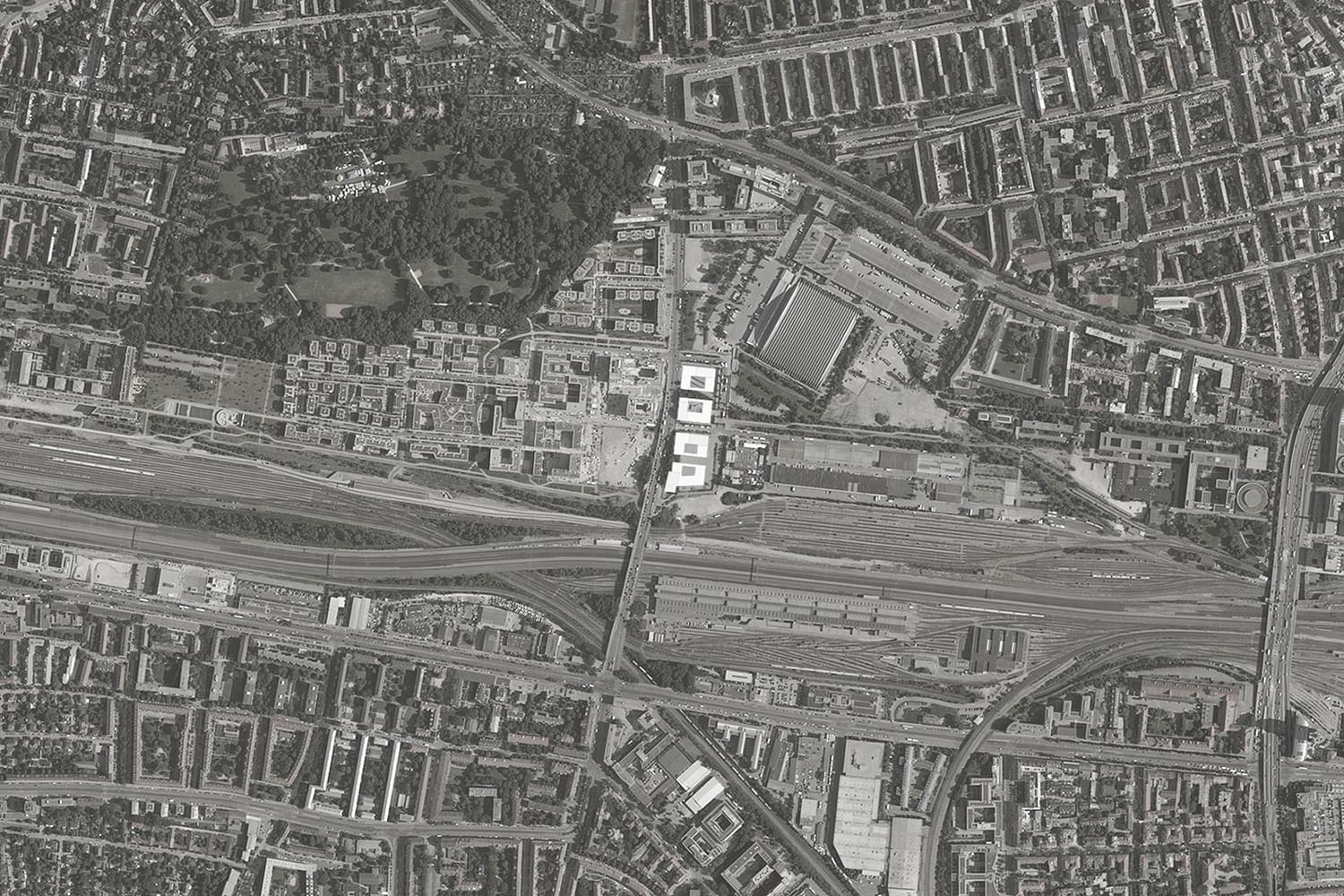
Site plan. Image © Wiel Arets Architects.

Project details

Location: Munich, Germany
Program: Office, Hotel, Retail
Size: 68.300 m2
Date of design: 2014-2015
Project team: Wiel Arets, Jelle Homburg, Moritz Theden, Eleni Papadaki, Amelia Perea Almenar
Collaborators: Jochem Homminga, Stephanie Poole, Marcos Romero
Clients: Aurelis Real Estate GmbH & Co. KG, OFB Projektentwicklung GmbH
Consultants: OKRA Landschapsarchitecten BV, Amstein + Walthert AG, JägerPartner AG SIA/USIC, Kersken + Kirchner GmbH, Frank Brühmann, Yoshi Nagamine

All images courtesy of Wiel Arets Architects.

For more of Wiel Arets Architects' projects on Bustler, click here.

Related

wiel arets architects ● wiel arets ● munich ● mixed use ● germany ● cluster ● campus

Share

  • Follow

    0 Comments

  • Comment as :

Wiel Arets Architects to design 'Am Hirschgarten' cluster in Munich

New architecture and design competitions: IDEAS Awards, UIA-HYP CUP International Student Competition, Vancouver Tall Challenge, and Memorial to the Sixth Extinction

Best small projects chosen at AIA Small Project Award 2026

10 standout sustainable projects honored at AIA COTE Top Ten Award 2026

Best residential architecture of 2026 honored at AIA Housing Award

Best new interiors of 2026 chosen at AIA Interior Architecture Awards

Best global architecture honored at RIBA International Awards 2026

World’s most beautiful airports of 2026 chosen by Prix Versailles

New architecture and design competitions: Brick in Architecture Awards, Study Architecture Student Showcase, N.Y.C. Groceries, and New York High Falls Riverfront Market

Sign up for Bustler's Email Newsletters

SmithGroup’s ‘pioneering’ Philip Merrill Environmental Center wins AIA Twenty-five Year Award

Sponsored Post by Buildner

Museum of Emotions / Edition #8 FINAL registration deadline is in 5 DAYS!

Here are the winners of the 2026 AIA Architecture Awards

40 emerging architects and designers under 40 from Europe honored

Northwestern University selects 12-firm longlist to design new engineering building

New architecture and design competitions: Exploring 130 Years of American Design, Christo & Jeanne-Claude Center, 13 White Houses, and La Pyramide

Micro-architecture honored in latest Tiny House Architecture Competition

Next page » Loading

Wiel Arets Architects to design 'Am Hirschgarten' cluster in Munich

By Bustler Editors|

Monday, Mar 16, 2015

Share

Image © Wiel Arets Architects.

Related

wiel arets architects ● wiel arets ● munich ● mixed use ● germany ● cluster ● campus

Wiel Arets Architects announced today that they are the competition winners to design the Am Hirschgarten, a new campus-like cluster of four horseshoe-shaped buildings in Munich, Germany.

Rendered in WAA's signature style of sleek, window-clad facades, the project required economical, flexible, and of course, sustainable buildings that can accommodate possible program conversions in the future.

Check it out below.

Project description:

"Located on the western edge of Munich, near the Friedenheimer bridge, and adjacent to the light-rail lines that string throughout the city’s center, ‘Am Hirschgarten’ is a campus-like cluster of four buildings, each of which entails a tower, which rises from the base of every building’s plinth. The project’s urban planning requirements mandated economical, sustainable, and flexible buildings, whose programming could also accommodate a future conversion–for instance–into residential spaces. ‘Am Hirschgarten’ therefore constitutes four horseshoe-shaped buildings, each with a plinth of six to seven stories."

Image © Wiel Arets Architects.

"A tower rises from each plinth–the pinnacle of which is 17-stories; it prominently cantilevers from its plinth, which creates a landmark within the project. Only steps away from the ‘Hirschgarten’ station along the city’s light-rail lines, and just a few hundred meters from multiple stops along the city’s tram lines, this campus-like cluster of four buildings is able to be swiftly accessed, throughout the entire city."

Image © Wiel Arets Architects.

"The courtyard of each building is offset from surrounding public space by a single story pergola; these pergolas are a buffer zone between public and semi-public exterior areas. Each is entered through a massive gate, which autonomously pivots open in accordance with office hours, for added security. Each building has a depth of around 18 m; this creates interior flexibility, and enables the office workspaces to be awash with abundant daylight. All entrances are oriented toward public roads; this maintains a semi-bucolic character in the spaces between these four buildings, and encourages pedestrian interaction.

Public programmatic spaces are located at ground level, which is also the location of the proposed hotel’s entrance. Where retail is absent, office space occupies; it can be scaled to expand or contract, in order to create individual offices, combined offices, or open offices–made possible by the 18 m depth of each building. The flexible interior spaces, and the compact cores, together with the meticulous placement of all glazing, holistically contribute to the project’s energy efficiency." 

Image © Wiel Arets Architects.

"All of the parking garages are submerged, and two of the four buildings are connected underground via one of these garages, which increase the access, and sharing of utilities, between these four buildings. The project’s façade is to be comprised of concrete panels, with an ornamental surface-texture relief, which is anticipated to allow the entire project to subtly mirror the tactile qualities of its immediate environment.

Various sized floor-to-ceiling windows, some of which are operable, and some of which are fixed, further contribute to the high degree of interior flexibility. Glazing occupies half of the façade surface area, protected from solar gain by a computer-controlled algorithm, which can also be overridden by office employees, for added comfort. From the office interiors, inhabitants either look outward to Munich, or inward toward the semi-private courtyards–a view that entails overlooking multiple lusciously sprawling gardens, which will take root atop the roof of each plinth."

Site plan. Image © Wiel Arets Architects.

Project details

Location: Munich, Germany
Program: Office, Hotel, Retail
Size: 68.300 m2
Date of design: 2014-2015
Project team: Wiel Arets, Jelle Homburg, Moritz Theden, Eleni Papadaki, Amelia Perea Almenar
Collaborators: Jochem Homminga, Stephanie Poole, Marcos Romero
Clients: Aurelis Real Estate GmbH & Co. KG, OFB Projektentwicklung GmbH
Consultants: OKRA Landschapsarchitecten BV, Amstein + Walthert AG, JägerPartner AG SIA/USIC, Kersken + Kirchner GmbH, Frank Brühmann, Yoshi Nagamine

All images courtesy of Wiel Arets Architects.

For more of Wiel Arets Architects' projects on Bustler, click here.

Share

  • Follow

    0 Comments

  • Comment as :

Archinect JobsArchinect Jobs

The Archinect Job Board attracts the world's top architectural design talents.

VIEW ALL JOBS POST A JOB

Marketing and Architectural Assistant

AGENCIE / Architecture & Engineering

Marketing and Architectural Assistant

New York, NY, US

Marketing + Communications Specialist

Trahan Architects

Marketing + Communications Specialist

New York, NY, US

Design Director or Sr. Architect

b.hills architecture, P.C.

Design Director or Sr. Architect

Boise, ID, US

Project Captain

Practice (formerly GGA+)

Project Captain

Pasadena, CA, US

Project Manager

Populous

Project Manager

San Francisco, CA, US

Landscape Architect

EDR - Environmental Design & Research

Landscape Architect

Syracuse, NY, US

Interior Designer - Intermediate Level (3-7 Years)

Yazdani Studio of Cannon Design

Interior Designer - Intermediate Level (3-7 Years)

Los Angeles, CA, US

Architect / Architectural Designer (3-5 years experience)

Resolution: 4 Architecture

Architect / Architectural Designer (3-5 years experience)

New York, NY, US

Intermediate Architect

GF55 Architects

Intermediate Architect

New York, NY, US

Architect

KieranTimberlake

Architect

Philadelphia, PA, US

Next page » Loading