• Login / Join
  • About
  • •
  • Contact
  • •
  • Advertising
bustler logo
bustler logo
  • News
  • Competitions
  • Events
  • Bustler is powered by Archinect
  • Sign up for Bustler's Email Newsletters

  • Follow these Bustler feeds:

  • Search

    Search in

  • Submit

    What are you submitting?

    News Pitch
    Competition
    Event
  • Login / Join
  • News|Competitions|Events
  • Search
    | Submit
    | Follow
  • Search in

    What are you submitting?

    News Pitch
    Competition
    Event

    Follow these Bustler feeds:

  • About|Contact|Advertising
  • Login / Join

Sasaki Associates, Variable Projects, and WRT among 2015 AIA Small Project Awardees

By Bustler Editors|

Thursday, Jun 11, 2015
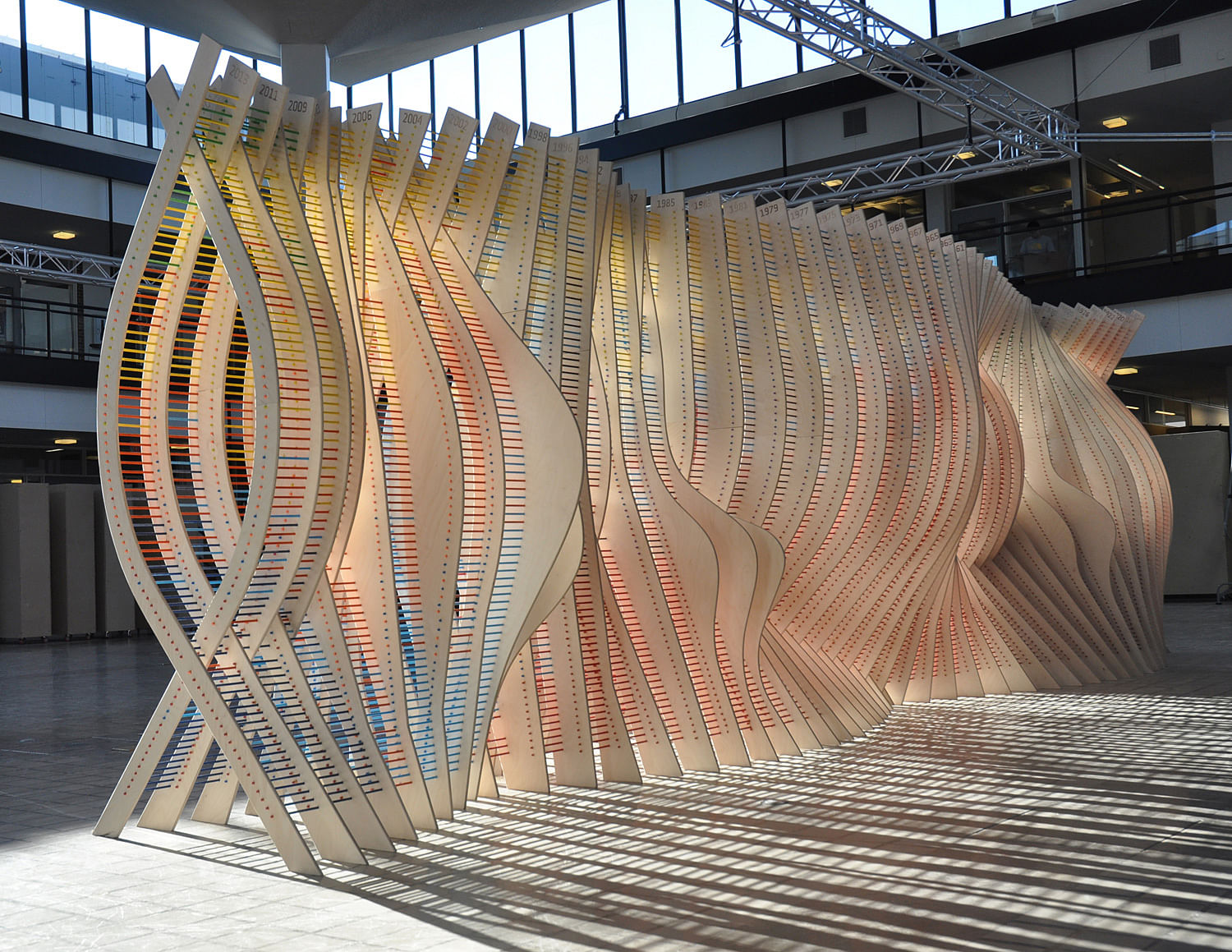
Centennial Chromagraph, University of Minnesota School of Architecture; Minneapolis by Variable Projects. Photo © Adam Marcus

The AIA Small Project Awards program is back for its 12th year. As a means to promote design excellence regardless the limits of size and scope, the program recognizes small-project practitioners around the U.S. for their distinguishable high quality of their work.

For 2015, seven projects scooped up awards in three small-project categories.

In previous editions, winners include the Nexus House by Johnsen Schmaling Architects; the Saint Nicholas Antiochian Orthodox Christian Church by Marlon Blackwell Architect; and SPACEFLAVOR'S Mobile Dwelling Cube.

Check out the 2015 winners right below.

CATEGORY 1 - small project construction, object, work of environmental art or architectural design element up to $150,000 in construction cost.

Centennial Chromagraph, University of Minnesota School of Architecture; Minneapolis
by Variable Projects

"As an experiment in data spatialization, the project’s aesthetic effects—its curvature and its coloration—are in many ways a direct product of the historical data that was employed within the design process. The final construction, however, transcends these quantitative origins and takes on a dynamic presence within the school’s existing courtyard space. One of the most exciting and unexpected effects of the structure is its changing appearance in different conditions of light and shadow. Most dramatic is its behavior in the late afternoon sunlight that filters down through the clerestory in the courtyard space, producing intense shadows and reflections of the colored pencils between the ribs. The project’s careful calibration of quantitative data, materiality, and spatial effect allows it to take on multiple readings at multiple scales. This perceptual multiplicity has added a richness and element of surprise to the spatial experience of Rapson Hall’s courtyard."
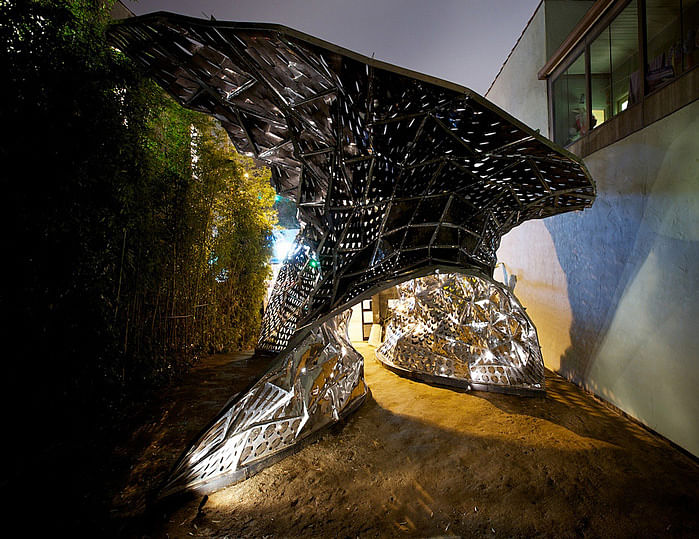
Bloom; Los Angeles - USC School of Architecture. Photo © Brandon Shigeta; Derek Greene; Doris Sung

Bloom; Los Angeles
by USC School of Architecture

"As a pavilion, this project's function is to provide comfortable, shaded space using a new building material. Using sheet thermobimetal, an inexpensive 'smart' material that automatically curls when heated, building skins can self-ventilate and sun-shade, while reducing its dependency on mechanical air conditioning as well as indirectly decreasing a city’s 'heat island' effect. When heated by the sun or air temperature, the surface, a lamination of two alloys of metal with different coefficients of expansion, curls. When cooled, the surface tiles return to their original flat state. With today’s digital technology and driving interest in sustainable design, this simple material can transcend its currently limited role as a small mechanical actuating device to a dynamic building surface material, while expanding the discourse of performative architecture."

CATEGORY 2 - A small project construction, up to $1,500,000 in construction cost
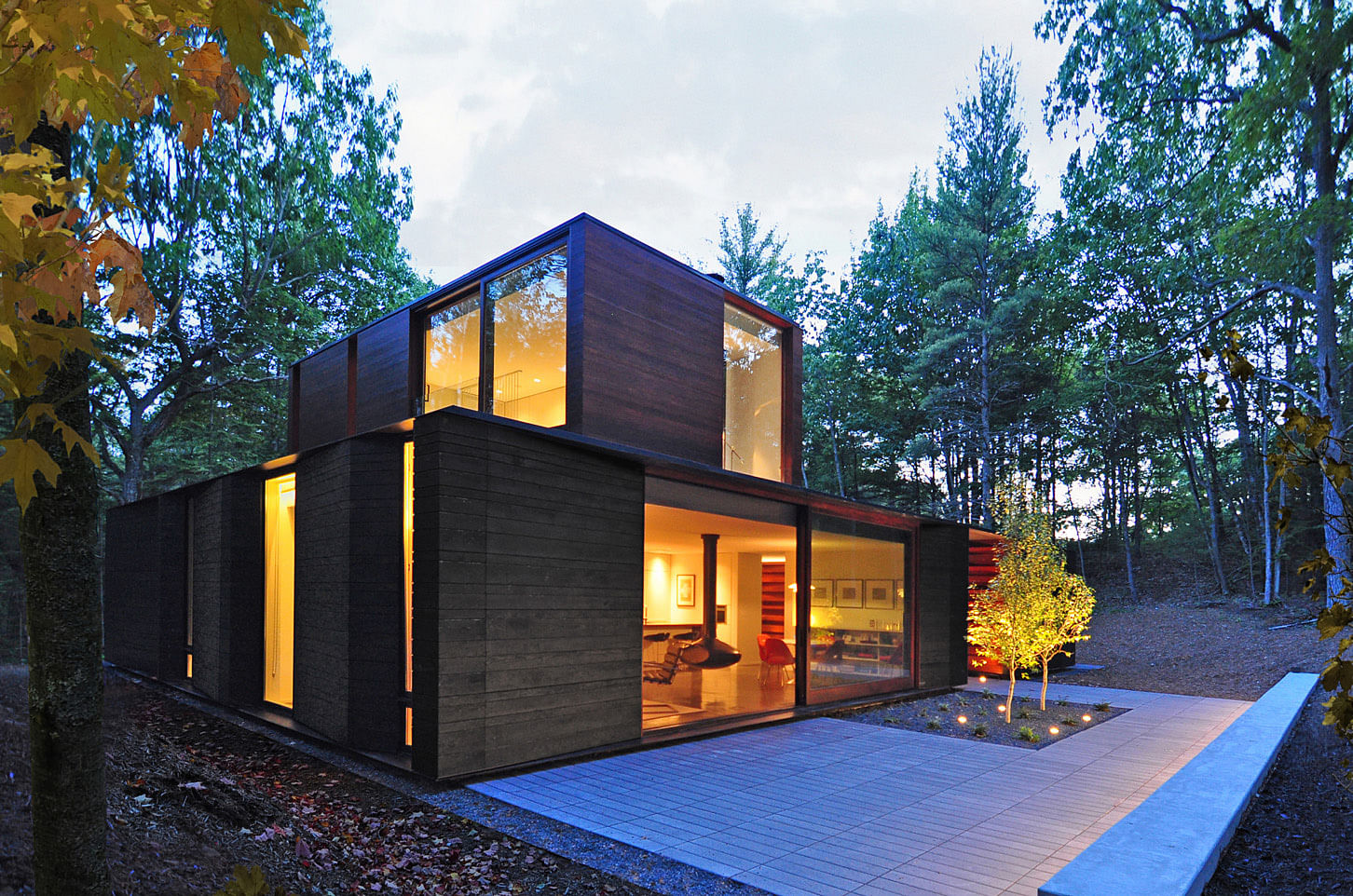
Pleated House; Door County, Wisconsin - Johnsen Schmaling Architects. Photo courtesy of 2015 AIA Small Project Awards

Pleated House; Door County, Wisconsin
by Johnsen Schmaling Architects

"The building’s restrained exterior material palette is limited to charred cedar siding from Northern Wisconsin, its textured somber blackness complemented by varnished clear cedar, dark-anodized aluminum and glass. Echoing the visual depth and surface oscillations of bark covering the trunks of trees, the charred wood boards were installed over furring strips of varying depths to form a gently folding, undulating building skin, not unlike a pleated curtain. A meandering and highly faceted veil that wraps the house and replaces what could have been a conventional, sharply defined perimeter with a more ambiguous boundary, one that softens the building’s rigorous geometry and moderates the transition from artificial construct to natural context."
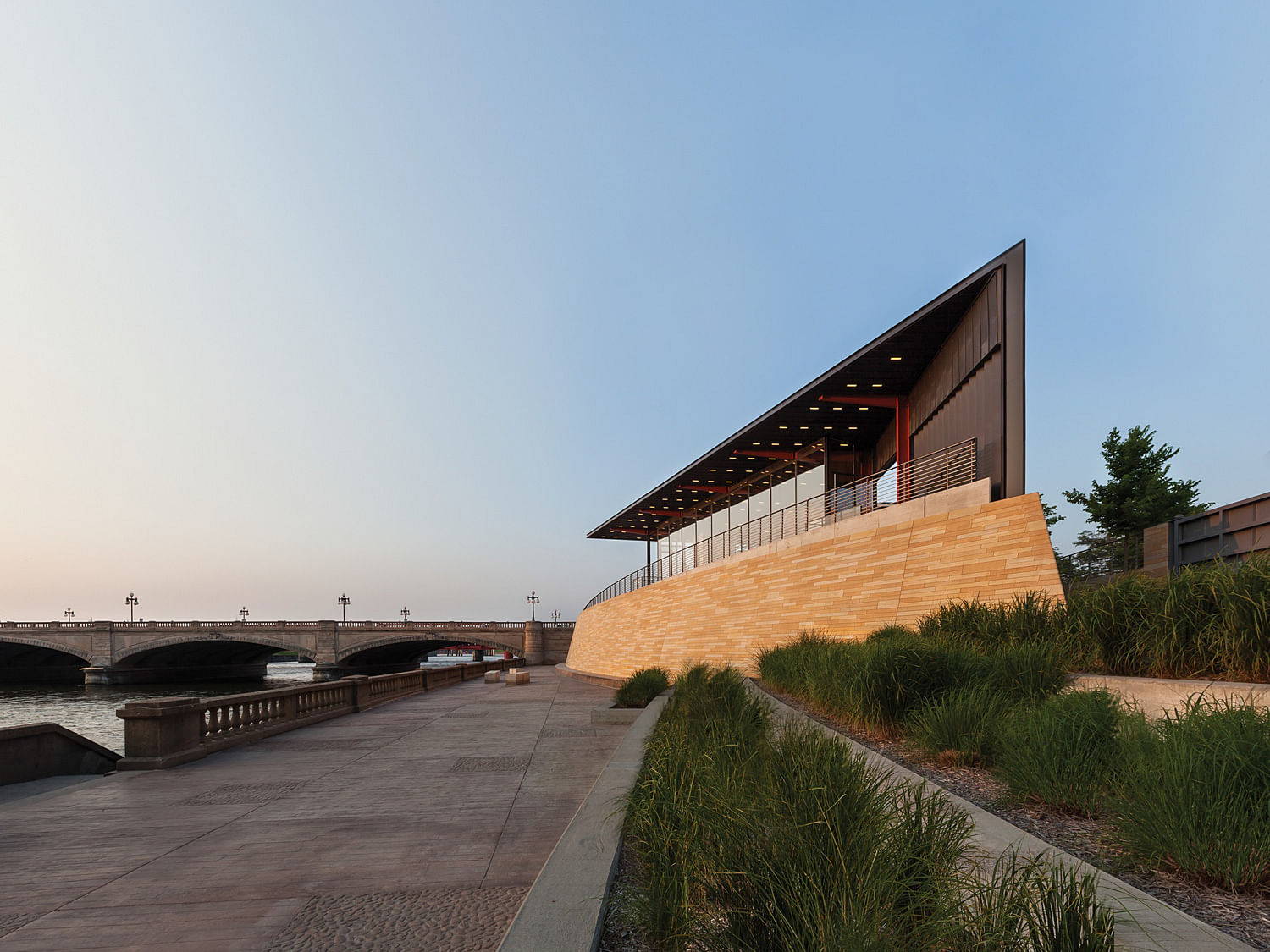
Principal Riverwalk Pavilion; Des Moinesby Substance Architecture. Photo © Paul Crosby

Principal Riverwalk Pavilion; Des Moines
by Substance Architecture

"This 2,200 square foot pavilion and plaza occupy a prominent site along the Des Moines River in downtown Des Moines. The building is a key part of the new Principal Riverwalk – a $50 million public/private partnership which will revitalize the riverfront and draw Des Moines’ residents back to the river. The triangular building was conceived as a crystalline space resting at the prow of a gently sloping, boat-shaped plaza formed by the adjacent trails, streets and promenades. This crystal is, in turn, shrouded by a folded black zinc skin. This skin is selectively unfolded to provide panoramic views out of the upper level café. The resulting roof overhangs provide solar protection to the buildings east and south façades. The west façade is louvered to allow for views upriver to the north while blocking the harsh, western sun. The interior of the café is a single, glass dining space with a solid concrete “chimney” to the south and a wood and steel 'kitchen' block to the west."
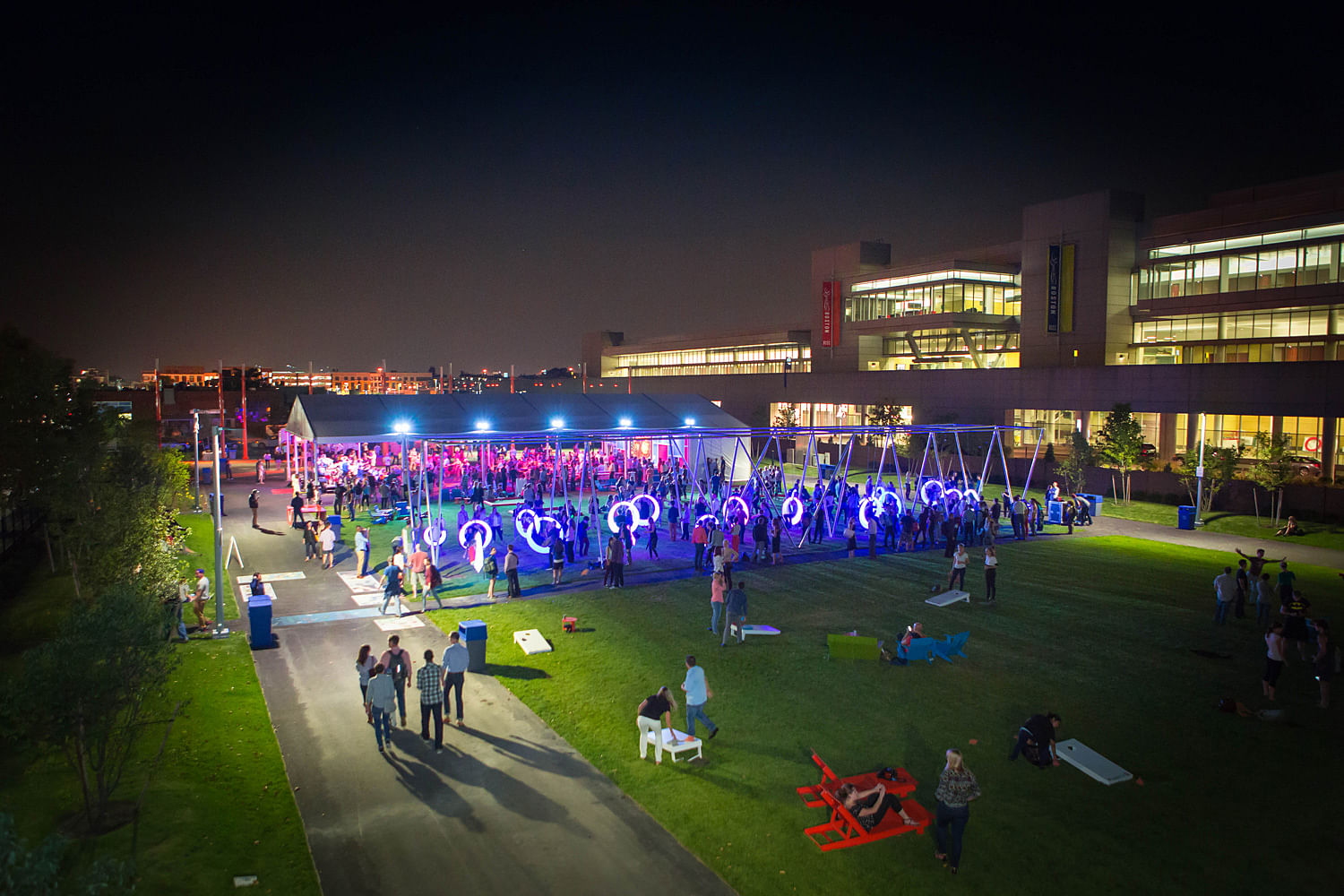
The Lawn on D; Watertown, Massachusetts by Sasaki Associates. Photo © Christian Phillips.

The Lawn on D; Watertown, Massachusetts
by Sasaki Associates

"As the Massachusetts Convention Center Authority (MCCA) is gearing up for a major expansion, Sasaki Associates was brought on board by the MCCA to help shape a vision for D Street and its upcoming development. In collaboration with representatives from the surrounding community, the design team and the MCCA conceived the Lawn on D - a flexible, vibrant, and temporary open space that would be an “early arrival” on D Street. The project provides a conduit for new neighborhood occupying a critical mid-point between South Boston, the Innovation District and Liberty Wharf, and the Fort Point and Channel Center neighborhoods. This new district aspires to be interactive, flexible, technologically advanced, inspired by art and events, and inclusive of many constituents (residents, workers, conventioneers, tourists)."

CATEGORY 3 - small project construction, object, environmental art work, or architectural design less than 5,000-square-foot constructed by the architect.
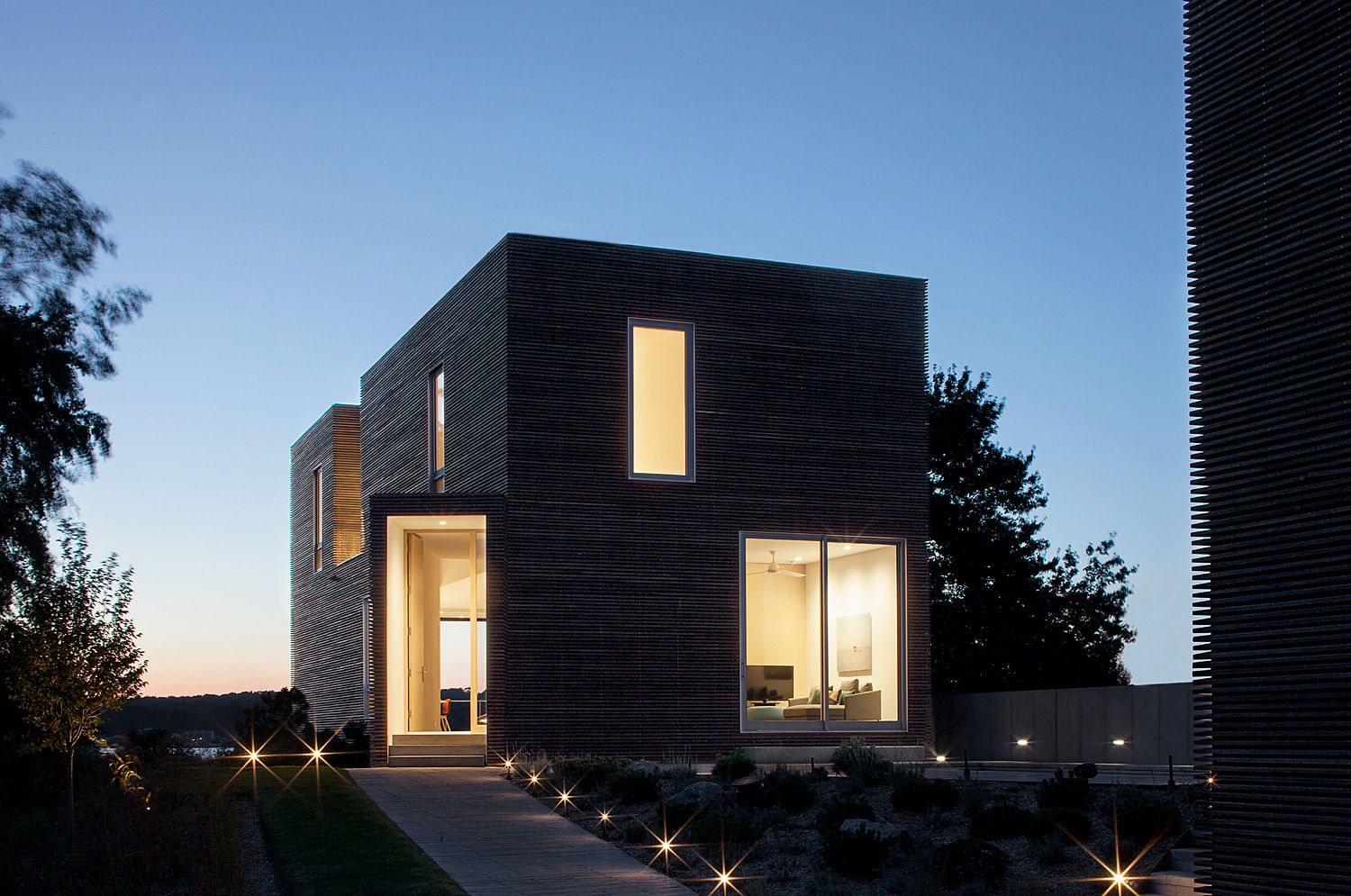
Quonochontaug House; Quonochontaug, Rhode Island by Bernheimer Architecture PLLC. Photo © Jeremy Bitterman.

Quonochontaug House; Quonochontaug, Rhode Island
by Bernheimer Architecture PLLC

"The house is organized around an open-plan ground floor punctuated by a series of double-height skylit spaces that progress from entry to bay view. The skylight volumes, which alternate around an east-west axis defined by the pool terrace (to the east) and the ocean (to the west), taper at their apex to the dimension of standard skylights, which provide shifting and ephemeral natural light patterns throughout the day, varying across seasons and changes in the sky and weather. The largest of the volumes, situated over the kitchen and the living room, is provided with two skylights, producing diverging pyramidal forms that add to the unexpected quality of light. The outdoor deck on the water-facing side of the house contains its own double-height space that is open to the sky. The second floor is supported, volumetrically, by a cluster of plywood-clad shapes on the first floor containing building services. The second floor is a simple series of bedrooms distributed around the skylight volumes which extend upwards from the first floor."
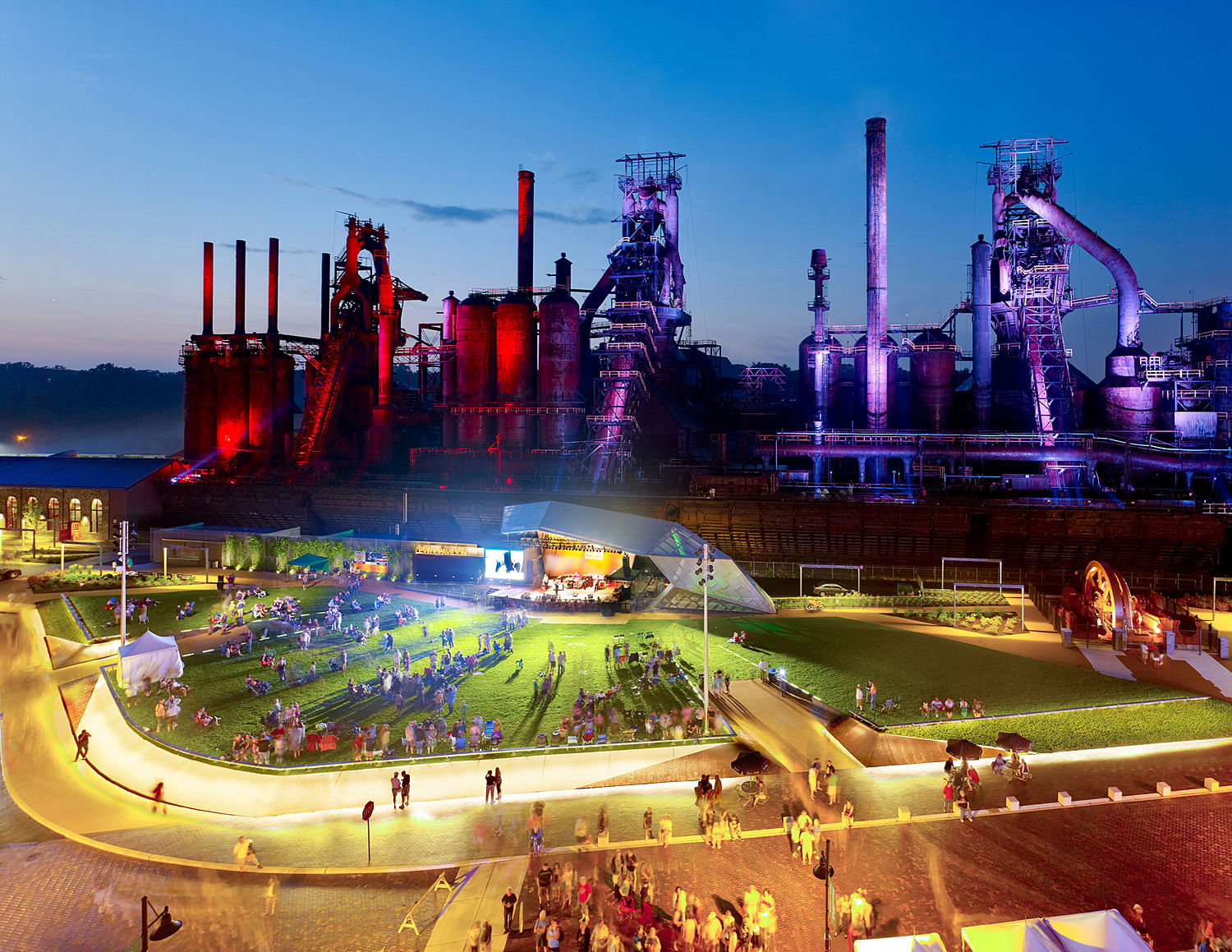
The Levitt Pavilion; Bethlehem, Pennsylvania by WRT. Photo © Jeffrey Totaro; Paul Warchol

The Levitt Pavilion; Bethlehem, Pennsylvania
by WRT

"The Levitt Pavilion is the focal point of the 9.5-acre SteelStacks Arts and Cultural Campus, part of the larger re-development of the former Bethlehem Steel mill. By design, the mill’s five 20-story blast furnaces, iconic in their own right, form a dramatic backdrop the newly created 21st Century Town Square project. Knitted together in its repurposed industrial landscape are four plazas, a playground, a picnic area, and at the heart of it stands the Levitt Pavilion. Clad in perforated, stainless-steel panels, the shell is an asymmetrical segmented arch that touches the ground on one side and cantilevers over the stage. The amphitheater bowl’s chevron shaped COR-TEN steel and precast concrete retaining walls echo the folded plates of the pavilion’s shell, establishing a dialogue that binds the overall site together. The urban design and architecture of this new project rejuvenates life on all parts of the SteelStacks Campus, creating a series of outdoor places that are aesthetically appropriate and programmatically supportive of the activities and aspiration of the community."

The 2015 Small Project Practitioners Awards jury: Marc Manack, AIA (Chair), SILO AR+D; Roy Decker, AIA, Duval Decker; Susan Jones, FAIA, Atelier Jones; Ben Schreiter, AIA, Zwick Construction and Andrew Wells, FAIA, Dake | Wells.

Related

small project awards ● pavilion ● american institute of architects ● aia ● small projects

Share

  • Follow

    0 Comments

  • Comment as :

Sasaki Associates, Variable Projects, and WRT among 2015 AIA Small Project Awardees

New architecture and design competitions: IDEAS Awards, UIA-HYP CUP International Student Competition, Vancouver Tall Challenge, and Memorial to the Sixth Extinction

Best small projects chosen at AIA Small Project Award 2026

10 standout sustainable projects honored at AIA COTE Top Ten Award 2026

Best residential architecture of 2026 honored at AIA Housing Award

Best new interiors of 2026 chosen at AIA Interior Architecture Awards

Best global architecture honored at RIBA International Awards 2026

World’s most beautiful airports of 2026 chosen by Prix Versailles

New architecture and design competitions: Brick in Architecture Awards, Study Architecture Student Showcase, N.Y.C. Groceries, and New York High Falls Riverfront Market

Sign up for Bustler's Email Newsletters

SmithGroup’s ‘pioneering’ Philip Merrill Environmental Center wins AIA Twenty-five Year Award

Sponsored Post by Buildner

Museum of Emotions / Edition #8 FINAL registration deadline is in 5 DAYS!

Here are the winners of the 2026 AIA Architecture Awards

40 emerging architects and designers under 40 from Europe honored

Northwestern University selects 12-firm longlist to design new engineering building

New architecture and design competitions: Exploring 130 Years of American Design, Christo & Jeanne-Claude Center, 13 White Houses, and La Pyramide

Micro-architecture honored in latest Tiny House Architecture Competition

Next page » Loading

Sasaki Associates, Variable Projects, and WRT among 2015 AIA Small Project Awardees

By Bustler Editors|

Thursday, Jun 11, 2015

Share

Centennial Chromagraph, University of Minnesota School of Architecture; Minneapolis by Variable Projects. Photo © Adam Marcus

Related

small project awards ● pavilion ● american institute of architects ● aia ● small projects

The AIA Small Project Awards program is back for its 12th year. As a means to promote design excellence regardless the limits of size and scope, the program recognizes small-project practitioners around the U.S. for their distinguishable high quality of their work.

For 2015, seven projects scooped up awards in three small-project categories.

In previous editions, winners include the Nexus House by Johnsen Schmaling Architects; the Saint Nicholas Antiochian Orthodox Christian Church by Marlon Blackwell Architect; and SPACEFLAVOR'S Mobile Dwelling Cube.

Check out the 2015 winners right below.

CATEGORY 1 - small project construction, object, work of environmental art or architectural design element up to $150,000 in construction cost.

Centennial Chromagraph, University of Minnesota School of Architecture; Minneapolis
by Variable Projects

"As an experiment in data spatialization, the project’s aesthetic effects—its curvature and its coloration—are in many ways a direct product of the historical data that was employed within the design process. The final construction, however, transcends these quantitative origins and takes on a dynamic presence within the school’s existing courtyard space. One of the most exciting and unexpected effects of the structure is its changing appearance in different conditions of light and shadow. Most dramatic is its behavior in the late afternoon sunlight that filters down through the clerestory in the courtyard space, producing intense shadows and reflections of the colored pencils between the ribs. The project’s careful calibration of quantitative data, materiality, and spatial effect allows it to take on multiple readings at multiple scales. This perceptual multiplicity has added a richness and element of surprise to the spatial experience of Rapson Hall’s courtyard."

Bloom; Los Angeles - USC School of Architecture. Photo © Brandon Shigeta; Derek Greene; Doris Sung

Bloom; Los Angeles
by USC School of Architecture

"As a pavilion, this project's function is to provide comfortable, shaded space using a new building material. Using sheet thermobimetal, an inexpensive 'smart' material that automatically curls when heated, building skins can self-ventilate and sun-shade, while reducing its dependency on mechanical air conditioning as well as indirectly decreasing a city’s 'heat island' effect. When heated by the sun or air temperature, the surface, a lamination of two alloys of metal with different coefficients of expansion, curls. When cooled, the surface tiles return to their original flat state. With today’s digital technology and driving interest in sustainable design, this simple material can transcend its currently limited role as a small mechanical actuating device to a dynamic building surface material, while expanding the discourse of performative architecture."

CATEGORY 2 - A small project construction, up to $1,500,000 in construction cost

Pleated House; Door County, Wisconsin - Johnsen Schmaling Architects. Photo courtesy of 2015 AIA Small Project Awards

Pleated House; Door County, Wisconsin
by Johnsen Schmaling Architects

"The building’s restrained exterior material palette is limited to charred cedar siding from Northern Wisconsin, its textured somber blackness complemented by varnished clear cedar, dark-anodized aluminum and glass. Echoing the visual depth and surface oscillations of bark covering the trunks of trees, the charred wood boards were installed over furring strips of varying depths to form a gently folding, undulating building skin, not unlike a pleated curtain. A meandering and highly faceted veil that wraps the house and replaces what could have been a conventional, sharply defined perimeter with a more ambiguous boundary, one that softens the building’s rigorous geometry and moderates the transition from artificial construct to natural context."

Principal Riverwalk Pavilion; Des Moinesby Substance Architecture. Photo © Paul Crosby

Principal Riverwalk Pavilion; Des Moines
by Substance Architecture

"This 2,200 square foot pavilion and plaza occupy a prominent site along the Des Moines River in downtown Des Moines. The building is a key part of the new Principal Riverwalk – a $50 million public/private partnership which will revitalize the riverfront and draw Des Moines’ residents back to the river. The triangular building was conceived as a crystalline space resting at the prow of a gently sloping, boat-shaped plaza formed by the adjacent trails, streets and promenades. This crystal is, in turn, shrouded by a folded black zinc skin. This skin is selectively unfolded to provide panoramic views out of the upper level café. The resulting roof overhangs provide solar protection to the buildings east and south façades. The west façade is louvered to allow for views upriver to the north while blocking the harsh, western sun. The interior of the café is a single, glass dining space with a solid concrete “chimney” to the south and a wood and steel 'kitchen' block to the west."

The Lawn on D; Watertown, Massachusetts by Sasaki Associates. Photo © Christian Phillips.

The Lawn on D; Watertown, Massachusetts
by Sasaki Associates

"As the Massachusetts Convention Center Authority (MCCA) is gearing up for a major expansion, Sasaki Associates was brought on board by the MCCA to help shape a vision for D Street and its upcoming development. In collaboration with representatives from the surrounding community, the design team and the MCCA conceived the Lawn on D - a flexible, vibrant, and temporary open space that would be an “early arrival” on D Street. The project provides a conduit for new neighborhood occupying a critical mid-point between South Boston, the Innovation District and Liberty Wharf, and the Fort Point and Channel Center neighborhoods. This new district aspires to be interactive, flexible, technologically advanced, inspired by art and events, and inclusive of many constituents (residents, workers, conventioneers, tourists)."

CATEGORY 3 - small project construction, object, environmental art work, or architectural design less than 5,000-square-foot constructed by the architect.

Quonochontaug House; Quonochontaug, Rhode Island by Bernheimer Architecture PLLC. Photo © Jeremy Bitterman.

Quonochontaug House; Quonochontaug, Rhode Island
by Bernheimer Architecture PLLC

"The house is organized around an open-plan ground floor punctuated by a series of double-height skylit spaces that progress from entry to bay view. The skylight volumes, which alternate around an east-west axis defined by the pool terrace (to the east) and the ocean (to the west), taper at their apex to the dimension of standard skylights, which provide shifting and ephemeral natural light patterns throughout the day, varying across seasons and changes in the sky and weather. The largest of the volumes, situated over the kitchen and the living room, is provided with two skylights, producing diverging pyramidal forms that add to the unexpected quality of light. The outdoor deck on the water-facing side of the house contains its own double-height space that is open to the sky. The second floor is supported, volumetrically, by a cluster of plywood-clad shapes on the first floor containing building services. The second floor is a simple series of bedrooms distributed around the skylight volumes which extend upwards from the first floor."

The Levitt Pavilion; Bethlehem, Pennsylvania by WRT. Photo © Jeffrey Totaro; Paul Warchol

The Levitt Pavilion; Bethlehem, Pennsylvania
by WRT

"The Levitt Pavilion is the focal point of the 9.5-acre SteelStacks Arts and Cultural Campus, part of the larger re-development of the former Bethlehem Steel mill. By design, the mill’s five 20-story blast furnaces, iconic in their own right, form a dramatic backdrop the newly created 21st Century Town Square project. Knitted together in its repurposed industrial landscape are four plazas, a playground, a picnic area, and at the heart of it stands the Levitt Pavilion. Clad in perforated, stainless-steel panels, the shell is an asymmetrical segmented arch that touches the ground on one side and cantilevers over the stage. The amphitheater bowl’s chevron shaped COR-TEN steel and precast concrete retaining walls echo the folded plates of the pavilion’s shell, establishing a dialogue that binds the overall site together. The urban design and architecture of this new project rejuvenates life on all parts of the SteelStacks Campus, creating a series of outdoor places that are aesthetically appropriate and programmatically supportive of the activities and aspiration of the community."

The 2015 Small Project Practitioners Awards jury: Marc Manack, AIA (Chair), SILO AR+D; Roy Decker, AIA, Duval Decker; Susan Jones, FAIA, Atelier Jones; Ben Schreiter, AIA, Zwick Construction and Andrew Wells, FAIA, Dake | Wells.

Share

  • Follow

    0 Comments

  • Comment as :

Archinect JobsArchinect Jobs

The Archinect Job Board attracts the world's top architectural design talents.

VIEW ALL JOBS POST A JOB

Job Captain - Residential

DAHLIN Architecture | Planning | Interiors

Job Captain - Residential

Pleasanton, CA, US

Marketing and Architectural Assistant

AGENCIE / Architecture & Engineering

Marketing and Architectural Assistant

New York, NY, US

Architectural/Structural Drafter

New Beginnings Engineering

Architectural/Structural Drafter

Irvine, CA, US

Junior to Intermediate Architect

Totum

Junior to Intermediate Architect

Sherman Oaks, CA, US

Architectural Designer, Residential

Roman and Williams Buildings and Interiors

Architectural Designer, Residential

New York, NY, US

Architectural Designer / Junior Architect (1–3 Years Experience)

Andrew Magnes Architecture

Architectural Designer / Junior Architect (1–3 Years Experience)

Brooklyn, NY, US

Project Designer

The Brooklyn Studio

Project Designer

Brooklyn, NY, US

Junior/Intermediate Architect

Archimaera Architecture

Junior/Intermediate Architect

New York, NY, US

Architect / Architectural Designer (3-5 years experience)

Resolution: 4 Architecture

Architect / Architectural Designer (3-5 years experience)

New York, NY, US

Junior Designer

Shadow Architect, P.C.

Junior Designer

New York, NY, US

Next page » Loading