• Login / Join
  • About
  • •
  • Contact
  • •
  • Advertising
bustler logo
bustler logo
  • News
  • Competitions
  • Events
  • Bustler is powered by Archinect
  • Sign up for Bustler's Email Newsletters

  • Follow these Bustler feeds:

  • Search

    Search in

  • Submit

    What are you submitting?

    News Pitch
    Competition
    Event
  • Login / Join
  • News|Competitions|Events
  • Search
    | Submit
    | Follow
  • Search in

    What are you submitting?

    News Pitch
    Competition
    Event

    Follow these Bustler feeds:

  • About|Contact|Advertising
  • Login / Join

Results of NASA's 3D Printed Habitat Challenge for space exploration

By Bustler Editors|

Monday, Oct 5, 2015

1ST PLACE: "Mars Ice House" by Team Space Exploration Architecture and Clouds Architecture Office.

NASA and America Makes (National Additive Manufacturing Innovation Institute) co-launched the $2.25 million 3D Printed Habitat Challenge earlier this year as part of NASA's Centennial Challenges program, which awards prizes to innovations originating from diverse independent and non-traditional sources. The first phase of the challenge had multi-disciplinary teams develop shelters equipped to survive the environments of Mars and deep-space exploration.

Starting out with more than 165 entries, the top 30 highest-scoring projects were vigorously judged and also publicly displayed at the World Maker Faire NYC event on September 27. At the end of the challenge, three teams won US$40,000 total in cash prizes. Read more about the second-phase competitions here.

Get a glimpse of the winning entries and a few of the top 30 finalist projects below.

1ST PLACE ($25,000): "Mars Ice House" by Team Space Exploration Architecture and Clouds Architecture Office

1ST PLACE team: Space Exploration Architecture and Clouds Architecture Office.

'SEArch / Clouds AO: with ties to Pratt Institute, Carnegie Mellon University, Columbia University, Princeton University, and Parsons School of Design, is comprised of 8 designers: Christina Ciardullo, Kelsey Lents, Jeffrey Montes, Michael Morris and Melodie Yashar of SEArch, and Ostap Rudakevych, Masayuki Sono, and Yuko Sono of Clouds AO. SEArch’s formation builds upon a 10-year portfolio combining academic Space research and practice.

Members of SEArch have worked on the NASA Constellation Program, the 2015 Caltech Space Challenge winning design, and the 2016 X-Hab Innovation Challenge for Human Centered Designs. Clouds AO has produced several architectural projects distilled from research and analysis exploring the intersection between conceptual and experiential approaches.'

RELATED NEWS Archinect launches Open Call for Submissions: Help
1ST PLACE: Detail of "Mars Ice House" by Team Space Exploration Architecture and Clouds Architecture Office.

Description: "ICE HOUSE is born from the imperative to bring light and a connection to the outdoors into the vocabulary of Martian architecture – to create protected space in which the mind and body will not just survive, but thrive. With water as the core resource for future outposts on extraterrestrial bodies, NASA has taken a “follow the water” approach to exploration; ICE HOUSE extends that concept to construction. The innovative structure draws on the abundance of water and persistently low temperatures in Mars’ northern latitudes to create a multi-layered pressurized radiation shell of ice that encloses a lander habitat and gardens within. A unique 3D printing technique harnesses the physics of water and its phase transition to construct ICE HOUSE."

2ND PLACE ($15,000) + People's Choice Award winner: GAMMA

2ND PLACE + People's Choice Award winner: GAMMA.

Description: "A semi-autonomous multi-robot regolith additive manufacturing (RAM) system is used to create a protective in situ shield around a modular inflatable hab. The proposal primarily explores system and design redundancy through distributed functionality: from the initial descent and navigation of the three inflatable dodecohedral modules to find a suitable location; with the flexible and interchangeable internal habitat design; through to the multi-robot microwave regolith melting. Even more fundamentally, allowing for unknown outcomes acknowledges the uncertainty in the frontier environment and the mission, shown in the freedom of the deployment, the module arrangement, and construction process."

3RD PLACE: LavaHive

3RD PLACE: LavaHive.

Excerpted Description: "LavaHive is a modular, additive-manufactured Martian habitat design using a proposed novel ‘lava-casting’ construction technique as well as utilizing recycled spacecraft materials and structures. Our design incorporates usually discarded components as a key element of the habitat concept. The back shell of the Entry, Descent and Landing (EDL) system that will deliver the construction rovers will be used for the primary habitat roof, with an inflatable module underneath as the primary living habitat. Using the readily available Martian regolith, two rovers will use a combination of sintering and ‘lava-casting’ to build connecting corridors and sub-habitats around the main inflatable section. These sub-habitats will then be fitted, sealed internally with epoxy and furnished as a research area, workshop or greenhouse depending on the mission design..."

RUNNER-UP Hybrid Composites

Runner-Up: Hybrid Composites.

Excerpted Description: "...Our approach is to pursue the use of high performance composite materials and robotic fabrication techniques to challenge and go beyond the current cement based 3D printing approaches. Rather than using extrusion of powder based cement based materials, our team proposes a hybrid approach that integrates multiple robotically controlled fabrication techniques that employ the use of high performance composite fibers and fast curing polymers that react to heat or UV light. Primary structural systems and shell enclosures can be 3D printed by extruding composite fibers woven into various profiles such as strands, sleeves and fabrics through robotically controlled mandrel systems..."

Best in Class: Best Architectural Design: "The NEO NATIVE" by MOA Architecture

Best in Class: Best Architectural Design: "The NEO NATIVE" by MOA Architecture.

Excerpted Description: "...As human influence reaches into new worlds, we must consider the impact of a neo-native species inhabiting a distant planet. We can create a shelter reminiscent of our earth-bound dwelling to remind us of our origins and to replicate the human ideology, or we can create a living shell that responds to its environment and pushes the limitations of not only what we know but who we are. The 3D printer of the future will be capable of scanning surrounding geology to create an adaptation of local environmental conditions based on thermal and solar requirements, soil characteristics, wind patterns, radiation hazards, and structural foundation requirements..."

Best in Class: Best Technical Proposal: "Donut House Mk. I" by A.R.C.H.
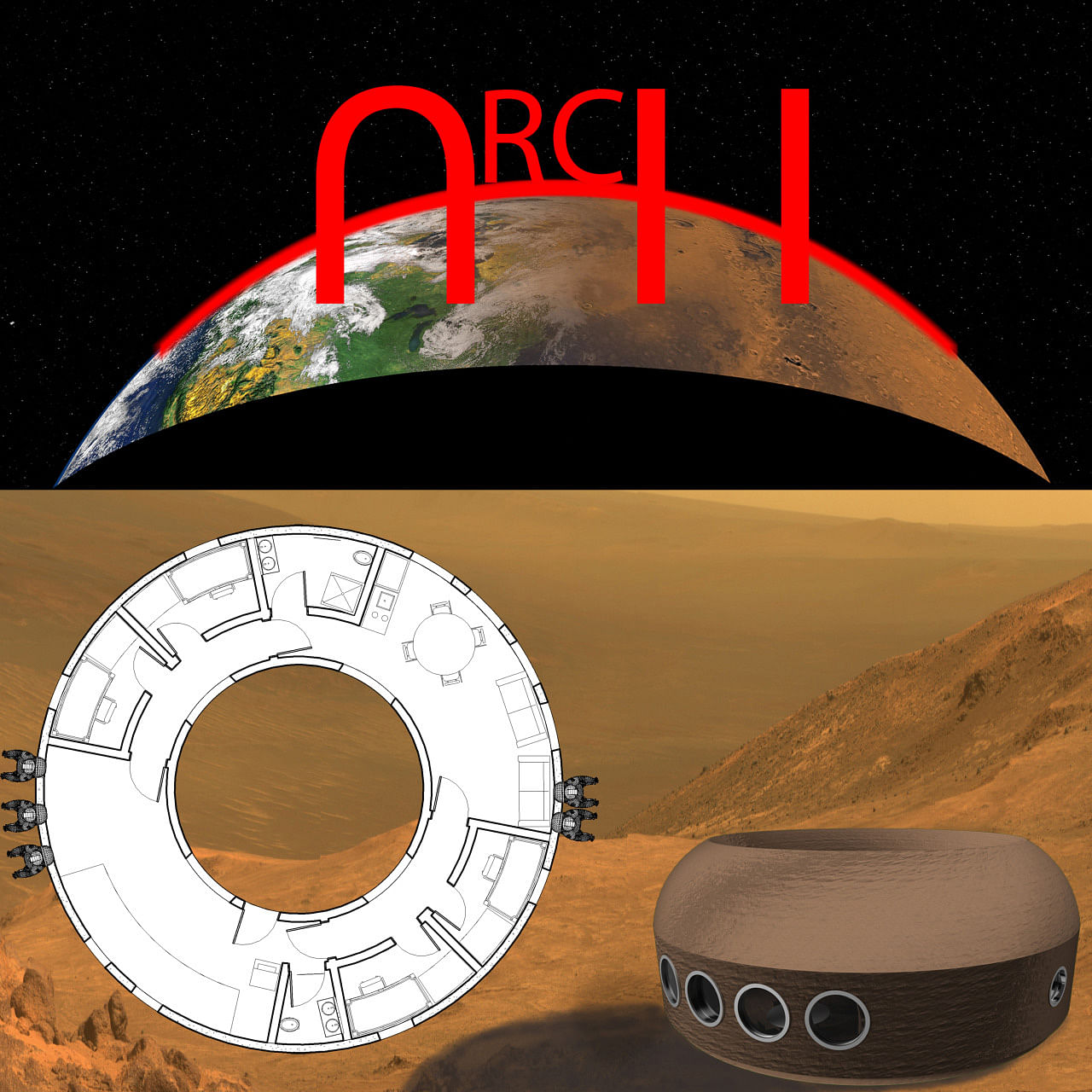
Best in Class: Best Technical Proposal: "Donut House Mk. I" by A.R.C.H.

Excerpted Description: "Team A.R.C.H’s submission uses the design and construction methodology of basalt fiber clay matrix structures for in-situ habitat construction on Mars and other celestial bodies. The basalt fiber reinforced clay is produced from soils and rocks found on most terrestrial bodies including the Earth, the Moon, and Mars. This material provides an economical solution for extraterrestrial construction, as well as eco-friendly, low cost housing on Earth. Our technique updates the proven technology of “Cobb” construction; replacing straw with basalt fibers, using additive manufacturing to produce efficient, complete, and habitable structures..."

Best in Class: Best Use of Space: "Seed Habitat" by CTLGroup Mars

Best in Class: Best Use of Space: "Seed Habitat" by CTLGroup Mars.

Excerpted Description: "CTLGroup:Mars’ submission to the 3D-printed habitat challenge combines advances in our ability to “print” structurally sound materials and solutions to engineering challenges devised in ancient Rome. The structure we propose is informed by ancient concrete designs that did not include reinforcing steel (which is difficult to manufacture on Mars or to transport from Earth) and by investigations into the use of concrete for lunar structures that took place in the 1980’s. Additive manufacturing technologies allow for structural customization to suit any location of interest on Mars..."

See the top 30 entries here.

Related

space ● shelter ● nasa ● mars ● habitat ● 3d printing

Share

  • Follow

    0 Comments

  • Comment as :

Results of NASA's 3D Printed Habitat Challenge for space exploration

Over $500,000 awarded to architectural discourse projects by Graham Foundation

Best in urban planning recognized at AIA Regional & Urban Design Award 2026

Sponsored Post by Buildner

Re:Form - New Life for Old Spaces / Edition #3 advance registration deadline is approaching!

New architecture and design competitions: IDEAS Awards, UIA-HYP CUP International Student Competition, Vancouver Tall Challenge, and Memorial to the Sixth Extinction

Best small projects chosen at AIA Small Project Award 2026

10 standout sustainable projects honored at AIA COTE Top Ten Award 2026

Best residential architecture of 2026 honored at AIA Housing Award

Best new interiors of 2026 chosen at AIA Interior Architecture Awards

Sign up for Bustler's Email Newsletters

Best global architecture honored at RIBA International Awards 2026

World’s most beautiful airports of 2026 chosen by Prix Versailles

New architecture and design competitions: Brick in Architecture Awards, Study Architecture Student Showcase, N.Y.C. Groceries, and New York High Falls Riverfront Market

SmithGroup’s ‘pioneering’ Philip Merrill Environmental Center wins AIA Twenty-five Year Award

Sponsored Post by Buildner

Museum of Emotions / Edition #8 FINAL registration deadline is in 5 DAYS!

Here are the winners of the 2026 AIA Architecture Awards

40 emerging architects and designers under 40 from Europe honored

Next page » Loading

Results of NASA's 3D Printed Habitat Challenge for space exploration

By Bustler Editors|

Monday, Oct 5, 2015

Share

1ST PLACE: "Mars Ice House" by Team Space Exploration Architecture and Clouds Architecture Office.

Related

space ● shelter ● nasa ● mars ● habitat ● 3d printing

NASA and America Makes (National Additive Manufacturing Innovation Institute) co-launched the $2.25 million 3D Printed Habitat Challenge earlier this year as part of NASA's Centennial Challenges program, which awards prizes to innovations originating from diverse independent and non-traditional sources. The first phase of the challenge had multi-disciplinary teams develop shelters equipped to survive the environments of Mars and deep-space exploration.

Starting out with more than 165 entries, the top 30 highest-scoring projects were vigorously judged and also publicly displayed at the World Maker Faire NYC event on September 27. At the end of the challenge, three teams won US$40,000 total in cash prizes. Read more about the second-phase competitions here.

Get a glimpse of the winning entries and a few of the top 30 finalist projects below.

1ST PLACE ($25,000): "Mars Ice House" by Team Space Exploration Architecture and Clouds Architecture Office

1ST PLACE team: Space Exploration Architecture and Clouds Architecture Office.

'SEArch / Clouds AO: with ties to Pratt Institute, Carnegie Mellon University, Columbia University, Princeton University, and Parsons School of Design, is comprised of 8 designers: Christina Ciardullo, Kelsey Lents, Jeffrey Montes, Michael Morris and Melodie Yashar of SEArch, and Ostap Rudakevych, Masayuki Sono, and Yuko Sono of Clouds AO. SEArch’s formation builds upon a 10-year portfolio combining academic Space research and practice.

Members of SEArch have worked on the NASA Constellation Program, the 2015 Caltech Space Challenge winning design, and the 2016 X-Hab Innovation Challenge for Human Centered Designs. Clouds AO has produced several architectural projects distilled from research and analysis exploring the intersection between conceptual and experiential approaches.'

RELATED NEWS Archinect launches Open Call for Submissions: Help
1ST PLACE: Detail of "Mars Ice House" by Team Space Exploration Architecture and Clouds Architecture Office.

Description: "ICE HOUSE is born from the imperative to bring light and a connection to the outdoors into the vocabulary of Martian architecture – to create protected space in which the mind and body will not just survive, but thrive. With water as the core resource for future outposts on extraterrestrial bodies, NASA has taken a “follow the water” approach to exploration; ICE HOUSE extends that concept to construction. The innovative structure draws on the abundance of water and persistently low temperatures in Mars’ northern latitudes to create a multi-layered pressurized radiation shell of ice that encloses a lander habitat and gardens within. A unique 3D printing technique harnesses the physics of water and its phase transition to construct ICE HOUSE."

2ND PLACE ($15,000) + People's Choice Award winner: GAMMA

2ND PLACE + People's Choice Award winner: GAMMA.

Description: "A semi-autonomous multi-robot regolith additive manufacturing (RAM) system is used to create a protective in situ shield around a modular inflatable hab. The proposal primarily explores system and design redundancy through distributed functionality: from the initial descent and navigation of the three inflatable dodecohedral modules to find a suitable location; with the flexible and interchangeable internal habitat design; through to the multi-robot microwave regolith melting. Even more fundamentally, allowing for unknown outcomes acknowledges the uncertainty in the frontier environment and the mission, shown in the freedom of the deployment, the module arrangement, and construction process."

3RD PLACE: LavaHive

3RD PLACE: LavaHive.

Excerpted Description: "LavaHive is a modular, additive-manufactured Martian habitat design using a proposed novel ‘lava-casting’ construction technique as well as utilizing recycled spacecraft materials and structures. Our design incorporates usually discarded components as a key element of the habitat concept. The back shell of the Entry, Descent and Landing (EDL) system that will deliver the construction rovers will be used for the primary habitat roof, with an inflatable module underneath as the primary living habitat. Using the readily available Martian regolith, two rovers will use a combination of sintering and ‘lava-casting’ to build connecting corridors and sub-habitats around the main inflatable section. These sub-habitats will then be fitted, sealed internally with epoxy and furnished as a research area, workshop or greenhouse depending on the mission design..."

RUNNER-UP Hybrid Composites

Runner-Up: Hybrid Composites.

Excerpted Description: "...Our approach is to pursue the use of high performance composite materials and robotic fabrication techniques to challenge and go beyond the current cement based 3D printing approaches. Rather than using extrusion of powder based cement based materials, our team proposes a hybrid approach that integrates multiple robotically controlled fabrication techniques that employ the use of high performance composite fibers and fast curing polymers that react to heat or UV light. Primary structural systems and shell enclosures can be 3D printed by extruding composite fibers woven into various profiles such as strands, sleeves and fabrics through robotically controlled mandrel systems..."

Best in Class: Best Architectural Design: "The NEO NATIVE" by MOA Architecture

Best in Class: Best Architectural Design: "The NEO NATIVE" by MOA Architecture.

Excerpted Description: "...As human influence reaches into new worlds, we must consider the impact of a neo-native species inhabiting a distant planet. We can create a shelter reminiscent of our earth-bound dwelling to remind us of our origins and to replicate the human ideology, or we can create a living shell that responds to its environment and pushes the limitations of not only what we know but who we are. The 3D printer of the future will be capable of scanning surrounding geology to create an adaptation of local environmental conditions based on thermal and solar requirements, soil characteristics, wind patterns, radiation hazards, and structural foundation requirements..."

Best in Class: Best Technical Proposal: "Donut House Mk. I" by A.R.C.H.

Best in Class: Best Technical Proposal: "Donut House Mk. I" by A.R.C.H.

Excerpted Description: "Team A.R.C.H’s submission uses the design and construction methodology of basalt fiber clay matrix structures for in-situ habitat construction on Mars and other celestial bodies. The basalt fiber reinforced clay is produced from soils and rocks found on most terrestrial bodies including the Earth, the Moon, and Mars. This material provides an economical solution for extraterrestrial construction, as well as eco-friendly, low cost housing on Earth. Our technique updates the proven technology of “Cobb” construction; replacing straw with basalt fibers, using additive manufacturing to produce efficient, complete, and habitable structures..."

Best in Class: Best Use of Space: "Seed Habitat" by CTLGroup Mars

Best in Class: Best Use of Space: "Seed Habitat" by CTLGroup Mars.

Excerpted Description: "CTLGroup:Mars’ submission to the 3D-printed habitat challenge combines advances in our ability to “print” structurally sound materials and solutions to engineering challenges devised in ancient Rome. The structure we propose is informed by ancient concrete designs that did not include reinforcing steel (which is difficult to manufacture on Mars or to transport from Earth) and by investigations into the use of concrete for lunar structures that took place in the 1980’s. Additive manufacturing technologies allow for structural customization to suit any location of interest on Mars..."

See the top 30 entries here.

Share

  • Follow

    0 Comments

  • Comment as :

Archinect JobsArchinect Jobs

The Archinect Job Board attracts the world's top architectural design talents.

VIEW ALL JOBS POST A JOB

Designer (Level 3)

KPMB

Designer (Level 3)

Cambridge, MA, US

Project Architect

The Goldman Group

Project Architect

Walpole, MA, US

Senior Architectural Planner

Payette

Senior Architectural Planner

Boston, MA, US

Senior Associate/ Project Manager

DWY Landscape Architects

Senior Associate/ Project Manager

Sarasota, FL, US

Studio Coordinator

Sarah Jacoby Architect

Studio Coordinator

Long Island City, NY, US

Designer

Jayson Architecture

Designer

San Francisco, CA, US

Design Technologist / BIM Lead

The American Housing Corporation

Design Technologist / BIM Lead

Austin, TX, US

Lead Design Architect

The American Housing Corporation

Lead Design Architect

Austin, TX, US

Assistant Professor Architecture

California State Polytechnic University, Pomona

Assistant Professor Architecture

Pomona, CA, US

Project Architect

The American Housing Corporation

Project Architect

Austin, TX, US

Next page » Loading