• Login / Join
  • About
  • •
  • Contact
  • •
  • Advertising
bustler logo
bustler logo
  • News
  • Competitions
  • Events
  • Bustler is powered by Archinect
  • Sign up for Bustler's Email Newsletters

  • Follow these Bustler feeds:

  • Search

    Search in

  • Submit

    What are you submitting?

    News Pitch
    Competition
    Event
  • Login / Join
  • News|Competitions|Events
  • Search
    | Submit
    | Follow
  • Search in

    What are you submitting?

    News Pitch
    Competition
    Event

    Follow these Bustler feeds:

  • About|Contact|Advertising
  • Login / Join

A closer look at "The False Mirror", the Europan 13 Norway Trondheim 1st-prize winner

By Bustler Editors|

Wednesday, Jan 6, 2016
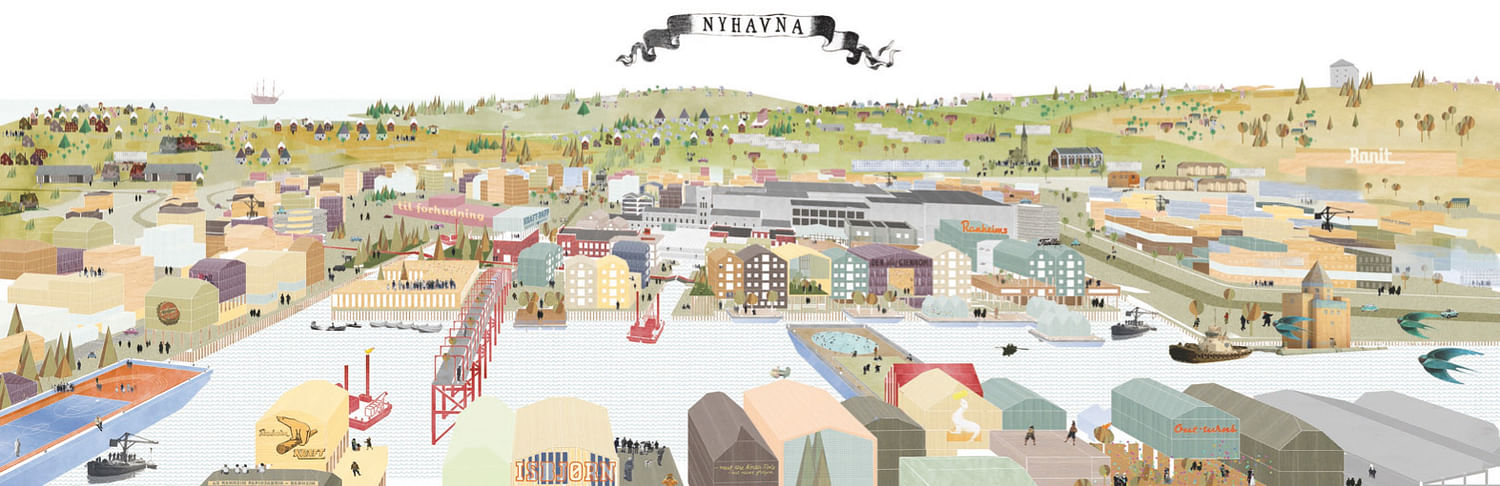
Europan 13 Norway Trondheim - 1st prize winner: "The False Mirror". Aerial view of Trondheim’s harbour along with the completed renovation of Strandveikaia district.

In response to the Europan 13's "adaptable city" theme, the Norway competition for the city of Trondheim sought the best proposals that would improve the city's current urban design, while also acknowledging local typology, morphology, and culture. "The False Mirror", created by an architectural team who calls themselves The False Mirror Project, won first prize for this Norwegian site.

According to the competition jury, "The False Mirror" won the top prize for their analysis and reinterpretation of Trondheim's defining elements, including the city's warehouses, canals, sea vessels, and its unique landscape and infrastructure (On a side note, TFM Project's renderings are also utterly charming, no?)

Read on for more about the project that the architects shared with us.

Project description:

"The False Mirror / Det Falske Speil:

Europan addresses, for the second time, the matter of adaptability to the ever-changing condition of cities, along with the investigation about extremely actual concepts such as temporaryness, flexiblility and sustainability. Eventually set aside the superordinate paradigms of the Modern, nowadays it’s possible to outline a new trend within the urban dimension: what is flexible and fluid tries to replace what is permanent, the serial multiplicity substitutes Identity, while the generic scrapes away the specific.

In a context where such acclaimed adaptability seems to be no longer a conscious attitude, but a dogmatic precept, the false mirror internalizes such premises facing the automated enslavement to this belief and questions the foundation itself of this process: to what extent can the use of standardized, repetitive and environmentally adaptable elements represent a solution for a whatever city without losing the identity of that city itself? So, getting away from the common scenery visualized by this fortunate encounter between a very high-tech formalism and the misleading aesthetics of green sustainability, the false mirror tries to define a different declination of the word adaptable."
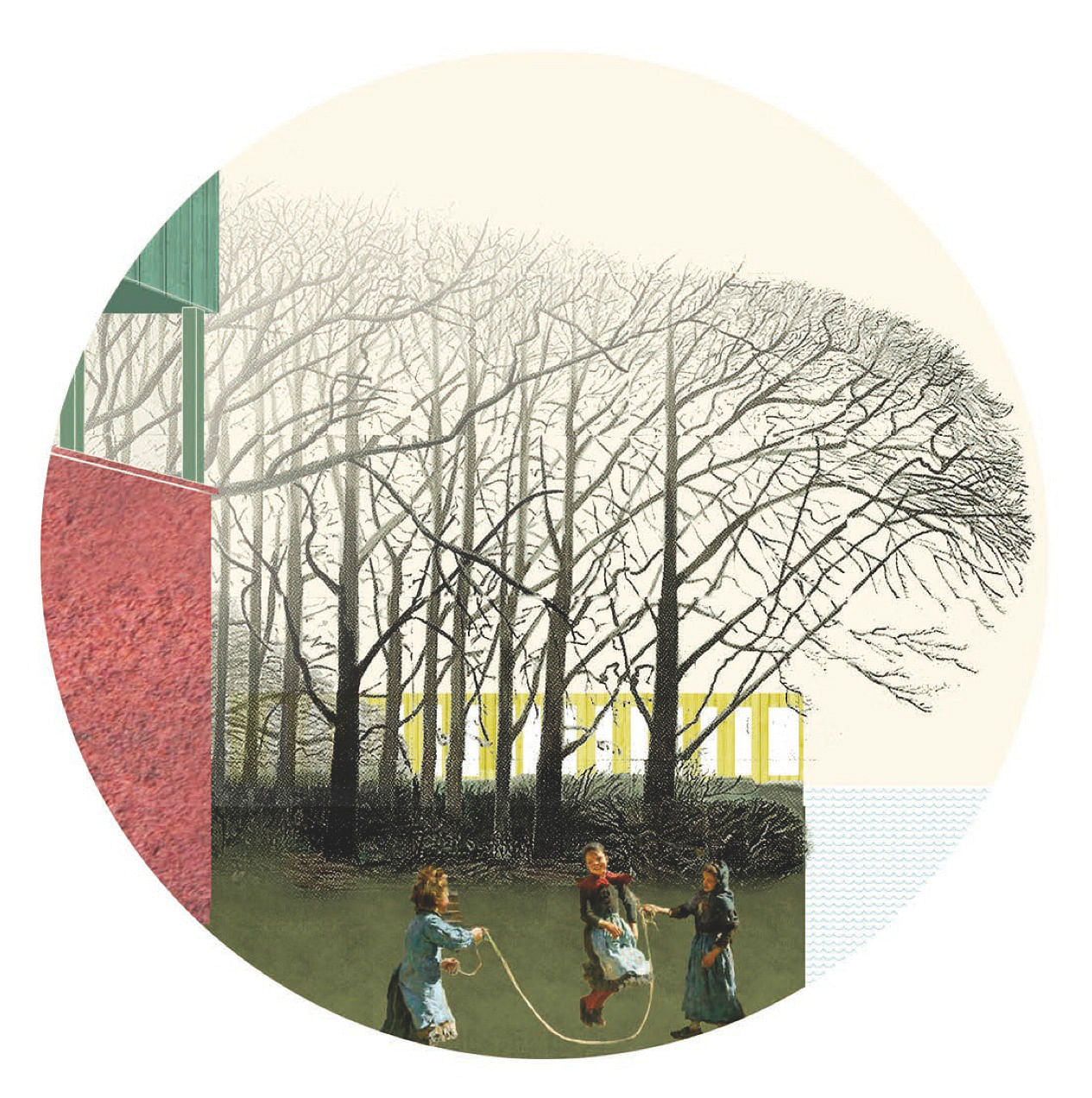
Concept Blink 1: the new urban park and the new kindergarten of Strandveikaia.

"Right from the critical reading of the main topics raised by Europan 13, Trondheim pops up like the perfect case study where testing a process based on the coexistence between the demanded flexibility and the specificity of a waterfront, along with its cultural, historical and urban background. Therefore Europan 13 turns into the perfect playground to experiment an innovative, heterogeneous approach where the obsolete slogan 'from local question to global solutio' naturally switches to a more appropriate 'from global requests to specific solution', while Nyhavna becomes the stage of a renovation process where the refusal of 'green-tech', neutral devices makes room for a hybrid vision that combines the pre-existence with a flexible process of transformation." 
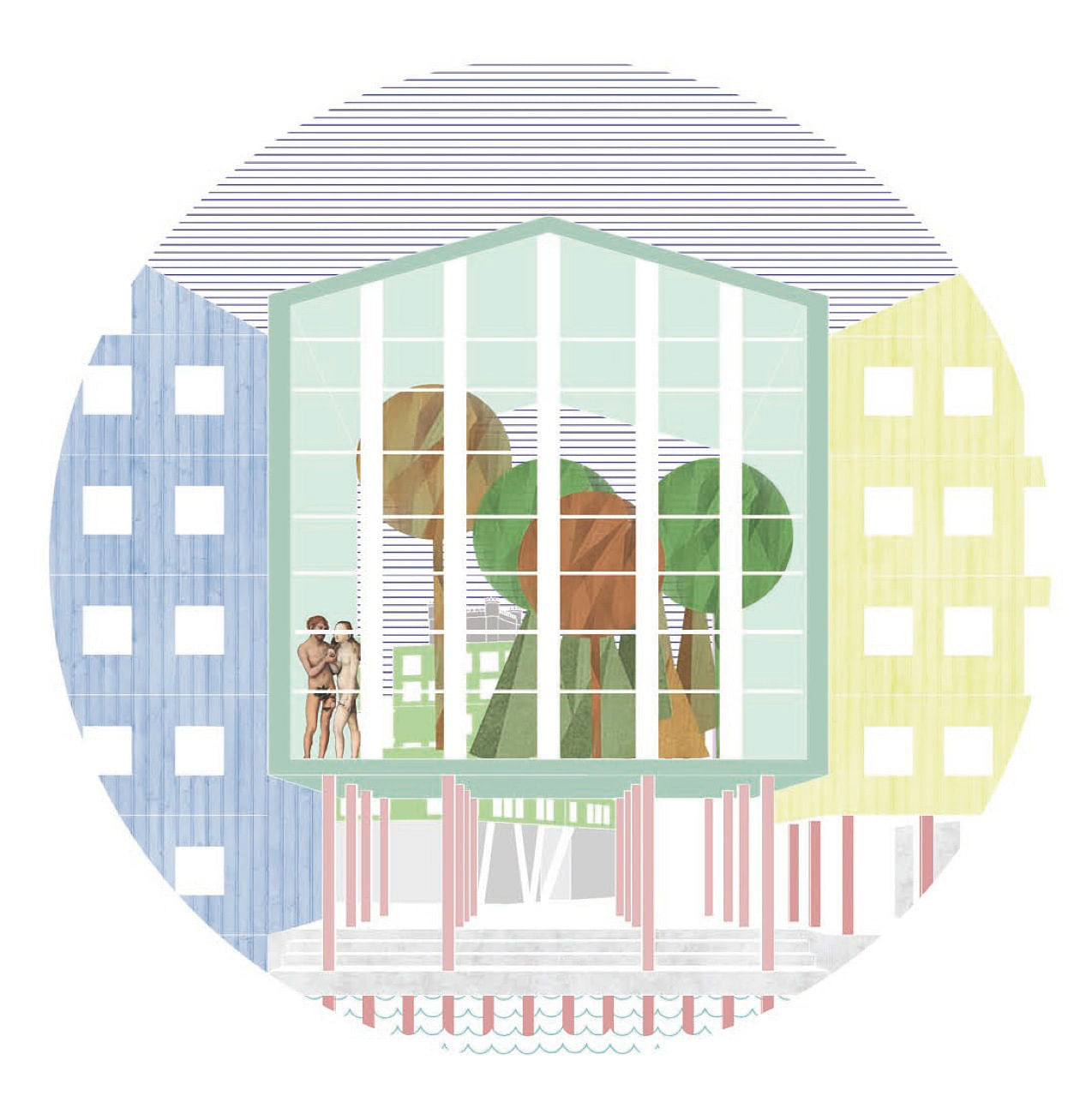
Concept Blink 2: waterfront densification throughout the new multipurpose buildings characterized by playful layers of density and permeability.

"Strandveikaia’s neighbourhood — and, more in general, all the harbour district of Nyhavna — is the testing ground where playing out our personal declination of the adaptable city, thanks to an approach able to combine a new waterfront, the existent heritage, the renovation of an industrial district and the presence of cultural actors. Looking at this miscellaneous context, the false mirror launches an inedited renewal process in which combining the reinterpretation of four local archetypes:

The typological reinterpretation of the warehouses: the morphology of one between the most iconic architectures of Trondheim represents the starting point for the formulation of a new hybrid typology able to establish itself in Strandveikaia through an urban characterizing pattern. Distancing from any kind of nostalgic revival, the former concept of the warehouse is revisited as a multifunctional typology characterized by an utter permeability at the street level: a polyhedric structure raised on pillars suitable to welcome different programs (such as co-housing, residential, offices, wintergardens..) and designed with a contemporary linguistic code.

The canalization of the whole Strandveikaia’s neighbourhood: the historical relationship between the harbour district and the water is re-established through a compelling dejavu created by a system of canals which give back to Strandveikaia its original sea View. The canals are an interactive fluid infrastructure able to give life to a new urban metabolism, turning Nyhavna into a limber playground, theatre of social interactions and flexible developments."
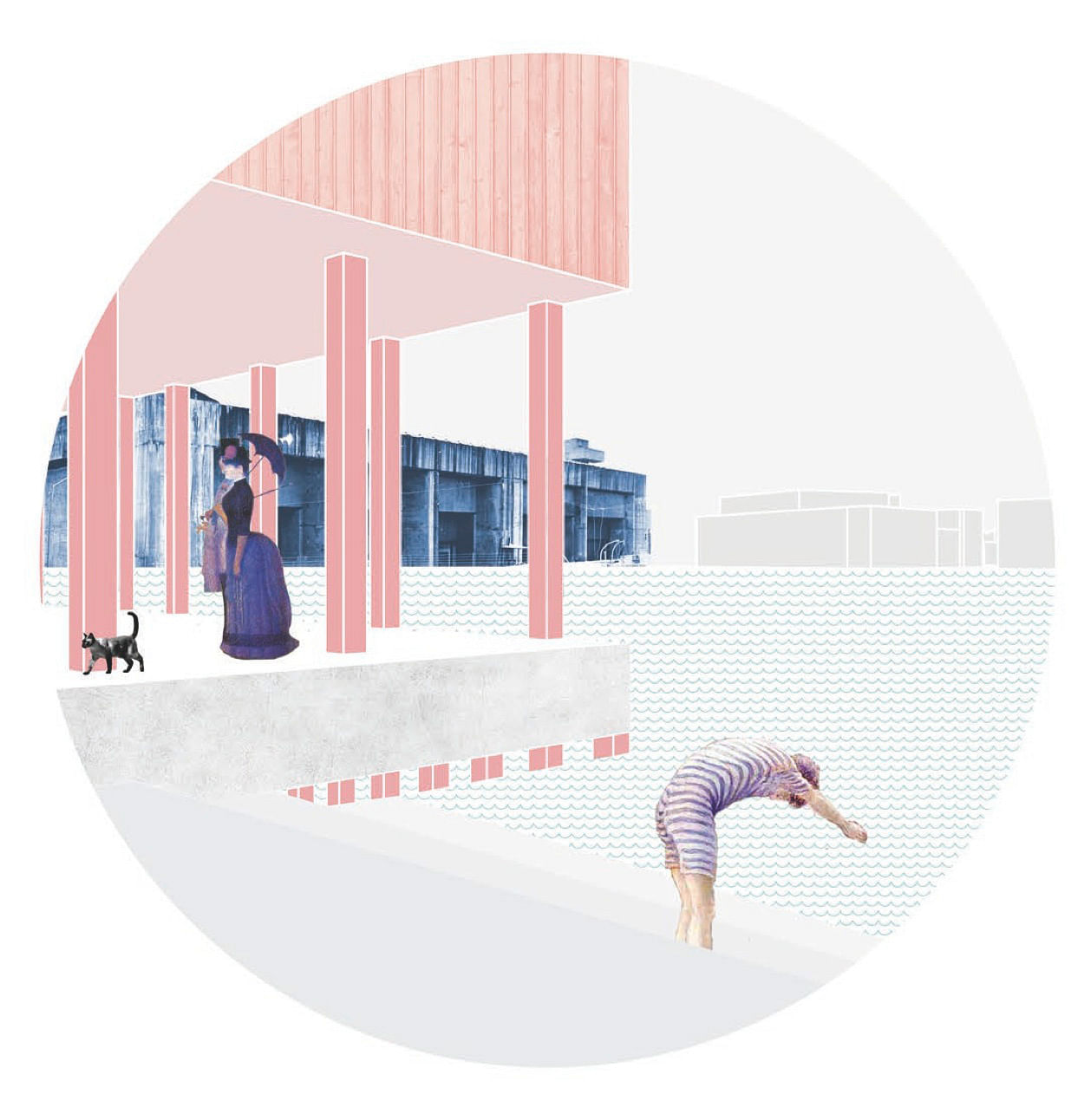
Concept Blink 3: new kinds of interaction with waterfront throughout the introduction of a covered promenade as well as public terraces, slopes, and green spots.

"The new fleet of temporary and multi-programmatic barges: as an answer to the need of temporary and flexible spaces, the false mirror takes advantage of the local-produced barges and ships. Trough a process of recovery, transformation, re-arrangement and reuse, the Trondheim’s fleet interacts with the new infrastructure given by the canals through partecipatory processes and maintains the metabolism of the district. Temporary bridges, floating shipyards, pavilions, water and green parks, saunas and floating markets are just few examples whereby Strandveikaia declines his artistic nature. Conceived as a generator of different and vibrant sceneries, the new Trondheim’s fleet reveals its twofold nature: on one hand they temporally host all the cultural activities running within the heritage buildings under the renovation process; on the other they continously transform Strandveikaia’s waterfront in an ever changing machine for programs, exhibitions and events.

A new land-water network: the infrastructural network induced by the canalization process, connects the district of Nyhavna, the waterfront and the city centre, thanks to a new system of urban ferries. With the aim of sewing up the gap between Strandveikaia and the city centre, a public network on the land accompanies the water infrastructure, in order to discourage the massive use of private vehicles in favour of an implemented public mobility system, thus aligning the guide lines of the Municipality masterplan. Restricted traffic areas for residents, juxtaposed by a new bycicle and pedestrian path, cross the site to rejoin the connection system included in the masterplan, while a new tram-line connected with the city centre helps out the defragmentation process of linking Strandveikaia to the central neighbourhoods of Trondheim." 
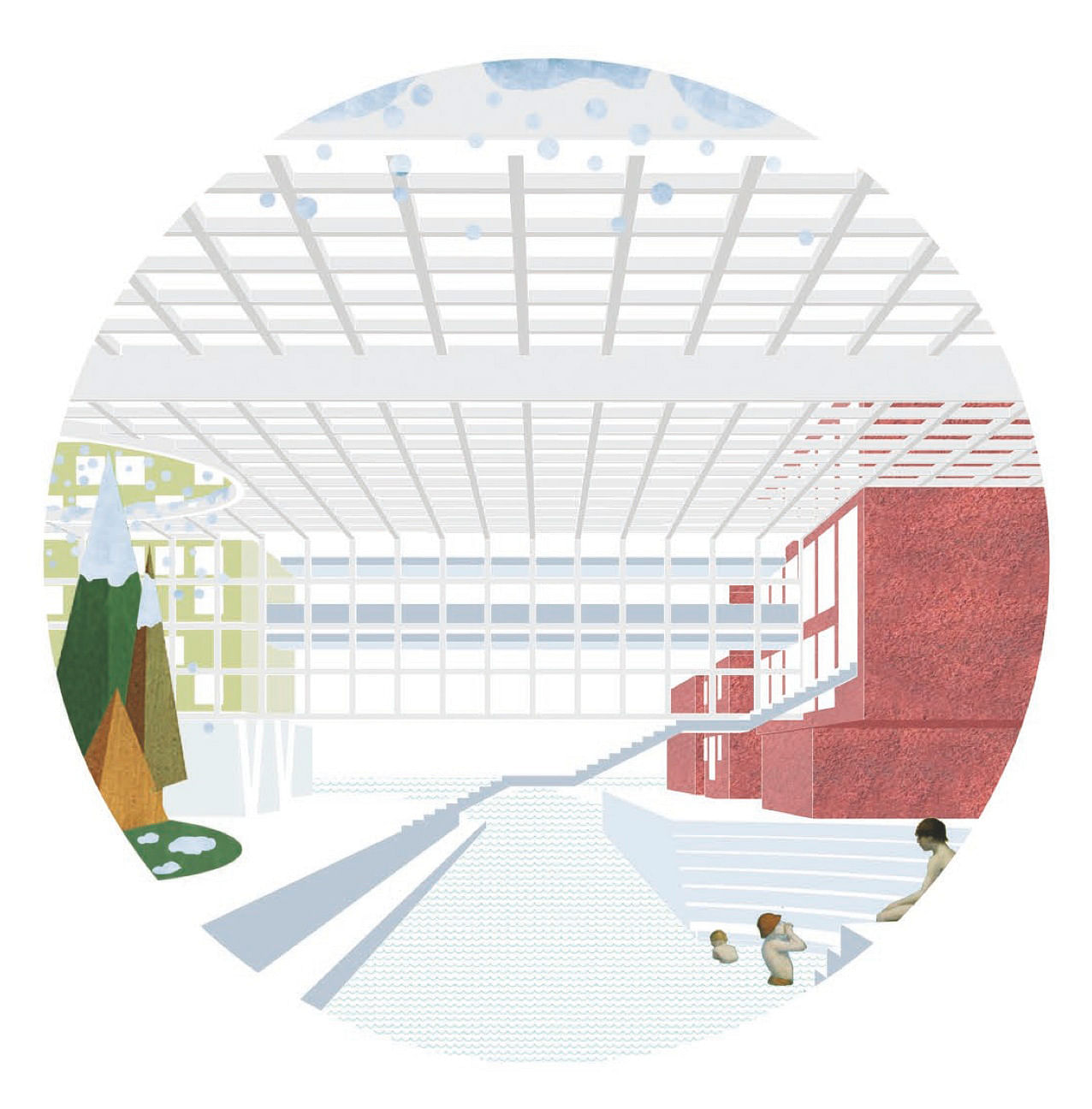
Concept Blink 4: the new climate controlled artificial sky along with one of the several new canals characterising the new dynamic waterfront of Strandveikaia.

"The combination of these new features, starting point for the renewal of Stranveikaia, takes shape through the development of a typological abacus consisting in 52 elements (sorted by type and characteristics). Rather than standard devices, ready for a possible, homogeneous and neutral application, each element lives a proper, specific life and rapresents a direct declination of the four archetypes the process is based on. Contextually adapted rather than generically adaptable, the elements of the abacus give Trondheim an inedit compromise between innovation and tradition, flexibility and permanence."
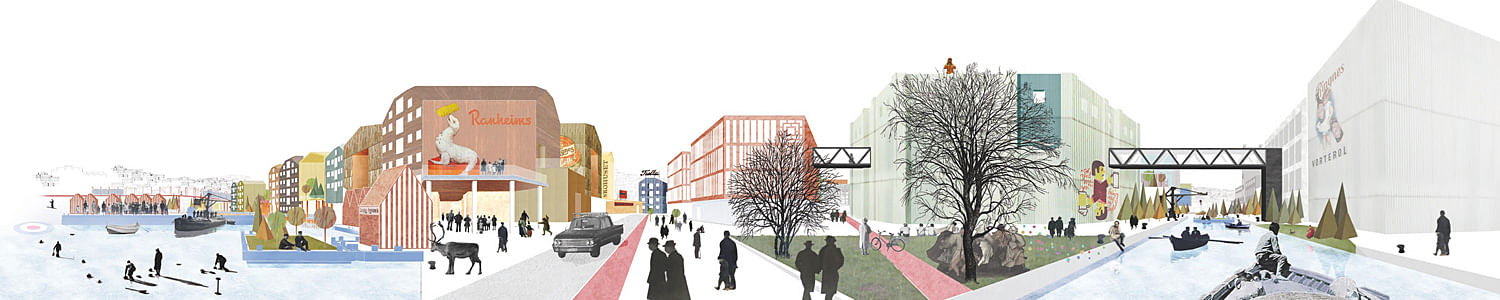
Multi-perspective view of the renovated district of Strandveikaia.

"Whether the false mirror answers the demand for an urban renovation — combining the four archetypes to a site specific package of elements — Strandveikaia might become the manifesto for a new way of understanding the XXI century’s city through a parallel reflection upon the development process itself."
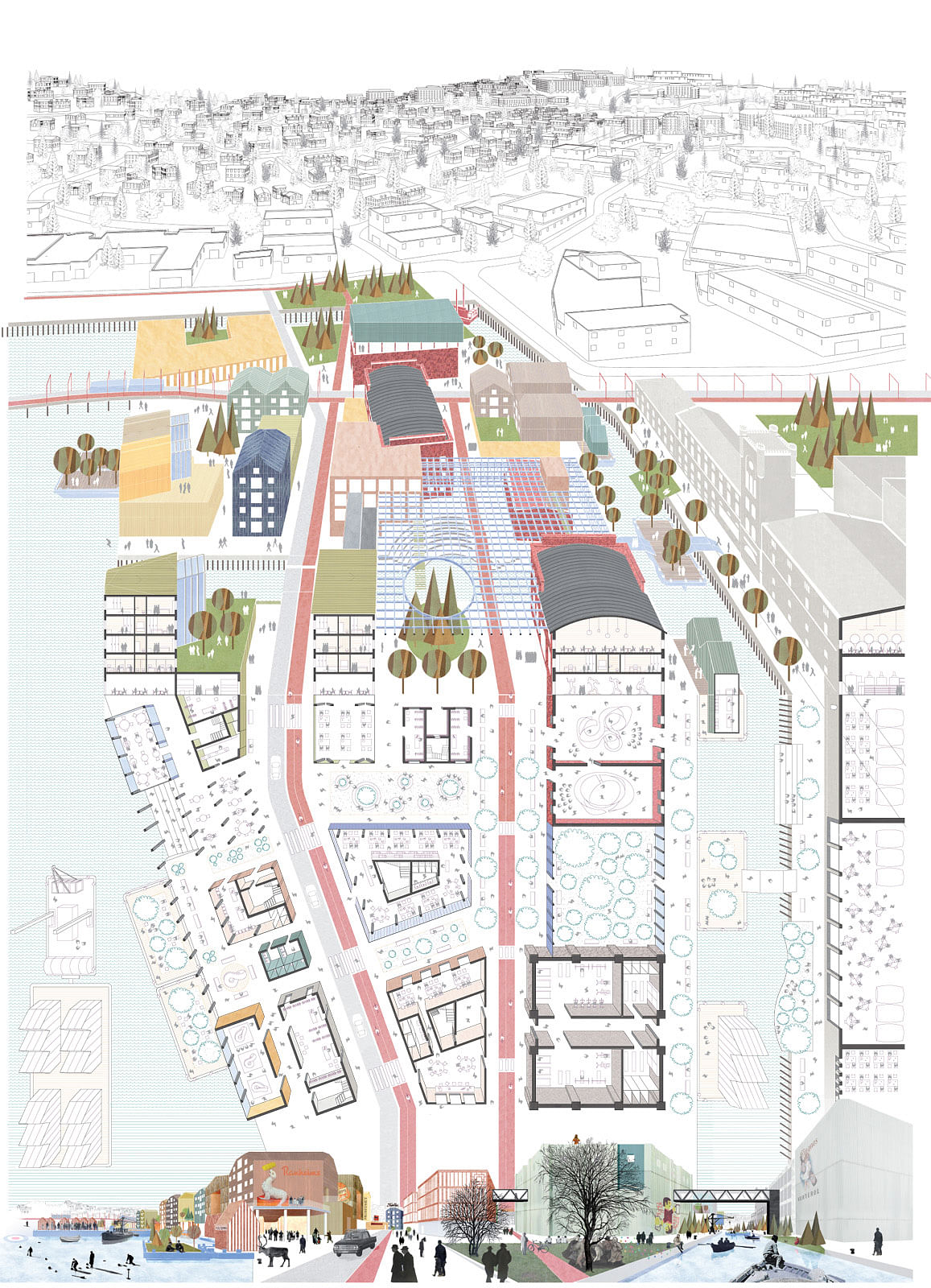
Multi-perspective view of the renovated district of Strandveikaia along with the overall Nihavna harbour district as well as the suburban surroundings.

"The contemporary urban context, together with its addiction to punctual strategies and transformation processes, can no longer rely on programs whose completeness is the only guarantee of success. A weakness that might be found as well in those aislated and autonomous processes whose lonely, happy existences reveal the inability to build up a system within the metabolism of the city taken as a whole. The false mirror starts up a process of renewal in Strandveikaia replacing the linear dimension of the temporal progression with a system of situations based on the interactions between the programmatic conditions offered by the context and the specific solutions derived from the abacus."
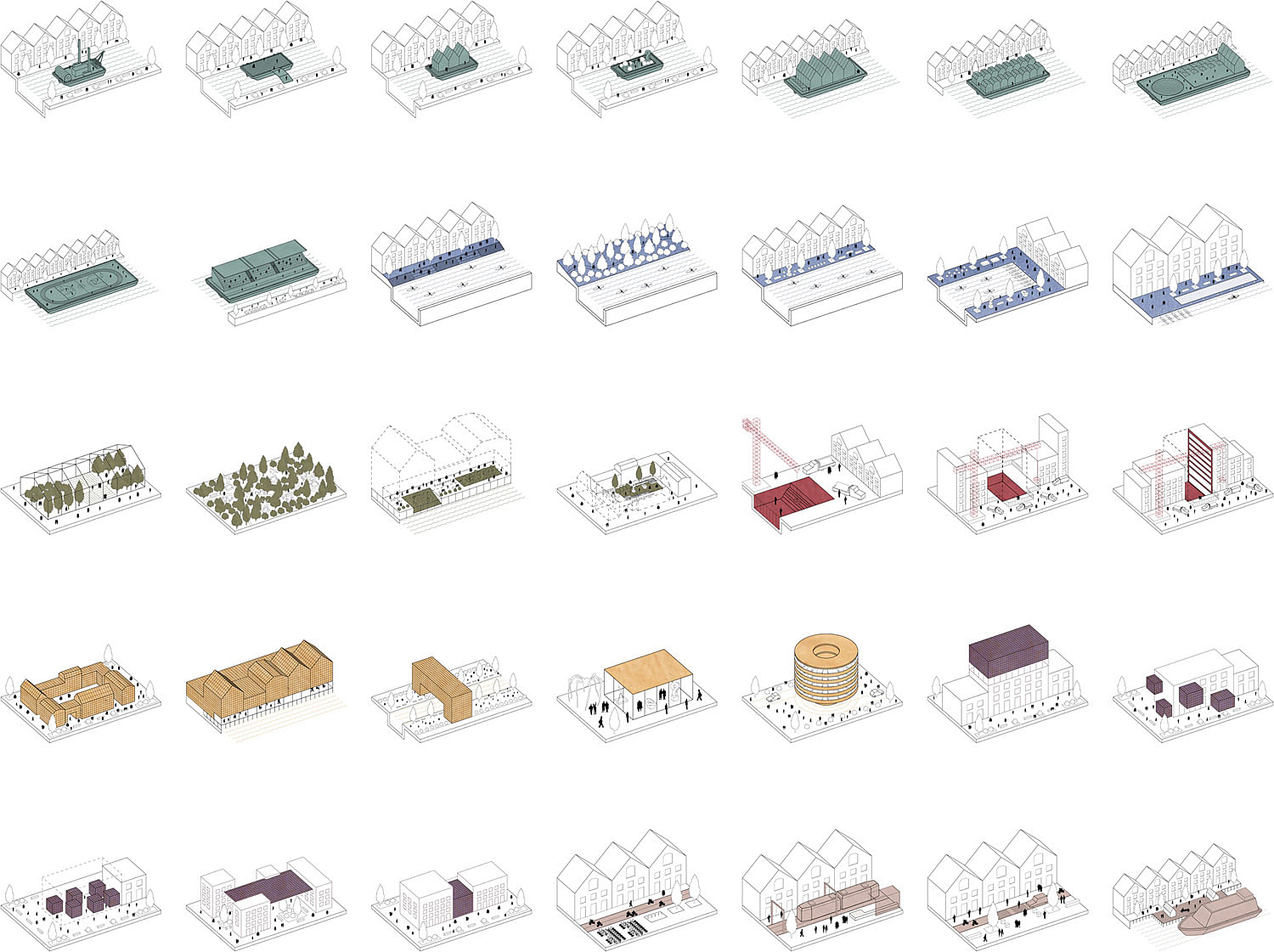
The abacus of the 35 architectural devices designed for Strandveikaia and used to create a new panorama of urban interactions.

"Without the need to outline the future of Strandveikaia through the rigid boundaries given by a strict time schedule, the development process of the harbor district of Trondheim grows through a network of interactions unlinked to a precise time sequence. Strandveikaia becomes the stage of an interactive and flexible process of interconnected situations, where the logical replaces the chronological and the trial and error strategies make room for a new trial and goal philosophy. 

The false mirror project defines the district of Strandveikaia as a new thrilling scenario for the waterfront of Trondheim, through a plan that works with time and against the generic city."
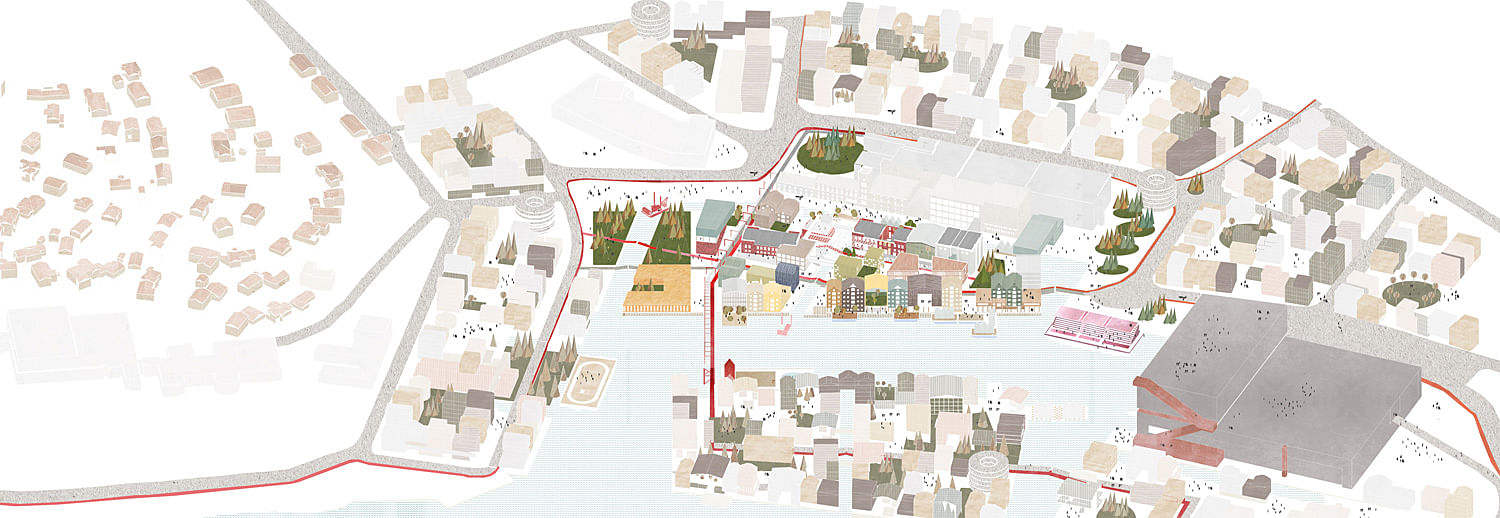
Axonometric view of the last phase of logical process envisioned for Strandveikaia. Labelled as « Opening Up Nyhavna », this phase shows how the renovation of the site project has been conceived as a trigger for an evolutionary process addressed to the harbour district of Nyhavna as a whole.

All images courtesy of The False Mirror Project.

Did you participate in Europan 13? Submit your winning entries to Bustler! We'll be posting a selection of entries in the coming weeks.

To find out how to submit, click here.

You can also check out previous winning Europan projects here.
Related

waterfront ● urban renewal ● urban planning ● urban design ● trondheim ● norway ● mirror ● europan 13 ● europan ● adaptability

Share

  • Follow

    0 Comments

  • Comment as :

A closer look at "The False Mirror", the Europan 13 Norway Trondheim 1st-prize winner

World’s most beautiful airports of 2026 chosen by Prix Versailles

New architecture and design competitions: Brick in Architecture Awards, Study Architecture Student Showcase, N.Y.C. Groceries, and New York High Falls Riverfront Market

SmithGroup’s ‘pioneering’ Philip Merrill Environmental Center wins AIA Twenty-five Year Award

Sponsored Post by Buildner

Museum of Emotions / Edition #8 FINAL registration deadline is in 5 DAYS!

Here are the winners of the 2026 AIA Architecture Awards

40 emerging architects and designers under 40 from Europe honored

Northwestern University selects 12-firm longlist to design new engineering building

New architecture and design competitions: Exploring 130 Years of American Design, Christo & Jeanne-Claude Center, 13 White Houses, and La Pyramide

Sign up for Bustler's Email Newsletters

Micro-architecture honored in latest Tiny House Architecture Competition

World’s most beautiful restaurants of 2026 chosen by Prix Versailles

Sponsored Post by Buildner

Design a wine tasting room in Italy! Valli Wine Tasting Room is launched!

10 can't-miss architecture & design events to see this June in London, Los Angeles, Chicago, San Francisco, Detroit, San Diego, Porto, and Barcelona

Sponsored Post by Buildner

Museum of Emotions / Edition #8 FINAL registration deadline is approaching!

Seven global projects make AR Public Awards shortlist 2026

Sponsored Post by Buildner

Design a slow-living restaurant in Portugal! Portugal Long Table Restaurant is launched!

Next page » Loading

A closer look at "The False Mirror", the Europan 13 Norway Trondheim 1st-prize winner

By Bustler Editors|

Wednesday, Jan 6, 2016

Share

Europan 13 Norway Trondheim - 1st prize winner: "The False Mirror". Aerial view of Trondheim’s harbour along with the completed renovation of Strandveikaia district.

Related

waterfront ● urban renewal ● urban planning ● urban design ● trondheim ● norway ● mirror ● europan 13 ● europan ● adaptability

In response to the Europan 13's "adaptable city" theme, the Norway competition for the city of Trondheim sought the best proposals that would improve the city's current urban design, while also acknowledging local typology, morphology, and culture. "The False Mirror", created by an architectural team who calls themselves The False Mirror Project, won first prize for this Norwegian site.

According to the competition jury, "The False Mirror" won the top prize for their analysis and reinterpretation of Trondheim's defining elements, including the city's warehouses, canals, sea vessels, and its unique landscape and infrastructure (On a side note, TFM Project's renderings are also utterly charming, no?)

Read on for more about the project that the architects shared with us.

Project description:

"The False Mirror / Det Falske Speil:

Europan addresses, for the second time, the matter of adaptability to the ever-changing condition of cities, along with the investigation about extremely actual concepts such as temporaryness, flexiblility and sustainability. Eventually set aside the superordinate paradigms of the Modern, nowadays it’s possible to outline a new trend within the urban dimension: what is flexible and fluid tries to replace what is permanent, the serial multiplicity substitutes Identity, while the generic scrapes away the specific.

In a context where such acclaimed adaptability seems to be no longer a conscious attitude, but a dogmatic precept, the false mirror internalizes such premises facing the automated enslavement to this belief and questions the foundation itself of this process: to what extent can the use of standardized, repetitive and environmentally adaptable elements represent a solution for a whatever city without losing the identity of that city itself? So, getting away from the common scenery visualized by this fortunate encounter between a very high-tech formalism and the misleading aesthetics of green sustainability, the false mirror tries to define a different declination of the word adaptable."

Concept Blink 1: the new urban park and the new kindergarten of Strandveikaia.

"Right from the critical reading of the main topics raised by Europan 13, Trondheim pops up like the perfect case study where testing a process based on the coexistence between the demanded flexibility and the specificity of a waterfront, along with its cultural, historical and urban background. Therefore Europan 13 turns into the perfect playground to experiment an innovative, heterogeneous approach where the obsolete slogan 'from local question to global solutio' naturally switches to a more appropriate 'from global requests to specific solution', while Nyhavna becomes the stage of a renovation process where the refusal of 'green-tech', neutral devices makes room for a hybrid vision that combines the pre-existence with a flexible process of transformation." 

Concept Blink 2: waterfront densification throughout the new multipurpose buildings characterized by playful layers of density and permeability.

"Strandveikaia’s neighbourhood — and, more in general, all the harbour district of Nyhavna — is the testing ground where playing out our personal declination of the adaptable city, thanks to an approach able to combine a new waterfront, the existent heritage, the renovation of an industrial district and the presence of cultural actors. Looking at this miscellaneous context, the false mirror launches an inedited renewal process in which combining the reinterpretation of four local archetypes:

The typological reinterpretation of the warehouses: the morphology of one between the most iconic architectures of Trondheim represents the starting point for the formulation of a new hybrid typology able to establish itself in Strandveikaia through an urban characterizing pattern. Distancing from any kind of nostalgic revival, the former concept of the warehouse is revisited as a multifunctional typology characterized by an utter permeability at the street level: a polyhedric structure raised on pillars suitable to welcome different programs (such as co-housing, residential, offices, wintergardens..) and designed with a contemporary linguistic code.

The canalization of the whole Strandveikaia’s neighbourhood: the historical relationship between the harbour district and the water is re-established through a compelling dejavu created by a system of canals which give back to Strandveikaia its original sea View. The canals are an interactive fluid infrastructure able to give life to a new urban metabolism, turning Nyhavna into a limber playground, theatre of social interactions and flexible developments."

Concept Blink 3: new kinds of interaction with waterfront throughout the introduction of a covered promenade as well as public terraces, slopes, and green spots.

"The new fleet of temporary and multi-programmatic barges: as an answer to the need of temporary and flexible spaces, the false mirror takes advantage of the local-produced barges and ships. Trough a process of recovery, transformation, re-arrangement and reuse, the Trondheim’s fleet interacts with the new infrastructure given by the canals through partecipatory processes and maintains the metabolism of the district. Temporary bridges, floating shipyards, pavilions, water and green parks, saunas and floating markets are just few examples whereby Strandveikaia declines his artistic nature. Conceived as a generator of different and vibrant sceneries, the new Trondheim’s fleet reveals its twofold nature: on one hand they temporally host all the cultural activities running within the heritage buildings under the renovation process; on the other they continously transform Strandveikaia’s waterfront in an ever changing machine for programs, exhibitions and events.

A new land-water network: the infrastructural network induced by the canalization process, connects the district of Nyhavna, the waterfront and the city centre, thanks to a new system of urban ferries. With the aim of sewing up the gap between Strandveikaia and the city centre, a public network on the land accompanies the water infrastructure, in order to discourage the massive use of private vehicles in favour of an implemented public mobility system, thus aligning the guide lines of the Municipality masterplan. Restricted traffic areas for residents, juxtaposed by a new bycicle and pedestrian path, cross the site to rejoin the connection system included in the masterplan, while a new tram-line connected with the city centre helps out the defragmentation process of linking Strandveikaia to the central neighbourhoods of Trondheim." 

Concept Blink 4: the new climate controlled artificial sky along with one of the several new canals characterising the new dynamic waterfront of Strandveikaia.

"The combination of these new features, starting point for the renewal of Stranveikaia, takes shape through the development of a typological abacus consisting in 52 elements (sorted by type and characteristics). Rather than standard devices, ready for a possible, homogeneous and neutral application, each element lives a proper, specific life and rapresents a direct declination of the four archetypes the process is based on. Contextually adapted rather than generically adaptable, the elements of the abacus give Trondheim an inedit compromise between innovation and tradition, flexibility and permanence."

Multi-perspective view of the renovated district of Strandveikaia.

"Whether the false mirror answers the demand for an urban renovation — combining the four archetypes to a site specific package of elements — Strandveikaia might become the manifesto for a new way of understanding the XXI century’s city through a parallel reflection upon the development process itself."

Multi-perspective view of the renovated district of Strandveikaia along with the overall Nihavna harbour district as well as the suburban surroundings.

"The contemporary urban context, together with its addiction to punctual strategies and transformation processes, can no longer rely on programs whose completeness is the only guarantee of success. A weakness that might be found as well in those aislated and autonomous processes whose lonely, happy existences reveal the inability to build up a system within the metabolism of the city taken as a whole. The false mirror starts up a process of renewal in Strandveikaia replacing the linear dimension of the temporal progression with a system of situations based on the interactions between the programmatic conditions offered by the context and the specific solutions derived from the abacus."

The abacus of the 35 architectural devices designed for Strandveikaia and used to create a new panorama of urban interactions.

"Without the need to outline the future of Strandveikaia through the rigid boundaries given by a strict time schedule, the development process of the harbor district of Trondheim grows through a network of interactions unlinked to a precise time sequence. Strandveikaia becomes the stage of an interactive and flexible process of interconnected situations, where the logical replaces the chronological and the trial and error strategies make room for a new trial and goal philosophy. 

The false mirror project defines the district of Strandveikaia as a new thrilling scenario for the waterfront of Trondheim, through a plan that works with time and against the generic city."

Axonometric view of the last phase of logical process envisioned for Strandveikaia. Labelled as « Opening Up Nyhavna », this phase shows how the renovation of the site project has been conceived as a trigger for an evolutionary process addressed to the harbour district of Nyhavna as a whole.

All images courtesy of The False Mirror Project.

Did you participate in Europan 13? Submit your winning entries to Bustler! We'll be posting a selection of entries in the coming weeks.

To find out how to submit, click here.

You can also check out previous winning Europan projects here.

Share

  • Follow

    0 Comments

  • Comment as :

Archinect JobsArchinect Jobs

The Archinect Job Board attracts the world's top architectural design talents.

VIEW ALL JOBS POST A JOB

Architectural Designer, Residential

Roman and Williams Buildings and Interiors

Architectural Designer, Residential

New York, NY, US

Junior Architect / Architectural Designer

S20M

Junior Architect / Architectural Designer

New York, NY, US

Miami Senior Project Coordinator

BMA Architects

Miami Senior Project Coordinator

Miami, FL, US

Architectural Project Manager - Residential

DAHLIN Architecture | Planning | Interiors

Architectural Project Manager - Residential

Pleasanton, CA, US

 Intermediate Architect

Curtis + Ginsberg Architects LLP

Intermediate Architect

New York, NY, US

Project Manager / Project Architect (5–10 Years’ Experience)

Millan Architect / Studio Inc.

Project Manager / Project Architect (5–10 Years’ Experience)

Venice, CA, US

Marketing + Communications Specialist

Trahan Architects

Marketing + Communications Specialist

New York, NY, US

Junior Architect

Eric Colbert & Associates

Junior Architect

Washington, DC, US

Senior Project Architect

Breland – Harper

Senior Project Architect

Los Angeles, CA, US

AutoCAD Drafter/Architectural Designer

Kari Whitman Interiors

AutoCAD Drafter/Architectural Designer

Boulder, CO, US

Next page » Loading