• Login / Join
  • About
  • •
  • Contact
  • •
  • Advertising
bustler logo
bustler logo
  • News
  • Competitions
  • Events
  • Bustler is powered by Archinect
  • Sign up for Bustler's Email Newsletters

  • Follow these Bustler feeds:

  • Search

    Search in

  • Submit

    What are you submitting?

    News Pitch
    Competition
    Event
  • Login / Join
  • News|Competitions|Events
  • Search
    | Submit
    | Follow
  • Search in

    What are you submitting?

    News Pitch
    Competition
    Event

    Follow these Bustler feeds:

  • About|Contact|Advertising
  • Login / Join

How would you reimagine NYC’s MetLife Building? These top architects share their winning ideas

By Justine Testado|

Friday, Mar 4, 2016

Have you ever found yourself mentally redesigning the exterior of an architectural icon, say the MetLife Building in NYC, for instance? Architects and designers worldwide had the opportunity to draw out such ideas in the “Reimagine a New York City Icon” competition, which Metals in Construction magazine launched last September.

Designed by Emery Roth & Sons, Pietro Belluschi, and Walter Gropius, the 59-story-tall structure was originally known as the Pan Am Building when it first opened on March 7, 1963. The airline company used the building as its headquarters until MetLife purchased it in 1981. Although MetLife sold the structure in 2005, the MetLife Building name still stuck.

For the competition, entrants were tasked with reimagining the building with a "resource-conserving, eco-friendly enclosure [that] creates a light, transparents, and highly efficient envelope" that meets present-day office demands. At the same time, proposals had to preserve and enhance the original aesthetic of the building. There are no actual plans to redesign the MetLife Building's facade, but the ideas could be used to help fix up other structures.

'The competition was conceived to explore ways of retrofitting existing facades for high performance when preservation and innovation are competing priorities,' stated Gary Higbee, director of industry development for the Ornamental Metal Institute of New York and editor of Metals in Construction. 'Recladding a building can give it a new visual identity and radically improve its energy performance in the process. But how do you address this with recognized landmarks?'

The competition concluded with the selection of six winning entries, which shared the US$15,000 prize.

Have a look at them below.
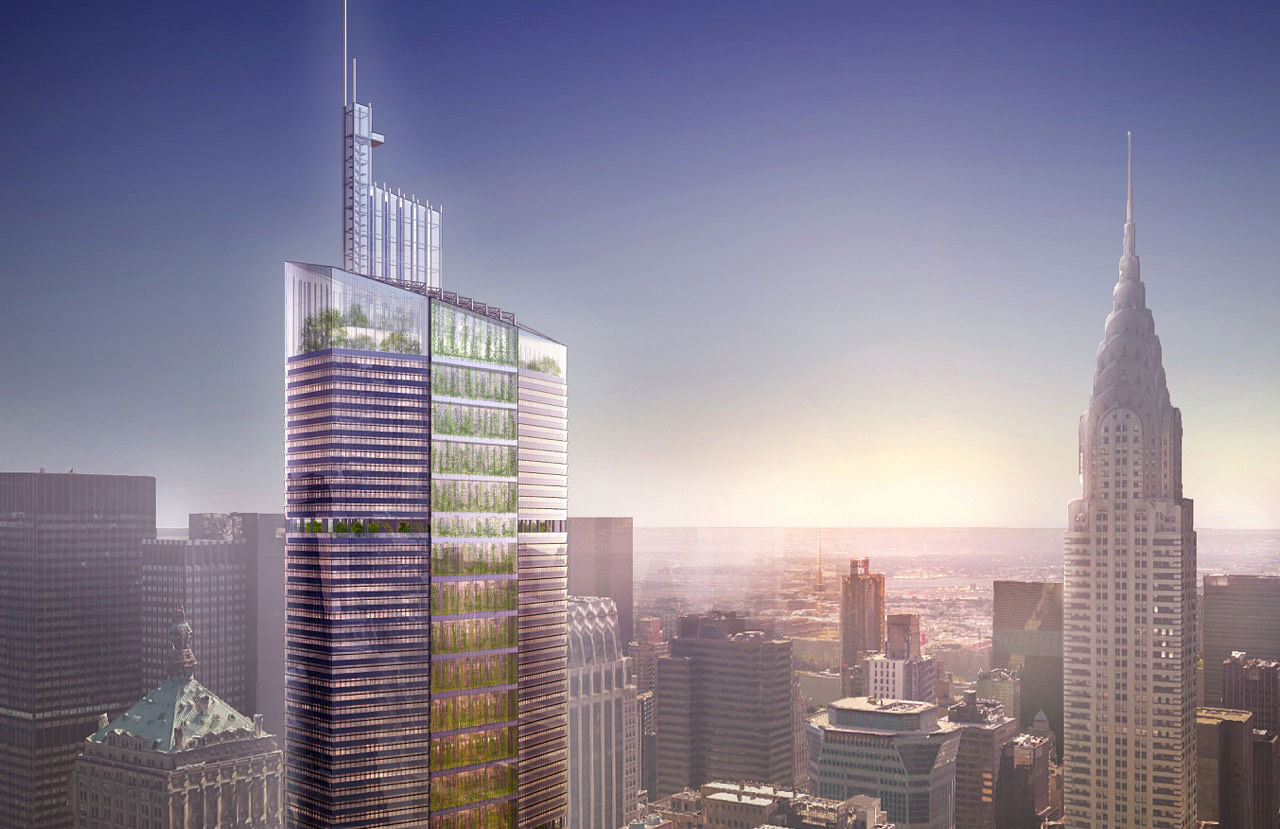
HARNESSING URBAN ENERGIES by FXFOWLE, Thornton Tomasetti, and Dagher Engineering.

HARNESSING URBAN ENERGIES
by FXFOWLE, Thornton Tomasetti, and Dagher Engineering

Project excerpt: "Broadly considered, the building façade is a mediating element: between public and private realms; between interior and exterior environments; and between urban and human scales. In working through and reconciling these sometimes conflicting considerations, the design takes on a specific character...It is our conviction that the responsibility to minimize energy consumption and carbon emissions in our built environment comes with an equal responsibility to achieve the highest standards of design. In our submission for the Metals in Architecture competition, we have lowered the present annual energy consumption of the building by 80 percent, and by 74 percent as compared to the median New York City office building."

Full proposal

​PANAM UNDER GLASS by VOA Architecture and Werner Sobek New York Corp.

PANAM UNDER GLASS
by VOA Architecture and Werner Sobek New York Corp.

Project excerpt: "Piercing the tower on either side of the New York Central Building and then chiseling bulk away around the penetrations creates just enough transparency to allow the building to remain a focal point without the complete removal of mass between the core and the wings. Removed floor area is relocated to graduated upper floors to suggest skyward ascension. The outer glass sheath restores the building to a simpler geometry. Adapting the tapered form of the tower as a geometric module/motif creates a non-directional pattern across the surface of the tower – in keeping with early models and renderings which emphasized the form over the surface. Applied in a larger scale to the tower allows for maximum daylighting while the denser, smaller scale at the podium creates a more monolithic reading much closer to pedestrian level."

Full proposal

PERFORMANCE‐BASED PRESERVATION by SHoP Architects, Heintges, and CASE-RPI.

PERFORMANCE‐BASED PRESERVATION
by SHoP Architects, Heintges, and CASE-RPI

Project excerpt: "Our proposal for 200 Park Avenue preserves the most iconic element of the existing facade: its precast concrete shell. On the north and south, we add a new unitized curtainwall outboard of the concrete that uses emerging materials to generate energy while dynamically controlling solar heat gain and glare. On the east and west, we bring the new envelope inboard of the concrete to highlight the materiality and plasticity of the existing skin. By preserving and overcladding - instead of demolishing and recladding - our proposal reduces the building’s environmental impact by 42% over the next 50 years. We see our approach as a template for making needed improvements to New York’s existing building stock. Performance-based preservation is a progressive approach to preservation that enables us to meet the challenges ahead without jettisoning the past."

Full proposal

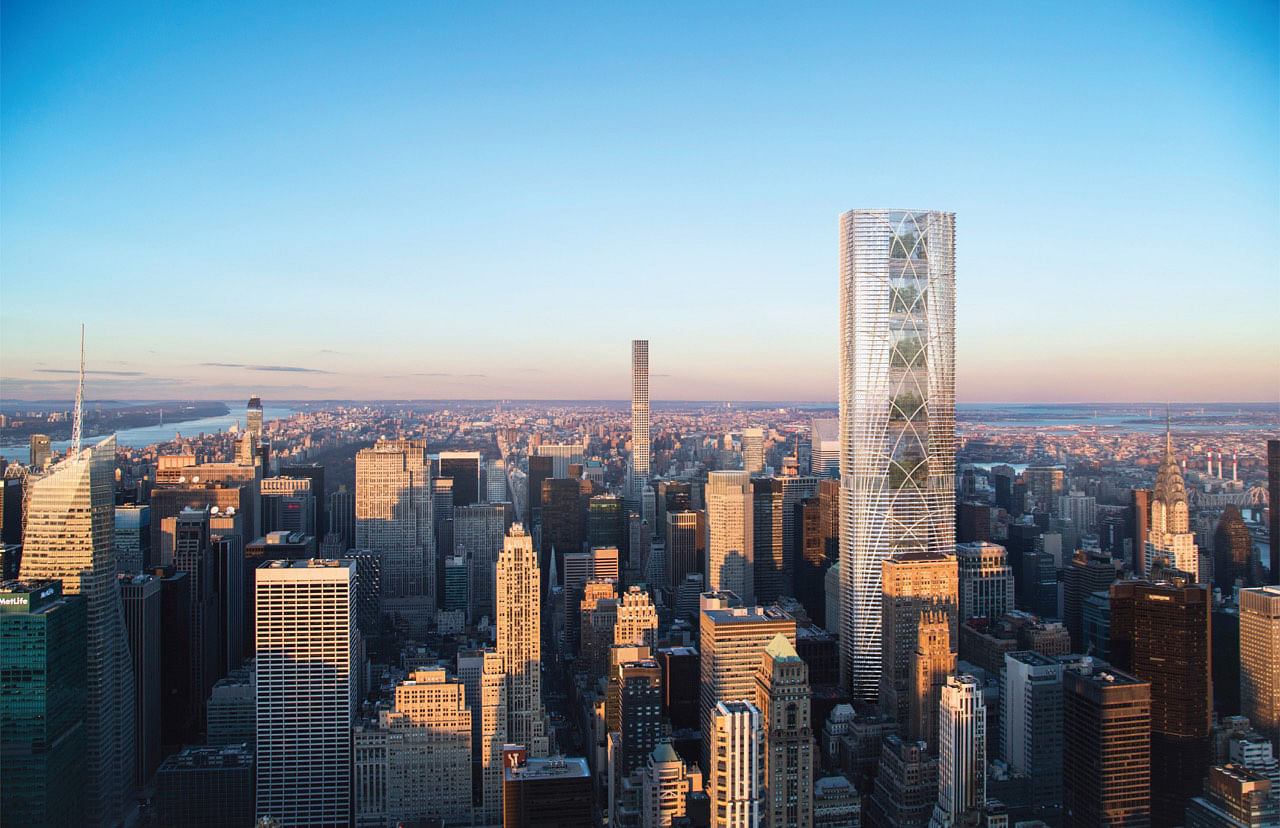
THERMALSWITCH FAÇADE by StudioTJOA.

THERMALSWITCH FAÇADE
by StudioTJOA

Project excerpt: "There are four different types of facade renovations: Replacement, Recladding, Overcladding and Double Skin. When it comes to the preservation of a landmark building, like The Metlife Building, the first two could be argued as the most appropriate, although probably not the most financially feasible. The Thermalswitch facade looks at hybridizing the overcladding and double skin techniques to create a unitized frame which mounts directly over the existing precast panels. The Metlife facade is constructed of a primary precast panel with integrated fins on both sides that alternates every other bay. Between these primary panels, secondary infills are set at the spandrel conditions..."
Full proposal

​VERTIMEME by AECOM, Volley Studio (rendering).

VERTIMEME
by AECOM, Volley Studio

Project excerpt: "Memetics is the process that defines the spread of an idea based on social evolution. We are already seeing building repositioning projects that increase in height and provide significantly improved space to occupants. The vertical memetics of the future city will include a myriad of strategies to bind economic impacts with environmental efficacy. Vertimeme celebrates the social evolution of the vertical city as the extrapolation of an idea."

Full proposal

FARM FOLLOWS FICTION by LemayLAB, Ecosystem, and Sefaira.

FARM FOLLOWS FICTION
by LemayLAB, Ecosystem, and Sefaira

Project summary: Depicted in the form of a graphic novel, the story of the MetLife Building is reimagined as an urban farm skyscraper.

Read it here.

JURY

  • Ben Tranel, Gensler
  • Areta Pawlynsky, Heintges
  • Billie Faircloth, Kieran Timberlake
  • Fiona Cousins, Arup
  • Sameer Kumar, SHoP Architects
  • Hauke Jungjohann, Thornton Tomasetti
  • Peter Arbour, Vidaris

Related

iconic structures ● facade ● ideas competition ● competition ● new york city ● identity
FXCollaborative
FXCollaborative Hiring!
Thornton Tomasetti
Thornton Tomasetti
Dagher Engineering
Dagher Engineering
Werner Sobek
Werner Sobek
SHoP Architects
SHoP Architects
STUDIOTJOA
STUDIOTJOA
AECOM
AECOM
Volley Studio
Volley Studio
Sefaira
Sefaira

Share

  • Follow

    0 Comments

  • Comment as :

How would you reimagine NYC’s MetLife Building? These top architects share their winning ideas

New architecture and design competitions: Brick in Architecture Awards, Study Architecture Student Showcase, N.Y.C. Groceries, and New York High Falls Riverfront Market

SmithGroup’s ‘pioneering’ Philip Merrill Environmental Center wins AIA Twenty-five Year Award

Sponsored Post by Buildner

Museum of Emotions / Edition #8 FINAL registration deadline is in 5 DAYS!

Here are the winners of the 2026 AIA Architecture Awards

40 emerging architects and designers under 40 from Europe honored

Northwestern University selects 12-firm longlist to design new engineering building

New architecture and design competitions: Exploring 130 Years of American Design, Christo & Jeanne-Claude Center, 13 White Houses, and La Pyramide

Micro-architecture honored in latest Tiny House Architecture Competition

Sign up for Bustler's Email Newsletters

World’s most beautiful restaurants of 2026 chosen by Prix Versailles

Sponsored Post by Buildner

Design a wine tasting room in Italy! Valli Wine Tasting Room is launched!

10 can't-miss architecture & design events to see this June in London, Los Angeles, Chicago, San Francisco, Detroit, San Diego, Porto, and Barcelona

Sponsored Post by Buildner

Museum of Emotions / Edition #8 FINAL registration deadline is approaching!

Seven global projects make AR Public Awards shortlist 2026

Sponsored Post by Buildner

Design a slow-living restaurant in Portugal! Portugal Long Table Restaurant is launched!

World's best tall buildings honored at the CVU 2026 Award of Excellence

Next page » Loading

How would you reimagine NYC’s MetLife Building? These top architects share their winning ideas

By Justine Testado|

Friday, Mar 4, 2016

Share

Related

iconic structures ● facade ● ideas competition ● competition ● new york city ● identity
FXCollaborative
FXCollaborative Hiring!
Thornton Tomasetti
Thornton Tomasetti
Dagher Engineering
Dagher Engineering
Werner Sobek
Werner Sobek
SHoP Architects
SHoP Architects
STUDIOTJOA
STUDIOTJOA
AECOM
AECOM
Volley Studio
Volley Studio
Sefaira
Sefaira

Have you ever found yourself mentally redesigning the exterior of an architectural icon, say the MetLife Building in NYC, for instance? Architects and designers worldwide had the opportunity to draw out such ideas in the “Reimagine a New York City Icon” competition, which Metals in Construction magazine launched last September.

Designed by Emery Roth & Sons, Pietro Belluschi, and Walter Gropius, the 59-story-tall structure was originally known as the Pan Am Building when it first opened on March 7, 1963. The airline company used the building as its headquarters until MetLife purchased it in 1981. Although MetLife sold the structure in 2005, the MetLife Building name still stuck.

For the competition, entrants were tasked with reimagining the building with a "resource-conserving, eco-friendly enclosure [that] creates a light, transparents, and highly efficient envelope" that meets present-day office demands. At the same time, proposals had to preserve and enhance the original aesthetic of the building. There are no actual plans to redesign the MetLife Building's facade, but the ideas could be used to help fix up other structures.

'The competition was conceived to explore ways of retrofitting existing facades for high performance when preservation and innovation are competing priorities,' stated Gary Higbee, director of industry development for the Ornamental Metal Institute of New York and editor of Metals in Construction. 'Recladding a building can give it a new visual identity and radically improve its energy performance in the process. But how do you address this with recognized landmarks?'

The competition concluded with the selection of six winning entries, which shared the US$15,000 prize.

Have a look at them below.

HARNESSING URBAN ENERGIES by FXFOWLE, Thornton Tomasetti, and Dagher Engineering.

HARNESSING URBAN ENERGIES
by FXFOWLE, Thornton Tomasetti, and Dagher Engineering

Project excerpt: "Broadly considered, the building façade is a mediating element: between public and private realms; between interior and exterior environments; and between urban and human scales. In working through and reconciling these sometimes conflicting considerations, the design takes on a specific character...It is our conviction that the responsibility to minimize energy consumption and carbon emissions in our built environment comes with an equal responsibility to achieve the highest standards of design. In our submission for the Metals in Architecture competition, we have lowered the present annual energy consumption of the building by 80 percent, and by 74 percent as compared to the median New York City office building."

Full proposal

​PANAM UNDER GLASS by VOA Architecture and Werner Sobek New York Corp.

PANAM UNDER GLASS
by VOA Architecture and Werner Sobek New York Corp.

Project excerpt: "Piercing the tower on either side of the New York Central Building and then chiseling bulk away around the penetrations creates just enough transparency to allow the building to remain a focal point without the complete removal of mass between the core and the wings. Removed floor area is relocated to graduated upper floors to suggest skyward ascension. The outer glass sheath restores the building to a simpler geometry. Adapting the tapered form of the tower as a geometric module/motif creates a non-directional pattern across the surface of the tower – in keeping with early models and renderings which emphasized the form over the surface. Applied in a larger scale to the tower allows for maximum daylighting while the denser, smaller scale at the podium creates a more monolithic reading much closer to pedestrian level."

Full proposal

PERFORMANCE‐BASED PRESERVATION by SHoP Architects, Heintges, and CASE-RPI.

PERFORMANCE‐BASED PRESERVATION
by SHoP Architects, Heintges, and CASE-RPI

Project excerpt: "Our proposal for 200 Park Avenue preserves the most iconic element of the existing facade: its precast concrete shell. On the north and south, we add a new unitized curtainwall outboard of the concrete that uses emerging materials to generate energy while dynamically controlling solar heat gain and glare. On the east and west, we bring the new envelope inboard of the concrete to highlight the materiality and plasticity of the existing skin. By preserving and overcladding - instead of demolishing and recladding - our proposal reduces the building’s environmental impact by 42% over the next 50 years. We see our approach as a template for making needed improvements to New York’s existing building stock. Performance-based preservation is a progressive approach to preservation that enables us to meet the challenges ahead without jettisoning the past."

Full proposal

THERMALSWITCH FAÇADE by StudioTJOA.

THERMALSWITCH FAÇADE
by StudioTJOA

Project excerpt: "There are four different types of facade renovations: Replacement, Recladding, Overcladding and Double Skin. When it comes to the preservation of a landmark building, like The Metlife Building, the first two could be argued as the most appropriate, although probably not the most financially feasible. The Thermalswitch facade looks at hybridizing the overcladding and double skin techniques to create a unitized frame which mounts directly over the existing precast panels. The Metlife facade is constructed of a primary precast panel with integrated fins on both sides that alternates every other bay. Between these primary panels, secondary infills are set at the spandrel conditions..."

Full proposal

​VERTIMEME by AECOM, Volley Studio (rendering).

VERTIMEME
by AECOM, Volley Studio

Project excerpt: "Memetics is the process that defines the spread of an idea based on social evolution. We are already seeing building repositioning projects that increase in height and provide significantly improved space to occupants. The vertical memetics of the future city will include a myriad of strategies to bind economic impacts with environmental efficacy. Vertimeme celebrates the social evolution of the vertical city as the extrapolation of an idea."

Full proposal

FARM FOLLOWS FICTION by LemayLAB, Ecosystem, and Sefaira.

FARM FOLLOWS FICTION
by LemayLAB, Ecosystem, and Sefaira

Project summary: Depicted in the form of a graphic novel, the story of the MetLife Building is reimagined as an urban farm skyscraper.

Read it here.

JURY

  • Ben Tranel, Gensler
  • Areta Pawlynsky, Heintges
  • Billie Faircloth, Kieran Timberlake
  • Fiona Cousins, Arup
  • Sameer Kumar, SHoP Architects
  • Hauke Jungjohann, Thornton Tomasetti
  • Peter Arbour, Vidaris

Share

  • Follow

    0 Comments

  • Comment as :

Archinect JobsArchinect Jobs

The Archinect Job Board attracts the world's top architectural design talents.

VIEW ALL JOBS POST A JOB

Project Architect

Office JDY

Project Architect

Brooklyn, NY, US

Architectural Designer

1100 Architect

Architectural Designer

New York, NY, US

Job Captain

Studio AR&D Architects

Job Captain

Los Angeles, CA, US

Architectural Designer

Build Block Inc.

Architectural Designer

Los Angeles, CA, US

Designer

HATCH ARCHITECTURE

Designer

Los Angeles, CA, US

Architectural Designer, Residential

Roman and Williams Buildings and Interiors

Architectural Designer, Residential

New York, NY, US

Hospitality Project Architect

bonetti/kozerski architecture DPC

Hospitality Project Architect

New York, NY, US

Project Architect

Pickard Architects

Project Architect

Whittier, CA, US

Intermediate Designer - 3+ Years Experience (NY)

Cass Calder Smith

Intermediate Designer - 3+ Years Experience (NY)

New York, NY, US

Junior Designer

OLIVER FREUNDLICH DESIGN

Junior Designer

New York, NY, US

Next page » Loading