• Login / Join
  • About
  • •
  • Contact
  • •
  • Advertising
bustler logo
bustler logo
  • News
  • Competitions
  • Events
  • Bustler is powered by Archinect
  • Sign up for Bustler's Email Newsletters

  • Follow these Bustler feeds:

  • Search

    Search in

  • Submit

    What are you submitting?

    News Pitch
    Competition
    Event
  • Login / Join
  • News|Competitions|Events
  • Search
    | Submit
    | Follow
  • Search in

    What are you submitting?

    News Pitch
    Competition
    Event

    Follow these Bustler feeds:

  • About|Contact|Advertising
  • Login / Join

Urban Forest Wins Streetscapes in a New World Competition

By Bustler Editors|

Wednesday, Aug 13, 2008

The international competition for a New Urban Streetscape in Beijing, China was organized by New World China Land Limited – one of Asia’s largest development corporations – in collaboration with Di Magazine, a leading architectural review published in Beijing.  The designated site area divides New World’s recently built commercial center, located on Chongwenmen Street.

The key sponsor, New World China Land Limited, is based in Hong Kong, with a wide range of projects currently under construction - including commercial, residential, hotel and resort developments throughout the People’s Republic of China. 
image

The competition brief described the design objective as a search for an environmentally responsible public space that would also propose a new paradigm for expanding the number and quality of parks, plazas and gardens in Beijing.

The SITE New York office was invited by WaHa Studio in Toronto, Canada (li Wang and Marc Halle) to head a Canadian/Chinese team of architects and landscape designers – including WaHa, Yang Yang and Ronghui Li – with the purpose of proposing a concept for the New World competition. This project is the result of a SITE New York and WaHa Studio collaboration.

Premises for the design approach:

The burgeoning growth of central Beijing has either destroyed or disrupted a large number of the city’s original one-to-three story residential neighborhoods – especially in the most vulnerable and historic Hutong areas.  Large-scale developments have imposed an imbalance between commercial expansion and the maintenance of traditional communities.  It has also increased air pollution, visibly exposed the gap between rich and poor, exacerbated the level of street crime and decreased the amount of leisure and garden space within the central city.
image

In addition to social, cultural, contextual and ecological considerations, the SITE/WaHa design approach to the New World Plaza has been based on Beijing’s radical contrast of scales – from intimate residential streets to massive commercial zones.  It is our team’s view that one of the main values of horizontal surfaces in the cityscape is to use streets, parks, plazas and gardens as means of mediation between neighborhoods, building heights, economic levels and territorial functions. 

Project description:

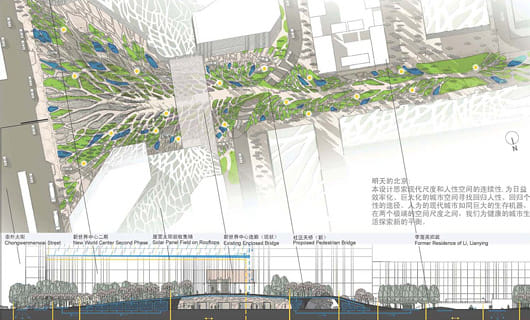
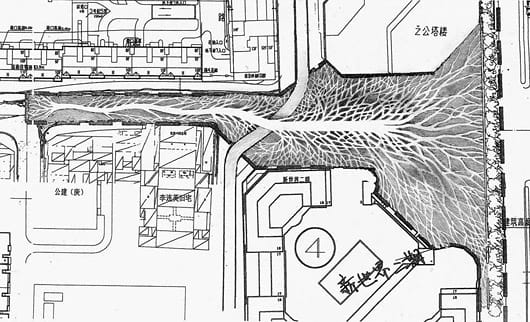
In designing the New World public space, the SITE/WaHa “Urban Forest” concept has been influenced by an observation that the existing site is roughly shaped like a growing tree, with a crown of extended branches.  It can also be seen as similar to a river, with many tributaries, or linked to the cardiovascular system of a human body.  In addition, since the entire Beijing street system is based on a classic grid, the paved areas in this design are used for a special iconographic significance.  These horizontal surfaces have been dematerialized and fragmented into casual, ribbon-like patterns, reminiscent of Chinese calligraphy and landscape painting.  While intentionally ambiguous, the plaza imagery is proposed as a nature-based and culturally referenced source of symbolism for a rapidly expanding metropolis. 

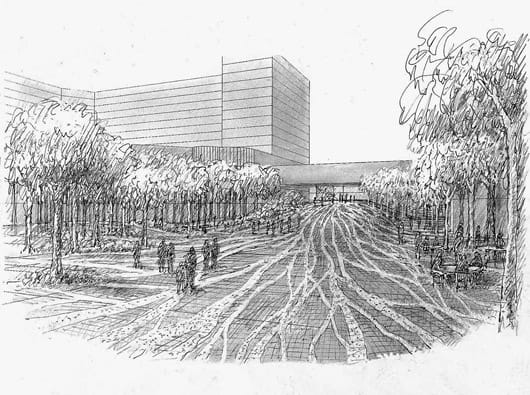
This Urban Forest approach transforms the widest part of the site’s tree-like profile (facing Chongwenmen Street) into a major pedestrian plaza, surrounded by trees.  Cast-in-place ribbons of concrete cover the walking surfaces, creating a tree/river/vein-like imagery.  This arterial network circumscribes a series of irregularly shaped spaces, used for planting zones, water features, seating areas, earth mounds, and various paving materials.
image

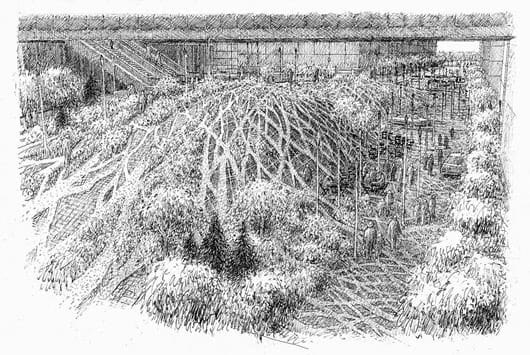
As the main plaza narrows in width – passing underneath an East/West pedestrian bridge - its horizontal surfaces gradually metamorphose into a large mounded configuration.  This raised area, proposed as a web-like structure in concrete with glass and landscape infill, shelters an arcade of small shops and restaurants.  One of the principle innovations of this approach is the gradual transformation of a horizontal public space into a mountain-like building, which then returns to a ground-level walking surface after bridging over Lianzi Xiang Street.  The main features of this concept – an evolution from plaza to architecture, inside and outside treated as simultaneous events, dense forest areas in the cityscape and an infinitely flexible paving design – are readily applicable to other parts of the city. 
image

Both East and West corridors, for the entire length of the plaza, are covered with forests of trees and ground cover.  The purpose is to create the visual and horticultural experience of urban woodlands, while simultaneously offering shaded sanctuaries for walking, recreational activities and relaxation in outdoor cafes.

At the highest elevation - where the walking corridor passes under the pedestrian bridge – this section serves as an overpass, spanning Lianzi Xiang Street.  An escalator provides access from the bridge to the top of the mounded plaza, thereby connecting two distinct shopping zones.  At the East end of the site, this walking zone gradually decreases in height and width, concluding with a tree-shaded avenue for smaller shops and eateries.

Contextual and environmental advantages

From a conceptual and philosophical perspective, the fragmented imagery of the Urban Forest establishes a selection of universal themes for Beijing.  These iconic references are applicable to the New World commercial center, as well as other neighborhoods in the city’s future public space development. They also provide a source of visual and functional variety, a choice of elevations for people watching, and supplemental architectural enclosures for commercial enterprises.

The landscape palette for Urban Forest is selected from regional trees and ground cover.  This choice also recognizes the four-season characteristics of Beijing in its use of ginko, persimmon, poplar, and savin trees.
image

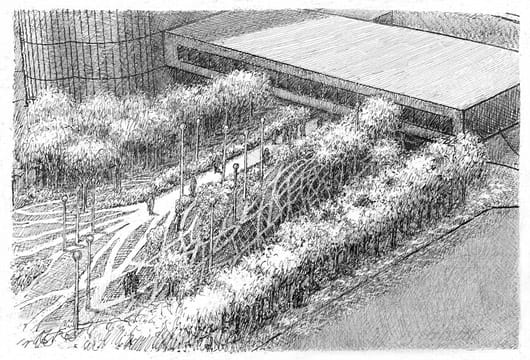
There are a number of environmentally responsible features, including a “forest floor” paving and walkways made of permeable materials, with water salvaged by catchments at plaza level and on top of surrounding rooftops.  The collected water is stored in cisterns under the elevated sections of the plaza.  Additionally, Photovoltaic solar panels generate electricity for adjacent buildings and the pedestrian areas.  This power source fuels virtual portals for ecological information nodes, located throughout the public areas.  Park lighting is provided by L.E.D. “forests of street lamps,” in the form of randomly distributed, vertical clusters of tall poles, illuminated from top to bottom.

In summary, the horizontal surfaces and mounded configurations of the Urban Forest establish a universal (but also site-specific) concept - including a tree branch • river tributaries • vascular system • Chinese calligraphy • regional landscape imagery - for Beijing’s New World center.  This iconography is expressed vertically and horizontally, physically and symbolically, experientially and ecologically.

Related

winners ● waha studio ● urban forest ● urban design ● site new york ● results ● landscape design ● china ● beijing ● asia

Share

  • Follow

    0 Comments

  • Comment as :

Urban Forest Wins Streetscapes in a New World Competition

Northwestern University selects 12-firm longlist to design new engineering building

New architecture and design competitions: Exploring 130 Years of American Design, Christo & Jeanne-Claude Center, 13 White Houses, and La Pyramide

Micro-architecture honored in latest Tiny House Architecture Competition

World’s most beautiful restaurants of 2026 chosen by Prix Versailles

Sponsored Post by Buildner

Design a wine tasting room in Italy! Valli Wine Tasting Room is launched!

10 can't-miss architecture & design events to see this June in London, Los Angeles, Chicago, San Francisco, Detroit, San Diego, Porto, and Barcelona

Sponsored Post by Buildner

Museum of Emotions / Edition #8 FINAL registration deadline is approaching!

Seven global projects make AR Public Awards shortlist 2026

Sign up for Bustler's Email Newsletters

Sponsored Post by Buildner

Design a slow-living restaurant in Portugal! Portugal Long Table Restaurant is launched!

World's best tall buildings honored at the CVU 2026 Award of Excellence

Sponsored Post by TWOPAGES

Final call: TWOPAGES X Design Contest 2026 submissions close June 5

Kengo Kuma & Paul Raff win Alberta national park visitor center competition with landscape-focused design

2026 Moira Gemmill and MJ Long prizes announced by W Awards

New architecture and design competitions: Kinderspace, Stewardson Keefe LeBrun Travel Grant, SMALL PROJECT BIG IMPACT, and Garden of University House, Bucharest

The Century of Gehry: New retrospective explores the late architect's work & collaborations

Next page » Loading

Urban Forest Wins Streetscapes in a New World Competition

By Bustler Editors|

Wednesday, Aug 13, 2008

Share

Related

winners ● waha studio ● urban forest ● urban design ● site new york ● results ● landscape design ● china ● beijing ● asia

The international competition for a New Urban Streetscape in Beijing, China was organized by New World China Land Limited – one of Asia’s largest development corporations – in collaboration with Di Magazine, a leading architectural review published in Beijing.  The designated site area divides New World’s recently built commercial center, located on Chongwenmen Street.

The key sponsor, New World China Land Limited, is based in Hong Kong, with a wide range of projects currently under construction - including commercial, residential, hotel and resort developments throughout the People’s Republic of China. 

image

The competition brief described the design objective as a search for an environmentally responsible public space that would also propose a new paradigm for expanding the number and quality of parks, plazas and gardens in Beijing.

The SITE New York office was invited by WaHa Studio in Toronto, Canada (li Wang and Marc Halle) to head a Canadian/Chinese team of architects and landscape designers – including WaHa, Yang Yang and Ronghui Li – with the purpose of proposing a concept for the New World competition. This project is the result of a SITE New York and WaHa Studio collaboration.

Premises for the design approach:

The burgeoning growth of central Beijing has either destroyed or disrupted a large number of the city’s original one-to-three story residential neighborhoods – especially in the most vulnerable and historic Hutong areas.  Large-scale developments have imposed an imbalance between commercial expansion and the maintenance of traditional communities.  It has also increased air pollution, visibly exposed the gap between rich and poor, exacerbated the level of street crime and decreased the amount of leisure and garden space within the central city.

image

In addition to social, cultural, contextual and ecological considerations, the SITE/WaHa design approach to the New World Plaza has been based on Beijing’s radical contrast of scales – from intimate residential streets to massive commercial zones.  It is our team’s view that one of the main values of horizontal surfaces in the cityscape is to use streets, parks, plazas and gardens as means of mediation between neighborhoods, building heights, economic levels and territorial functions. 

Project description:

In designing the New World public space, the SITE/WaHa “Urban Forest” concept has been influenced by an observation that the existing site is roughly shaped like a growing tree, with a crown of extended branches.  It can also be seen as similar to a river, with many tributaries, or linked to the cardiovascular system of a human body.  In addition, since the entire Beijing street system is based on a classic grid, the paved areas in this design are used for a special iconographic significance.  These horizontal surfaces have been dematerialized and fragmented into casual, ribbon-like patterns, reminiscent of Chinese calligraphy and landscape painting.  While intentionally ambiguous, the plaza imagery is proposed as a nature-based and culturally referenced source of symbolism for a rapidly expanding metropolis. 

This Urban Forest approach transforms the widest part of the site’s tree-like profile (facing Chongwenmen Street) into a major pedestrian plaza, surrounded by trees.  Cast-in-place ribbons of concrete cover the walking surfaces, creating a tree/river/vein-like imagery.  This arterial network circumscribes a series of irregularly shaped spaces, used for planting zones, water features, seating areas, earth mounds, and various paving materials.

image

As the main plaza narrows in width – passing underneath an East/West pedestrian bridge - its horizontal surfaces gradually metamorphose into a large mounded configuration.  This raised area, proposed as a web-like structure in concrete with glass and landscape infill, shelters an arcade of small shops and restaurants.  One of the principle innovations of this approach is the gradual transformation of a horizontal public space into a mountain-like building, which then returns to a ground-level walking surface after bridging over Lianzi Xiang Street.  The main features of this concept – an evolution from plaza to architecture, inside and outside treated as simultaneous events, dense forest areas in the cityscape and an infinitely flexible paving design – are readily applicable to other parts of the city. 

image

Both East and West corridors, for the entire length of the plaza, are covered with forests of trees and ground cover.  The purpose is to create the visual and horticultural experience of urban woodlands, while simultaneously offering shaded sanctuaries for walking, recreational activities and relaxation in outdoor cafes.

At the highest elevation - where the walking corridor passes under the pedestrian bridge – this section serves as an overpass, spanning Lianzi Xiang Street.  An escalator provides access from the bridge to the top of the mounded plaza, thereby connecting two distinct shopping zones.  At the East end of the site, this walking zone gradually decreases in height and width, concluding with a tree-shaded avenue for smaller shops and eateries.

Contextual and environmental advantages

From a conceptual and philosophical perspective, the fragmented imagery of the Urban Forest establishes a selection of universal themes for Beijing.  These iconic references are applicable to the New World commercial center, as well as other neighborhoods in the city’s future public space development. They also provide a source of visual and functional variety, a choice of elevations for people watching, and supplemental architectural enclosures for commercial enterprises.

The landscape palette for Urban Forest is selected from regional trees and ground cover.  This choice also recognizes the four-season characteristics of Beijing in its use of ginko, persimmon, poplar, and savin trees.

image

There are a number of environmentally responsible features, including a “forest floor” paving and walkways made of permeable materials, with water salvaged by catchments at plaza level and on top of surrounding rooftops.  The collected water is stored in cisterns under the elevated sections of the plaza.  Additionally, Photovoltaic solar panels generate electricity for adjacent buildings and the pedestrian areas.  This power source fuels virtual portals for ecological information nodes, located throughout the public areas.  Park lighting is provided by L.E.D. “forests of street lamps,” in the form of randomly distributed, vertical clusters of tall poles, illuminated from top to bottom.

In summary, the horizontal surfaces and mounded configurations of the Urban Forest establish a universal (but also site-specific) concept - including a tree branch • river tributaries • vascular system • Chinese calligraphy • regional landscape imagery - for Beijing’s New World center.  This iconography is expressed vertically and horizontally, physically and symbolically, experientially and ecologically.

Share

  • Follow

    0 Comments

  • Comment as :

Archinect JobsArchinect Jobs

The Archinect Job Board attracts the world's top architectural design talents.

VIEW ALL JOBS POST A JOB

Designer

HATCH ARCHITECTURE

Designer

Los Angeles, CA, US

Intermediate Residential Architect

52XConsulting

Intermediate Residential Architect

New York, NY, US

Registered Architect

Advantage Point Group, Inc.

Registered Architect

Saint Paul, MN, US

Project Manager - Civic/Community

DAHLIN ARCHITECTURE | PLANNING | INTERIORS

Project Manager - Civic/Community

Irvine, CA, US

Marketing Coordinator / EA

Stoss Landscape Urbanism

Marketing Coordinator / EA

Boston, MA, US

Architectural Job Captain

Christopher Courts Inc.

Architectural Job Captain

Los Angeles, CA, US

Project Architect

Turpentine Design

Project Architect

Fuquay-Varina, NC, US

Interior Designer | Education & Institutional Work

Berliner Architects

Interior Designer | Education & Institutional Work

Culver City, CA, US

Business Development Manager

WORKac

Business Development Manager

New York, NY, US

Senior Architectural Project Manager (Systems Driven, Human-Centric) (Hourly)

Local Parti Architecture, PC

Senior Architectural Project Manager (Systems Driven, Human-Centric) (Hourly)

New York, NY, US

Next page » Loading