• Login / Join
  • About
  • •
  • Contact
  • •
  • Advertising
bustler logo
bustler logo
  • News
  • Competitions
  • Events
  • Bustler is powered by Archinect
  • Sign up for Bustler's Email Newsletters

  • Follow these Bustler feeds:

  • Search

    Search in

  • Submit

    What are you submitting?

    News Pitch
    Competition
    Event
  • Login / Join
  • News|Competitions|Events
  • Search
    | Submit
    | Follow
  • Search in

    What are you submitting?

    News Pitch
    Competition
    Event

    Follow these Bustler feeds:

  • About|Contact|Advertising
  • Login / Join

More Design Office creates a film noir-inspired interactive theater in Shanghai

By Justine Testado|

Tuesday, Jul 25, 2017

Photo: Dirk Weiblen

The Jian Li Ju Theatre in Shanghai is clad in a sleek interior that immerses visitors in contrasting shades of black and white, light and shadow. Locally based practice More Design Office (MDO) looked to the glorious melodrama of film noir in designing the theater's atmospheric interior. Completed this year, the project was recently named a Civic, Culture & Transport category finalist in this year's INSIDE: World Festival of Interiors competition, which will happen in Berlin during the World Architecture Festival this November.

MDO shared more details about their project below.
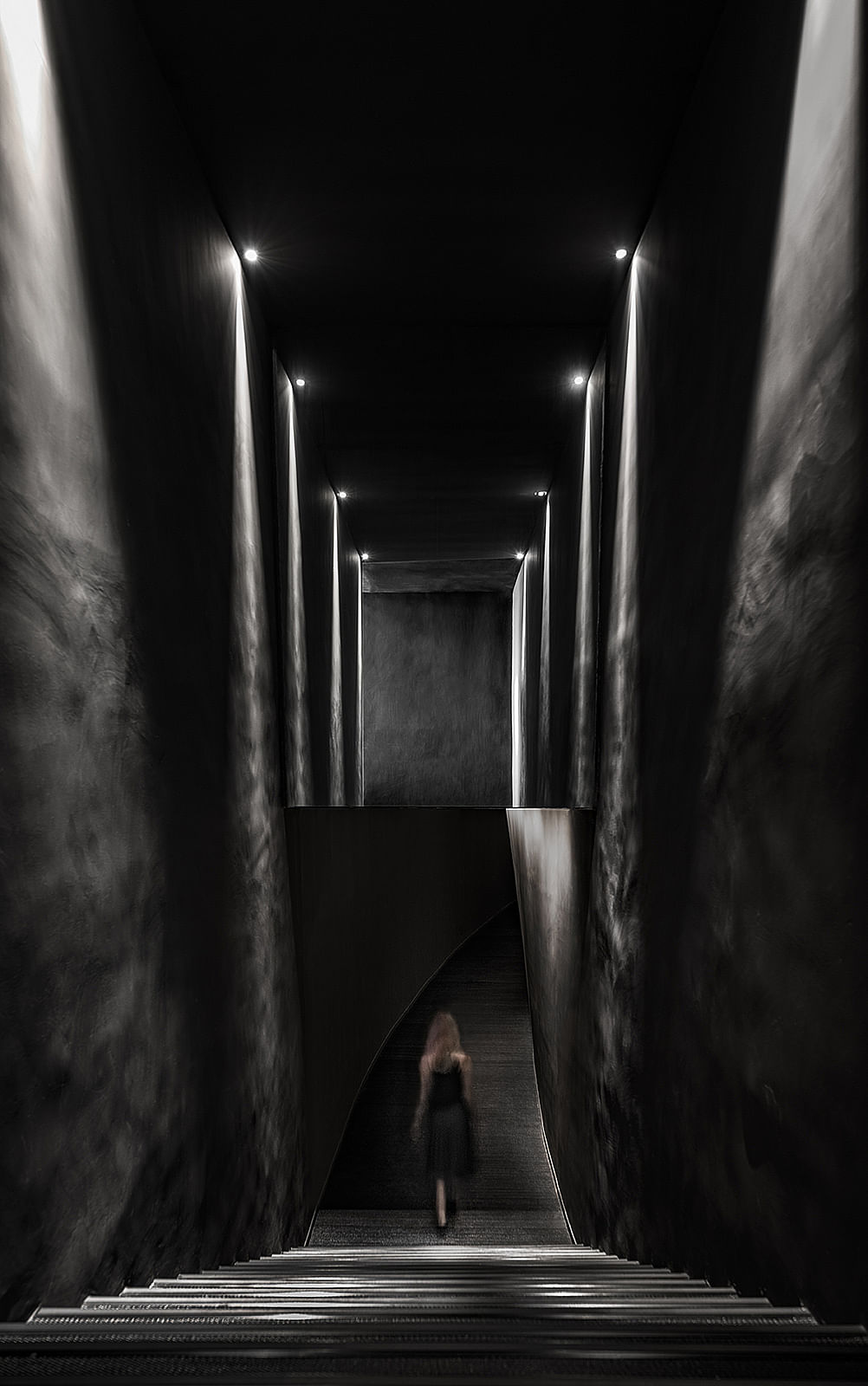
Entrance stairway. Photo: Dirk Weiblen

For a theater company like Jian Li Ju wherein the audience also gets to play as actors in the performances, their new space demanded a careful architectural approach to space, event, and movement, MDO says. Located on a non-descript street in central Shanghai, the theatre is accessed through a hidden entrance door at the back of an antique furniture emporium. Visitors only arrive with a time, location, and number.
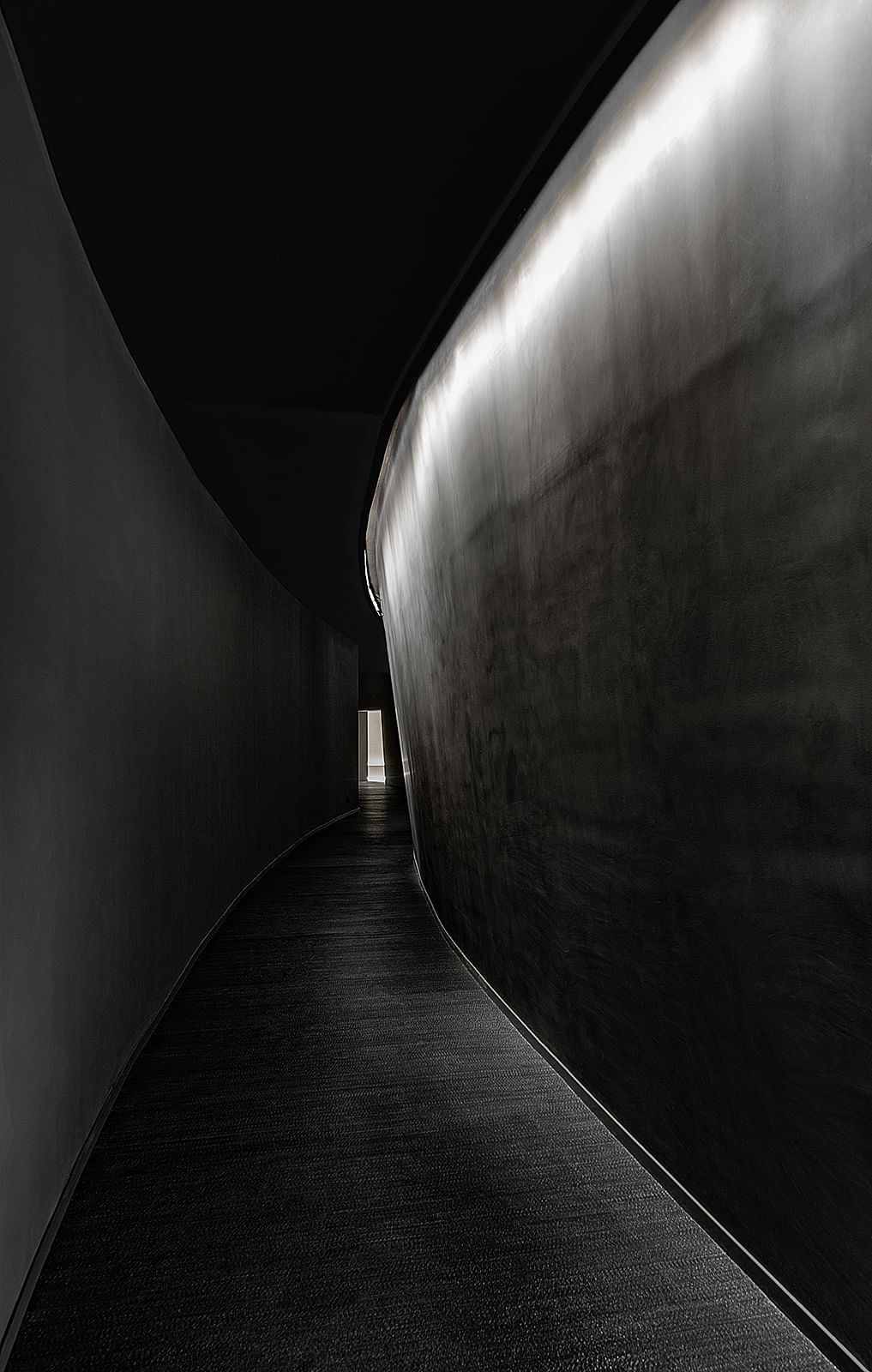
Entrance curve. Photo: Dirk Weiblen

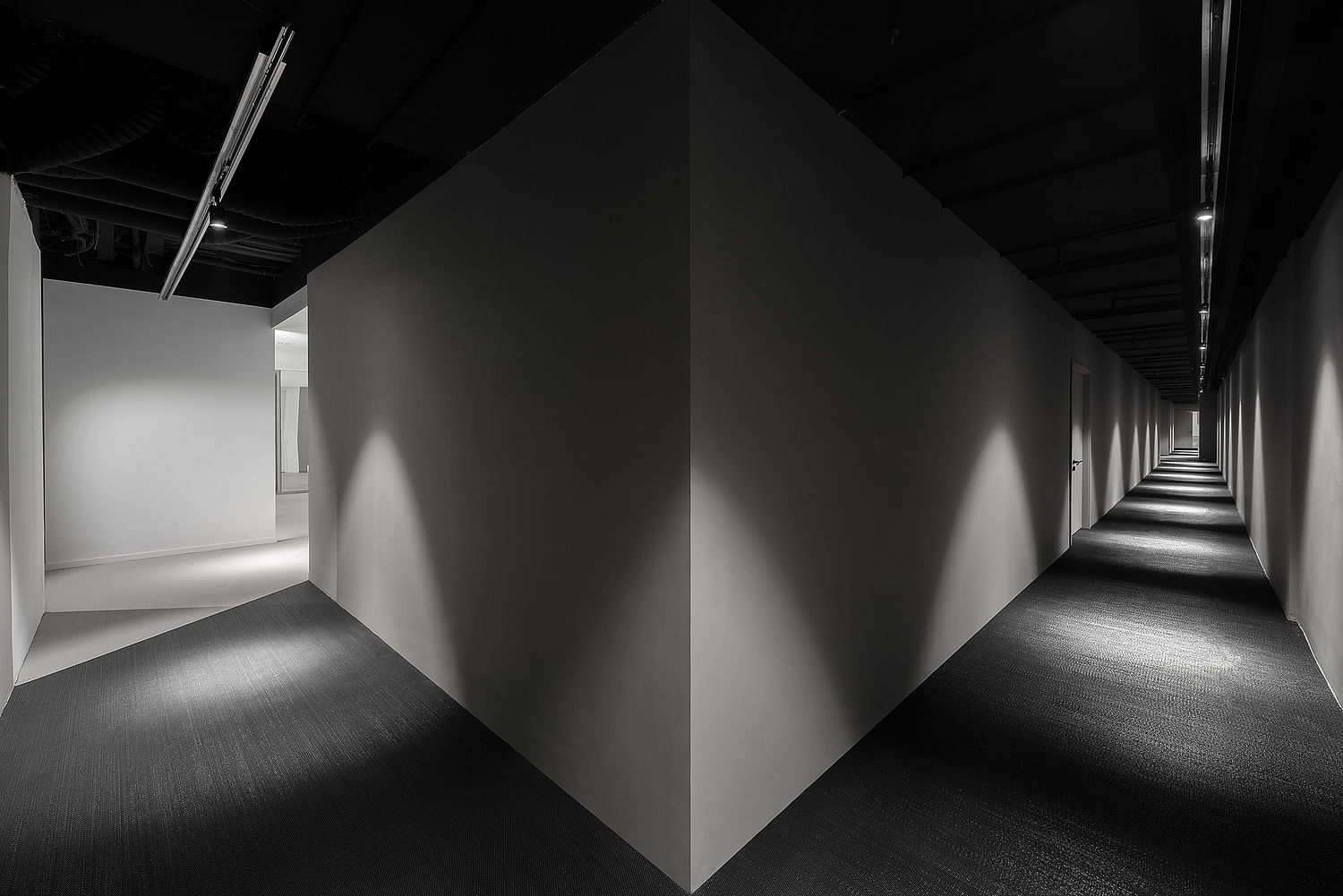
A staircase leads down into the darkness, “a deliberate act of disorientation initiated by a dark curved corridor that emphasizes low-key lighting and unbalanced compositions that eventually leads to the interior spaces. The functions are organized into a linear arrangement of spaces, where the visitor is prevented from going backwards, as if following an unknown figure through the street at night,” the architects describe.
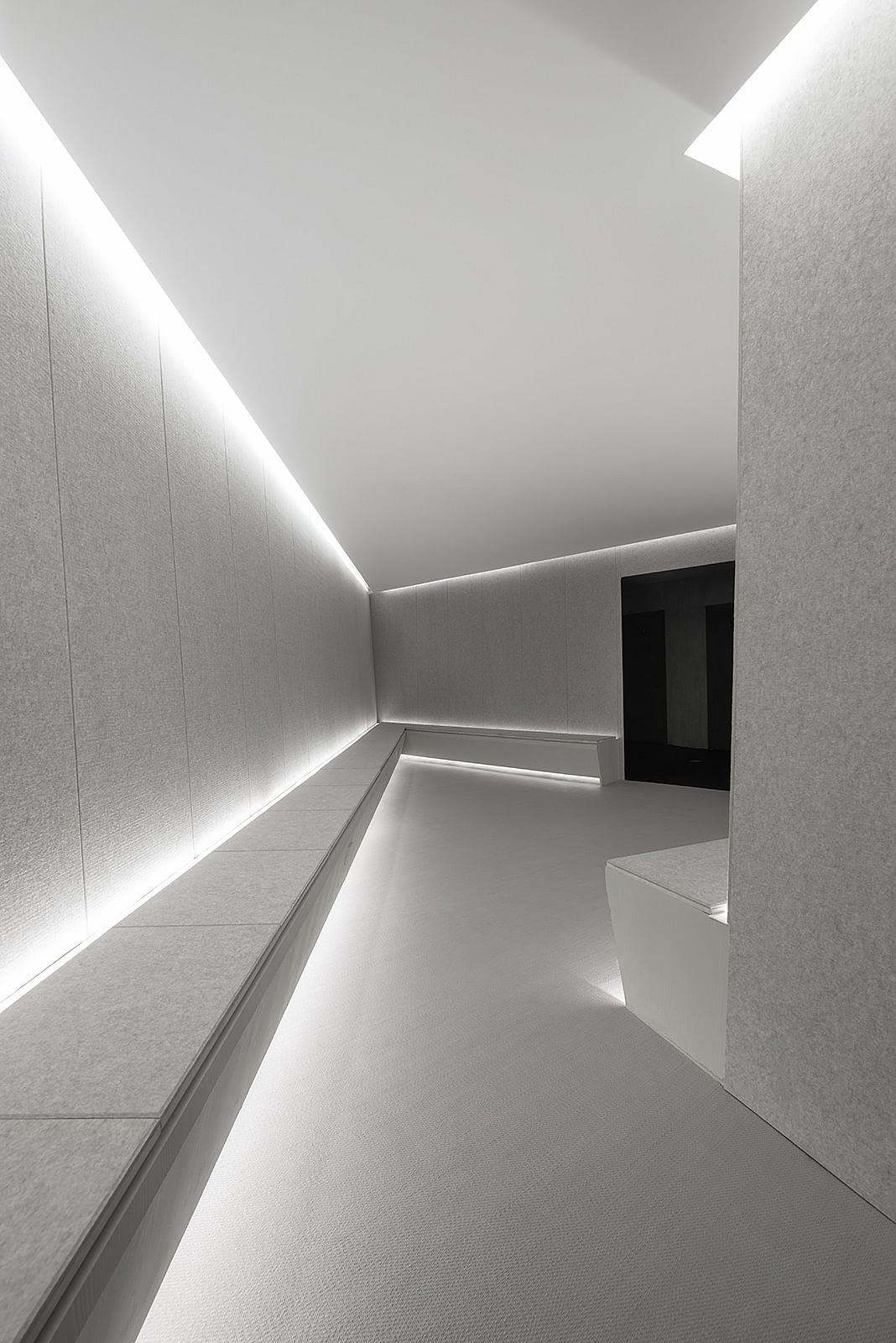

Conditioning room. Photo: Dirk Weiblen

“The palette is simple throughout, with a hint of texture through the treatment of the plaster to add luster and depth to the spaces. In contrast to the threshold sequence, the first space, the lobby, is bright and lined with acoustic paneling on the walls and benches creating a closed and soft environment” to prepare visitors for the performance.
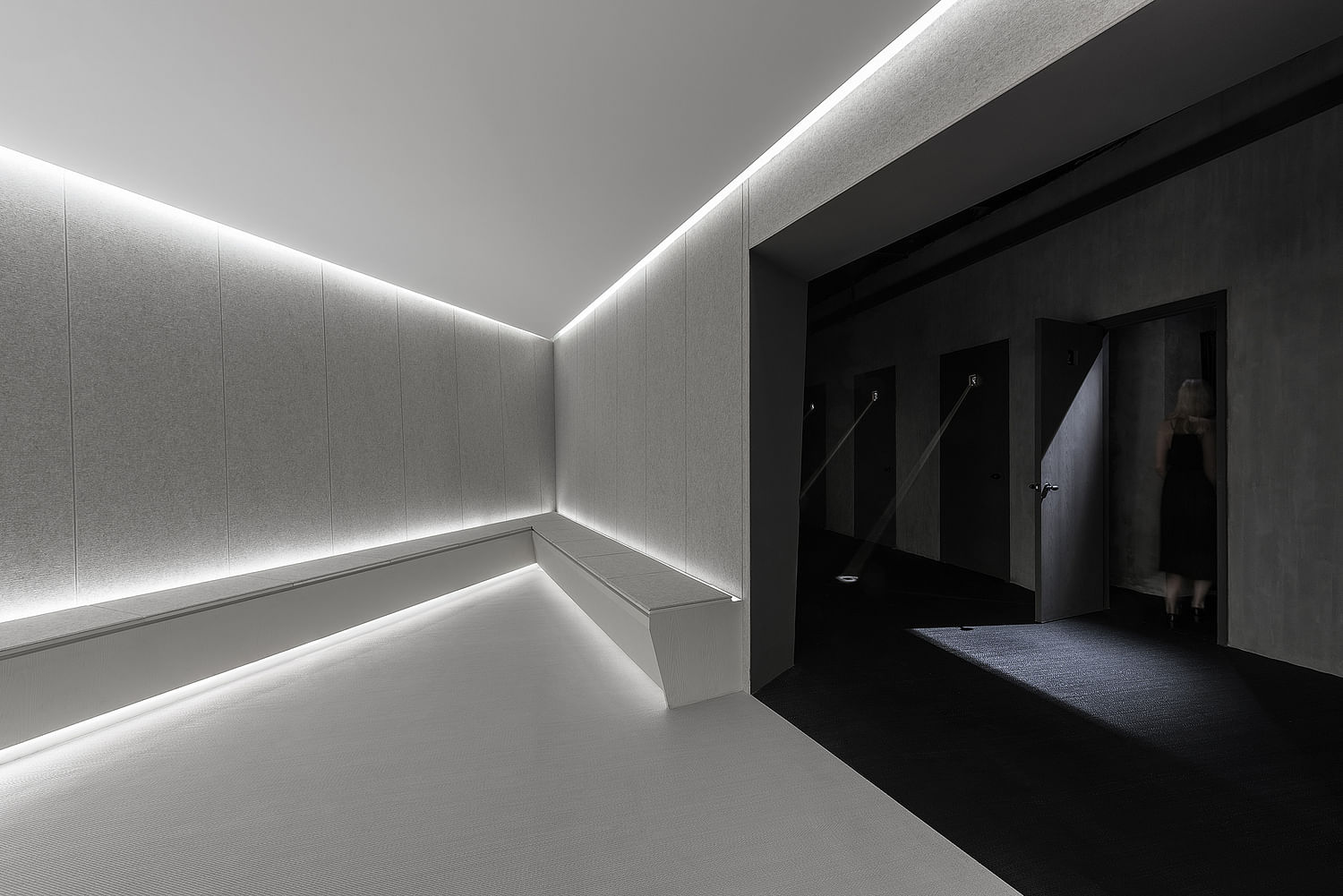
Conditioning room. Photo: Dirk Weiblen
Changing room. Photo: Dirk Weiblen

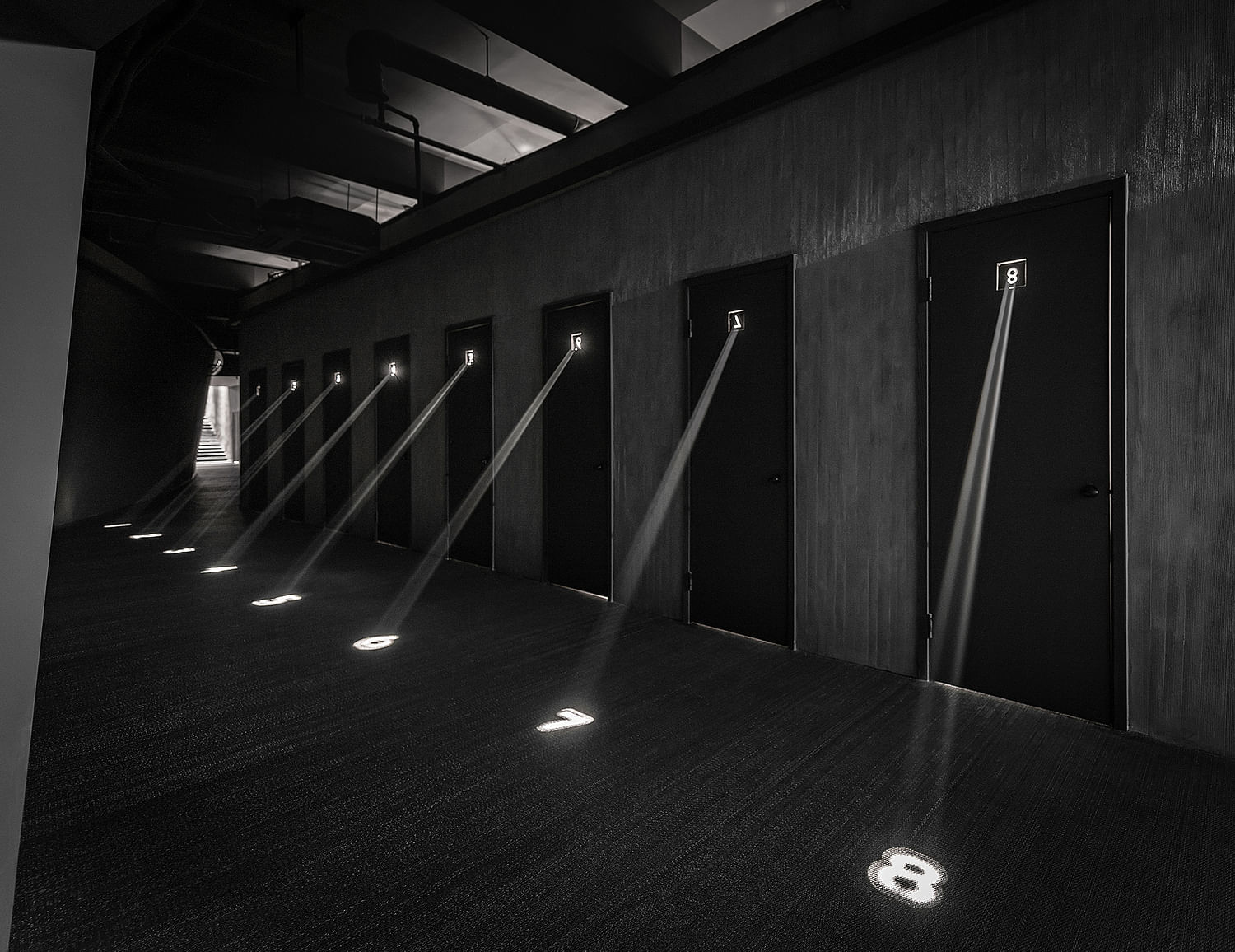
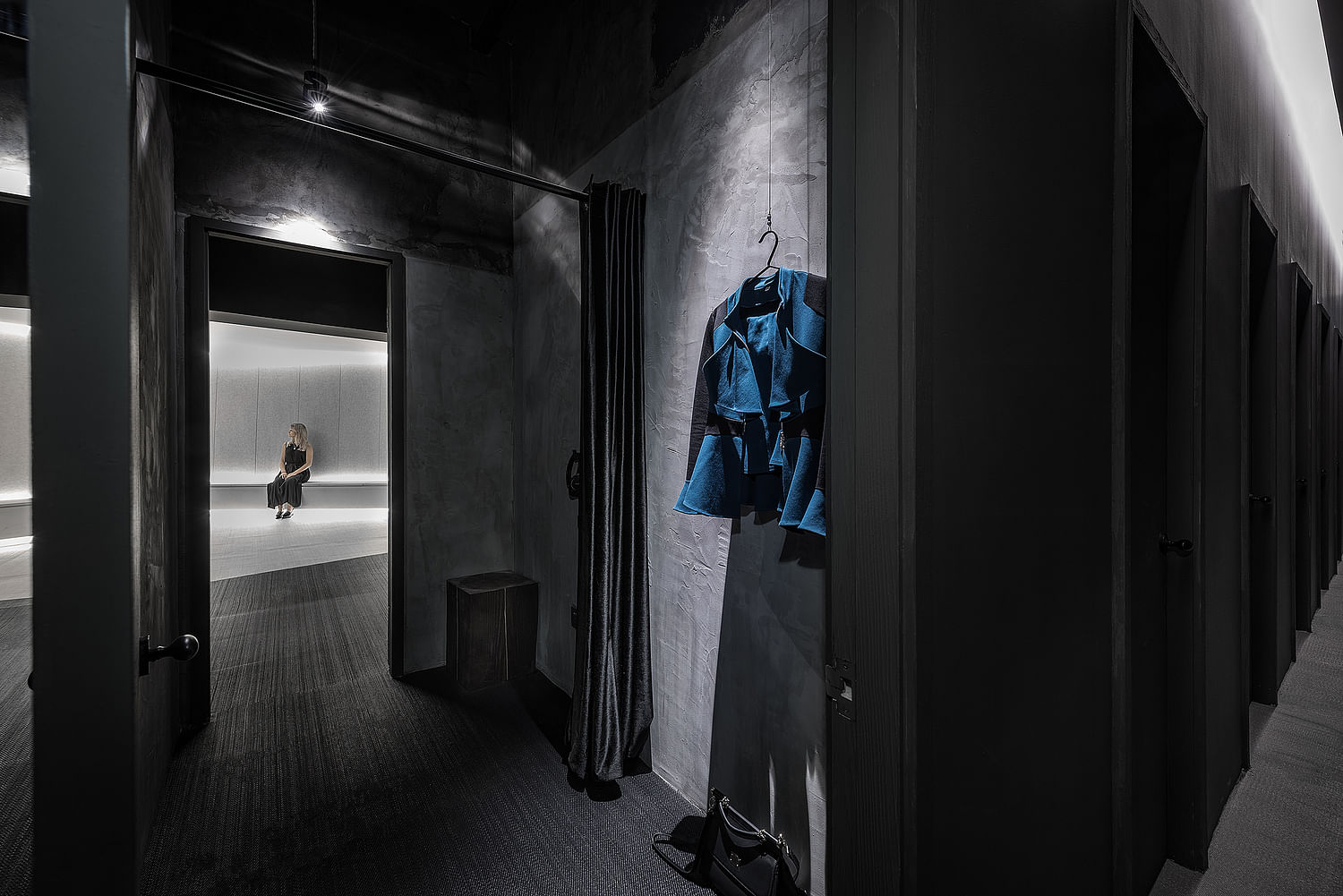
When it's time, each participant in the production enters a small changing space that is highlighted by an eerie number projected from a pinhole aperture on to the dark corridor floor. Behind heavy velvet curtains, visitors are provided with a script and change into costume as they transform into character. 
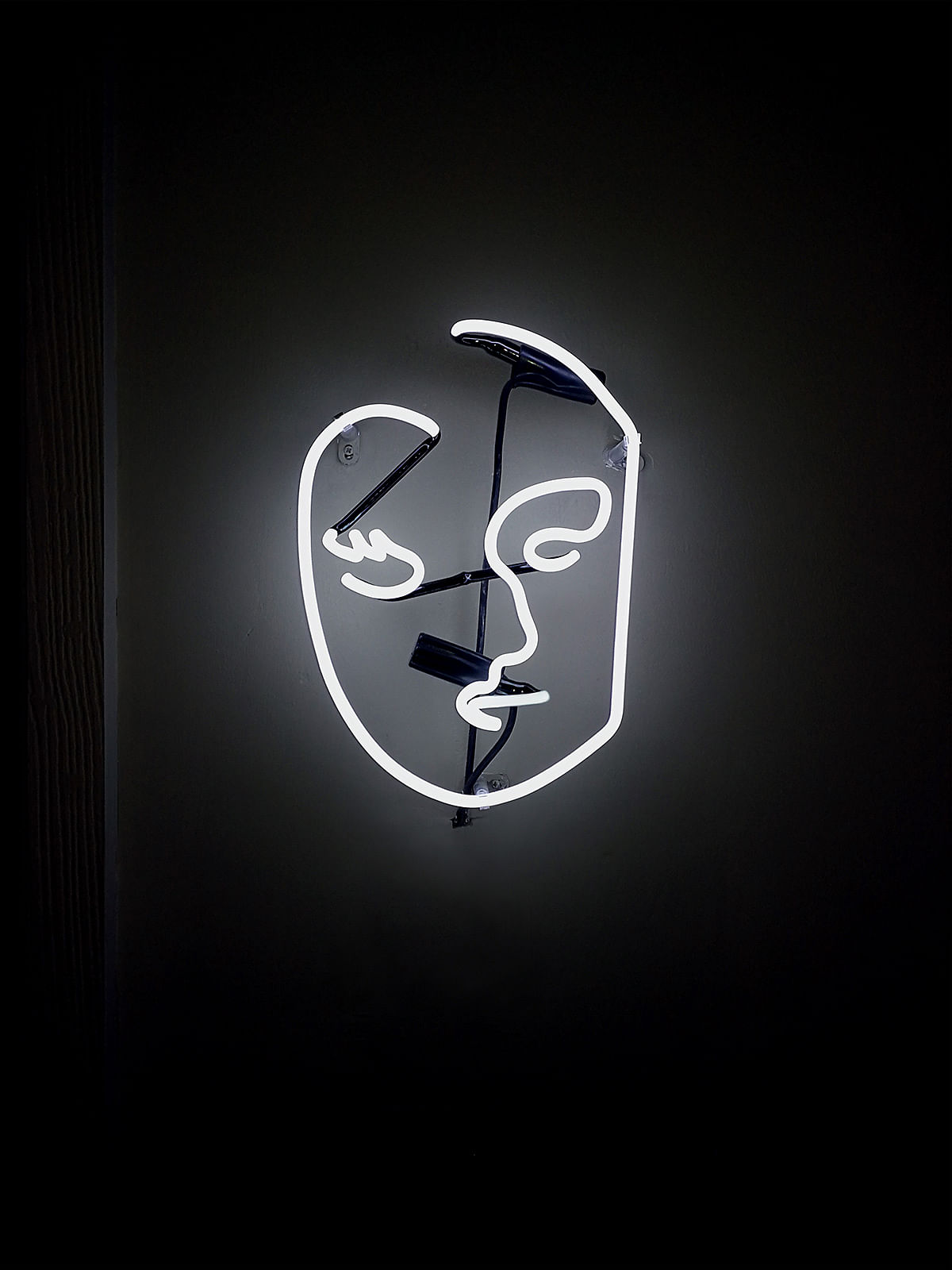
Theatre entrance sign. Photo: Dirk Weiblen

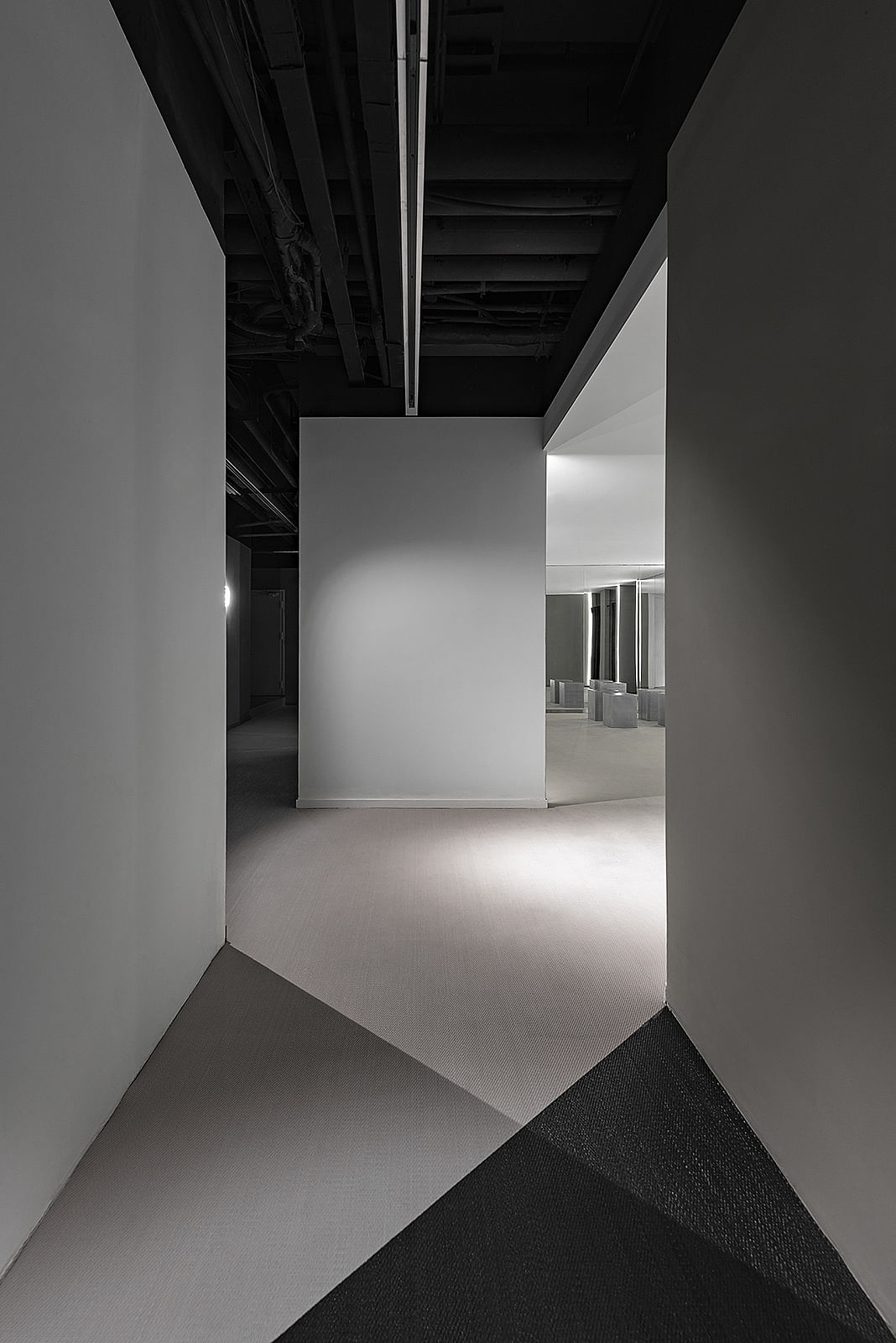
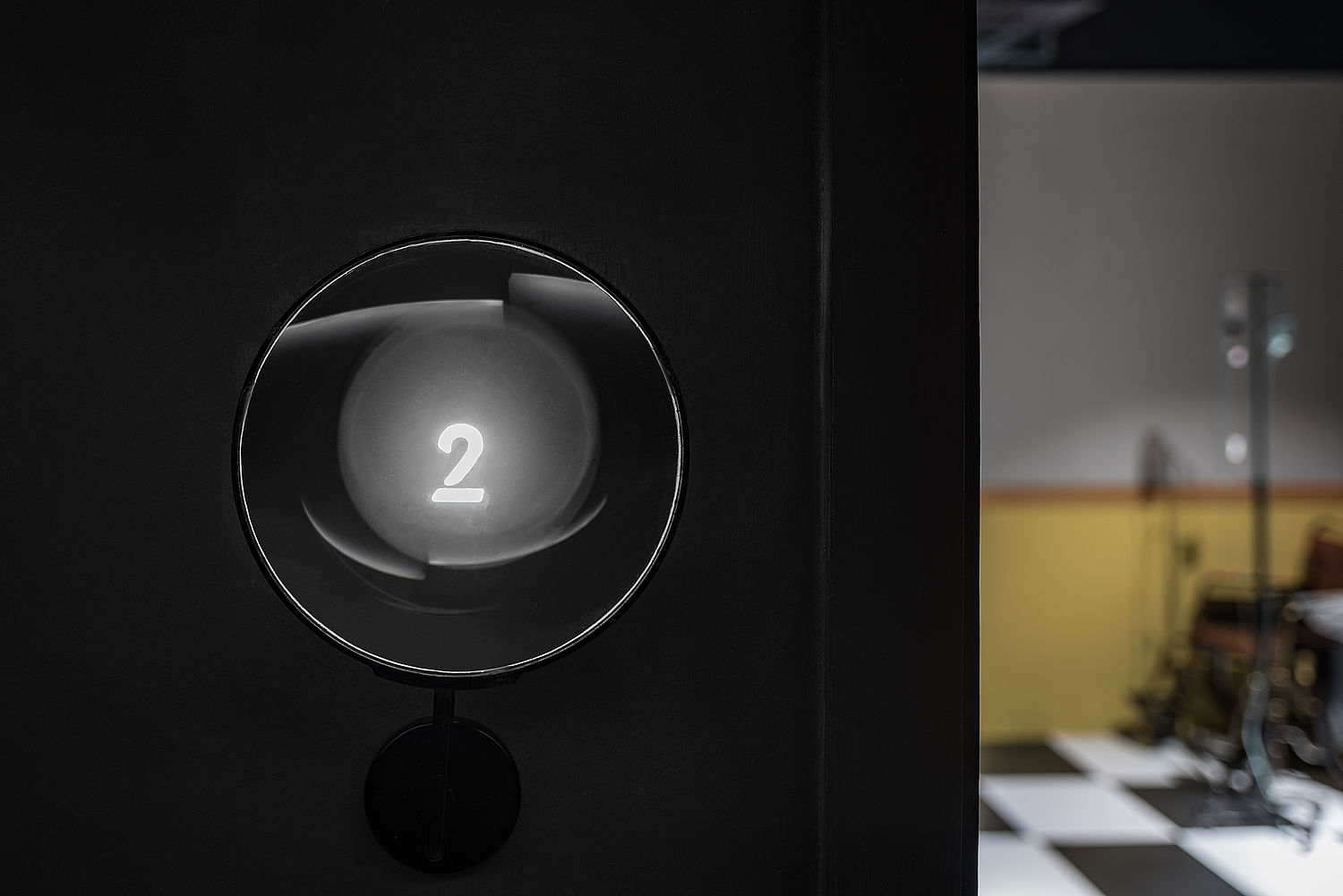
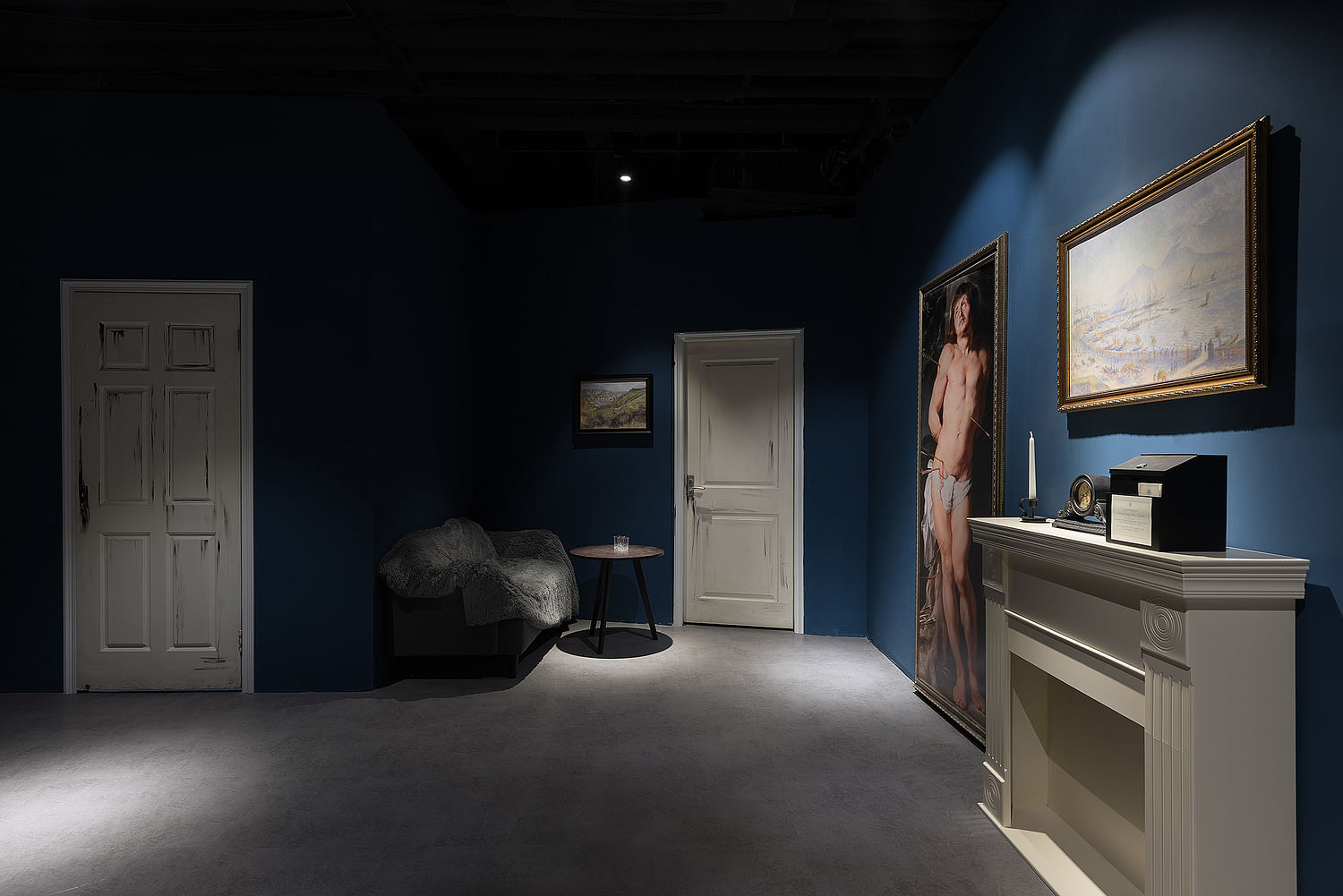
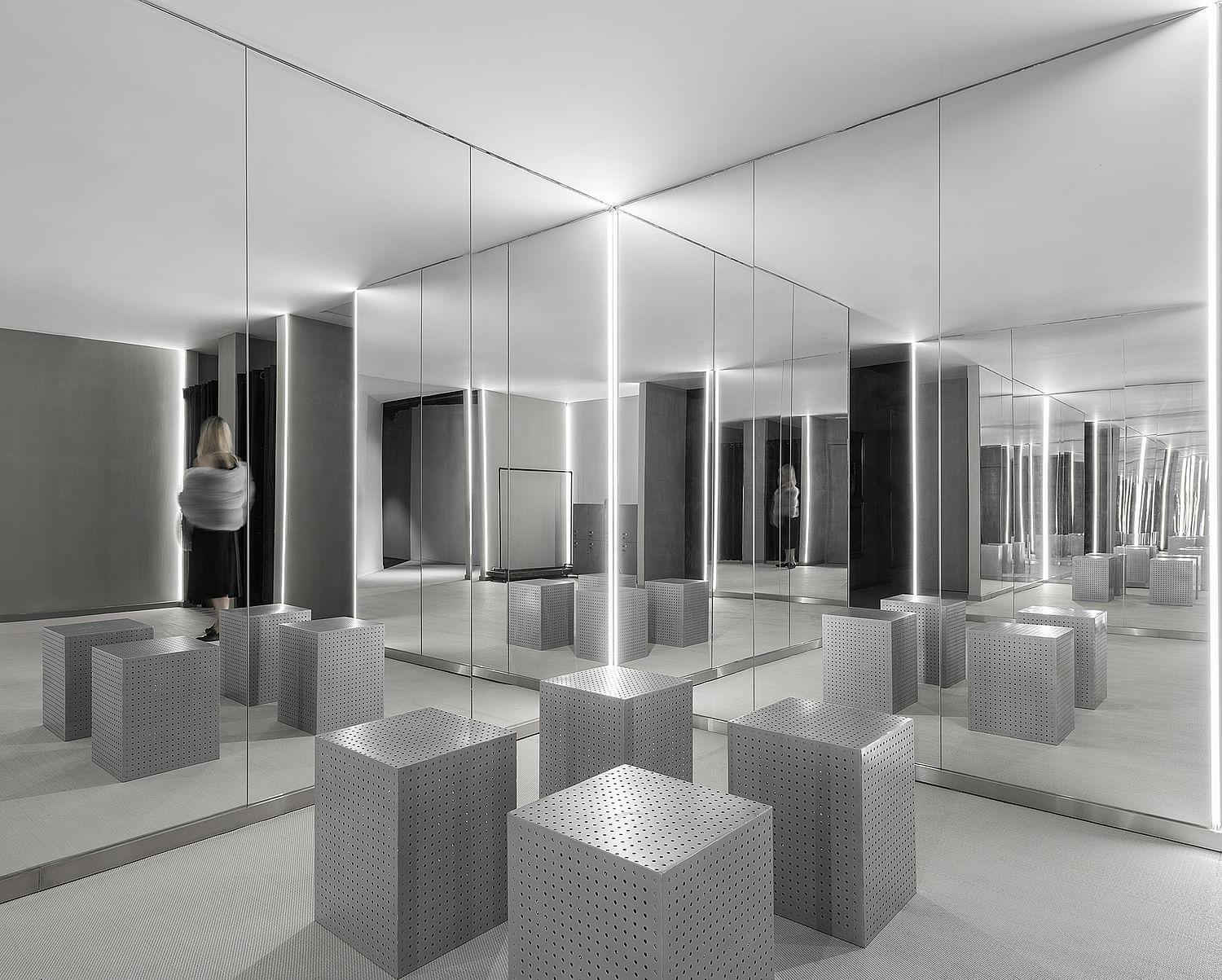
Visitors then walk into a small "anti-chamber" with four asymmetric walls. A number is displayed through a magnifying glass that provides stage directions to the participating actors. After the show, visitors end their experience in the final space, a hall of mirrors. 
Theatre space. Photo: Dirk Weiblen
Mirror room. Photo: Dirk Weiblen
Signage. Photo: Dirk Weiblen
Rear corridor. Photo: Dirk Weiblen

In this type of project, “the architectural theory of Tschumi, especially the 1976 Screenplays project, is never far away and many of the formal strategies employed by MDO directly reference the parallels with screen editing and the time-space nature of architecture,” according to the architects. “Tools such as distortion, repetition and superimposition often used by the great directors of the film noir scene have all been applied as a method to soak the interior with the atmosphere of a 50s Hollywood melodrama.”

All photos courtesy of More Design Office.

Project details: 

Project Name: Jian Li Ju Theatre
Architecture Firm: More Design Office (MDO)
Status: Completed 2017
Size: 930 sq.m.
Address: B1, No.301 East Hongsong Road, Minhang District, Shanghai, China
Client: Jianliju Theatre Company
Photographer: Dirk Weiblen
Signage: Evelyn Chiu

RELATED NEWS Shortlist highlights of the 2017 INSIDE: World Festival of Interiors
RELATED NEWS The World Architecture Festival has announced its shortlist for the 2017 Awards
RELATED NEWS Black Cant System store by Hangzhou AN Interior Design wins 2016 World Interior of the Year
RELATED NEWS Feast your eyes on this sleek trade center by HALLUCINATE, a 2016 INSIDE shortlister

Related

inside: world festival of interiors ● interior design ● theater design ● competition ● finalist ● shanghai ● china ● minimalism ● experience design

Share

  • Follow

    0 Comments

  • Comment as :

More Design Office creates a film noir-inspired interactive theater in Shanghai

Micro-architecture honored in latest Tiny House Architecture Competition

World’s most beautiful restaurants of 2026 chosen by Prix Versailles

Sponsored Post by Buildner

Design a wine tasting room in Italy! Valli Wine Tasting Room is launched!

10 can't-miss architecture & design events to see this June in London, Los Angeles, Chicago, San Francisco, Detroit, San Diego, Porto, and Barcelona

Sponsored Post by Buildner

Museum of Emotions / Edition #8 FINAL registration deadline is approaching!

Seven global projects make AR Public Awards shortlist 2026

Sponsored Post by Buildner

Design a slow-living restaurant in Portugal! Portugal Long Table Restaurant is launched!

World's best tall buildings honored at the CVU 2026 Award of Excellence

Sign up for Bustler's Email Newsletters

Sponsored Post by TWOPAGES

Final call: TWOPAGES X Design Contest 2026 submissions close June 5

Kengo Kuma & Paul Raff win Alberta national park visitor center competition with landscape-focused design

2026 Moira Gemmill and MJ Long prizes announced by W Awards

New architecture and design competitions: Kinderspace, Stewardson Keefe LeBrun Travel Grant, SMALL PROJECT BIG IMPACT, and Garden of University House, Bucharest

The Century of Gehry: New retrospective explores the late architect's work & collaborations

Sponsored Post by Buildner

Rome Rain Rooms FINAL registration deadline is in 5 DAYS!

UIA and UN Habitat unveil sustainability-focused winners for UIA 2030 Award

Next page » Loading

More Design Office creates a film noir-inspired interactive theater in Shanghai

By Justine Testado|

Tuesday, Jul 25, 2017

Share

Photo: Dirk Weiblen

Related

inside: world festival of interiors ● interior design ● theater design ● competition ● finalist ● shanghai ● china ● minimalism ● experience design

The Jian Li Ju Theatre in Shanghai is clad in a sleek interior that immerses visitors in contrasting shades of black and white, light and shadow. Locally based practice More Design Office (MDO) looked to the glorious melodrama of film noir in designing the theater's atmospheric interior. Completed this year, the project was recently named a Civic, Culture & Transport category finalist in this year's INSIDE: World Festival of Interiors competition, which will happen in Berlin during the World Architecture Festival this November.

MDO shared more details about their project below.

Entrance stairway. Photo: Dirk Weiblen

For a theater company like Jian Li Ju wherein the audience also gets to play as actors in the performances, their new space demanded a careful architectural approach to space, event, and movement, MDO says. Located on a non-descript street in central Shanghai, the theatre is accessed through a hidden entrance door at the back of an antique furniture emporium. Visitors only arrive with a time, location, and number.

Entrance curve. Photo: Dirk Weiblen

A staircase leads down into the darkness, “a deliberate act of disorientation initiated by a dark curved corridor that emphasizes low-key lighting and unbalanced compositions that eventually leads to the interior spaces. The functions are organized into a linear arrangement of spaces, where the visitor is prevented from going backwards, as if following an unknown figure through the street at night,” the architects describe.


Conditioning room. Photo: Dirk Weiblen

“The palette is simple throughout, with a hint of texture through the treatment of the plaster to add luster and depth to the spaces. In contrast to the threshold sequence, the first space, the lobby, is bright and lined with acoustic paneling on the walls and benches creating a closed and soft environment” to prepare visitors for the performance.

Conditioning room. Photo: Dirk Weiblen
Changing room. Photo: Dirk Weiblen

When it's time, each participant in the production enters a small changing space that is highlighted by an eerie number projected from a pinhole aperture on to the dark corridor floor. Behind heavy velvet curtains, visitors are provided with a script and change into costume as they transform into character. 

Theatre entrance sign. Photo: Dirk Weiblen

Visitors then walk into a small "anti-chamber" with four asymmetric walls. A number is displayed through a magnifying glass that provides stage directions to the participating actors. After the show, visitors end their experience in the final space, a hall of mirrors. 
Theatre space. Photo: Dirk Weiblen
Mirror room. Photo: Dirk Weiblen
Signage. Photo: Dirk Weiblen
Rear corridor. Photo: Dirk Weiblen

In this type of project, “the architectural theory of Tschumi, especially the 1976 Screenplays project, is never far away and many of the formal strategies employed by MDO directly reference the parallels with screen editing and the time-space nature of architecture,” according to the architects. “Tools such as distortion, repetition and superimposition often used by the great directors of the film noir scene have all been applied as a method to soak the interior with the atmosphere of a 50s Hollywood melodrama.”

All photos courtesy of More Design Office.

Project details: 

Project Name: Jian Li Ju Theatre
Architecture Firm: More Design Office (MDO)
Status: Completed 2017
Size: 930 sq.m.
Address: B1, No.301 East Hongsong Road, Minhang District, Shanghai, China
Client: Jianliju Theatre Company
Photographer: Dirk Weiblen
Signage: Evelyn Chiu

RELATED NEWS Shortlist highlights of the 2017 INSIDE: World Festival of Interiors
RELATED NEWS The World Architecture Festival has announced its shortlist for the 2017 Awards
RELATED NEWS Black Cant System store by Hangzhou AN Interior Design wins 2016 World Interior of the Year
RELATED NEWS Feast your eyes on this sleek trade center by HALLUCINATE, a 2016 INSIDE shortlister

Share

  • Follow

    0 Comments

  • Comment as :

Archinect JobsArchinect Jobs

The Archinect Job Board attracts the world's top architectural design talents.

VIEW ALL JOBS POST A JOB

Mid-Level Architect/Designer

Payette

Mid-Level Architect/Designer

Boston, MA, US

Project Architect at High End Boutique Townhouse Firm in BK

Steering House Design and Development

Project Architect at High End Boutique Townhouse Firm in BK

Brooklyn, NY, US

Job Captain (3-5 years experience)

Evan Raabe Architecture Studio

Job Captain (3-5 years experience)

Los Angeles, CA, US

Senior Technical Architect - Interiors - New York Office

Fogarty Finger

Senior Technical Architect - Interiors - New York Office

New York, NY, US

Architects with 4-10 Years' Experience

Adamson Associates, Inc.

Architects with 4-10 Years' Experience

Los Angeles, CA, US

Architectural Designer | 2-5 Years

LSM

Architectural Designer | 2-5 Years

Washington, DC, US

Senior Designer / Architect

NardiHaus

Senior Designer / Architect

Pasadena, CA, US

Intermediate Architectural Designer

David Smotrich & Partners LLP

Intermediate Architectural Designer

New York, NY, US

Intermediate Designer - 3+ Years Experience (NY)

Cass Calder Smith

Intermediate Designer - 3+ Years Experience (NY)

New York, NY, US

Intermediate Architect

FROM Architecture DPC

Intermediate Architect

New York, NY, US

Next page » Loading