• Login / Join
  • About
  • •
  • Contact
  • •
  • Advertising
bustler logo
bustler logo
  • News
  • Competitions
  • Events
  • Bustler is powered by Archinect
  • Sign up for Bustler's Email Newsletters

  • Follow these Bustler feeds:

  • Search

    Search in

  • Submit

    What are you submitting?

    News Pitch
    Competition
    Event
  • Login / Join
  • News|Competitions|Events
  • Search
    | Submit
    | Follow
  • Search in

    What are you submitting?

    News Pitch
    Competition
    Event

    Follow these Bustler feeds:

  • About|Contact|Advertising
  • Login / Join

“New Waters” wins the 2017 Burnham Prize “Under the Dome” competition

By Justine Testado|

Friday, Oct 6, 2017

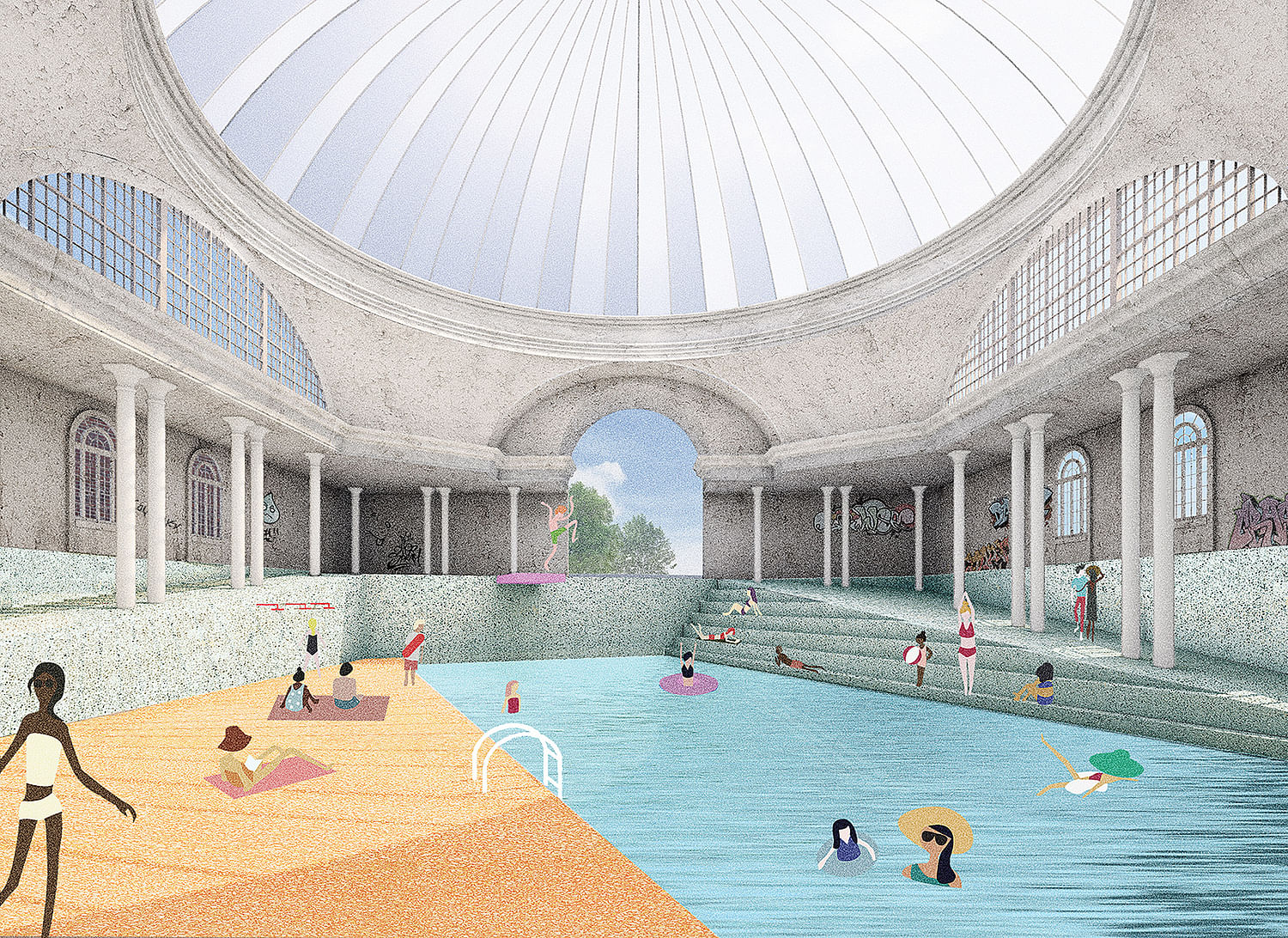
Winner: “NEW WATERS” by Sonja Cheng, Jennifer Ly and Max Obata.

The Chicago Architectural Club's annual Burnham Prize had another successful run for 2017. This time around, entrants developed speculative architectural interventions for the dome of the abandoned St. Stephen Church in Chicago.

At the end of the competition, Sonja Cheng, Jennifer Ly and Max Obata won the prize with their submission “New Waters”, while an honorable mention went to “Dualism” by John David Todd, Kevin Lamyuktseung, and James Martin. Check out the entries below.

Winner: “NEW WATERS” by Sonja Cheng, Jennifer Ly and Max Obata

Winner: “NEW WATERS” by Sonja Cheng, Jennifer Ly and Max Obata.

Project description: “The dome is not neutral — it is a monumental architectural form. It dominates, centralizes and defines a focal point for congregation. The abandoned St. Stephen’s Church offers the opportunity for a new interpretation of public space. The pool has the ability to regenerate the neighborhood while creating an intimate and playful public space.

The public swimming pool has had a contested history in America dating back to the 19th century. It first emerged as a place for personal hygiene and then evolved into a site of public tension through gender, economic, and racial divide. Today, Chicago manages 49 outdoor pools and 28 indoor pools. The new pool joins this existing, established network, but offer a new spatial environment that juxtaposes between the new and the old.

By reconfiguring the church’s section into a multi-level groundscape, the new public pool provides a playful environment for recreation, relaxation and spectacle. This new intervention of multi-color terrazzo meets the existing, decaying plaster church walls through a strict horizontal datum that straddles intervention with preservation. 

As a response to the new program, the existing Guastavino dome is replaced with a new dome that follows the former’s silhouette. The new dome utilizes modern technology and construction with glue joined glass elements. It is comprised of a pleated, slumped glass module that references the existing Guastavino coffer module. By recreating the dome with modern techniques and translucent materials, the new dome brings light and air into the swimming pool and serves as an urban beacon.”

Honorable Mention: “Dualism” by John David Todd, Kevin Lamyuktseung, and James Martin
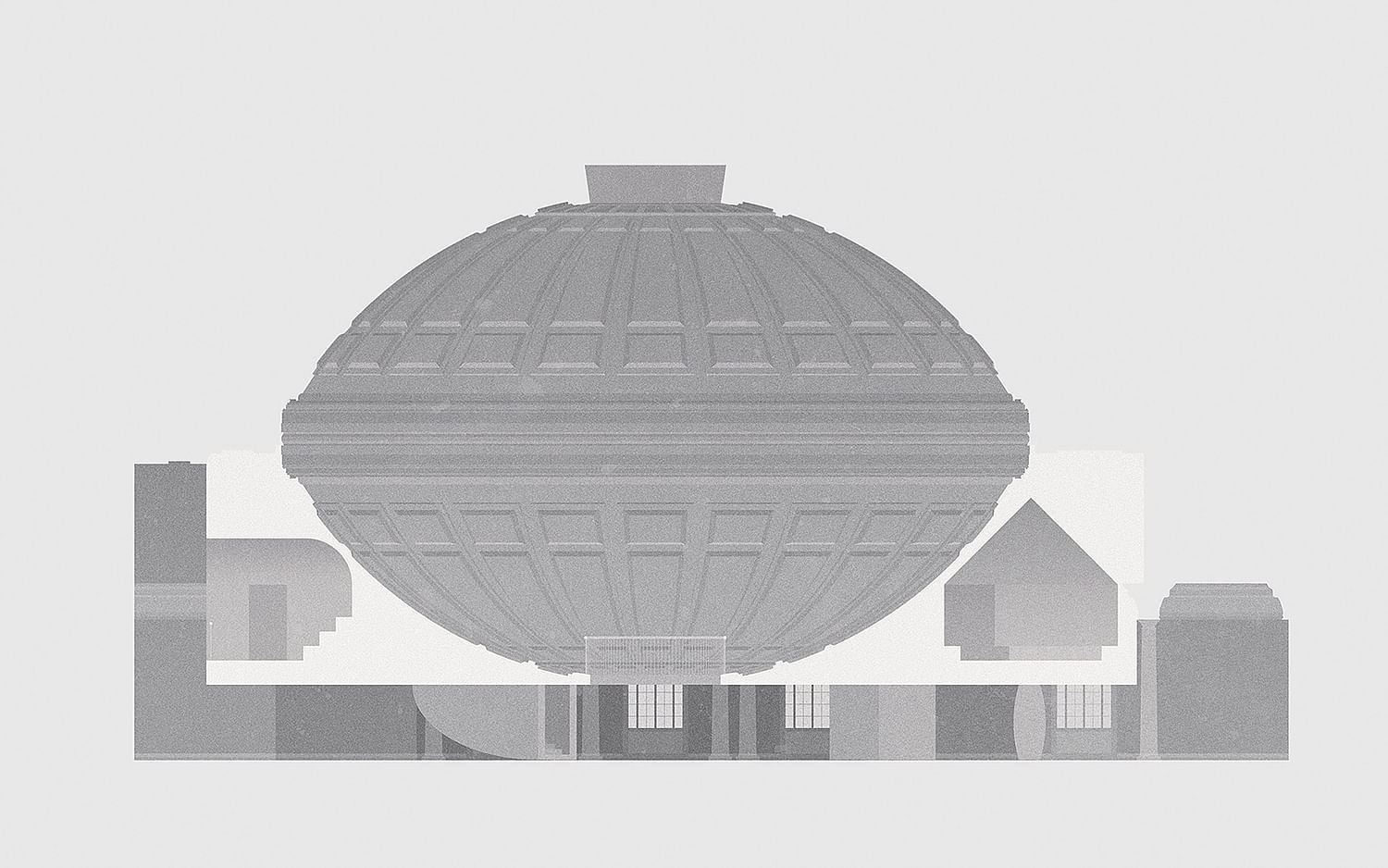
Honorable Mention: “Dualism” by John David Todd, Kevin Lamyuktseung, and James Martin​

Project description: “We have become a multitude. We have become atomized collections of individuals, no longer bound to a collective. The collapse of the Enlightenment Project into the many ‘isms’ of the 20th century left a bad taste in our collective mouth. It has left us ambivalent about institutions and power, pessimistic toward the possibility of a utopia, skeptical of unifying systems and Grands Projets. Wandering about the no-stop Cartesian plain, we are left in search of our own private pleasures, consuming our own meaning. Yet, in this Cambrian explosionof truths and tribes, we have lost the polis.

In Ancient Greece, the polis referred to both the spatial territory of thecity-state as well as the collective body of citizens. For the Greeks, thebasis of humanity and society was bound to the creation of a public, and the public to the construction of the political. Central to the publiclife in the agora was the ekklesiasterion, the space of general assembly that gave place to politic.

The dome is a representational space of unity. Capping the heavens, itfocuses all that is beneath into a unified whole from above. The inversion of the dome is a bowl. It is an inhabited topography—focusing view and gathering movement inward, constructing unity from the ground up. It is the space of the ekklesiasterion. It is a social space of negotiation that constructs the body of the polis through dialogue and debate.

First encountered is the space of the grid—a low and horizontal expanse to wander amongst a forest of columns and cores. Ascending into the poché, a foam-like assemblage of chambers provide opportunity for seclusion and small gathering. Finally, there is the space of the dome and of the bowl.”

Images + project text courtesy of Chicago Architectural Club.

RELATED COMPETITION 2017 Burnham Prize Competition: Under the Dome
RELATED NEWS Winners of the 2013 Burnham Prize Competition: NEXT STOP-Designing Chicago BRT Stations

Related

chicago architectural club ● burnham prize ● dome ● ideas competition ● competition ● chicago ● speculative architecture ● intervention

Share

  • Follow

    0 Comments

  • Comment as :

“New Waters” wins the 2017 Burnham Prize “Under the Dome” competition

World Architecture Festival: Explore the shortlisted finalists for 2026

New architecture and design competitions: Tiny Houses, A' Design Award, L A M P, and Walzwerk

Studio Gang receives 2026 AIA Chicago Firm Award for ‘conceptual rigor’

Ellen Peirson wins 2026 Wheelwright Prize for kitchens as ‘mineral landscapes’

Here are the winners of the 2026 AIA Los Angeles Board of Directors Awards

A proposal reusing decommissioned buses as mobile playgrounds wins the 2026 Davidson Prize

Carlo Ratti and Park Associati to redevelop Italian hospital by linking architecture and healing

Sponsored Post by Buildner

Mujassam Watan Urban Sculpture Challenge #8 FINAL registration deadline is approaching!

Sign up for Bustler's Email Newsletters

Excellence in sacred architecture reflected across the 2026 Faith & Form International Awards for Religious Architecture & Art winners

Sponsored Post by Buildner

Underbridge / Edition #2 advance registration deadline is approaching!

World’s most beautiful commercial stores of 2026 selected by Prix Versailles

Sponsored Post by Buildner

Buildner’s Unbuilt Award 2026 advance registration deadline is approaching!

Eight innovative timber projects honored at 2026 Wood in Architecture Awards

Beautiful brick architecture honored at BRICK AWARD 26

Over $500,000 awarded to architectural discourse projects by Graham Foundation

Next page » Loading

“New Waters” wins the 2017 Burnham Prize “Under the Dome” competition

By Justine Testado|

Friday, Oct 6, 2017

Share

Winner: “NEW WATERS” by Sonja Cheng, Jennifer Ly and Max Obata.

Related

chicago architectural club ● burnham prize ● dome ● ideas competition ● competition ● chicago ● speculative architecture ● intervention

The Chicago Architectural Club's annual Burnham Prize had another successful run for 2017. This time around, entrants developed speculative architectural interventions for the dome of the abandoned St. Stephen Church in Chicago.

At the end of the competition, Sonja Cheng, Jennifer Ly and Max Obata won the prize with their submission “New Waters”, while an honorable mention went to “Dualism” by John David Todd, Kevin Lamyuktseung, and James Martin. Check out the entries below.

Winner: “NEW WATERS” by Sonja Cheng, Jennifer Ly and Max Obata

Winner: “NEW WATERS” by Sonja Cheng, Jennifer Ly and Max Obata.

Project description: “The dome is not neutral — it is a monumental architectural form. It dominates, centralizes and defines a focal point for congregation. The abandoned St. Stephen’s Church offers the opportunity for a new interpretation of public space. The pool has the ability to regenerate the neighborhood while creating an intimate and playful public space.

The public swimming pool has had a contested history in America dating back to the 19th century. It first emerged as a place for personal hygiene and then evolved into a site of public tension through gender, economic, and racial divide. Today, Chicago manages 49 outdoor pools and 28 indoor pools. The new pool joins this existing, established network, but offer a new spatial environment that juxtaposes between the new and the old.

By reconfiguring the church’s section into a multi-level groundscape, the new public pool provides a playful environment for recreation, relaxation and spectacle. This new intervention of multi-color terrazzo meets the existing, decaying plaster church walls through a strict horizontal datum that straddles intervention with preservation. 

As a response to the new program, the existing Guastavino dome is replaced with a new dome that follows the former’s silhouette. The new dome utilizes modern technology and construction with glue joined glass elements. It is comprised of a pleated, slumped glass module that references the existing Guastavino coffer module. By recreating the dome with modern techniques and translucent materials, the new dome brings light and air into the swimming pool and serves as an urban beacon.”

Honorable Mention: “Dualism” by John David Todd, Kevin Lamyuktseung, and James Martin
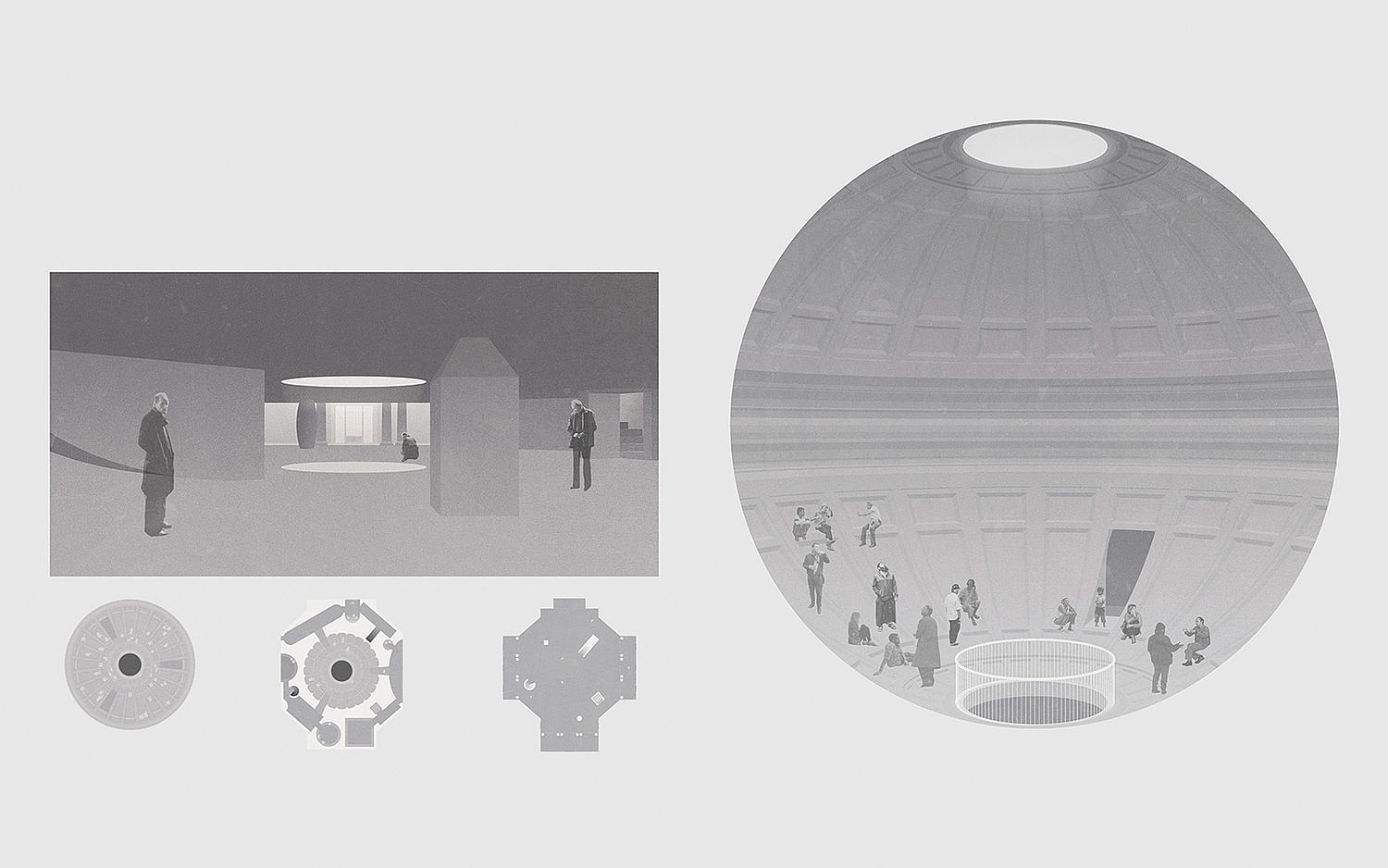
Honorable Mention: “Dualism” by John David Todd, Kevin Lamyuktseung, and James Martin​

Project description: “We have become a multitude. We have become atomized collections of individuals, no longer bound to a collective. The collapse of the Enlightenment Project into the many ‘isms’ of the 20th century left a bad taste in our collective mouth. It has left us ambivalent about institutions and power, pessimistic toward the possibility of a utopia, skeptical of unifying systems and Grands Projets. Wandering about the no-stop Cartesian plain, we are left in search of our own private pleasures, consuming our own meaning. Yet, in this Cambrian explosionof truths and tribes, we have lost the polis.

In Ancient Greece, the polis referred to both the spatial territory of thecity-state as well as the collective body of citizens. For the Greeks, thebasis of humanity and society was bound to the creation of a public, and the public to the construction of the political. Central to the publiclife in the agora was the ekklesiasterion, the space of general assembly that gave place to politic.

The dome is a representational space of unity. Capping the heavens, itfocuses all that is beneath into a unified whole from above. The inversion of the dome is a bowl. It is an inhabited topography—focusing view and gathering movement inward, constructing unity from the ground up. It is the space of the ekklesiasterion. It is a social space of negotiation that constructs the body of the polis through dialogue and debate.

First encountered is the space of the grid—a low and horizontal expanse to wander amongst a forest of columns and cores. Ascending into the poché, a foam-like assemblage of chambers provide opportunity for seclusion and small gathering. Finally, there is the space of the dome and of the bowl.”

Images + project text courtesy of Chicago Architectural Club.

RELATED COMPETITION 2017 Burnham Prize Competition: Under the Dome
RELATED NEWS Winners of the 2013 Burnham Prize Competition: NEXT STOP-Designing Chicago BRT Stations

Share

  • Follow

    0 Comments

  • Comment as :

Archinect JobsArchinect Jobs

The Archinect Job Board attracts the world's top architectural design talents.

VIEW ALL JOBS POST A JOB

Architect

Ageloff Design Group

Architect

New York, NY, US

Intermediate Interior Designer

Alchemy Studio

Intermediate Interior Designer

Brooklyn, NY, US

Intermediate Architectural Designer, Commercial Interiors - Boston Office

Fogarty Finger

Intermediate Architectural Designer, Commercial Interiors - Boston Office

Boston, MA, US

Landscape Designer / Landscape Architect

Stoss Landscape Urbanism

Landscape Designer / Landscape Architect

Los Angeles, CA, US

Project Architect

StudioSC

Project Architect

New York, NY, US

Associate: Theatre Space Designer

Apeiro Design

Associate: Theatre Space Designer

New York, NY, US

Architect

Savane Design + Build

Architect

Chicago, IL, US

Cool Project Architect / Designer

CHxTLD

Cool Project Architect / Designer

Urban Designer

LMN

Urban Designer

Seattle, WA, US

Project Coordinator - Interior Millwork and Custom Furniture

Kati Curtis Design

Project Coordinator - Interior Millwork and Custom Furniture

New York, NY, US

Next page » Loading