• Login / Join
  • About
  • •
  • Contact
  • •
  • Advertising
bustler logo
bustler logo
  • News
  • Competitions
  • Events
  • Bustler is powered by Archinect
  • Sign up for Bustler's Email Newsletters

  • Follow these Bustler feeds:

  • Search

    Search in

  • Submit

    What are you submitting?

    News Pitch
    Competition
    Event
  • Login / Join
  • News|Competitions|Events
  • Search
    | Submit
    | Follow
  • Search in

    What are you submitting?

    News Pitch
    Competition
    Event

    Follow these Bustler feeds:

  • About|Contact|Advertising
  • Login / Join

“Alien” Bike Rack Selected in NYC Design Competition

By Bustler Editors|

Friday, Nov 7, 2008

It began with a competition. The New York City Department of Transportation and the Cooper-Hewitt National Design Museum, along with Google, wanted to encourage cycling as a convenient method of transportation. After a study revealed that lack of access to secure bike parking was the main deterrent, the two organizations created a contest to develop an innovative bike rack that would raise the profile of cycling in the city. Francis Bitonti, principal with FADarchitecture, jumped at the opportunity to participate.

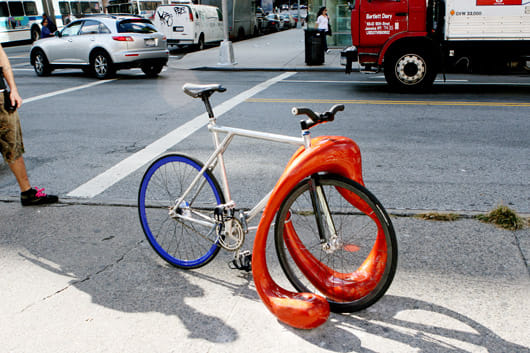
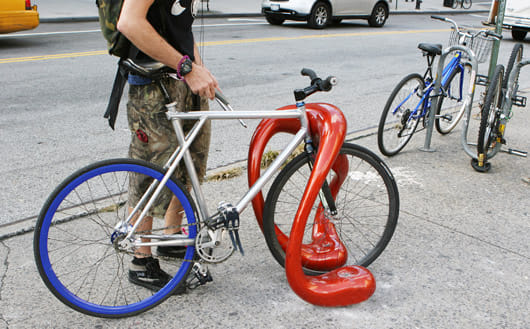
“Entering the contest seemed like good opportunity,” said Bitonti, whose firm is a young, full-service design firm, with a commitment to innovation. He created a bike rack that uses modular pieces and freeform geometry. He says it looks “alien.”
image

Bike Rack by Francis Anthony Bitonti (FADarchitecture)

image

Bike Rack by Francis Anthony Bitonti (FADarchitecture)

“A lot of what I do comes out of writing small computer programs that generate forms,” he said. “This form is disconnected but continuous at the same time, operating as a modular system that produces many variations. It is about finding beauty in the unfamiliar.” While this was a benefit in terms of design, it could have been challenging to create without the help of RedEye.

Bitonti designed the rack using animation software “to develop the forms and create an aesthetic sensibility for the project,” he said. He then transferred his work to software typically used for scientific computing to produce complex patterns that would be very time-consuming and difficult to produce any other way.
image

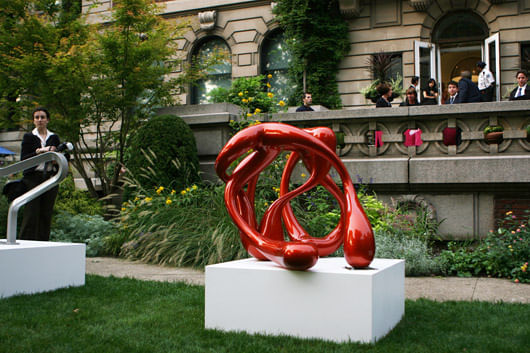
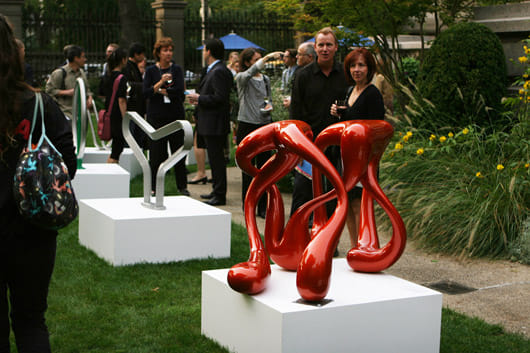
At the presentation of CityRacks’ finalists

image

At the presentation of CityRacks’ finalists

The complexity was no problem for RedEye. “We are used to creating unusual shapes and forms,” said Ryan Sybrant, RedEye Architectural Development Manager. “We extracted data from Frank’s CAD file, which directed one of our 100 fused deposition modeling (FDM) systems to put down layers of material, similar to the way an ink jet printer puts down ink. 

Bitonti originally planned to mill the rack, but the complicated design would have required 200 parts. “Because the design had so many curves,” Bitonti said, “every time it went in a different direction, we would have had to cut one of the pipes. It would have been nearly impossible to fabricate with traditional milling procedures. 3D printing was the most cost-efficient and precise way to manufacture these parts. With RedEye’s FDM technology, only 18 parts were needed. That’s a tremendous difference.”
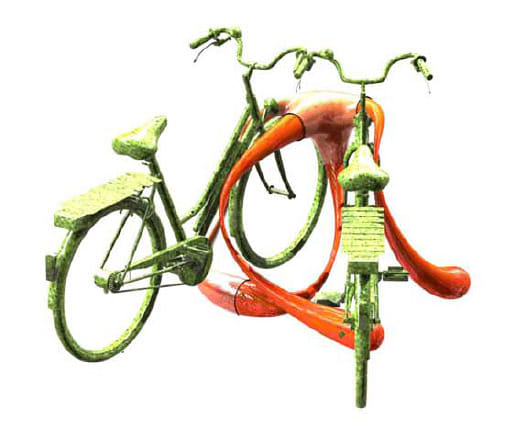
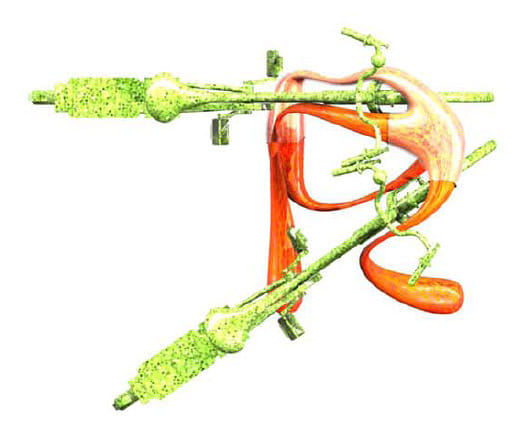
image

Concept Rendering

image

Concept Rendering

Even the size of the 18 large bike rack components was not a problem for RedEye. “With our ‘large build envelope,’ we could nest pieces together,” said Sybrant. “Large pieces are not a problem for us.” Assembly was much easier, too. It only took two people, compared to a very large crew that would have been required to assemble the 200 parts created with traditional milling.”

Security is an issue for bikes, especially in a city the size of New York. Bitonti was able to reinforce the plastic bike rack with steel cabling.

A honeycomb interior reduced both production time and cost, an important factor given the city’s limited budget, said Bitonti. “The sparse honeycomb filling still provided rigidity, but at half the cost.”
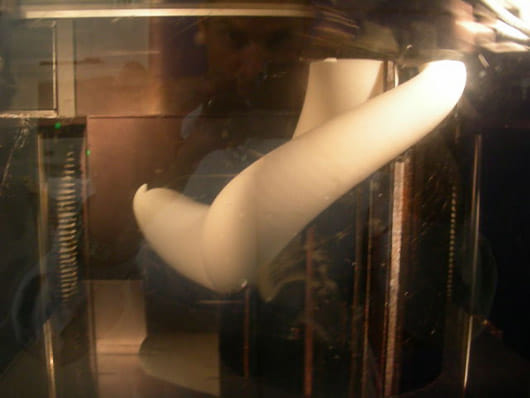
image

A piece of the rack inside the 3D Printer

Bitonti redesigned the rack many times along the way to reduced the number of modular connections, making it easier for bikers to use. Even so, by altering the rotation, position and number of units, one can produce 63 drastically different variations of the design. Bitonti believes the design of his new rack will enable a maximum number of bikes to be stored in limited sidewalk space, keeping the sidewalk more open for pedestrians. Two prototypes of the bike rack were created. One is actually in use on the streets of New York. The other is on display at the Cooper-Hewitt National Design Museum.

Choosing a glossy ABS plastic material from one of RedEye’s 15 choices, Bitonti painted the parts an automotive deep red-orange. “The automotive paint became an excellent way for me to create a kind of living surface that is always changing with the light and relationship of the observer to the object,” he said.

Perhaps the greatest compliment of all came from a potential user who said, “The bike rack is so unique that (thieves) will steal the rack before they steal my bike.”

Images: Francis Anthony Bitonti (FADarchitecture)

Related

usa ● the new york city department of transportation ● redeye ● nyc dot ● nyc ● new york ● frank bitonti ● francis bitonti ● fadarchitecture ● east coast ● design compeition ● design ● competition ● bike rack

Share

  • Follow

    0 Comments

  • Comment as :

“Alien” Bike Rack Selected in NYC Design Competition

New architecture and design competitions: Exploring 130 Years of American Design, Christo & Jeanne-Claude Center, 13 White Houses, and La Pyramide

Micro-architecture honored in latest Tiny House Architecture Competition

World’s most beautiful restaurants of 2026 chosen by Prix Versailles

Sponsored Post by Buildner

Design a wine tasting room in Italy! Valli Wine Tasting Room is launched!

10 can't-miss architecture & design events to see this June in London, Los Angeles, Chicago, San Francisco, Detroit, San Diego, Porto, and Barcelona

Sponsored Post by Buildner

Museum of Emotions / Edition #8 FINAL registration deadline is approaching!

Seven global projects make AR Public Awards shortlist 2026

Sponsored Post by Buildner

Design a slow-living restaurant in Portugal! Portugal Long Table Restaurant is launched!

Sign up for Bustler's Email Newsletters

World's best tall buildings honored at the CVU 2026 Award of Excellence

Sponsored Post by TWOPAGES

Final call: TWOPAGES X Design Contest 2026 submissions close June 5

Kengo Kuma & Paul Raff win Alberta national park visitor center competition with landscape-focused design

2026 Moira Gemmill and MJ Long prizes announced by W Awards

New architecture and design competitions: Kinderspace, Stewardson Keefe LeBrun Travel Grant, SMALL PROJECT BIG IMPACT, and Garden of University House, Bucharest

The Century of Gehry: New retrospective explores the late architect's work & collaborations

Sponsored Post by Buildner

Rome Rain Rooms FINAL registration deadline is in 5 DAYS!

Next page » Loading

“Alien” Bike Rack Selected in NYC Design Competition

By Bustler Editors|

Friday, Nov 7, 2008

Share

Related

usa ● the new york city department of transportation ● redeye ● nyc dot ● nyc ● new york ● frank bitonti ● francis bitonti ● fadarchitecture ● east coast ● design compeition ● design ● competition ● bike rack

It began with a competition. The New York City Department of Transportation and the Cooper-Hewitt National Design Museum, along with Google, wanted to encourage cycling as a convenient method of transportation. After a study revealed that lack of access to secure bike parking was the main deterrent, the two organizations created a contest to develop an innovative bike rack that would raise the profile of cycling in the city. Francis Bitonti, principal with FADarchitecture, jumped at the opportunity to participate.

“Entering the contest seemed like good opportunity,” said Bitonti, whose firm is a young, full-service design firm, with a commitment to innovation. He created a bike rack that uses modular pieces and freeform geometry. He says it looks “alien.”

image

Bike Rack by Francis Anthony Bitonti (FADarchitecture)

image

Bike Rack by Francis Anthony Bitonti (FADarchitecture)

“A lot of what I do comes out of writing small computer programs that generate forms,” he said. “This form is disconnected but continuous at the same time, operating as a modular system that produces many variations. It is about finding beauty in the unfamiliar.” While this was a benefit in terms of design, it could have been challenging to create without the help of RedEye.

Bitonti designed the rack using animation software “to develop the forms and create an aesthetic sensibility for the project,” he said. He then transferred his work to software typically used for scientific computing to produce complex patterns that would be very time-consuming and difficult to produce any other way.

image

At the presentation of CityRacks’ finalists

image

At the presentation of CityRacks’ finalists

The complexity was no problem for RedEye. “We are used to creating unusual shapes and forms,” said Ryan Sybrant, RedEye Architectural Development Manager. “We extracted data from Frank’s CAD file, which directed one of our 100 fused deposition modeling (FDM) systems to put down layers of material, similar to the way an ink jet printer puts down ink. 

Bitonti originally planned to mill the rack, but the complicated design would have required 200 parts. “Because the design had so many curves,” Bitonti said, “every time it went in a different direction, we would have had to cut one of the pipes. It would have been nearly impossible to fabricate with traditional milling procedures. 3D printing was the most cost-efficient and precise way to manufacture these parts. With RedEye’s FDM technology, only 18 parts were needed. That’s a tremendous difference.”

image

Concept Rendering

image

Concept Rendering

Even the size of the 18 large bike rack components was not a problem for RedEye. “With our ‘large build envelope,’ we could nest pieces together,” said Sybrant. “Large pieces are not a problem for us.” Assembly was much easier, too. It only took two people, compared to a very large crew that would have been required to assemble the 200 parts created with traditional milling.”

Security is an issue for bikes, especially in a city the size of New York. Bitonti was able to reinforce the plastic bike rack with steel cabling.

A honeycomb interior reduced both production time and cost, an important factor given the city’s limited budget, said Bitonti. “The sparse honeycomb filling still provided rigidity, but at half the cost.”

image

A piece of the rack inside the 3D Printer

Bitonti redesigned the rack many times along the way to reduced the number of modular connections, making it easier for bikers to use. Even so, by altering the rotation, position and number of units, one can produce 63 drastically different variations of the design. Bitonti believes the design of his new rack will enable a maximum number of bikes to be stored in limited sidewalk space, keeping the sidewalk more open for pedestrians. Two prototypes of the bike rack were created. One is actually in use on the streets of New York. The other is on display at the Cooper-Hewitt National Design Museum.

Choosing a glossy ABS plastic material from one of RedEye’s 15 choices, Bitonti painted the parts an automotive deep red-orange. “The automotive paint became an excellent way for me to create a kind of living surface that is always changing with the light and relationship of the observer to the object,” he said.

Perhaps the greatest compliment of all came from a potential user who said, “The bike rack is so unique that (thieves) will steal the rack before they steal my bike.”

Images: Francis Anthony Bitonti (FADarchitecture)

Share

  • Follow

    0 Comments

  • Comment as :

Archinect JobsArchinect Jobs

The Archinect Job Board attracts the world's top architectural design talents.

VIEW ALL JOBS POST A JOB

Intermediate Architect

FAME Architecture & Interior Design

Intermediate Architect

Los Angeles, CA, US

Junior Architect

VanderHorn Architects

Junior Architect

Greenwich, CT, US

Senior Technical Designer, Commercial Interiors - New York Office

Fogarty Finger

Senior Technical Designer, Commercial Interiors - New York Office

New York, NY, US

Business Development Manager

WORKac

Business Development Manager

New York, NY, US

Job Captain / Project Manager

Breland – Harper

Job Captain / Project Manager

Los Angeles, CA, US

Senior Interior Architect/ Designer

Silverstone Group

Senior Interior Architect/ Designer

Washington, DC, US

Architect 10+

Standard Architects

Architect 10+

Long Island City, NY, US

Junior Architect

Elizabeth Roberts Architecture & Design

Junior Architect

Brooklyn, NY, US

Intermediate Designer / Architect [5+ years experience]

RO | ROCKETT DESIGN

Intermediate Designer / Architect [5+ years experience]

Sausalito, CA, US

Project Manager - Civic/Community

DAHLIN ARCHITECTURE | PLANNING | INTERIORS

Project Manager - Civic/Community

Irvine, CA, US

Next page » Loading