• Login / Join
  • About
  • •
  • Contact
  • •
  • Advertising
bustler logo
bustler logo
  • News
  • Competitions
  • Events
  • Bustler is powered by Archinect
  • Sign up for Bustler's Email Newsletters

  • Follow these Bustler feeds:

  • Search

    Search in

  • Submit

    What are you submitting?

    News Pitch
    Competition
    Event
  • Login / Join
  • News|Competitions|Events
  • Search
    | Submit
    | Follow
  • Search in

    What are you submitting?

    News Pitch
    Competition
    Event

    Follow these Bustler feeds:

  • About|Contact|Advertising
  • Login / Join

The four finalists of the 2018 Mies Crown Hall Americas Prize for Emerging Architecture

By Justine Testado|

Thursday, Mar 15, 2018

Embodied Computation Lab by David Benjamin​, Streicher Bridge Princeton, New Jersey, United States. Photo: Michael Moran, Pablo Marvel.

The 2018 cycle for the IIT College of Architecture's Mies Crown Hall Americas Prize is well underway. Recently, four finalists were announced for the MCHAP.emerge competition. The corresponding biennial prize recognizes an outstanding built work in the Americas by an emerging architecture practice.

On April 12, the finalists will be celebrated at the MCHAP.emerge Symposium and Award Dinner, during which the MCHAP.emerge 2018 award recipient will be announced. In the meantime, check out the finalist projects below.

Children Village in Formoso do Araguaia, Tocantins, Brazil by Aleph Zero + Rosenbaum

Children Village in Formoso do Araguaia, Tocantins, Brazil by Aleph Zero + Rosenbaum. Photo: Leonardo Finotti.

Project excerpt - Objectives: “The process: To better understand the scale of this place inhabited by children, whose point of view changes with every grown inch and to propose a new understanding of the learning space also as a place of residence, we developed a cooperation process. It involved an open and intense collaboration with the local community, teachers, administration and, especially, the children. The process went through stages of research, immersion and teamwork with all those involved, through workshops and dynamics in which a common understanding of the problem and its possible solutions, arising from the dialogue between the contemporary technique and the rich local vernacular knowledge, were sought. Nature: In the context of the Brazilian Amazonian Savannah, nature is understood as “the wild”, and is constantly replaced by plantations. The exuberant forest`s maintenance is implied as a delay, while its beauty is reduced to sporadic exogenous flower gardens. Thus, the project aims to create a new perspective of progress, establishing a more open dialogue between nature, the built environment and the local people`s needs. Industrialization: Industrialization was a necessity, considering the scarse time -14 months to build 23,344.17m2- long distances to be covered and the need for precision and standardization. Therefore, the design unfolds in a set of repeated and assembled pieces, made mostly of wood or compressed earth blocks using local soil. These elements constitute both the spatiality of the building and are also a possible model of simple construction techniques to be spread among the local community.”

PRIMARY AUTHORS: Gustavo Utrabo / Aleph Zero, Pedro Duschenes / Aleph Zero, Adriana Benguela / Rosenbaum, Marcelo Rosenbaum / Rosenbaum
CONTRIBUTING AUTHORS: Helio Olga / Ita Construtora (Engineer), Ricardo Heder / Lux Projetos (Light Designer), Raul Pereira / Raul Pereira Arquitetos Associados (Landscape Designer)
AUTHOR: Fundação Bradesco

COMMON UNITY by Rozana Montiel Estudio de Arquitectura, Rozana Montiel + Alin V. Wallach
Mexico City, Mexico

RELATED NEWS Rozana Montiel + Alin V. Wallach, WORKac, SO – IL among 2017 Archmarathon Award winners
RELATED NEWS 2017 Women in Architecture Awards names Gabriela Carrillo as Architect of the Year + Rozana Montiel wins Moira Gemmill Prize
COMMON UNITY​​ in Mexico City, Mexico by Rozana Montiel Estudio de Arquitectura, Rozana Montiel + Alin V. Wallach. Photo: Sandra Pereznieto González, Jaime Navarro Soto​.

Project excerpt - Objectives: “We worked around the barriers created by the inhabitants in order to make them permeable, democratic and meaningful. One of our design strategies to reclaim privatized spaces for public use was to shift the vertical (railing, walls, gates, enclosures) which separate and divide for the horizontal (roof, shelter, floors, passageway) that connects, reunites, and encourages community interaction. The horizontal became more than just a roof: by expanding the program of potential activities in common areas through compact multi-functional structures, our COMMONUNITY project gathered the community under the same roof. The design of the new space spoke for itself: people willingly gave up 90% of the barriers. Rehabilitating public space restored the community’s use of it, transforming the UNIT into COMMON-UNITY. 6 The recovered public space in Xalpa became an extension of each apartment, while it remained free to the public. The real-estate value of the apartments doubled: the apartments surrounding the rehabilitated areas acquired the added value of community life. Safety was achieved through design. Our intervention was aimed at placemaking: by expanding the program from the perspective of its temporal and multifunctional uses, we transformed the space into a place with identity and character. Placemaking is about understanding architecture as a social construction too. The public spaces we design CHANGE BARRIERS INTO BOUNDARIES. While barriers lock everyone further into conflict, boundaries require people to communicate aspirations as well as uncomfortable issues. Our touchstone was BUILDING TRUST through design.”

AUTHOR: INFONAVIT (Carlos Zedillo Velasco, CIDS director)

María Montessori School by EPArguitectos + Estudio Macias Peredo
Mazatlán, Sinaloa, Mexico
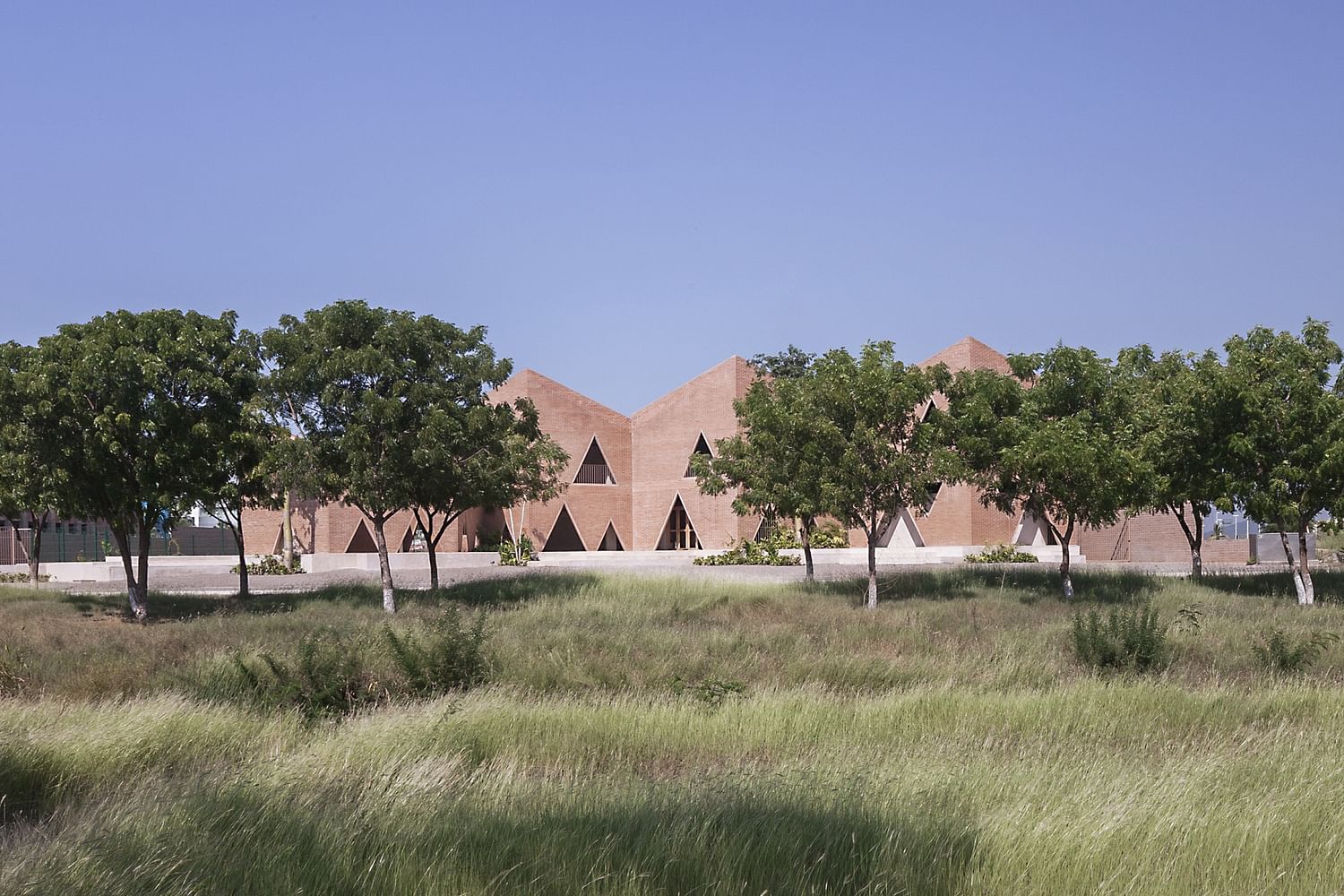
María Montessori School in Mazatlán, Sinaloa, Mexico​ by EPArguitectos + Estudio Macias Peredo, ​. Photo: Onnis Luque Rodriguez. Photo: Onnis Luque Rodriguez​.

Project excerpt - Objectives: “What is more exciting than designing for children? To create spaces that will stimulate their imagination and their sensitivity. The challenge was to design, plan and build the first phase of this project in 6 months. The client had the dream of a unique building that 12 would facilitate the delivery of the Montessori Method, which is not linear (from the teacher to the child) but concentric (from the child himself). The purpose of the method is to help obtain an integral development of the child, to achieve a maximum degree in his intellectual, physical and spiritual capacities, offering a prepared environment. The prepared learning environment, takes into account that children are eager for knowledge. The classroom had to facilitate these goals, with a flexible module that solve different education levels. The project should be solved as a repetitive system and taking into account local construction techniques that would make an agile construction process.”

PRIMARY AUTHORS: Erick Pérez (EPArquitectos), Salvador Macías (Estudio Macías Peredo), Magui Peredo (Estudio Macías Peredo)
CONTRIBUTING AUTHORS: Guillermo Barrera (EPArquitectos) (Project Director), Isaac Veloz (Estudio Macías Peredo) (Project Director), H Arquitectos (Contractor)
AUTHOR: Paulina Carrillo Collard

Embodied Computation Lab by David Benjamin
Streicher Bridge Princeton, New Jersey, United States

Embodied Computation Lab by David Benjamin​, Streicher Bridge Princeton, New Jersey, United States. Photo: Michael Moran, Pablo Marvel.

Project excerpt - Objectives: “This building is both an experiment and a research instrument. Just as biologists use a microscope to study organisms, architects will use this structure to study buildings. In other words, the project involves a simple but futuristic building to host research on the future of buildings. // Research will include automated construction, embedded sensors, feedback systems, geothermal wells, energy harnessing, and wall and roof prototypes. Projects will involve interdisciplinary collaboration between architects, engineers, computer scientists, and artists. // The building itself is also a research project on multiple levels. It involves a close study of natural and low-embodied energy materials. In particular, we worked with salvaged scaffolding boards, which are ubiquitous in construction, but they are typically discarded after a year as a rule-of-thumb, rather than inspected for problems such as warping or cracking. We used 900 scaffolding boards that would otherwise become waste. But more than offering a sustainable material, this approach allowed us to see architectural materials in a new way. Our experiments led us to emphasize revealing natural variation in boards rather than suppressing it with a one-size-fits-all or lowest-common-denominator approach. We began to read how each board comes from a different tree with a different history of growth. This allowed us to process each board according to its properties and create a unique facade. But more fundamentally, this allowed us to develop a new perspective on buildings as a temporary synthesis of materials, energy, and labor—connected to other formations before and after the life of the building.”

CONTRIBUTING AUTHORS: John Locke / The Living (Project Manager), Dan Topping / NK Architects (Architect of record), Axel Kilian / Princeton University (Faculty researcher), Forrest Meggers / Princeton University (Faculty researcher), Cristobal Correa / Buro Happold (Structural and MEP engineering), Justin Green / Big Reuse (Material salvage), Evan Eisman / Evan Eisman Studio (Sandblasting), Mike Tartaglia / Epic (Contractor)
AUTHOR: Princeton University

RELATED NEWS YAP winner The Living selected to re-design MoMA PS1's courtyard this summer
RELATED NEWS Productora wins 2016 MCHAP.emerge Award with Pavilion on the Zocalo
RELATED NEWS SANAA's Grace Farms “River” project crowned as MCHAP winner
RELATED NEWS Take a gander at the latest MCHAP finalist projects

Related

mchap ● iit ● chicago ● mies crown hall americas prize ● competition ● finalist ● illinois institute of technology ● emerging architect ● emerging architecture
Illinois Institute of Technology (IIT)
The Living
The Living

Share

  • Follow

    0 Comments

  • Comment as :

The four finalists of the 2018 Mies Crown Hall Americas Prize for Emerging Architecture

Micro-architecture honored in latest Tiny House Architecture Competition

World’s most beautiful restaurants of 2026 chosen by Prix Versailles

Sponsored Post by Buildner

Design a wine tasting room in Italy! Valli Wine Tasting Room is launched!

10 can't-miss architecture & design events to see this June in London, Los Angeles, Chicago, San Francisco, Detroit, San Diego, Porto, and Barcelona

Sponsored Post by Buildner

Museum of Emotions / Edition #8 FINAL registration deadline is approaching!

Seven global projects make AR Public Awards shortlist 2026

Sponsored Post by Buildner

Design a slow-living restaurant in Portugal! Portugal Long Table Restaurant is launched!

World's best tall buildings honored at the CVU 2026 Award of Excellence

Sign up for Bustler's Email Newsletters

Sponsored Post by TWOPAGES

Final call: TWOPAGES X Design Contest 2026 submissions close June 5

Kengo Kuma & Paul Raff win Alberta national park visitor center competition with landscape-focused design

2026 Moira Gemmill and MJ Long prizes announced by W Awards

New architecture and design competitions: Kinderspace, Stewardson Keefe LeBrun Travel Grant, SMALL PROJECT BIG IMPACT, and Garden of University House, Bucharest

The Century of Gehry: New retrospective explores the late architect's work & collaborations

Sponsored Post by Buildner

Rome Rain Rooms FINAL registration deadline is in 5 DAYS!

UIA and UN Habitat unveil sustainability-focused winners for UIA 2030 Award

Next page » Loading

The four finalists of the 2018 Mies Crown Hall Americas Prize for Emerging Architecture

By Justine Testado|

Thursday, Mar 15, 2018

Share

Embodied Computation Lab by David Benjamin​, Streicher Bridge Princeton, New Jersey, United States. Photo: Michael Moran, Pablo Marvel.

Related

mchap ● iit ● chicago ● mies crown hall americas prize ● competition ● finalist ● illinois institute of technology ● emerging architect ● emerging architecture
Illinois Institute of Technology (IIT)
The Living
The Living

The 2018 cycle for the IIT College of Architecture's Mies Crown Hall Americas Prize is well underway. Recently, four finalists were announced for the MCHAP.emerge competition. The corresponding biennial prize recognizes an outstanding built work in the Americas by an emerging architecture practice.

On April 12, the finalists will be celebrated at the MCHAP.emerge Symposium and Award Dinner, during which the MCHAP.emerge 2018 award recipient will be announced. In the meantime, check out the finalist projects below.

Children Village in Formoso do Araguaia, Tocantins, Brazil by Aleph Zero + Rosenbaum

Children Village in Formoso do Araguaia, Tocantins, Brazil by Aleph Zero + Rosenbaum. Photo: Leonardo Finotti.

Project excerpt - Objectives: “The process: To better understand the scale of this place inhabited by children, whose point of view changes with every grown inch and to propose a new understanding of the learning space also as a place of residence, we developed a cooperation process. It involved an open and intense collaboration with the local community, teachers, administration and, especially, the children. The process went through stages of research, immersion and teamwork with all those involved, through workshops and dynamics in which a common understanding of the problem and its possible solutions, arising from the dialogue between the contemporary technique and the rich local vernacular knowledge, were sought. Nature: In the context of the Brazilian Amazonian Savannah, nature is understood as “the wild”, and is constantly replaced by plantations. The exuberant forest`s maintenance is implied as a delay, while its beauty is reduced to sporadic exogenous flower gardens. Thus, the project aims to create a new perspective of progress, establishing a more open dialogue between nature, the built environment and the local people`s needs. Industrialization: Industrialization was a necessity, considering the scarse time -14 months to build 23,344.17m2- long distances to be covered and the need for precision and standardization. Therefore, the design unfolds in a set of repeated and assembled pieces, made mostly of wood or compressed earth blocks using local soil. These elements constitute both the spatiality of the building and are also a possible model of simple construction techniques to be spread among the local community.”

PRIMARY AUTHORS: Gustavo Utrabo / Aleph Zero, Pedro Duschenes / Aleph Zero, Adriana Benguela / Rosenbaum, Marcelo Rosenbaum / Rosenbaum
CONTRIBUTING AUTHORS: Helio Olga / Ita Construtora (Engineer), Ricardo Heder / Lux Projetos (Light Designer), Raul Pereira / Raul Pereira Arquitetos Associados (Landscape Designer)
AUTHOR: Fundação Bradesco

COMMON UNITY by Rozana Montiel Estudio de Arquitectura, Rozana Montiel + Alin V. Wallach
Mexico City, Mexico

RELATED NEWS Rozana Montiel + Alin V. Wallach, WORKac, SO – IL among 2017 Archmarathon Award winners
RELATED NEWS 2017 Women in Architecture Awards names Gabriela Carrillo as Architect of the Year + Rozana Montiel wins Moira Gemmill Prize
COMMON UNITY​​ in Mexico City, Mexico by Rozana Montiel Estudio de Arquitectura, Rozana Montiel + Alin V. Wallach. Photo: Sandra Pereznieto González, Jaime Navarro Soto​.

Project excerpt - Objectives: “We worked around the barriers created by the inhabitants in order to make them permeable, democratic and meaningful. One of our design strategies to reclaim privatized spaces for public use was to shift the vertical (railing, walls, gates, enclosures) which separate and divide for the horizontal (roof, shelter, floors, passageway) that connects, reunites, and encourages community interaction. The horizontal became more than just a roof: by expanding the program of potential activities in common areas through compact multi-functional structures, our COMMONUNITY project gathered the community under the same roof. The design of the new space spoke for itself: people willingly gave up 90% of the barriers. Rehabilitating public space restored the community’s use of it, transforming the UNIT into COMMON-UNITY. 6 The recovered public space in Xalpa became an extension of each apartment, while it remained free to the public. The real-estate value of the apartments doubled: the apartments surrounding the rehabilitated areas acquired the added value of community life. Safety was achieved through design. Our intervention was aimed at placemaking: by expanding the program from the perspective of its temporal and multifunctional uses, we transformed the space into a place with identity and character. Placemaking is about understanding architecture as a social construction too. The public spaces we design CHANGE BARRIERS INTO BOUNDARIES. While barriers lock everyone further into conflict, boundaries require people to communicate aspirations as well as uncomfortable issues. Our touchstone was BUILDING TRUST through design.”

AUTHOR: INFONAVIT (Carlos Zedillo Velasco, CIDS director)

María Montessori School by EPArguitectos + Estudio Macias Peredo
Mazatlán, Sinaloa, Mexico

María Montessori School in Mazatlán, Sinaloa, Mexico​ by EPArguitectos + Estudio Macias Peredo, ​. Photo: Onnis Luque Rodriguez. Photo: Onnis Luque Rodriguez​.

Project excerpt - Objectives: “What is more exciting than designing for children? To create spaces that will stimulate their imagination and their sensitivity. The challenge was to design, plan and build the first phase of this project in 6 months. The client had the dream of a unique building that 12 would facilitate the delivery of the Montessori Method, which is not linear (from the teacher to the child) but concentric (from the child himself). The purpose of the method is to help obtain an integral development of the child, to achieve a maximum degree in his intellectual, physical and spiritual capacities, offering a prepared environment. The prepared learning environment, takes into account that children are eager for knowledge. The classroom had to facilitate these goals, with a flexible module that solve different education levels. The project should be solved as a repetitive system and taking into account local construction techniques that would make an agile construction process.”

PRIMARY AUTHORS: Erick Pérez (EPArquitectos), Salvador Macías (Estudio Macías Peredo), Magui Peredo (Estudio Macías Peredo)
CONTRIBUTING AUTHORS: Guillermo Barrera (EPArquitectos) (Project Director), Isaac Veloz (Estudio Macías Peredo) (Project Director), H Arquitectos (Contractor)
AUTHOR: Paulina Carrillo Collard

Embodied Computation Lab by David Benjamin
Streicher Bridge Princeton, New Jersey, United States

Embodied Computation Lab by David Benjamin​, Streicher Bridge Princeton, New Jersey, United States. Photo: Michael Moran, Pablo Marvel.

Project excerpt - Objectives: “This building is both an experiment and a research instrument. Just as biologists use a microscope to study organisms, architects will use this structure to study buildings. In other words, the project involves a simple but futuristic building to host research on the future of buildings. // Research will include automated construction, embedded sensors, feedback systems, geothermal wells, energy harnessing, and wall and roof prototypes. Projects will involve interdisciplinary collaboration between architects, engineers, computer scientists, and artists. // The building itself is also a research project on multiple levels. It involves a close study of natural and low-embodied energy materials. In particular, we worked with salvaged scaffolding boards, which are ubiquitous in construction, but they are typically discarded after a year as a rule-of-thumb, rather than inspected for problems such as warping or cracking. We used 900 scaffolding boards that would otherwise become waste. But more than offering a sustainable material, this approach allowed us to see architectural materials in a new way. Our experiments led us to emphasize revealing natural variation in boards rather than suppressing it with a one-size-fits-all or lowest-common-denominator approach. We began to read how each board comes from a different tree with a different history of growth. This allowed us to process each board according to its properties and create a unique facade. But more fundamentally, this allowed us to develop a new perspective on buildings as a temporary synthesis of materials, energy, and labor—connected to other formations before and after the life of the building.”

CONTRIBUTING AUTHORS: John Locke / The Living (Project Manager), Dan Topping / NK Architects (Architect of record), Axel Kilian / Princeton University (Faculty researcher), Forrest Meggers / Princeton University (Faculty researcher), Cristobal Correa / Buro Happold (Structural and MEP engineering), Justin Green / Big Reuse (Material salvage), Evan Eisman / Evan Eisman Studio (Sandblasting), Mike Tartaglia / Epic (Contractor)
AUTHOR: Princeton University

RELATED NEWS YAP winner The Living selected to re-design MoMA PS1's courtyard this summer
RELATED NEWS Productora wins 2016 MCHAP.emerge Award with Pavilion on the Zocalo
RELATED NEWS SANAA's Grace Farms “River” project crowned as MCHAP winner
RELATED NEWS Take a gander at the latest MCHAP finalist projects

Share

  • Follow

    0 Comments

  • Comment as :

Archinect JobsArchinect Jobs

The Archinect Job Board attracts the world's top architectural design talents.

VIEW ALL JOBS POST A JOB

Graduate Architect

RATIO Design

Graduate Architect

Chicago, IL, US

Project Architect

BuildingWork

Project Architect

Seattle, WA, US

Architect / Urban Designer

Office for the Next Environment (OFTN)

Architect / Urban Designer

New York, NY, US

Project Designer / Job Captain

Solutions Architecture Corp

Project Designer / Job Captain

Verona, NJ, US

Designer

HATCH ARCHITECTURE

Designer

Los Angeles, CA, US

High-End Single-Family Residential Project Designer (6-8 years experience)

LUNO Design Studio

High-End Single-Family Residential Project Designer (6-8 years experience)

Los Angeles, CA, US

Project Architect/Interior Designer

IMC Architecture

Project Architect/Interior Designer

Brooklyn, NY, US

Architecture Project Manager

RDH Architecture + Interior Design

Architecture Project Manager

Las Vegas, NV, US

Business Development Manager

WORKac

Business Development Manager

New York, NY, US

Project Architect

jones | haydu

Project Architect

San Francisco, CA, US

Next page » Loading