• Login / Join
  • About
  • •
  • Contact
  • •
  • Advertising
bustler logo
bustler logo
  • News
  • Competitions
  • Events
  • Bustler is powered by Archinect
  • Sign up for Bustler's Email Newsletters

  • Follow these Bustler feeds:

  • Search

    Search in

  • Submit

    What are you submitting?

    News Pitch
    Competition
    Event
  • Login / Join
  • News|Competitions|Events
  • Search
    | Submit
    | Follow
  • Search in

    What are you submitting?

    News Pitch
    Competition
    Event

    Follow these Bustler feeds:

  • About|Contact|Advertising
  • Login / Join

2018 ACSA/AISC Steel Design Student Competition winners

By Justine Testado|

Friday, Sep 7, 2018
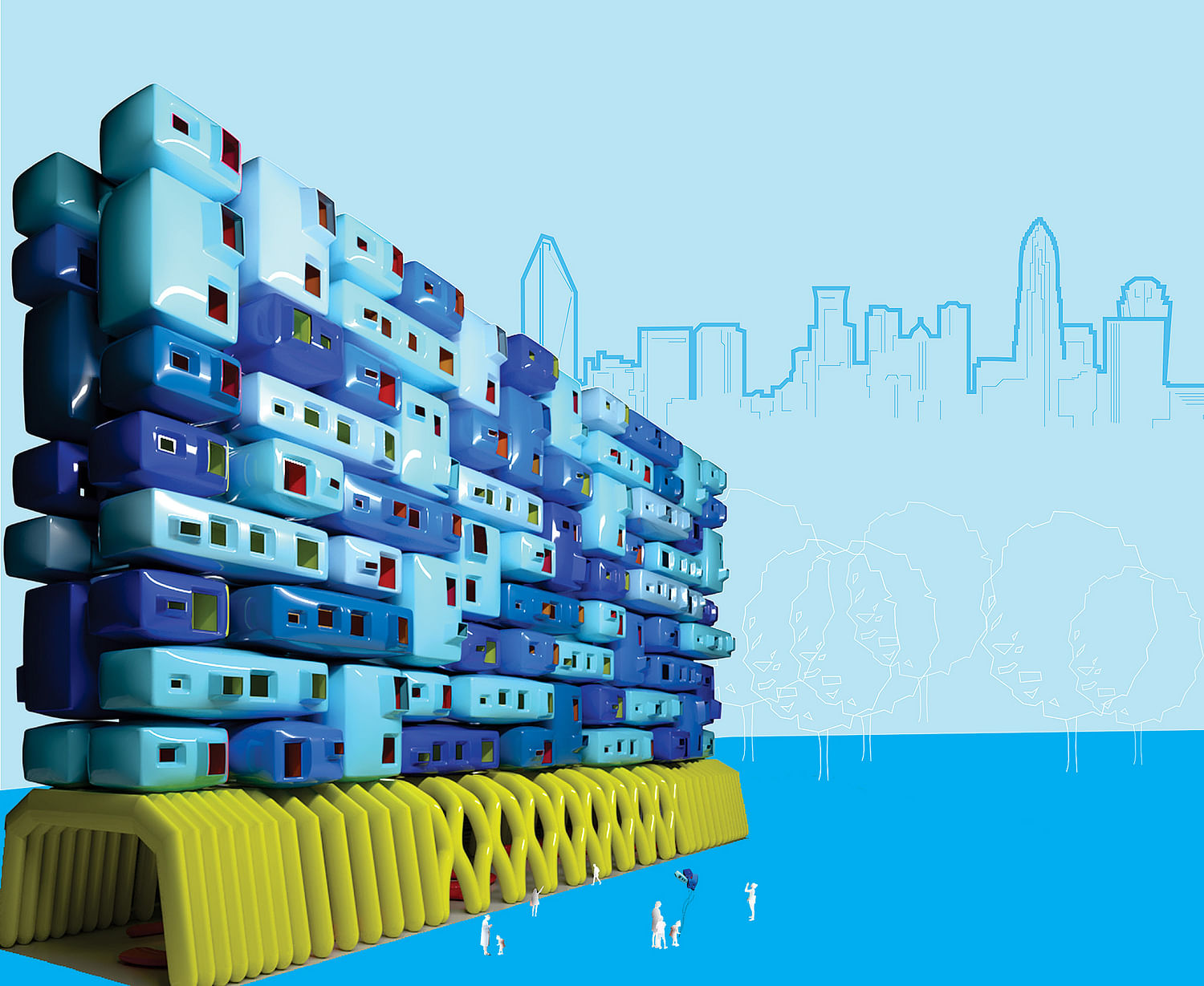
Category I - First place: Balloonité​. Students: Austin Vandepoll and Nathalie Altamirano. Faculty Sponsor: Marc Anthony Manack. School: University of North Carolina at Charlotte​.

Students across North America got to flex their steel-design skills in the 2018 ACSA/AISC Steel Design Student Competition. Over 900 students and faculty submitted more than 300 entries to the two competition categories: Category One challenged students to design affordable multi-family housing in an urban context. Category Two was an Open competition with limited restrictions that allowed students to freely investigate steel design.

A total of $14,000 in cash prizes was awarded to the winning students and their faculty sponsors. Check out the top-winning projects below.

CATEGORY I – AFFORDABLE HOUSING

(cover image) First Place: Balloonité
Students: Austin Vandepoll and Nathalie Altamirano
Faculty Sponsor: Marc Anthony Manack
School: University of North Carolina at Charlotte

Project excerpt: Charlotte, North Carolina’s Leading on Opportunity Task Force Report identified strategies to mitigate Charlotte’s lack of upward mobility. Key to the success of this strategy is housing that does not cost burden residents and allows a variety of people to stay in established neighborhoods. Balloonitè addresses Charlotte's urgent need to affordable housing with a vivid and experimental architectural response. The project seeks to re-animate the architectural approach of Le Corbusier’s Unitè d’Habitation through the use of innovative inflatable steel technology. Most inflated steel experiments are small objects and intimate installations, but they have revealed the technology’s capacity to produce thin shelled, strong, rapidly, and deployable structures. From the housing unit to the structural frame and shell, Balloonitè capitalizes on the potential of the technology at the multiple scales within the architecture.

Second Place: The Beta Commune
Student: Cera Yeo
Faculty Sponsors: Christopher Falliers and Antje K. Steinmuller
School: California College of the Arts
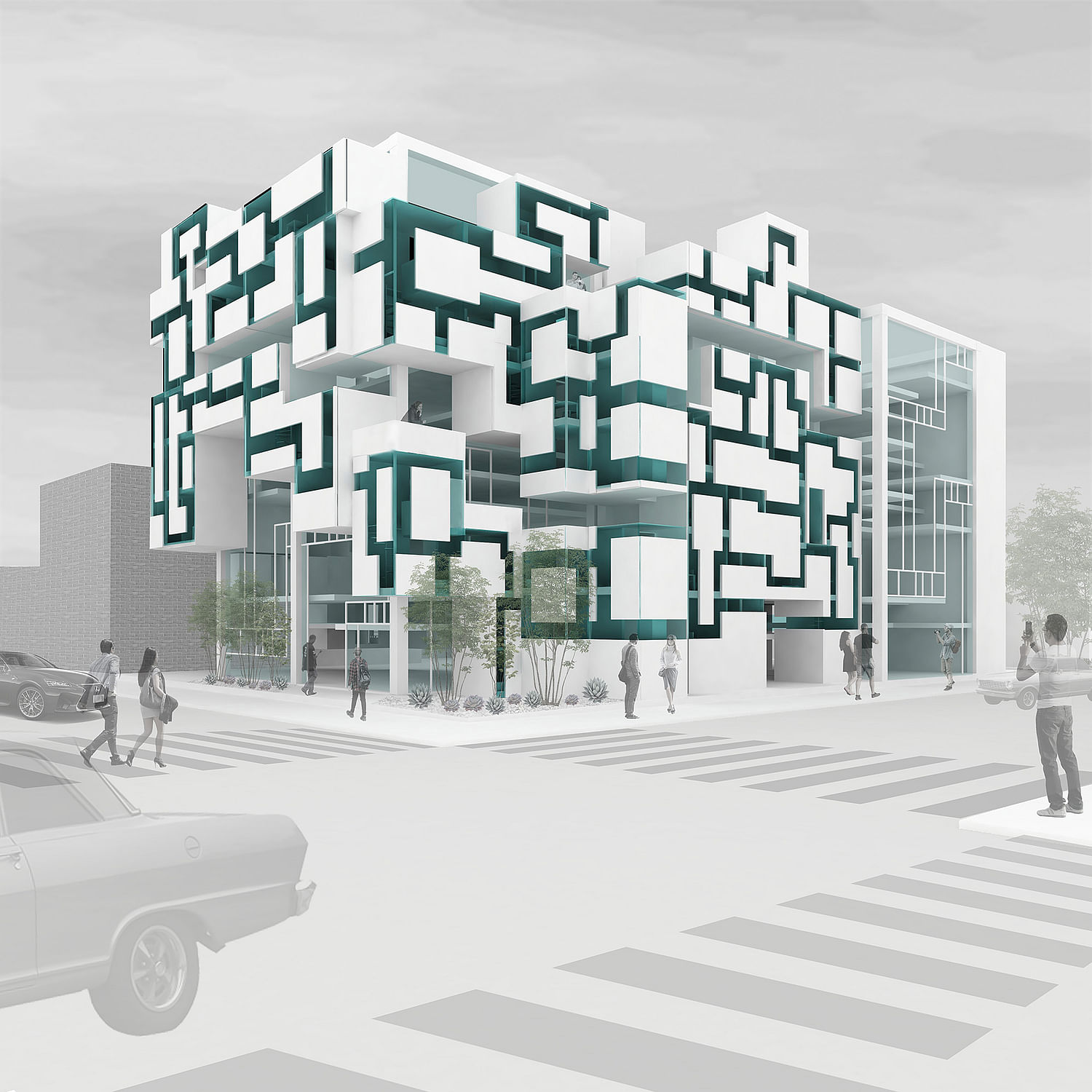
​Category I - Second Place: The Beta Commun​e. Student: Cera Yeo. Faculty Sponsors: Christopher Falliers and Antje K. Steinmuller. School: California College of the Arts​.

Project excerpt: San Francisco used to be a creative haven. However, the influx of tech industries relocating to the Bay Area has generated conflict between the two groups due to displacement of the former residents. This calls for a need of more affordable housing options for artists. The Beta Commune tackles this by offering communal living between the two. The formal design was developed by using case studies of clustering systems for housing, such as Moshe Safie’s Habitat 67 and Kisho Kurokawa’s Capsule Tower. Instead of typical concrete structures that these projects explore, the Beta Commune introduces an innovative use of steel. The Beta Commune is structured to hold communal spaces with individual room units. Five types of minimal units will plug into a steel frame with long span truss running throughout the communal spaces.These trusses then hold up cantilevering plug-in units on perpendicular sides of the building. The steel structure would form large open spaces that are sectionally divided. A five foot difference produces visual boundaries for social spaces that occur in a three dimensional cluster.

Third Place: Pressing Matters of Affordability
Students: Arturo Lujan, Pedro Pinera-Rodriguez and Ryan Smith
Faculty Sponsors: Peter L. Wong and Christopher Jarrett
School: University of North Carolina at Charlotte
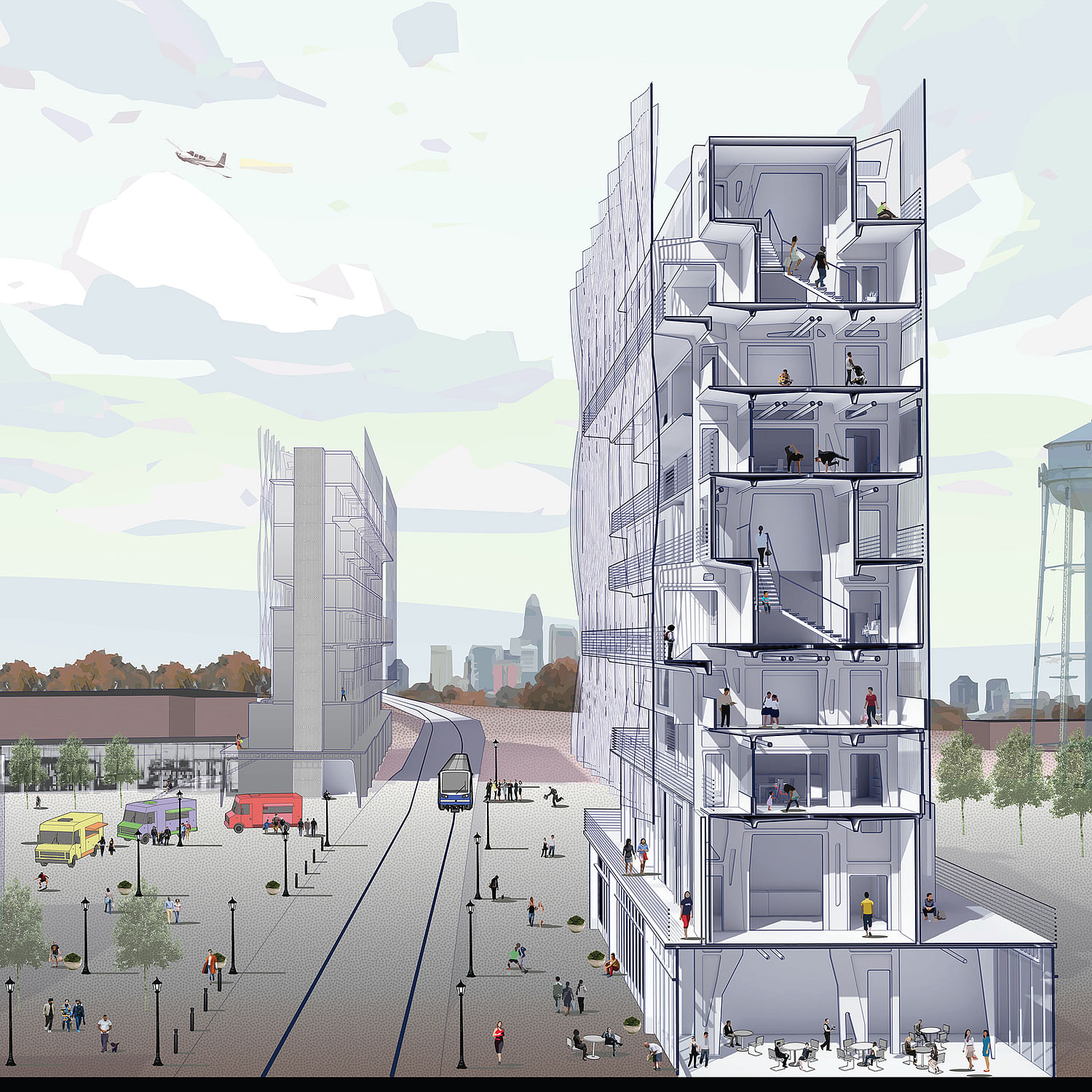
Category I - Third Place: Pressing Matters of Affordability. Students: Arturo Lujan, Pedro Pinera-Rodriguez and Ryan Smith. Faculty Sponsors: Peter L. Wong and Christopher Jarrett. School: University of North Carolina at Charlotte.

Project excerpt: Our proposal for an affordable housing complex in a former industrial zone seeks to shift from the heroic use of steel to a softer, smoother state. We propose that pressure forming metal via stamping and tooling processes can advance steel as a more subtle and seamless alternative to tectonic techniques. Sheet materials offer sophisticated shaping opportunities, demand lower energy use, and provide lateral resistance due to their planar and stress-skinned capabilities. In order to test these techniques, we imagine this design as an innovative use of blanking, stamping, drawing, and piercing methods common to automotive and other industrial manufacturing. A series of customized unitized-frames function as vertical supports running the length of the building, while a system of double-layered, stress-skinned floor plates comprise the horizontal structure. Lateral support is afforded by external skins and panels serving both structural and shading roles. Pressing serves as an activity for the smoothness of this reconsidered technology. It also imagines the bumpy yet urgent matter of housing opportunity in urban areas of gentrification.

CATEGORY I Honorable Mentions

CATEGORY II - OPEN COMPETITION

First Place: Uproot
Student: Tatiana Estrina
Faculty Sponsor: Vincent Hui
School: Ryerson University
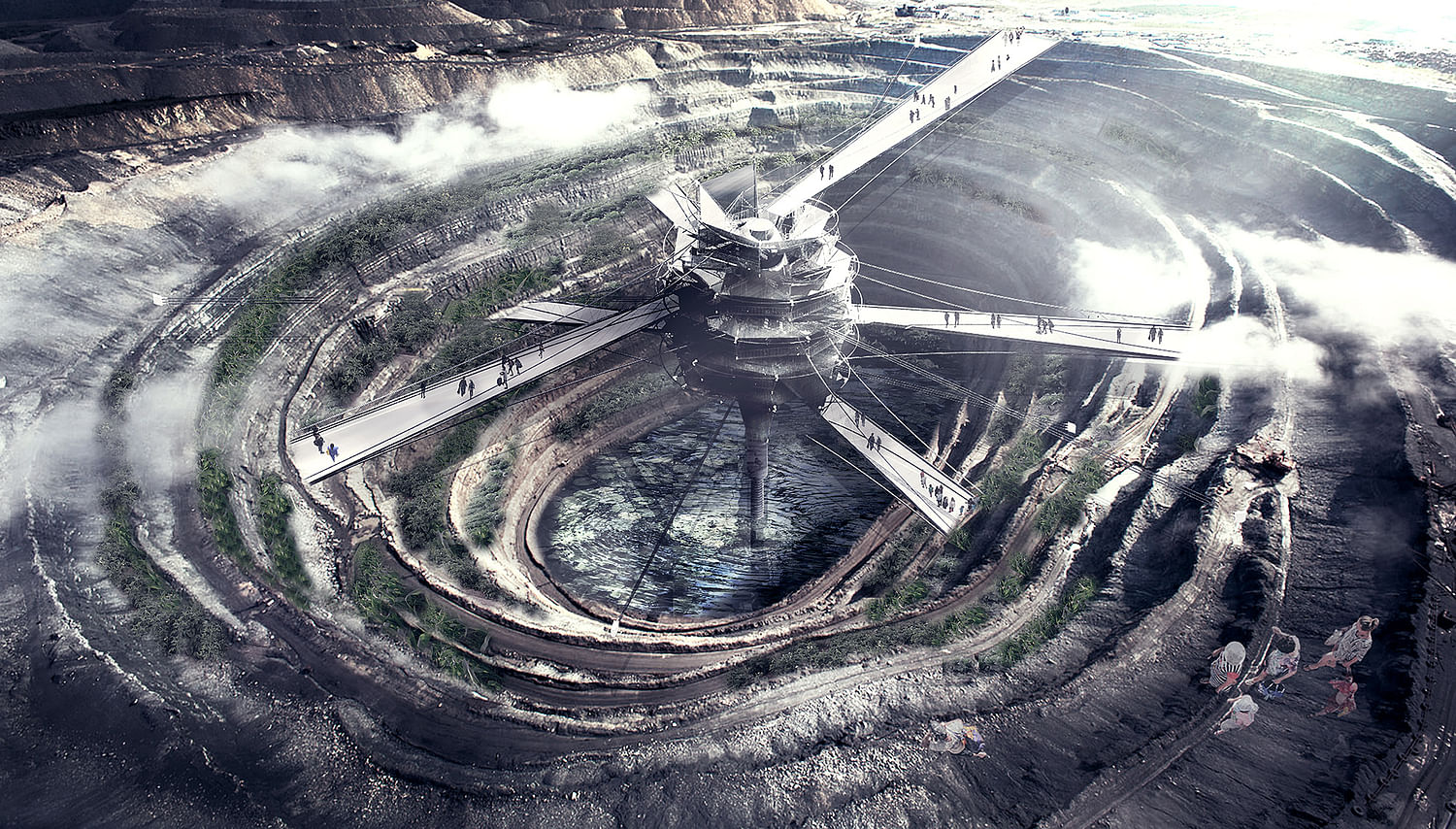
Category II - First Place: Uproot. Student: Tatiana Estrina Faculty Sponsor: Vincent Hui. School: Ryerson University.

Project excerpt: In Northern Ontario, open-pit mining is frequently used to extract minerals such as gold and diamonds. However, when the mine closes, the area is often left empty while the miners’ families face unemployment and uncertainty. In anticipation of the closure of several Ontario’s mines, UPROOT provides a structure with an alternative use for these areas. UPROOT calls for the redevelopment of open-pit mines into stepping community farmland, offering new possibilities for its use after closure. It provides a sustainable solution to global environmental concerns regarding abandoned closed mines as well as creates new opportunities in response to Ontario laws requiring mining industry to take responsibility for re-generating the area after natural resources are depleted. The design itself acts as a linkage within the pit as well as re-establishes the relationship between towns and their local food production. By taking advantage of structural steel’s strength under tension, UPROOT becomes a suspended hub for agricultural and social activities.

Second Place: Contagion
Student: Tyler Armstrong
Faculty Sponsor: Margarida Yin
School: California Polytechnic State University
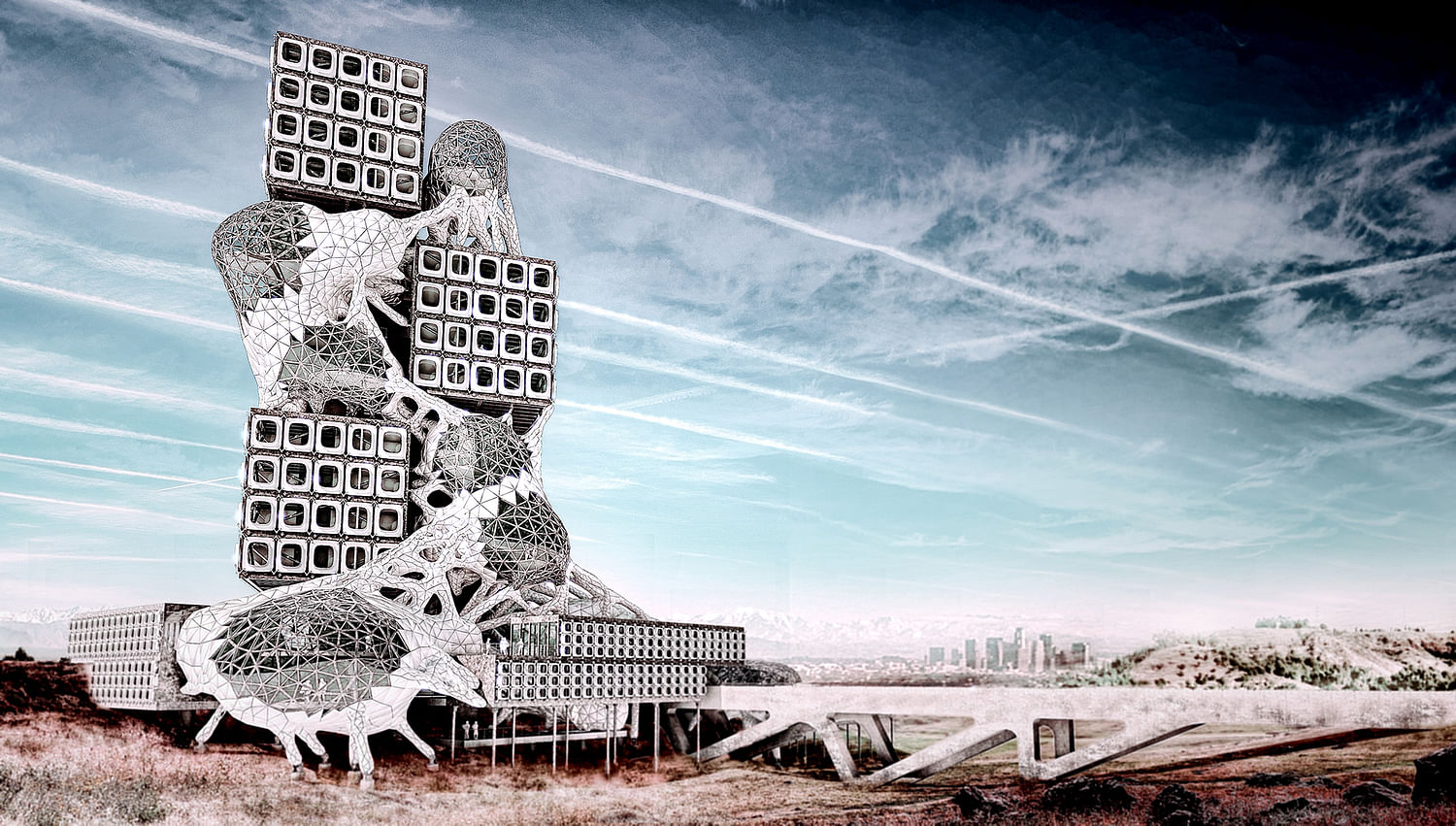
Category II - Second Place: Contagion​. Student: Tyler Armstrong. Faculty Sponsor: Margarida Yin. School: California Polytechnic State University​.

Project excerpt: My project Contagion seeks to speculate upon not just the future of the Inglewood oil field but upon the very nature of Los Angeles’ continued relationship with fossil fuels. The primary design vectors that were explored within the project are the notions of a deferred authorship through computational design, architectural succession within the landscape of Los Angeles and the built form as a kind of cultural palimpsest. The idea of a deferment of authorship was formulated in response to the decentralized architecturally spontaneous nature of Southern California. The fluid forms are a result of a generative algorithm that uses swarming logics to simulate the growth of moss like blob structures over rigid boxes. The next design driver, architectural succession is tied to the rather linear nature of Southern California development. From virgin landscapes, to resource extraction and finally a kind of decentralized urbanism in which the land is carved up between numerous areas of dense wealth and sprawling poverty. This issue of the social and economic fragmenting of Los Angeles through architectural means is simultaneously accepted and rejected by the project which like a palimpsest possesses elements both freshly written and half erased by time.

Third Place: Exocarpic Interceptor
Students: Stephen Breaux and Cutler Price
Faculty Sponsor: Thomas Fowler
School: California Polytechnic State University
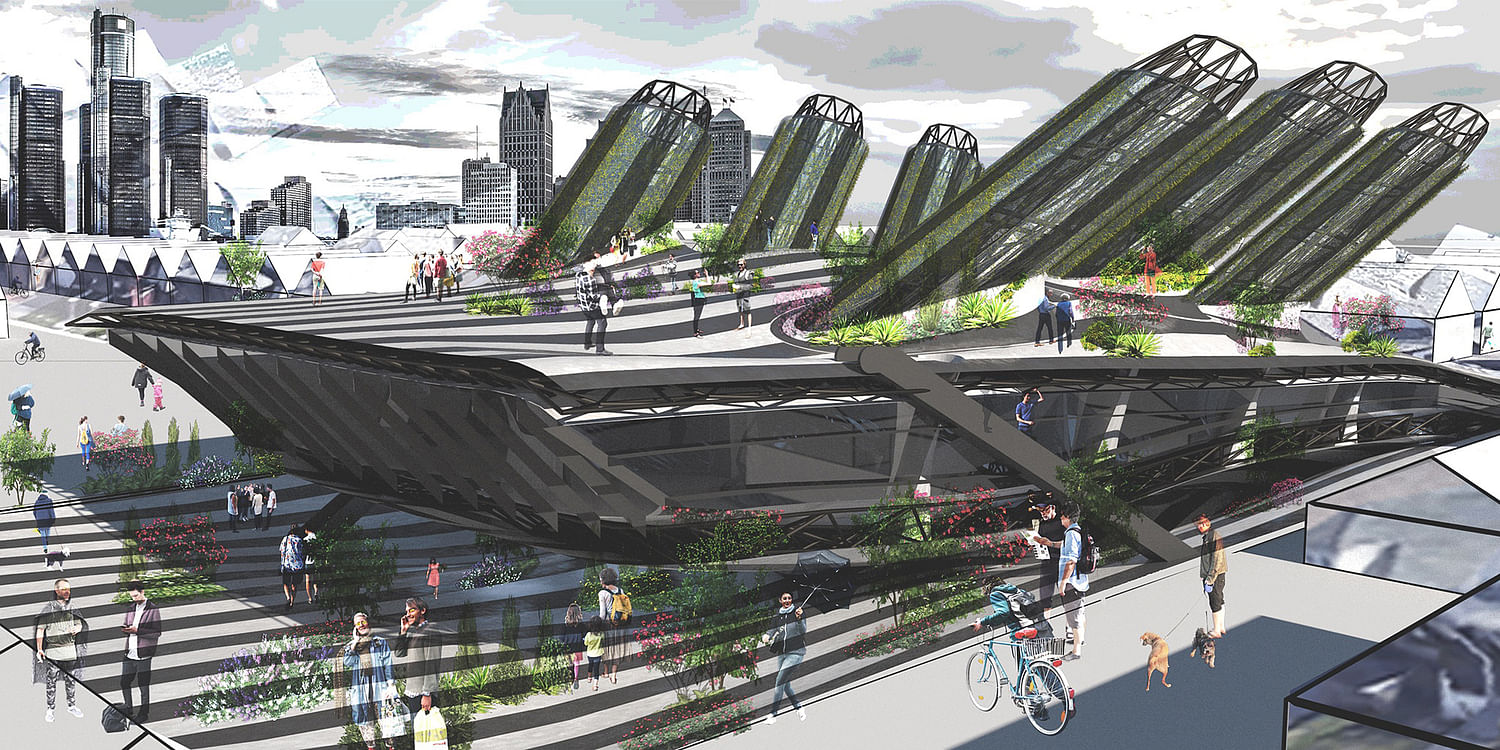
Category II - ​Third Place: Exocarpic Interceptor.​ Students: Stephen Breaux and Cutler Price. Faculty Sponsor: Thomas Fowler. School: California Polytechnic State University​.

Project excerpt: The skyline of Detroit was once defined by the endless valleys and peaks of the gables of single family homes, punctuated by the occasional midrise of a factory or exhaust tower and its endless trail of vapor fading into the heavens. Today, this skyline has eroded, the once constant gables sparse, the midrise mid-collapse, and the vapors all but evaporated. Our project introduces a new industry to revitalize Detroit through hyper efficient vertical farming towers. The farming tower, whose verticality harkens to the prosperity of a younger Detroit, creates a new industry on a sustainable foundation which generations can rely. Just as the economic viability of the towers impacts the social fabric of the city, they interpolate the topography of the site, generating spaces in which community vitality can gather and flourish around the new industry of their city.

Category II Honorable Mentions

All images courtesy of 2018 ACSA/AISC Steel Design Student Competition.

RELATED NEWS The 2017 ACSA/AISC Steel Design Student Competition winners

Related

acsa ● aisc ● student competition ● steel ● competition

Share

  • Follow

    0 Comments

  • Comment as :

2018 ACSA/AISC Steel Design Student Competition winners

Over $500,000 awarded to architectural discourse projects by Graham Foundation

Best in urban planning recognized at AIA Regional & Urban Design Award 2026

Sponsored Post by Buildner

Re:Form - New Life for Old Spaces / Edition #3 advance registration deadline is approaching!

New architecture and design competitions: IDEAS Awards, UIA-HYP CUP International Student Competition, Vancouver Tall Challenge, and Memorial to the Sixth Extinction

Best small projects chosen at AIA Small Project Award 2026

10 standout sustainable projects honored at AIA COTE Top Ten Award 2026

Best residential architecture of 2026 honored at AIA Housing Award

Best new interiors of 2026 chosen at AIA Interior Architecture Awards

Sign up for Bustler's Email Newsletters

Best global architecture honored at RIBA International Awards 2026

World’s most beautiful airports of 2026 chosen by Prix Versailles

New architecture and design competitions: Brick in Architecture Awards, Study Architecture Student Showcase, N.Y.C. Groceries, and New York High Falls Riverfront Market

SmithGroup’s ‘pioneering’ Philip Merrill Environmental Center wins AIA Twenty-five Year Award

Sponsored Post by Buildner

Museum of Emotions / Edition #8 FINAL registration deadline is in 5 DAYS!

Here are the winners of the 2026 AIA Architecture Awards

40 emerging architects and designers under 40 from Europe honored

Next page » Loading

2018 ACSA/AISC Steel Design Student Competition winners

By Justine Testado|

Friday, Sep 7, 2018

Share

Category I - First place: Balloonité​. Students: Austin Vandepoll and Nathalie Altamirano. Faculty Sponsor: Marc Anthony Manack. School: University of North Carolina at Charlotte​.

Related

acsa ● aisc ● student competition ● steel ● competition

Students across North America got to flex their steel-design skills in the 2018 ACSA/AISC Steel Design Student Competition. Over 900 students and faculty submitted more than 300 entries to the two competition categories: Category One challenged students to design affordable multi-family housing in an urban context. Category Two was an Open competition with limited restrictions that allowed students to freely investigate steel design.

A total of $14,000 in cash prizes was awarded to the winning students and their faculty sponsors. Check out the top-winning projects below.

CATEGORY I – AFFORDABLE HOUSING

(cover image) First Place: Balloonité
Students: Austin Vandepoll and Nathalie Altamirano
Faculty Sponsor: Marc Anthony Manack
School: University of North Carolina at Charlotte

Project excerpt: Charlotte, North Carolina’s Leading on Opportunity Task Force Report identified strategies to mitigate Charlotte’s lack of upward mobility. Key to the success of this strategy is housing that does not cost burden residents and allows a variety of people to stay in established neighborhoods. Balloonitè addresses Charlotte's urgent need to affordable housing with a vivid and experimental architectural response. The project seeks to re-animate the architectural approach of Le Corbusier’s Unitè d’Habitation through the use of innovative inflatable steel technology. Most inflated steel experiments are small objects and intimate installations, but they have revealed the technology’s capacity to produce thin shelled, strong, rapidly, and deployable structures. From the housing unit to the structural frame and shell, Balloonitè capitalizes on the potential of the technology at the multiple scales within the architecture.

Second Place: The Beta Commune
Student: Cera Yeo
Faculty Sponsors: Christopher Falliers and Antje K. Steinmuller
School: California College of the Arts

​Category I - Second Place: The Beta Commun​e. Student: Cera Yeo. Faculty Sponsors: Christopher Falliers and Antje K. Steinmuller. School: California College of the Arts​.

Project excerpt: San Francisco used to be a creative haven. However, the influx of tech industries relocating to the Bay Area has generated conflict between the two groups due to displacement of the former residents. This calls for a need of more affordable housing options for artists. The Beta Commune tackles this by offering communal living between the two. The formal design was developed by using case studies of clustering systems for housing, such as Moshe Safie’s Habitat 67 and Kisho Kurokawa’s Capsule Tower. Instead of typical concrete structures that these projects explore, the Beta Commune introduces an innovative use of steel. The Beta Commune is structured to hold communal spaces with individual room units. Five types of minimal units will plug into a steel frame with long span truss running throughout the communal spaces.These trusses then hold up cantilevering plug-in units on perpendicular sides of the building. The steel structure would form large open spaces that are sectionally divided. A five foot difference produces visual boundaries for social spaces that occur in a three dimensional cluster.

Third Place: Pressing Matters of Affordability
Students: Arturo Lujan, Pedro Pinera-Rodriguez and Ryan Smith
Faculty Sponsors: Peter L. Wong and Christopher Jarrett
School: University of North Carolina at Charlotte

Category I - Third Place: Pressing Matters of Affordability. Students: Arturo Lujan, Pedro Pinera-Rodriguez and Ryan Smith. Faculty Sponsors: Peter L. Wong and Christopher Jarrett. School: University of North Carolina at Charlotte.

Project excerpt: Our proposal for an affordable housing complex in a former industrial zone seeks to shift from the heroic use of steel to a softer, smoother state. We propose that pressure forming metal via stamping and tooling processes can advance steel as a more subtle and seamless alternative to tectonic techniques. Sheet materials offer sophisticated shaping opportunities, demand lower energy use, and provide lateral resistance due to their planar and stress-skinned capabilities. In order to test these techniques, we imagine this design as an innovative use of blanking, stamping, drawing, and piercing methods common to automotive and other industrial manufacturing. A series of customized unitized-frames function as vertical supports running the length of the building, while a system of double-layered, stress-skinned floor plates comprise the horizontal structure. Lateral support is afforded by external skins and panels serving both structural and shading roles. Pressing serves as an activity for the smoothness of this reconsidered technology. It also imagines the bumpy yet urgent matter of housing opportunity in urban areas of gentrification.

CATEGORY I Honorable Mentions

CATEGORY II - OPEN COMPETITION

First Place: Uproot
Student: Tatiana Estrina
Faculty Sponsor: Vincent Hui
School: Ryerson University

Category II - First Place: Uproot. Student: Tatiana Estrina Faculty Sponsor: Vincent Hui. School: Ryerson University.

Project excerpt: In Northern Ontario, open-pit mining is frequently used to extract minerals such as gold and diamonds. However, when the mine closes, the area is often left empty while the miners’ families face unemployment and uncertainty. In anticipation of the closure of several Ontario’s mines, UPROOT provides a structure with an alternative use for these areas. UPROOT calls for the redevelopment of open-pit mines into stepping community farmland, offering new possibilities for its use after closure. It provides a sustainable solution to global environmental concerns regarding abandoned closed mines as well as creates new opportunities in response to Ontario laws requiring mining industry to take responsibility for re-generating the area after natural resources are depleted. The design itself acts as a linkage within the pit as well as re-establishes the relationship between towns and their local food production. By taking advantage of structural steel’s strength under tension, UPROOT becomes a suspended hub for agricultural and social activities.

Second Place: Contagion
Student: Tyler Armstrong
Faculty Sponsor: Margarida Yin
School: California Polytechnic State University

Category II - Second Place: Contagion​. Student: Tyler Armstrong. Faculty Sponsor: Margarida Yin. School: California Polytechnic State University​.

Project excerpt: My project Contagion seeks to speculate upon not just the future of the Inglewood oil field but upon the very nature of Los Angeles’ continued relationship with fossil fuels. The primary design vectors that were explored within the project are the notions of a deferred authorship through computational design, architectural succession within the landscape of Los Angeles and the built form as a kind of cultural palimpsest. The idea of a deferment of authorship was formulated in response to the decentralized architecturally spontaneous nature of Southern California. The fluid forms are a result of a generative algorithm that uses swarming logics to simulate the growth of moss like blob structures over rigid boxes. The next design driver, architectural succession is tied to the rather linear nature of Southern California development. From virgin landscapes, to resource extraction and finally a kind of decentralized urbanism in which the land is carved up between numerous areas of dense wealth and sprawling poverty. This issue of the social and economic fragmenting of Los Angeles through architectural means is simultaneously accepted and rejected by the project which like a palimpsest possesses elements both freshly written and half erased by time.

Third Place: Exocarpic Interceptor
Students: Stephen Breaux and Cutler Price
Faculty Sponsor: Thomas Fowler
School: California Polytechnic State University

Category II - ​Third Place: Exocarpic Interceptor.​ Students: Stephen Breaux and Cutler Price. Faculty Sponsor: Thomas Fowler. School: California Polytechnic State University​.

Project excerpt: The skyline of Detroit was once defined by the endless valleys and peaks of the gables of single family homes, punctuated by the occasional midrise of a factory or exhaust tower and its endless trail of vapor fading into the heavens. Today, this skyline has eroded, the once constant gables sparse, the midrise mid-collapse, and the vapors all but evaporated. Our project introduces a new industry to revitalize Detroit through hyper efficient vertical farming towers. The farming tower, whose verticality harkens to the prosperity of a younger Detroit, creates a new industry on a sustainable foundation which generations can rely. Just as the economic viability of the towers impacts the social fabric of the city, they interpolate the topography of the site, generating spaces in which community vitality can gather and flourish around the new industry of their city.

Category II Honorable Mentions

All images courtesy of 2018 ACSA/AISC Steel Design Student Competition.

RELATED NEWS The 2017 ACSA/AISC Steel Design Student Competition winners

Share

  • Follow

    0 Comments

  • Comment as :

Archinect JobsArchinect Jobs

The Archinect Job Board attracts the world's top architectural design talents.

VIEW ALL JOBS POST A JOB

Architectural Designer / Junior Architect (1–3 Years Experience)

Andrew Magnes Architecture

Architectural Designer / Junior Architect (1–3 Years Experience)

Brooklyn, NY, US

Project Designer / Manager

BuiltIN Studio

Project Designer / Manager

New York, NY, US

Project Architect - Residential

DAHLIN Architecture | Planning | Interiors

Project Architect - Residential

Pleasanton, CA, US

Architectural Designer Level 2

Arthur Chabon Architect

Architectural Designer Level 2

New York, NY, US

Interior Architect / Interior Designer

Annum Architects (formerly Ann Beha Architects)

Interior Architect / Interior Designer

Boston, MA, US

Junior Designer/Architect

O'Neill Rose Architects

Junior Designer/Architect

Brooklyn, NY, US

Designer (Level 3)

KPMB

Designer (Level 3)

Cambridge, MA, US

Job Captain

Studio AR&D Architects

Job Captain

Los Angeles, CA, US

Interior Design Project Manager

DAHLIN Architecture | Planning | Interiors

Interior Design Project Manager

Bellevue, WA, US

Architectural/Structural Drafter

New Beginnings Engineering

Architectural/Structural Drafter

Irvine, CA, US

Next page » Loading