• Login / Join
  • About
  • •
  • Contact
  • •
  • Advertising
bustler logo
bustler logo
  • News
  • Competitions
  • Events
  • Bustler is powered by Archinect
  • Sign up for Bustler's Email Newsletters

  • Follow these Bustler feeds:

  • Search

    Search in

  • Submit

    What are you submitting?

    News Pitch
    Competition
    Event
  • Login / Join
  • News|Competitions|Events
  • Search
    | Submit
    | Follow
  • Search in

    What are you submitting?

    News Pitch
    Competition
    Event

    Follow these Bustler feeds:

  • About|Contact|Advertising
  • Login / Join

gh3 to Design June Callwood Park in Toronto

By Bustler Editors|

Friday, Feb 27, 2009

Toronto-based architecture and landscape design firm gh3 have been awarded with the first prize in the international design competition for Toronto’s June Callwood Park.
image

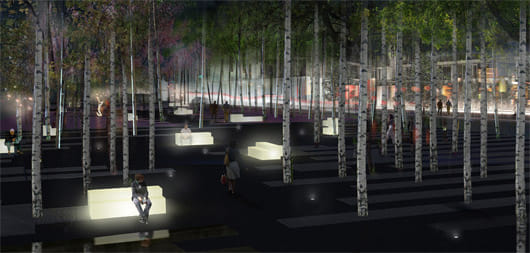
Night view of the Super-Real Forest, looking north from the Ephemeral Garden. Framed by the new urban development on either edge, the continuous ground plane is conceived as a true community park with an animated night life.

The June Callwood Park is to be designed and developed as a new park, and significant addition to the public realm of Toronto’s Central Waterfront. The park is located at the foot of the historic Fort York area of Toronto in Ward 19. It will serve as the central public space for local neighborhood activities.
image

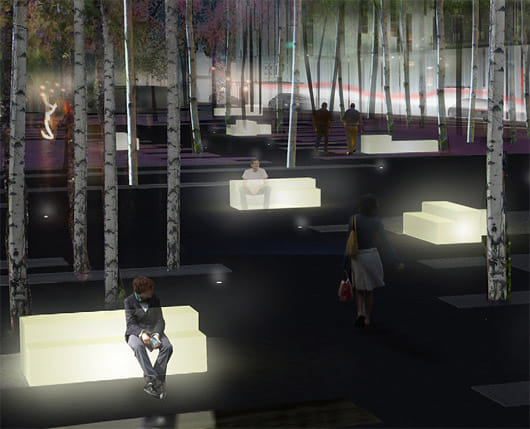
Illuminated Corian benches bring the park to life, with LED point lights sparkling like fireflies along the granite path.

The new park is named in honor of June Callwood, who passed away in April 2007 at the age of 82. June Callwood was an internationally acclaimed female journalist, author, television host, community activist, recipient of nearly 20 honorary degrees, and Companion of the Order of Canada. Before her passing, June attended a naming ceremony for the park in July 2005.
image

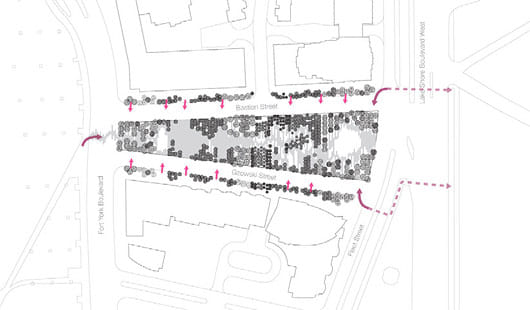
CONTEXT PLAN: The wave pattern based on June’s words creates a sinewy path that runs north to south through six clearings in the forest, connecting Lakeshore Blvd to Fort York, its black granite planks touching the edges at several points to provide east-west community access into the park. Rows of trees from the Super-Real Forest extend the park’s influence into the broad sidewalks of the residential buildings to the east and west.

gh3 was chosen as winning firm from four semi-finalists: Balmori & Associates and dTAH, gh3, Janet Rosenberg & Associates, and PMA Landscape Architects and Ground. A public exhibition of the four short-listed teams was held between October 18th to 21st, 2008.
image

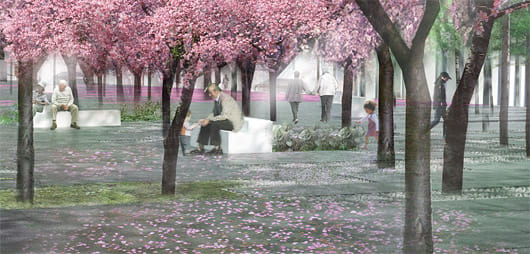
The meditative space of the Time Strip Gardens, where linear strips of planting tell stories grounded in historical and contemporary landscape preoccupations. The pink flowers of ornamental crab apples are the spring manifestation of a Callwood landscape memorial within the park. Light cubes—translucent Corian benches illuminated from within—are scattered throughout the park.

The jury consisted of Nina-Marie Lister, Associate Professor, Ryerson University School of Urban & Regional Planning, Rocco Maragna, Architect, Maragna Architect Inc., Lisa Rochon, Architecture Critic, The Globe and Mail, Greg Smallenberg, Landscape Architect and Principal, Phillips, Farevaag, Smallenberg, Laura Solano, Landscape Architect and Principal, Michael Van Valkenburgh Associates Inc., George Stroumboulopoulous, TV host of The Hour, CBC, Margery Winkler, Professor, Ryerson University, School of Architecture.
image

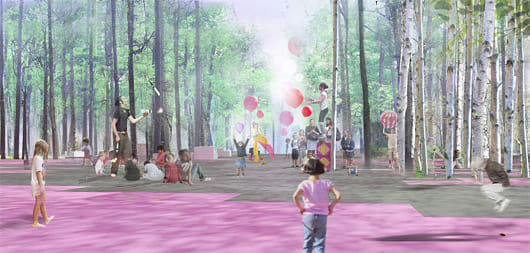
Looking north from the Pink Field, the largest of the Super-Real Forest’s five clearings. Surfaced with pink elastocrete, its smooth, rubberized texture welcomes barefoot play in the summer. It is home to a range of year round activity: Frisbee, ball games, skipping, tag in the summer; snowball fights, snowmen, and snow angels in the winter.

This is how gh3 describe their design:

A Voice in the Forest. The starting point of our design takes a voice sampling of June’s own words—“I believe in kindness”—physically mapped onto the site, its undulations creating the abstract geometric pattern of openings and clearings within the dense groves of the Super-Real Forest. June spoke of kindness as “the god in our machinery,” believing in kindness rather than organized religion or God; these words are taken from her last interview expressing that core idea. The edge of this voice wave pattern creates a sinewy path that runs north to south through five clearings in the forest, connecting Lakeshore to Fort York, its black granite planks touching the edges at several points to provide east-west community access into the park.
image

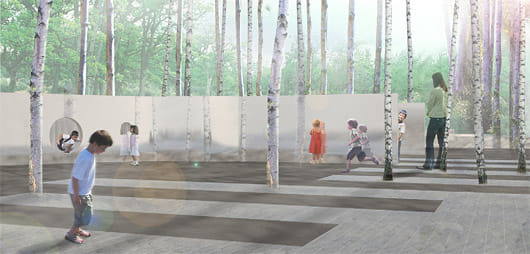
The curved stainless steel walls of the Maze are the focal point of activity. The acoustic qualities of the maze are further amplified through a sound installation, which permits disembodied voices to communicate with others elsewhere in the maze.

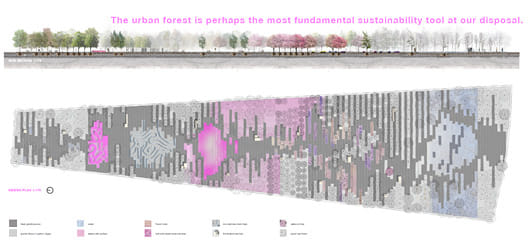
The Super-Real Forest inhabits the site with plantings of native Canadian trees, a sampling of the specimens that would have inhabited the Lake Ontario shoreline at the time the city was settled. The park is loosely zoned into six clearings: the Puddle Plaza, the Puzzle Garden, the Maze, the Pink Field Plaza, Time Strip Gardens, and Ephemeral Pools, each with its own unique spatial character and aspects of unprogramed play it encourages.
image

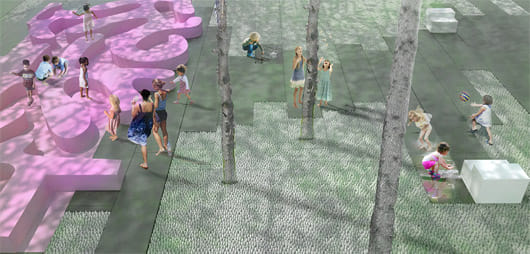
This view looking west through maples and oak trees shows the meandering path that connects the extruded elastocrete benches of the Puzzle Garden (left) and the Puddle Plaza, where indentations carved into the black granite planks of the path invite puddle play. The pink benches double as a mini-maze for younger children, and a seating area that overlooks the Puddle Plaza and the stainless steel maze.

The range of experience invited in the park is rooted in archetypal, timeless themes of human play, rather than contrived mechanical devices or apparatus that often limit their enjoyment to a specific age range. The surfaces openly invite activity that can be social, recreational or meditative. Support for play and self-directed games is implied in the spaces, open to ageless activities that could range from splashing in the shallow pools and puddles in summer, to hide-and-seek in the maze, to impromptu sports in the clearing and tai chi in the morning by the mist pools.
image

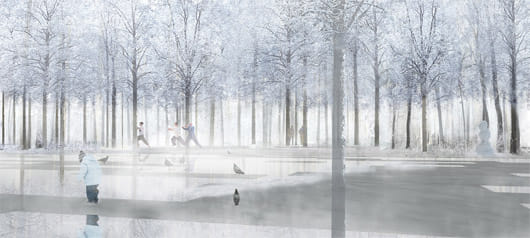
This winter view of the Ephemeral Garden shows the misty morning fog that is the result of geothermal heating of the shallow water pool a few degrees warmer than the air. Within a tempered microclimate surrounded by forest, the shallow pools of this clearing reflect the sculptural forms of the red oaks and maples that buffer the park at the lake shore.

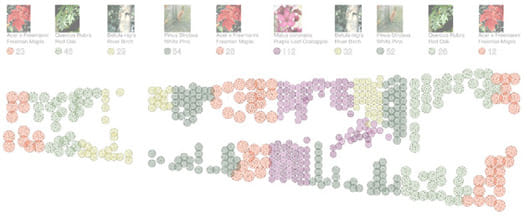
Intrinsic to the Super-Real Forest is the idea of ecological responsibility, its design inextricably bound to its underlying environmental imperative. Its open spaces are priceless amenities of good city living, the context for the kind of play that results in a healthy population. Investment in a forest commits to thinking long-term; we imagine the lifespan of the park will make it relevant to centuries of children and adults alike. The basic moves of the design—the creation of a richly varied forest interwoven with opportunities to enjoy the simple pleasures of community and play—find a common starting point in the fundamentally optimistic vision of life in the city that characterized June’s world view. Community engagement in the process will also play an important role: we imagine that Toronto youth will be active in the park’s creation and stewardship. Children from TDSB’s 451 elementary schools and 16 alternative elementary schools will be invited to plant a tree on behalf of their school, gathering on the site in early spring to take part in a city-wide planting ceremony that will celebrate June’s life and legacy in shaping our city. The forest planting will also welcome members of the community, friends and family of June, and people she influenced and mentored as well, who we will encourage to come together to plant a tree in June’s honor.
image

Tree plan diagram (see hi-res version as PDF here)

image

Site section and design plan (see hi-res version as PDF here)

Images: gh3

Related

canada ● june callwood park ● landscape ● landscape architecture ● toronto ● urban forest ● gh3

Share

  • Follow

    0 Comments

  • Comment as :

gh3 to Design June Callwood Park in Toronto

New architecture and design competitions: Exploring 130 Years of American Design, Christo & Jeanne-Claude Center, 13 White Houses, and La Pyramide

Micro-architecture honored in latest Tiny House Architecture Competition

World’s most beautiful restaurants of 2026 chosen by Prix Versailles

Sponsored Post by Buildner

Design a wine tasting room in Italy! Valli Wine Tasting Room is launched!

10 can't-miss architecture & design events to see this June in London, Los Angeles, Chicago, San Francisco, Detroit, San Diego, Porto, and Barcelona

Sponsored Post by Buildner

Museum of Emotions / Edition #8 FINAL registration deadline is approaching!

Seven global projects make AR Public Awards shortlist 2026

Sponsored Post by Buildner

Design a slow-living restaurant in Portugal! Portugal Long Table Restaurant is launched!

Sign up for Bustler's Email Newsletters

World's best tall buildings honored at the CVU 2026 Award of Excellence

Sponsored Post by TWOPAGES

Final call: TWOPAGES X Design Contest 2026 submissions close June 5

Kengo Kuma & Paul Raff win Alberta national park visitor center competition with landscape-focused design

2026 Moira Gemmill and MJ Long prizes announced by W Awards

New architecture and design competitions: Kinderspace, Stewardson Keefe LeBrun Travel Grant, SMALL PROJECT BIG IMPACT, and Garden of University House, Bucharest

The Century of Gehry: New retrospective explores the late architect's work & collaborations

Sponsored Post by Buildner

Rome Rain Rooms FINAL registration deadline is in 5 DAYS!

Next page » Loading

gh3 to Design June Callwood Park in Toronto

By Bustler Editors|

Friday, Feb 27, 2009

Share

Related

canada ● june callwood park ● landscape ● landscape architecture ● toronto ● urban forest ● gh3

Toronto-based architecture and landscape design firm gh3 have been awarded with the first prize in the international design competition for Toronto’s June Callwood Park.

image

Night view of the Super-Real Forest, looking north from the Ephemeral Garden. Framed by the new urban development on either edge, the continuous ground plane is conceived as a true community park with an animated night life.

The June Callwood Park is to be designed and developed as a new park, and significant addition to the public realm of Toronto’s Central Waterfront. The park is located at the foot of the historic Fort York area of Toronto in Ward 19. It will serve as the central public space for local neighborhood activities.

image

Illuminated Corian benches bring the park to life, with LED point lights sparkling like fireflies along the granite path.

The new park is named in honor of June Callwood, who passed away in April 2007 at the age of 82. June Callwood was an internationally acclaimed female journalist, author, television host, community activist, recipient of nearly 20 honorary degrees, and Companion of the Order of Canada. Before her passing, June attended a naming ceremony for the park in July 2005.

image

CONTEXT PLAN: The wave pattern based on June’s words creates a sinewy path that runs north to south through six clearings in the forest, connecting Lakeshore Blvd to Fort York, its black granite planks touching the edges at several points to provide east-west community access into the park. Rows of trees from the Super-Real Forest extend the park’s influence into the broad sidewalks of the residential buildings to the east and west.

gh3 was chosen as winning firm from four semi-finalists: Balmori & Associates and dTAH, gh3, Janet Rosenberg & Associates, and PMA Landscape Architects and Ground. A public exhibition of the four short-listed teams was held between October 18th to 21st, 2008.

image

The meditative space of the Time Strip Gardens, where linear strips of planting tell stories grounded in historical and contemporary landscape preoccupations. The pink flowers of ornamental crab apples are the spring manifestation of a Callwood landscape memorial within the park. Light cubes—translucent Corian benches illuminated from within—are scattered throughout the park.

The jury consisted of Nina-Marie Lister, Associate Professor, Ryerson University School of Urban & Regional Planning, Rocco Maragna, Architect, Maragna Architect Inc., Lisa Rochon, Architecture Critic, The Globe and Mail, Greg Smallenberg, Landscape Architect and Principal, Phillips, Farevaag, Smallenberg, Laura Solano, Landscape Architect and Principal, Michael Van Valkenburgh Associates Inc., George Stroumboulopoulous, TV host of The Hour, CBC, Margery Winkler, Professor, Ryerson University, School of Architecture.

image

Looking north from the Pink Field, the largest of the Super-Real Forest’s five clearings. Surfaced with pink elastocrete, its smooth, rubberized texture welcomes barefoot play in the summer. It is home to a range of year round activity: Frisbee, ball games, skipping, tag in the summer; snowball fights, snowmen, and snow angels in the winter.

This is how gh3 describe their design:

A Voice in the Forest. The starting point of our design takes a voice sampling of June’s own words—“I believe in kindness”—physically mapped onto the site, its undulations creating the abstract geometric pattern of openings and clearings within the dense groves of the Super-Real Forest. June spoke of kindness as “the god in our machinery,” believing in kindness rather than organized religion or God; these words are taken from her last interview expressing that core idea. The edge of this voice wave pattern creates a sinewy path that runs north to south through five clearings in the forest, connecting Lakeshore to Fort York, its black granite planks touching the edges at several points to provide east-west community access into the park.

image

The curved stainless steel walls of the Maze are the focal point of activity. The acoustic qualities of the maze are further amplified through a sound installation, which permits disembodied voices to communicate with others elsewhere in the maze.

The Super-Real Forest inhabits the site with plantings of native Canadian trees, a sampling of the specimens that would have inhabited the Lake Ontario shoreline at the time the city was settled. The park is loosely zoned into six clearings: the Puddle Plaza, the Puzzle Garden, the Maze, the Pink Field Plaza, Time Strip Gardens, and Ephemeral Pools, each with its own unique spatial character and aspects of unprogramed play it encourages.

image

This view looking west through maples and oak trees shows the meandering path that connects the extruded elastocrete benches of the Puzzle Garden (left) and the Puddle Plaza, where indentations carved into the black granite planks of the path invite puddle play. The pink benches double as a mini-maze for younger children, and a seating area that overlooks the Puddle Plaza and the stainless steel maze.

The range of experience invited in the park is rooted in archetypal, timeless themes of human play, rather than contrived mechanical devices or apparatus that often limit their enjoyment to a specific age range. The surfaces openly invite activity that can be social, recreational or meditative. Support for play and self-directed games is implied in the spaces, open to ageless activities that could range from splashing in the shallow pools and puddles in summer, to hide-and-seek in the maze, to impromptu sports in the clearing and tai chi in the morning by the mist pools.

image

This winter view of the Ephemeral Garden shows the misty morning fog that is the result of geothermal heating of the shallow water pool a few degrees warmer than the air. Within a tempered microclimate surrounded by forest, the shallow pools of this clearing reflect the sculptural forms of the red oaks and maples that buffer the park at the lake shore.

Intrinsic to the Super-Real Forest is the idea of ecological responsibility, its design inextricably bound to its underlying environmental imperative. Its open spaces are priceless amenities of good city living, the context for the kind of play that results in a healthy population. Investment in a forest commits to thinking long-term; we imagine the lifespan of the park will make it relevant to centuries of children and adults alike. The basic moves of the design—the creation of a richly varied forest interwoven with opportunities to enjoy the simple pleasures of community and play—find a common starting point in the fundamentally optimistic vision of life in the city that characterized June’s world view. Community engagement in the process will also play an important role: we imagine that Toronto youth will be active in the park’s creation and stewardship. Children from TDSB’s 451 elementary schools and 16 alternative elementary schools will be invited to plant a tree on behalf of their school, gathering on the site in early spring to take part in a city-wide planting ceremony that will celebrate June’s life and legacy in shaping our city. The forest planting will also welcome members of the community, friends and family of June, and people she influenced and mentored as well, who we will encourage to come together to plant a tree in June’s honor.

image

Tree plan diagram (see hi-res version as PDF here)

image

Site section and design plan (see hi-res version as PDF here)

Images: gh3

Share

  • Follow

    0 Comments

  • Comment as :

Archinect JobsArchinect Jobs

The Archinect Job Board attracts the world's top architectural design talents.

VIEW ALL JOBS POST A JOB

Site Planning and Master Development Consultant, Part-Time / Hybrid

Naim Associates Inc.

Site Planning and Master Development Consultant, Part-Time / Hybrid

West Hollywood, CA, US

Architectural Project Manager - Multifamily

DAHLIN ARCHITECTURE | PLANNING | INTERIORS

Architectural Project Manager - Multifamily

Irvine, CA, US

Designer

HATCH ARCHITECTURE

Designer

Los Angeles, CA, US

Project Manager - Civic/Community

DAHLIN ARCHITECTURE | PLANNING | INTERIORS

Project Manager - Civic/Community

Irvine, CA, US

Intermediate Architect/Designer

DXA Studio

Intermediate Architect/Designer

New York, NY, US

Marketing Coordinator

Blair + Mui Dowd Architects

Marketing Coordinator

New York, NY, US

Intermediate Architectural Designer

David Smotrich & Partners LLP

Intermediate Architectural Designer

New York, NY, US

Project Architect/Job Captain

HLW International LLP

Project Architect/Job Captain

West Palm Beach, FL, US

Interior Designer | Education & Institutional Work

Berliner Architects

Interior Designer | Education & Institutional Work

Culver City, CA, US

Senior Interior Designer

IMC Architecture

Senior Interior Designer

Brooklyn, NY, US

Next page » Loading