• Login / Join
  • About
  • •
  • Contact
  • •
  • Advertising
bustler logo
bustler logo
  • News
  • Competitions
  • Events
  • Bustler is powered by Archinect
  • Sign up for Bustler's Email Newsletters

  • Follow these Bustler feeds:

  • Search

    Search in

  • Submit

    What are you submitting?

    News Pitch
    Competition
    Event
  • Login / Join
  • News|Competitions|Events
  • Search
    | Submit
    | Follow
  • Search in

    What are you submitting?

    News Pitch
    Competition
    Event

    Follow these Bustler feeds:

  • About|Contact|Advertising
  • Login / Join

Rethink: 2025 designs imagine life after Covid-19

By Alexander Walter|

Friday, Jul 10, 2020

Longlisted entry: Living in Hope, Rachel Moberly, Will Allen, Steve McDougall and Reuben Reid, University of Bath

RIBA's Rethink: 2025 international design competition just released a longlist of 32 entries that most creatively imagined what our built environment might look like in 2025, how the pandemic may have changed the way humans interact with space and one another, and how these design ideas have the potential to generate a better paradigm for living in a post-pandemic world. 

Entries were asked to consider these seven areas: healthcare spaces, high-density living, public transport, high streets vs online shopping, remote learning, international travel, and the use of technology to monitor and control populations.

Following are the longlisted entries, organized into the three categories Body, Buildings, and Communities:

Longlisted entry: Get Everyone In, Benjamin Holland, Oliva Dolan, Katie Williams, University of Liverpool

BODY

  • Childbirth Made Personal, Sarah Joyce, University of Leeds
    Designs are people/tech-driven in this new era. The maternity policy goals of 2020 are achieved through personalized “maternity bubbles” – buildings and spaces organized around pregnant women. 
  • Separation without Barriers to Learning, Emma Tincombe
    Designs for a positive, personalized classroom experience. Individuals choose their own level of physical separation whilst remaining engaged in social and learning activities.
  • Blue Tile, Ahmad Yakout
    Blue Tile is an interlocking tile system placed strategically at building gates and pathways. It contains a built-in mechanism to spray disinfectant/vaccine mist upwards when stepped on.
  • Safer Buses, GTM-a
    Each bus compartment at street level has its own access and can accommodate between one and four people, standing or seated, with luggage, prams, wheelchair, children, or bicycle. Both levels are open to the outside air and divided physically but not visually, by screens.
  • World Sanitation Box, George Stoneham, University of Creative Arts
    The World Health Sanitation Box is a network of compact stations utilizing UVC light to disinfect people on the go, creating a healthier world for tomorrow.
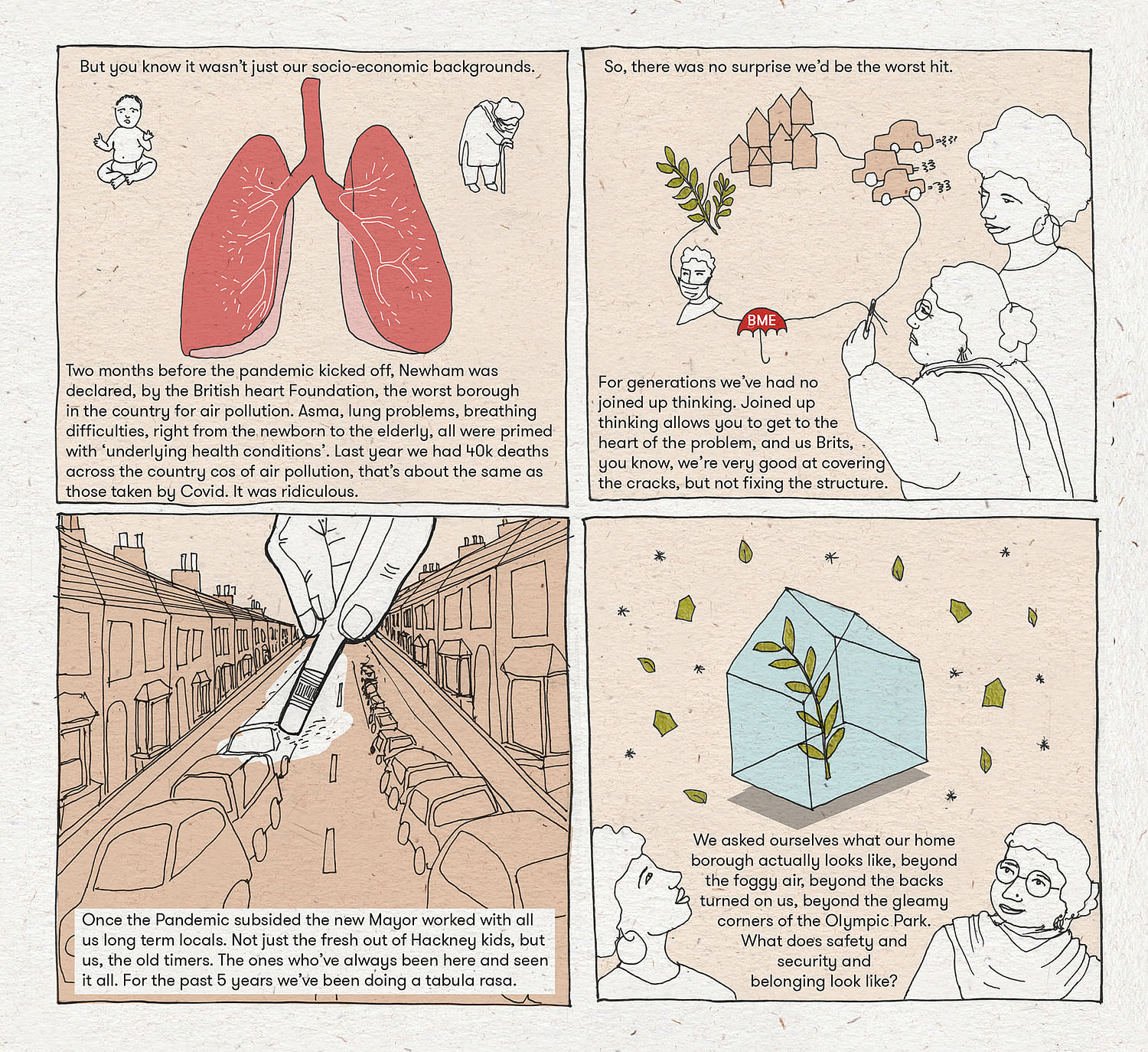
Longlisted entry: Eco-Archi Post Covid, Mark Bonshek, Khan Bonshek

BUILDINGS

  • Markthalle, Sophie Judson
    Markthalle breaks down socio-economic and health-related barriers created by the pandemic, providing local residents with a space to socialize while supporting local businesses.
  • Pop-up Teaching for Outdoor Learning, Curl La Tourelle Head Architecture
    Temporary low-cost emergency schools using recycled festival marquees, to provide outdoor learning opportunities.
  • Hyper-Emotional Society, Hon Yen Chong and Chen-Yong Tan
    The pandemic has caused an evolution towards a hyper-emotional society as we re-evaluate life priorities to become less driven by financial motivations but more by personal emotion and interests. This proposal is to transform the way we work through a work joining project app, micro home labs and forums.
  • Green Catalyst, Kamvari Architects
    Public realm, small scale food production, and high-density homes come together in a high rise design. These towers are built up from prefabricated timber cubes. Courtyard plans create pleasant airy open space.
  • Spiral Bike Store, Fatkin Ltd
    The spiral bike store provides a fun and efficient solution to secure cycle storage.
  • House Farm, Peru Kenyi Kevin and Sulca Quichca, Universidad Nacional de Ingenieria
    A new experience for life at home through a new space – a timber-framed home extension with two functions: producing vegetables for family consumption and a place for recreation. 
  • Design-a-Shed, Kilshaw and Partners
    This fictional company specializes in responsive garden office design with an integrated hydrogen fuel cell - an optimum solution in a de-urbanised future.
  • Street Support Hub, Axis Design Architects
    A neighborhood common room for teaching, entertaining and socializing, with energy generating capacity. All in the area of one car parking space. This infrastructure scales down energy and social services, while scaling up the spatial boundaries of the private home.
  • Far Off is Close at Hand, Haslam & Co Architects
    Reworking of a shop as a home. Four critical aspects of living in the city through the lens of a new urban house design: a perch on the street, a nest to withdraw, creating space for the ritual of washing at the threshold and the creation of a ‘bar of exchange’ as boundary between home and street.
  • Window Living, Alice Vivoda, Patricia Schleeh, Eva Setz Kengen and Mark Kengen, The University of Edinburgh
    An interactive window retrofitted to existing buildings to transform into a balcony or sitting place allowing closer interactions with neighbors and nature.
  • Institute of Making Homes, Monty Dobney
    A radical solution to drive innovative, collaborative and community involved research into the design, manufacture and construction of homes.
  • Podding the City, The Good Thing
    Homes will be places for more activities, for healing, working, learning; flexible and elastic living spaces where we will spend most of our time. Lightweight 'spods' can be attached to extend existing homes.
  • Get Everyone In, Benjamin Holland, Oliva Dolan, Katie Williams, University of Liverpool
    Design for the reuse of empty offices to house the homeless. Working from home is now the new norm.  Office towers are empty… Here’s how government funds can help the vulnerable in society survive and thrive.
  • Living in Hope, Rachel Moberly, Will Allen, Steve McDougall and Reuben Reid, University of Bath
    The mass production of bespoke high-quality homes at low cost using a mobile app and AI to ensure the home works for the user while being based a consistent grid and structure.

Longlisted entry: Home Front 2025, Sung and Ivan TL Chan

COMMUNITIES

  • The Thread and Blanket, Studio McLeod
    Simple objects in the street and home to help remember the pandemic and build back better. Ranging from intimate artifacts to public memorial, The Blanket, Thread, Lamp and Streetlight would be catalysts which continue to harness the power of 'symbols' to connect, unite and strengthen communities.
  • Re-invention of the Mid Twentieth Century Estates, Yvonne Dean Architecture
    Reimagining the suburban street with ventilation towers and green roofs to bring nature and food production home.
  • Streets are Made for Walking, PeopleMatter.
    Rethinking how space along our streets can better serve the communities who neighbor them with new ways of interacting between traffic and people, the cross-section shows one such speculation in London. 
  • Community Retrofit, Farrells
    Empty department stores and half-used office spaces retrofitted to combat loneliness by reinventing the high street toward sustainable, localized communities in the heart of our towns and cities.
  • Reclaiming our Streets, Assael Architecture
    A blueprint for a community-led, grassroots intervention to reclaim the streets we live on.
  • Eco-Archi Post Covid, Mark Bonshek, Khan Bonshek
    This comic explores the impact of air pollution upon Covid-19 transmission and the disproportionate effects upon BAME communities living in the inner suburbs of our cities.
  • Post Pandemic Exchange, Elle Thompson, University of Nottingham
    The City’s Garden Streets: Designs for a cleaner, greener, more attractive inner-city, promoting sustainable societal choices, rendering that infrequent trip to the office a worthwhile healing experience. 
  • Village City, Stephen Macbean
    A development model that creates a hub of essential facilities in walking distance from a cluster of villages. This reaffirms the strengths of localism, providing economic and community cohesion, with considerable environmental benefits. It may be in need as people move out of cities post-pandemic.
  • Greater London Agriculture, Tim Rodber and Dominic Walker
    A city region master plan to encourage fresh ways of growing and eating in cities, divesting from industrialized food systems, letting global biodiversity flourish, and - almost incidentally - reducing chances of future pandemics.
  • Pedestrian Friendly Streets, Gabriel Fox, University of Bath
    COVID-19 has provided us with the perfect opportunity to rethink urban design so that pedestrians and cyclists are put above motorists. This proposes three tiers of streets, pedestrian streets, cycle streets and regular streets.
  • Leafrow, Highly Creative Minds
    Covid-19 or not, 2025 will present a different world: environmental preservation will be key with lifestyles changing accordingly. Redundant planes could be made in all sorts of community spaces, re-energizing green spaces but with targeted recycling that makes this ‘plane’-sailing. 
  • A Catalogue of Regeneration, Andrew Jackson
    Elements for the regeneration of homes to address issues of health, density, sustainability, and the physical implications of the Covid-19 fallout in a phased, economical manner designed to help the most vulnerable in society. Improvements will be made to roads and pavements, facades and street furniture.
  • Home Front 2025,Sung and Ivan TL Chan
    An urban vision of interventions and activities which encourages the full participation of the public in addressing the global fear of pandemic. Submission in the form of a comic book.

Stay tuned for the announcement of the shortlisted and winning entries later this month.

Related

competition ● riba ● covid-19 ● pandemic ● uk ● europe ● london
Royal Institute of British Architects

Share

  • Follow

    0 Comments

  • Comment as :

Rethink: 2025 designs imagine life after Covid-19

Northwestern University selects 12-firm longlist to design new engineering building

New architecture and design competitions: Exploring 130 Years of American Design, Christo & Jeanne-Claude Center, 13 White Houses, and La Pyramide

Micro-architecture honored in latest Tiny House Architecture Competition

World’s most beautiful restaurants of 2026 chosen by Prix Versailles

Sponsored Post by Buildner

Design a wine tasting room in Italy! Valli Wine Tasting Room is launched!

10 can't-miss architecture & design events to see this June in London, Los Angeles, Chicago, San Francisco, Detroit, San Diego, Porto, and Barcelona

Sponsored Post by Buildner

Museum of Emotions / Edition #8 FINAL registration deadline is approaching!

Seven global projects make AR Public Awards shortlist 2026

Sign up for Bustler's Email Newsletters

Sponsored Post by Buildner

Design a slow-living restaurant in Portugal! Portugal Long Table Restaurant is launched!

World's best tall buildings honored at the CVU 2026 Award of Excellence

Sponsored Post by TWOPAGES

Final call: TWOPAGES X Design Contest 2026 submissions close June 5

Kengo Kuma & Paul Raff win Alberta national park visitor center competition with landscape-focused design

2026 Moira Gemmill and MJ Long prizes announced by W Awards

New architecture and design competitions: Kinderspace, Stewardson Keefe LeBrun Travel Grant, SMALL PROJECT BIG IMPACT, and Garden of University House, Bucharest

The Century of Gehry: New retrospective explores the late architect's work & collaborations

Next page » Loading

Rethink: 2025 designs imagine life after Covid-19

By Alexander Walter|

Friday, Jul 10, 2020

Share

Longlisted entry: Living in Hope, Rachel Moberly, Will Allen, Steve McDougall and Reuben Reid, University of Bath

Related

competition ● riba ● covid-19 ● pandemic ● uk ● europe ● london
Royal Institute of British Architects

RIBA's Rethink: 2025 international design competition just released a longlist of 32 entries that most creatively imagined what our built environment might look like in 2025, how the pandemic may have changed the way humans interact with space and one another, and how these design ideas have the potential to generate a better paradigm for living in a post-pandemic world. 

Entries were asked to consider these seven areas: healthcare spaces, high-density living, public transport, high streets vs online shopping, remote learning, international travel, and the use of technology to monitor and control populations.

Following are the longlisted entries, organized into the three categories Body, Buildings, and Communities:

Longlisted entry: Get Everyone In, Benjamin Holland, Oliva Dolan, Katie Williams, University of Liverpool

BODY

  • Childbirth Made Personal, Sarah Joyce, University of Leeds
    Designs are people/tech-driven in this new era. The maternity policy goals of 2020 are achieved through personalized “maternity bubbles” – buildings and spaces organized around pregnant women. 
  • Separation without Barriers to Learning, Emma Tincombe
    Designs for a positive, personalized classroom experience. Individuals choose their own level of physical separation whilst remaining engaged in social and learning activities.
  • Blue Tile, Ahmad Yakout
    Blue Tile is an interlocking tile system placed strategically at building gates and pathways. It contains a built-in mechanism to spray disinfectant/vaccine mist upwards when stepped on.
  • Safer Buses, GTM-a
    Each bus compartment at street level has its own access and can accommodate between one and four people, standing or seated, with luggage, prams, wheelchair, children, or bicycle. Both levels are open to the outside air and divided physically but not visually, by screens.
  • World Sanitation Box, George Stoneham, University of Creative Arts
    The World Health Sanitation Box is a network of compact stations utilizing UVC light to disinfect people on the go, creating a healthier world for tomorrow.

Longlisted entry: Eco-Archi Post Covid, Mark Bonshek, Khan Bonshek

BUILDINGS

  • Markthalle, Sophie Judson
    Markthalle breaks down socio-economic and health-related barriers created by the pandemic, providing local residents with a space to socialize while supporting local businesses.
  • Pop-up Teaching for Outdoor Learning, Curl La Tourelle Head Architecture
    Temporary low-cost emergency schools using recycled festival marquees, to provide outdoor learning opportunities.
  • Hyper-Emotional Society, Hon Yen Chong and Chen-Yong Tan
    The pandemic has caused an evolution towards a hyper-emotional society as we re-evaluate life priorities to become less driven by financial motivations but more by personal emotion and interests. This proposal is to transform the way we work through a work joining project app, micro home labs and forums.
  • Green Catalyst, Kamvari Architects
    Public realm, small scale food production, and high-density homes come together in a high rise design. These towers are built up from prefabricated timber cubes. Courtyard plans create pleasant airy open space.
  • Spiral Bike Store, Fatkin Ltd
    The spiral bike store provides a fun and efficient solution to secure cycle storage.
  • House Farm, Peru Kenyi Kevin and Sulca Quichca, Universidad Nacional de Ingenieria
    A new experience for life at home through a new space – a timber-framed home extension with two functions: producing vegetables for family consumption and a place for recreation. 
  • Design-a-Shed, Kilshaw and Partners
    This fictional company specializes in responsive garden office design with an integrated hydrogen fuel cell - an optimum solution in a de-urbanised future.
  • Street Support Hub, Axis Design Architects
    A neighborhood common room for teaching, entertaining and socializing, with energy generating capacity. All in the area of one car parking space. This infrastructure scales down energy and social services, while scaling up the spatial boundaries of the private home.
  • Far Off is Close at Hand, Haslam & Co Architects
    Reworking of a shop as a home. Four critical aspects of living in the city through the lens of a new urban house design: a perch on the street, a nest to withdraw, creating space for the ritual of washing at the threshold and the creation of a ‘bar of exchange’ as boundary between home and street.
  • Window Living, Alice Vivoda, Patricia Schleeh, Eva Setz Kengen and Mark Kengen, The University of Edinburgh
    An interactive window retrofitted to existing buildings to transform into a balcony or sitting place allowing closer interactions with neighbors and nature.
  • Institute of Making Homes, Monty Dobney
    A radical solution to drive innovative, collaborative and community involved research into the design, manufacture and construction of homes.
  • Podding the City, The Good Thing
    Homes will be places for more activities, for healing, working, learning; flexible and elastic living spaces where we will spend most of our time. Lightweight 'spods' can be attached to extend existing homes.
  • Get Everyone In, Benjamin Holland, Oliva Dolan, Katie Williams, University of Liverpool
    Design for the reuse of empty offices to house the homeless. Working from home is now the new norm.  Office towers are empty… Here’s how government funds can help the vulnerable in society survive and thrive.
  • Living in Hope, Rachel Moberly, Will Allen, Steve McDougall and Reuben Reid, University of Bath
    The mass production of bespoke high-quality homes at low cost using a mobile app and AI to ensure the home works for the user while being based a consistent grid and structure.

Longlisted entry: Home Front 2025, Sung and Ivan TL Chan

COMMUNITIES

  • The Thread and Blanket, Studio McLeod
    Simple objects in the street and home to help remember the pandemic and build back better. Ranging from intimate artifacts to public memorial, The Blanket, Thread, Lamp and Streetlight would be catalysts which continue to harness the power of 'symbols' to connect, unite and strengthen communities.
  • Re-invention of the Mid Twentieth Century Estates, Yvonne Dean Architecture
    Reimagining the suburban street with ventilation towers and green roofs to bring nature and food production home.
  • Streets are Made for Walking, PeopleMatter.
    Rethinking how space along our streets can better serve the communities who neighbor them with new ways of interacting between traffic and people, the cross-section shows one such speculation in London. 
  • Community Retrofit, Farrells
    Empty department stores and half-used office spaces retrofitted to combat loneliness by reinventing the high street toward sustainable, localized communities in the heart of our towns and cities.
  • Reclaiming our Streets, Assael Architecture
    A blueprint for a community-led, grassroots intervention to reclaim the streets we live on.
  • Eco-Archi Post Covid, Mark Bonshek, Khan Bonshek
    This comic explores the impact of air pollution upon Covid-19 transmission and the disproportionate effects upon BAME communities living in the inner suburbs of our cities.
  • Post Pandemic Exchange, Elle Thompson, University of Nottingham
    The City’s Garden Streets: Designs for a cleaner, greener, more attractive inner-city, promoting sustainable societal choices, rendering that infrequent trip to the office a worthwhile healing experience. 
  • Village City, Stephen Macbean
    A development model that creates a hub of essential facilities in walking distance from a cluster of villages. This reaffirms the strengths of localism, providing economic and community cohesion, with considerable environmental benefits. It may be in need as people move out of cities post-pandemic.
  • Greater London Agriculture, Tim Rodber and Dominic Walker
    A city region master plan to encourage fresh ways of growing and eating in cities, divesting from industrialized food systems, letting global biodiversity flourish, and - almost incidentally - reducing chances of future pandemics.
  • Pedestrian Friendly Streets, Gabriel Fox, University of Bath
    COVID-19 has provided us with the perfect opportunity to rethink urban design so that pedestrians and cyclists are put above motorists. This proposes three tiers of streets, pedestrian streets, cycle streets and regular streets.
  • Leafrow, Highly Creative Minds
    Covid-19 or not, 2025 will present a different world: environmental preservation will be key with lifestyles changing accordingly. Redundant planes could be made in all sorts of community spaces, re-energizing green spaces but with targeted recycling that makes this ‘plane’-sailing. 
  • A Catalogue of Regeneration, Andrew Jackson
    Elements for the regeneration of homes to address issues of health, density, sustainability, and the physical implications of the Covid-19 fallout in a phased, economical manner designed to help the most vulnerable in society. Improvements will be made to roads and pavements, facades and street furniture.
  • Home Front 2025,Sung and Ivan TL Chan
    An urban vision of interventions and activities which encourages the full participation of the public in addressing the global fear of pandemic. Submission in the form of a comic book.

Stay tuned for the announcement of the shortlisted and winning entries later this month.

Share

  • Follow

    0 Comments

  • Comment as :

Archinect JobsArchinect Jobs

The Archinect Job Board attracts the world's top architectural design talents.

VIEW ALL JOBS POST A JOB

Project Designer (3-5 years)

Edmonds + Lee Architects

Project Designer (3-5 years)

San Francisco, CA, US

Project Architect

Turpentine Design

Project Architect

Fuquay-Varina, NC, US

Junior Designer

OLIVER FREUNDLICH DESIGN

Junior Designer

New York, NY, US

Intermediate Architect

NDKazalas Architecture PC

Intermediate Architect

New York, NY, US

Senior Technical Designer, Commercial Interiors - New York Office

Fogarty Finger

Senior Technical Designer, Commercial Interiors - New York Office

New York, NY, US

Marketing and Architectural Assistant

AGENCIE / Architecture & Engineering

Marketing and Architectural Assistant

New York, NY, US

Project Architect at High End Boutique Townhouse Firm in BK

Steering House Design and Development

Project Architect at High End Boutique Townhouse Firm in BK

Brooklyn, NY, US

Junior Architect / Architectural Designer

S20M

Junior Architect / Architectural Designer

New York, NY, US

Junior Architect

Elizabeth Roberts Architecture & Design

Junior Architect

Brooklyn, NY, US

Business Development Manager

WORKac

Business Development Manager

New York, NY, US

Next page » Loading