• Login / Join
  • About
  • •
  • Contact
  • •
  • Advertising
bustler logo
bustler logo
  • News
  • Competitions
  • Events
  • Bustler is powered by Archinect
  • Sign up for Bustler's Email Newsletters

  • Follow these Bustler feeds:

  • Search

    Search in

  • Submit

    What are you submitting?

    News Pitch
    Competition
    Event
  • Login / Join
  • News|Competitions|Events
  • Search
    | Submit
    | Follow
  • Search in

    What are you submitting?

    News Pitch
    Competition
    Event

    Follow these Bustler feeds:

  • About|Contact|Advertising
  • Login / Join

"In Situ: Architecture and Landscape" Opens Today at MoMA

By Bustler Editors|

Wednesday, Apr 8, 2009

The exhibition In Situ: Architecture and Landscape draws from the rich collection of The Museum of Modern Art to examine the diverse attitudes towards landscape over the last 100 years. Featuring approximately 60 drawings, models, and videos, projects include single houses that frame the landscape, designs for buildings based on the surrounding landscape, urban gardens that compose “nature” within the city, and parks that transform former industrial areas into new attractions. The exhibition closes with three cemeteries whose designs demonstrate that our relationship to landscape often transcends our quotidian needs. The exhibition is on view in The Philip Johnson Architecture and Design Galleries, third floor, from April 8 to September 14, 2009. It is organized by Andres Lepik, Curator, and Margot Weller, Curatorial Assistant, Department of Architecture and Design, The Museum of Modern Art.
image

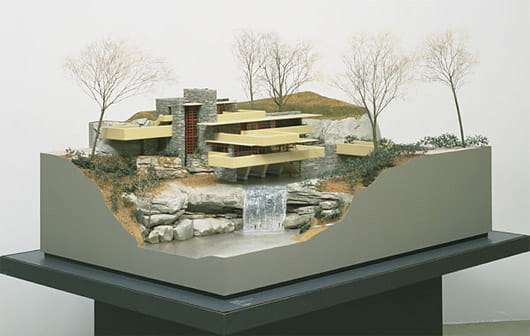
Frank Lloyd Wright’s Fallingwater, Edgar J. Kaufmann House in Mill Run, Pennsylvania (1937), image courtesy of Best Products Company Architecture Fund and the Museum of Modern Art.

In recent decades, landscape has taken on an expanded definition in architecture. In the first half of the twentieth century, the architectural avant-garde celebrated autonomy from nature, and architects devised utopian schemes for creating urban realms ex novo. More recently, however, the challenges of a threatened environment and rapidly expanding cities have fostered a revised understanding of landscape. Harmony between the spatial, social, and environmental aspects of human life has become a priority in political thought, and this has had profound reverberations in both architecture and landscape design. Landscape—no longer understood merely as nature untouched—now encompasses complex interventions by architects and landscape architects in urban and rural surroundings.
image

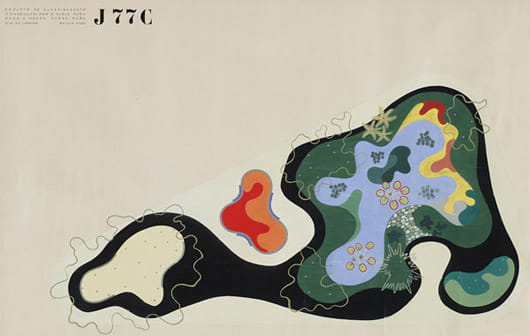
Roberto Burle Marx’s Garden Design for Saenz Pena Square in Rio de Janeiro (1948), image courtesy of Museum of Modern Art.

Frank Lloyd Wright’s famous Fallingwater, Edgar J Kaufmann House (1934-1937) in which architecture becomes part of a dramatic setting in the nature, and Mies van der Rohe’s Wolf House (1925-27), built atop a prominent ridge of Gubin overlooking the Neisse River Valley, are among the earliest examples in the exhibition. Other examples that demonstrate a similar profiting relationship between architecture and landscape are Edward Larrabee Barnes’ Haystack Mountain School of Crafts (1958-61), Emilio Ambasz’s Casa de Retiro Espiritual in Spain (1976-1979), and Diller + Scofidio’s Slow House project (1988-90). Hans Hollein’s Vulcania (1994-2001), Tadao Ando’s Chikatsu-Asuka Historical Museum in Osaka (1989-1994) or Toyo Ito’s Relaxation Park in Torrevieja, Spain (2001-2006) all seem to merge with their surroundings. Roberto Burle Marx’s lively landscape design for Saenz Pena Square (1948) and Duque de Caxias Square (1948) in Rio des Janeiro bring nature back into the densely populated city. These examples show his painterly style, mixing biomorphic abstraction with tropical planting into a new geometric language for urban gardens.

A contemporary approach for urban parks is the Southeast Coastal Park in Barcelona (2000-2004) by Foreign Office Architects. Inspired by seaside dunes, the parks gentle peaks swell to accommodate two open air-auditoriums. One of the famous competitions for the transformation of former industrial areas into “an urban parc for the twenty-first century” with new attractions is the Parc de la Vilette of 1982-83. Bernard Tschumi and Zaha Hadid had both developed highly complex concepts to create a new space for recreation, sports, and culture in which nature is included as one layer among many others. Cemeteries have also been a traditional exercise to combine architecture and landscape. This is represented in examples from Erik Gunnar Asplund’s Woodland Crematorium (1935-1940), Aldo Rossi’s San Cataldo Cemetery (1971-1984), and Enric Miralles and Carme Pinos’s Igualada Cemetery (1985-1996).

In Situ: Architecture and Landscape
April 8, 2009 – September 14, 2009
MoMA New York
The Philip Johnson Architecture and Design Galleries, third floor

Related

usa ● new york ● museum ● moma ● landscape ● exhibition ● event ● east coast

Share

  • Follow

    0 Comments

  • Comment as :

"In Situ: Architecture and Landscape" Opens Today at MoMA

New architecture and design competitions: Brick in Architecture Awards, Study Architecture Student Showcase, N.Y.C. Groceries, and New York High Falls Riverfront Market

SmithGroup’s ‘pioneering’ Philip Merrill Environmental Center wins AIA Twenty-five Year Award

Sponsored Post by Buildner

Museum of Emotions / Edition #8 FINAL registration deadline is in 5 DAYS!

Here are the winners of the 2026 AIA Architecture Awards

40 emerging architects and designers under 40 from Europe honored

Northwestern University selects 12-firm longlist to design new engineering building

New architecture and design competitions: Exploring 130 Years of American Design, Christo & Jeanne-Claude Center, 13 White Houses, and La Pyramide

Micro-architecture honored in latest Tiny House Architecture Competition

Sign up for Bustler's Email Newsletters

World’s most beautiful restaurants of 2026 chosen by Prix Versailles

Sponsored Post by Buildner

Design a wine tasting room in Italy! Valli Wine Tasting Room is launched!

10 can't-miss architecture & design events to see this June in London, Los Angeles, Chicago, San Francisco, Detroit, San Diego, Porto, and Barcelona

Sponsored Post by Buildner

Museum of Emotions / Edition #8 FINAL registration deadline is approaching!

Seven global projects make AR Public Awards shortlist 2026

Sponsored Post by Buildner

Design a slow-living restaurant in Portugal! Portugal Long Table Restaurant is launched!

World's best tall buildings honored at the CVU 2026 Award of Excellence

Next page » Loading

"In Situ: Architecture and Landscape" Opens Today at MoMA

By Bustler Editors|

Wednesday, Apr 8, 2009

Share

Related

usa ● new york ● museum ● moma ● landscape ● exhibition ● event ● east coast

The exhibition In Situ: Architecture and Landscape draws from the rich collection of The Museum of Modern Art to examine the diverse attitudes towards landscape over the last 100 years. Featuring approximately 60 drawings, models, and videos, projects include single houses that frame the landscape, designs for buildings based on the surrounding landscape, urban gardens that compose “nature” within the city, and parks that transform former industrial areas into new attractions. The exhibition closes with three cemeteries whose designs demonstrate that our relationship to landscape often transcends our quotidian needs. The exhibition is on view in The Philip Johnson Architecture and Design Galleries, third floor, from April 8 to September 14, 2009. It is organized by Andres Lepik, Curator, and Margot Weller, Curatorial Assistant, Department of Architecture and Design, The Museum of Modern Art.

image

Frank Lloyd Wright’s Fallingwater, Edgar J. Kaufmann House in Mill Run, Pennsylvania (1937), image courtesy of Best Products Company Architecture Fund and the Museum of Modern Art.

In recent decades, landscape has taken on an expanded definition in architecture. In the first half of the twentieth century, the architectural avant-garde celebrated autonomy from nature, and architects devised utopian schemes for creating urban realms ex novo. More recently, however, the challenges of a threatened environment and rapidly expanding cities have fostered a revised understanding of landscape. Harmony between the spatial, social, and environmental aspects of human life has become a priority in political thought, and this has had profound reverberations in both architecture and landscape design. Landscape—no longer understood merely as nature untouched—now encompasses complex interventions by architects and landscape architects in urban and rural surroundings.

image

Roberto Burle Marx’s Garden Design for Saenz Pena Square in Rio de Janeiro (1948), image courtesy of Museum of Modern Art.

Frank Lloyd Wright’s famous Fallingwater, Edgar J Kaufmann House (1934-1937) in which architecture becomes part of a dramatic setting in the nature, and Mies van der Rohe’s Wolf House (1925-27), built atop a prominent ridge of Gubin overlooking the Neisse River Valley, are among the earliest examples in the exhibition. Other examples that demonstrate a similar profiting relationship between architecture and landscape are Edward Larrabee Barnes’ Haystack Mountain School of Crafts (1958-61), Emilio Ambasz’s Casa de Retiro Espiritual in Spain (1976-1979), and Diller + Scofidio’s Slow House project (1988-90). Hans Hollein’s Vulcania (1994-2001), Tadao Ando’s Chikatsu-Asuka Historical Museum in Osaka (1989-1994) or Toyo Ito’s Relaxation Park in Torrevieja, Spain (2001-2006) all seem to merge with their surroundings. Roberto Burle Marx’s lively landscape design for Saenz Pena Square (1948) and Duque de Caxias Square (1948) in Rio des Janeiro bring nature back into the densely populated city. These examples show his painterly style, mixing biomorphic abstraction with tropical planting into a new geometric language for urban gardens.

A contemporary approach for urban parks is the Southeast Coastal Park in Barcelona (2000-2004) by Foreign Office Architects. Inspired by seaside dunes, the parks gentle peaks swell to accommodate two open air-auditoriums. One of the famous competitions for the transformation of former industrial areas into “an urban parc for the twenty-first century” with new attractions is the Parc de la Vilette of 1982-83. Bernard Tschumi and Zaha Hadid had both developed highly complex concepts to create a new space for recreation, sports, and culture in which nature is included as one layer among many others. Cemeteries have also been a traditional exercise to combine architecture and landscape. This is represented in examples from Erik Gunnar Asplund’s Woodland Crematorium (1935-1940), Aldo Rossi’s San Cataldo Cemetery (1971-1984), and Enric Miralles and Carme Pinos’s Igualada Cemetery (1985-1996).

In Situ: Architecture and Landscape
April 8, 2009 – September 14, 2009
MoMA New York
The Philip Johnson Architecture and Design Galleries, third floor

Share

  • Follow

    0 Comments

  • Comment as :

Archinect JobsArchinect Jobs

The Archinect Job Board attracts the world's top architectural design talents.

VIEW ALL JOBS POST A JOB

Architectural Designer

1100 Architect

Architectural Designer

New York, NY, US

Architectural Designer (5-7 Years) - Commercial & Hospitality Focus

Pfeffer Torode Architecture

Architectural Designer (5-7 Years) - Commercial & Hospitality Focus

Nashville, TN, US

Senior Designer / Architect

NardiHaus

Senior Designer / Architect

Pasadena, CA, US

Project Manager - Civic/Community

DAHLIN Architecture | Planning | Interiors

Project Manager - Civic/Community

Irvine, CA, US

Interior Design Project Manager

DAHLIN Architecture | Planning | Interiors

Interior Design Project Manager

Bellevue, WA, US

Designer

HATCH ARCHITECTURE

Designer

Los Angeles, CA, US

Design Director or Sr. Architect

b.hills architecture, P.C.

Design Director or Sr. Architect

Boise, ID, US

Intermediate Architect/Designer

DXA Studio

Intermediate Architect/Designer

New York, NY, US

Architect

OBRA Architects

Architect

New York, NY, US

Project Manager / Project Architect (5–10 Years’ Experience)

Millan Architect / Studio Inc.

Project Manager / Project Architect (5–10 Years’ Experience)

Venice, CA, US

Next page » Loading