• Login / Join
  • About
  • •
  • Contact
  • •
  • Advertising
bustler logo
bustler logo
  • News
  • Competitions
  • Events
  • Bustler is powered by Archinect
  • Sign up for Bustler's Email Newsletters

  • Follow these Bustler feeds:

  • Search

    Search in

  • Submit

    What are you submitting?

    News Pitch
    Competition
    Event
  • Login / Join
  • News|Competitions|Events
  • Search
    | Submit
    | Follow
  • Search in

    What are you submitting?

    News Pitch
    Competition
    Event

    Follow these Bustler feeds:

  • About|Contact|Advertising
  • Login / Join

Adrian Smith + Gordon Gill Architecture to Design World's 4th Tallest Building

By Bustler Editors|

Tuesday, Jun 28, 2011
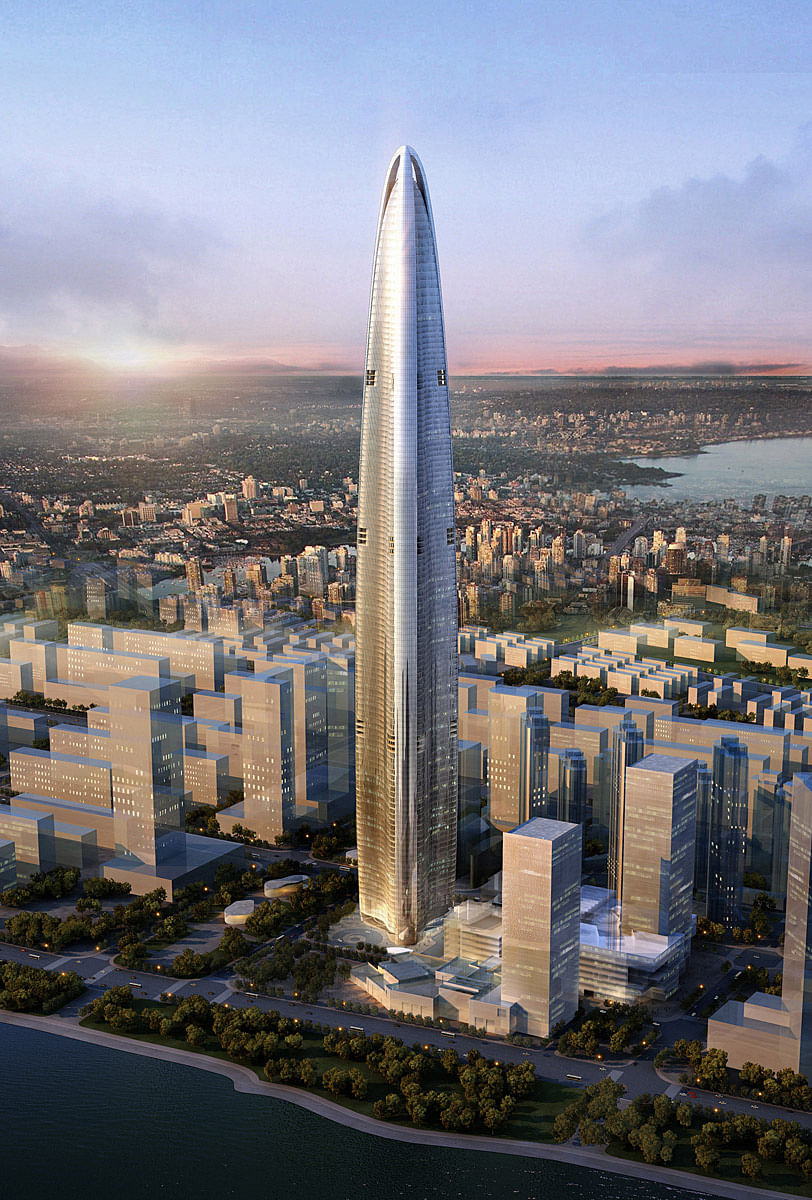
The competition-winning design for the Wuhan Greenland Center at dusk (Image: Adrian Smith + Gordon Gill Architecture)

Chicago-based firm Adrian Smith + Gordon Gill Architecture recently announced that it has won an international competition to design Wuhan Greenland Center, which at 606 meters (1,988 feet) will likely be China’s third-tallest building, and the fourth tallest in the world, when completed in about five years. Construction is scheduled to begin this summer in Wuhan near the meeting of the Yangtze and Han rivers.

A project of the Shanghai-based Greenland Group, the 119-level Wuhan Greenland Center will be comprised of about 300,000 square meters of floor area, including about 200,000 sm of offices, 50,000 sm of luxury apartments and condominiums, a 45,000 sm five-star hotel, and a 5,000 sm, 27-meter-tall private club with spectacular views at the tower’s penthouse level.

AS+GG is leading an interdisciplinary design team that also includes the structural engineering firm Thornton Tomasetti as well as PositivEnergy Practice, an energy services, engineering and consulting company. The other finalists in the design competition were the Chicago office of Skidmore, Owings & Merrill; HOK Architects; GMP Architects; and P&T Architects.
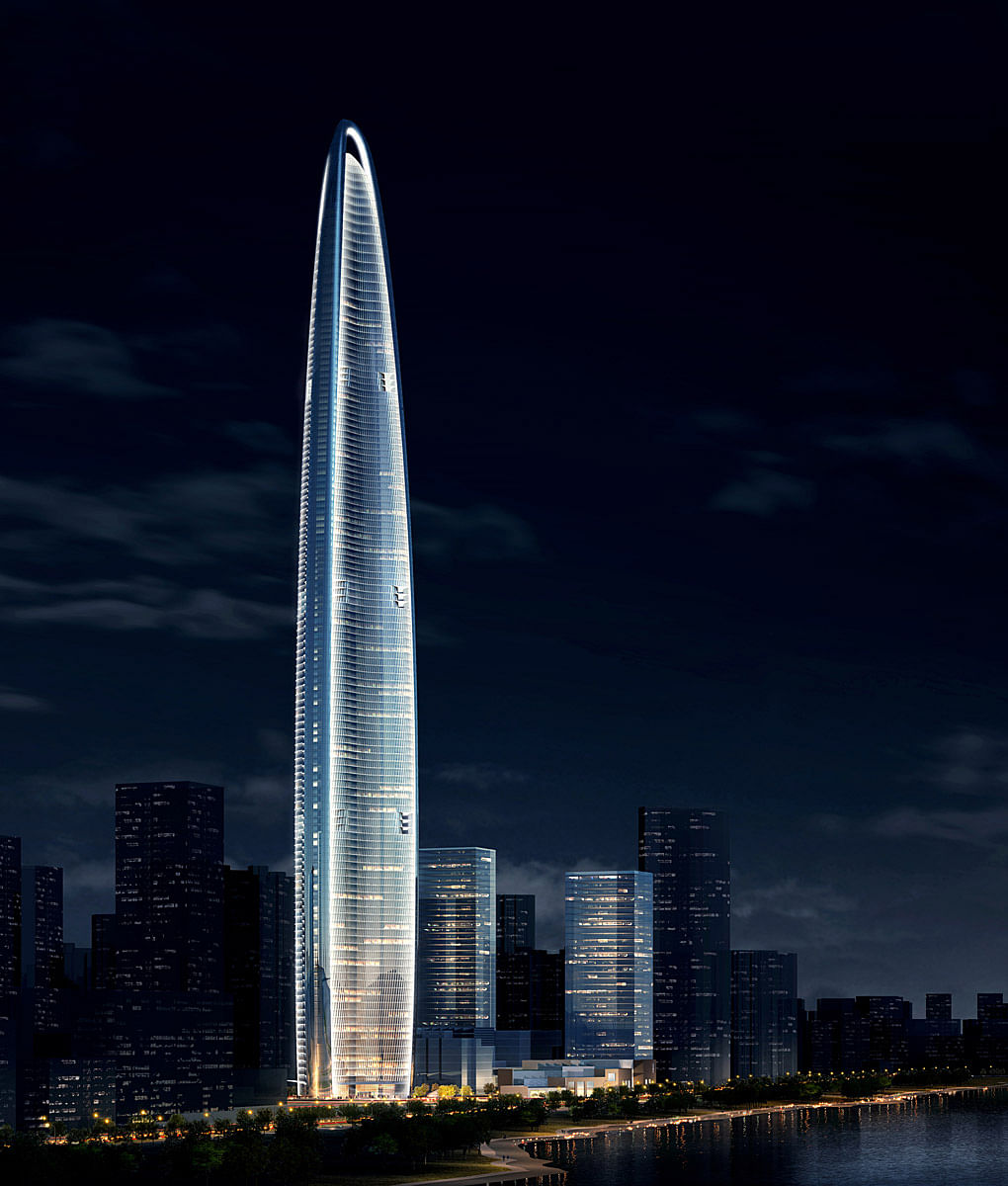
Visualization, night (Image: Adrian Smith + Gordon Gill Architecture)

The project reunites the Greenland Group with Adrian Smith and Gordon Gill, who designed the Nanjing Greenland Financial Center, and Robert Forest, who managed the Nanjing design process, all while at SOM. Nanjing Greenland Financial Center’s Zifeng Tower, currently the world’s seventh-tallest building at 450 meters (1,476 feet), opened last fall.

“We’re thrilled to be working with the Greenland Group once again,” Adrian Smith said. “We had a very good experience on the Nanjing project, and we think Wuhan promises to be just as rewarding. As always, we’re extremely impressed with Greenland’s commitment to good design and quality construction.”
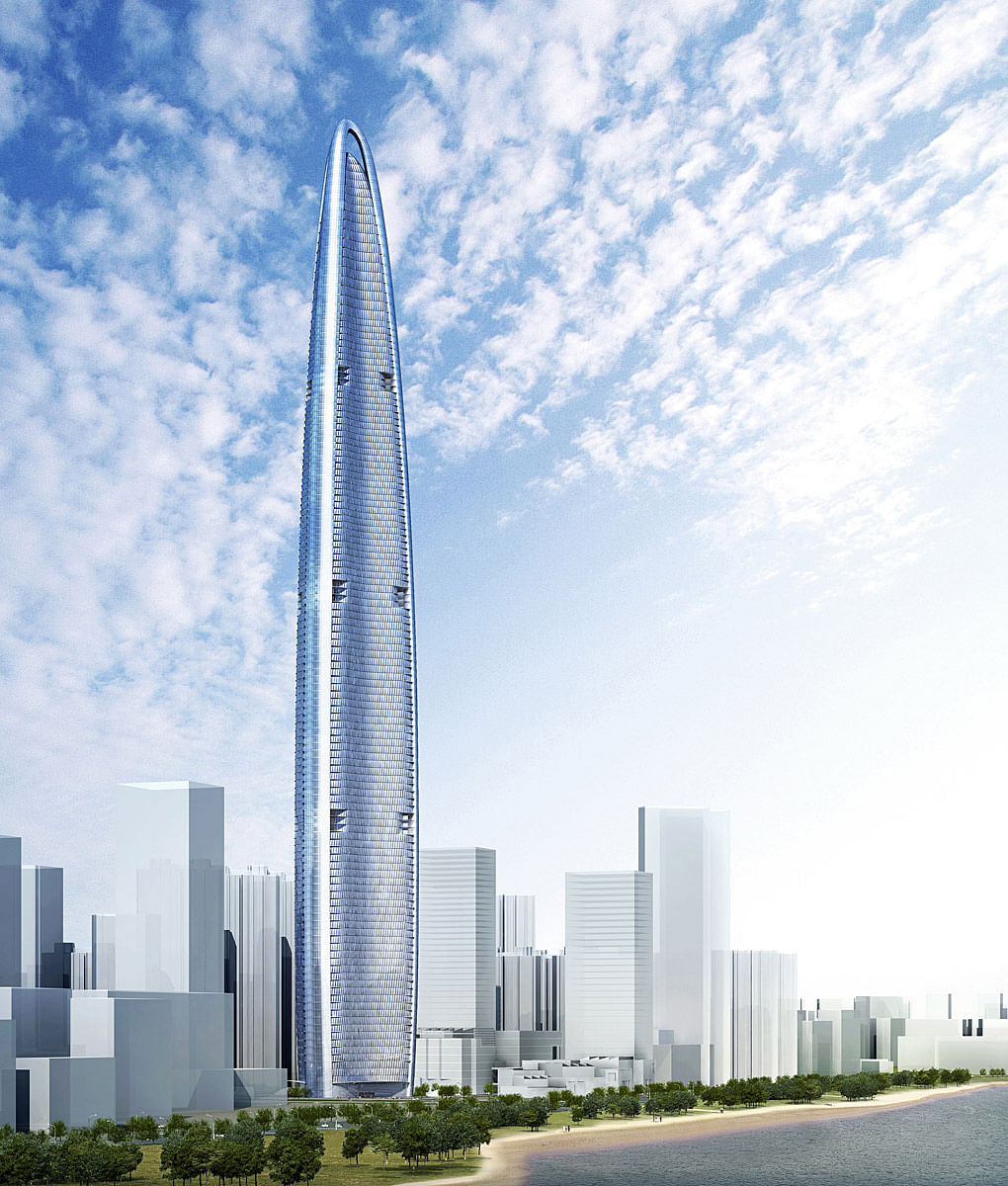
Visualization, day (Image: Adrian Smith + Gordon Gill Architecture)

“Wuhan is an exciting and important project for our firm as we continue to advance our ideas about performance-based supertall tower design,” added Gordon Gill. “We look forward to building on past experience on similar projects, with particular emphasis on the relation of architectural form and performance as they pertain to structural wind loads. It’s very rewarding to be working with the Greenland team. We enjoyed our time on Nanjing and look forward to creating a world-class project with them for Wuhan.”
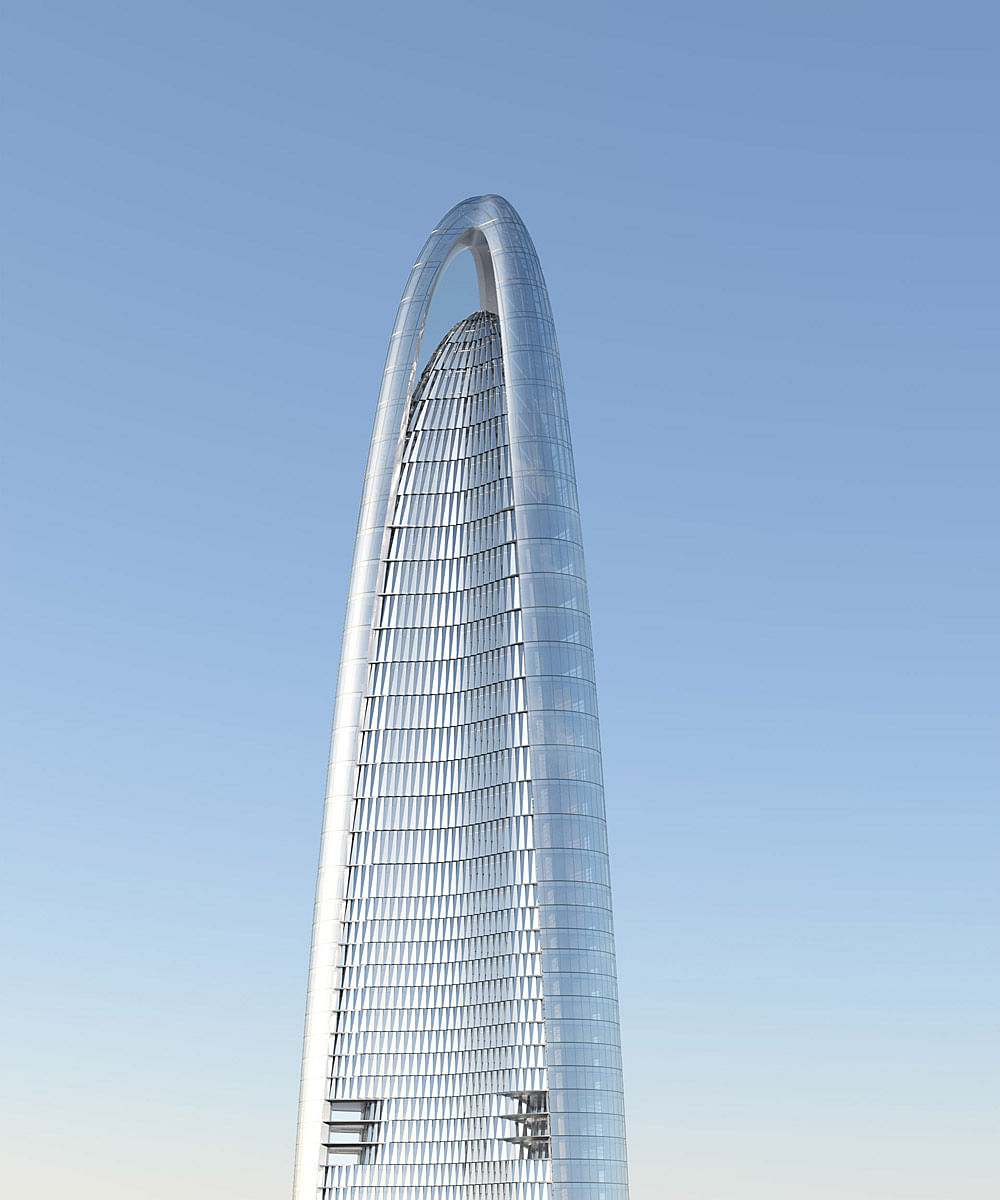
Visualization, top (Image: Adrian Smith + Gordon Gill Architecture)

Still under design, Wuhan Greenland Center features a uniquely streamlined form that combines three key shaping concepts—a tapered body, softly rounded corners and a domed top—to reduce wind resistance and vortex action that builds up around supertall towers. The building’s extremely efficient aerodynamic performance will allow it to minimize the amount of structural material (and its associated embodied carbon) needed for construction.
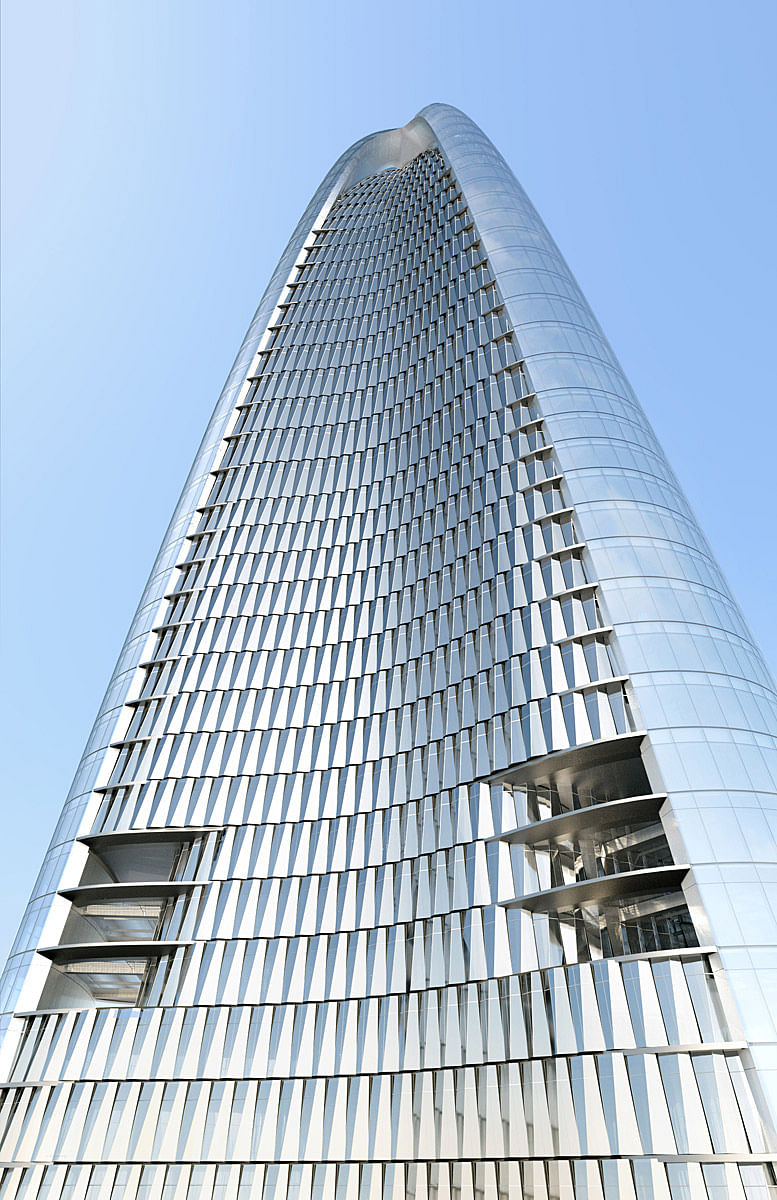
Visualization, looking up (Image: Adrian Smith + Gordon Gill Architecture)

The tower’s three corners rise from its tripod-shaped base and taper upward, culminating in an arched tip above the dome at the top. The corners will be of smooth curved glass, contrasting markedly with the more textured curtain wall cladding the body of the tower. The curtain wall will enclose a composite concrete core with steel framing. Apertures in the curtain wall at regular intervals will assist in venting wind pressure against the tower; the apertures will also house window-washing systems and air intake and exhaust systems on mechanical floors.
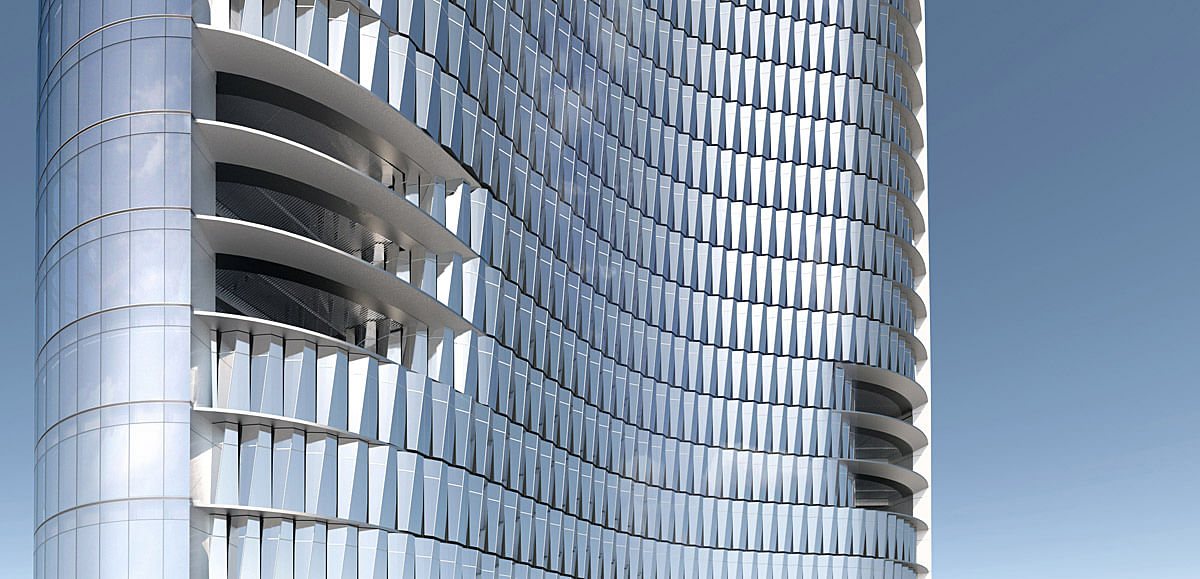
Visualization, skin and vents (Image: Adrian Smith + Gordon Gill Architecture)

“One of the distinctive features of this project is the innovative introduction of vents at the tips of the three legs of the tower at vertical quarter sections that will reduce wind pressure on the tower and reduce the vortices that can cause horizontal acceleration of movement,” Smith said. “This feature, along with the elegant tapering of the tower, is an essential element in this performative design concept.”

“It’s an honor to be working with Greenland Group again on such a significant project,” AS+GG partner Robert Forest added. “Wuhan Greenland Center continues our commitment to providing designs that enhance China’s ability to provide for an increasing population density while striving to reduce energy use and carbon emissions without compromising design quality, performance and cost.”
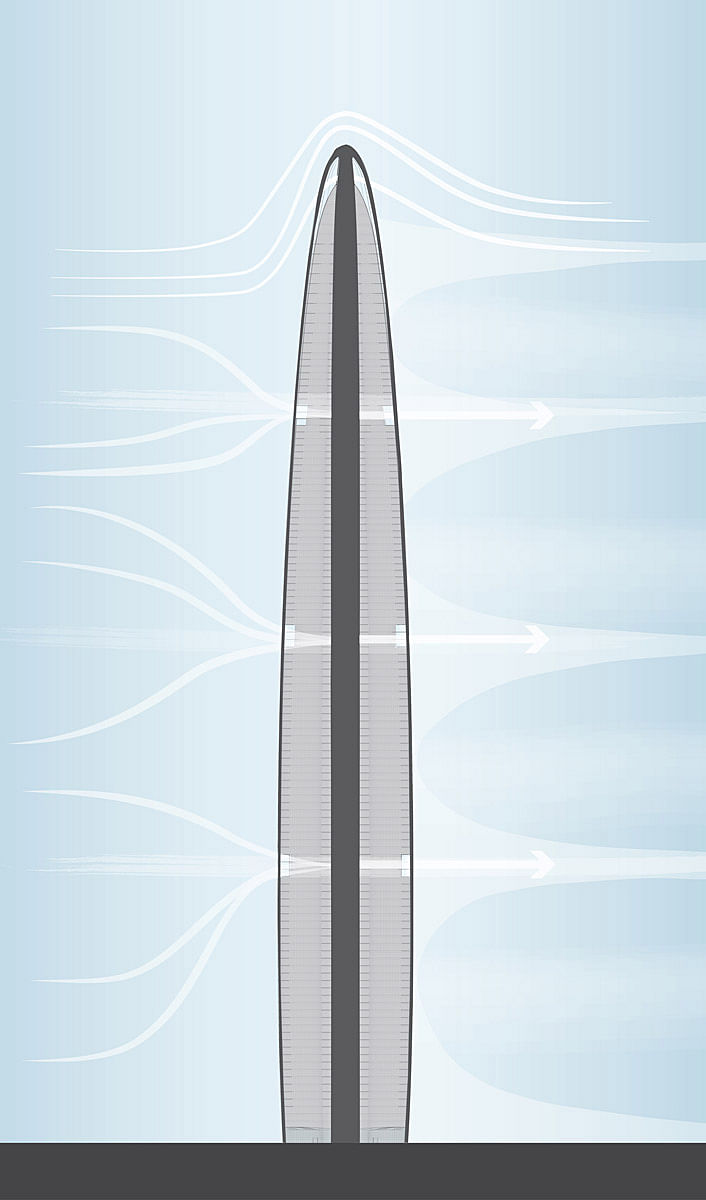
Wind diagram (Image: Adrian Smith + Gordon Gill Architecture)

Other planned sustainable elements of the project include:

  • Energy recovery using an enthalpy wheel integrated into the ventilation system; this captures energy from the building’s exhaust systems and uses it to pre-heat or pre-cool air entering the building.
  • A greywater recovery system, which takes waste water from the hotel laundry, sinks and showers and reuses it in the building’s evaporative cooling system.
  • A high-efficiency lighting system, which uses low-energy-consuming ballasts and lamps to reduce required power consumption.
  • A daylight-responsive control system, which automatically turns off electric lights when sufficient daylight is available.
  • Water-conserving low-flow plumbing fixtures, which reduce the total amount of potable water required as well as the associated pumping energy.

In addition, the AS+GG Interiors studio is developing the tower’s fluidly sculpted interior public spaces, many of which reflect the tower’s exterior silhouette. The conical silhouette is visibly echoed in the entrances to the primary elevator bank from the main lobby, as well as in the shapes of the elevator cabs and other public spaces. The lobbies and other amenity spaces within the tower also feature sweeping, fluid lines and a neutral blue-gray palette that recalls the reflective glass of the exterior wall. The transparency of the ground-floor lobby wall allows views from inside toward the entry canopy drop-off areas, establishing a seamless relationship between the interior and exterior.

Related

wuhan greenland center ● wuhan ● tower ● skyscraper ● high-rise ● china ● asia ● adrian smith + gordon gill architecture

Share

  • Follow

    0 Comments

  • Comment as :

Adrian Smith + Gordon Gill Architecture to Design World's 4th Tallest Building

Best in urban planning recognized at AIA Regional & Urban Design Award 2026

Sponsored Post by Buildner

Re:Form - New Life for Old Spaces / Edition #3 advance registration deadline is approaching!

New architecture and design competitions: IDEAS Awards, UIA-HYP CUP International Student Competition, Vancouver Tall Challenge, and Memorial to the Sixth Extinction

Best small projects chosen at AIA Small Project Award 2026

10 standout sustainable projects honored at AIA COTE Top Ten Award 2026

Best residential architecture of 2026 honored at AIA Housing Award

Best new interiors of 2026 chosen at AIA Interior Architecture Awards

Best global architecture honored at RIBA International Awards 2026

Sign up for Bustler's Email Newsletters

World’s most beautiful airports of 2026 chosen by Prix Versailles

New architecture and design competitions: Brick in Architecture Awards, Study Architecture Student Showcase, N.Y.C. Groceries, and New York High Falls Riverfront Market

SmithGroup’s ‘pioneering’ Philip Merrill Environmental Center wins AIA Twenty-five Year Award

Sponsored Post by Buildner

Museum of Emotions / Edition #8 FINAL registration deadline is in 5 DAYS!

Here are the winners of the 2026 AIA Architecture Awards

40 emerging architects and designers under 40 from Europe honored

Northwestern University selects 12-firm longlist to design new engineering building

Next page » Loading

Adrian Smith + Gordon Gill Architecture to Design World's 4th Tallest Building

By Bustler Editors|

Tuesday, Jun 28, 2011

Share

The competition-winning design for the Wuhan Greenland Center at dusk (Image: Adrian Smith + Gordon Gill Architecture)

Related

wuhan greenland center ● wuhan ● tower ● skyscraper ● high-rise ● china ● asia ● adrian smith + gordon gill architecture

Chicago-based firm Adrian Smith + Gordon Gill Architecture recently announced that it has won an international competition to design Wuhan Greenland Center, which at 606 meters (1,988 feet) will likely be China’s third-tallest building, and the fourth tallest in the world, when completed in about five years. Construction is scheduled to begin this summer in Wuhan near the meeting of the Yangtze and Han rivers.

A project of the Shanghai-based Greenland Group, the 119-level Wuhan Greenland Center will be comprised of about 300,000 square meters of floor area, including about 200,000 sm of offices, 50,000 sm of luxury apartments and condominiums, a 45,000 sm five-star hotel, and a 5,000 sm, 27-meter-tall private club with spectacular views at the tower’s penthouse level.

AS+GG is leading an interdisciplinary design team that also includes the structural engineering firm Thornton Tomasetti as well as PositivEnergy Practice, an energy services, engineering and consulting company. The other finalists in the design competition were the Chicago office of Skidmore, Owings & Merrill; HOK Architects; GMP Architects; and P&T Architects.

Visualization, night (Image: Adrian Smith + Gordon Gill Architecture)

The project reunites the Greenland Group with Adrian Smith and Gordon Gill, who designed the Nanjing Greenland Financial Center, and Robert Forest, who managed the Nanjing design process, all while at SOM. Nanjing Greenland Financial Center’s Zifeng Tower, currently the world’s seventh-tallest building at 450 meters (1,476 feet), opened last fall.

“We’re thrilled to be working with the Greenland Group once again,” Adrian Smith said. “We had a very good experience on the Nanjing project, and we think Wuhan promises to be just as rewarding. As always, we’re extremely impressed with Greenland’s commitment to good design and quality construction.”

Visualization, day (Image: Adrian Smith + Gordon Gill Architecture)

“Wuhan is an exciting and important project for our firm as we continue to advance our ideas about performance-based supertall tower design,” added Gordon Gill. “We look forward to building on past experience on similar projects, with particular emphasis on the relation of architectural form and performance as they pertain to structural wind loads. It’s very rewarding to be working with the Greenland team. We enjoyed our time on Nanjing and look forward to creating a world-class project with them for Wuhan.”

Visualization, top (Image: Adrian Smith + Gordon Gill Architecture)

Still under design, Wuhan Greenland Center features a uniquely streamlined form that combines three key shaping concepts—a tapered body, softly rounded corners and a domed top—to reduce wind resistance and vortex action that builds up around supertall towers. The building’s extremely efficient aerodynamic performance will allow it to minimize the amount of structural material (and its associated embodied carbon) needed for construction.

Visualization, looking up (Image: Adrian Smith + Gordon Gill Architecture)

The tower’s three corners rise from its tripod-shaped base and taper upward, culminating in an arched tip above the dome at the top. The corners will be of smooth curved glass, contrasting markedly with the more textured curtain wall cladding the body of the tower. The curtain wall will enclose a composite concrete core with steel framing. Apertures in the curtain wall at regular intervals will assist in venting wind pressure against the tower; the apertures will also house window-washing systems and air intake and exhaust systems on mechanical floors.

Visualization, skin and vents (Image: Adrian Smith + Gordon Gill Architecture)

“One of the distinctive features of this project is the innovative introduction of vents at the tips of the three legs of the tower at vertical quarter sections that will reduce wind pressure on the tower and reduce the vortices that can cause horizontal acceleration of movement,” Smith said. “This feature, along with the elegant tapering of the tower, is an essential element in this performative design concept.”

“It’s an honor to be working with Greenland Group again on such a significant project,” AS+GG partner Robert Forest added. “Wuhan Greenland Center continues our commitment to providing designs that enhance China’s ability to provide for an increasing population density while striving to reduce energy use and carbon emissions without compromising design quality, performance and cost.”

Wind diagram (Image: Adrian Smith + Gordon Gill Architecture)

Other planned sustainable elements of the project include:

  • Energy recovery using an enthalpy wheel integrated into the ventilation system; this captures energy from the building’s exhaust systems and uses it to pre-heat or pre-cool air entering the building.
  • A greywater recovery system, which takes waste water from the hotel laundry, sinks and showers and reuses it in the building’s evaporative cooling system.
  • A high-efficiency lighting system, which uses low-energy-consuming ballasts and lamps to reduce required power consumption.
  • A daylight-responsive control system, which automatically turns off electric lights when sufficient daylight is available.
  • Water-conserving low-flow plumbing fixtures, which reduce the total amount of potable water required as well as the associated pumping energy.

In addition, the AS+GG Interiors studio is developing the tower’s fluidly sculpted interior public spaces, many of which reflect the tower’s exterior silhouette. The conical silhouette is visibly echoed in the entrances to the primary elevator bank from the main lobby, as well as in the shapes of the elevator cabs and other public spaces. The lobbies and other amenity spaces within the tower also feature sweeping, fluid lines and a neutral blue-gray palette that recalls the reflective glass of the exterior wall. The transparency of the ground-floor lobby wall allows views from inside toward the entry canopy drop-off areas, establishing a seamless relationship between the interior and exterior.

Share

  • Follow

    0 Comments

  • Comment as :

Archinect JobsArchinect Jobs

The Archinect Job Board attracts the world's top architectural design talents.

VIEW ALL JOBS POST A JOB

Designer (Level 3)

KPMB

Designer (Level 3)

Cambridge, MA, US

Architect

Joe Serrins Studio

Architect

New York, NY, US

Digital Futures Fellow

The University of Tennessee - Knoxville

Digital Futures Fellow

Knoxville, TN, US

Junior Designer

Shadow Architect, P.C.

Junior Designer

New York, NY, US

Senior Landscape Designer

Surfacedesign, Inc.

Senior Landscape Designer

San Francisco, CA, US

Architect

OBRA Architects

Architect

New York, NY, US

Architect / Architectural Designer (3-5 years experience)

Resolution: 4 Architecture

Architect / Architectural Designer (3-5 years experience)

New York, NY, US

Project Architect

Office JDY

Project Architect

Brooklyn, NY, US

Junior Architect in nyc

Lara Apelian Studio

Junior Architect in nyc

New York, NY, US

Marketing & Business Development Manager

KPB Architects

Marketing & Business Development Manager

Anchorage, AK, US

Next page » Loading