• Login / Join
  • About
  • •
  • Contact
  • •
  • Advertising
bustler logo
bustler logo
  • News
  • Competitions
  • Events
  • Bustler is powered by Archinect
  • Sign up for Bustler's Email Newsletters

  • Follow these Bustler feeds:

  • Search

    Search in

  • Submit

    What are you submitting?

    News Pitch
    Competition
    Event
  • Login / Join
  • News|Competitions|Events
  • Search
    | Submit
    | Follow
  • Search in

    What are you submitting?

    News Pitch
    Competition
    Event

    Follow these Bustler feeds:

  • About|Contact|Advertising
  • Login / Join

MVRDV Wins Gwanggyo City Centre Competition in South Korea

By Bustler Editors|

Thursday, Dec 4, 2008

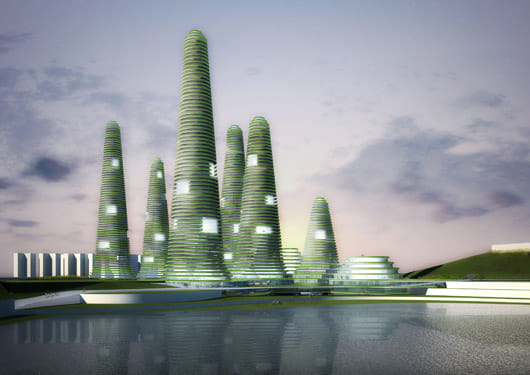
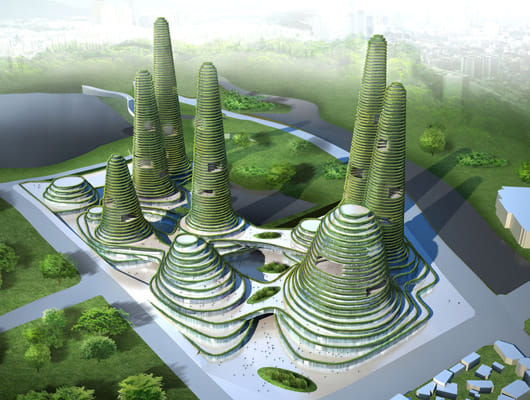
The Daewoo Consortium and the municipality of Gwanggyo announced the MVRDV concept design for a dense city centre winner of the developer’s competition for the future new town of Gwanggyo, located 35km south of the Korean capital Seoul. The plan consists of a series of overgrown hill shaped buildings with high programmatic diversity, aiming for high urban density and encouragement of further developments around this so-called ‘Power Centre’, one of the envisioned two centre’s of the future new town.
image

Gwanggyo Power Centre - Aerial view day

image

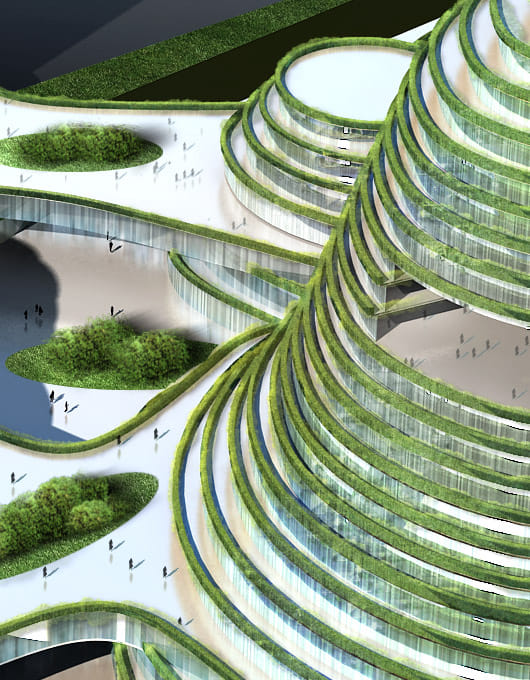
Gwanggyo Power Centre - Aerial view day, detail

image

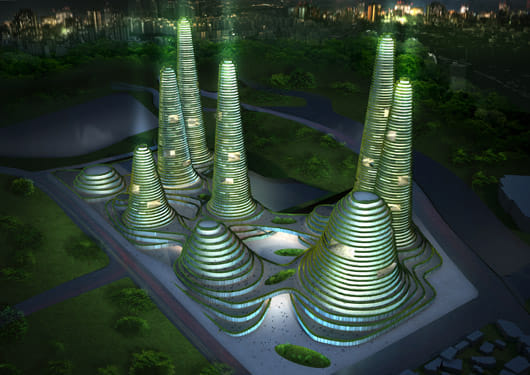
Gwanggyo Power Centre - Aerial view night

image

Gwanggyo Power Centre - Aerial view dusk

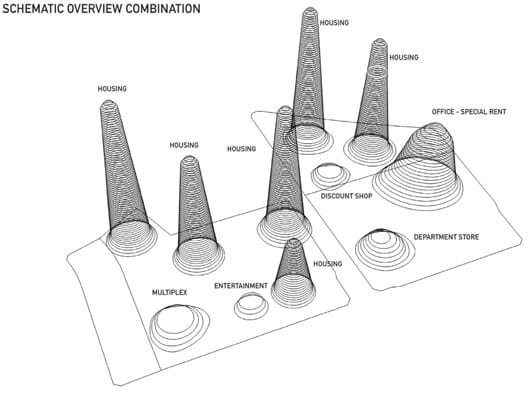
Since the beginning of the millennium, local nodes with a high density concentration of mixed program are used in Korean town planning. These nodes consist of a mix of public, retail, culture, housing, offices and leisure generating life in new metropolitan areas and encouraging further developments around them: the Power Centre strategy. The Gwanggyo Power Centre will consist of 200,000m2 housing, 48,000m2 offices, 200,000m2 mix of culture, retail, leisure and education and 200,000m2 parking.

image

Gwanggyo Power Centre - Valley view

image

Gwanggyo Power Centre - Valley view, detail

image

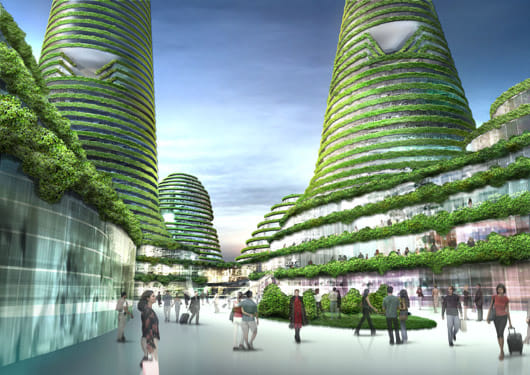
Gwanggyo Power Centre - Street view

image

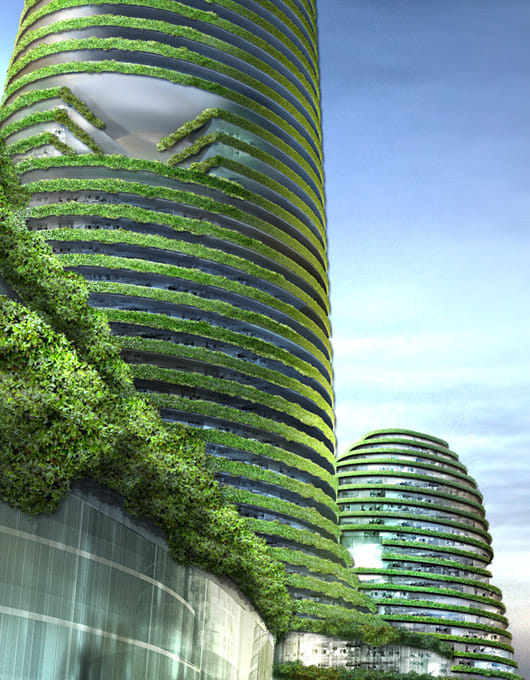
Gwanggyo Power Centre - Street view, detail

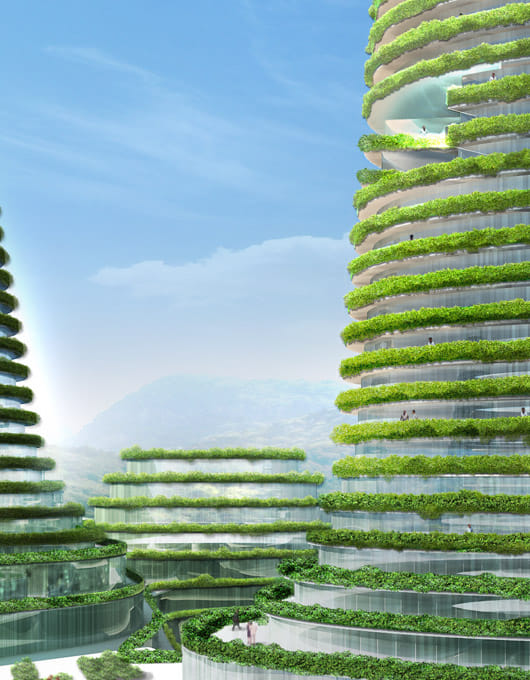
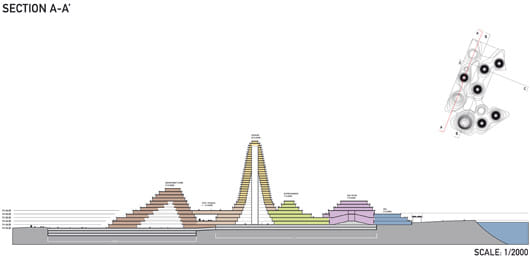
This diverse program has different needs for phasing, positioning and size. To facilitate this, all elements are designed as rings. By pushing these rings outwards, every part of the program receives a terrace for outdoor life. Plantations around the terraces with a floor to floor circulation system store water and irrigate the plants. The roofs of these hills and the terraces are planted with box hedges creating a strong, recognizable, cohesive park. This vertical park will improve the climate and ventilation, reduce energy and water usage. As a result a series of overgrown green ‘hills’ appear in the landscape.

image

Gwanggyo Power Centre - Atrium

image

Gwanggyo Power Centre - Interior

The site is surrounded by a beautiful lake and forested hills, the design aims to create a landscape on top of the new program that enlarges the green qualities and that links the surrounding parks by turning the site into a park.

image

Gwanggyo Power Centre - Scheme

image

Gwanggyo Power Centre - Scheme

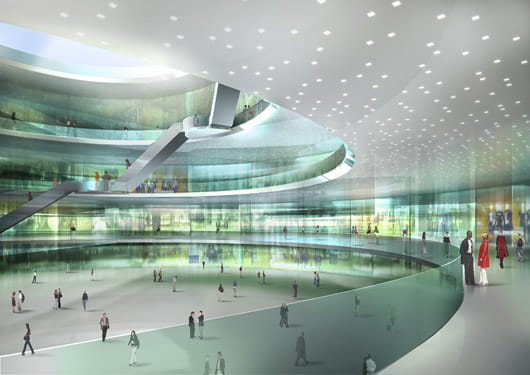
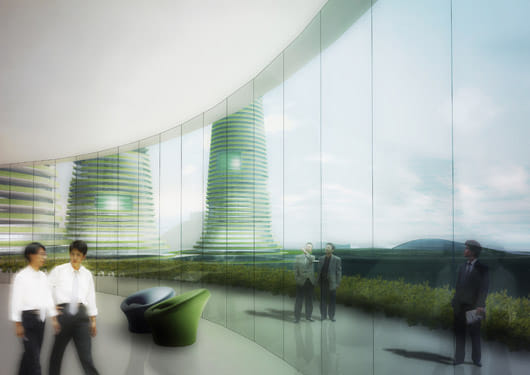
The shifting of the floors causes as a counter effect hollow cores that form large atriums. They serve as lobbies for the housing and offices, plazas for the shopping center and halls for the museum and leisure functions. In each tower a number of voids connect to the atrium providing for light and ventilation and creating semi-public spaces. On the lower floors the atriums are connected through a series of public spaces on various levels linking the towers and serving the outdoor facilities of the culture, retail and leisure program. The Power Centre creates a dense urban program with a green regard.

image

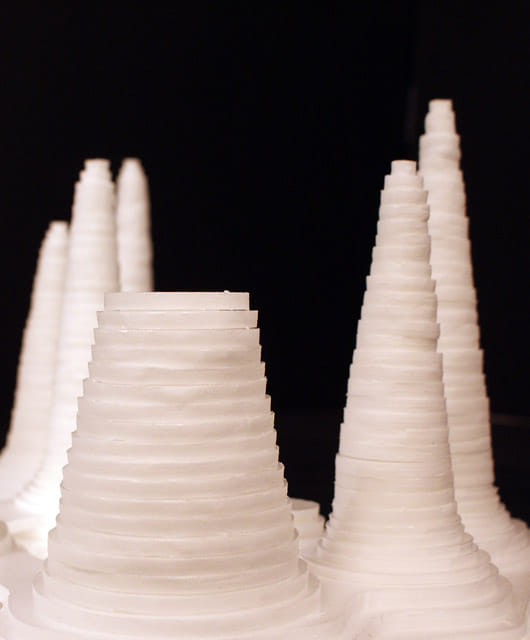
Gwanggyo Power Centre - Model making

image

Gwanggyo Power Centre - Model making

image

Gwanggyo Power Centre - Model making

The concept plan is currently at the Gyeonggi provincial authority’s Urban Innovation Corporation for further development and feasibility study, the entire new town will be a self sufficient city of 77,000 inhabitants. The estimated budget and timeframe are still in the process of being established, completion is envisioned for 2011. A consortium lead by Daewoo develops the project with local firm DA Group, which commissioned MVRDV to design the scheme. British firm Arup is involved as engineer.

Images: MVRDV

Related

winner ● urban ● seoul ● rotterdam ● netherlands ● mvrdv ● korea ● housing ● gwanggyo ● green ● europe ● city ● asia

Share

  • Follow

    0 Comments

  • Comment as :

MVRDV Wins Gwanggyo City Centre Competition in South Korea

New architecture and design competitions: IDEAS Awards, UIA-HYP CUP International Student Competition, Vancouver Tall Challenge, and Memorial to the Sixth Extinction

Best small projects chosen at AIA Small Project Award 2026

10 standout sustainable projects honored at AIA COTE Top Ten Award 2026

Best residential architecture of 2026 honored at AIA Housing Award

Best new interiors of 2026 chosen at AIA Interior Architecture Awards

Best global architecture honored at RIBA International Awards 2026

World’s most beautiful airports of 2026 chosen by Prix Versailles

New architecture and design competitions: Brick in Architecture Awards, Study Architecture Student Showcase, N.Y.C. Groceries, and New York High Falls Riverfront Market

Sign up for Bustler's Email Newsletters

SmithGroup’s ‘pioneering’ Philip Merrill Environmental Center wins AIA Twenty-five Year Award

Sponsored Post by Buildner

Museum of Emotions / Edition #8 FINAL registration deadline is in 5 DAYS!

Here are the winners of the 2026 AIA Architecture Awards

40 emerging architects and designers under 40 from Europe honored

Northwestern University selects 12-firm longlist to design new engineering building

New architecture and design competitions: Exploring 130 Years of American Design, Christo & Jeanne-Claude Center, 13 White Houses, and La Pyramide

Micro-architecture honored in latest Tiny House Architecture Competition

Next page » Loading

MVRDV Wins Gwanggyo City Centre Competition in South Korea

By Bustler Editors|

Thursday, Dec 4, 2008

Share

Related

winner ● urban ● seoul ● rotterdam ● netherlands ● mvrdv ● korea ● housing ● gwanggyo ● green ● europe ● city ● asia

The Daewoo Consortium and the municipality of Gwanggyo announced the MVRDV concept design for a dense city centre winner of the developer’s competition for the future new town of Gwanggyo, located 35km south of the Korean capital Seoul. The plan consists of a series of overgrown hill shaped buildings with high programmatic diversity, aiming for high urban density and encouragement of further developments around this so-called ‘Power Centre’, one of the envisioned two centre’s of the future new town.
image

Gwanggyo Power Centre - Aerial view day

image

Gwanggyo Power Centre - Aerial view day, detail

image

Gwanggyo Power Centre - Aerial view night

image

Gwanggyo Power Centre - Aerial view dusk

Since the beginning of the millennium, local nodes with a high density concentration of mixed program are used in Korean town planning. These nodes consist of a mix of public, retail, culture, housing, offices and leisure generating life in new metropolitan areas and encouraging further developments around them: the Power Centre strategy. The Gwanggyo Power Centre will consist of 200,000m2 housing, 48,000m2 offices, 200,000m2 mix of culture, retail, leisure and education and 200,000m2 parking.
image

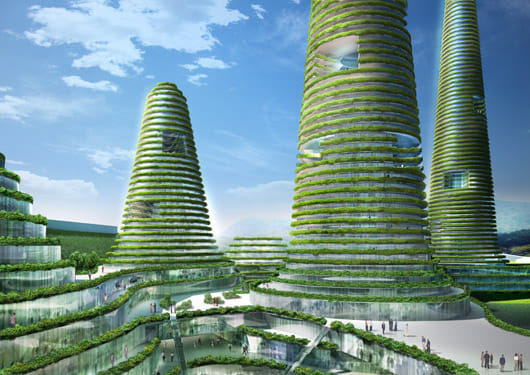
Gwanggyo Power Centre - Valley view

image

Gwanggyo Power Centre - Valley view, detail

image

Gwanggyo Power Centre - Street view

image

Gwanggyo Power Centre - Street view, detail

This diverse program has different needs for phasing, positioning and size. To facilitate this, all elements are designed as rings. By pushing these rings outwards, every part of the program receives a terrace for outdoor life. Plantations around the terraces with a floor to floor circulation system store water and irrigate the plants. The roofs of these hills and the terraces are planted with box hedges creating a strong, recognizable, cohesive park. This vertical park will improve the climate and ventilation, reduce energy and water usage. As a result a series of overgrown green ‘hills’ appear in the landscape.
image

Gwanggyo Power Centre - Atrium

image

Gwanggyo Power Centre - Interior

The site is surrounded by a beautiful lake and forested hills, the design aims to create a landscape on top of the new program that enlarges the green qualities and that links the surrounding parks by turning the site into a park.
image

Gwanggyo Power Centre - Scheme

image

Gwanggyo Power Centre - Scheme

The shifting of the floors causes as a counter effect hollow cores that form large atriums. They serve as lobbies for the housing and offices, plazas for the shopping center and halls for the museum and leisure functions. In each tower a number of voids connect to the atrium providing for light and ventilation and creating semi-public spaces. On the lower floors the atriums are connected through a series of public spaces on various levels linking the towers and serving the outdoor facilities of the culture, retail and leisure program. The Power Centre creates a dense urban program with a green regard.
image

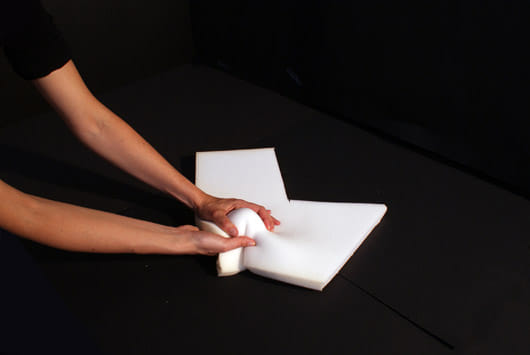
Gwanggyo Power Centre - Model making

image

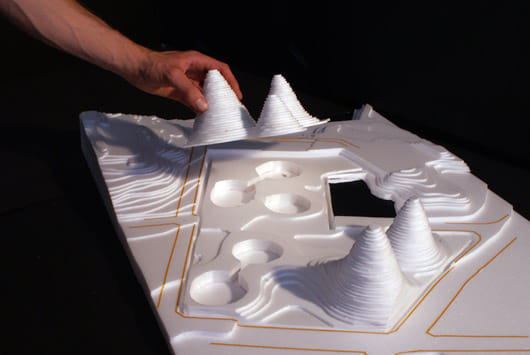
Gwanggyo Power Centre - Model making

image

Gwanggyo Power Centre - Model making

The concept plan is currently at the Gyeonggi provincial authority’s Urban Innovation Corporation for further development and feasibility study, the entire new town will be a self sufficient city of 77,000 inhabitants. The estimated budget and timeframe are still in the process of being established, completion is envisioned for 2011. A consortium lead by Daewoo develops the project with local firm DA Group, which commissioned MVRDV to design the scheme. British firm Arup is involved as engineer.

Images: MVRDV

Share

  • Follow

    0 Comments

  • Comment as :

Archinect JobsArchinect Jobs

The Archinect Job Board attracts the world's top architectural design talents.

VIEW ALL JOBS POST A JOB

Interior Designer

Fowlkes Studio

Interior Designer

Washington, DC, US

Architect / Architectural Designer (3-5 years experience)

Resolution: 4 Architecture

Architect / Architectural Designer (3-5 years experience)

New York, NY, US

Architect

OBRA Architects

Architect

New York, NY, US

Project Architect

Fowlkes Studio

Project Architect

Washington, DC, US

Project Manager

Payette

Project Manager

Boston, MA, US

Interior Designer - Intermediate Level (3-7 Years)

Yazdani Studio of Cannon Design

Interior Designer - Intermediate Level (3-7 Years)

Los Angeles, CA, US

Architect/Project Manager - Commercial

DAHLIN Architecture | Planning | Interiors

Architect/Project Manager - Commercial

Pleasanton, CA, US

BIM Application Specialist

Lake Flato Architects

BIM Application Specialist

San Antonio, TX, US

Architectural Designer

1100 Architect

Architectural Designer

New York, NY, US

Job Captain - Residential

DAHLIN Architecture | Planning | Interiors

Job Captain - Residential

Pleasanton, CA, US

Next page » Loading