• Login / Join
  • About
  • •
  • Contact
  • •
  • Advertising
bustler logo
bustler logo
  • News
  • Competitions
  • Events
  • Bustler is powered by Archinect
  • Sign up for Bustler's Email Newsletters

  • Follow these Bustler feeds:

  • Search

    Search in

  • Submit

    What are you submitting?

    News Pitch
    Competition
    Event
  • Login / Join
  • News|Competitions|Events
  • Search
    | Submit
    | Follow
  • Search in

    What are you submitting?

    News Pitch
    Competition
    Event

    Follow these Bustler feeds:

  • About|Contact|Advertising
  • Login / Join

A closer look at Daniel Buren's colorful intervention at the Fondation Louis Vuitton

By Justine Testado|

Friday, May 13, 2016

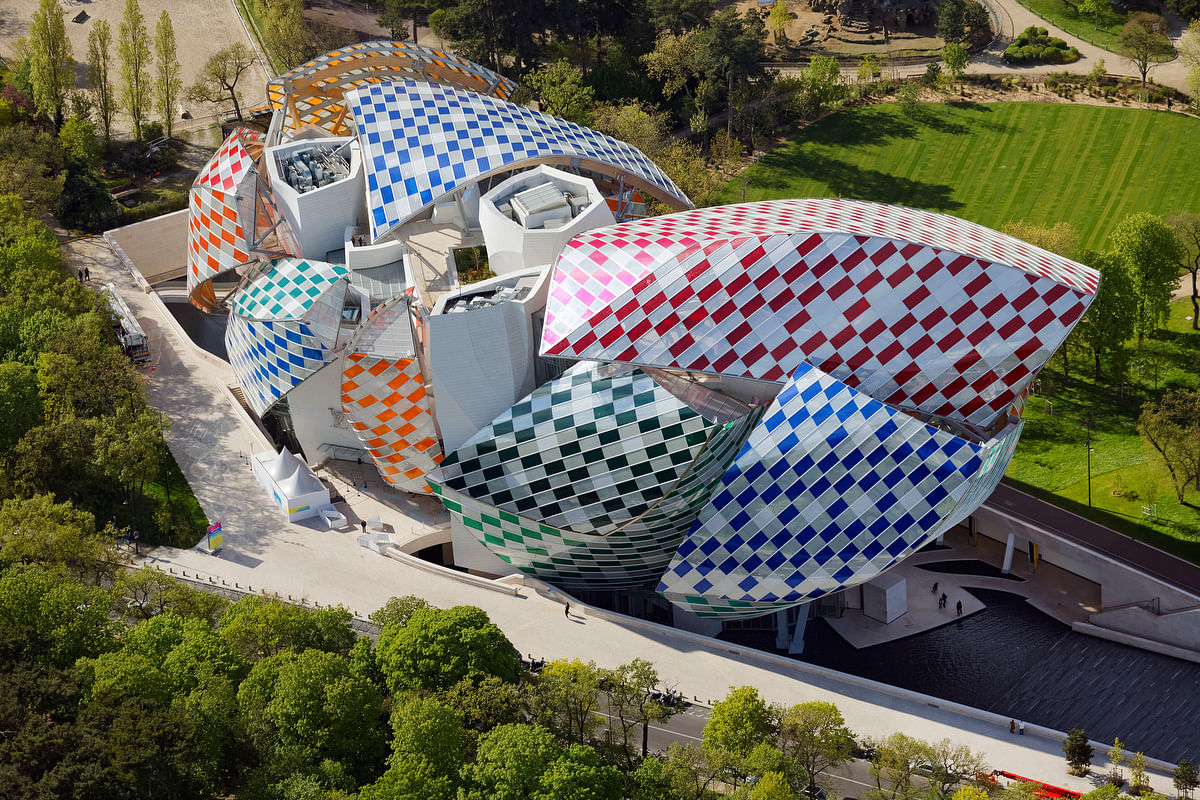
Daniel Buren, “L’Observatoire de la lumière”, work in situ, Fondation Louis Vuitton, Paris, 2016. © DB-ADAGP Paris / Philippe Guignard / Air Images / Fondation Louis Vuitton

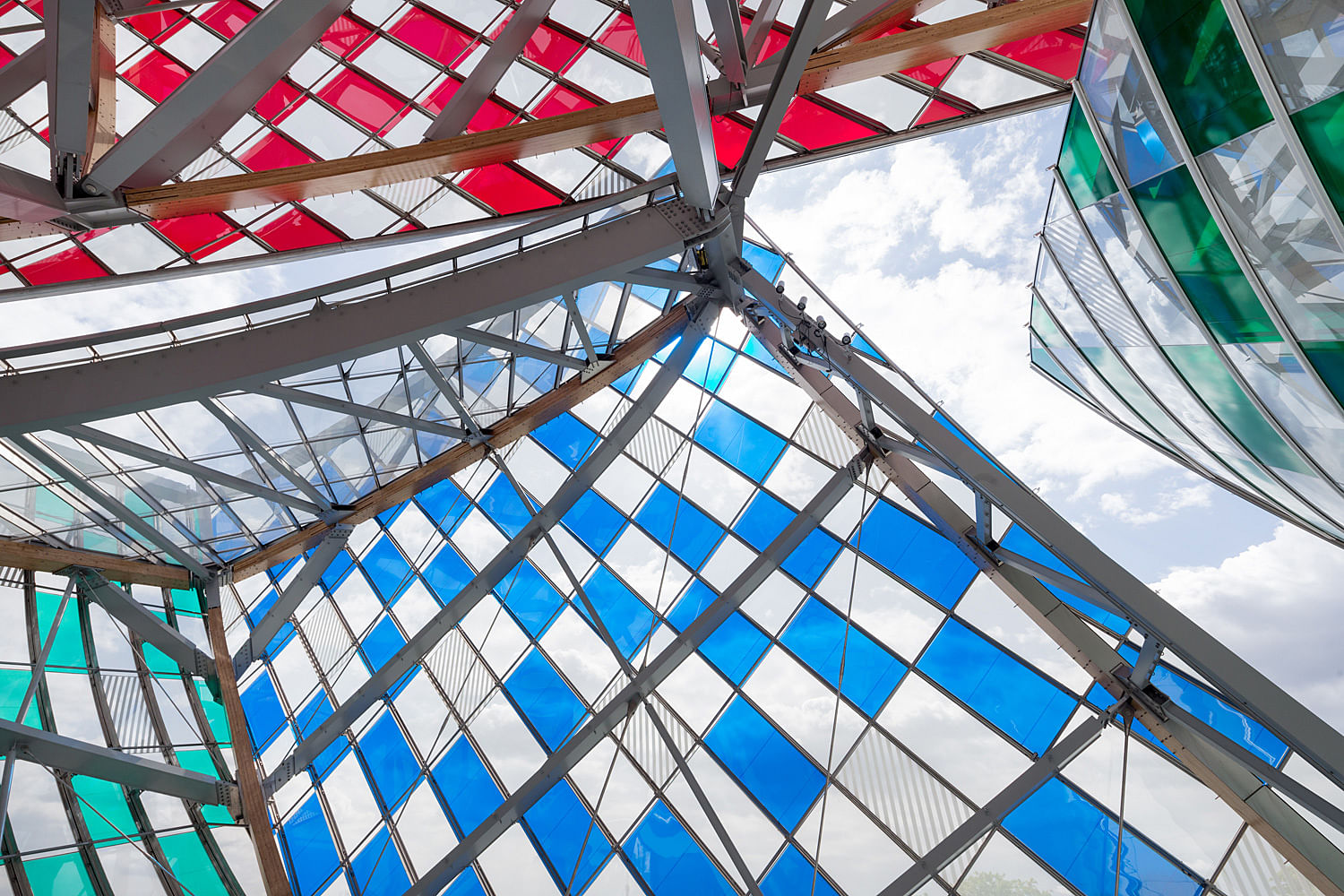
Thanks to in situ artist Daniel Buren, the white glassy curved sails of the Gehry-designed Fondation Louis Vuitton in Paris have received a generous splash of vibrant color — or 13 colors, to be exact. And just in time for the summer season. Developed in collaboration with Frank Gehry, Buren's temporary piece, titled “The Observatory of Light“, made its official debut this past Wednesday. It took 29 nights over a period of five weeks to apply the dyed filters and white 8.7 cm-wide strips throughout the building's 3,528 glass panes.

In developing the intervention, Buren wanted to visually challenge the structure, while also respecting it. The piece adds a new playful interaction of contrasting color, unexpected mirrored reflections, transparency, and lighting to both inside and outside the building. Visitors who stop by the Fondation now will get to experience the Fondation building with a refreshing one-of-a-kind perspective.

Keep reading for snippets of a conversation between Daniel Buren and FLV Artistic Director Suzanne Pagé, featured in the accompanying book Daniel Buren, “The Observatory of Light”, co-edited by Fondation Louis Vuitton / Editions Xavier Barral.
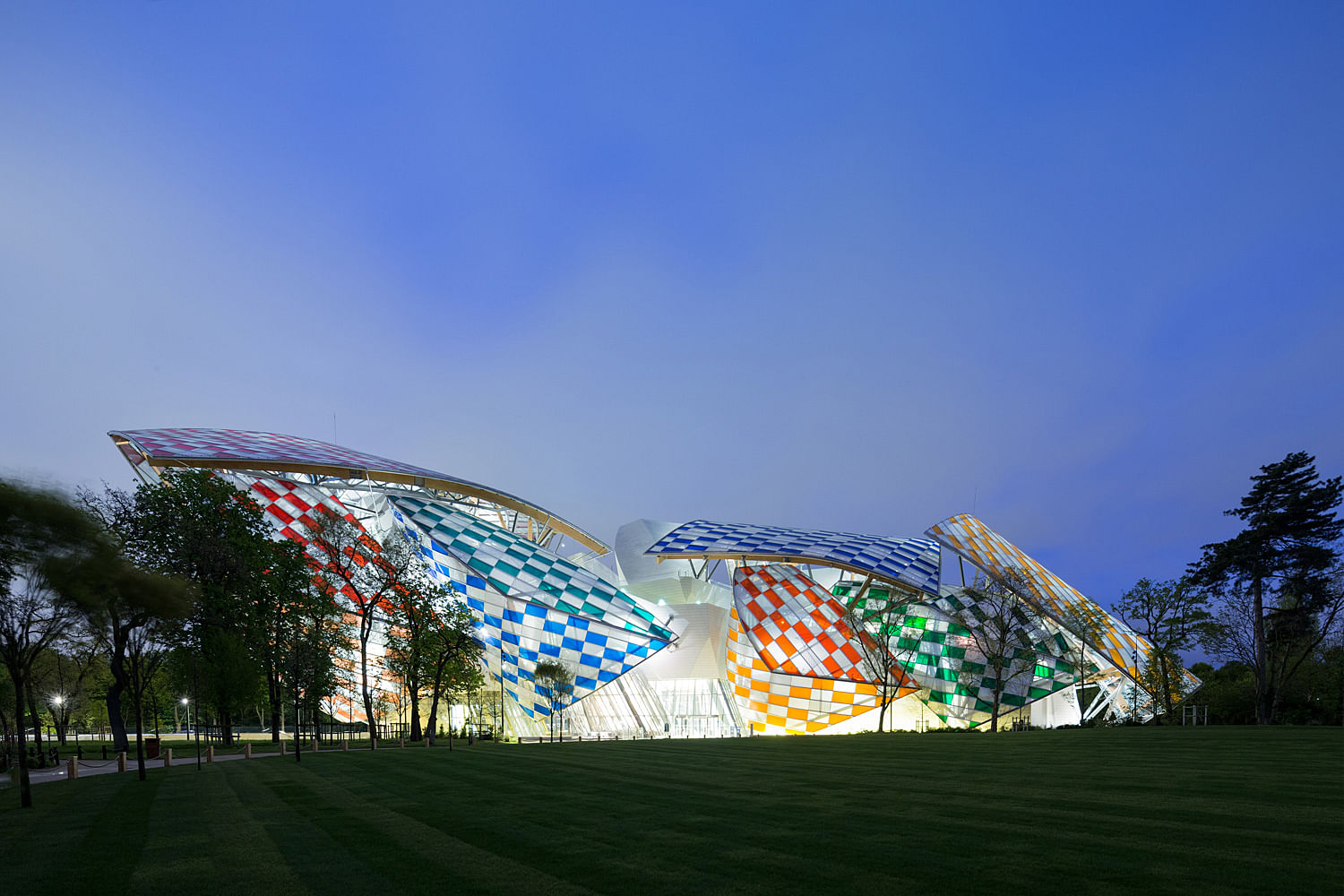
Daniel Buren, “L’Observatoire de la lumière”, work in situ, Fondation Louis Vuitton, Paris, 2016. © DB-ADAGP Paris / Iwan Baan / Fondation Louis Vuitton

Suzanne Pagé (SP): “You and Frank Gehry have known each other for more than forty years. Today you have entered into a new dialogue, in situ, after the singular and more distanced one in Bilbao. What was your perception of this building, which you have always been enthusiastic about? [...] What is it that interests you in the idea of reviving that now, ten years later?”

Daniel Buren (DB): “You were there. It was in June, I think. Frank Gehry asked me to come. He wanted to tell me how keen he was for me to do something. He imagined types of flags floating amidst his ‘sails’ on two of the terraces, partially covering them. I told him that I needed to take a closer look and that I thought it was already too late for the opening. The flags or other objects in the wind, I couldn’t imagine that. However, the use of coloured filters could be spectacular and interesting because of the complexity of the structure, of what is going on over them. I really like this controlled chaos. The transparent glass panels – well, they’re silkscreened to attenuate the sunlight a bit – that cover the entire structure, along with the waterfall that disappears under the museum, are, in my view, the most successful parts. There’s nothing like that in Bilbao. The only thing the two buildings share is that both are the work of the same architect.”
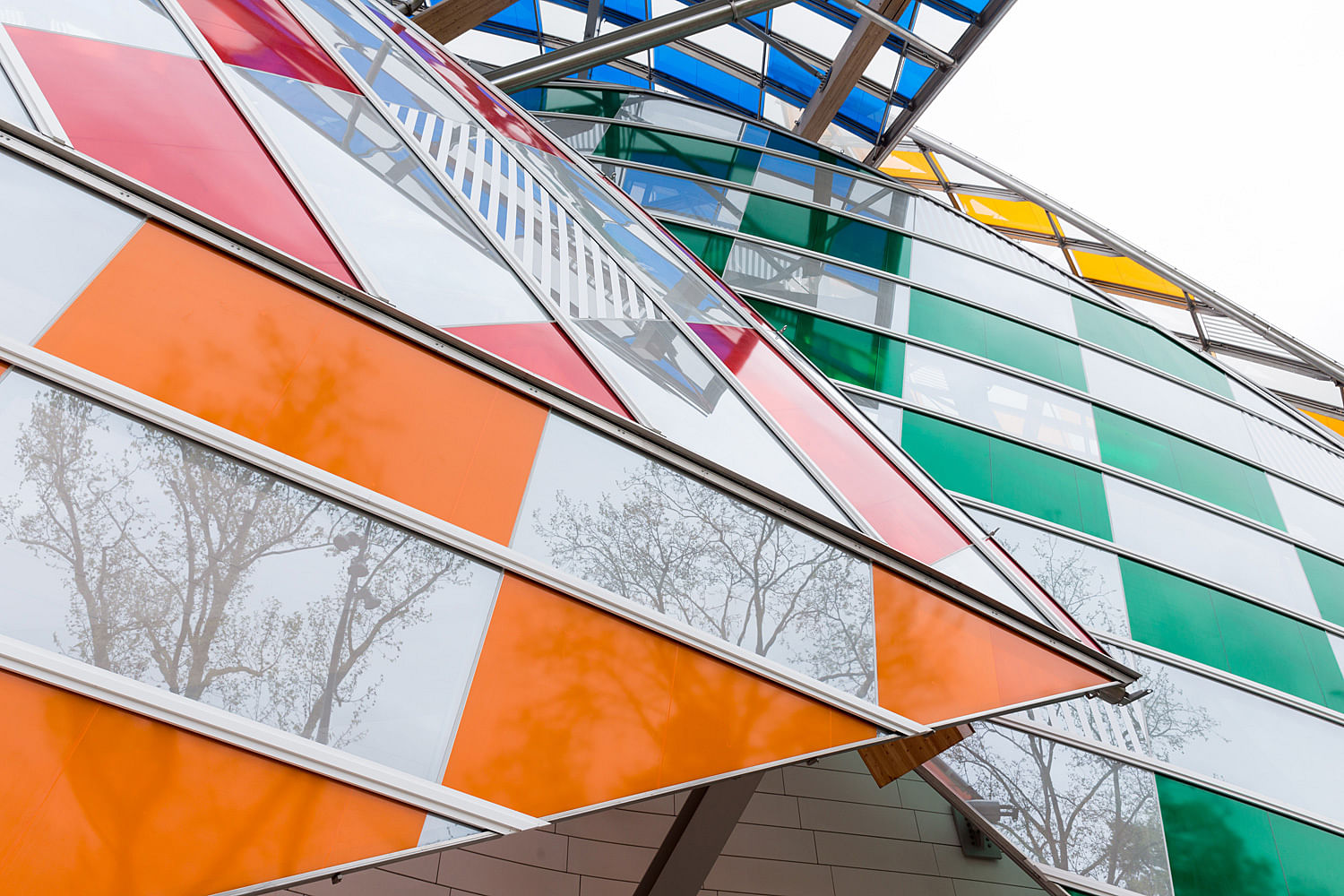
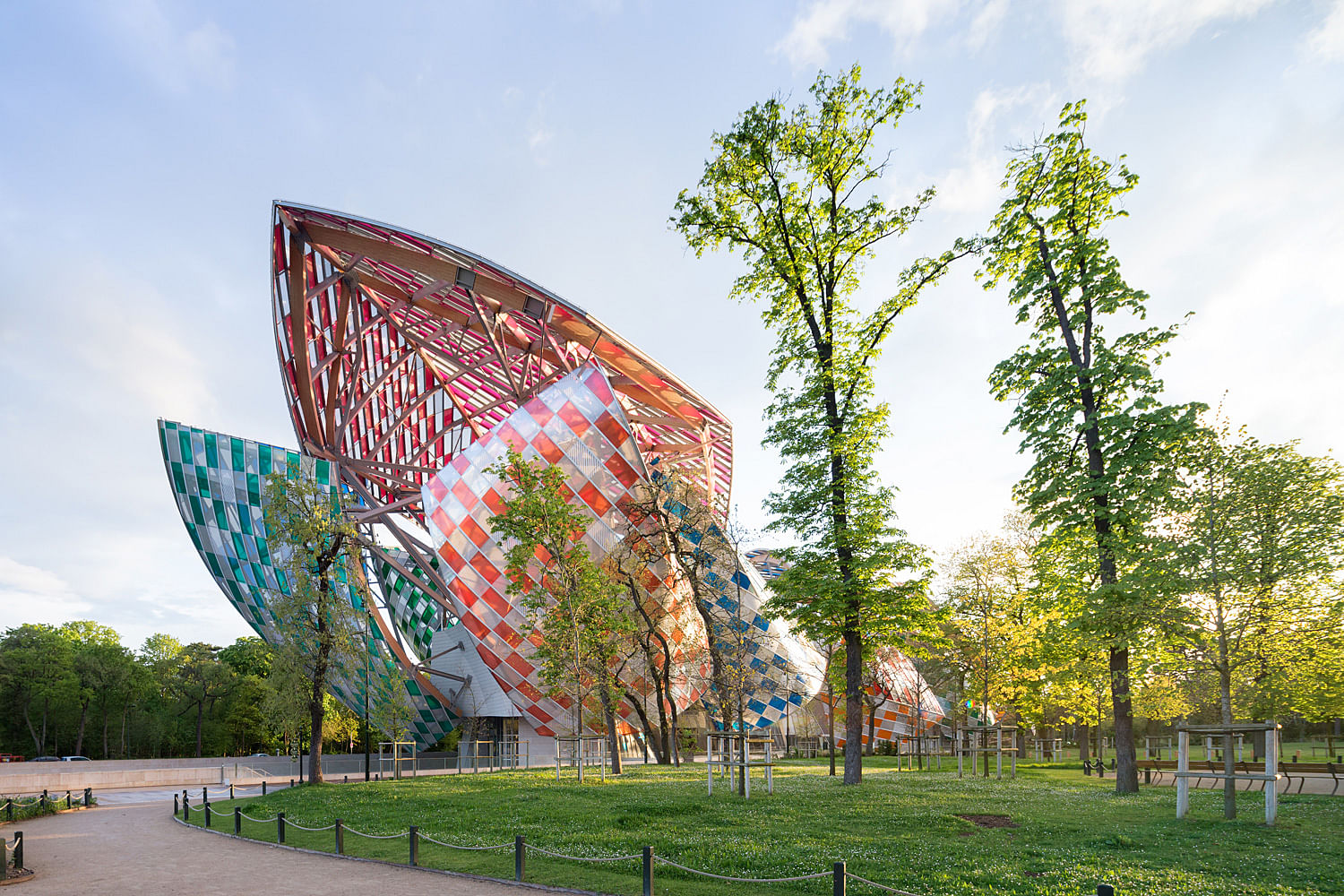
Daniel Buren, “L’Observatoire de la lumière”, work in situ, Fondation Louis Vuitton, Paris, 2016. © DB-ADAGP Paris / Iwan Baan / Fondation Louis Vuitton

SP: “The scale, too, is different.”

DB: “You can’t compare them. In a way, the idea of turning everything here towards the interior by using multiple terraces, which mean that you can be outside while being in the museum, is a rather amusing one and it opens up a whole lot of possibilities. I had nothing specific in mind but I was sure that there were a thousand ways of intervening. So, I thought of filters, which were perfectly in keeping with the spirit of the construction. Of course, Gehry still had to agree to someone touching his structure. But then, he did tell me: ‘You know, when I make a museum, it’s for artists to do what they want in it, to question it, to destroy it.’ If I was allowed to touch the glass, then I could get to work. I made a model of the project and in August I sent it to Frank, as I did to you, in fact. He answered me the same day: he thought the project was magnificent, but he added: ‘We need to give the public a bit of time, at least a year, so they can get used to the architecture. After that, you’ll be free to transform it.’ I was expecting him to say that. Gehry naturally wanted the museum to be seen as he had designed it, before letting someone touch it. That’s how it started. For me, then, it’s great to be going back to this project.”
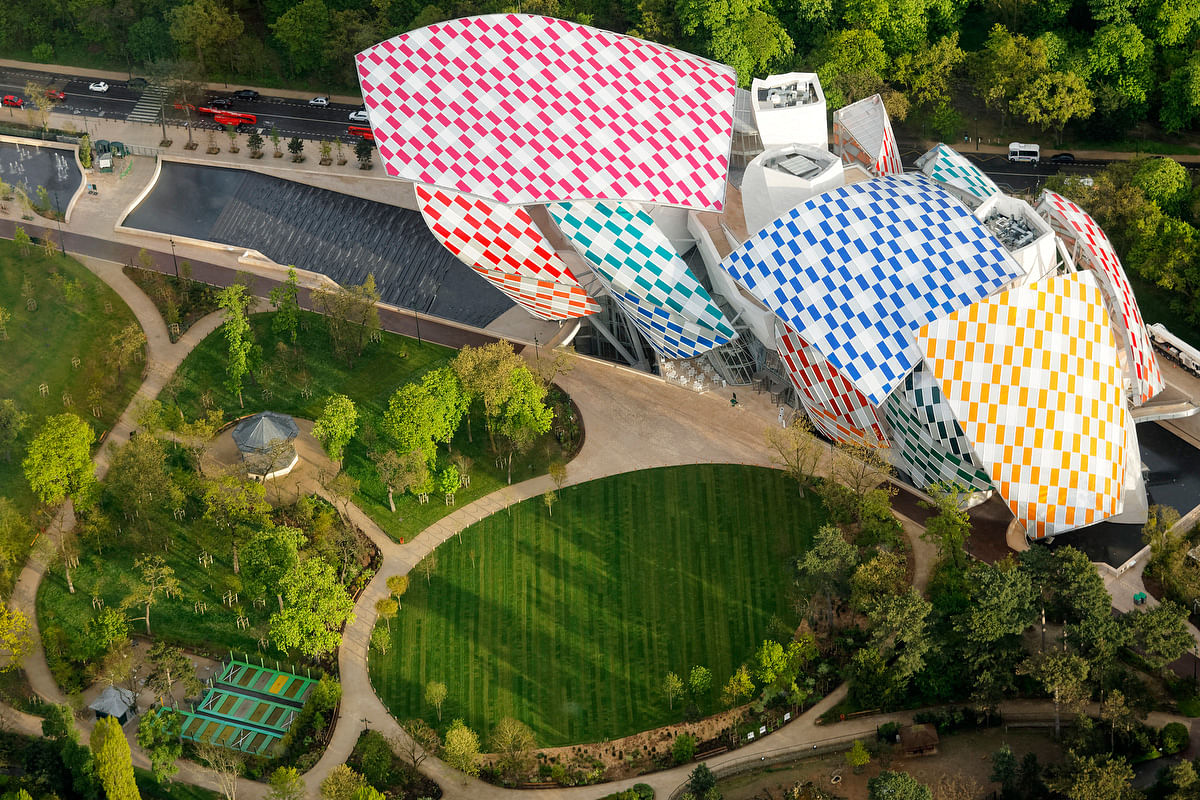
Daniel Buren, “L’Observatoire de la lumière”, work in situ, Fondation Louis Vuitton, Paris, 2016. Detail. © DB-ADAGP Paris / Philippe Guignard / Air Images / Fondation Louis Vuitton

SP: “Exactly, what kind of provocation does this building represent for you? Did it constrain you, and did you try to adopt certain principles or, on the contrary, maintain or even create tension?”

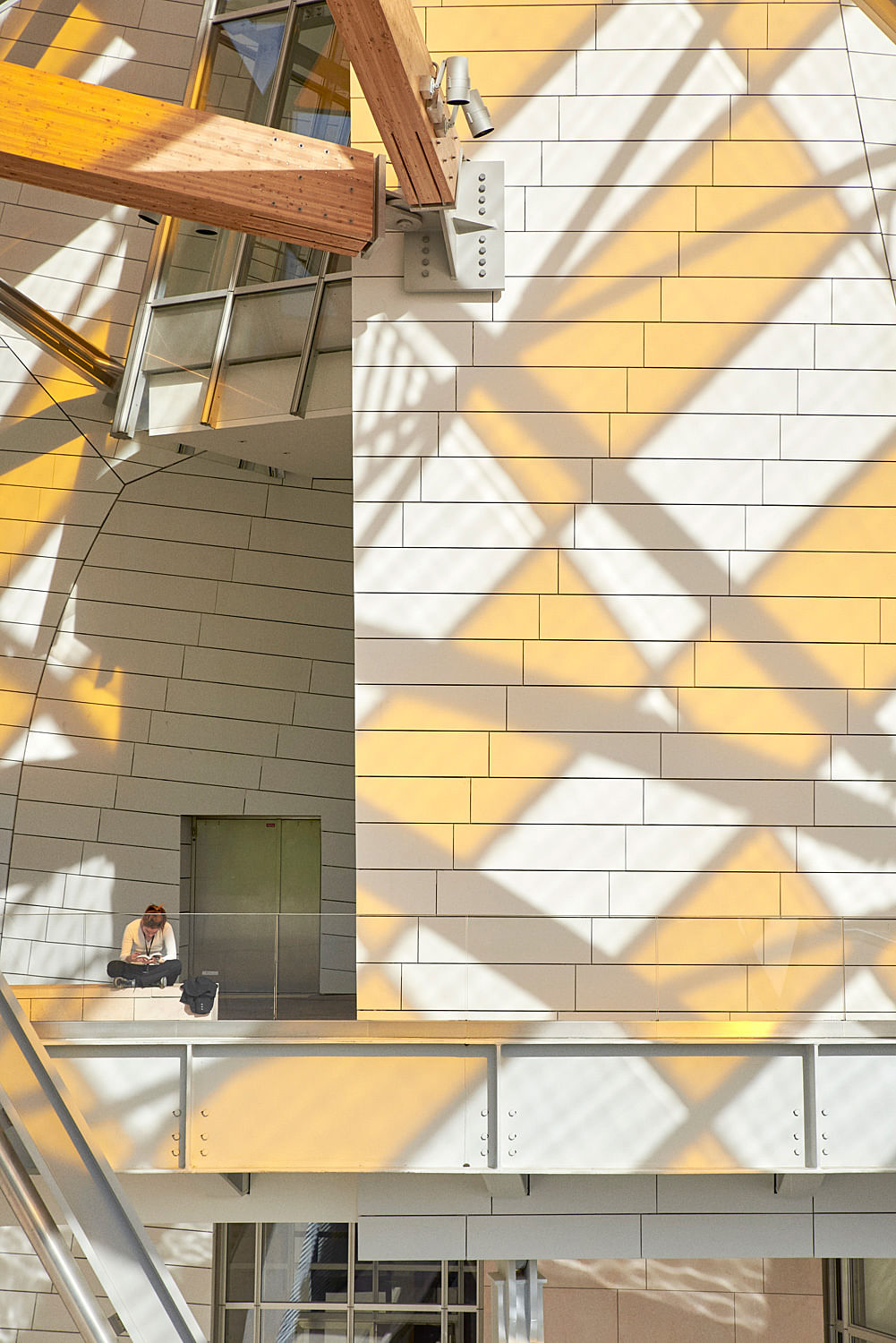
DB: “I knew, even before I made it, that my project would visually challenge this structure. At the same time, it also respects it. It’s obvious that the terraces are going to be transfigured on sunny days by the projections, which will completely change what we already know about this new structure. The original construction is very monochrome – creamy. Nothing interferes with the golden-brown ambience. Especially in the daytime, because there is no artificial lighting. Adding colour to this structure will radically change the impression it gives. Without physically transforming anything, simply because of the quality of the glass and its curves and dips, the forms will shift even though nothing has been changed.”
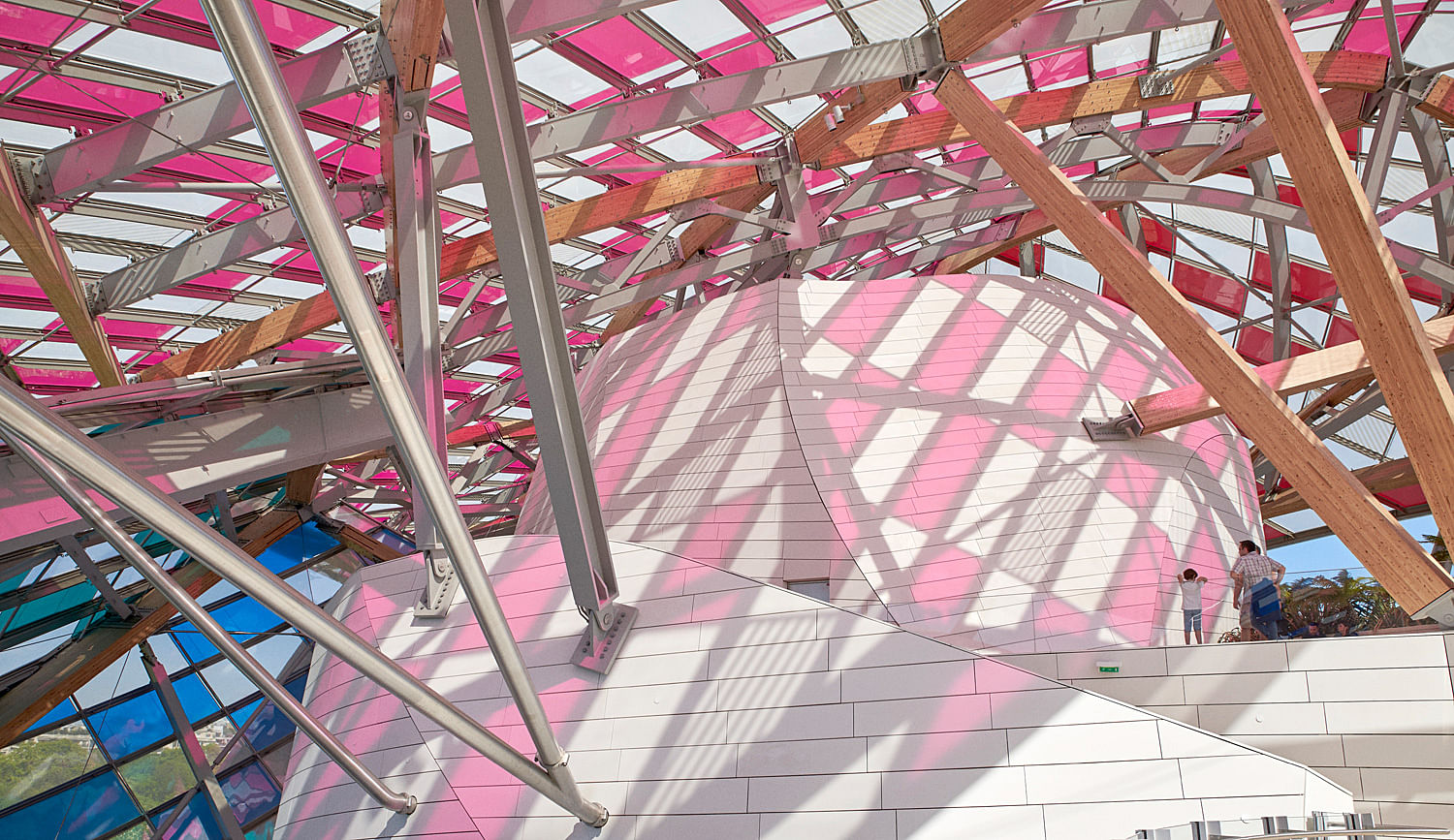
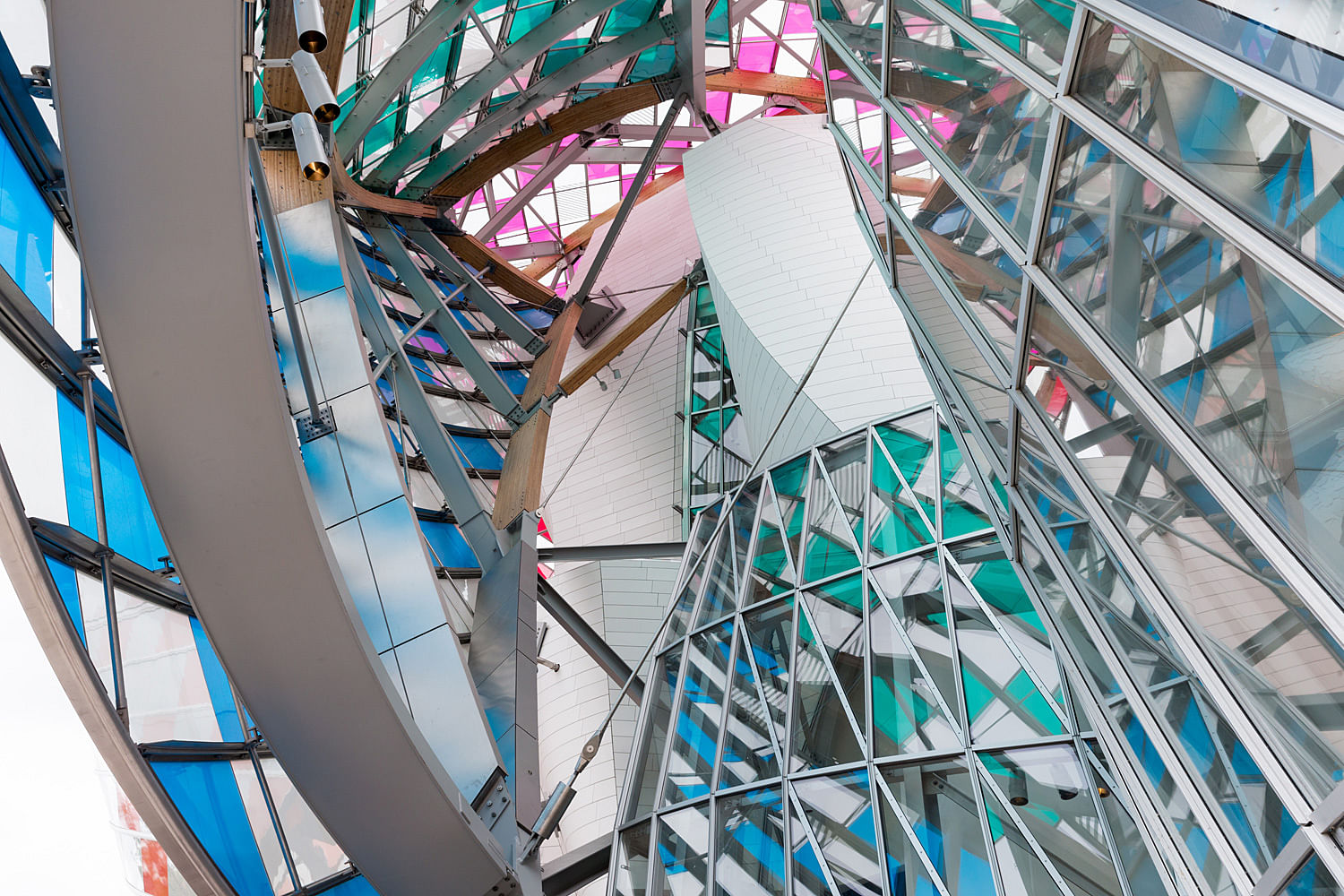
Daniel Buren, “Observatory of Light”, work in situ, Fondation Louis Vuitton, Paris, 2016. © DB - ADAGP Paris, 2016 © Manuel Lagos - Cid.
Daniel Buren, “L’Observatoire de la lumière”, work in situ, Fondation Louis Vuitton, Paris, 2016. © DB-ADAGP Paris / Iwan Baan / Fondation Louis Vuitton

SP: “Your basic vocabulary is quite apparent in your project here, that well-know ‘visual tool’ as you call it, with the alternating 8.7 cm stripes, colour-light and transparency and, of course, mirrors. Transparency and mirror effects are exactly what we find in Gehry, too.”

DB: “There are all kinds of mirror effects that do not come from mirrors but from the glass. Almost everywhere there are reflections. If we do not notice this effect that much, that is because it seems obvious, with all this glass, the beginnings or endings of corridors. The doors and glass walls set up a multitude of reflections, and what is reflected is what is above us, as I said, dressed in a monochrome, or rather in gradations going from off-white to the golden-brown of the beams. It’s so fluid, so harmonious that you hardly notice it, it all seems so normal. What I am sure of, though, is that when the sails are coloured, these reflections will become much more present and will make these ‘dormant’ mirrors that are positioned all around us more active.”
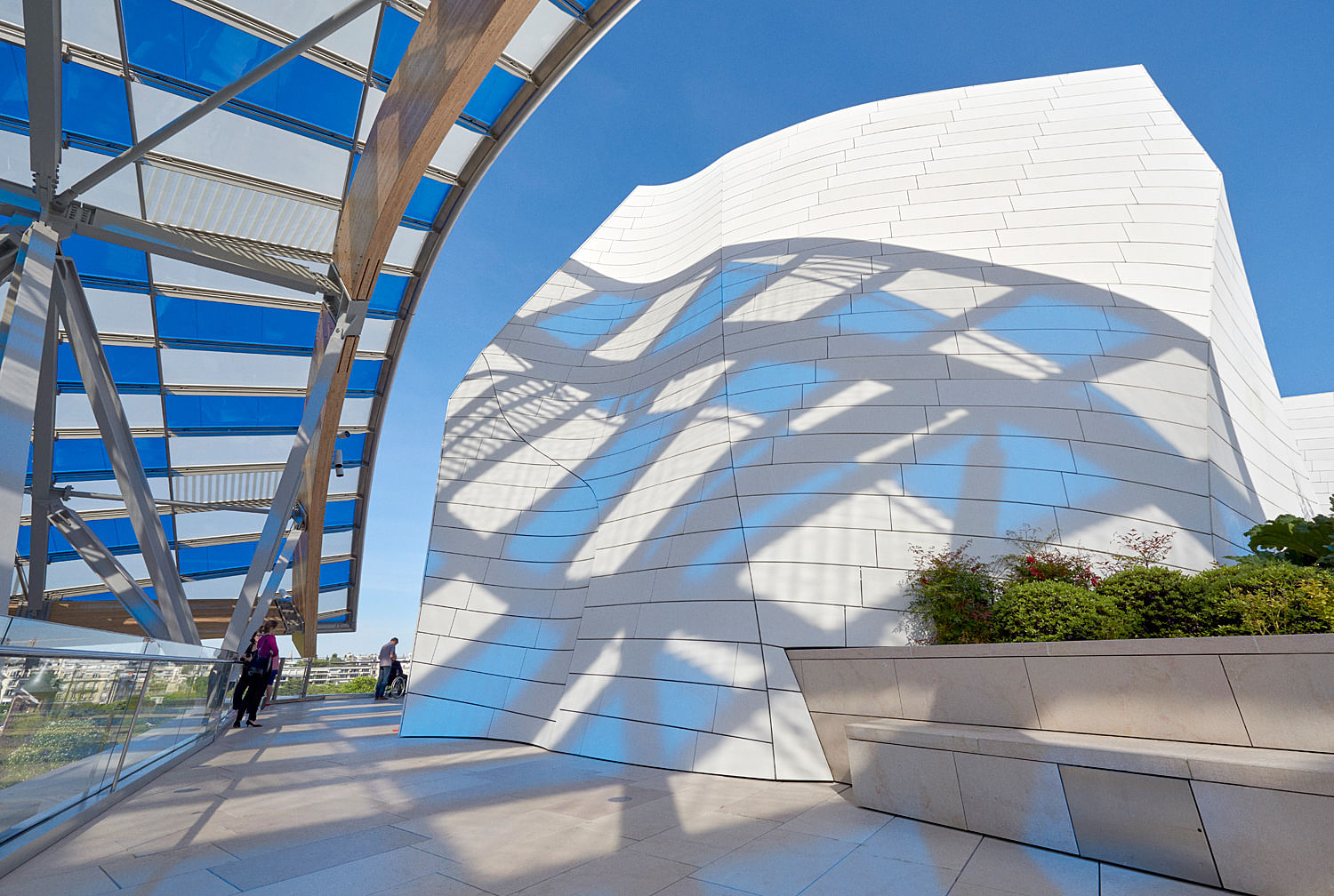
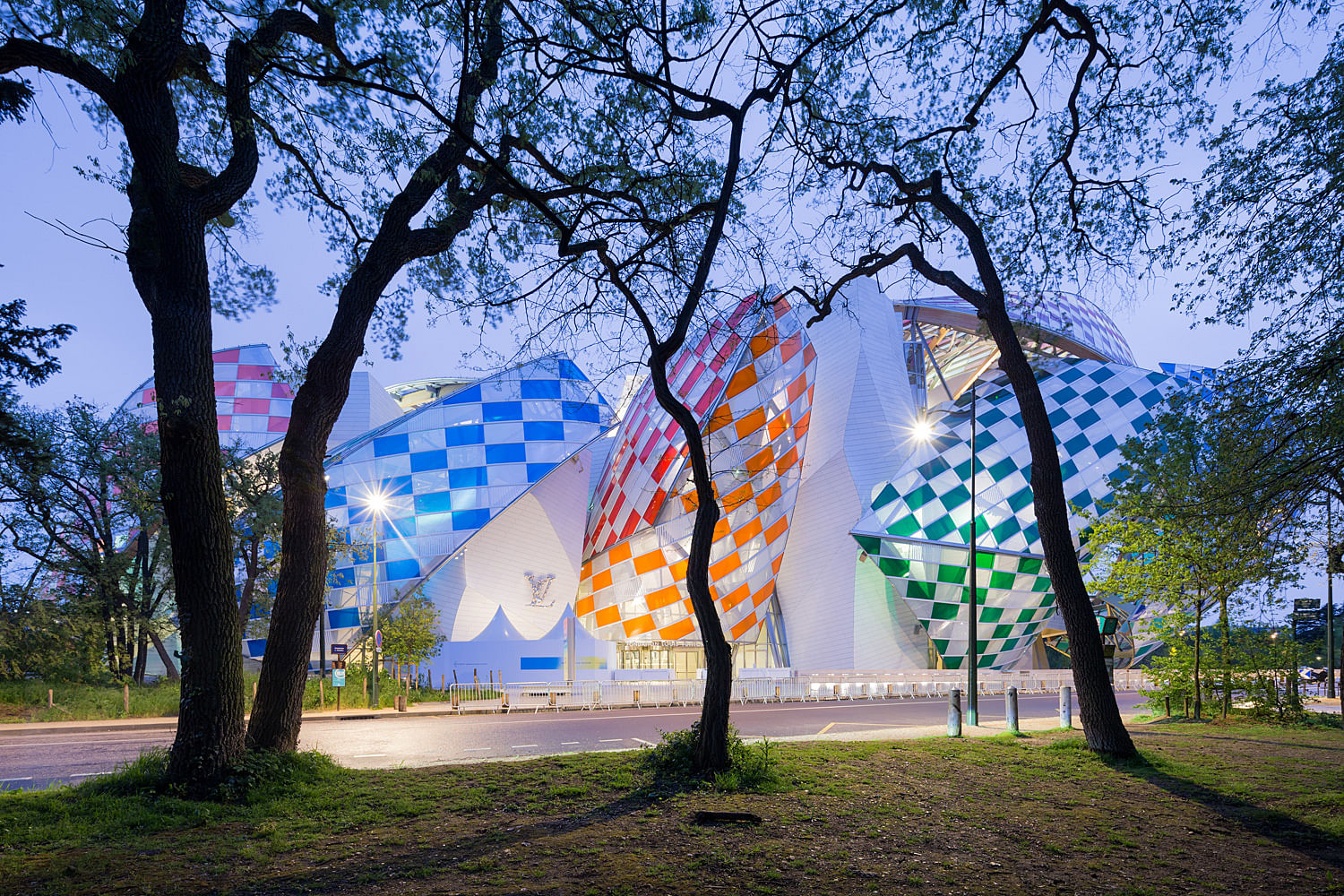
Daniel Buren, “Observatory of Light”, work in situ, Fondation Louis Vuitton, Paris, 2016. © DB - ADAGP Paris, 2016 © Manuel Lagos - Cid.
Daniel Buren, “L’Observatoire de la lumière”, work in situ, Fondation Louis Vuitton, Paris, 2016. © DB-ADAGP Paris / Iwan Baan / Fondation Louis Vuitton

SP: “Did Gehry’s decisions set rules for you here? How do you plan to assert yourself in the face of the architecture?”

DB: “That’s something which has never bothered me. In most of my pieces, especially the ones articulated mainly around the architecture of a given place, I remain dependent. I play with it while never really trying to dominate. If one side gains the upper hand, it’s usually the architecture. The problem here is that Gehry’s proposition is, if I can say this, barely visible. That’s why I’m sure that when a bit of red or yellow appears in the reflection of the roofing over a stairway, or over the restaurant, say, people will realise that they are being reflected, whereas now you have to be very attentive to see that the transparent sides are all latent mirrors.”
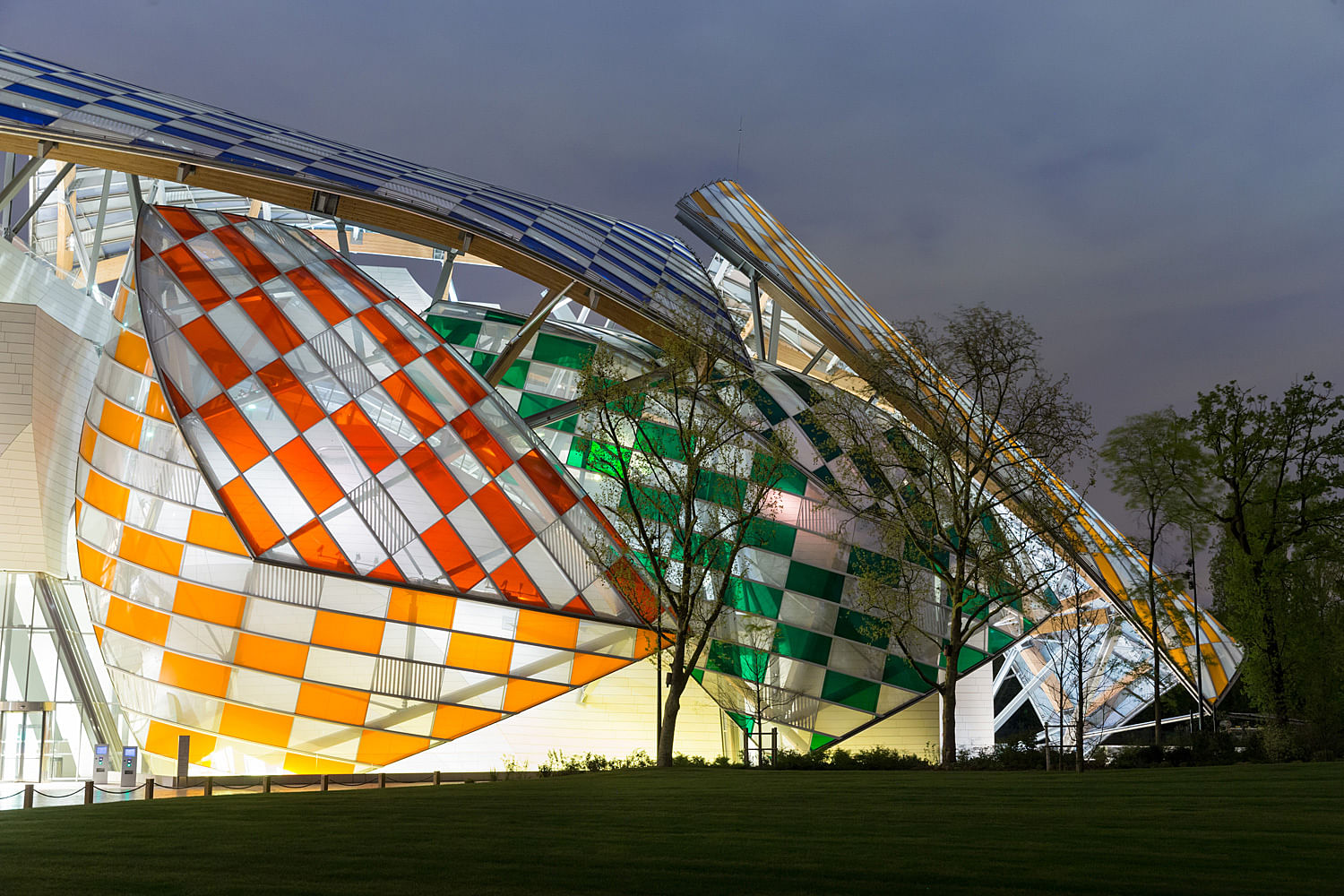
Daniel Buren, “L’Observatoire de la lumière”, work in situ, Fondation Louis Vuitton, Paris, 2016. © DB-ADAGP Paris / Iwan Baan / Fondation Louis Vuitton

SP: “You have chosen thirteen colours and given us a certain latitude in positioning them on the two-sided sails. Am I right?”

DB: “Yes and no. When we were choosing the folded sails, I always specified the colour – light or dark – and, having established this principle, as I thought it would be very similar either way, I left the freedom to decide to position the light above and the dark below, or vice versa.”

SP: “Your choice of colours is very precise, however.”

DB: “Yes, but at the same time I’m playing with existing materials that have limited possibilities. Also, there are some colours, like the reds or the blues, where you can barely make out the different shades, unless you put them side by side. If, say, I position a sky-blue sail not far from a sail that is in a slightly darker blue, the nuance is so subtle that nobody will see the difference. However, when they’re projected onto the walls or the floor the difference between the two blues will be visible. Then the true colour appears. Under the sky, the value is slightly different. That’s what I like about these filters: everything is multiple and subtle. The colours that are chosen are basic ones – except when you have the idea of a dark shade and another lighter one. The blue must be a blue, the green, a green, the red a red, the orange an orange. There’s no confusing bold colours.”
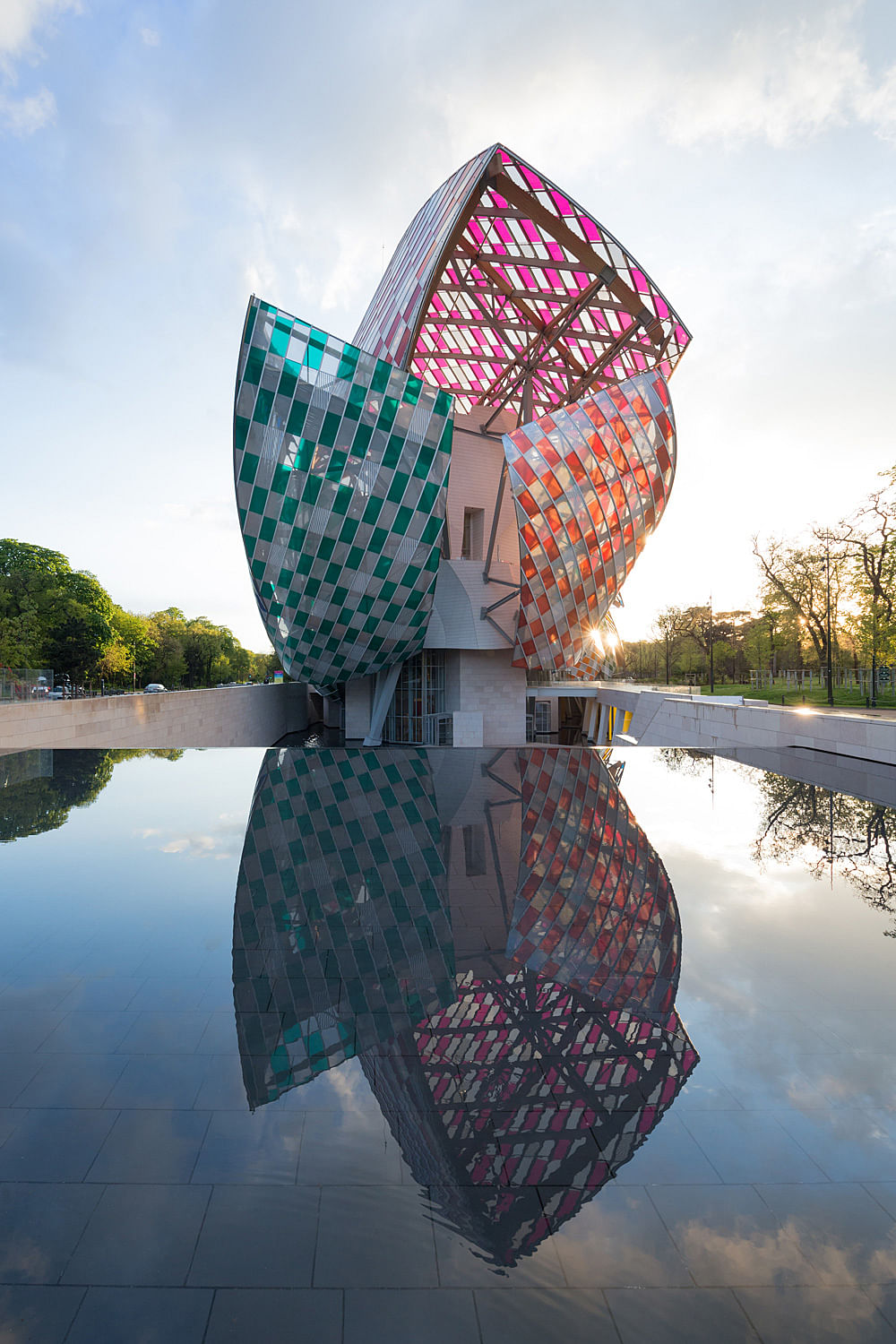
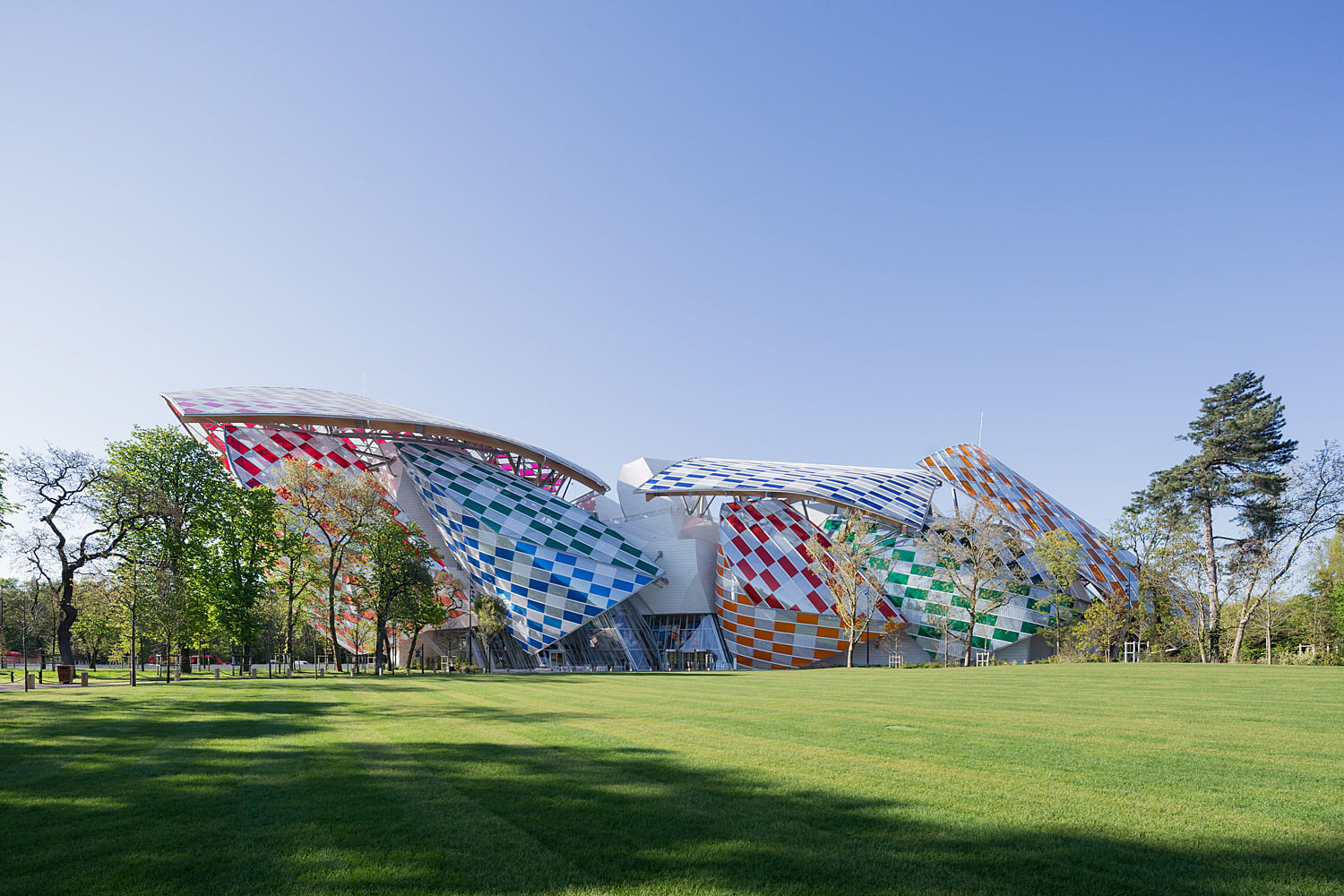
Daniel Buren, “L’Observatoire de la lumière”, work in situ, Fondation Louis Vuitton, Paris, 2016. © DB-ADAGP Paris / Iwan Baan / Fondation Louis Vuitton

SP: “You have the mastery, the total awareness, but paradoxically, it’s precisely because of this that the unexpected, that miracles can happen. That goes for Gehry and for you. For any true artist.”

DB: “Miracles happen when the project is a success. If everything is rigorous enough, if it follows the logic from start to finish, then the person looking at the work is free. If there is the slightest accident, physically or mentally, in the construction, the slightest grain of sand in an engine that was running fantastically smoothly, everything can go wrong. The viewer can no longer be free; all they can think about are the causes of this accident. Everything, in a work of art, is connected, and the viewer or listener has to keep their freedom.”
RELATED NEWS Frank Gehry is the first architect to win the Harvard Arts Medal
RELATED NEWS James Corner is designing a field of ICEBERGS at the National Building Museum this summer
RELATED NEWS LAN chosen to restructure iconic Grand Palais in Paris

Related

daniel buren ● fondation louis vuitton ● frank gehry ● observatory ● paris ● france ● europe ● intervention ● art intervention ● glass ● color design ● collaboration ● art and architecture
Gehry Partners, LLP
Gehry Partners, LLP

Share

  • Follow

    0 Comments

  • Comment as :

A closer look at Daniel Buren's colorful intervention at the Fondation Louis Vuitton

World’s most beautiful airports of 2026 chosen by Prix Versailles

New architecture and design competitions: Brick in Architecture Awards, Study Architecture Student Showcase, N.Y.C. Groceries, and New York High Falls Riverfront Market

SmithGroup’s ‘pioneering’ Philip Merrill Environmental Center wins AIA Twenty-five Year Award

Sponsored Post by Buildner

Museum of Emotions / Edition #8 FINAL registration deadline is in 5 DAYS!

Here are the winners of the 2026 AIA Architecture Awards

40 emerging architects and designers under 40 from Europe honored

Northwestern University selects 12-firm longlist to design new engineering building

New architecture and design competitions: Exploring 130 Years of American Design, Christo & Jeanne-Claude Center, 13 White Houses, and La Pyramide

Sign up for Bustler's Email Newsletters

Micro-architecture honored in latest Tiny House Architecture Competition

World’s most beautiful restaurants of 2026 chosen by Prix Versailles

Sponsored Post by Buildner

Design a wine tasting room in Italy! Valli Wine Tasting Room is launched!

10 can't-miss architecture & design events to see this June in London, Los Angeles, Chicago, San Francisco, Detroit, San Diego, Porto, and Barcelona

Sponsored Post by Buildner

Museum of Emotions / Edition #8 FINAL registration deadline is approaching!

Seven global projects make AR Public Awards shortlist 2026

Sponsored Post by Buildner

Design a slow-living restaurant in Portugal! Portugal Long Table Restaurant is launched!

Next page » Loading

A closer look at Daniel Buren's colorful intervention at the Fondation Louis Vuitton

By Justine Testado|

Friday, May 13, 2016

Share

Daniel Buren, “L’Observatoire de la lumière”, work in situ, Fondation Louis Vuitton, Paris, 2016. © DB-ADAGP Paris / Philippe Guignard / Air Images / Fondation Louis Vuitton

Related

daniel buren ● fondation louis vuitton ● frank gehry ● observatory ● paris ● france ● europe ● intervention ● art intervention ● glass ● color design ● collaboration ● art and architecture
Gehry Partners, LLP
Gehry Partners, LLP

Thanks to in situ artist Daniel Buren, the white glassy curved sails of the Gehry-designed Fondation Louis Vuitton in Paris have received a generous splash of vibrant color — or 13 colors, to be exact. And just in time for the summer season. Developed in collaboration with Frank Gehry, Buren's temporary piece, titled “The Observatory of Light“, made its official debut this past Wednesday. It took 29 nights over a period of five weeks to apply the dyed filters and white 8.7 cm-wide strips throughout the building's 3,528 glass panes.

In developing the intervention, Buren wanted to visually challenge the structure, while also respecting it. The piece adds a new playful interaction of contrasting color, unexpected mirrored reflections, transparency, and lighting to both inside and outside the building. Visitors who stop by the Fondation now will get to experience the Fondation building with a refreshing one-of-a-kind perspective.

Keep reading for snippets of a conversation between Daniel Buren and FLV Artistic Director Suzanne Pagé, featured in the accompanying book Daniel Buren, “The Observatory of Light”, co-edited by Fondation Louis Vuitton / Editions Xavier Barral.

Daniel Buren, “L’Observatoire de la lumière”, work in situ, Fondation Louis Vuitton, Paris, 2016. © DB-ADAGP Paris / Iwan Baan / Fondation Louis Vuitton

Suzanne Pagé (SP): “You and Frank Gehry have known each other for more than forty years. Today you have entered into a new dialogue, in situ, after the singular and more distanced one in Bilbao. What was your perception of this building, which you have always been enthusiastic about? [...] What is it that interests you in the idea of reviving that now, ten years later?”

Daniel Buren (DB): “You were there. It was in June, I think. Frank Gehry asked me to come. He wanted to tell me how keen he was for me to do something. He imagined types of flags floating amidst his ‘sails’ on two of the terraces, partially covering them. I told him that I needed to take a closer look and that I thought it was already too late for the opening. The flags or other objects in the wind, I couldn’t imagine that. However, the use of coloured filters could be spectacular and interesting because of the complexity of the structure, of what is going on over them. I really like this controlled chaos. The transparent glass panels – well, they’re silkscreened to attenuate the sunlight a bit – that cover the entire structure, along with the waterfall that disappears under the museum, are, in my view, the most successful parts. There’s nothing like that in Bilbao. The only thing the two buildings share is that both are the work of the same architect.”

Daniel Buren, “L’Observatoire de la lumière”, work in situ, Fondation Louis Vuitton, Paris, 2016. © DB-ADAGP Paris / Iwan Baan / Fondation Louis Vuitton

SP: “The scale, too, is different.”

DB: “You can’t compare them. In a way, the idea of turning everything here towards the interior by using multiple terraces, which mean that you can be outside while being in the museum, is a rather amusing one and it opens up a whole lot of possibilities. I had nothing specific in mind but I was sure that there were a thousand ways of intervening. So, I thought of filters, which were perfectly in keeping with the spirit of the construction. Of course, Gehry still had to agree to someone touching his structure. But then, he did tell me: ‘You know, when I make a museum, it’s for artists to do what they want in it, to question it, to destroy it.’ If I was allowed to touch the glass, then I could get to work. I made a model of the project and in August I sent it to Frank, as I did to you, in fact. He answered me the same day: he thought the project was magnificent, but he added: ‘We need to give the public a bit of time, at least a year, so they can get used to the architecture. After that, you’ll be free to transform it.’ I was expecting him to say that. Gehry naturally wanted the museum to be seen as he had designed it, before letting someone touch it. That’s how it started. For me, then, it’s great to be going back to this project.”

Daniel Buren, “L’Observatoire de la lumière”, work in situ, Fondation Louis Vuitton, Paris, 2016. Detail. © DB-ADAGP Paris / Philippe Guignard / Air Images / Fondation Louis Vuitton

SP: “Exactly, what kind of provocation does this building represent for you? Did it constrain you, and did you try to adopt certain principles or, on the contrary, maintain or even create tension?”

DB: “I knew, even before I made it, that my project would visually challenge this structure. At the same time, it also respects it. It’s obvious that the terraces are going to be transfigured on sunny days by the projections, which will completely change what we already know about this new structure. The original construction is very monochrome – creamy. Nothing interferes with the golden-brown ambience. Especially in the daytime, because there is no artificial lighting. Adding colour to this structure will radically change the impression it gives. Without physically transforming anything, simply because of the quality of the glass and its curves and dips, the forms will shift even though nothing has been changed.”

Daniel Buren, “Observatory of Light”, work in situ, Fondation Louis Vuitton, Paris, 2016. © DB - ADAGP Paris, 2016 © Manuel Lagos - Cid.
Daniel Buren, “L’Observatoire de la lumière”, work in situ, Fondation Louis Vuitton, Paris, 2016. © DB-ADAGP Paris / Iwan Baan / Fondation Louis Vuitton

SP: “Your basic vocabulary is quite apparent in your project here, that well-know ‘visual tool’ as you call it, with the alternating 8.7 cm stripes, colour-light and transparency and, of course, mirrors. Transparency and mirror effects are exactly what we find in Gehry, too.”

DB: “There are all kinds of mirror effects that do not come from mirrors but from the glass. Almost everywhere there are reflections. If we do not notice this effect that much, that is because it seems obvious, with all this glass, the beginnings or endings of corridors. The doors and glass walls set up a multitude of reflections, and what is reflected is what is above us, as I said, dressed in a monochrome, or rather in gradations going from off-white to the golden-brown of the beams. It’s so fluid, so harmonious that you hardly notice it, it all seems so normal. What I am sure of, though, is that when the sails are coloured, these reflections will become much more present and will make these ‘dormant’ mirrors that are positioned all around us more active.”

Daniel Buren, “Observatory of Light”, work in situ, Fondation Louis Vuitton, Paris, 2016. © DB - ADAGP Paris, 2016 © Manuel Lagos - Cid.
Daniel Buren, “L’Observatoire de la lumière”, work in situ, Fondation Louis Vuitton, Paris, 2016. © DB-ADAGP Paris / Iwan Baan / Fondation Louis Vuitton

SP: “Did Gehry’s decisions set rules for you here? How do you plan to assert yourself in the face of the architecture?”

DB: “That’s something which has never bothered me. In most of my pieces, especially the ones articulated mainly around the architecture of a given place, I remain dependent. I play with it while never really trying to dominate. If one side gains the upper hand, it’s usually the architecture. The problem here is that Gehry’s proposition is, if I can say this, barely visible. That’s why I’m sure that when a bit of red or yellow appears in the reflection of the roofing over a stairway, or over the restaurant, say, people will realise that they are being reflected, whereas now you have to be very attentive to see that the transparent sides are all latent mirrors.”

Daniel Buren, “L’Observatoire de la lumière”, work in situ, Fondation Louis Vuitton, Paris, 2016. © DB-ADAGP Paris / Iwan Baan / Fondation Louis Vuitton

SP: “You have chosen thirteen colours and given us a certain latitude in positioning them on the two-sided sails. Am I right?”

DB: “Yes and no. When we were choosing the folded sails, I always specified the colour – light or dark – and, having established this principle, as I thought it would be very similar either way, I left the freedom to decide to position the light above and the dark below, or vice versa.”

SP: “Your choice of colours is very precise, however.”

DB: “Yes, but at the same time I’m playing with existing materials that have limited possibilities. Also, there are some colours, like the reds or the blues, where you can barely make out the different shades, unless you put them side by side. If, say, I position a sky-blue sail not far from a sail that is in a slightly darker blue, the nuance is so subtle that nobody will see the difference. However, when they’re projected onto the walls or the floor the difference between the two blues will be visible. Then the true colour appears. Under the sky, the value is slightly different. That’s what I like about these filters: everything is multiple and subtle. The colours that are chosen are basic ones – except when you have the idea of a dark shade and another lighter one. The blue must be a blue, the green, a green, the red a red, the orange an orange. There’s no confusing bold colours.”

Daniel Buren, “L’Observatoire de la lumière”, work in situ, Fondation Louis Vuitton, Paris, 2016. © DB-ADAGP Paris / Iwan Baan / Fondation Louis Vuitton

SP: “You have the mastery, the total awareness, but paradoxically, it’s precisely because of this that the unexpected, that miracles can happen. That goes for Gehry and for you. For any true artist.”

DB: “Miracles happen when the project is a success. If everything is rigorous enough, if it follows the logic from start to finish, then the person looking at the work is free. If there is the slightest accident, physically or mentally, in the construction, the slightest grain of sand in an engine that was running fantastically smoothly, everything can go wrong. The viewer can no longer be free; all they can think about are the causes of this accident. Everything, in a work of art, is connected, and the viewer or listener has to keep their freedom.”


RELATED NEWS Frank Gehry is the first architect to win the Harvard Arts Medal
RELATED NEWS James Corner is designing a field of ICEBERGS at the National Building Museum this summer
RELATED NEWS LAN chosen to restructure iconic Grand Palais in Paris

Share

  • Follow

    0 Comments

  • Comment as :

Archinect JobsArchinect Jobs

The Archinect Job Board attracts the world's top architectural design talents.

VIEW ALL JOBS POST A JOB

Project Architect - Residential

DAHLIN Architecture | Planning | Interiors

Project Architect - Residential

Pleasanton, CA, US

Architectural Designer (3-5 Years) - Commercial & Hospitality Focus

Pfeffer Torode Architecture

Architectural Designer (3-5 Years) - Commercial & Hospitality Focus

Nashville, TN, US

Project Architect

Lang Architecture

Project Architect

New York, NY, US

Intermediate Designer / Architect [5+ years experience]

RO | ROCKETT DESIGN

Intermediate Designer / Architect [5+ years experience]

Sausalito, CA, US

Junior Architect / Architectural Designer

S20M

Junior Architect / Architectural Designer

New York, NY, US

Project Architect

AYON Studio

Project Architect

New York, NY, US

Senior Project Architect

Breland – Harper

Senior Project Architect

Los Angeles, CA, US

Project Architect

Office JDY

Project Architect

Brooklyn, NY, US

Intermediate Architect

FROM Architecture DPC

Intermediate Architect

New York, NY, US

Office Assistant / Studio Coordinator

Beinfield Architecture PC

Office Assistant / Studio Coordinator

Norwalk, CT, US

Next page » Loading