• Login / Join
  • About
  • •
  • Contact
  • •
  • Advertising
bustler logo
bustler logo
  • News
  • Competitions
  • Events
  • Bustler is powered by Archinect
  • Sign up for Bustler's Email Newsletters

  • Follow these Bustler feeds:

  • Search

    Search in

  • Submit

    What are you submitting?

    News Pitch
    Competition
    Event
  • Login / Join
  • News|Competitions|Events
  • Search
    | Submit
    | Follow
  • Search in

    What are you submitting?

    News Pitch
    Competition
    Event

    Follow these Bustler feeds:

  • About|Contact|Advertising
  • Login / Join

Hou de Sousa proposes “Cuneiformed” National Museum of World Writing in Incheon

By Justine Testado|

Wednesday, Sep 27, 2017

Image courtesy of Hou de Sousa.

New York-based architecture studio Hou de Sousa took their chances in the National Museum of World Writing International Design Competition in Korea, which was the first large-scale competition that the emerging practice entered. They were thrilled to learn they won second place with their proposal, “Cuneiformed”, out of 126 teams in 40 countries.  

Organized by the Ministry of Culture, Sports and Tourism, the competition sought designs for the National Museum of World Writing, which explores the history of writing systems of various countries around the world. Proposed to be built in Incheon, the museum will also serve as a space for cultural and educational public programming. First prize went to “Pages” by Samoo Architects & Engineers, while third prize went to Juhyunkim Architecture's “Deciphering of Hidden Presence”. Indonesian practice Davin Tanasa + Associates and Unsangdong Architects Cooperation were each named as a runner-up. Construction of the museum is currently scheduled to begin in December 2018 with a 2021 opening date.

Hou de Sousa shared more details of their competition entry below.

Rooftop. Image courtesy of Hou de Sousa.

Project excerpt: “The National Museum of World Writing in Songdo pairs two conditions at odds with one another. The first is the purpose of the Museum: exploring the ancient universality of human communication in written form. The second is its site: the city of Songdo, built in the past decade on a tabula rasa of reclaimed land. 

Our proposal for the Museum addresses these opposites, creating a container for the study and exposition of writing as an ancient manifestation of culture in a city whose culture is so new as to be undefined. In the process, we are writing this new city’s culture through architecture.”

Main entrance. Image courtesy of Hou de Sousa.

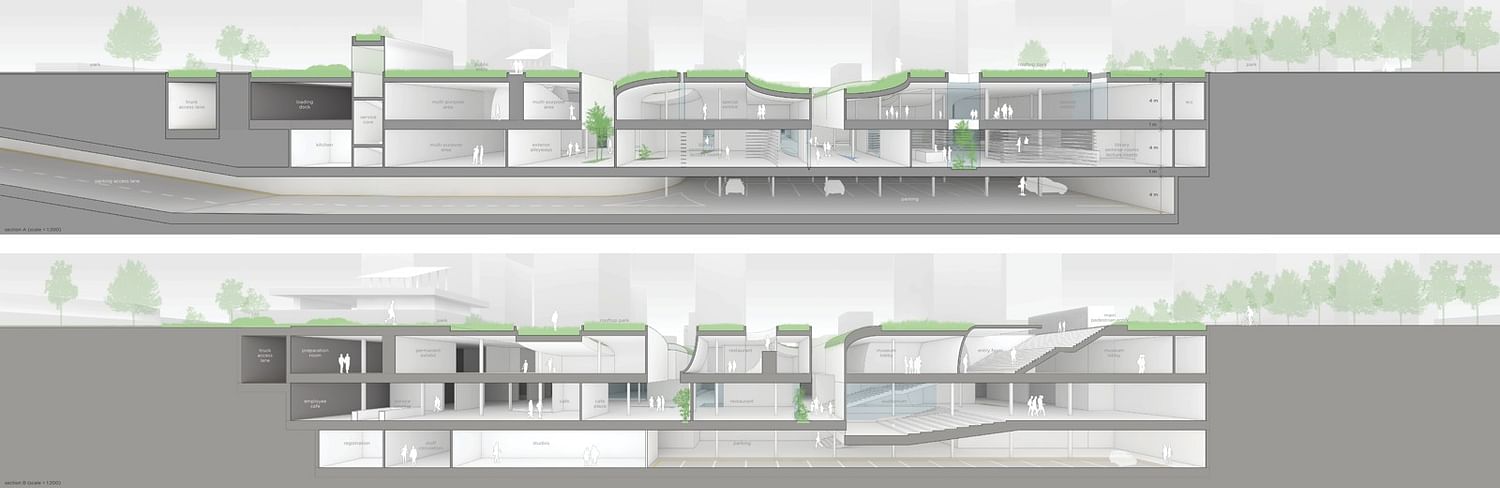
“Our strategy addresses these conditions by proposing a form evocative of the very thing Songdo lacks: a history. But rather than employ stereotypical historic architectural forms, we looked for the places where the fundamentals of writing and architecture overlap - solid to void relationships, the trace of gesture on surface, the meaning in the depth of a mark, penetration, or extrusion. And we expressed these on the tabula rasa of the site, cutting into the surface with abstractions of these formal elements. The result is a museum one discovers as if by accident, revealed in the earth as an archaeological site, its repeated modular geometries evocative of the ancient Cuneiform writing system of marks cut into a flat clay surface.”
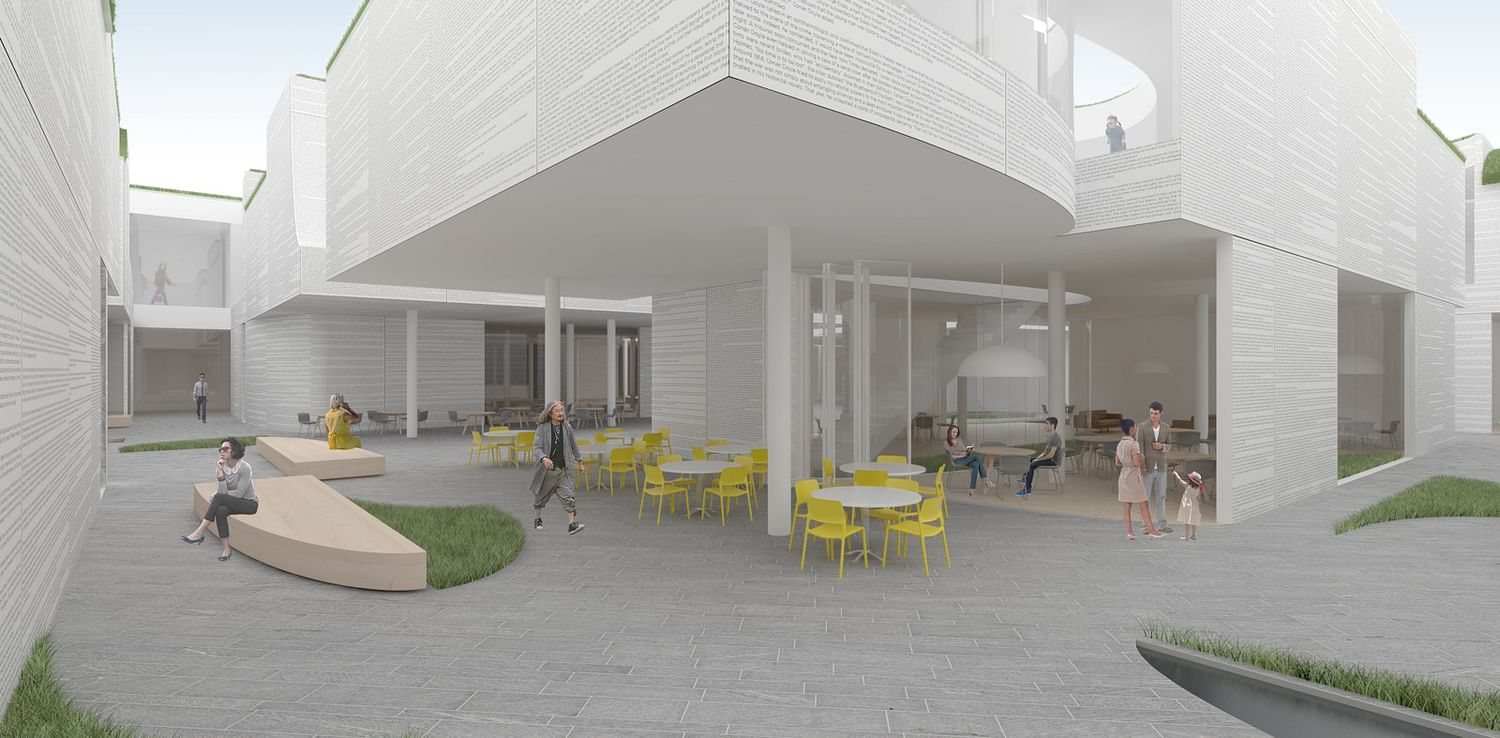
Plaza alleys cafe. Image courtesy of Hou de Sousa.

“Rather than a singular building, the museum reads as a below-grade, unearthed village. Two levels down, visitors circulate on open-air plazas that connect the program components. The components are contained in a ring of circulation and support systems that is entirely below grade. The village components themselves are composed of 7mx7mx5m modules, each of which has a carved void element. These carved elements are inspired by typographic maneuvers shared by all writing systems. 

The result is a ‘roof’ that is actually a ground plane of unexpected openings and penetrations that encourage investigation and discovery. Additionally, the voids of each module serve as light wells, clerestories, and small courtyards while simultaneously providing a means of partitioning spaces.”

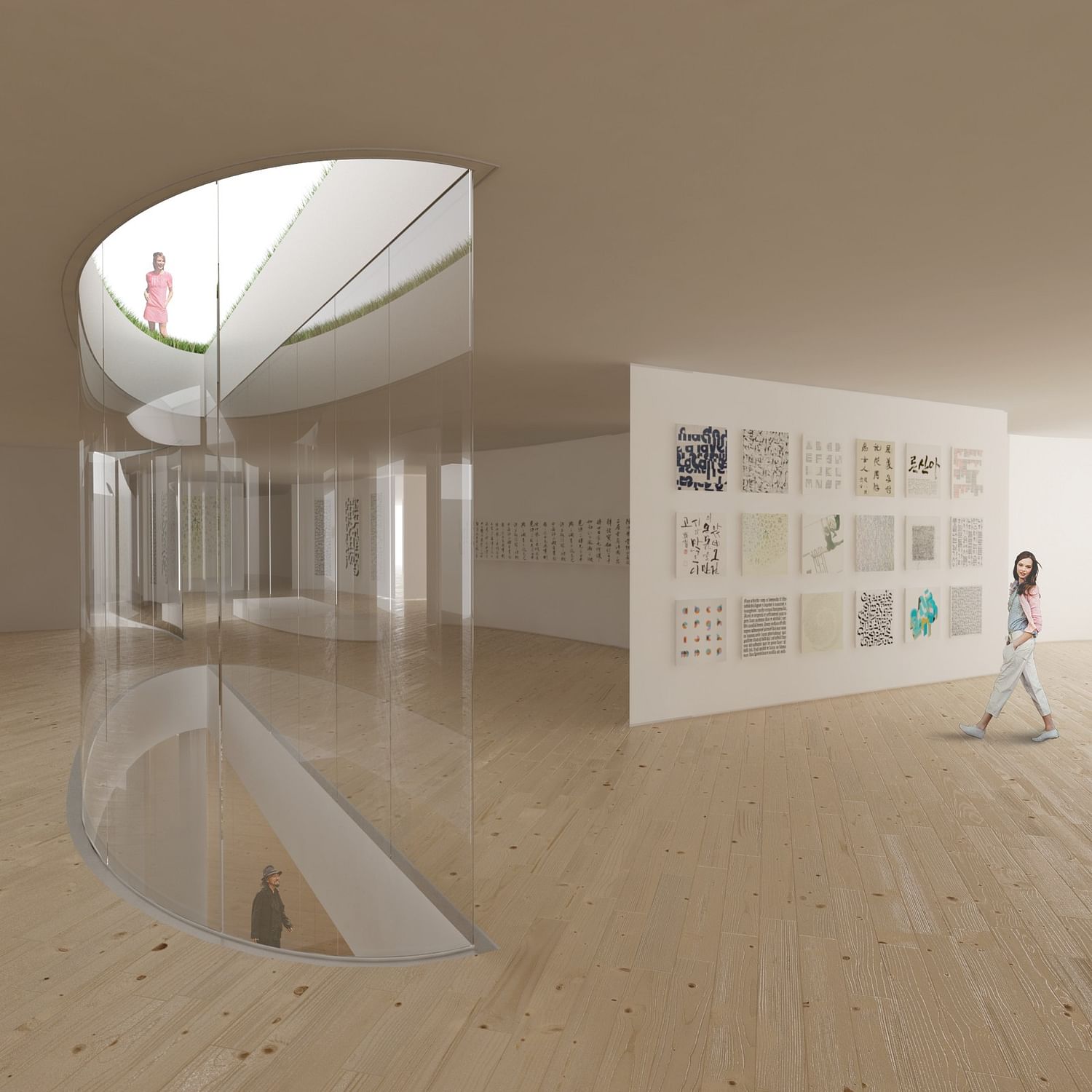
Permanent exhibition space. Image courtesy of Hou de Sousa.
Special exhibition space. Image courtesy of Hou de Sousa.
Auditorium. Image courtesy of Hou de Sousa.

You can read the rest of Hou de Sousa's proposal on their website. More project images below.

RELATED COMPETITION National Museum of World Writing International Design Competition
RELATED NEWS Folly 2016 winners Hou de Sousa to build pavilion of “Sticks” for education studio
RELATED NEWS Play ball! Get a glimpse of Hou de Sousa's winning Re-Ball! installation design

Related

museum design ● writing ● competition ● incheon ● korea ● arts & culture ● cultural space
Hou de Sousa
Hou de Sousa

Share

  • Follow

    0 Comments

  • Comment as :

Hou de Sousa proposes “Cuneiformed” National Museum of World Writing in Incheon

New architecture and design competitions: Exploring 130 Years of American Design, Christo & Jeanne-Claude Center, 13 White Houses, and La Pyramide

Micro-architecture honored in latest Tiny House Architecture Competition

World’s most beautiful restaurants of 2026 chosen by Prix Versailles

Sponsored Post by Buildner

Design a wine tasting room in Italy! Valli Wine Tasting Room is launched!

10 can't-miss architecture & design events to see this June in London, Los Angeles, Chicago, San Francisco, Detroit, San Diego, Porto, and Barcelona

Sponsored Post by Buildner

Museum of Emotions / Edition #8 FINAL registration deadline is approaching!

Seven global projects make AR Public Awards shortlist 2026

Sponsored Post by Buildner

Design a slow-living restaurant in Portugal! Portugal Long Table Restaurant is launched!

Sign up for Bustler's Email Newsletters

World's best tall buildings honored at the CVU 2026 Award of Excellence

Sponsored Post by TWOPAGES

Final call: TWOPAGES X Design Contest 2026 submissions close June 5

Kengo Kuma & Paul Raff win Alberta national park visitor center competition with landscape-focused design

2026 Moira Gemmill and MJ Long prizes announced by W Awards

New architecture and design competitions: Kinderspace, Stewardson Keefe LeBrun Travel Grant, SMALL PROJECT BIG IMPACT, and Garden of University House, Bucharest

The Century of Gehry: New retrospective explores the late architect's work & collaborations

Sponsored Post by Buildner

Rome Rain Rooms FINAL registration deadline is in 5 DAYS!

Next page » Loading

Hou de Sousa proposes “Cuneiformed” National Museum of World Writing in Incheon

By Justine Testado|

Wednesday, Sep 27, 2017

Share

Image courtesy of Hou de Sousa.

Related

museum design ● writing ● competition ● incheon ● korea ● arts & culture ● cultural space
Hou de Sousa
Hou de Sousa

New York-based architecture studio Hou de Sousa took their chances in the National Museum of World Writing International Design Competition in Korea, which was the first large-scale competition that the emerging practice entered. They were thrilled to learn they won second place with their proposal, “Cuneiformed”, out of 126 teams in 40 countries.  

Organized by the Ministry of Culture, Sports and Tourism, the competition sought designs for the National Museum of World Writing, which explores the history of writing systems of various countries around the world. Proposed to be built in Incheon, the museum will also serve as a space for cultural and educational public programming. First prize went to “Pages” by Samoo Architects & Engineers, while third prize went to Juhyunkim Architecture's “Deciphering of Hidden Presence”. Indonesian practice Davin Tanasa + Associates and Unsangdong Architects Cooperation were each named as a runner-up. Construction of the museum is currently scheduled to begin in December 2018 with a 2021 opening date.

Hou de Sousa shared more details of their competition entry below.

Rooftop. Image courtesy of Hou de Sousa.

Project excerpt: “The National Museum of World Writing in Songdo pairs two conditions at odds with one another. The first is the purpose of the Museum: exploring the ancient universality of human communication in written form. The second is its site: the city of Songdo, built in the past decade on a tabula rasa of reclaimed land. 

Our proposal for the Museum addresses these opposites, creating a container for the study and exposition of writing as an ancient manifestation of culture in a city whose culture is so new as to be undefined. In the process, we are writing this new city’s culture through architecture.”

Main entrance. Image courtesy of Hou de Sousa.

“Our strategy addresses these conditions by proposing a form evocative of the very thing Songdo lacks: a history. But rather than employ stereotypical historic architectural forms, we looked for the places where the fundamentals of writing and architecture overlap - solid to void relationships, the trace of gesture on surface, the meaning in the depth of a mark, penetration, or extrusion. And we expressed these on the tabula rasa of the site, cutting into the surface with abstractions of these formal elements. The result is a museum one discovers as if by accident, revealed in the earth as an archaeological site, its repeated modular geometries evocative of the ancient Cuneiform writing system of marks cut into a flat clay surface.”

Plaza alleys cafe. Image courtesy of Hou de Sousa.

“Rather than a singular building, the museum reads as a below-grade, unearthed village. Two levels down, visitors circulate on open-air plazas that connect the program components. The components are contained in a ring of circulation and support systems that is entirely below grade. The village components themselves are composed of 7mx7mx5m modules, each of which has a carved void element. These carved elements are inspired by typographic maneuvers shared by all writing systems. 

The result is a ‘roof’ that is actually a ground plane of unexpected openings and penetrations that encourage investigation and discovery. Additionally, the voids of each module serve as light wells, clerestories, and small courtyards while simultaneously providing a means of partitioning spaces.”

Permanent exhibition space. Image courtesy of Hou de Sousa.
Special exhibition space. Image courtesy of Hou de Sousa.
Auditorium. Image courtesy of Hou de Sousa.

You can read the rest of Hou de Sousa's proposal on their website. More project images below.

RELATED COMPETITION National Museum of World Writing International Design Competition
RELATED NEWS Folly 2016 winners Hou de Sousa to build pavilion of “Sticks” for education studio
RELATED NEWS Play ball! Get a glimpse of Hou de Sousa's winning Re-Ball! installation design

Share

  • Follow

    0 Comments

  • Comment as :

Archinect JobsArchinect Jobs

The Archinect Job Board attracts the world's top architectural design talents.

VIEW ALL JOBS POST A JOB

Junior Architect

Eric Colbert & Associates

Junior Architect

Washington, DC, US

Senior Interior Architect/ Designer

Silverstone Group

Senior Interior Architect/ Designer

Washington, DC, US

Intermediate Architect

NDKazalas Architecture PC

Intermediate Architect

New York, NY, US

Associate - Interior Designer

FitzGerald Associates Architects

Associate - Interior Designer

Chicago, IL, US

Project Manager

Evan Raabe Architecture Studio

Project Manager

Los Angeles, CA, US

Senior Designer - Residential Design

Laura U Design Collective

Senior Designer - Residential Design

Houston, TX, US

Intermediate Architect

IMC Architecture

Intermediate Architect

Brooklyn, NY, US

Junior Designer

OLIVER FREUNDLICH DESIGN

Junior Designer

New York, NY, US

Site Planning and Master Development Consultant, Part-Time / Hybrid

Naim Associates Inc.

Site Planning and Master Development Consultant, Part-Time / Hybrid

West Hollywood, CA, US

Project Architect

Arrowstreet

Project Architect

Boston, MA, US

Next page » Loading