• Login / Join
  • About
  • •
  • Contact
  • •
  • Advertising
bustler logo
bustler logo
  • News
  • Competitions
  • Events
  • Bustler is powered by Archinect
  • Sign up for Bustler's Email Newsletters

  • Follow these Bustler feeds:

  • Search

    Search in

  • Submit

    What are you submitting?

    News Pitch
    Competition
    Event
  • Login / Join
  • News|Competitions|Events
  • Search
    | Submit
    | Follow
  • Search in

    What are you submitting?

    News Pitch
    Competition
    Event

    Follow these Bustler feeds:

  • About|Contact|Advertising
  • Login / Join

Living in America: Frank Lloyd Wright, Harlem & Modern Housing

Saturday, Sep 9, 201712 AM — Sunday, Dec 17, 20176 PMEDT

Wallach Art Gallery, Lenfest Center for the Arts, Columbia University, 615 West 129th St (West of Broadway) New York, NY, US New York, NY, US | Wallach Art Gallery, Lenfest Center for the Arts, Columbia University, 615 West 129th St (West of Broadway)

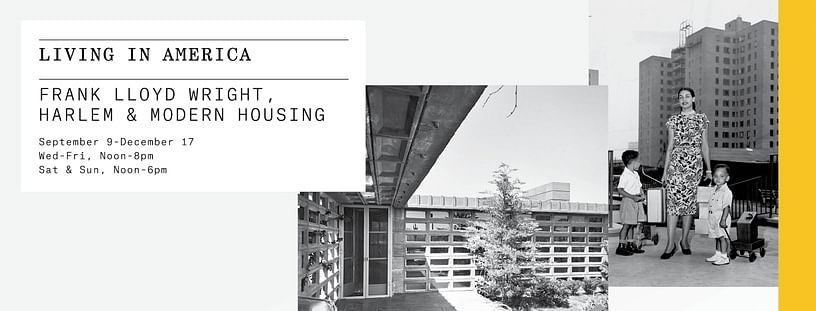
“Living in America,” a phrase written on wooden panels traveling with the model of Frank Lloyd Wright’s Broadacre City (1929–58), evokes a question that preoccupied architects and planners throughout the mid-twentieth century: How to live together? Wright’s proposal for an exurban settlement of single-family houses offered one possible answer; plans for large public or subsidized housing located in urban areas presented another. Although these two visions seem a world apart, they share a common history.

Wright (1867–1959) first exhibited his Broadacre City project at Rockefeller Center in Midtown Manhattan in 1935. While the prominent Wisconsin-based architect anticipated a degree of economic diversity, Broadacre’s residents were, for the most part, implicitly white. In 1936 construction began on one of New York City’s first public housing developments, the Harlem River Houses, funded by the Public Works Administration under President Franklin D. Roosevelt’s New Deal. Built for working-class African Americans, the complex was designed by a consortium including John Louis Wilson Jr., the first African American to graduate from Columbia University’s School of Architecture. Through such parallel examples, this exhibition shows how two different approaches to housing combine societal aspiration with racial segregation and socioeconomic inequality, and asks: How to live in America, together?

The exhibition’s narrative takes the form of two interwoven plotlines, developed through displays of project-specific drawings, photographs, and other material dating from the late 1920s to the late 1950s. One plotline tracks the Broadacre scheme as it plays out in Wright’s subsequent work, scattered around the country; the other tracks the development of public housing in Upper Manhattan’s Harlem neighborhood, ending just outside the gallery, adjacent to Columbia’s new campus. Both stories connect social institutions, such as the nuclear family, with economic structures, such as private property or its alternatives. Wright’s version of the “American Dream” and Harlem’s public housing both draw lines of race, class, and gender, many of which persist today. Their differences remind us that the right to housing once defined, and could still define, what it means to live in America.

--

Living in America: Frank Lloyd Wright, Harlem & Modern Housing has been curated by The Temple Hoyne Buell Center for the Study of American Architecture at Columbia University’s Graduate School of Architecture, Planning, and Preservation (GSAPP), and is co-presented by The Buell Center, The Miriam and Ira D. Wallach Art Gallery, and Avery Architectural and Fine Arts Library. The exhibition is presented in correlation with Frank Lloyd Wright at 150: Unpacking the Archive, on view at The Museum of Modern Art, New York, from June 12 through October 1, 2017. “Broad Acres and Narrow Lots,” an associated essay by David Smiley, Assistant Director of the Urban Design Program at Columbia GSAPP, is included in the MoMA exhibition catalogue. Living in America’s curatorial team is composed of students from various Columbia University masters and doctoral programs together with the Center staff and in close collaboration with archivists from the Avery Architectural and Fine Arts library and other institutions.
RELATED EVENT Symposium: "Living in America: Frank Lloyd Wright, Harlem & Modern Housing"

Share

  • Follow

    0 Comments

  • Comment as :

Living in America: Frank Lloyd Wright, Harlem & Modern Housing

Sat, Sep 9 - Sun, Dec 17, 2017

New York, NY, US

NeoCon 2026

Sun, Jun 7 - Wed, Jun 10, 2026

Chicago, IL, US

A LACMA Therapy Session

Sun, Jun 7

Los Angeles, CA, US

Rumble 2026

Mon, Jun 8 - Tue, Jun 9, 2026

Los Angeles, CA, US

AIA26 Conference on Architecture

Wed, Jun 10 - Sat, Jun 13, 2026

San Diego, CA, US

Flyway City: Architecture for a Flourishing Ecosystem

Thu, Jun 11 - Sun, Jan 3, 2027

Chicago, IL, US

Chicago's Living Habitat

Thu, Jun 11 - Fri, Jan 15, 2027

Chicago, IL, US

CAMPOSAZ 52:52_alimentAZIONI per Tonezza - Wooden Self-Build Workshop

Fri, Jun 12 - Sun, Jun 21, 2026

Tonezza del Cimone (VI), Italy

The Century of Gehry

Fri, Jun 12 - Wed, Dec 30, 2026

Porto, PT

Sign up for Bustler's Email Newsletters

Drawing Together: 145th Annual Meeting & Party

Tue, Jun 16

Brooklyn, NY, US

Current Work: In Transformation, with Dan Stubbergaard

Mon, Jun 22

New York, NY, US

5th International Placemaking Week

Wed, Jun 24 - Fri, Jun 26, 2026

Detroit, MI, US

UIA World Congress of Architects 2026 Barcelona

Sun, Jun 28 - Thu, Jul 2, 2026

Barcelona, ES

Architects, not Architecture, Barcelona 2026

Thu, Jul 2

Barcelona, ES

CAMPOSAZ 54:54 | Progetto Manifattura - Wooden Self-Build Workshop

Fri, Jul 3 - Sun, Jul 12, 2026

Rovereto, IT

Architects of Liberation: Modernism in Western Africa

Sun, Jul 5 - Sat, Jan 2, 2027

New York, NY, US

Next page » Loading

Living in America: Frank Lloyd Wright, Harlem & Modern Housing

Saturday, Sep 9, 201712 AM — Sunday, Dec 17, 20176 PMEDT

Wallach Art Gallery, Lenfest Center for the Arts, Columbia University, 615 West 129th St (West of Broadway) New York, NY, US New York, NY, US | Wallach Art Gallery, Lenfest Center for the Arts, Columbia University, 615 West 129th St (West of Broadway)

Share

Related

columbia gsapp ● columbia university ● frank lloyd wright ● urban planning ● housing issues ● socio-economics ● architectural exhibition ● new york city ● new york ● usa ● urban living ● exhibition
Columbia University
Columbia University

“Living in America,” a phrase written on wooden panels traveling with the model of Frank Lloyd Wright’s Broadacre City (1929–58), evokes a question that preoccupied architects and planners throughout the mid-twentieth century: How to live together? Wright’s proposal for an exurban settlement of single-family houses offered one possible answer; plans for large public or subsidized housing located in urban areas presented another. Although these two visions seem a world apart, they share a common history.

Wright (1867–1959) first exhibited his Broadacre City project at Rockefeller Center in Midtown Manhattan in 1935. While the prominent Wisconsin-based architect anticipated a degree of economic diversity, Broadacre’s residents were, for the most part, implicitly white. In 1936 construction began on one of New York City’s first public housing developments, the Harlem River Houses, funded by the Public Works Administration under President Franklin D. Roosevelt’s New Deal. Built for working-class African Americans, the complex was designed by a consortium including John Louis Wilson Jr., the first African American to graduate from Columbia University’s School of Architecture. Through such parallel examples, this exhibition shows how two different approaches to housing combine societal aspiration with racial segregation and socioeconomic inequality, and asks: How to live in America, together?

The exhibition’s narrative takes the form of two interwoven plotlines, developed through displays of project-specific drawings, photographs, and other material dating from the late 1920s to the late 1950s. One plotline tracks the Broadacre scheme as it plays out in Wright’s subsequent work, scattered around the country; the other tracks the development of public housing in Upper Manhattan’s Harlem neighborhood, ending just outside the gallery, adjacent to Columbia’s new campus. Both stories connect social institutions, such as the nuclear family, with economic structures, such as private property or its alternatives. Wright’s version of the “American Dream” and Harlem’s public housing both draw lines of race, class, and gender, many of which persist today. Their differences remind us that the right to housing once defined, and could still define, what it means to live in America.

--

Living in America: Frank Lloyd Wright, Harlem & Modern Housing has been curated by The Temple Hoyne Buell Center for the Study of American Architecture at Columbia University’s Graduate School of Architecture, Planning, and Preservation (GSAPP), and is co-presented by The Buell Center, The Miriam and Ira D. Wallach Art Gallery, and Avery Architectural and Fine Arts Library. The exhibition is presented in correlation with Frank Lloyd Wright at 150: Unpacking the Archive, on view at The Museum of Modern Art, New York, from June 12 through October 1, 2017. “Broad Acres and Narrow Lots,” an associated essay by David Smiley, Assistant Director of the Urban Design Program at Columbia GSAPP, is included in the MoMA exhibition catalogue. Living in America’s curatorial team is composed of students from various Columbia University masters and doctoral programs together with the Center staff and in close collaboration with archivists from the Avery Architectural and Fine Arts library and other institutions.

RELATED EVENT Symposium: "Living in America: Frank Lloyd Wright, Harlem & Modern Housing"

Share

  • Follow

    0 Comments

  • Comment as :

Promoted Events

The Many Lives of the Nakagin Capsule Tower

Jul 11 - Jul 12, 2026

New York, NY, US

Gerrit Rietveld: Wealth of Sobriety

May 07 - Sep 2, 2026

New York, NY, US

Flyway City: Architecture for a Flourishing Ecosystem

Jun 11 - Jan 3, 2027

Chicago, IL, US

He Built This City: Joe Macken’s Model

Feb 12 - Dec 31, 2026

New York, NY, US

Architects of Liberation: Modernism in Western Africa

Jul 05 - Jan 2, 2027

New York, NY, US

Frank Gehry

May 14 - Jun 27, 2026

Beverly Hills, CA, US

Earthen Comforts: Airing Earth

May 30 - Oct 25, 2026

Los Angeles, CA, US

Encounters: Denise Scott Brown Photographs

Jan 08 - Jul 3, 2026

New Haven, CT, US

The Century of Gehry

Jun 12 - Dec 30, 2026

Porto, PT

Core Samples

Mar 12 - Jun 30, 2026

Los Angeles, CA, US

Latinitudes: A Collection of Latin American Modern Architecture

Apr 02 - Jul 18, 2026

Chicago, IL, US

Next page » Loading