• Login / Join
  • About
  • •
  • Contact
  • •
  • Advertising
bustler logo
bustler logo
  • News
  • Competitions
  • Events
  • Bustler is powered by Archinect
  • Sign up for Bustler's Email Newsletters

  • Follow these Bustler feeds:

  • Search

    Search in

  • Submit

    What are you submitting?

    News Pitch
    Competition
    Event
  • Login / Join
  • News|Competitions|Events
  • Search
    | Submit
    | Follow
  • Search in

    What are you submitting?

    News Pitch
    Competition
    Event

    Follow these Bustler feeds:

  • About|Contact|Advertising
  • Login / Join

Winners of 2008 RIBA President's Medals Student Awards

By Bustler Editors|

Wednesday, Dec 3, 2008

The Royal Institute of British Architects has been awarding the President’s Medals since the 1850s and the awards were established in their current format in 1984. The aim of these prestigious awards is to promote excellence in the study of architecture, to reward talent and to encourage architectural debate worldwide.

The 2008 awards have been presented at the President’s Medals Awards ceremony at the RIBA in London today.

Winner 2008 - Paul Davis Award: Time and Tide for Seaweed Part 2, James Tait, University of Strathclyde, Glasgow, UK:

From James Tait’s project statement: “From fuel production and fertiliser to cosmetics and foodstuffs seaweeds’ versatility makes it a lucrative natural resource. Scotland’s shores host around 20% of the total seaweed biomass in Europe and nearly half of this can be found in the North West coast.”
image

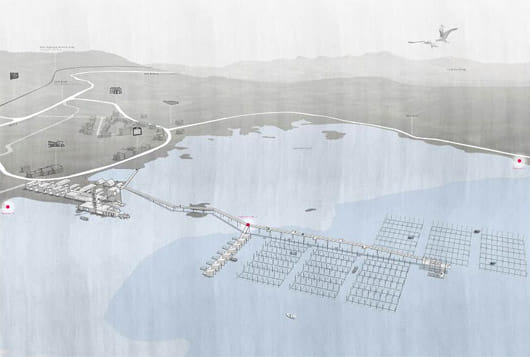
Aerial Perspective of the cultivation farm and its offshoots, demonstrating how the project skilfully responds to its natural environment.

“A thriving seaweed industry would revitalize and reinvigorate the area, reconnecting it with its vast coastline, repopulating and diversifying the social mix of its towns and villages while providing much needed opportunities for its young people.”
image

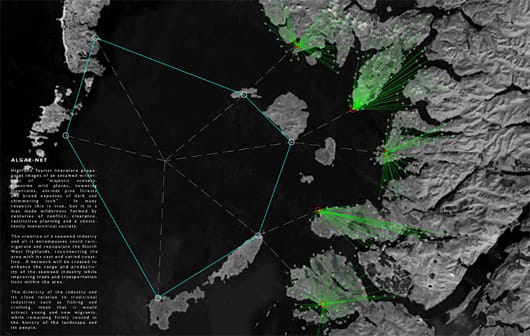
ALGAE-NET: Diagram of a seaweed industry as the generator for a trade and transport network connecting remote areas within the North West Highlands.

“The thesis project focuses on the coastal village of Arisaig which will become a center for ‘sea vegetable’ cultivation while providing seaweed based facilities for health and leisure. This will establish a flourishing seaweed industry, while providing employment and enjoyment to the people of Arisaig and its visitors, all year round.”
image

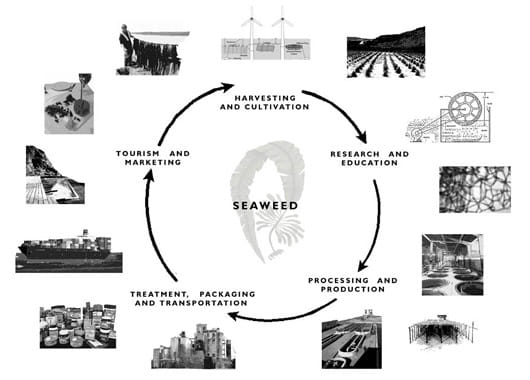
A preparatory study investigating seaweed as a natural resource, process and product and the physical manifestations of each.

“The architectural proposal will consist of an offshore cultivation farm, farmers’ bothy, floating restaurant and new pier seaweed baths and drying tower.”
image

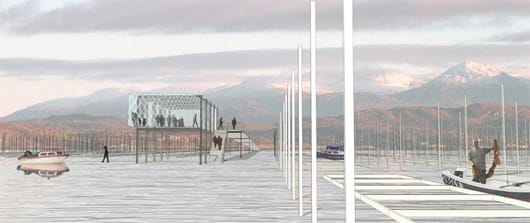
Sunset view of new floating sea vegetable cafe, surrounded by the farm rafts which serve it.

“The seaweed farm complex at Arisaig requires little energy to transform the raw material into a product, the farmers boats will be powered by biodiesel made from unused seaweed, while the cultivation process aids biodiversity by providing nutrients for fish and other marine life.”
image

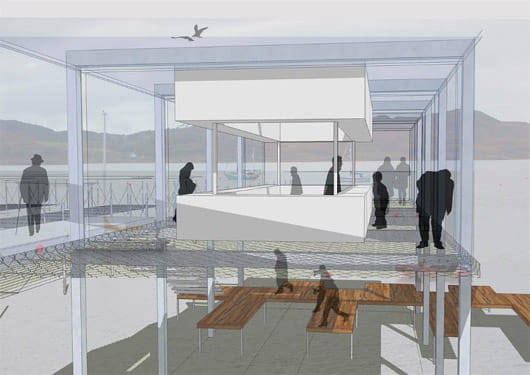
Floating cafe interior, opening out to the stunning surrounding landscape.

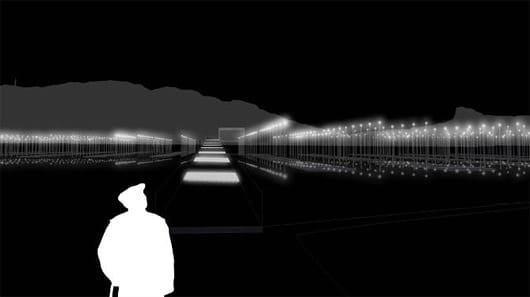
“A policy of energy re-use is also employed in the cultivation rafts where LEDs absorb and store daylight during the day and emit it at night while the drying tower base is home to a series of steam baths which use the energy created during the seaweed drying process.”
image

Phenomenology and industry combine to produce a magical nightime affect across the bay, as the cultivation raft poles glow at night.

“These elegant, innovative and poetic structures will explore all aspects of this new industry through cultivation, production and consumption while remaining both culturally and visually rooted in their surrounding landscape.”

Winner 2008: Invisible University Library Part 1, Wynne Leung & Francesco Matteo Belfiore, University of Greenwich, London, UK:

From the project statement: “Our ‘mutoscopes’ are spaces which make invisible processes visible. We’ve established a logistical communication network between the city and countryside by displacing urban voids such as traffic islands, street furniture and hedgerows into the grounds of Hay Castle and Hay town. Streetlamps are enlarged to accommodate writers, whose invisible activities become visible signals in the nocturnal ambiance.”
image

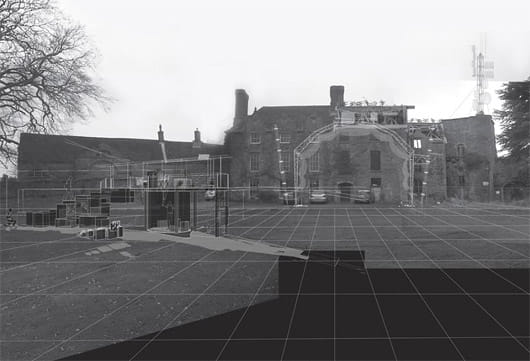
Hide & Seek: displaced urban mutoscope on invisible university lawn -the momentary pleasure of displaced flanerie and voyeurism.

image

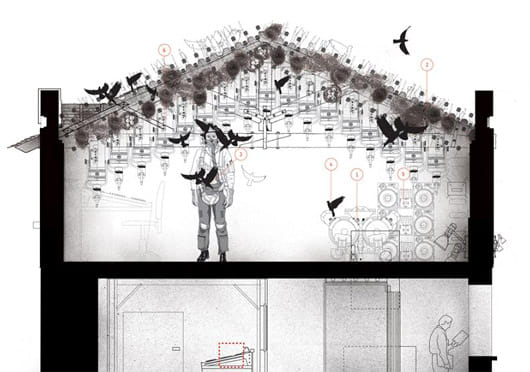
Sound recording engineer tends to the birdsnests and microphones: Nature + Artifice intertwined.

image

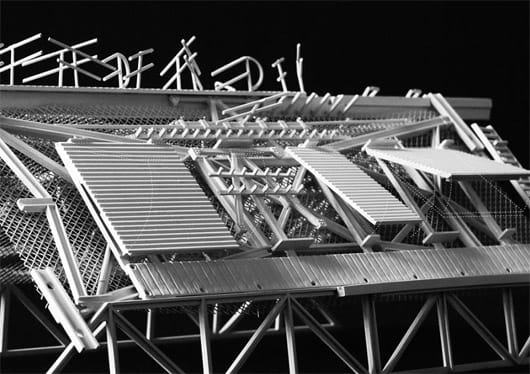
Pigeonfanciers and their migrating messengers find shelter in the birdsnesting roof

“Literary London decamps to Hay on Wye for the festival: flaneurs, voyeurs and agitators of the production process of writing. Ruins are the setting for recital, storytelling, lecturing, preaching, listening, whispering and eavesdropping; while pigeonfanciers dispense messages about future events. It is a soundscape where nature and artifice are intertwined. Once the books are converted to audio format, they are shredded, pulped and recycled to provide new paper for emerging writers. Writers, readers and audience occupy an illuminating space in the ruins of history; confounded by the ever expanding accumulation of technologies.”

image

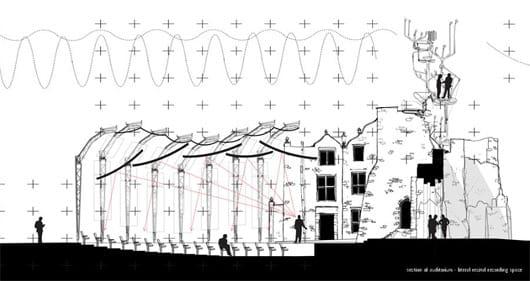
Soundscape of invisible lectures. Nature is inhabited by artifice as the castle becomes a mechanized and digitized rural artifact.

image

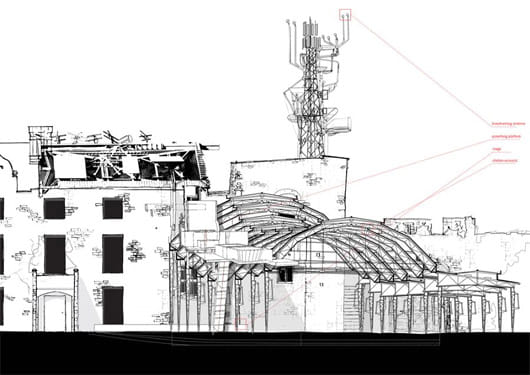
The castle offers an idealized pastoral landscape where books are read out, transferred to audio format, broadcast to a live audience, and on radio programs.

Images: RIBA President’s Medals Awards

Related

united kingdom ● student ● strathclyde ● school ● riba ● prize ● president's medal ● greenwich ● europe ● award

Share

  • Follow

    0 Comments

  • Comment as :

Winners of 2008 RIBA President's Medals Student Awards

Micro-architecture honored in latest Tiny House Architecture Competition

World’s most beautiful restaurants of 2026 chosen by Prix Versailles

Sponsored Post by Buildner

Design a wine tasting room in Italy! Valli Wine Tasting Room is launched!

10 can't-miss architecture & design events to see this June in London, Los Angeles, Chicago, San Francisco, Detroit, San Diego, Porto, and Barcelona

Sponsored Post by Buildner

Museum of Emotions / Edition #8 FINAL registration deadline is approaching!

Seven global projects make AR Public Awards shortlist 2026

Sponsored Post by Buildner

Design a slow-living restaurant in Portugal! Portugal Long Table Restaurant is launched!

World's best tall buildings honored at the CVU 2026 Award of Excellence

Sign up for Bustler's Email Newsletters

Sponsored Post by TWOPAGES

Final call: TWOPAGES X Design Contest 2026 submissions close June 5

Kengo Kuma & Paul Raff win Alberta national park visitor center competition with landscape-focused design

2026 Moira Gemmill and MJ Long prizes announced by W Awards

New architecture and design competitions: Kinderspace, Stewardson Keefe LeBrun Travel Grant, SMALL PROJECT BIG IMPACT, and Garden of University House, Bucharest

The Century of Gehry: New retrospective explores the late architect's work & collaborations

Sponsored Post by Buildner

Rome Rain Rooms FINAL registration deadline is in 5 DAYS!

UIA and UN Habitat unveil sustainability-focused winners for UIA 2030 Award

Next page » Loading

Winners of 2008 RIBA President's Medals Student Awards

By Bustler Editors|

Wednesday, Dec 3, 2008

Share

Related

united kingdom ● student ● strathclyde ● school ● riba ● prize ● president's medal ● greenwich ● europe ● award

The Royal Institute of British Architects has been awarding the President’s Medals since the 1850s and the awards were established in their current format in 1984. The aim of these prestigious awards is to promote excellence in the study of architecture, to reward talent and to encourage architectural debate worldwide.

The 2008 awards have been presented at the President’s Medals Awards ceremony at the RIBA in London today.

Winner 2008 - Paul Davis Award: Time and Tide for Seaweed Part 2, James Tait, University of Strathclyde, Glasgow, UK:

From James Tait’s project statement: “From fuel production and fertiliser to cosmetics and foodstuffs seaweeds’ versatility makes it a lucrative natural resource. Scotland’s shores host around 20% of the total seaweed biomass in Europe and nearly half of this can be found in the North West coast.”

image

Aerial Perspective of the cultivation farm and its offshoots, demonstrating how the project skilfully responds to its natural environment.

“A thriving seaweed industry would revitalize and reinvigorate the area, reconnecting it with its vast coastline, repopulating and diversifying the social mix of its towns and villages while providing much needed opportunities for its young people.”

image

ALGAE-NET: Diagram of a seaweed industry as the generator for a trade and transport network connecting remote areas within the North West Highlands.

“The thesis project focuses on the coastal village of Arisaig which will become a center for ‘sea vegetable’ cultivation while providing seaweed based facilities for health and leisure. This will establish a flourishing seaweed industry, while providing employment and enjoyment to the people of Arisaig and its visitors, all year round.”

image

A preparatory study investigating seaweed as a natural resource, process and product and the physical manifestations of each.

“The architectural proposal will consist of an offshore cultivation farm, farmers’ bothy, floating restaurant and new pier seaweed baths and drying tower.”

image

Sunset view of new floating sea vegetable cafe, surrounded by the farm rafts which serve it.

“The seaweed farm complex at Arisaig requires little energy to transform the raw material into a product, the farmers boats will be powered by biodiesel made from unused seaweed, while the cultivation process aids biodiversity by providing nutrients for fish and other marine life.”

image

Floating cafe interior, opening out to the stunning surrounding landscape.

“A policy of energy re-use is also employed in the cultivation rafts where LEDs absorb and store daylight during the day and emit it at night while the drying tower base is home to a series of steam baths which use the energy created during the seaweed drying process.”

image

Phenomenology and industry combine to produce a magical nightime affect across the bay, as the cultivation raft poles glow at night.

“These elegant, innovative and poetic structures will explore all aspects of this new industry through cultivation, production and consumption while remaining both culturally and visually rooted in their surrounding landscape.”

Winner 2008: Invisible University Library Part 1, Wynne Leung & Francesco Matteo Belfiore, University of Greenwich, London, UK:

From the project statement: “Our ‘mutoscopes’ are spaces which make invisible processes visible. We’ve established a logistical communication network between the city and countryside by displacing urban voids such as traffic islands, street furniture and hedgerows into the grounds of Hay Castle and Hay town. Streetlamps are enlarged to accommodate writers, whose invisible activities become visible signals in the nocturnal ambiance.”
image

Hide & Seek: displaced urban mutoscope on invisible university lawn -the momentary pleasure of displaced flanerie and voyeurism.

image

Sound recording engineer tends to the birdsnests and microphones: Nature + Artifice intertwined.

image

Pigeonfanciers and their migrating messengers find shelter in the birdsnesting roof

“Literary London decamps to Hay on Wye for the festival: flaneurs, voyeurs and agitators of the production process of writing. Ruins are the setting for recital, storytelling, lecturing, preaching, listening, whispering and eavesdropping; while pigeonfanciers dispense messages about future events. It is a soundscape where nature and artifice are intertwined. Once the books are converted to audio format, they are shredded, pulped and recycled to provide new paper for emerging writers. Writers, readers and audience occupy an illuminating space in the ruins of history; confounded by the ever expanding accumulation of technologies.”
image

Soundscape of invisible lectures. Nature is inhabited by artifice as the castle becomes a mechanized and digitized rural artifact.

image

The castle offers an idealized pastoral landscape where books are read out, transferred to audio format, broadcast to a live audience, and on radio programs.

Images: RIBA President’s Medals Awards

Share

  • Follow

    0 Comments

  • Comment as :

Archinect JobsArchinect Jobs

The Archinect Job Board attracts the world's top architectural design talents.

VIEW ALL JOBS POST A JOB

Project Architect/Job Captain

HLW International LLP

Project Architect/Job Captain

West Palm Beach, FL, US

Project Architect

Arrowstreet

Project Architect

Boston, MA, US

Architects with 4-10 Years' Experience

Adamson Associates, Inc.

Architects with 4-10 Years' Experience

Los Angeles, CA, US

Architect 10+

Standard Architects

Architect 10+

Long Island City, NY, US

Senior Architectural Project Manager (Systems Driven, Human-Centric) (Hourly)

Local Parti Architecture, PC

Senior Architectural Project Manager (Systems Driven, Human-Centric) (Hourly)

New York, NY, US

Architecture Project Manager

RDH Architecture + Interior Design

Architecture Project Manager

Las Vegas, NV, US

Designer

HATCH ARCHITECTURE

Designer

Los Angeles, CA, US

Architect

mani colaku architects

Architect

New York, NY, US

Junior Designer

OLIVER FREUNDLICH DESIGN

Junior Designer

New York, NY, US

Project Architect/Interior Designer

IMC Architecture

Project Architect/Interior Designer

Brooklyn, NY, US

Next page » Loading