• Login / Join
  • About
  • •
  • Contact
  • •
  • Advertising
bustler logo
bustler logo
  • News
  • Competitions
  • Events
  • Bustler is powered by Archinect
  • Sign up for Bustler's Email Newsletters

  • Follow these Bustler feeds:

  • Search

    Search in

  • Submit

    What are you submitting?

    News Pitch
    Competition
    Event
  • Login / Join
  • News|Competitions|Events
  • Search
    | Submit
    | Follow
  • Search in

    What are you submitting?

    News Pitch
    Competition
    Event

    Follow these Bustler feeds:

  • About|Contact|Advertising
  • Login / Join

Bridge Urban Life Typology by FangCheng Architects

By Bustler Editors|

Friday, Feb 24, 2012

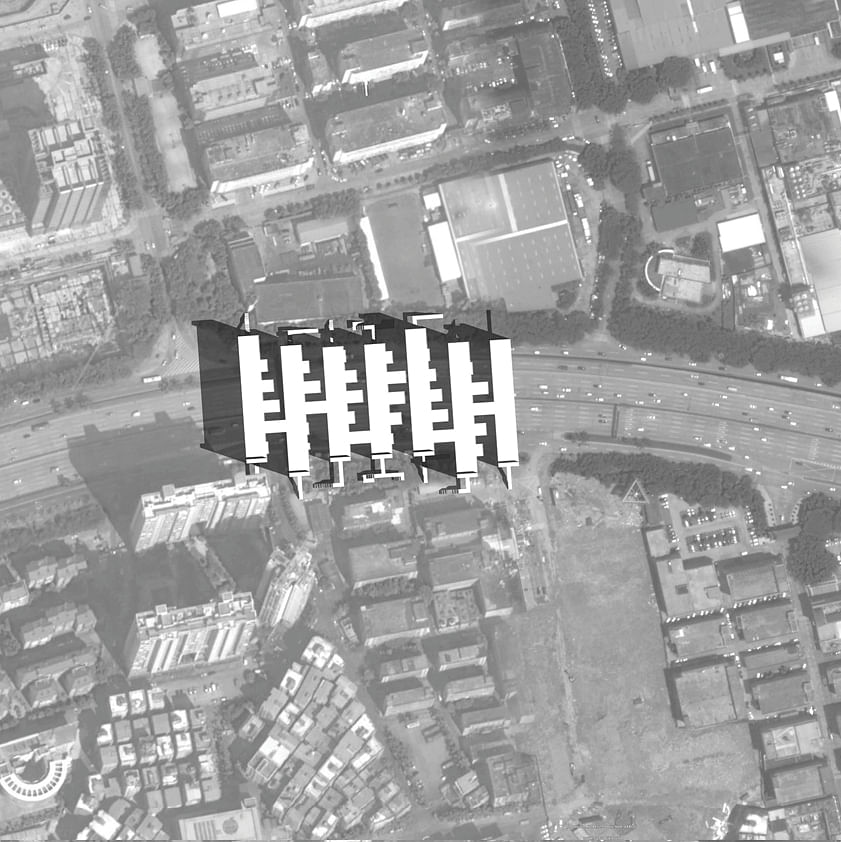
Second Prize at the 1.100.10000 Ideas Competition by FangCheng Architects (Image: FangCheng Architects)

Young Chinese firm FangCheng Architects has sent us their proposal Bridge Urban Life Typology, a city-wide network of bridge buildings which won the team the Second Prize at the 1.100.10000 Ideas Competition. The contest sought for innovative ideas to rapidly add 240,000 affordable housing units for more than 800,000 people in China's mega-boomtown Shenzhen.

Project Description from the Architects:

China's current 12th Five-Year-Plan has mandated the construction of 36 million units
of affordable housing planned to house billions of people during the years of 2011-2015.
According to this planning, Shenzhen government's assignment is to construct 240,000 units to house more than 800,000 people. This abrupt top-down task of rapid mass housing construction raises a series of problems such as planning, program, needs, policy, land resources, finance, design, construction, distribution and management. A critical question for the architectural profession has arisen: What can DESIGN do within this situation?

Commissioned by the Urban Planning, Land and Resources Commission of Shenzhen Municipality, the Shenzhen Design Center initiates a series of events and programs to encourage innovation in the design of affordable housing.
Expanding the Center's preliminary research, the 1.100.10000 Ideas Competition aims to generate discussion, debates and inventive proposals for affordable housing in China.

'1- unit' category focuses on the design solutions of maximum spatial efficiency of a single habitation unit.
'100- families' category encourages radical strategies to distribute affordable housing throughout the city with neighborhood pockets housing hundreds of families each.
'10000- residents' category explores alternatives to China's typical large residential communities by encouraging the incorporation of mixed use and low-cost living environments.

Master plan for the 12th Five-Year-Plan for affordable housing in Shenzhen SEZ, CN (Image: FangCheng Architects)

Shenzhen government plans to raise funds to build 240.000 affordable housing units with an 15.36 million square meters construction area. However, in the current strategy, most of the affordable housing is planned to be built outside the urban center, and many are even in the urban fringe. In this case, due to travelling time, cost and sense of isolation from the urban center, residents adopt a negative attitude to the policy even though the housing price is low.

The total building area for affordable housing in Shenzhen in the 12th Five-Year-Plan (Image: FangCheng Architects)

The entire landmass of Shenzhen is 1953 sq. kilometer, this includes 395.81 sq. kilometer special economic zone (SEZ). After thirty years of development, the utilization of land becomes more and more intensified, so how do we manage to build 15.36 million sq. meters for affordable housing under the land-contraction policy? And how to bring practical benefits to low-income groups who persistently make contributions to the city?
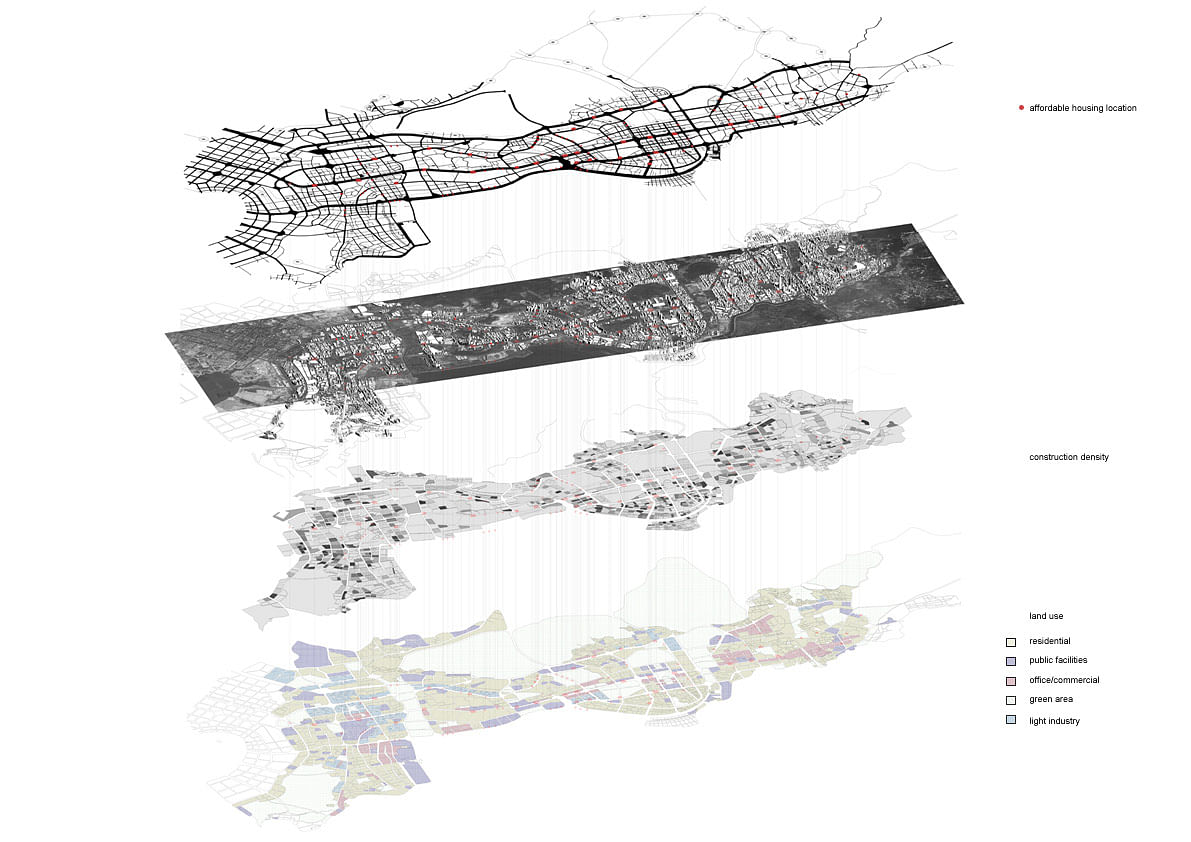
Strategy (Image: FangCheng Architects)

Apartments need to be bought outside the urban core, and rented inside. Our concept is to build as many affordable houses as possible in the urban center, this can decrease residents travelling time and increase usage and sharing of urban facilities.  This strategy has as goal to improve social housing integration in the urban core which is done through building 6200 affordable housing units in the urban center.

Built area distribution map (Image: FangCheng Architects)

In which manner can this goal be achieved? Through analyzing the built distribution map what becomes obvious is that 20% is occupied by municipal roads. These municipal roads are wide with a beautiful artificial landscape along the sides which lend for future development and construction of urban space.

Road width analysis (Image: FangCheng Architects)

According to the analysis there are several primary distributor roads, such as Shennan, Beihuan and Binhai road, whom are wider than 50 meters, and wider than 100 meters including the greenbelts on either side. To some extent these roads increase efficiency, but from the sustainable utilization of land view, they divide the city into pieces with a single function. This causes the city to loose its comfortable human scale.

Mass development distribution map (Image: FangCheng Architects)

The city is divided into various regions that operate like isolated islands due to the increasing traffic flow on highways. Therefore, the city lacks a pedestrian system, which is currently not sustainable. We need to promote pedestrian and public traffic in order to enhance the connectivity to each region, the question will be: Is it possible to use affordable housing as a means to reach this goal and modify the city?

Bridge, urban life typology (Image: FangCheng Architects)

The design proposal for affordable housing comes forth out of the city function typology study, which asked for several prototypes for a building. Our design of a "bridge building" encourages low-income habitants to live inside the urban-center and rebuilds the pedestrian traffic system for the whole city.

The proposal is neither the 10 thousand residents community nor the low-cost rental housing, but a city wide network which can increase the utilization of facilities, enhance the pedestrian system and provide a chance for residents to decrease travelling time to work. According to the land-use analysis, road-width, function distribution, urban density and height of  the buildings running along the main traffic arteries we have come to 4 types of "bridge buildings": single bridge, mega bridge, platform bridge and cascading bridge.
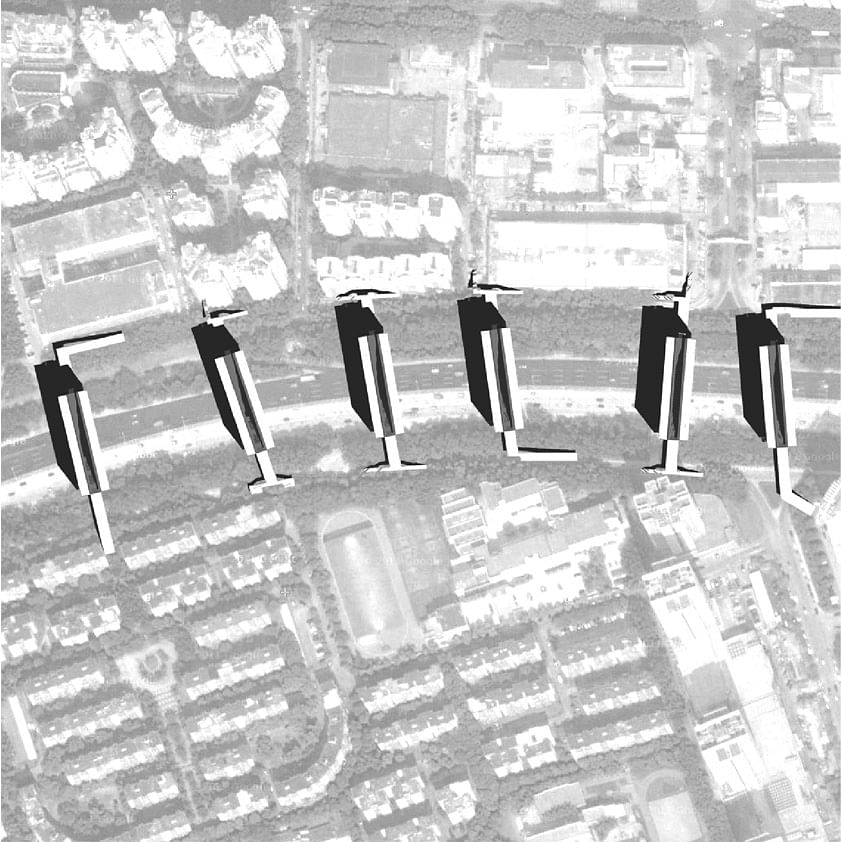
Single bridge (Image: FangCheng Architects)

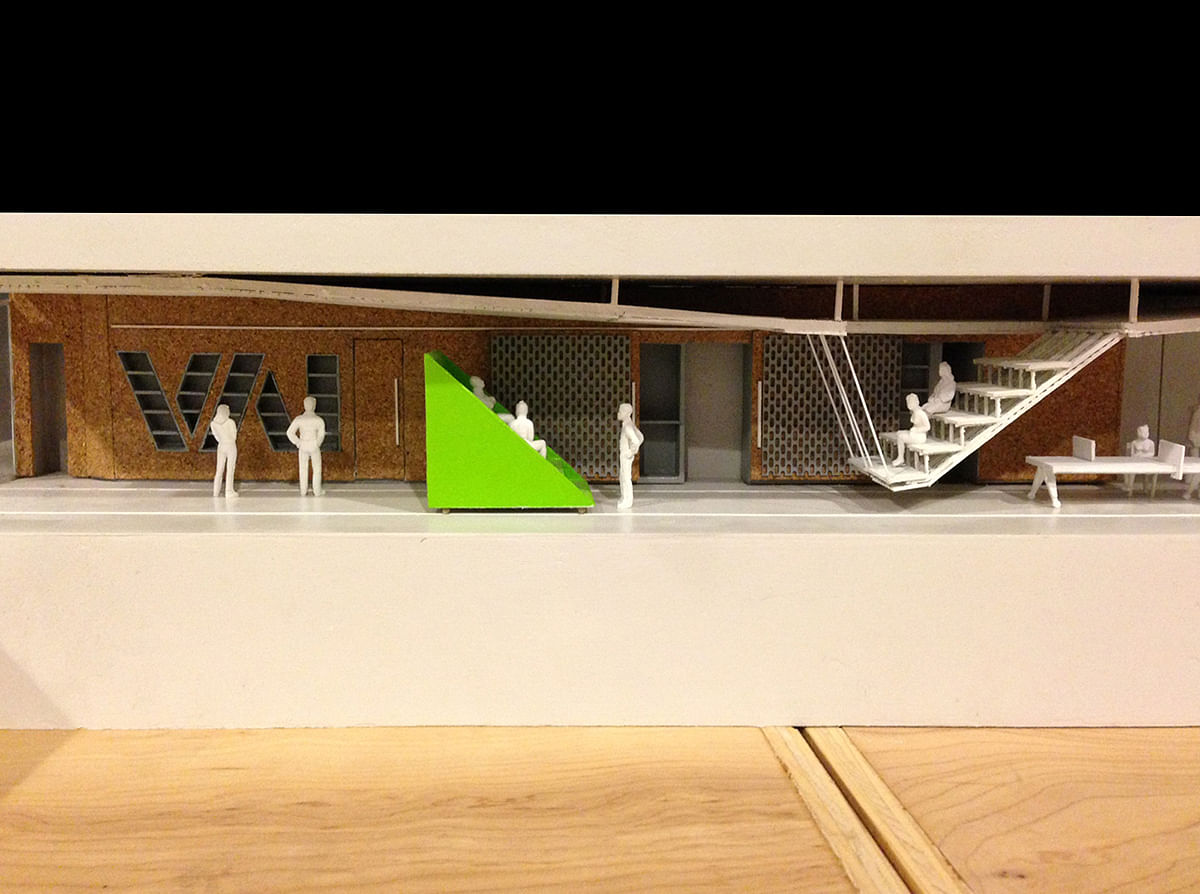
This typology can be built in an area that needs flow separation, in this case Beihuan road is selected as testing site, and provides an opportunity to replace the pedestrian bridges that are situated every 200 meters. The first floor holds free rental space for peddlers which sell life necessities. Inside the building, there is a wide staircase linking the upper residential floors, which on it self are again connected through several atria which serve as semi-public space. As a whole this typology works like a micro-city.

Image: FangCheng Architects

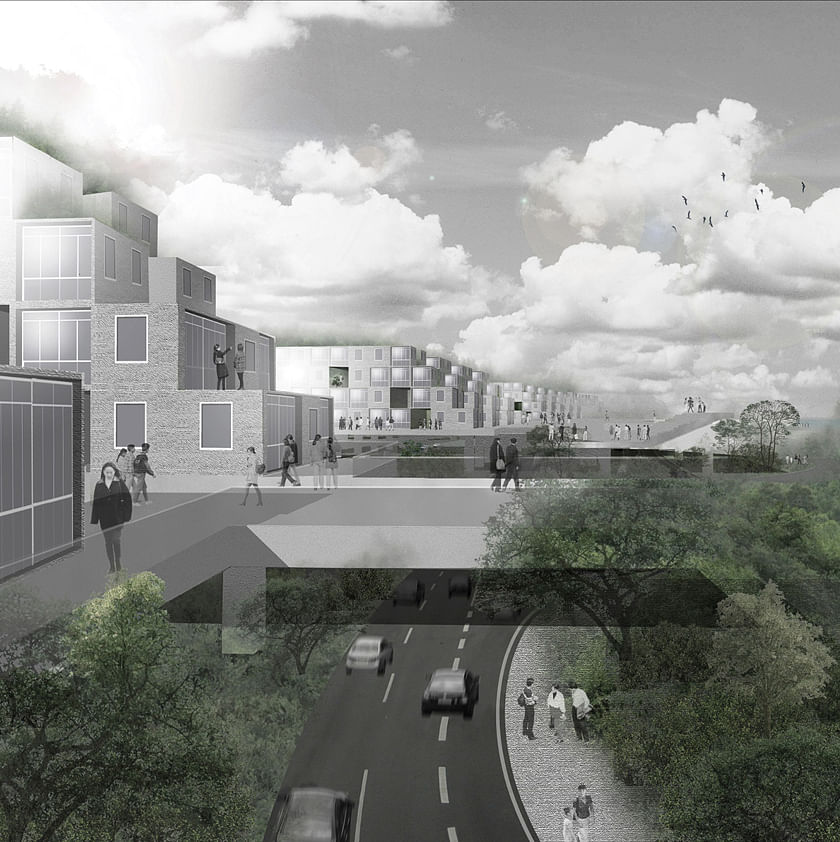
Along densely build Shennan road the mega bridge is located between the vast number of high-rise buildings. The area brings about a large group of workers, mega bridge unites this area by creating a single platform which link not only all the shared public facilities but also transportation, metro and bus, and weaves seamlessly into the existing structure and poses a mixed and differentiated architecture. The bridge will hold a diverse program including bookstore, cafe, restaurant, in order to attract, blend in and become a platform where people can enjoy a panoramic view of the urban landscape and become the living room of the city.

Platform bridge (Image: FangCheng Architects)

During rush hour, between the modern high-rise of Chegongmiao and Xiasha Urban village along Binhai road, the current footbridge cannot satisfy the intensity of urban flow, therefore the platform bridge is placed in-between, as to provide a multiple linking connection. To prevent hinder to car traffic because of shade the bridge is punctured on key locations, this will at the same time make for an interesting view from the platform. Low income habitants can utilize the open space of the platform and share facilities with the densely populated urban village. Since housing prices will be low they will form a direct competition with the village and cause prices to drop.

Cascading bridge (Image: FangCheng Architects)

The cascading bridge overlooks the Shenzhen coast along Binhai road and allows for amazing panoramic views, at the same time it makes for an easy access to the mangrove from the north and dismisses the need for parking. The bridge provides expect a view, a vast variety of outdoor activities like a basketball and tennis court, swimming pool and restaurant.

Mega bridge (Image: FangCheng Architects)

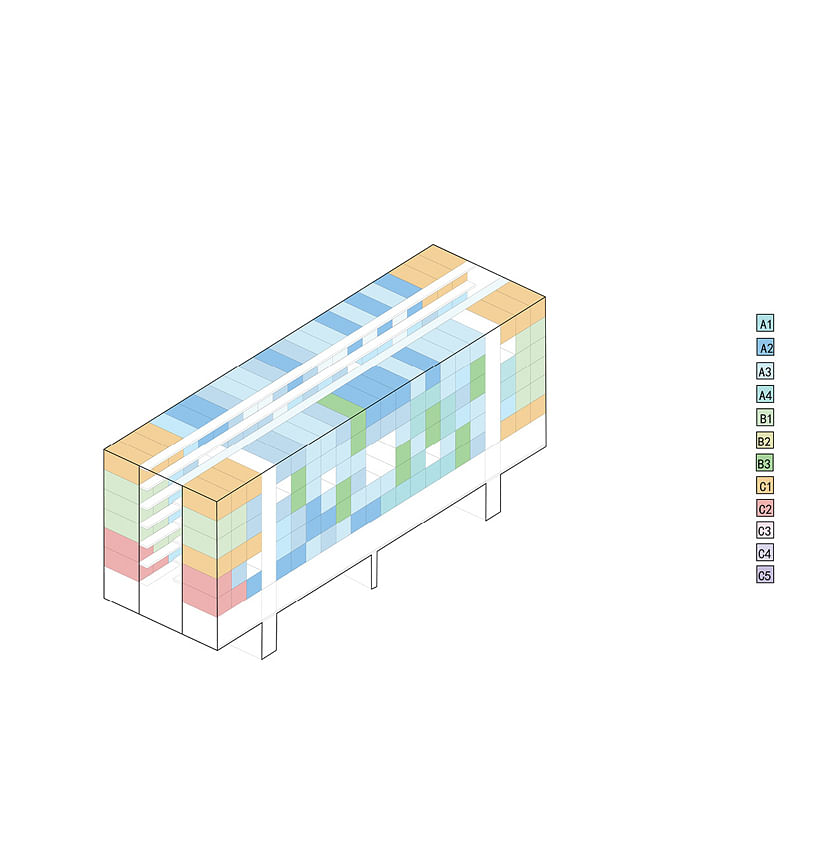
The resident can choose according to his/her needs and conditions a unit composed of the standard module of 3*3*6m. Each bridge holds each kind combination of units to increase the diversity of habitants.

Affordable housing selector software (Image: FangCheng Architects)

To inform the future resident of the possibilities, software is created that can run on windows, mac and android. By filling in a form the app sees if you are eligible for an apartment, what kind of unit you can choose from, the level of the rent and which bridge is closer to your job. Our goal with this system is to make society aware of the possibilities, and encourage them to explore.

Find many more plans, diagrams and renderings in the image gallery below.

Related

urban planning ● shenzhen ● residential ● master plan ● housing ● fangcheng architects ● china ● bridge ● asia

Share

  • Follow

    0 Comments

  • Comment as :

Bridge Urban Life Typology by FangCheng Architects

Northwestern University selects 12-firm longlist to design new engineering building

New architecture and design competitions: Exploring 130 Years of American Design, Christo & Jeanne-Claude Center, 13 White Houses, and La Pyramide

Micro-architecture honored in latest Tiny House Architecture Competition

World’s most beautiful restaurants of 2026 chosen by Prix Versailles

Sponsored Post by Buildner

Design a wine tasting room in Italy! Valli Wine Tasting Room is launched!

10 can't-miss architecture & design events to see this June in London, Los Angeles, Chicago, San Francisco, Detroit, San Diego, Porto, and Barcelona

Sponsored Post by Buildner

Museum of Emotions / Edition #8 FINAL registration deadline is approaching!

Seven global projects make AR Public Awards shortlist 2026

Sign up for Bustler's Email Newsletters

Sponsored Post by Buildner

Design a slow-living restaurant in Portugal! Portugal Long Table Restaurant is launched!

World's best tall buildings honored at the CVU 2026 Award of Excellence

Sponsored Post by TWOPAGES

Final call: TWOPAGES X Design Contest 2026 submissions close June 5

Kengo Kuma & Paul Raff win Alberta national park visitor center competition with landscape-focused design

2026 Moira Gemmill and MJ Long prizes announced by W Awards

New architecture and design competitions: Kinderspace, Stewardson Keefe LeBrun Travel Grant, SMALL PROJECT BIG IMPACT, and Garden of University House, Bucharest

The Century of Gehry: New retrospective explores the late architect's work & collaborations

Next page » Loading

Bridge Urban Life Typology by FangCheng Architects

By Bustler Editors|

Friday, Feb 24, 2012

Share

Second Prize at the 1.100.10000 Ideas Competition by FangCheng Architects (Image: FangCheng Architects)

Related

urban planning ● shenzhen ● residential ● master plan ● housing ● fangcheng architects ● china ● bridge ● asia

Young Chinese firm FangCheng Architects has sent us their proposal Bridge Urban Life Typology, a city-wide network of bridge buildings which won the team the Second Prize at the 1.100.10000 Ideas Competition. The contest sought for innovative ideas to rapidly add 240,000 affordable housing units for more than 800,000 people in China's mega-boomtown Shenzhen.

Project Description from the Architects:

China's current 12th Five-Year-Plan has mandated the construction of 36 million units
of affordable housing planned to house billions of people during the years of 2011-2015.
According to this planning, Shenzhen government's assignment is to construct 240,000 units to house more than 800,000 people. This abrupt top-down task of rapid mass housing construction raises a series of problems such as planning, program, needs, policy, land resources, finance, design, construction, distribution and management. A critical question for the architectural profession has arisen: What can DESIGN do within this situation?

Commissioned by the Urban Planning, Land and Resources Commission of Shenzhen Municipality, the Shenzhen Design Center initiates a series of events and programs to encourage innovation in the design of affordable housing.
Expanding the Center's preliminary research, the 1.100.10000 Ideas Competition aims to generate discussion, debates and inventive proposals for affordable housing in China.

'1- unit' category focuses on the design solutions of maximum spatial efficiency of a single habitation unit.
'100- families' category encourages radical strategies to distribute affordable housing throughout the city with neighborhood pockets housing hundreds of families each.
'10000- residents' category explores alternatives to China's typical large residential communities by encouraging the incorporation of mixed use and low-cost living environments.

Master plan for the 12th Five-Year-Plan for affordable housing in Shenzhen SEZ, CN (Image: FangCheng Architects)

Shenzhen government plans to raise funds to build 240.000 affordable housing units with an 15.36 million square meters construction area. However, in the current strategy, most of the affordable housing is planned to be built outside the urban center, and many are even in the urban fringe. In this case, due to travelling time, cost and sense of isolation from the urban center, residents adopt a negative attitude to the policy even though the housing price is low.

The total building area for affordable housing in Shenzhen in the 12th Five-Year-Plan (Image: FangCheng Architects)

The entire landmass of Shenzhen is 1953 sq. kilometer, this includes 395.81 sq. kilometer special economic zone (SEZ). After thirty years of development, the utilization of land becomes more and more intensified, so how do we manage to build 15.36 million sq. meters for affordable housing under the land-contraction policy? And how to bring practical benefits to low-income groups who persistently make contributions to the city?

Strategy (Image: FangCheng Architects)

Apartments need to be bought outside the urban core, and rented inside. Our concept is to build as many affordable houses as possible in the urban center, this can decrease residents travelling time and increase usage and sharing of urban facilities.  This strategy has as goal to improve social housing integration in the urban core which is done through building 6200 affordable housing units in the urban center.

Built area distribution map (Image: FangCheng Architects)

In which manner can this goal be achieved? Through analyzing the built distribution map what becomes obvious is that 20% is occupied by municipal roads. These municipal roads are wide with a beautiful artificial landscape along the sides which lend for future development and construction of urban space.

Road width analysis (Image: FangCheng Architects)

According to the analysis there are several primary distributor roads, such as Shennan, Beihuan and Binhai road, whom are wider than 50 meters, and wider than 100 meters including the greenbelts on either side. To some extent these roads increase efficiency, but from the sustainable utilization of land view, they divide the city into pieces with a single function. This causes the city to loose its comfortable human scale.

Mass development distribution map (Image: FangCheng Architects)

The city is divided into various regions that operate like isolated islands due to the increasing traffic flow on highways. Therefore, the city lacks a pedestrian system, which is currently not sustainable. We need to promote pedestrian and public traffic in order to enhance the connectivity to each region, the question will be: Is it possible to use affordable housing as a means to reach this goal and modify the city?

Bridge, urban life typology (Image: FangCheng Architects)

The design proposal for affordable housing comes forth out of the city function typology study, which asked for several prototypes for a building. Our design of a "bridge building" encourages low-income habitants to live inside the urban-center and rebuilds the pedestrian traffic system for the whole city.

The proposal is neither the 10 thousand residents community nor the low-cost rental housing, but a city wide network which can increase the utilization of facilities, enhance the pedestrian system and provide a chance for residents to decrease travelling time to work. According to the land-use analysis, road-width, function distribution, urban density and height of  the buildings running along the main traffic arteries we have come to 4 types of "bridge buildings": single bridge, mega bridge, platform bridge and cascading bridge.

Single bridge (Image: FangCheng Architects)

This typology can be built in an area that needs flow separation, in this case Beihuan road is selected as testing site, and provides an opportunity to replace the pedestrian bridges that are situated every 200 meters. The first floor holds free rental space for peddlers which sell life necessities. Inside the building, there is a wide staircase linking the upper residential floors, which on it self are again connected through several atria which serve as semi-public space. As a whole this typology works like a micro-city.

Image: FangCheng Architects

Along densely build Shennan road the mega bridge is located between the vast number of high-rise buildings. The area brings about a large group of workers, mega bridge unites this area by creating a single platform which link not only all the shared public facilities but also transportation, metro and bus, and weaves seamlessly into the existing structure and poses a mixed and differentiated architecture. The bridge will hold a diverse program including bookstore, cafe, restaurant, in order to attract, blend in and become a platform where people can enjoy a panoramic view of the urban landscape and become the living room of the city.

Platform bridge (Image: FangCheng Architects)

During rush hour, between the modern high-rise of Chegongmiao and Xiasha Urban village along Binhai road, the current footbridge cannot satisfy the intensity of urban flow, therefore the platform bridge is placed in-between, as to provide a multiple linking connection. To prevent hinder to car traffic because of shade the bridge is punctured on key locations, this will at the same time make for an interesting view from the platform. Low income habitants can utilize the open space of the platform and share facilities with the densely populated urban village. Since housing prices will be low they will form a direct competition with the village and cause prices to drop.

Cascading bridge (Image: FangCheng Architects)

The cascading bridge overlooks the Shenzhen coast along Binhai road and allows for amazing panoramic views, at the same time it makes for an easy access to the mangrove from the north and dismisses the need for parking. The bridge provides expect a view, a vast variety of outdoor activities like a basketball and tennis court, swimming pool and restaurant.

Mega bridge (Image: FangCheng Architects)

The resident can choose according to his/her needs and conditions a unit composed of the standard module of 3*3*6m. Each bridge holds each kind combination of units to increase the diversity of habitants.

Affordable housing selector software (Image: FangCheng Architects)

To inform the future resident of the possibilities, software is created that can run on windows, mac and android. By filling in a form the app sees if you are eligible for an apartment, what kind of unit you can choose from, the level of the rent and which bridge is closer to your job. Our goal with this system is to make society aware of the possibilities, and encourage them to explore.

Find many more plans, diagrams and renderings in the image gallery below.

Share

  • Follow

    0 Comments

  • Comment as :

Archinect JobsArchinect Jobs

The Archinect Job Board attracts the world's top architectural design talents.

VIEW ALL JOBS POST A JOB

Project Architect/Job Captain

HLW International LLP

Project Architect/Job Captain

West Palm Beach, FL, US

Architectural Designer (3-5 Years) - Commercial & Hospitality Focus

Pfeffer Torode Architecture

Architectural Designer (3-5 Years) - Commercial & Hospitality Focus

Nashville, TN, US

Project Architect

BuildingWork

Project Architect

Seattle, WA, US

AutoCAD Drafter/Architectural Designer

Kari Whitman Interiors

AutoCAD Drafter/Architectural Designer

Boulder, CO, US

Architect / Urban Designer

Office for the Next Environment (OFTN)

Architect / Urban Designer

New York, NY, US

Junior Architect / Architectural Designer

S20M

Junior Architect / Architectural Designer

New York, NY, US

Architectural Associate/Junior Architect

Goldstone Architecture

Architectural Associate/Junior Architect

Bennington, VT, US

Project Architect

Lang Architecture

Project Architect

New York, NY, US

Project Architect

AYON Studio

Project Architect

New York, NY, US

Senior Designer / Architect

NardiHaus

Senior Designer / Architect

Pasadena, CA, US

Next page » Loading