• Login / Join
  • About
  • •
  • Contact
  • •
  • Advertising
bustler logo
bustler logo
  • News
  • Competitions
  • Events
  • Bustler is powered by Archinect
  • Sign up for Bustler's Email Newsletters

  • Follow these Bustler feeds:

  • Search

    Search in

  • Submit

    What are you submitting?

    News Pitch
    Competition
    Event
  • Login / Join
  • News|Competitions|Events
  • Search
    | Submit
    | Follow
  • Search in

    What are you submitting?

    News Pitch
    Competition
    Event

    Follow these Bustler feeds:

  • About|Contact|Advertising
  • Login / Join

SEAT Pavilion by E/B Office

By Bustler Editors|

Wednesday, Mar 14, 2012
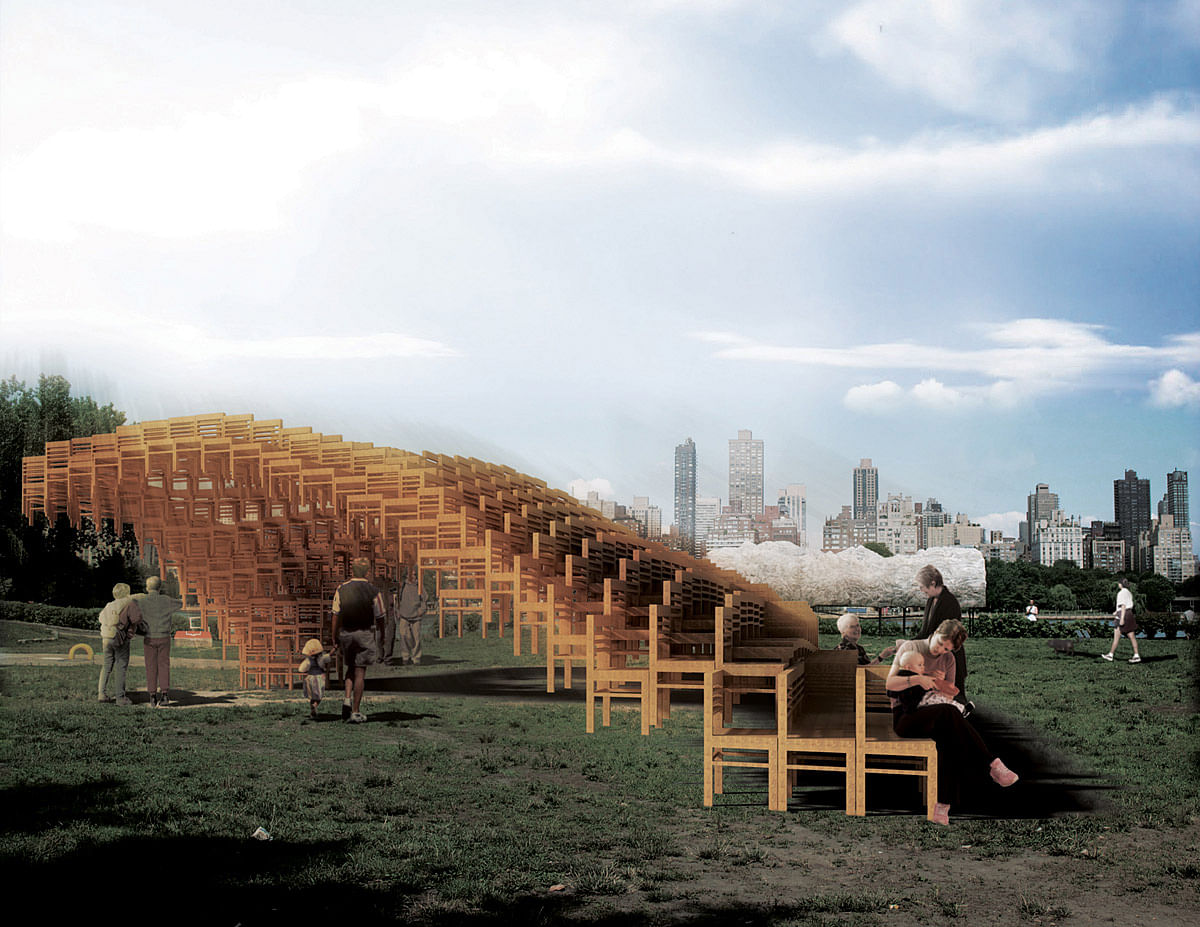
Competition-winning pavilion concept for this year's Freedom Park Project at Atlanta: SEAT by E/B Office (Image: E/B Office)

The pavilion concept SEAT by New York and Portland-based collaboration E/B Office has won the commission for this year's Freedom Park Project at Atlanta. SEAT is a garden pavilion composed of approximately 400 simple wooden chairs arrayed and stacked in a 3-dimensional sine wave surface rising above the ground.

In speaking about the project, E/B Office partner Yong Ju Lee commented, “I hope visitors to SEAT can see and enjoy how furniture, which they use every day, can be employed radically and orderly to make a complex architectural system that's ultimately artful and fun in nature.”

Brian Brush, fellow partner at E/B Office, added, “This project is about pushing/interrogating the content of domestic objects through spatial sculpture. With SEAT, we're looking beyond the symbol and function of the chair to its component parts as compositional and structural elements capable of generating unpredictable and whimsical architecture as art (or vice versa).”

Anne Dennington, executive director of Flux Projects, explained, “Our goal when submitting the call was to find a project that could engage the park and its audience for at least a month, have high visibility, and can be experienced by pedestrian, bike, and vehicular traffic. In addition, the Freedom Park Conservancy was interested in a project that could encourage people to come into and use the park. SEAT does all of this, and we are excited to see its impact on park visitors.”

This call for proposals was issued jointly by Flux Projects and the Freedom Park Conservancy, and members from both organizations sat on the selection committee.
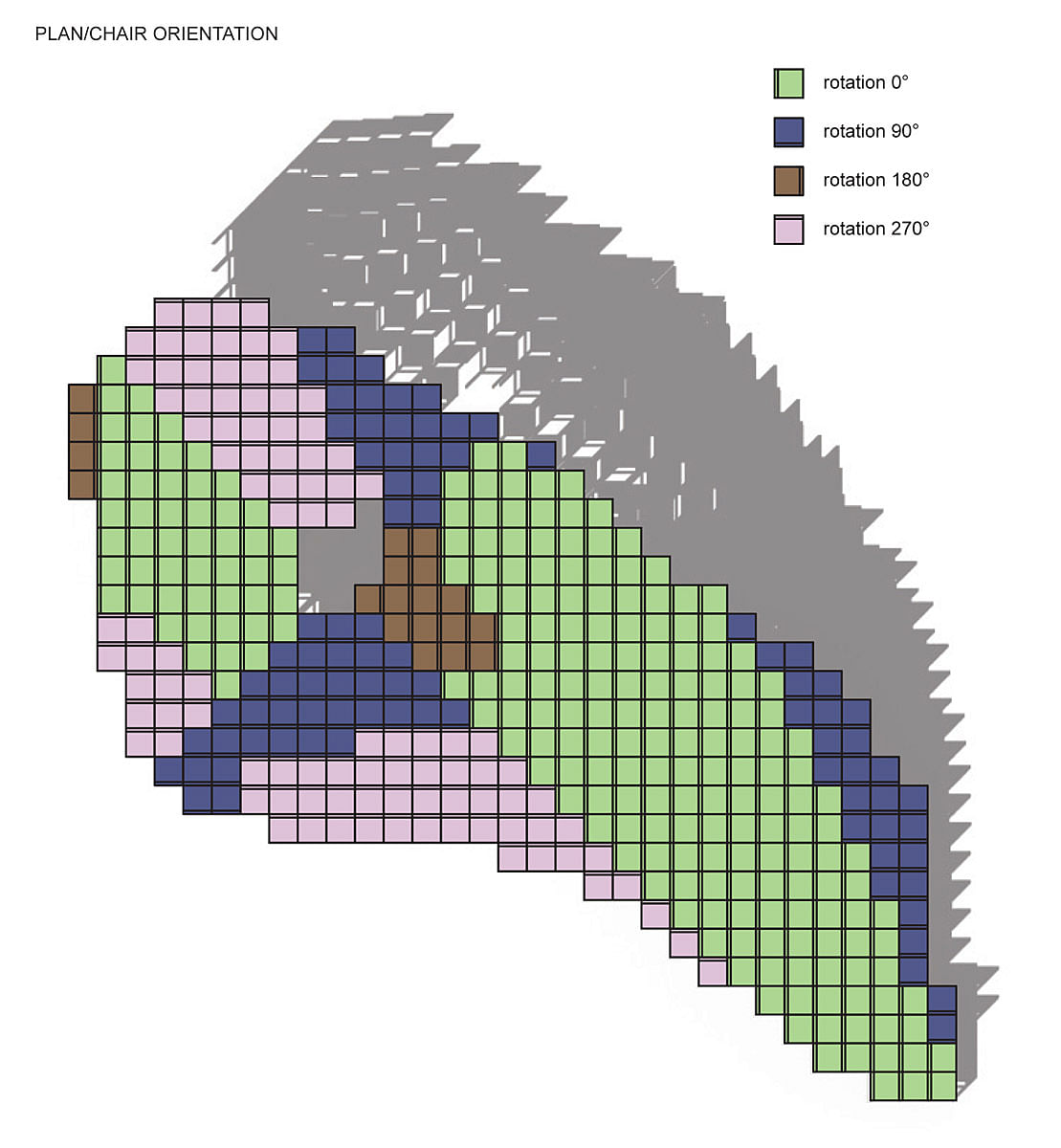
Plan/chair orientation (Image: E/B Office)

Project Description from the Architects:

Sitting is perhaps the most common condition from which we experience architecture. Whether we work, relax, watch, eat, sleep, or talk to each other, sitting is at the core of our relationship to buildings. Sitting enables the detached observation of our lives in space and time, whether it’s to look upon the buildings we inhabit, or look out from them, towards the cultural milieu that surrounds. Sitting enables a perception of the other and beyond opposite the inclusivity and interiority of our personal spaces that we carry with us. It conditions a cosmological covenant between one’s body and one’s place in architecture. It produces a body space continuum. Sitting structures our habitable spaces from within to without, determining the proportions of useable objects, forms, spaces, dimensions, and relationships in an unfolding sequence of architectonic layers.
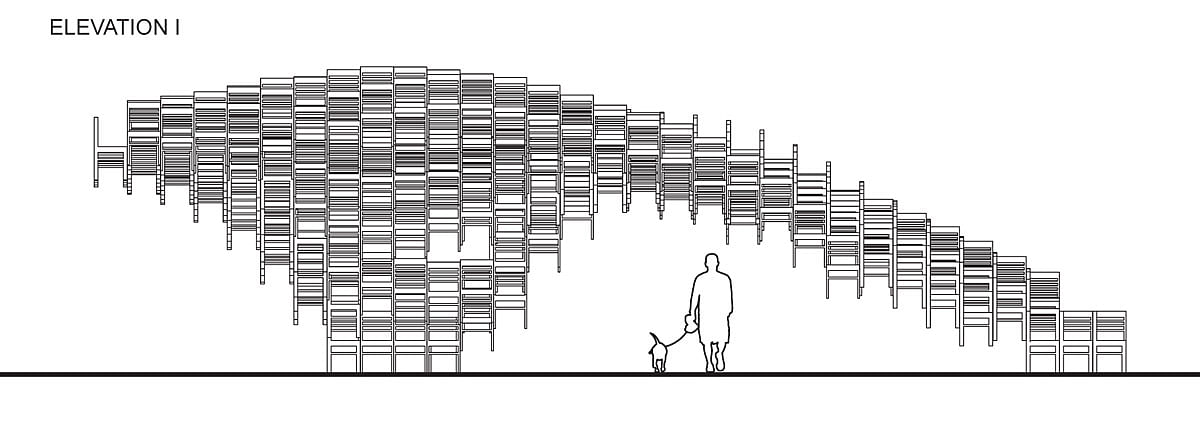
Elevation (Image: E/B Office)

Despite the importance of sitting in the use and experience of architecture, the objects we use to sit aren’t considered architecture at all. They are relegated to the domains of industrial design or furniture as mere players in a larger architectural scene. Why the disconnect? Why the disassociation of sitting in a designed object with architecture itself? Our proposal attempts to address this question through the exploration of the architectural Folly not in terms of a mused edifice of boundaries, i.e. walls, floors, and roofs rendered picturesque; but rather that which gives rise to architecture as observed and contemplative: the chair. We’ve turned the Folly inside out, creating a playful object of ornamental repose celebrating the act of repose itself as a fundamental architectural event.
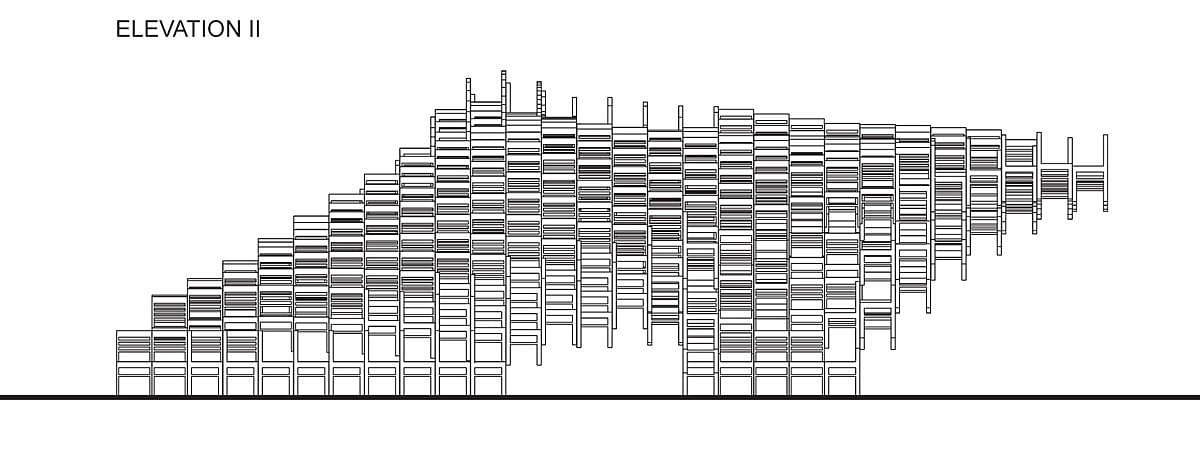
Elevation (Image: E/B Office)

SEAT is composed of approximately 400 simple wooden chairs arrayed and stacked in a sine wave surface drawn into an agitated vortex rising from the ground. It formalizes the transformation of chairs from detached useable objects into structural and spatial components of an ambiguously occupiable edifice. It’s intended to be legible and readable as a collection of individual seats, but when approached, visitors realize that sitting down in any one of them amounts to a deliberate act of occupation one can’t take for granted as usual; a temporary social contract to redefine their perception of sitting embodied as architecture. The structure is zoned by rotational differentiation in groups. Chairs around the immediate periphery are rotated for outward observation of the city and the surrounding neighborhood. At the base of the vortex, chairs turn inward to create an intimate, compressive space for visitors to converse and regard the upward flow of chairs transcending their function. Chairs suspended above ground between these zones re-constitute the role of the seated object as one that can also play as structure, decoration, and enclosure.
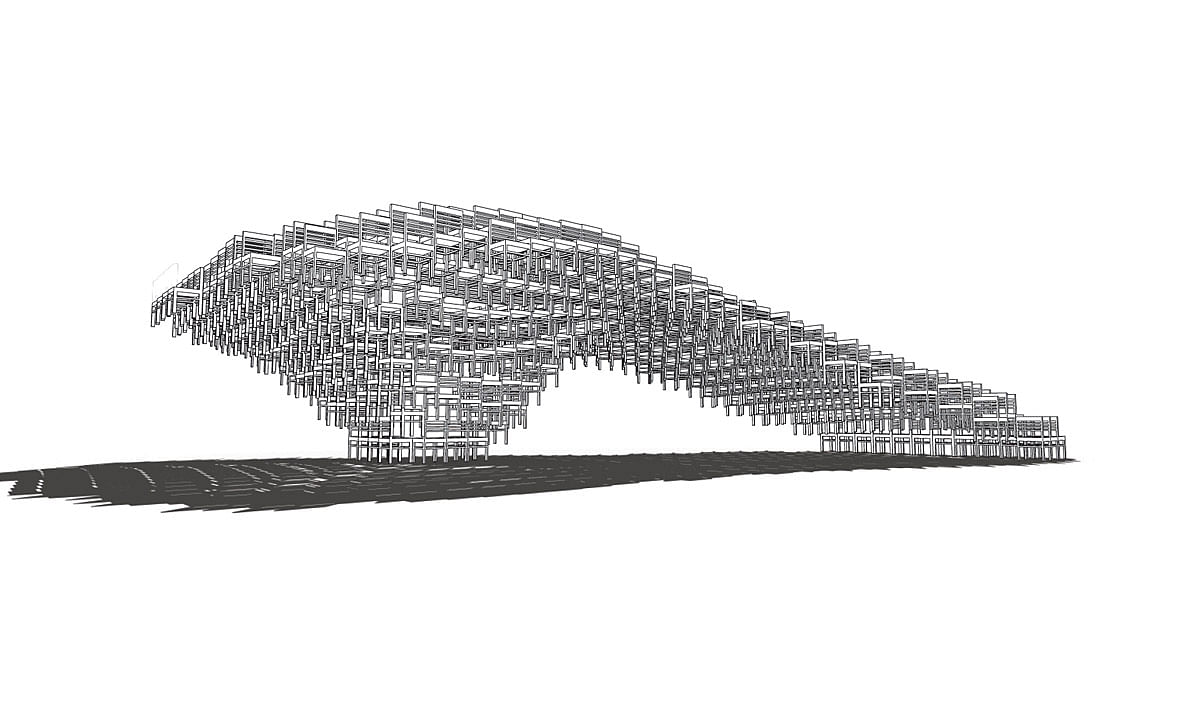
Perspective (Image: E/B Office)

The chairs are additively assembled through a modified “corbelling” process achieved by sequentially attaching chairs beginning at the edges and corners working towards the center. At times, the result playfully resembles Persian Muqarnas. The chairs are esiliently connected to each other via simple lag bolts, clamps, and screws that are hidden from view. Parametric detailing manages tolerances and connection pecifics of this hardware. Moment and shear forces are transferred through the entire structure as a continuous diaphragm ultimately loading at the vortex center and the seated periphery on the ground. A number of base connections, platforms, or struts may also augment structural stability and anchorage. Some cantilevered extensions exist to create overhanging enclosure, but are minor in actual weight aloft. Redundancy in aterial and connection will allow for stability, flexibility, and safety overall.

Related

usa ● sculpture ● pavilion ● park ● georgia ● furniture ● eb office ● chair ● atlanta

Share

  • Follow

    0 Comments

  • Comment as :

SEAT Pavilion by E/B Office

Over $500,000 awarded to architectural discourse projects by Graham Foundation

Best in urban planning recognized at AIA Regional & Urban Design Award 2026

Sponsored Post by Buildner

Re:Form - New Life for Old Spaces / Edition #3 advance registration deadline is approaching!

New architecture and design competitions: IDEAS Awards, UIA-HYP CUP International Student Competition, Vancouver Tall Challenge, and Memorial to the Sixth Extinction

Best small projects chosen at AIA Small Project Award 2026

10 standout sustainable projects honored at AIA COTE Top Ten Award 2026

Best residential architecture of 2026 honored at AIA Housing Award

Best new interiors of 2026 chosen at AIA Interior Architecture Awards

Sign up for Bustler's Email Newsletters

Best global architecture honored at RIBA International Awards 2026

World’s most beautiful airports of 2026 chosen by Prix Versailles

New architecture and design competitions: Brick in Architecture Awards, Study Architecture Student Showcase, N.Y.C. Groceries, and New York High Falls Riverfront Market

SmithGroup’s ‘pioneering’ Philip Merrill Environmental Center wins AIA Twenty-five Year Award

Sponsored Post by Buildner

Museum of Emotions / Edition #8 FINAL registration deadline is in 5 DAYS!

Here are the winners of the 2026 AIA Architecture Awards

40 emerging architects and designers under 40 from Europe honored

Next page » Loading

SEAT Pavilion by E/B Office

By Bustler Editors|

Wednesday, Mar 14, 2012

Share

Competition-winning pavilion concept for this year's Freedom Park Project at Atlanta: SEAT by E/B Office (Image: E/B Office)

Related

usa ● sculpture ● pavilion ● park ● georgia ● furniture ● eb office ● chair ● atlanta

The pavilion concept SEAT by New York and Portland-based collaboration E/B Office has won the commission for this year's Freedom Park Project at Atlanta. SEAT is a garden pavilion composed of approximately 400 simple wooden chairs arrayed and stacked in a 3-dimensional sine wave surface rising above the ground.

In speaking about the project, E/B Office partner Yong Ju Lee commented, “I hope visitors to SEAT can see and enjoy how furniture, which they use every day, can be employed radically and orderly to make a complex architectural system that's ultimately artful and fun in nature.”

Brian Brush, fellow partner at E/B Office, added, “This project is about pushing/interrogating the content of domestic objects through spatial sculpture. With SEAT, we're looking beyond the symbol and function of the chair to its component parts as compositional and structural elements capable of generating unpredictable and whimsical architecture as art (or vice versa).”

Anne Dennington, executive director of Flux Projects, explained, “Our goal when submitting the call was to find a project that could engage the park and its audience for at least a month, have high visibility, and can be experienced by pedestrian, bike, and vehicular traffic. In addition, the Freedom Park Conservancy was interested in a project that could encourage people to come into and use the park. SEAT does all of this, and we are excited to see its impact on park visitors.”

This call for proposals was issued jointly by Flux Projects and the Freedom Park Conservancy, and members from both organizations sat on the selection committee.

Plan/chair orientation (Image: E/B Office)

Project Description from the Architects:

Sitting is perhaps the most common condition from which we experience architecture. Whether we work, relax, watch, eat, sleep, or talk to each other, sitting is at the core of our relationship to buildings. Sitting enables the detached observation of our lives in space and time, whether it’s to look upon the buildings we inhabit, or look out from them, towards the cultural milieu that surrounds. Sitting enables a perception of the other and beyond opposite the inclusivity and interiority of our personal spaces that we carry with us. It conditions a cosmological covenant between one’s body and one’s place in architecture. It produces a body space continuum. Sitting structures our habitable spaces from within to without, determining the proportions of useable objects, forms, spaces, dimensions, and relationships in an unfolding sequence of architectonic layers.

Elevation (Image: E/B Office)

Despite the importance of sitting in the use and experience of architecture, the objects we use to sit aren’t considered architecture at all. They are relegated to the domains of industrial design or furniture as mere players in a larger architectural scene. Why the disconnect? Why the disassociation of sitting in a designed object with architecture itself? Our proposal attempts to address this question through the exploration of the architectural Folly not in terms of a mused edifice of boundaries, i.e. walls, floors, and roofs rendered picturesque; but rather that which gives rise to architecture as observed and contemplative: the chair. We’ve turned the Folly inside out, creating a playful object of ornamental repose celebrating the act of repose itself as a fundamental architectural event.

Elevation (Image: E/B Office)

SEAT is composed of approximately 400 simple wooden chairs arrayed and stacked in a sine wave surface drawn into an agitated vortex rising from the ground. It formalizes the transformation of chairs from detached useable objects into structural and spatial components of an ambiguously occupiable edifice. It’s intended to be legible and readable as a collection of individual seats, but when approached, visitors realize that sitting down in any one of them amounts to a deliberate act of occupation one can’t take for granted as usual; a temporary social contract to redefine their perception of sitting embodied as architecture. The structure is zoned by rotational differentiation in groups. Chairs around the immediate periphery are rotated for outward observation of the city and the surrounding neighborhood. At the base of the vortex, chairs turn inward to create an intimate, compressive space for visitors to converse and regard the upward flow of chairs transcending their function. Chairs suspended above ground between these zones re-constitute the role of the seated object as one that can also play as structure, decoration, and enclosure.

Perspective (Image: E/B Office)

The chairs are additively assembled through a modified “corbelling” process achieved by sequentially attaching chairs beginning at the edges and corners working towards the center. At times, the result playfully resembles Persian Muqarnas. The chairs are esiliently connected to each other via simple lag bolts, clamps, and screws that are hidden from view. Parametric detailing manages tolerances and connection pecifics of this hardware. Moment and shear forces are transferred through the entire structure as a continuous diaphragm ultimately loading at the vortex center and the seated periphery on the ground. A number of base connections, platforms, or struts may also augment structural stability and anchorage. Some cantilevered extensions exist to create overhanging enclosure, but are minor in actual weight aloft. Redundancy in aterial and connection will allow for stability, flexibility, and safety overall.

Share

  • Follow

    0 Comments

  • Comment as :

Archinect JobsArchinect Jobs

The Archinect Job Board attracts the world's top architectural design talents.

VIEW ALL JOBS POST A JOB

Digital Futures Fellow

The University of Tennessee - Knoxville

Digital Futures Fellow

Knoxville, TN, US

Lead Design Architect

The American Housing Corporation

Lead Design Architect

Austin, TX, US

Junior Designer/Architect

O'Neill Rose Architects

Junior Designer/Architect

Brooklyn, NY, US

Project Manager/architect

MKNH Architects

Project Manager/architect

New York, NY, US

Project Designer / Manager

BuiltIN Studio

Project Designer / Manager

New York, NY, US

Junior Architect in nyc

Lara Apelian Studio

Junior Architect in nyc

New York, NY, US

Architect / Architectural Designer (3-5 years experience)

Resolution: 4 Architecture

Architect / Architectural Designer (3-5 years experience)

New York, NY, US

Project Architect - Residential

DAHLIN Architecture | Planning | Interiors

Project Architect - Residential

Pleasanton, CA, US

Assistant Professor Architecture

California State Polytechnic University, Pomona

Assistant Professor Architecture

Pomona, CA, US

Design Technologist / BIM Lead

The American Housing Corporation

Design Technologist / BIM Lead

Austin, TX, US

Next page » Loading