• Login / Join
  • About
  • •
  • Contact
  • •
  • Advertising
bustler logo
bustler logo
  • News
  • Competitions
  • Events
  • Bustler is powered by Archinect
  • Sign up for Bustler's Email Newsletters

  • Follow these Bustler feeds:

  • Search

    Search in

  • Submit

    What are you submitting?

    News Pitch
    Competition
    Event
  • Login / Join
  • News|Competitions|Events
  • Search
    | Submit
    | Follow
  • Search in

    What are you submitting?

    News Pitch
    Competition
    Event

    Follow these Bustler feeds:

  • About|Contact|Advertising
  • Login / Join

POST+CAPITALIST CITY 3#Live - Winning Projects

By Bustler Editors|

Wednesday, Feb 27, 2013

A Storeys’ Tale

Just a few months ago, we had published the winners of episodes #1 Shop and #2 Work of the international ideas competition series, POST+CAPITALIST CITY. Here are now the three winning proposals of the third installment, #3 Live. The brief invited architects to imagine how a post+capitalist society could affect our daily lives and the way we envision housing.

Daniel Fernández Pascual, one of the jurors, remarked: "Since it was hard to decide whether the POST+CAPITALIST CITY has to be approached through dystopian scenarios; poetic forms of dwelling; or real-estate feasibility, we eventually awarded THREE FIRST PRIZES among the finalists."

If you are interested in participating in the most current competition cycle of POST+CAPITALIST CITY, #4 Move which launched last month, click here for more details. Submissions for #4 Move are due by April 15, 2013 (early birds registration: March 1, 2013), and the results will be announced in mid-May here on Bustler.

A Storeys’ Tale
by Natalia Petkova, Paula Petkova, Bernardo Robles Hidalgo (Slovakia / Spain)

Architecture is a potent expression of ideology. But nowhere is this made more evident as when it outlives the ideology that conceived it. In such cases, the built environment is compelled to reconcile with new societal aspirations, or face its untimely demise, be it physical or spiritual.

Petrzalka, a prefabricated mass-housing estate, which flowered under the communist regime in 1970s Bratislava, is the densest of its peers in all of Central Europe, housing one third of the city’s population. The demolition of the estate after the Velvet Revolution of 1989 was therefore inconceivable. Instead, standing among the ashes of the regime that constructed it, the 150,000-strong community suffered substantial neglect and deprivation under the ‘turbo’ neo-liberalism that swept through Slovakia.

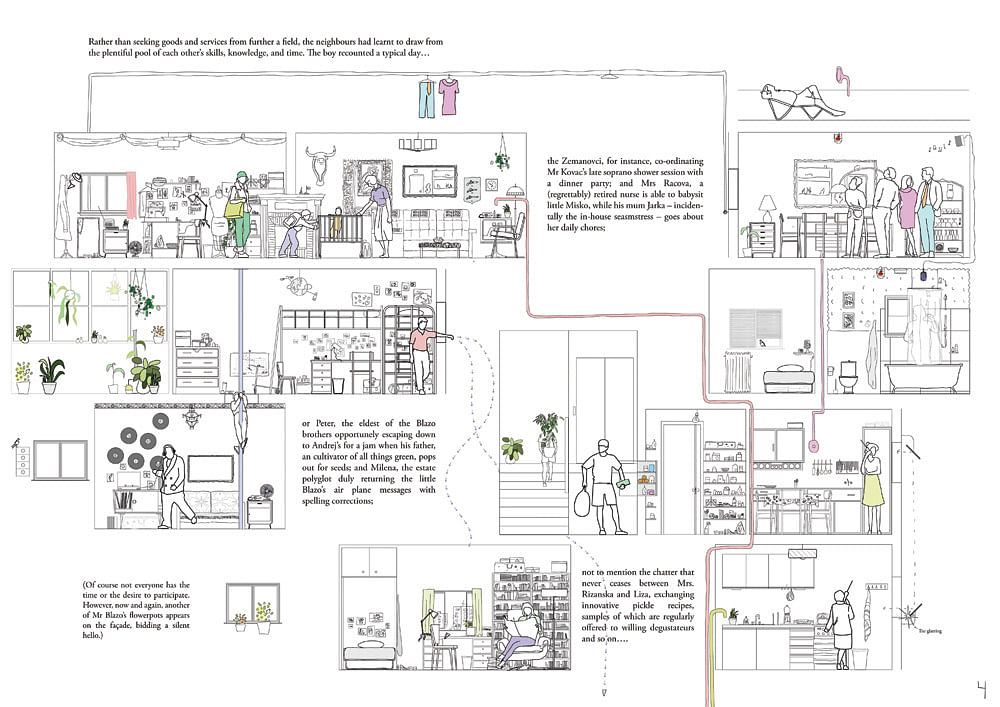
Our tale of life on the estate – a bricolage of reality and fiction – seeks to illustrate the uniquely human capacity to re-imagine and re-appropriate spaces, mobilizing their latent potential, and paving the way for regeneration. Against a background of concerns regarding urban sprawl, and the reality of the shrinking welfare state, we attempt to give sense to – and take advantage of – the existing ‘architecture of congestion’.

A Storeys’ Tale
A Storeys’ Tale
A Storeys’ Tale
A Storeys’ Tale


Macro-Lot
by Camiel Van Noten (Belgium)

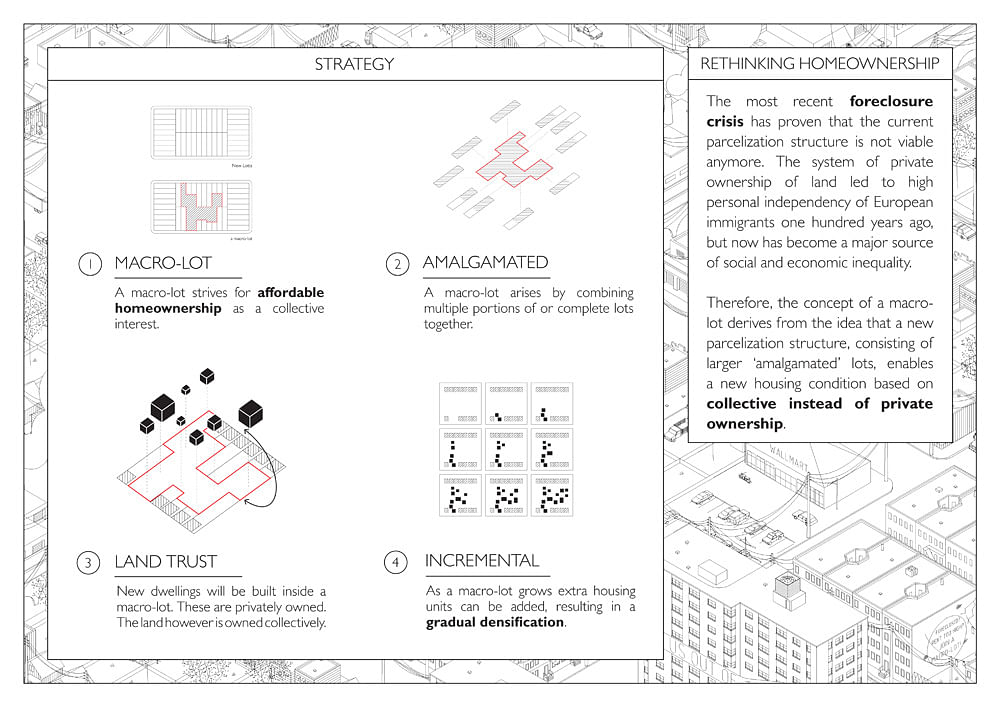
Macro-Lots examines strategic mutations of existing lot divisions in order to create a new housing condition, based on collective ownership. It proposes both a physical concept of combining multiple lots to enable new housing conditions, and a socio-economic strategy, which strives for affordable homeownership as a collective interest. This strategy focuses on the border condition in North American cities. These neighborhoods are located at the edge of the city and are inhabited by a socially disadvantaged class. These types of urban fabric symbolize the social inequality as a result from the uneven development inherent to neoliberal urbanisation.

The most recent foreclosure crisis has proven that the current parcelization structure is not viable anymore. The system of private ownership of land led to high personal independency of European immigrants one hundred years ago, but now has become a major source of social and economic inequality. Therefore, the concept of a macro-lot derives from the idea that a new parcelization structure, consisting of larger ëamalgamatedí lots, enables a new housing condition based on collective instead of private ownership.

A macro-lot arises by combining multiple portions of or complete lots together. Local homeowners, who encounter financial difficulties, can decide to join the macro-lot. Furthermore a macro-lot will provide new housing units. The new context, obtained by omitting the parcel boundaries, enables different typologies as a alternative on the existing housing stock. As an answer to the current housing issues, the main goal of a macro-lot is the provision of affordable homeownership. The division of land- and homeownership, based on community land trust ideas, is the fundamental principle of the financial structure of a macro-lot.

However, more than an architectural design, the concept of a macro-lot primarily represents a socio-economic reorganization. A macro-lot arises from a group of people who believe they are stronger together than alone. By definition, a macro-lot cannot be imposed on people, since it is set up, maintained and expanded by its residents. Therefore a macro-lot cannot be imagined by one person in front of a laptop. The involvement and the informing of the inhabitants is the most important ingredient for the success of a macro-lot.

Macro-Lot
Macro-Lot
Macro-Lot
Macro-Lot
Macro-Lot


Paris Circle
by Philip Clemens (Australia)

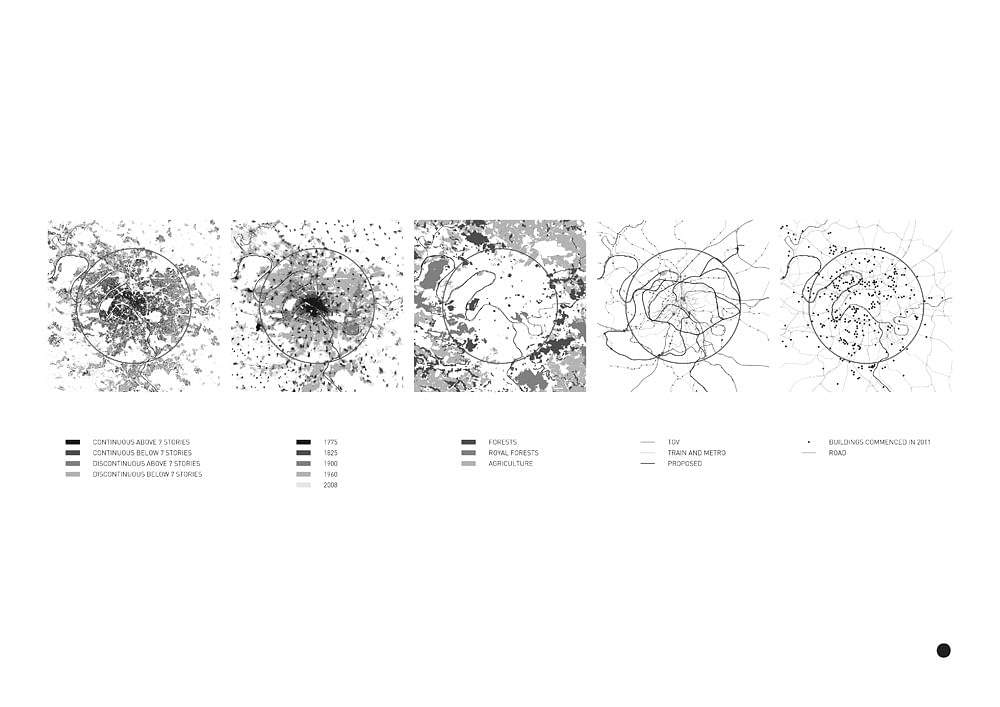
On 3 June 2010, the French National Assembly and the Senate adopted Law 2010-597 which formalised the goal to build 70,000 new homes within the Paris metropolitan region each year.

This project takes Law 2010-597 as a starting point in an alternate future where Paris is reconfigured at a massive scale by a single line inscribing its boundary, clarifying its interior. This line takes the form of a circle 15.9km in radius, exactly 100km long. This circle has a width of 6.7m and has ten stories. Separated from the towers of La Defense, it looms above its neighbours. There are four typologies of apartments with variations based on the location of communal spaces that puncture both façades. On average, there is a new apartment every 14.2m with provisions for circulation, maintenance and communal spaces. In total, there are 70,000 apartments within the circle.

Scale distorts. The line is a circle is a building. The building is wall is home. The abstraction forces its exceptional status within the city. Yet it remains necessarily habitable, an ambivalent figure, looking out in both directions. Knife thin, the Paris Circle defines and exists within both metropolis and hinterland. Thus bound, the metropolis turns inwards, upon itself.

Paris Circle
Paris Circle
Paris Circle
Paris Circle
Paris Circle

All images courtesy of POST+CAPITALIST CITY.

Related

society ● post+capitalist city ● live ● housing ● economic system ● city ● capitalism

Share

  • Follow

    0 Comments

  • Comment as :

POST+CAPITALIST CITY 3#Live - Winning Projects

New architecture and design competitions: IDEAS Awards, UIA-HYP CUP International Student Competition, Vancouver Tall Challenge, and Memorial to the Sixth Extinction

Best small projects chosen at AIA Small Project Award 2026

10 standout sustainable projects honored at AIA COTE Top Ten Award 2026

Best residential architecture of 2026 honored at AIA Housing Award

Best new interiors of 2026 chosen at AIA Interior Architecture Awards

Best global architecture honored at RIBA International Awards 2026

World’s most beautiful airports of 2026 chosen by Prix Versailles

New architecture and design competitions: Brick in Architecture Awards, Study Architecture Student Showcase, N.Y.C. Groceries, and New York High Falls Riverfront Market

Sign up for Bustler's Email Newsletters

SmithGroup’s ‘pioneering’ Philip Merrill Environmental Center wins AIA Twenty-five Year Award

Sponsored Post by Buildner

Museum of Emotions / Edition #8 FINAL registration deadline is in 5 DAYS!

Here are the winners of the 2026 AIA Architecture Awards

40 emerging architects and designers under 40 from Europe honored

Northwestern University selects 12-firm longlist to design new engineering building

New architecture and design competitions: Exploring 130 Years of American Design, Christo & Jeanne-Claude Center, 13 White Houses, and La Pyramide

Micro-architecture honored in latest Tiny House Architecture Competition

Next page » Loading

POST+CAPITALIST CITY 3#Live - Winning Projects

By Bustler Editors|

Wednesday, Feb 27, 2013

Share

A Storeys’ Tale

Related

society ● post+capitalist city ● live ● housing ● economic system ● city ● capitalism

Just a few months ago, we had published the winners of episodes #1 Shop and #2 Work of the international ideas competition series, POST+CAPITALIST CITY. Here are now the three winning proposals of the third installment, #3 Live. The brief invited architects to imagine how a post+capitalist society could affect our daily lives and the way we envision housing.

Daniel Fernández Pascual, one of the jurors, remarked: "Since it was hard to decide whether the POST+CAPITALIST CITY has to be approached through dystopian scenarios; poetic forms of dwelling; or real-estate feasibility, we eventually awarded THREE FIRST PRIZES among the finalists."

If you are interested in participating in the most current competition cycle of POST+CAPITALIST CITY, #4 Move which launched last month, click here for more details. Submissions for #4 Move are due by April 15, 2013 (early birds registration: March 1, 2013), and the results will be announced in mid-May here on Bustler.

A Storeys’ Tale
by Natalia Petkova, Paula Petkova, Bernardo Robles Hidalgo (Slovakia / Spain)

Architecture is a potent expression of ideology. But nowhere is this made more evident as when it outlives the ideology that conceived it. In such cases, the built environment is compelled to reconcile with new societal aspirations, or face its untimely demise, be it physical or spiritual.

Petrzalka, a prefabricated mass-housing estate, which flowered under the communist regime in 1970s Bratislava, is the densest of its peers in all of Central Europe, housing one third of the city’s population. The demolition of the estate after the Velvet Revolution of 1989 was therefore inconceivable. Instead, standing among the ashes of the regime that constructed it, the 150,000-strong community suffered substantial neglect and deprivation under the ‘turbo’ neo-liberalism that swept through Slovakia.

Our tale of life on the estate – a bricolage of reality and fiction – seeks to illustrate the uniquely human capacity to re-imagine and re-appropriate spaces, mobilizing their latent potential, and paving the way for regeneration. Against a background of concerns regarding urban sprawl, and the reality of the shrinking welfare state, we attempt to give sense to – and take advantage of – the existing ‘architecture of congestion’.
A Storeys’ Tale
A Storeys’ Tale
A Storeys’ Tale
A Storeys’ Tale


Macro-Lot
by Camiel Van Noten (Belgium)

Macro-Lots examines strategic mutations of existing lot divisions in order to create a new housing condition, based on collective ownership. It proposes both a physical concept of combining multiple lots to enable new housing conditions, and a socio-economic strategy, which strives for affordable homeownership as a collective interest. This strategy focuses on the border condition in North American cities. These neighborhoods are located at the edge of the city and are inhabited by a socially disadvantaged class. These types of urban fabric symbolize the social inequality as a result from the uneven development inherent to neoliberal urbanisation.

The most recent foreclosure crisis has proven that the current parcelization structure is not viable anymore. The system of private ownership of land led to high personal independency of European immigrants one hundred years ago, but now has become a major source of social and economic inequality. Therefore, the concept of a macro-lot derives from the idea that a new parcelization structure, consisting of larger ëamalgamatedí lots, enables a new housing condition based on collective instead of private ownership.

A macro-lot arises by combining multiple portions of or complete lots together. Local homeowners, who encounter financial difficulties, can decide to join the macro-lot. Furthermore a macro-lot will provide new housing units. The new context, obtained by omitting the parcel boundaries, enables different typologies as a alternative on the existing housing stock. As an answer to the current housing issues, the main goal of a macro-lot is the provision of affordable homeownership. The division of land- and homeownership, based on community land trust ideas, is the fundamental principle of the financial structure of a macro-lot.

However, more than an architectural design, the concept of a macro-lot primarily represents a socio-economic reorganization. A macro-lot arises from a group of people who believe they are stronger together than alone. By definition, a macro-lot cannot be imposed on people, since it is set up, maintained and expanded by its residents. Therefore a macro-lot cannot be imagined by one person in front of a laptop. The involvement and the informing of the inhabitants is the most important ingredient for the success of a macro-lot.

Macro-Lot
Macro-Lot
Macro-Lot
Macro-Lot
Macro-Lot


Paris Circle
by Philip Clemens (Australia)

On 3 June 2010, the French National Assembly and the Senate adopted Law 2010-597 which formalised the goal to build 70,000 new homes within the Paris metropolitan region each year.

This project takes Law 2010-597 as a starting point in an alternate future where Paris is reconfigured at a massive scale by a single line inscribing its boundary, clarifying its interior. This line takes the form of a circle 15.9km in radius, exactly 100km long. This circle has a width of 6.7m and has ten stories. Separated from the towers of La Defense, it looms above its neighbours. There are four typologies of apartments with variations based on the location of communal spaces that puncture both façades. On average, there is a new apartment every 14.2m with provisions for circulation, maintenance and communal spaces. In total, there are 70,000 apartments within the circle.

Scale distorts. The line is a circle is a building. The building is wall is home. The abstraction forces its exceptional status within the city. Yet it remains necessarily habitable, an ambivalent figure, looking out in both directions. Knife thin, the Paris Circle defines and exists within both metropolis and hinterland. Thus bound, the metropolis turns inwards, upon itself.

Paris Circle
Paris Circle
Paris Circle
Paris Circle
Paris Circle

All images courtesy of POST+CAPITALIST CITY.

Share

  • Follow

    0 Comments

  • Comment as :

Archinect JobsArchinect Jobs

The Archinect Job Board attracts the world's top architectural design talents.

VIEW ALL JOBS POST A JOB

Architect

Joe Serrins Studio

Architect

New York, NY, US

Architectural Designer II

mdg | m-design group

Architectural Designer II

New York, NY, US

Junior Designer/Architect

O'Neill Rose Architects

Junior Designer/Architect

Brooklyn, NY, US

Senior Designer / Architect

NardiHaus

Senior Designer / Architect

Pasadena, CA, US

Project Designer / Manager

BuiltIN Studio

Project Designer / Manager

New York, NY, US

Healthcare Project Manager

NK Architects

Healthcare Project Manager

New York, NY, US

Interior Designer - Intermediate Level (3-7 Years)

Yazdani Studio of Cannon Design

Interior Designer - Intermediate Level (3-7 Years)

Los Angeles, CA, US

Project Manager

Payette

Project Manager

Boston, MA, US

Project Architect - Residential

DAHLIN Architecture | Planning | Interiors

Project Architect - Residential

Pleasanton, CA, US

Architect / Project Architect

Joseph David Associates

Architect / Project Architect

Next page » Loading