• Login / Join
  • About
  • •
  • Contact
  • •
  • Advertising
bustler logo
bustler logo
  • News
  • Competitions
  • Events
  • Bustler is powered by Archinect
  • Sign up for Bustler's Email Newsletters

  • Follow these Bustler feeds:

  • Search

    Search in

  • Submit

    What are you submitting?

    News Pitch
    Competition
    Event
  • Login / Join
  • News|Competitions|Events
  • Search
    | Submit
    | Follow
  • Search in

    What are you submitting?

    News Pitch
    Competition
    Event

    Follow these Bustler feeds:

  • About|Contact|Advertising
  • Login / Join
Tagged: architectural typology

In The Unlikely Event examines the International Airport “species”

By Justine Testado|

Tuesday, Aug 16, 2016
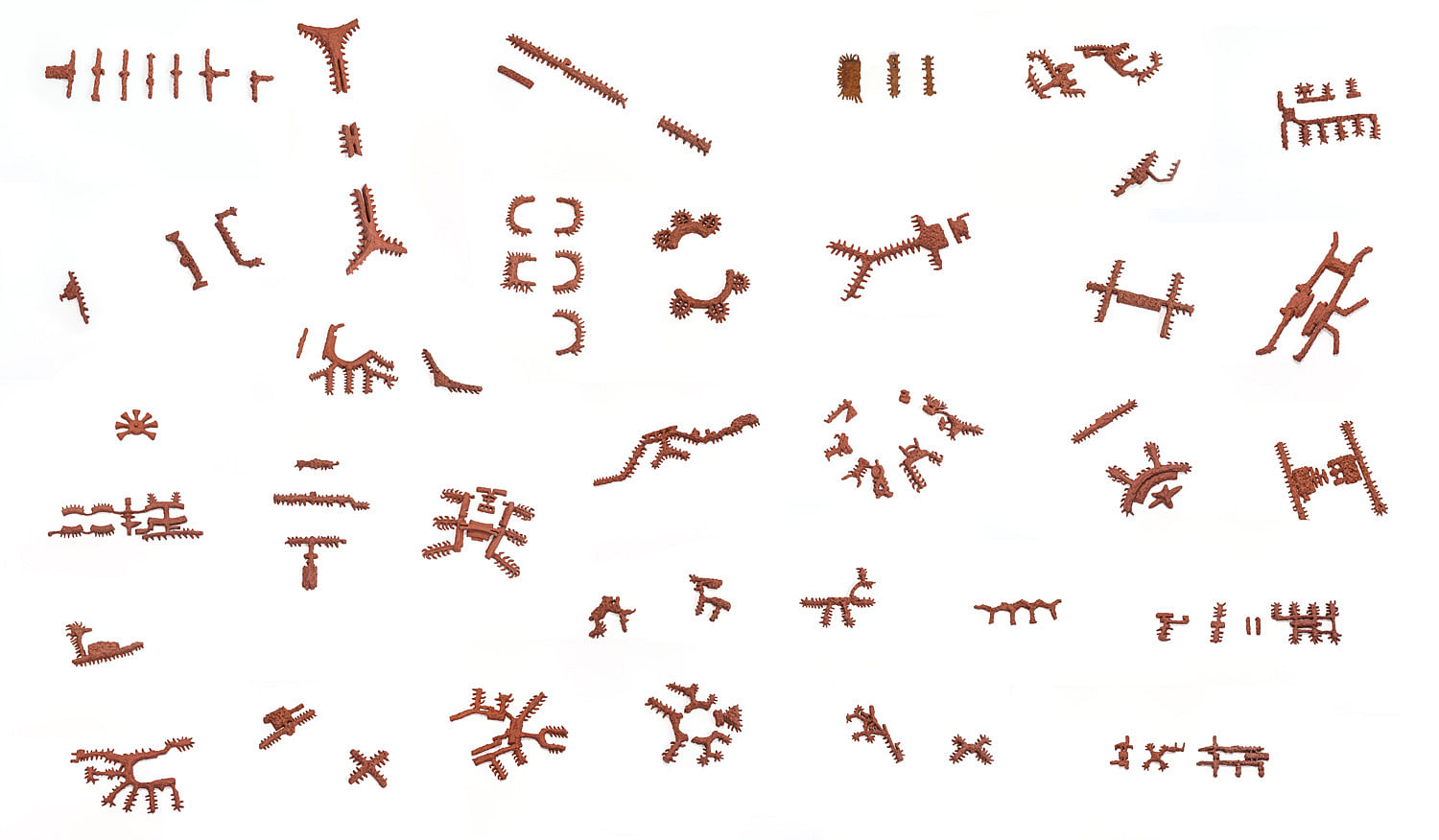
“In The Unlikely Event” by Janet Abrams. Photo courtesy of the artist.

“In The Unlikely Event” by artist Janet Abrams digs into the nature of the fantastical International Airport typology — “a significant species of monumental urbanism, perhaps the archetypal City State of our time”, as she describes. Created in 2013 during a residency in The Netherlands' European Ceramic Work Centre, “In The Unlikely Event” (ITUE) is an ambitious large-scale ceramic installation that showcases the Top 30 of the world's busiest international airports as terra cotta ceramic bas-reliefs, which Abrams molded individually by hand. 

Arranged like ancient fossils at a natural history museum, ITUE is part two of Abrams' "A Natural History of Technology" project. In the ongoing case study series, Abrams fuses the past, present, and future as she closely examines the formal evolution of man-made artifacts as if they were specimens from nature. In ITUE, each airport stands as a physical architectural expression of its home country's ambitions to compete in the global economy. 

Earlier this year, ITUE made its U.S. debut at Santa Fe's form + concept gallery. The exhibition will be on display until August 22.

Read on for more.
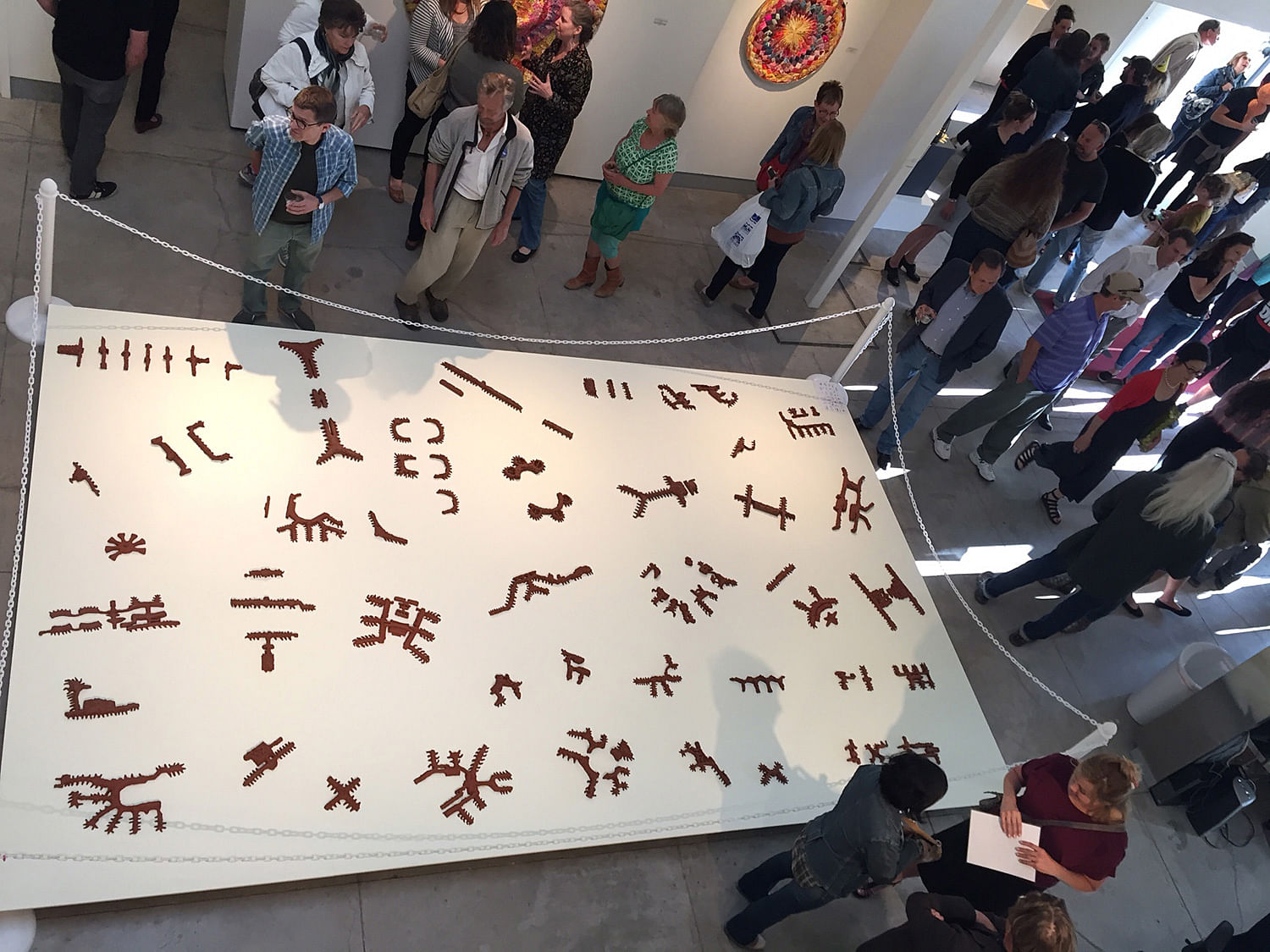
In The Unlikely Event, view during its US debut at form + concept gallery, Santa Fe, May 27 2016. Photo courtesy of Janet Abrams.

Pointing to True North, each terra cotta airport — from Singapore Changi to London Heathrow to LAX — is built to the same scale along with their component terminals. But ITUE won't end there. Abrams will create new airports and augment existing ones as their real counterparts gradually come to life around the globe. Plus, she plans on experimenting with different materials and different scales.

Below is an excerpt of Janet Abrams' keynote lecture, “The Making of In the Unlikely Event”, delivered during the 2015 AAAE Arts in the Airport workshop:

“What struck me as fascinating, as I gathered these images, was how utterly different each airport plan was from the others. This is a building type (as architecture junkies call it) in which the function is, more or less, identical from airport to airport — to get people and freight from one place to another. But more than any other building type I could think of, airports terminals are wildly varied in their shapes. This didn't seem to be directly related to geography, available land on which to build, or surrounding topography, although these factors are obviously highly significant and influential on the form. 

I knew there was a building-boom going on in this sector — major new airports are under construction all over the world. As an erstwhile architectural journalist, I remain interested in the relationship between architecture and economics. The newest airports are arising within emerging markets, particularly in South East Asia and in the Middle East. And they are physical expressions of those countries’ ambitions to compete — practically but also symbolically — in a global discourse of trade, transportation, and communication. Some of the newest ones are of dimensions that defy the imagination, but I’ll get to that in a moment.

Airports seemed perfect as the second case study in my series entitled ‘A Natural History of Technology’ which explores the formal evolution of man-made artifacts as though they were specimens from nature. ‘Fossils of Our Time,’ 2009, the first in this series, considered the evolution of the TV remote control, through plaster casts of their rubber keypads.

As an artist, I wanted to examine the ‘league table’ of the world’s busiest airports, and to make scale versions that could be looked at comparatively, side by side. Not so much as a data-visualization, or a statistical analysis, or a set of pristine architectural models. But in a way that would capture something more poetic and transcendent — synoptic — about the period of history we are in, and the conditions of globe-trotting that have become so taken-for-granted. A century and a half ago, I might have focused on railway stations instead.”

Full keynote text here. Learn more about In The Unlikely Event here.

RELATED NEWS Pininfarina + AECOM to design Istanbul New Airport traffic control tower
RELATED NEWS More details behind the Taiwan Taoyuan Int'l Airport Terminal 3 winning proposals
RELATED NEWS SAA and Benoy reveal design for Changi Airport Terminal 4 in Singapore

Related

airport ● airports ● architecture models ● clay ● artist ● event ● art exhibition ● architectural typology ● terra cotta ● public transportation ● economics

Share

  • Follow

    0 Comments

  • Comment as :

In The Unlikely Event examines the International Airport “species”

Sign up for Bustler's Email Newsletters

Next page » Loading

In The Unlikely Event examines the International Airport “species”

By Justine Testado|

Tuesday, Aug 16, 2016

Share

“In The Unlikely Event” by Janet Abrams. Photo courtesy of the artist.

Related

airport ● airports ● architecture models ● clay ● artist ● event ● art exhibition ● architectural typology ● terra cotta ● public transportation ● economics

“In The Unlikely Event” by artist Janet Abrams digs into the nature of the fantastical International Airport typology — “a significant species of monumental urbanism, perhaps the archetypal City State of our time”, as she describes. Created in 2013 during a residency in The Netherlands' European Ceramic Work Centre, “In The Unlikely Event” (ITUE) is an ambitious large-scale ceramic installation that showcases the Top 30 of the world's busiest international airports as terra cotta ceramic bas-reliefs, which Abrams molded individually by hand. 

Arranged like ancient fossils at a natural history museum, ITUE is part two of Abrams' "A Natural History of Technology" project. In the ongoing case study series, Abrams fuses the past, present, and future as she closely examines the formal evolution of man-made artifacts as if they were specimens from nature. In ITUE, each airport stands as a physical architectural expression of its home country's ambitions to compete in the global economy. 

Earlier this year, ITUE made its U.S. debut at Santa Fe's form + concept gallery. The exhibition will be on display until August 22.

Read on for more.

In The Unlikely Event, view during its US debut at form + concept gallery, Santa Fe, May 27 2016. Photo courtesy of Janet Abrams.

Pointing to True North, each terra cotta airport — from Singapore Changi to London Heathrow to LAX — is built to the same scale along with their component terminals. But ITUE won't end there. Abrams will create new airports and augment existing ones as their real counterparts gradually come to life around the globe. Plus, she plans on experimenting with different materials and different scales.

Below is an excerpt of Janet Abrams' keynote lecture, “The Making of In the Unlikely Event”, delivered during the 2015 AAAE Arts in the Airport workshop:

“What struck me as fascinating, as I gathered these images, was how utterly different each airport plan was from the others. This is a building type (as architecture junkies call it) in which the function is, more or less, identical from airport to airport — to get people and freight from one place to another. But more than any other building type I could think of, airports terminals are wildly varied in their shapes. This didn't seem to be directly related to geography, available land on which to build, or surrounding topography, although these factors are obviously highly significant and influential on the form. 

I knew there was a building-boom going on in this sector — major new airports are under construction all over the world. As an erstwhile architectural journalist, I remain interested in the relationship between architecture and economics. The newest airports are arising within emerging markets, particularly in South East Asia and in the Middle East. And they are physical expressions of those countries’ ambitions to compete — practically but also symbolically — in a global discourse of trade, transportation, and communication. Some of the newest ones are of dimensions that defy the imagination, but I’ll get to that in a moment.

Airports seemed perfect as the second case study in my series entitled ‘A Natural History of Technology’ which explores the formal evolution of man-made artifacts as though they were specimens from nature. ‘Fossils of Our Time,’ 2009, the first in this series, considered the evolution of the TV remote control, through plaster casts of their rubber keypads.

As an artist, I wanted to examine the ‘league table’ of the world’s busiest airports, and to make scale versions that could be looked at comparatively, side by side. Not so much as a data-visualization, or a statistical analysis, or a set of pristine architectural models. But in a way that would capture something more poetic and transcendent — synoptic — about the period of history we are in, and the conditions of globe-trotting that have become so taken-for-granted. A century and a half ago, I might have focused on railway stations instead.”

Full keynote text here. Learn more about In The Unlikely Event here.

RELATED NEWS Pininfarina + AECOM to design Istanbul New Airport traffic control tower
RELATED NEWS More details behind the Taiwan Taoyuan Int'l Airport Terminal 3 winning proposals
RELATED NEWS SAA and Benoy reveal design for Changi Airport Terminal 4 in Singapore

Share

  • Follow

    0 Comments

  • Comment as :

Archinect JobsArchinect Jobs

The Archinect Job Board attracts the world's top architectural design talents.

VIEW ALL JOBS POST A JOB

Interior Designer, 5+ Years Experience

Cass Calder Smith

Interior Designer, 5+ Years Experience

San Francisco, CA, US

Project Architect / Senior Designer

Touloukian Touloukian Inc.

Project Architect / Senior Designer

Boston, MA, US

Architectural Designer II

Studio AR&D Architects

Architectural Designer II

Los Angeles, CA, US

Architectural Project Manager - Multifamily

DAHLIN ARCHITECTURE | PLANNING | INTERIORS

Architectural Project Manager - Multifamily

Irvine, CA, US

Designer

HATCH ARCHITECTURE

Designer

Los Angeles, CA, US

Senior Hospitality FF&E Designer

bonetti/kozerski architecture DPC

Senior Hospitality FF&E Designer

New York, NY, US

Architects with 4-10 Years' Experience

Adamson Associates, Inc.

Architects with 4-10 Years' Experience

Los Angeles, CA, US

Architectural Designer

Build Block Inc.

Architectural Designer

Los Angeles, CA, US

Junior Architect / Architectural Designer

S20M

Junior Architect / Architectural Designer

New York, NY, US

Project Architect

Lang Architecture

Project Architect

New York, NY, US

Next page » Loading