• Login / Join
  • About
  • •
  • Contact
  • •
  • Advertising
bustler logo
bustler logo
  • News
  • Competitions
  • Events
  • Bustler is powered by Archinect
  • Sign up for Bustler's Email Newsletters

  • Follow these Bustler feeds:

  • Search

    Search in

  • Submit

    What are you submitting?

    News Pitch
    Competition
    Event
  • Login / Join
  • News|Competitions|Events
  • Search
    | Submit
    | Follow
  • Search in

    What are you submitting?

    News Pitch
    Competition
    Event

    Follow these Bustler feeds:

  • About|Contact|Advertising
  • Login / Join
Tagged: biotope

Palynopolis by ERIKSEN SKAJAA ARCHITECTS

By Bustler Editors|

Tuesday, Sep 28, 2010

Runner-up in the Man Made Reformulate competition: Palynopolis by ERIKSEN SKAJAA ARCHITECTS
Oslo-based practice ERIKSEN SKAJAA ARCHITECTS was awarded Runner-up in the Man Made Reformulate competition for the Oslo Triennale with their entry Palynopolis, a project proposing Urban Beehives to counteract the decline in biotopes in and around modern cities. The concept was designed in cooperation with Msc. Phd. Christina Charlotte Tolfsen who has a background in bee research at the University of Life Sciences in Ås, Norway.

Project Description:

Palynopolis is a proposal for a study on an urban scale examining how biodiversity and self-sufficiency can act as catalysts for urban development. An installation built in Vaterland could demonstrate how these ideas could generate a tool to deal with not only biodiversity but also social diversity. We believe that the river valley that runs through Oslo can serve as an infrastructure for self-sufficiency and social change. Democracy, or democratic space, means the opportunity to take part and is the main theme of the project.

The urban study will examine a range of programs that fit into the theme of biodiversity, urban food production and gardening. We believe that the Aker River and its surrounding areas are interesting as an already established infrastructure that might be developed into a true catalyst of change. The study will be centered on the river. We will examine the existing biodiversity and identify elements that are threatened and elements that can be developed further. We will demonstrate how new infrastructures can be developed to support biodiversity in the city. Finally, we will discuss and explorehow biodiversity, small-scale urban gardening and food production could contribute to a new layer of urban development centered on the riverbanks.

Palynopolis by ERIKSEN SKAJAA ARCHITECTS

The Vaterland Apiary will be a community-based apiary that allows for production of honey and other bee products. Bees are important pollinators in the urban environment. In conjunction with the apiary we will therefore also create a garden where it’s possible to bring flowers and other plants for pollination. The apiary with its garden will function as a focal point of floral sexuality. At the same time the installation has a strong social agenda as it will be possible for the public to take part in the honey production and to learn more about bees, which are highly sophisticated social organisms. It also has strong metaphorical possibilities connected to themes such as reproduction, fear and wealth.

Bees are an important part of urban gardening and agriculture. The background for our proposed installation is the global decline in bee populations which scientifically is denoted as the colony collapse disorder. Small-scale urban beekeeping could help raise the public awareness about this phenomenon and at the same time stimulate to a renewed interest in bee keeping.
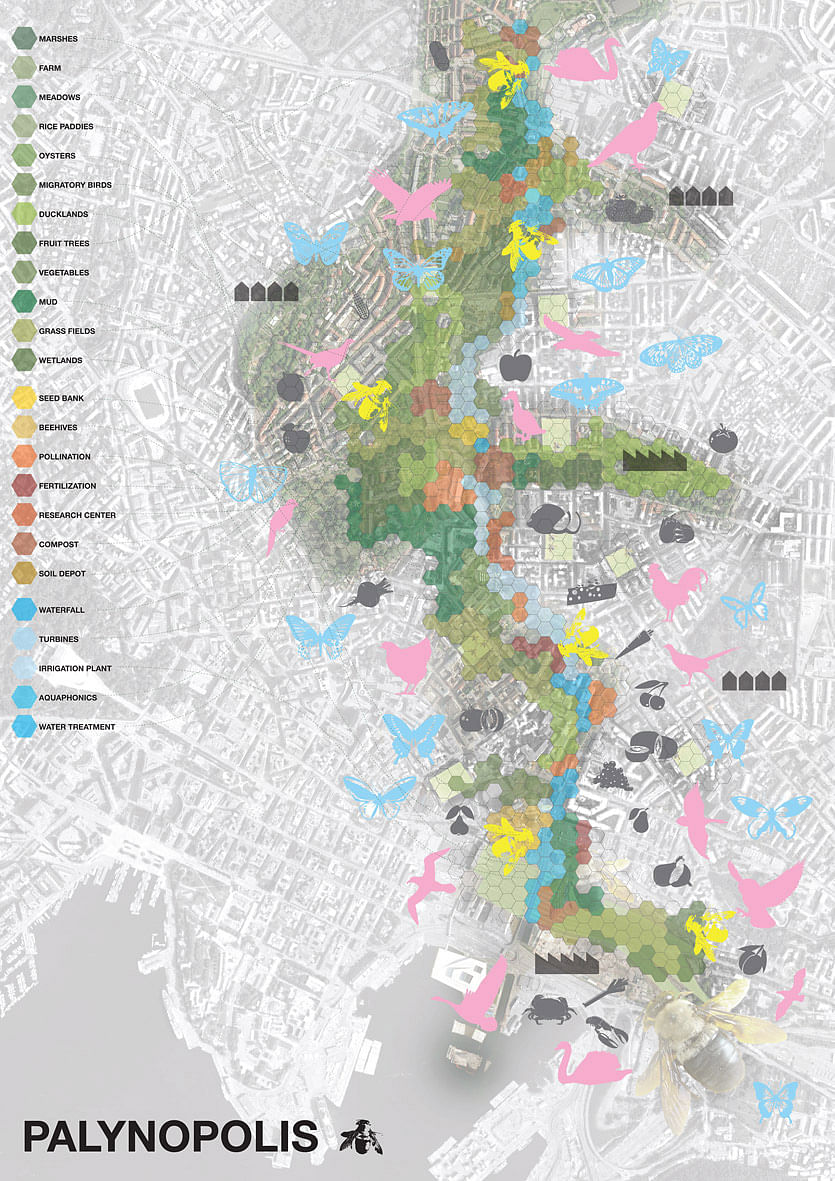
Palynopolis by ERIKSEN SKAJAA ARCHITECTS

The apiary combines the ideas of biodiversity and self-sufficiency with ideas of social change and a participatory democratic urban space. The Vaterland Park, despite its obvious qualities with a location close to the river, is now a gathering place for a mix of drug users and dealers, and is also home to a population of Rumanian short-term visitors. In addition the park is a route between the railway station and the Grønland area.

We think that the Vaterland Park makes apparent some of the great challenges to our democracy. By that we mean that the people who are present in the park represent the contrasts and the diversity of our society. How to deal with these differences and inequalities is a main challenge of the social democratic societies in a modern globalised world. If we are not capable of dealing with heterogeneity we are possibly not democracies at all, but what the Danish author Carsten Jensen calls dictatorships of the comfortable, without any other response to the different and uncomfortable than forced exile and urban displacement.

We believe that the Vaterland apiary can provide a unique opportunity for exchange between the displaced and the urban middle classes. The apiary combines small-scale food production, which have typically been more important to the poor, with the current obsession on gardening among the urban middle classes.

Palynopolis by ERIKSEN SKAJAA ARCHITECTS

Urban Apiculture can have aneducational purpose. The apiary may help teach the public more about honeybees and how these organisms are commercially and culturally important to the human society. We envisage a system similar to that of allotment gardens, where one will need to apply to set up private beehives, and where. All special tools that are needed will be available in the apiary.  A training system will have to be established, and could at the same time provide valuable contact between the public and bee specialists.  TheNorwegian University of Life Sciences (UMB) at Ås gives comprehensive courses in bee keeping. Local beekeepers’ associations offer smaller shorter courses.

Honey from urban bees is known for its rich taste. Bees are pollinators and a combination of suited plants such as raspberries, fruit trees and other types of flowers in the vicinity of the apiary may help increase the honey production. Bees normally fly about 800 kilometers before they die. They can travel up to 3-5 kilometers away from the hive to collect pollen, nectar and water, which they bring back to the hive. They travel several trips per day. How long they fly depend on the availability of plants in the area. Scout bees fly from the colony in search of pollen and nectar. If successful in finding good supplies of food, the scouts return to the colony and "dances" on the honeycomb to tell the other worker bees where to go.  One beehive might produce as much as 40 kg per year, bees also produce substantial amounts of pollen and propolis that, in the same way as honey, can be sold commercially. We plan to introduce either Carnolian honeybees (lat. Apis mellifera carnica Pollman), European dark bees(Apis mellifera mellifera) or Buckfast bees ( Apis mellifera hybrid bees) which are three common bee types used by beekeepers in Norway.

Equipment might be loaned or rented in the park. Minimum requirements for equipment are; bee suit, gloves, hive boxes, queen excluders, bee smoker, hive tool, frames etc. There could also bee also be a need for an incubator and other equipment to breed queen bees, but queens may alternatively be purchased from local beekeepers.


LOCATION: Oslo, Norway

SIZE: Based on amount of beehives

SCHEDULE: 2010-2011

TEAM: Joakim Skajaa, Arild Eriksen, Christina Charlotte Tolfsen

COMPETITION JURY: Markus Schaefer (AMO/OMA), Dagur Eggertson (Rintala Eggertson), Knut Erik Dahl (Dahl Uhre Architects) Bjarne Ringstad (Code), Mari Lending

Related

urban ● oslo ● norway ● europe ● eriksen skajaa architects ● biotope ● biodiversity ● beehives ● apiary

Share

  • Follow

    0 Comments

  • Comment as :

Palynopolis by ERIKSEN SKAJAA ARCHITECTS

Sign up for Bustler's Email Newsletters

Next page » Loading

Palynopolis by ERIKSEN SKAJAA ARCHITECTS

By Bustler Editors|

Tuesday, Sep 28, 2010

Share

Runner-up in the Man Made Reformulate competition: Palynopolis by ERIKSEN SKAJAA ARCHITECTS

Related

urban ● oslo ● norway ● europe ● eriksen skajaa architects ● biotope ● biodiversity ● beehives ● apiary
Oslo-based practice ERIKSEN SKAJAA ARCHITECTS was awarded Runner-up in the Man Made Reformulate competition for the Oslo Triennale with their entry Palynopolis, a project proposing Urban Beehives to counteract the decline in biotopes in and around modern cities. The concept was designed in cooperation with Msc. Phd. Christina Charlotte Tolfsen who has a background in bee research at the University of Life Sciences in Ås, Norway.

Project Description:

Palynopolis is a proposal for a study on an urban scale examining how biodiversity and self-sufficiency can act as catalysts for urban development. An installation built in Vaterland could demonstrate how these ideas could generate a tool to deal with not only biodiversity but also social diversity. We believe that the river valley that runs through Oslo can serve as an infrastructure for self-sufficiency and social change. Democracy, or democratic space, means the opportunity to take part and is the main theme of the project.

The urban study will examine a range of programs that fit into the theme of biodiversity, urban food production and gardening. We believe that the Aker River and its surrounding areas are interesting as an already established infrastructure that might be developed into a true catalyst of change. The study will be centered on the river. We will examine the existing biodiversity and identify elements that are threatened and elements that can be developed further. We will demonstrate how new infrastructures can be developed to support biodiversity in the city. Finally, we will discuss and explorehow biodiversity, small-scale urban gardening and food production could contribute to a new layer of urban development centered on the riverbanks.

Palynopolis by ERIKSEN SKAJAA ARCHITECTS

The Vaterland Apiary will be a community-based apiary that allows for production of honey and other bee products. Bees are important pollinators in the urban environment. In conjunction with the apiary we will therefore also create a garden where it’s possible to bring flowers and other plants for pollination. The apiary with its garden will function as a focal point of floral sexuality. At the same time the installation has a strong social agenda as it will be possible for the public to take part in the honey production and to learn more about bees, which are highly sophisticated social organisms. It also has strong metaphorical possibilities connected to themes such as reproduction, fear and wealth.

Bees are an important part of urban gardening and agriculture. The background for our proposed installation is the global decline in bee populations which scientifically is denoted as the colony collapse disorder. Small-scale urban beekeeping could help raise the public awareness about this phenomenon and at the same time stimulate to a renewed interest in bee keeping.

Palynopolis by ERIKSEN SKAJAA ARCHITECTS

The apiary combines the ideas of biodiversity and self-sufficiency with ideas of social change and a participatory democratic urban space. The Vaterland Park, despite its obvious qualities with a location close to the river, is now a gathering place for a mix of drug users and dealers, and is also home to a population of Rumanian short-term visitors. In addition the park is a route between the railway station and the Grønland area.

We think that the Vaterland Park makes apparent some of the great challenges to our democracy. By that we mean that the people who are present in the park represent the contrasts and the diversity of our society. How to deal with these differences and inequalities is a main challenge of the social democratic societies in a modern globalised world. If we are not capable of dealing with heterogeneity we are possibly not democracies at all, but what the Danish author Carsten Jensen calls dictatorships of the comfortable, without any other response to the different and uncomfortable than forced exile and urban displacement.

We believe that the Vaterland apiary can provide a unique opportunity for exchange between the displaced and the urban middle classes. The apiary combines small-scale food production, which have typically been more important to the poor, with the current obsession on gardening among the urban middle classes.

Palynopolis by ERIKSEN SKAJAA ARCHITECTS

Urban Apiculture can have aneducational purpose. The apiary may help teach the public more about honeybees and how these organisms are commercially and culturally important to the human society. We envisage a system similar to that of allotment gardens, where one will need to apply to set up private beehives, and where. All special tools that are needed will be available in the apiary.  A training system will have to be established, and could at the same time provide valuable contact between the public and bee specialists.  TheNorwegian University of Life Sciences (UMB) at Ås gives comprehensive courses in bee keeping. Local beekeepers’ associations offer smaller shorter courses.

Honey from urban bees is known for its rich taste. Bees are pollinators and a combination of suited plants such as raspberries, fruit trees and other types of flowers in the vicinity of the apiary may help increase the honey production. Bees normally fly about 800 kilometers before they die. They can travel up to 3-5 kilometers away from the hive to collect pollen, nectar and water, which they bring back to the hive. They travel several trips per day. How long they fly depend on the availability of plants in the area. Scout bees fly from the colony in search of pollen and nectar. If successful in finding good supplies of food, the scouts return to the colony and "dances" on the honeycomb to tell the other worker bees where to go.  One beehive might produce as much as 40 kg per year, bees also produce substantial amounts of pollen and propolis that, in the same way as honey, can be sold commercially. We plan to introduce either Carnolian honeybees (lat. Apis mellifera carnica Pollman), European dark bees(Apis mellifera mellifera) or Buckfast bees ( Apis mellifera hybrid bees) which are three common bee types used by beekeepers in Norway.

Equipment might be loaned or rented in the park. Minimum requirements for equipment are; bee suit, gloves, hive boxes, queen excluders, bee smoker, hive tool, frames etc. There could also bee also be a need for an incubator and other equipment to breed queen bees, but queens may alternatively be purchased from local beekeepers.


LOCATION: Oslo, Norway

SIZE: Based on amount of beehives

SCHEDULE: 2010-2011

TEAM: Joakim Skajaa, Arild Eriksen, Christina Charlotte Tolfsen

COMPETITION JURY: Markus Schaefer (AMO/OMA), Dagur Eggertson (Rintala Eggertson), Knut Erik Dahl (Dahl Uhre Architects) Bjarne Ringstad (Code), Mari Lending

Share

  • Follow

    0 Comments

  • Comment as :

Archinect JobsArchinect Jobs

The Archinect Job Board attracts the world's top architectural design talents.

VIEW ALL JOBS POST A JOB

Senior Architectural Project Manager (Systems Driven, Human-Centric) (Hourly)

Local Parti Architecture, PC

Senior Architectural Project Manager (Systems Driven, Human-Centric) (Hourly)

New York, NY, US

Architect / Urban Designer

Office for the Next Environment (OFTN)

Architect / Urban Designer

New York, NY, US

Intermediate Architect

IMC Architecture

Intermediate Architect

Brooklyn, NY, US

Registered Architect

Advantage Point Group, Inc.

Registered Architect

Saint Paul, MN, US

Interior Designer, 5+ Years Experience

Cass Calder Smith

Interior Designer, 5+ Years Experience

San Francisco, CA, US

Project Designer (3-5 years)

Edmonds + Lee Architects

Project Designer (3-5 years)

San Francisco, CA, US

Site Planning and Master Development Consultant, Part-Time / Hybrid

Naim Associates Inc.

Site Planning and Master Development Consultant, Part-Time / Hybrid

West Hollywood, CA, US

Architects with 4-10 Years' Experience

Adamson Associates, Inc.

Architects with 4-10 Years' Experience

Los Angeles, CA, US

Project Manager

VanderHorn Architects

Project Manager

Greenwich, CT, US

Junior to Intermediate Architect

Totum

Junior to Intermediate Architect

Sherman Oaks, CA, US

Next page » Loading