• Login / Join
  • About
  • •
  • Contact
  • •
  • Advertising
bustler logo
bustler logo
  • News
  • Competitions
  • Events
  • Bustler is powered by Archinect
  • Sign up for Bustler's Email Newsletters

  • Follow these Bustler feeds:

  • Search

    Search in

  • Submit

    What are you submitting?

    News Pitch
    Competition
    Event
  • Login / Join
  • News|Competitions|Events
  • Search
    | Submit
    | Follow
  • Search in

    What are you submitting?

    News Pitch
    Competition
    Event

    Follow these Bustler feeds:

  • About|Contact|Advertising
  • Login / Join
Tagged: heraklion

Crete Innovative Bioclimatic European School Complex - 2nd Place Entry

By Bustler Editors|

Wednesday, Jan 30, 2013
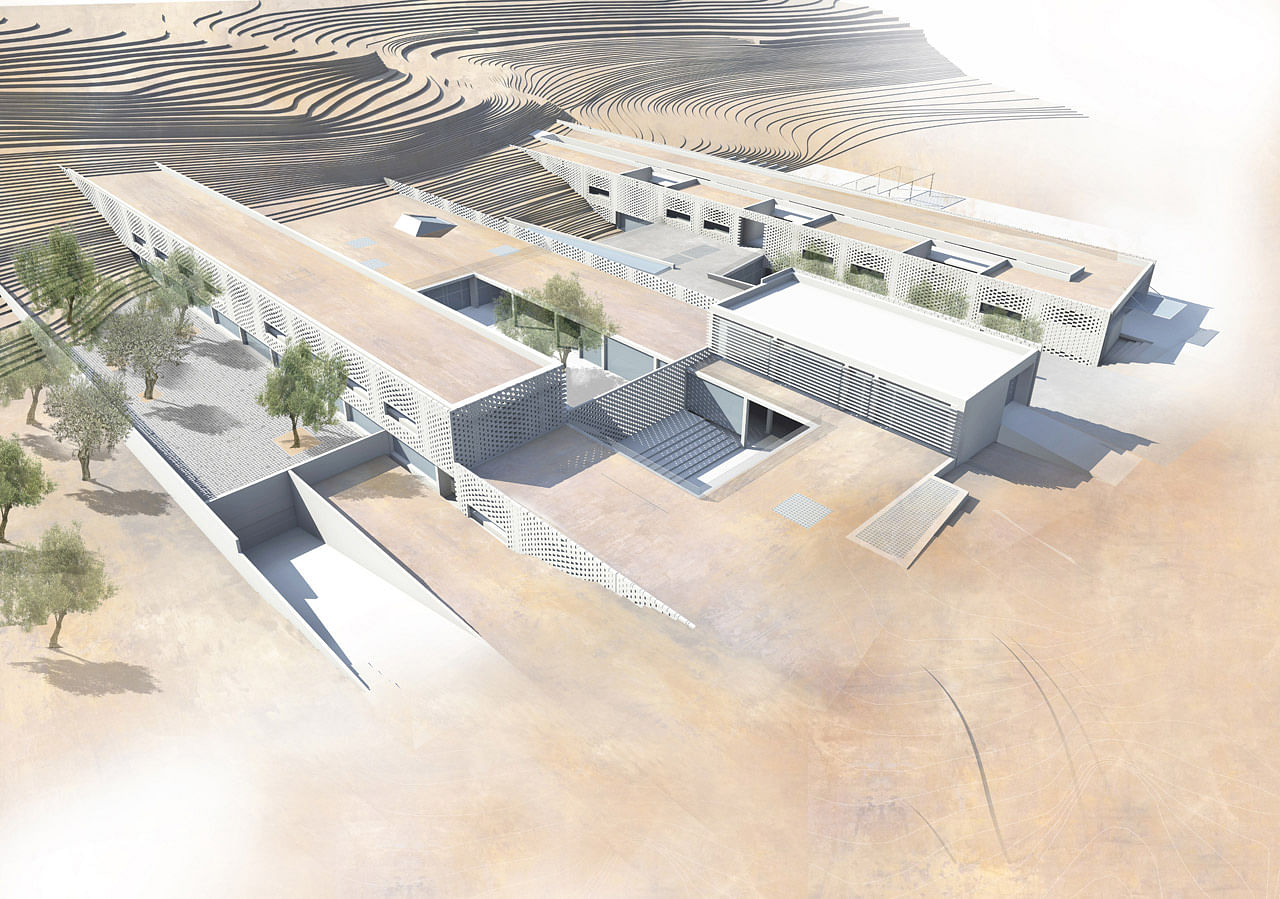
Perspective view

Earlier this month, we published the 3rd place-winning entry in the international architectural competition, Innovative Bioclimatic European School complex in Crete, Greece - SEEH (School of European Education in Heraklion). Here is now also the winner of the 2nd place by Greek architects Platon Issaias, Theodossis Issaias, Costandis Kizis, and Alexandra Vougia. The team collaborated with Ilias Matsas (mechanical engineer) and Giannis Tsafoulias (structural engineer).

Project Description from the Architects:

Our proposal for the Innovative Bioclimatic European School Complex in Crete develops around two fundamental elements of space: light and soil. Instead of romanticizing these two categories, we propose a man-made landscape which mediates and projects our view on the brief’s concerns and demands. Similarly to the olive groves of the surrounding area, our project leaves traces, marks and organizes the earth upon which it is built. Our proposal tries to redefine the existing landscape: it is a ‘bridge’ that connects, a ‘clay wall’ that defines and protects, and a ‘cave’ that shelters knowledge.
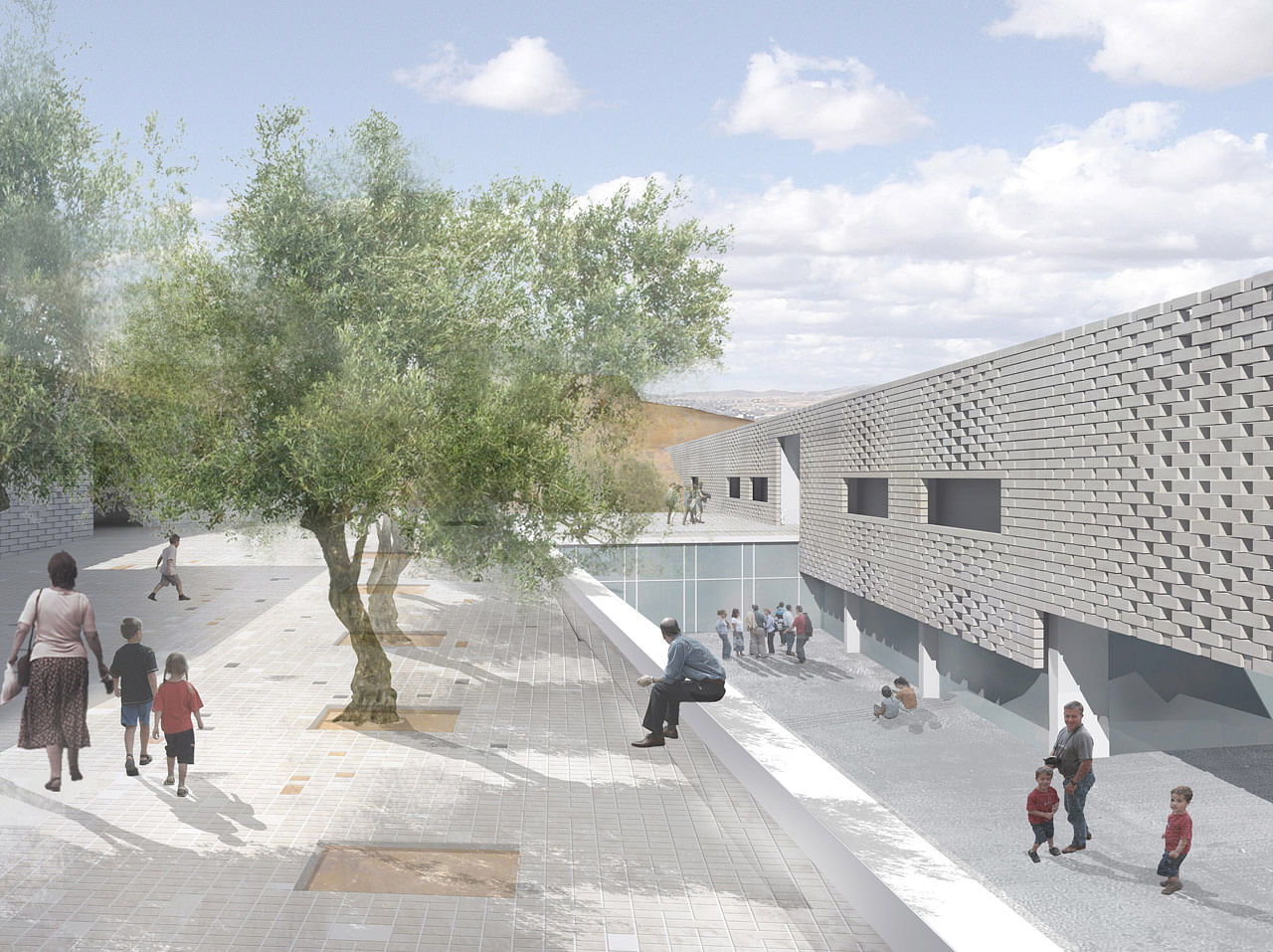
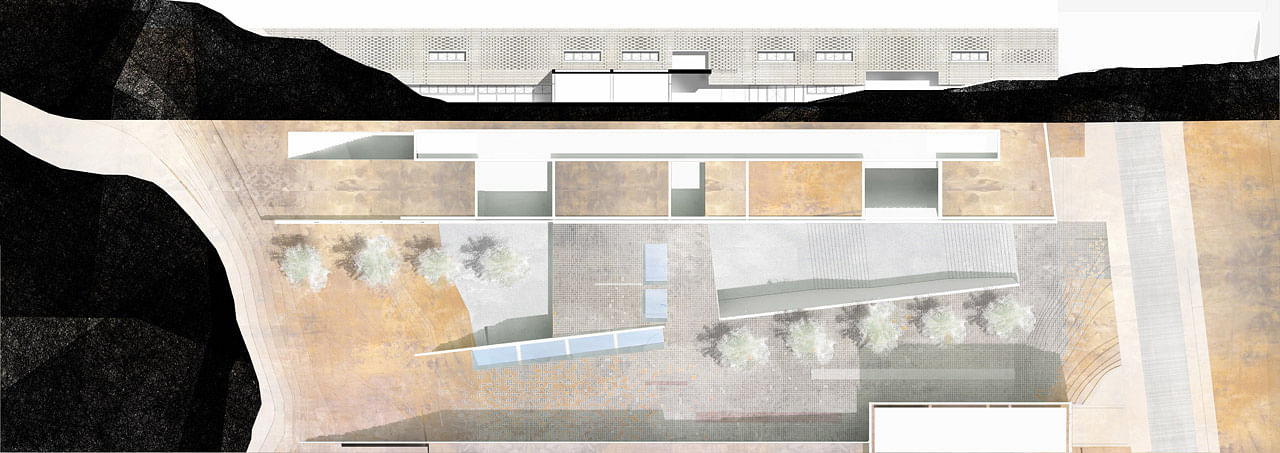
View of the central plaza

We responded to the intense landscape of the area of Voutes, Crete: The cliffs and valleys of the region sought for an architectural gesture that would take advantage of the microclimatic conditions while at the same time would underline the presence of an educational institution, not by standing out, but by letting the natural landscape play the leading role. The agricultural terraces, the dry stone walls and all the other innovative forms of environmentally sustainable management of earth, natural resources and space constitute our primary references.

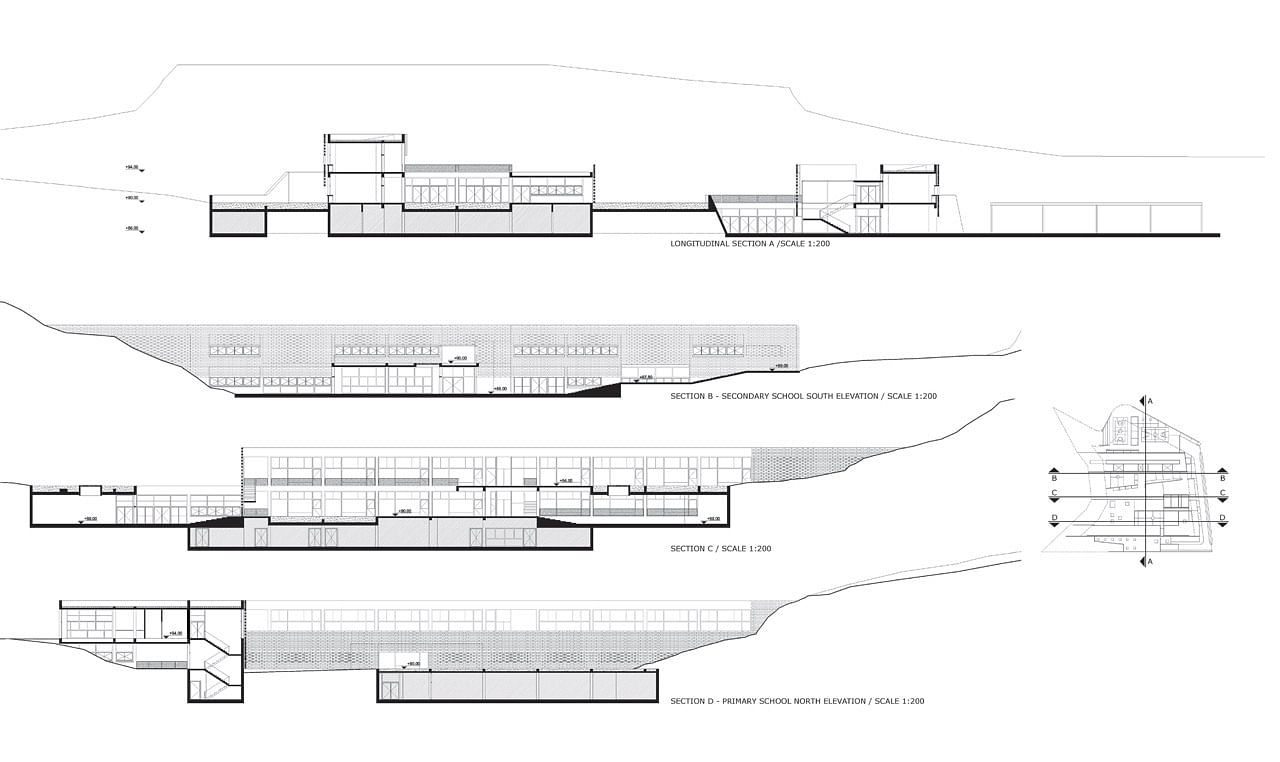
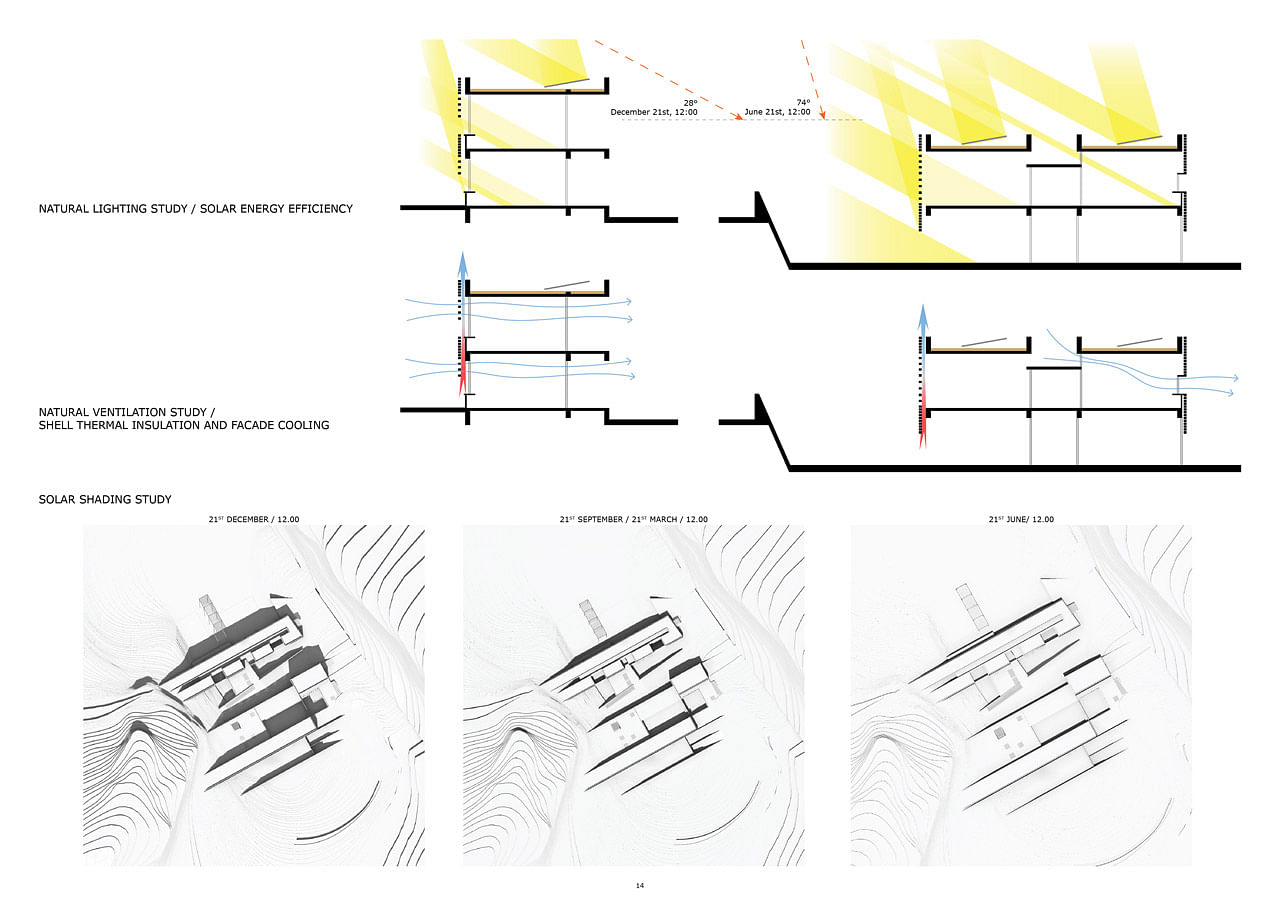
The volumes of the schools are arrayed facing south, in such a way that all the classrooms are exposed to the best bioclimatic conditions of sunshine and natural ventilation.
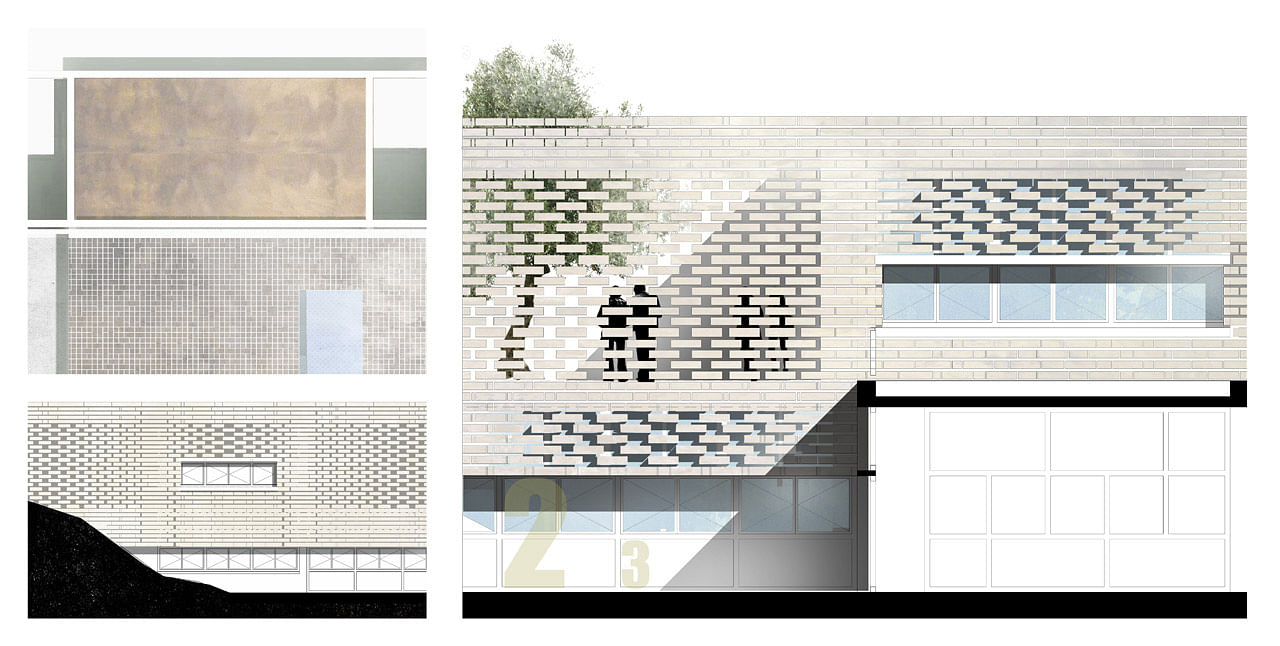
Details

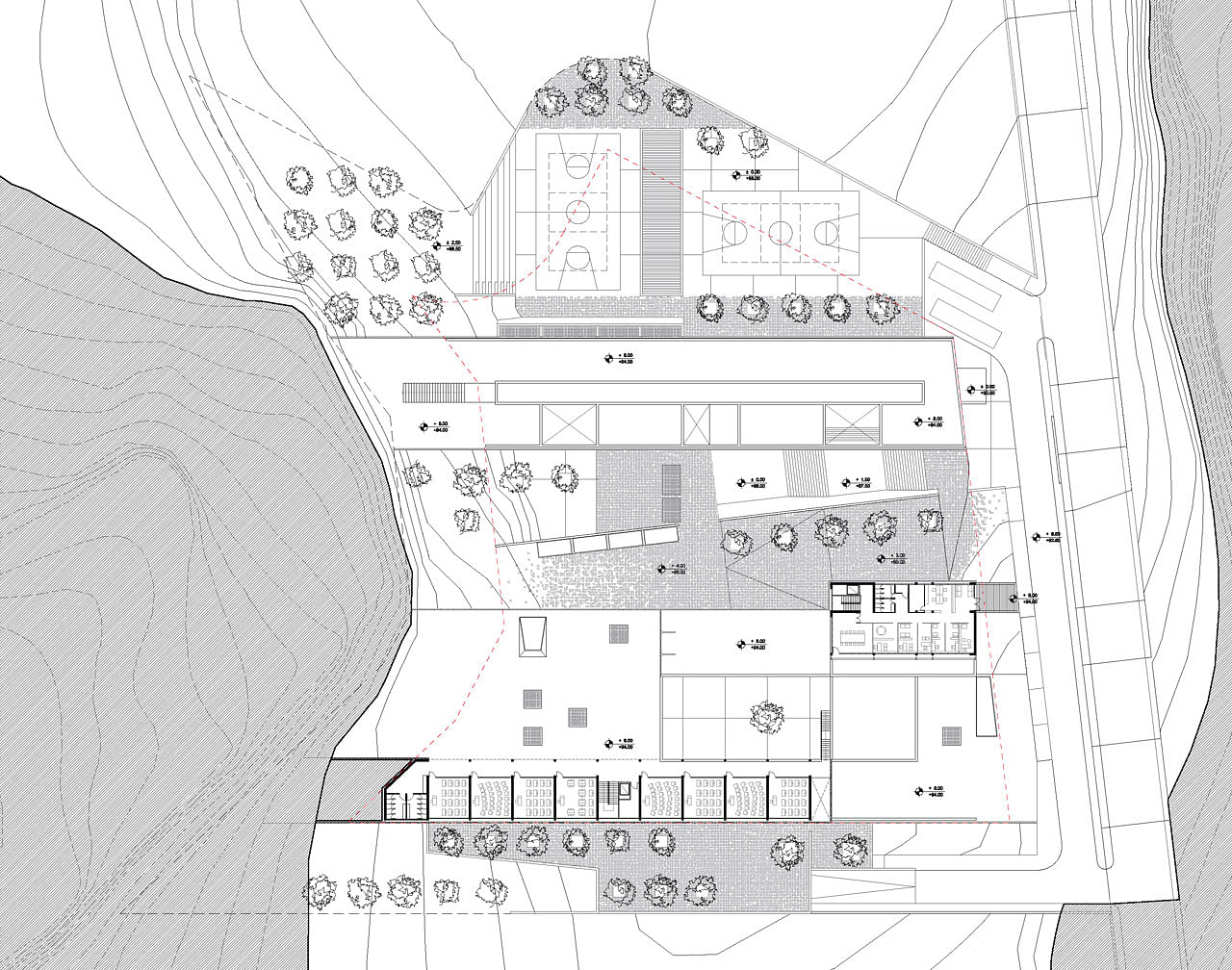
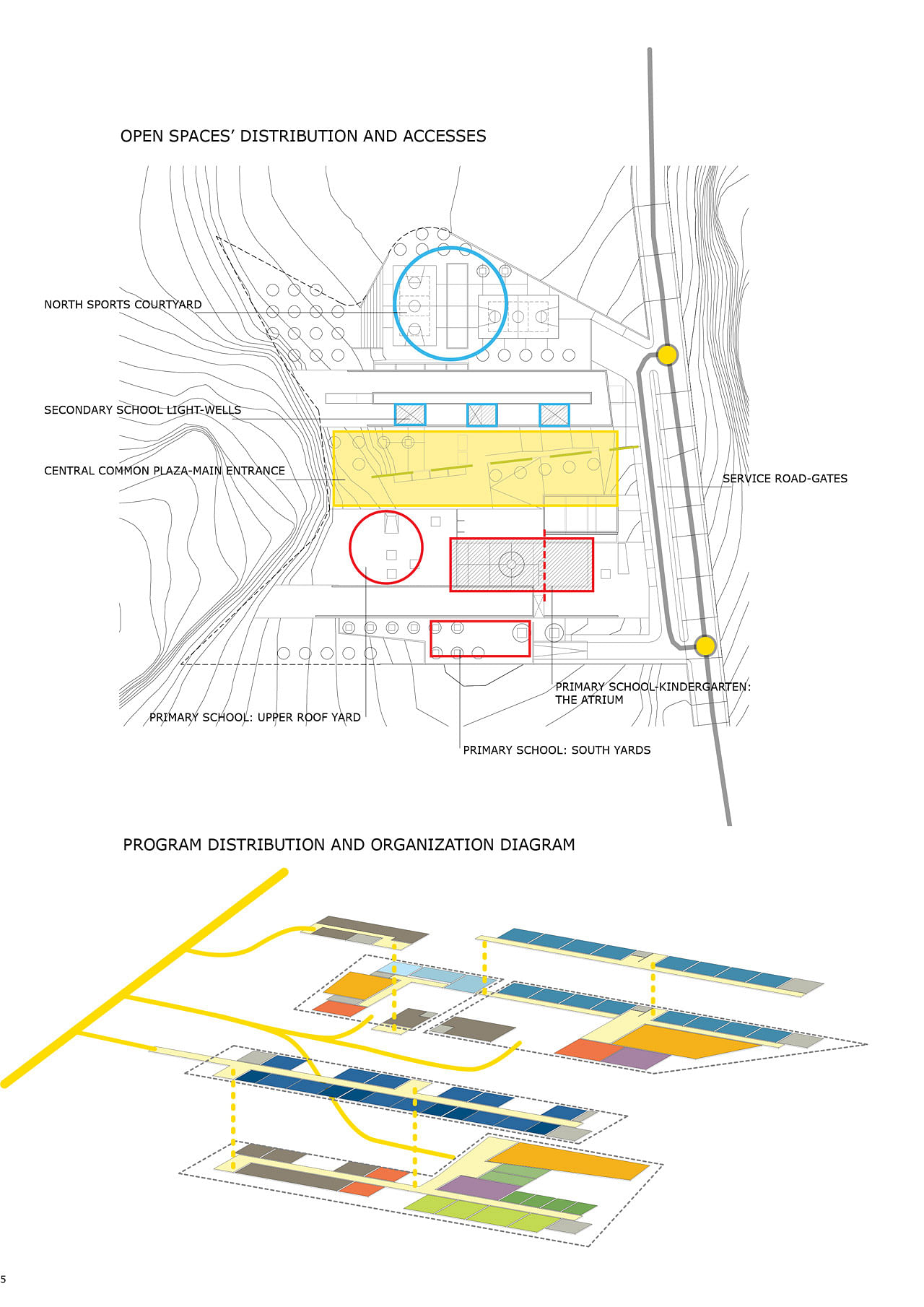
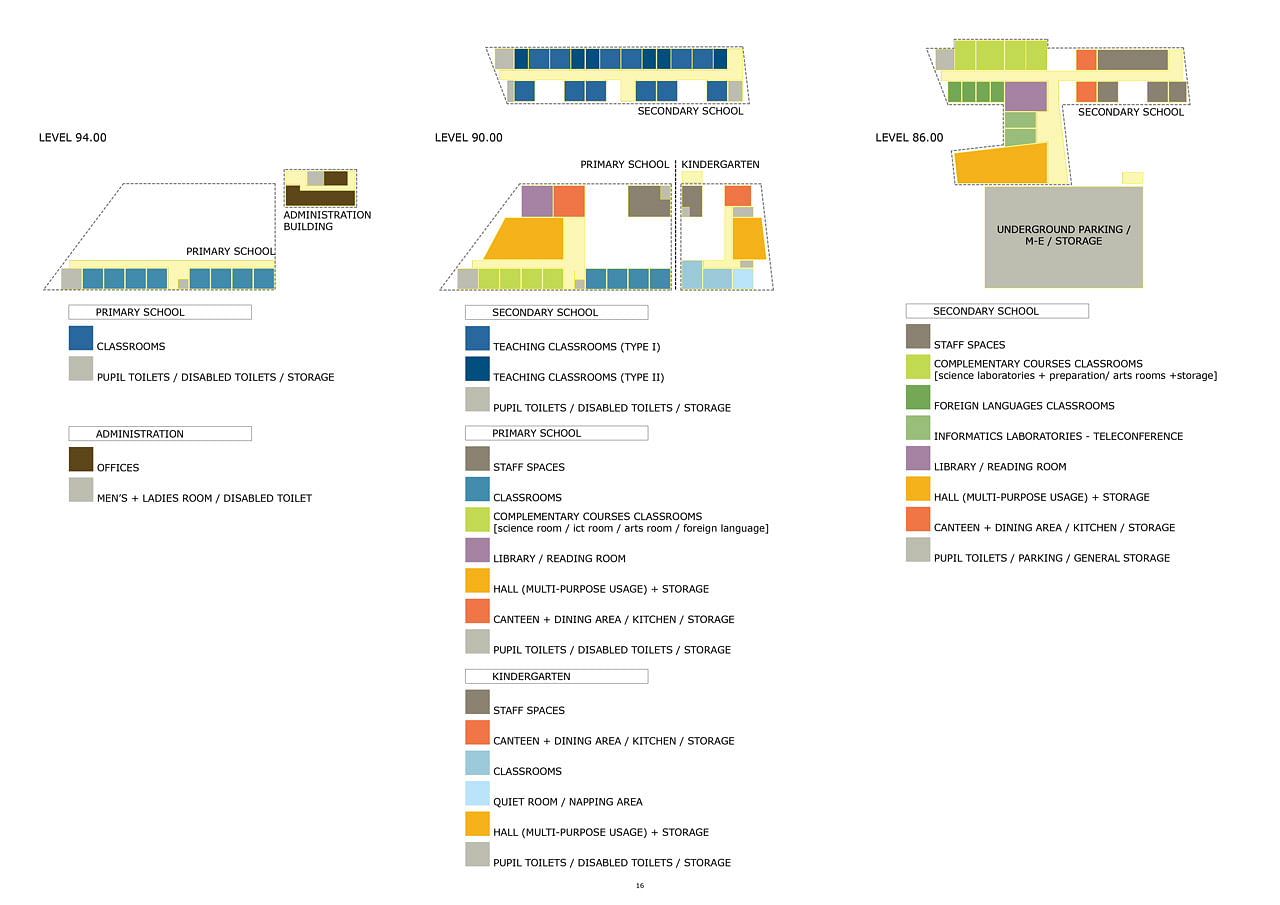
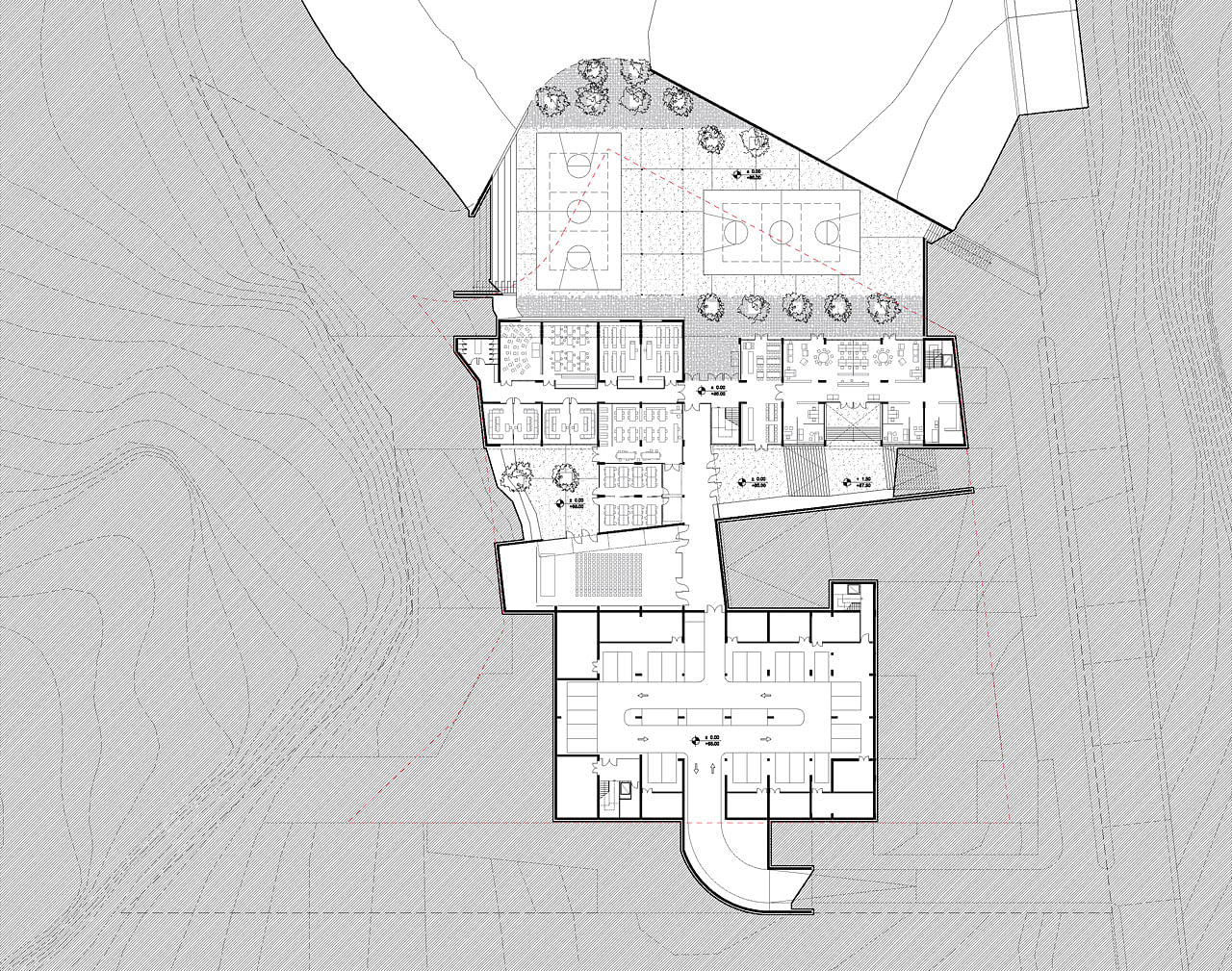
The schools are organized by the sides of a central common open plaza, in three distinct buildings. Despite the allowance for high buildings, our proposal does not exceed the height of two storeys. We dreamt of an open, horizontally organized school that inculcates un-hierarchical, egalitarian values to its students.
The size and typology of each school were dictated by the age of their users, the pupils. The kindergarten is a small scale protected environment, organized around a small yard. The primary school is also organized around a larger atrium, in the fashion of a contemporary agora. The secondary school -the biggest building in the complex- is organized in a rational model of two semi-independent clusters, the lower one being that of the more public uses of the school’s brief, and the higher that of teaching classrooms.
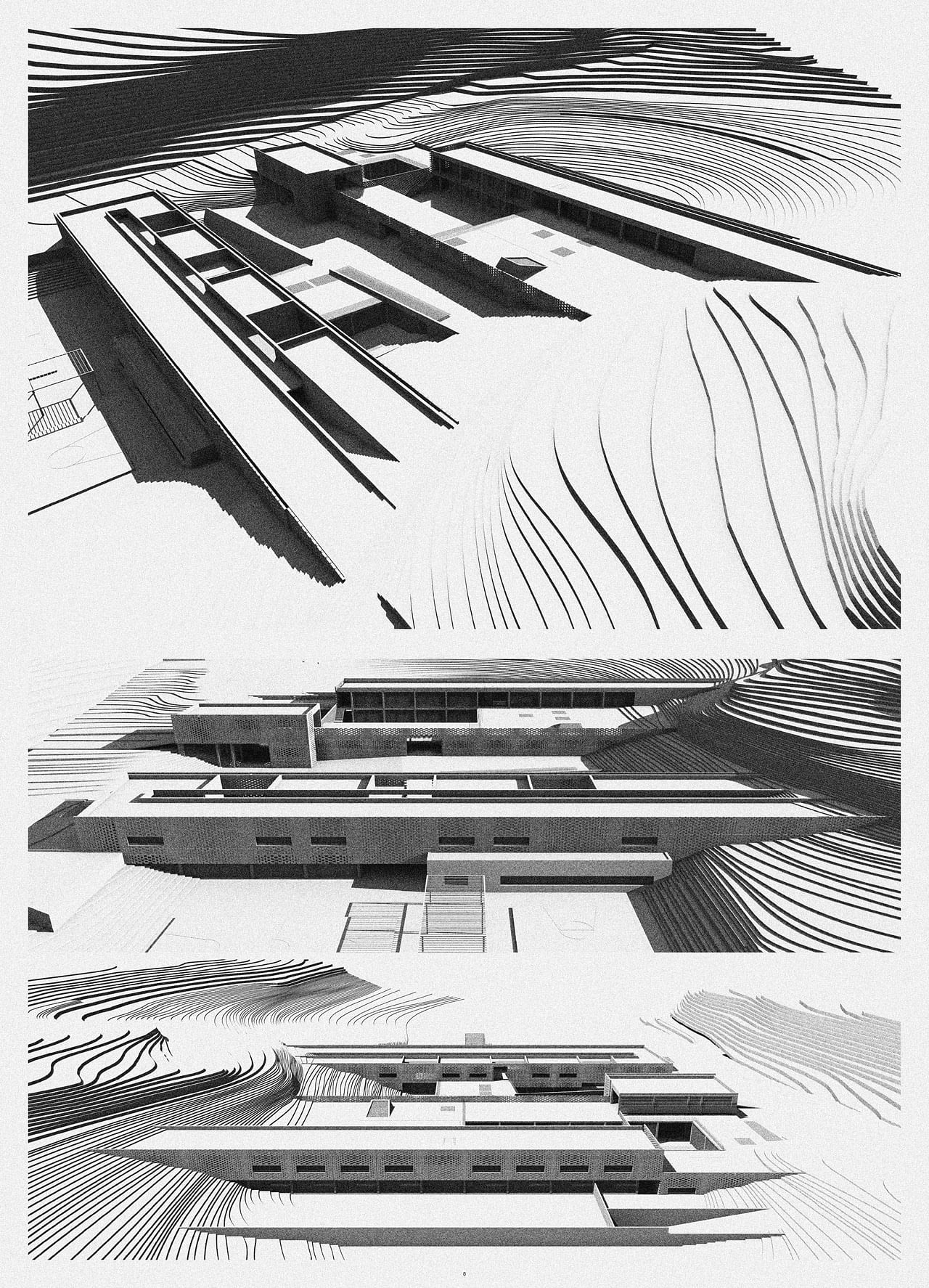
Views

Materials

Our proposal is formed as a contemporary mosaic, which is composed of two basic building elements: the brick and the pavée (paving block). The brick is our tool for unifying the facades, opaque or semi-transparent, according to the programmatic and bioclimatic needs of each space. We proposed the fabrication of a composite brick, made of local materials (clay and sheep wool). The brick not only is a contemporary attempt to continue the tradition of clay fabrication, but also only depends on the local agricultural and farming economy.
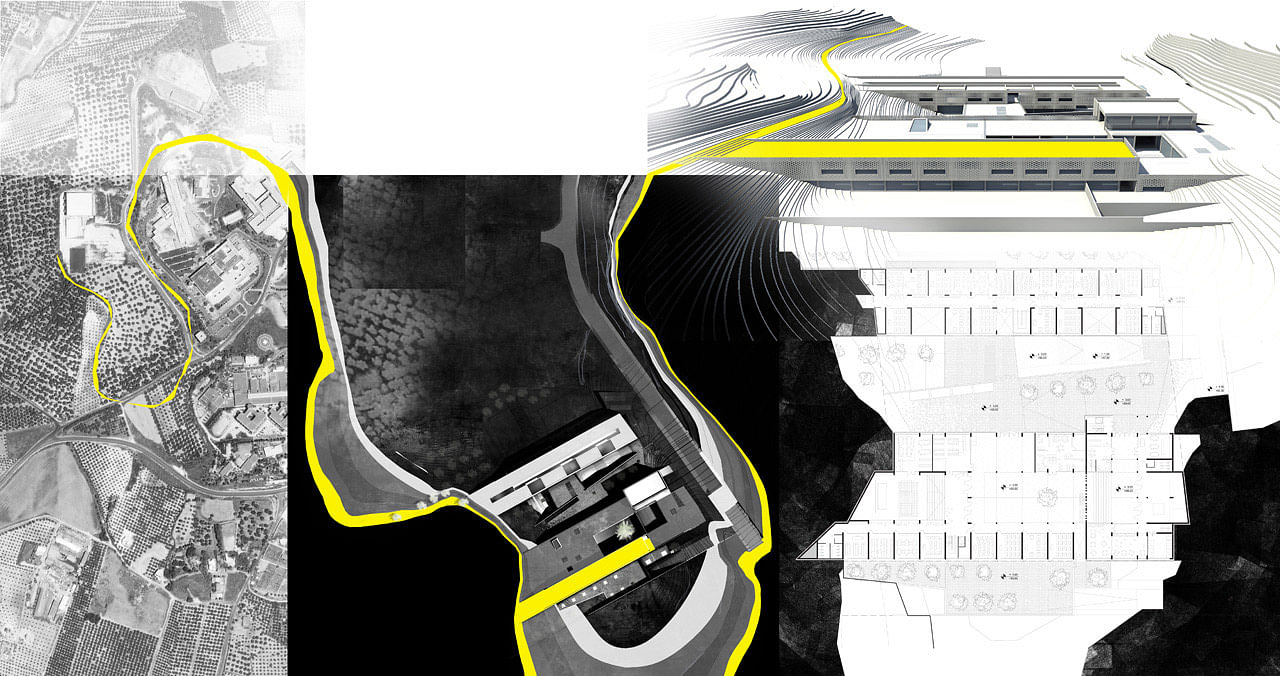
Concept

The pavée is also a local product, coming from one of the island’s numerous quarries. This material is paving all the exterior hard surfaces of the school, and is organically integrated with the natural soil that is prevailing throughout the complex.
Both materials are treated as tools of transition, from opaqueness to semi-transparency, and from the natural soil to a hard surface.

The selection of these two tesserae, the brick and the pavée complies with our intention to propose a building that is generated from the ground, and that gently pays a tribute to the Cretan landscape and culture.
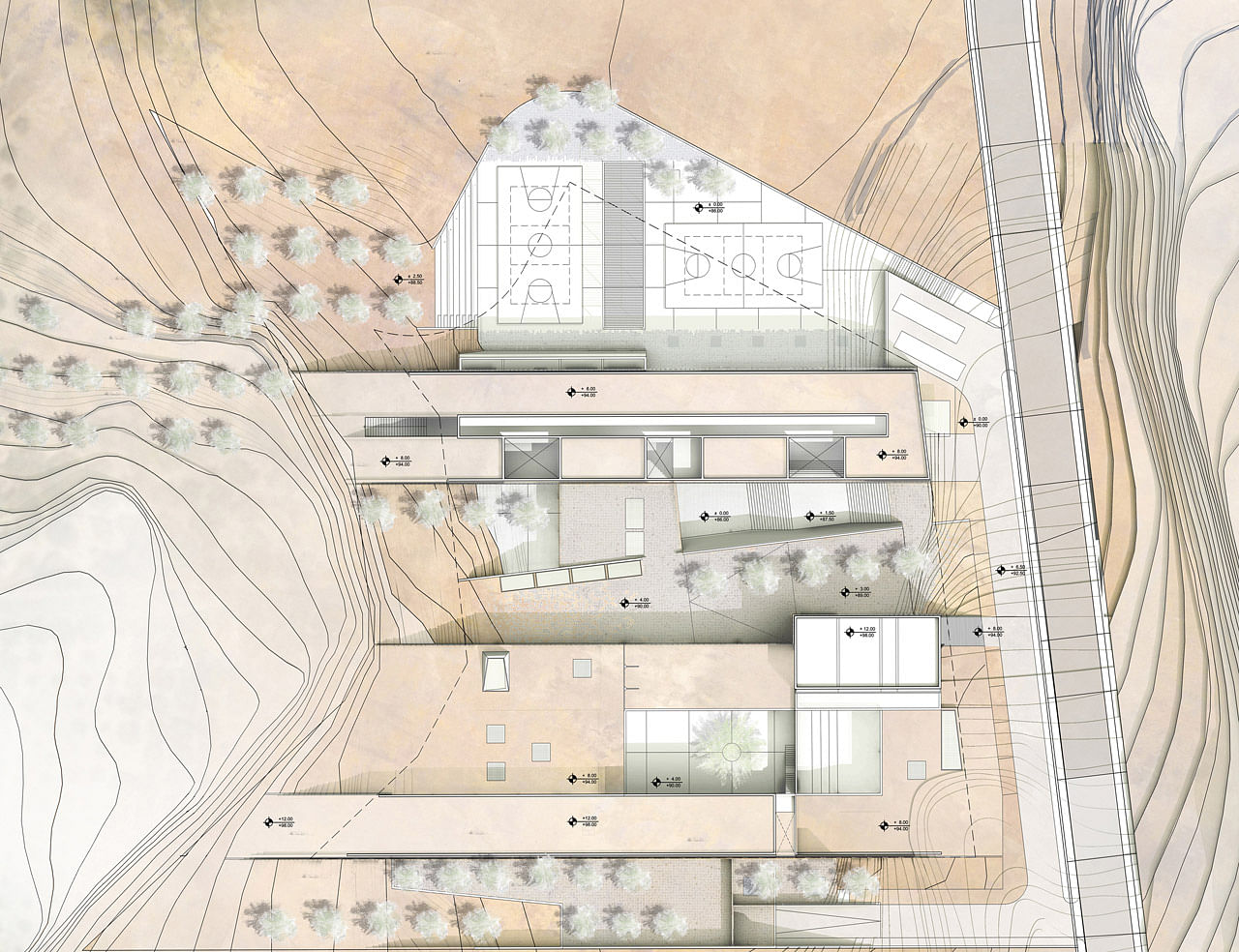
Topographic plan

Find also plans and diagrams of the scheme in the image gallery below.

All images courtesy of Platon Issaias, Theodossis Issaias, Costandis Kizis, Alexandra Vougia.
Related

theodossis issaias ● school ● platon issaias ● kindergarten ● heraklion ● greece ● europe ● education ● crete ● costandis kizis ● alexandra vougia

Share

  • Follow

    0 Comments

  • Comment as :

Crete Innovative Bioclimatic European School Complex - 2nd Place Entry

Sign up for Bustler's Email Newsletters

Next page » Loading

Crete Innovative Bioclimatic European School Complex - 2nd Place Entry

By Bustler Editors|

Wednesday, Jan 30, 2013

Share

Perspective view

Related

theodossis issaias ● school ● platon issaias ● kindergarten ● heraklion ● greece ● europe ● education ● crete ● costandis kizis ● alexandra vougia

Earlier this month, we published the 3rd place-winning entry in the international architectural competition, Innovative Bioclimatic European School complex in Crete, Greece - SEEH (School of European Education in Heraklion). Here is now also the winner of the 2nd place by Greek architects Platon Issaias, Theodossis Issaias, Costandis Kizis, and Alexandra Vougia. The team collaborated with Ilias Matsas (mechanical engineer) and Giannis Tsafoulias (structural engineer).

Project Description from the Architects:

Our proposal for the Innovative Bioclimatic European School Complex in Crete develops around two fundamental elements of space: light and soil. Instead of romanticizing these two categories, we propose a man-made landscape which mediates and projects our view on the brief’s concerns and demands. Similarly to the olive groves of the surrounding area, our project leaves traces, marks and organizes the earth upon which it is built. Our proposal tries to redefine the existing landscape: it is a ‘bridge’ that connects, a ‘clay wall’ that defines and protects, and a ‘cave’ that shelters knowledge.

View of the central plaza

We responded to the intense landscape of the area of Voutes, Crete: The cliffs and valleys of the region sought for an architectural gesture that would take advantage of the microclimatic conditions while at the same time would underline the presence of an educational institution, not by standing out, but by letting the natural landscape play the leading role. The agricultural terraces, the dry stone walls and all the other innovative forms of environmentally sustainable management of earth, natural resources and space constitute our primary references.

The volumes of the schools are arrayed facing south, in such a way that all the classrooms are exposed to the best bioclimatic conditions of sunshine and natural ventilation.

Details

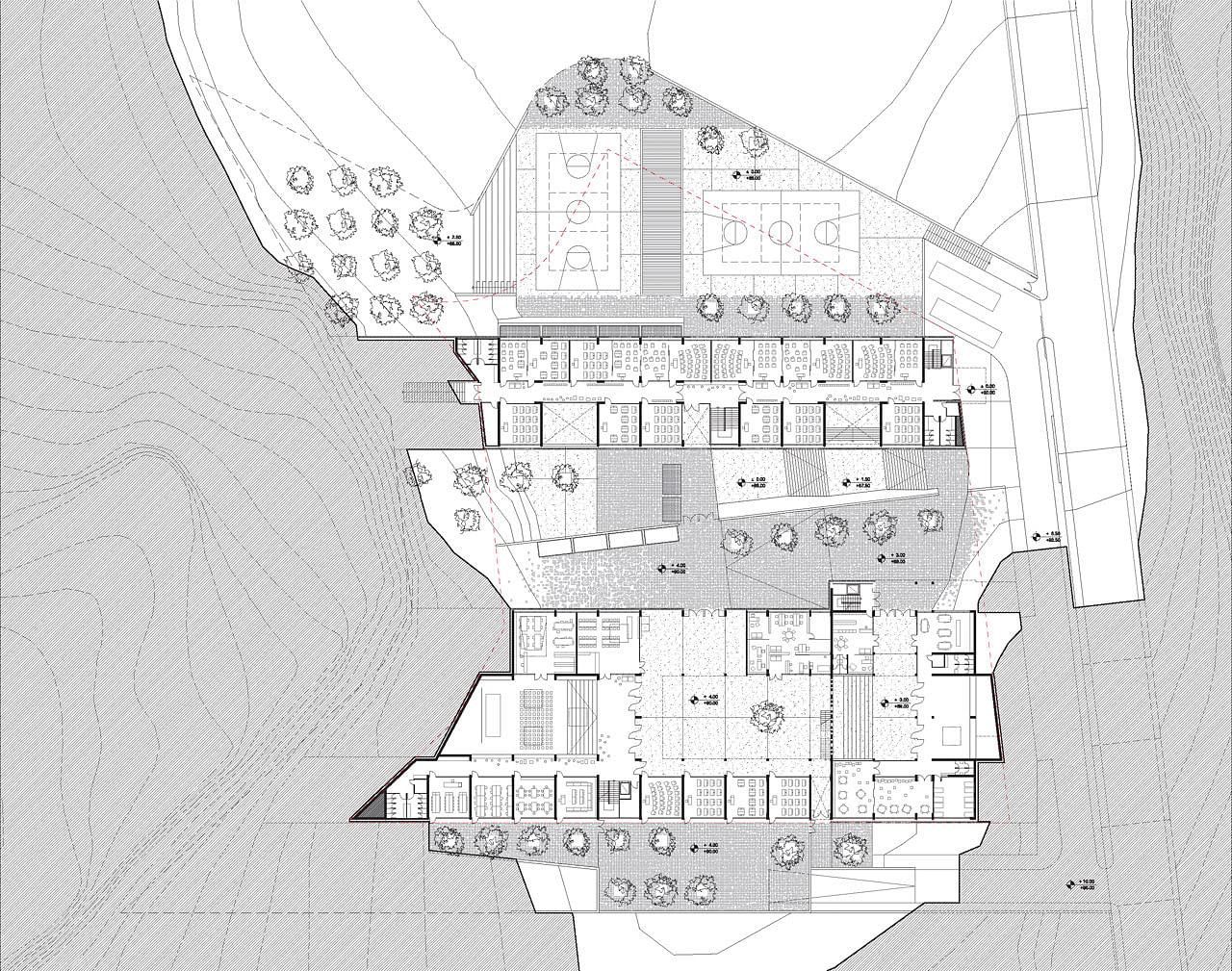
The schools are organized by the sides of a central common open plaza, in three distinct buildings. Despite the allowance for high buildings, our proposal does not exceed the height of two storeys. We dreamt of an open, horizontally organized school that inculcates un-hierarchical, egalitarian values to its students.
The size and typology of each school were dictated by the age of their users, the pupils. The kindergarten is a small scale protected environment, organized around a small yard. The primary school is also organized around a larger atrium, in the fashion of a contemporary agora. The secondary school -the biggest building in the complex- is organized in a rational model of two semi-independent clusters, the lower one being that of the more public uses of the school’s brief, and the higher that of teaching classrooms.

Views

Materials

Our proposal is formed as a contemporary mosaic, which is composed of two basic building elements: the brick and the pavée (paving block). The brick is our tool for unifying the facades, opaque or semi-transparent, according to the programmatic and bioclimatic needs of each space. We proposed the fabrication of a composite brick, made of local materials (clay and sheep wool). The brick not only is a contemporary attempt to continue the tradition of clay fabrication, but also only depends on the local agricultural and farming economy.

Concept

The pavée is also a local product, coming from one of the island’s numerous quarries. This material is paving all the exterior hard surfaces of the school, and is organically integrated with the natural soil that is prevailing throughout the complex.
Both materials are treated as tools of transition, from opaqueness to semi-transparency, and from the natural soil to a hard surface.

The selection of these two tesserae, the brick and the pavée complies with our intention to propose a building that is generated from the ground, and that gently pays a tribute to the Cretan landscape and culture.

Topographic plan

Find also plans and diagrams of the scheme in the image gallery below.

All images courtesy of Platon Issaias, Theodossis Issaias, Costandis Kizis, Alexandra Vougia.
Share

  • Follow

    0 Comments

  • Comment as :

Archinect JobsArchinect Jobs

The Archinect Job Board attracts the world's top architectural design talents.

VIEW ALL JOBS POST A JOB

Project Architect

Pickard Architects

Project Architect

Whittier, CA, US

Senior Hospitality FF&E Designer

bonetti/kozerski architecture DPC

Senior Hospitality FF&E Designer

New York, NY, US

Intermediate Designer

Rafael Viñoly Architects

Intermediate Designer

New York, NY, US

Senior Project Architect

Breland – Harper

Senior Project Architect

Los Angeles, CA, US

Intermediate Residential Architect

52XConsulting

Intermediate Residential Architect

New York, NY, US

Architect 10+

Standard Architects

Architect 10+

Long Island City, NY, US

Senior Technical Designer, Commercial Interiors - New York Office

Fogarty Finger

Senior Technical Designer, Commercial Interiors - New York Office

New York, NY, US

Project Architect

Arrowstreet

Project Architect

Boston, MA, US

Interior Project Manager

HLW International LLP

Interior Project Manager

New York, NY, US

Job Captain / Project Manager

Breland – Harper

Job Captain / Project Manager

Los Angeles, CA, US

Next page » Loading