• Login / Join
  • About
  • •
  • Contact
  • •
  • Advertising
bustler logo
bustler logo
  • News
  • Competitions
  • Events
  • Bustler is powered by Archinect
  • Sign up for Bustler's Email Newsletters

  • Follow these Bustler feeds:

  • Search

    Search in

  • Submit

    What are you submitting?

    News Pitch
    Competition
    Event
  • Login / Join
  • News|Competitions|Events
  • Search
    | Submit
    | Follow
  • Search in

    What are you submitting?

    News Pitch
    Competition
    Event

    Follow these Bustler feeds:

  • About|Contact|Advertising
  • Login / Join
Tagged: industrial area

"The Packard Belt", 2nd-prize Reanimate the Ruins winner in fuller detail

By Bustler Editors|

Monday, Dec 1, 2014

Image courtesy of Javier Galindo.

"Reanimate the Ruins" was another recently concluded ideas competition that challenged entrants to design a new urban center on the site of the historic Packard Motor Plant in Detroit. Entrants had to preserve original components of the decommissioned Packard while integrating new mixed-use elements for future development. And in a sprawled city like Detroit, which is best known for its car culture, one of those required elements was a transportation hub.

Architect Javier Galindo from the U.S. won second prize for his submission, "The Packard Belt."

Check it out right below.

Project description:

"The Packard Automotive Plant in Detroit, a once producer of luxury cars, was completed in 1911 and closed its doors in 1958, subsequently falling into ruin and becoming a symbol of the city’s downfall and financial crisis. The call for an International Competition titled Reanimate the Ruins, aiming to design, master plan and update the complex was immediately fascinating. This story of possible regeneration was moving to me since I was born in Havana, another city that has also become synonymous with ruins and destruction."

Image courtesy of Javier Galindo.

"The Packard Factory ruins are buildings in which cars were born. By thinking of this original situation, the history of the  relationship between the car and the building became central to the project’s narrative. That relationship between the first generation of cars and the buildings with which they coexisted in the city was, from the very beginning, radically autonomous. The car was confined to the street while the building was to be located within the city block, becoming the realm of the people. The worlds of the machine and that of men were detached, and they rarely crisscrossed programmatically."

Image courtesy of Javier Galindo.

"Only until the opening of the Lingotto Building in Turin and others like it, the car became a contributor of building design but this progressive relationship was not carried on in future integrations. The condition of segregation and detachment between the car and building needs reevaluation in favor of a more inclusive and integrated system. The Packard Factory seemed the perfect opportunity to reignite this lost dialogue."

Image courtesy of Javier Galindo.

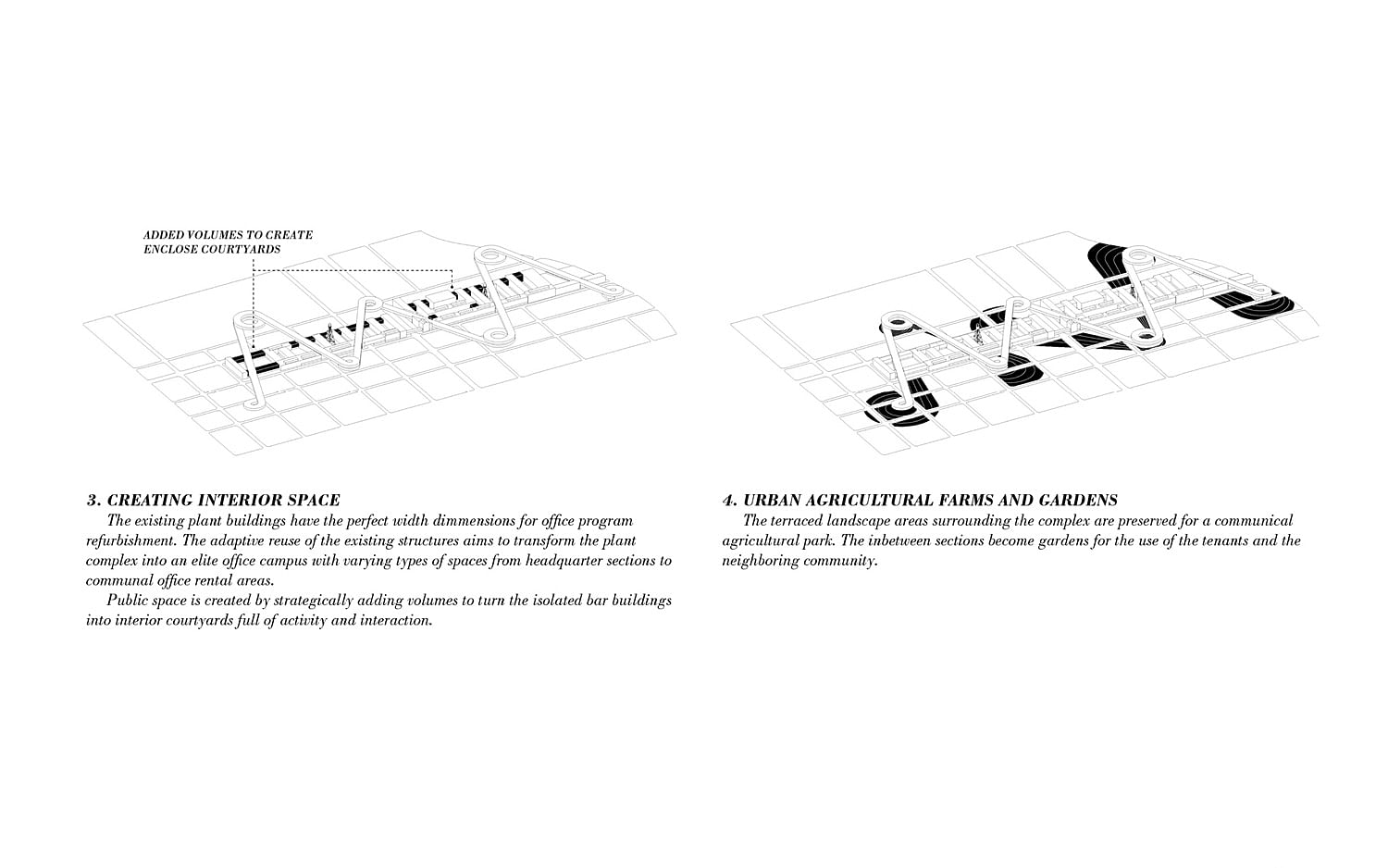
"At 3,000 feet long, the building does not relate to the surrounding city blocks and will always be viewed as a barrier. By dividing the larger volume into smaller buildings, we not only reduce the scale to a contextually sensitive one but also enable porosity across the buildings and the possibility of cross-programmatic interaction."
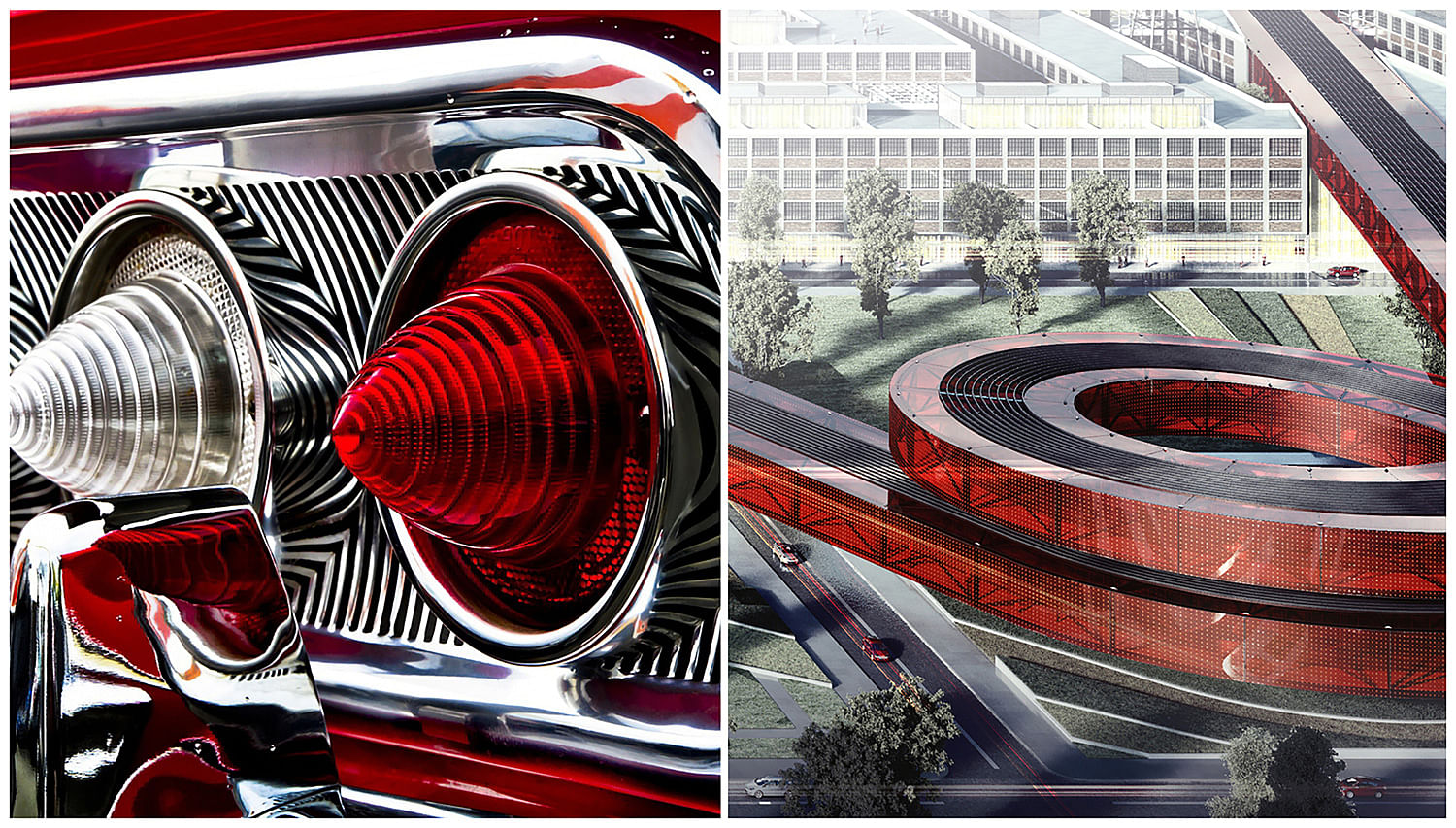
Image courtesy of Javier Galindo.

"Despite the car’s role in creating sprawl and destroying Detroit’s city center, it was impossible to treat it as an irrelevant part of the architecture in this specific case. The created serpentine belt that folds and meanders through the existing structures is seen as a way to stitch together all the resulted smaller scale buildings. It creates the grander gesture needed for a cohesive master plan."

Image courtesy of Javier Galindo.

"The form was inspired by the regenerative power of the serpentine belt found in car engines, which provides and unifies different components into a holistic functioning system. The cultural belt in the project unites the many disparate programmatic elements as well as it generates the high social and cultural voltage for a successful community."

Project details:

THE PACKARD BELT
Status: 2nd PRIZE WINNER.
Reanimate The Ruins Competition.
Design: Javier Galindo, Founder JGCH
Year: 2014  Location: Detroit, Michigan
Program: Mix Used Masterplan, 4,500,000 sqft

Click the thumbnails below for more project images and diagrams.

Related

urban living ● transportation ● transit ● renewal ● packard motor plant ● michigan ● industrial area ● ideas competition ● hub ● historic ● detroit

Share

  • Follow

    0 Comments

  • Comment as :

"The Packard Belt", 2nd-prize Reanimate the Ruins winner in fuller detail

Reanimate the Ruins winners reimagine Detroit's Packard Motor Plant

Sign up for Bustler's Email Newsletters

Next page » Loading

"The Packard Belt", 2nd-prize Reanimate the Ruins winner in fuller detail

By Bustler Editors|

Monday, Dec 1, 2014

Share

Image courtesy of Javier Galindo.

Related

urban living ● transportation ● transit ● renewal ● packard motor plant ● michigan ● industrial area ● ideas competition ● hub ● historic ● detroit

"Reanimate the Ruins" was another recently concluded ideas competition that challenged entrants to design a new urban center on the site of the historic Packard Motor Plant in Detroit. Entrants had to preserve original components of the decommissioned Packard while integrating new mixed-use elements for future development. And in a sprawled city like Detroit, which is best known for its car culture, one of those required elements was a transportation hub.

Architect Javier Galindo from the U.S. won second prize for his submission, "The Packard Belt."

Check it out right below.

Project description:

"The Packard Automotive Plant in Detroit, a once producer of luxury cars, was completed in 1911 and closed its doors in 1958, subsequently falling into ruin and becoming a symbol of the city’s downfall and financial crisis. The call for an International Competition titled Reanimate the Ruins, aiming to design, master plan and update the complex was immediately fascinating. This story of possible regeneration was moving to me since I was born in Havana, another city that has also become synonymous with ruins and destruction."

Image courtesy of Javier Galindo.

"The Packard Factory ruins are buildings in which cars were born. By thinking of this original situation, the history of the  relationship between the car and the building became central to the project’s narrative. That relationship between the first generation of cars and the buildings with which they coexisted in the city was, from the very beginning, radically autonomous. The car was confined to the street while the building was to be located within the city block, becoming the realm of the people. The worlds of the machine and that of men were detached, and they rarely crisscrossed programmatically."

Image courtesy of Javier Galindo.

"Only until the opening of the Lingotto Building in Turin and others like it, the car became a contributor of building design but this progressive relationship was not carried on in future integrations. The condition of segregation and detachment between the car and building needs reevaluation in favor of a more inclusive and integrated system. The Packard Factory seemed the perfect opportunity to reignite this lost dialogue."

Image courtesy of Javier Galindo.

"At 3,000 feet long, the building does not relate to the surrounding city blocks and will always be viewed as a barrier. By dividing the larger volume into smaller buildings, we not only reduce the scale to a contextually sensitive one but also enable porosity across the buildings and the possibility of cross-programmatic interaction."

Image courtesy of Javier Galindo.

"Despite the car’s role in creating sprawl and destroying Detroit’s city center, it was impossible to treat it as an irrelevant part of the architecture in this specific case. The created serpentine belt that folds and meanders through the existing structures is seen as a way to stitch together all the resulted smaller scale buildings. It creates the grander gesture needed for a cohesive master plan."

Image courtesy of Javier Galindo.

"The form was inspired by the regenerative power of the serpentine belt found in car engines, which provides and unifies different components into a holistic functioning system. The cultural belt in the project unites the many disparate programmatic elements as well as it generates the high social and cultural voltage for a successful community."

Project details:

THE PACKARD BELT
Status: 2nd PRIZE WINNER.
Reanimate The Ruins Competition.
Design: Javier Galindo, Founder JGCH
Year: 2014  Location: Detroit, Michigan
Program: Mix Used Masterplan, 4,500,000 sqft

Click the thumbnails below for more project images and diagrams.

Share

  • Follow

    0 Comments

  • Comment as :

Archinect JobsArchinect Jobs

The Archinect Job Board attracts the world's top architectural design talents.

VIEW ALL JOBS POST A JOB

Project Manager/Designer

BOTO Design Architects

Project Manager/Designer

Santa Monica, CA, US

Architectural Designer

Build Block Inc.

Architectural Designer

Los Angeles, CA, US

Job Captain

Studio AR&D Architects

Job Captain

Los Angeles, CA, US

Junior Designer

Shadow Architect, P.C.

Junior Designer

New York, NY, US

Office Assistant / Studio Coordinator

Beinfield Architecture PC

Office Assistant / Studio Coordinator

Norwalk, CT, US

Senior Designer - Residential Design

Laura U Design Collective

Senior Designer - Residential Design

Houston, TX, US

Project Architect

Lang Architecture

Project Architect

New York, NY, US

Junior Architect / Architectural Designer

S20M

Junior Architect / Architectural Designer

New York, NY, US

Architectural Associate/Junior Architect

Goldstone Architecture

Architectural Associate/Junior Architect

Bennington, VT, US

Project Architect/ Designer

Nandinee Phookan Architect, P.C.

Project Architect/ Designer

New York, NY, US

Next page » Loading