• Login / Join
  • About
  • •
  • Contact
  • •
  • Advertising
bustler logo
bustler logo
  • News
  • Competitions
  • Events
  • Bustler is powered by Archinect
  • Sign up for Bustler's Email Newsletters

  • Follow these Bustler feeds:

  • Search

    Search in

  • Submit

    What are you submitting?

    News Pitch
    Competition
    Event
  • Login / Join
  • News|Competitions|Events
  • Search
    | Submit
    | Follow
  • Search in

    What are you submitting?

    News Pitch
    Competition
    Event

    Follow these Bustler feeds:

  • About|Contact|Advertising
  • Login / Join
Tagged: landscape of the year

Taylor Cullity Lethlean wins Landscape of the Year Award for the second year in a row

By Bustler Editors|

Tuesday, Oct 7, 2014

The sculptured landforms of the Central Clearing form part of the visitor arrival sequence. Photograph by John Gollings.

It's another lucky year for Australian landscape architecture firm Taylor Cullity Lethlean, who won the World Architecture Festival Landscape of the Year award once again. For 2014, the firm received the top Landscape award for the National Arboretum in Canberra, Australia, designed in collaboration with Tonkin Zulaikha Greer. Last year, TCL scooped up Landscape of the Year for the Australian Garden.

One unique feature of The Arboretum is that it houses 100 "forests" of the most endangered trees species on a 250-hectare site where a major fire occurred in 2003. Aesthetics aside, the trees also make a statement on issues about biodiversity and public environmental concern.

Learn more about the project right below.

Project description:

"The design of Australia’s National Arboretum was selected via an international designcompetition following the devastating Canberra bush fires of 2003.  The winning concept; 100 Forests, comprises forests with 100 of the world’s most endangered tree species. 100 Forests redefines the meaning of public garden in the 21st century. Growing out of very real issues of sustainability, biodiversity, and public environmental concern; 100 Forests is a strategy, a program and an ongoing event, not a design based chiefly on aesthetics."

The Arboretum is host to a series of large sculptures that will, over time, be discovered within the forest landscape. Photograph by John Gollings.

"100 Forests not only provides unique experiences, the pleasure of being enveloped in a forest of one endangered species; but is more importantly a seed bank for the future. Each holds a viable seed population to preserve these threatened species.100 Forests is located above the shores of Lake Burley Griffin in the Australian National Capital, Canberra. The 250ha site with its rolling, elevated topography, panoramic city views and two stands of individual exotic tree species planted under the direction of the city’s Masterplan designers Walter and Marion Burley-Griffin, provided the canvas and catalyst for the design."
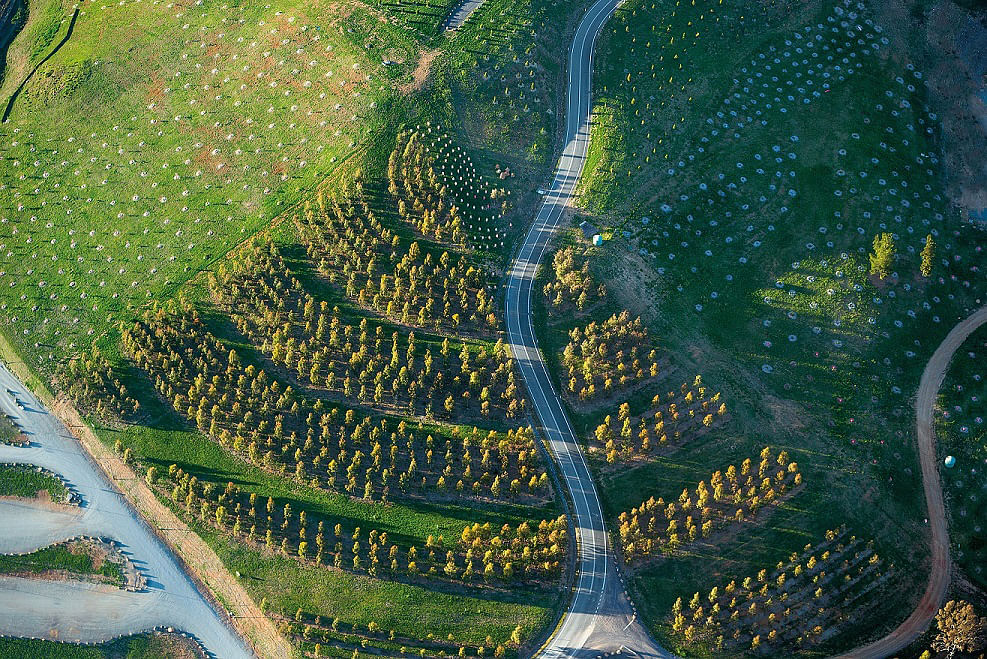
The layout of the trees are distinct for each forest and are designed based on their botanical or cultural qualities for each species. Each TCL designer provided ideas for the 100 forests, with the result of a patchwork of ideas. Photograph by John Gollings.

"The forests, each 2-3 hectares in size, are arranged via a grid across the undulating  topography, which are orientated to align with a civic axis created by the Burley-Griffins. This   patchwork of forests, with their varying colour, form and textures, provide a striking backdrop the city and engages at an urban scale with the developing City. 

The Arboretum offers a contemporary reinterpretation of the notion of arboretum by including botanically threatened or ethnobotanically significant tree species from around the world into a repository of biodiversity for the future.

The result of planting the trees into single-species forest lots containing between 300 and 2000 trees will be a botanically significant collection offering an immersive experience of form, colour and light, augmented by the rustle of leaf-litter, the texture of the bark and the sound of wind moving through the canopies."

Large terraced earth sculptures form the major arrival sequence into the Arboretum. At the base, a carefully designed irrigation system directs water to the dam to redistribute back into the Arboretum. Photograph by John Gollings.

"The project has established connections across the world through the botanical value of itscollection to institutions interested in preserving the planet’s biodiversity such as the   Millennium Seed Bank in Kew Gardens, England and more locally with the Australian National University, Canberra. 100 forests is an important civic and community venue, not only providing education, interpretation and experiences within some of the world’s most beautiful trees; it is also a setting for events, gardens play, cafes amphitheatres and recreational paths.

Beautiful architectural and event spaces engage the visitor to connect with the setting, creating a ‘heart’ to the project which can grow over time, expanding as the Arboretum and city expand."
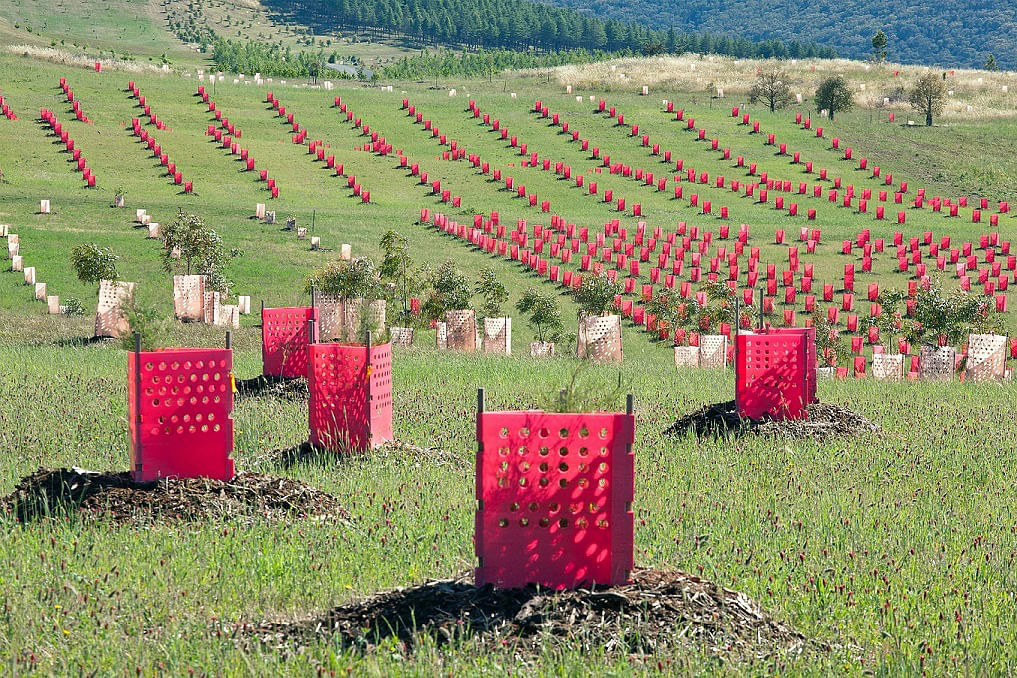
All of the 100 forests are arranged differently, the qualities provide distinct spatial arrangements that respond to species horticultural requirements and many cultural themes. Photograph by Ben Wrigley.

"The spatial concept of the Arboretum can be explained sequentially through the carefully choreographed arrival experience from outside into the core. When approaching the   entrance a portal of forests immediately immerses the visitor. The entrance road then gently twists through the forest before breaking out into the central valley clearing with 12ha of sculpted and terraced landform reaching up over 50m in elevation towards the ‘canopy’ form of the Visitor’s Centre building."

View from the bottom of the central valley toward the Visitors Centre. Visitors Centre by TZG Architects. Photograph by John Gollings.

"Immersion continues as a short walk takes the visitor towards the crest of the hill where a rock-walled ravine has been carved through the earth, enclosing and directing them to the Visitor’s Centre building and toward the heart of the arboretum. After this confined experience, the open vaulted ceiling and timber beams of the canopy-like building reach up-and-over to a panoramic vista through the sculpted, forest lined central valley and across the lake to the city of Canberra.

The visitor centre provides not only orientates visitors to the 100 forest experiences, it also links  to adjacent the adjacent 'Pod Playspace' which creatively engages children with the beauty of trees and fosters a life-long connection to this remarkable environment.  Using the idea of seeds as the beginning life amongst the forest, children and their families   can enter a fantasy world of exaggerated scales. A play space with giant acorns floating in the sky, and enormous Banksia cones nestled on the forest floor."

The Pod Playground consists of a toddler play area (Banksias), swing set area, older children area (Acorns) and net play to the left of the Acorns. The Acorn area consists of six Acorn cubby houses varying in height from 2.5 metres to 5 metres above ground. Photograph by Brett Boardman.

"The design recognises that play is a vital social development and educational tool for  children of all ages, and is particularly important when it assists in forming relationships to its   landscape, climate and surrounding context. The world amongst the giant seeds aims to stimulate spontaneity and creativity, to foster the imagination and to challenge and   encourage confidence with growth."

Rope tunnels connect four of the Acorns together, creating a clambering play element for children to explore the Acorns. The enclosed rope tunnels also allow heights to exceed 2.5 metres from the ground. Photograph by Gemma Fennell.

"100 Forests is a living project, it has no completion date, its experiences and messages will continually evolve and adapt; creating experiences of true community within a sublime  place that will grow with the people, the city and the nation."

‘Wide Brown Land’ Sculpture. Located near recently planted Washingtonia SP. Photograph by John Gollings.

Project details and credits

Project Designers/Credit: Taylor Cullity Lethlean (TCL) with Tonkin Zulaikha Greer (TZG)

Project Name: National Arboretum Canberra
Project Completion year: 2013
Town/Emplacement: Canberra
Location: Canberra, Australian Capital Territory, Australia
Surface Area: 250 Hectares
Construction Companies: Urban Contractors; Cord Civil; Design Landscapes; Guidelines; BurHor and Marsupial Landscape Management
Site Management: Cardno
Forest Curator –Adam Burgess
Maintenance manager: Adam Burgess

Related

world architecture festival ● waf awards ● waf ● trees ● landscape of the year ● landscape design ● landscape architecture ● landscape ● forest ● environmental design ● australia

Share

  • Follow

    0 Comments

  • Comment as :

Taylor Cullity Lethlean wins Landscape of the Year Award for the second year in a row

Sign up for Bustler's Email Newsletters

Next page » Loading

Taylor Cullity Lethlean wins Landscape of the Year Award for the second year in a row

By Bustler Editors|

Tuesday, Oct 7, 2014

Share

The sculptured landforms of the Central Clearing form part of the visitor arrival sequence. Photograph by John Gollings.

Related

world architecture festival ● waf awards ● waf ● trees ● landscape of the year ● landscape design ● landscape architecture ● landscape ● forest ● environmental design ● australia

It's another lucky year for Australian landscape architecture firm Taylor Cullity Lethlean, who won the World Architecture Festival Landscape of the Year award once again. For 2014, the firm received the top Landscape award for the National Arboretum in Canberra, Australia, designed in collaboration with Tonkin Zulaikha Greer. Last year, TCL scooped up Landscape of the Year for the Australian Garden.

One unique feature of The Arboretum is that it houses 100 "forests" of the most endangered trees species on a 250-hectare site where a major fire occurred in 2003. Aesthetics aside, the trees also make a statement on issues about biodiversity and public environmental concern.

Learn more about the project right below.

Project description:

"The design of Australia’s National Arboretum was selected via an international designcompetition following the devastating Canberra bush fires of 2003.  The winning concept; 100 Forests, comprises forests with 100 of the world’s most endangered tree species. 100 Forests redefines the meaning of public garden in the 21st century. Growing out of very real issues of sustainability, biodiversity, and public environmental concern; 100 Forests is a strategy, a program and an ongoing event, not a design based chiefly on aesthetics."

The Arboretum is host to a series of large sculptures that will, over time, be discovered within the forest landscape. Photograph by John Gollings.

"100 Forests not only provides unique experiences, the pleasure of being enveloped in a forest of one endangered species; but is more importantly a seed bank for the future. Each holds a viable seed population to preserve these threatened species.100 Forests is located above the shores of Lake Burley Griffin in the Australian National Capital, Canberra. The 250ha site with its rolling, elevated topography, panoramic city views and two stands of individual exotic tree species planted under the direction of the city’s Masterplan designers Walter and Marion Burley-Griffin, provided the canvas and catalyst for the design."

The layout of the trees are distinct for each forest and are designed based on their botanical or cultural qualities for each species. Each TCL designer provided ideas for the 100 forests, with the result of a patchwork of ideas. Photograph by John Gollings.

"The forests, each 2-3 hectares in size, are arranged via a grid across the undulating  topography, which are orientated to align with a civic axis created by the Burley-Griffins. This   patchwork of forests, with their varying colour, form and textures, provide a striking backdrop the city and engages at an urban scale with the developing City. 

The Arboretum offers a contemporary reinterpretation of the notion of arboretum by including botanically threatened or ethnobotanically significant tree species from around the world into a repository of biodiversity for the future.

The result of planting the trees into single-species forest lots containing between 300 and 2000 trees will be a botanically significant collection offering an immersive experience of form, colour and light, augmented by the rustle of leaf-litter, the texture of the bark and the sound of wind moving through the canopies."

Large terraced earth sculptures form the major arrival sequence into the Arboretum. At the base, a carefully designed irrigation system directs water to the dam to redistribute back into the Arboretum. Photograph by John Gollings.

"The project has established connections across the world through the botanical value of itscollection to institutions interested in preserving the planet’s biodiversity such as the   Millennium Seed Bank in Kew Gardens, England and more locally with the Australian National University, Canberra. 100 forests is an important civic and community venue, not only providing education, interpretation and experiences within some of the world’s most beautiful trees; it is also a setting for events, gardens play, cafes amphitheatres and recreational paths.

Beautiful architectural and event spaces engage the visitor to connect with the setting, creating a ‘heart’ to the project which can grow over time, expanding as the Arboretum and city expand."

All of the 100 forests are arranged differently, the qualities provide distinct spatial arrangements that respond to species horticultural requirements and many cultural themes. Photograph by Ben Wrigley.

"The spatial concept of the Arboretum can be explained sequentially through the carefully choreographed arrival experience from outside into the core. When approaching the   entrance a portal of forests immediately immerses the visitor. The entrance road then gently twists through the forest before breaking out into the central valley clearing with 12ha of sculpted and terraced landform reaching up over 50m in elevation towards the ‘canopy’ form of the Visitor’s Centre building."

View from the bottom of the central valley toward the Visitors Centre. Visitors Centre by TZG Architects. Photograph by John Gollings.

"Immersion continues as a short walk takes the visitor towards the crest of the hill where a rock-walled ravine has been carved through the earth, enclosing and directing them to the Visitor’s Centre building and toward the heart of the arboretum. After this confined experience, the open vaulted ceiling and timber beams of the canopy-like building reach up-and-over to a panoramic vista through the sculpted, forest lined central valley and across the lake to the city of Canberra.

The visitor centre provides not only orientates visitors to the 100 forest experiences, it also links  to adjacent the adjacent 'Pod Playspace' which creatively engages children with the beauty of trees and fosters a life-long connection to this remarkable environment.  Using the idea of seeds as the beginning life amongst the forest, children and their families   can enter a fantasy world of exaggerated scales. A play space with giant acorns floating in the sky, and enormous Banksia cones nestled on the forest floor."

The Pod Playground consists of a toddler play area (Banksias), swing set area, older children area (Acorns) and net play to the left of the Acorns. The Acorn area consists of six Acorn cubby houses varying in height from 2.5 metres to 5 metres above ground. Photograph by Brett Boardman.

"The design recognises that play is a vital social development and educational tool for  children of all ages, and is particularly important when it assists in forming relationships to its   landscape, climate and surrounding context. The world amongst the giant seeds aims to stimulate spontaneity and creativity, to foster the imagination and to challenge and   encourage confidence with growth."

Rope tunnels connect four of the Acorns together, creating a clambering play element for children to explore the Acorns. The enclosed rope tunnels also allow heights to exceed 2.5 metres from the ground. Photograph by Gemma Fennell.

"100 Forests is a living project, it has no completion date, its experiences and messages will continually evolve and adapt; creating experiences of true community within a sublime  place that will grow with the people, the city and the nation."

‘Wide Brown Land’ Sculpture. Located near recently planted Washingtonia SP. Photograph by John Gollings.

Project details and credits

Project Designers/Credit: Taylor Cullity Lethlean (TCL) with Tonkin Zulaikha Greer (TZG)

Project Name: National Arboretum Canberra
Project Completion year: 2013
Town/Emplacement: Canberra
Location: Canberra, Australian Capital Territory, Australia
Surface Area: 250 Hectares
Construction Companies: Urban Contractors; Cord Civil; Design Landscapes; Guidelines; BurHor and Marsupial Landscape Management
Site Management: Cardno
Forest Curator –Adam Burgess
Maintenance manager: Adam Burgess

Share

  • Follow

    0 Comments

  • Comment as :

Archinect JobsArchinect Jobs

The Archinect Job Board attracts the world's top architectural design talents.

VIEW ALL JOBS POST A JOB

Job Captain (3-5 years experience)

Evan Raabe Architecture Studio

Job Captain (3-5 years experience)

Los Angeles, CA, US

Interior Designer

SIMIDA DESIGN

Interior Designer

Chicago, IL, US

Owner's Representative - Entry Level

McMahon-Baek Architecture

Owner's Representative - Entry Level

New York, NY, US

Project Manager

VanderHorn Architects

Project Manager

Greenwich, CT, US

Designer

Jayson Architecture

Designer

San Francisco, CA, US

Project Architect/Interior Designer

IMC Architecture

Project Architect/Interior Designer

Brooklyn, NY, US

Senior Project Architect

IMC Architecture

Senior Project Architect

Brooklyn, NY, US

Job Captain

Ana Williamson Architect

Job Captain

Menlo Park, CA, US

Senior Interior Architect/ Designer

Silverstone Group

Senior Interior Architect/ Designer

Washington, DC, US

Project Architect

Turpentine Design

Project Architect

Fuquay-Varina, NC, US

Next page » Loading