• Login / Join
  • About
  • •
  • Contact
  • •
  • Advertising
bustler logo
bustler logo
  • News
  • Competitions
  • Events
  • Bustler is powered by Archinect
  • Sign up for Bustler's Email Newsletters

  • Follow these Bustler feeds:

  • Search

    Search in

  • Submit

    What are you submitting?

    News Pitch
    Competition
    Event
  • Login / Join
  • News|Competitions|Events
  • Search
    | Submit
    | Follow
  • Search in

    What are you submitting?

    News Pitch
    Competition
    Event

    Follow these Bustler feeds:

  • About|Contact|Advertising
  • Login / Join
Tagged: place de la république

Place de la République Proposal by Mateo Arquitectura

By Bustler Editors|

Friday, Mar 12, 2010

Barcelona-based Mateo Arquitectura has sent us a first preview of their proposal ‘Place de la République as public space’ for the restricted competition looking to redesign the Place de la République in Paris, France.

Place de la République. Restricted Competition from Josep Lluis Mateo on Vimeo.

Here is a project description from Josep Lluís Mateo:

Transforming a traffic junction into an urban space means, firstly, reducing the impact of road traffic. According to studies carried out by our traffic engineers, based on available data, it is possible to reduce 7-8 lanes to 4-5. It is also possible to avoid vehicular traffic around the monument.

Having addressed the traffic, the challenge is to transform the place into an urban space.
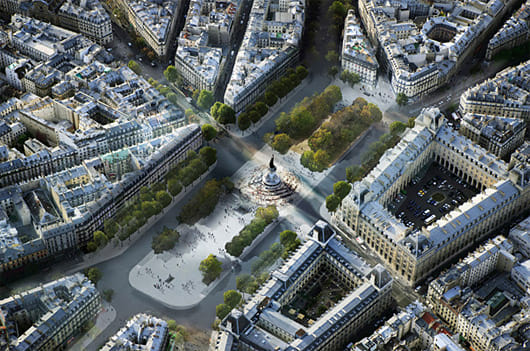
image

Mateo Arquitectura’s concept for the Place de la République in Paris

1. Pavements and plaza
We propose a substantial increase in pavement space, concentrating all specifically urban flows (buses and taxis) around its edge. The pavement, transformed into a boulevard, would then be able to accommodate both pedestrian traffic and the kiosks and galleries that house the overflow of ground-floor businesses, as well as being a place for people to sit and rest.

The central plaza, also enlarged, would be of a different nature: a space for demonstration and representation that can coexist with the more domestic, ludic presence of nature. Monument esplanade, garden.
image

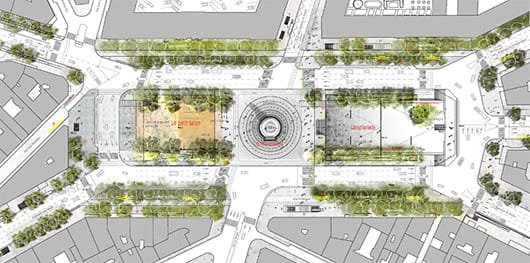
2. The plaza: unity and diversity
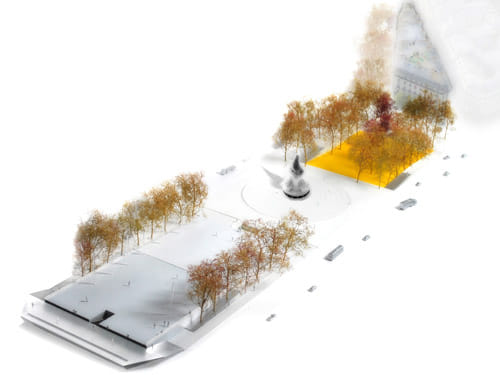
The plaza, a long space running NW-SE, takes in three different urban moments. These characteristics call for specific attention to create a figure that is designed to be unitary but also special, contextual and varied.
image

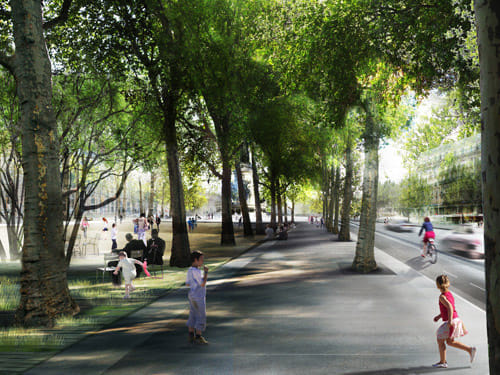
2A The small salon
At its north-west point (rue Boulanger, bvd St Martin, …), the plaza meets the pre-Haussmann city, with its finer grain and less geometrical monumentality. Our response is the small salon; earth makes an appearance at ground level, with emphasis on the urban continuity of bvd St Martin-rue Boulanger. The idea of the paving is to establish continuities between the city and the plaza. Traffic, though a real presence, could be studied and eliminated at certain points to ensure pedestrian continuity.
image

2B The centre of the monument
The centre of the place, at present a small island amid the flow of traffic, is marked by movement. We propose constructing a base for it, a podium which, with a slight slope, accentuates the volcanic composition of the object and allows people to walk around it, establish a direct relation with it and rest in its shelter.
image

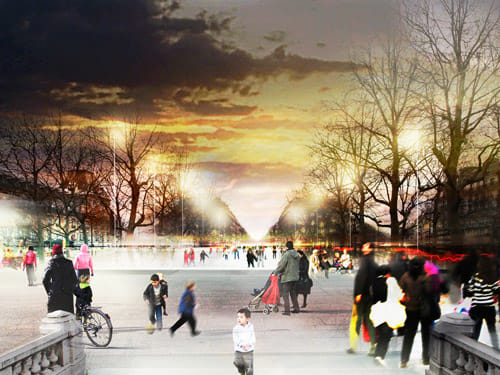
2C The esplanade
The most abstract boundary would be on the three-pronged Haussmann layout: bvd Voltaire, République, bvd du Temple. This is the site of the big demonstrations that characterize the place. We propose the construction of a great petrous esplanade, with a 2.5% gradient, at the far edge of which people would be naturally higher (2 m) than the traffic, which would pass under foot without being seen. A break in section near the end would allow the introduction, in the English landscape tradition, of a ha-ha, an invisible railing, offering views from the esplanade of the spectacle of the vanishing points of the boulevards, with the great petrous base as the only foreground.

The great esplanade constitutes the dialectical counterpoint with the small salon, at the same time ensuring continuity with the symbolism of the monument.

Project Details:
Title: Place de la République
Type: Restricted competition
Site: Paris
Surface: 34,000 m2
Author: Josep Lluís Mateo

External collaborators:
Lighting concept: Artec
Landscaping: d’Ici-là
Structure / Installations: EGI (Enginyeria i Gestió d’Infrastructures)
Video: Tiago Camara


Related

urban ● traffic ● place de la république ● paris ● monument ● mateo arquitectura ● france ● europe ● city ● barcelona

Share

  • Follow

    0 Comments

  • Comment as :

Place de la République Proposal by Mateo Arquitectura

Sign up for Bustler's Email Newsletters

Next page » Loading

Place de la République Proposal by Mateo Arquitectura

By Bustler Editors|

Friday, Mar 12, 2010

Share

Related

urban ● traffic ● place de la république ● paris ● monument ● mateo arquitectura ● france ● europe ● city ● barcelona

Barcelona-based Mateo Arquitectura has sent us a first preview of their proposal ‘Place de la République as public space’ for the restricted competition looking to redesign the Place de la République in Paris, France.

Place de la République. Restricted Competition from Josep Lluis Mateo on Vimeo.

Here is a project description from Josep Lluís Mateo:

Transforming a traffic junction into an urban space means, firstly, reducing the impact of road traffic. According to studies carried out by our traffic engineers, based on available data, it is possible to reduce 7-8 lanes to 4-5. It is also possible to avoid vehicular traffic around the monument.

Having addressed the traffic, the challenge is to transform the place into an urban space.

image

Mateo Arquitectura’s concept for the Place de la République in Paris

1. Pavements and plaza
We propose a substantial increase in pavement space, concentrating all specifically urban flows (buses and taxis) around its edge. The pavement, transformed into a boulevard, would then be able to accommodate both pedestrian traffic and the kiosks and galleries that house the overflow of ground-floor businesses, as well as being a place for people to sit and rest.

The central plaza, also enlarged, would be of a different nature: a space for demonstration and representation that can coexist with the more domestic, ludic presence of nature. Monument esplanade, garden.

image

2. The plaza: unity and diversity
The plaza, a long space running NW-SE, takes in three different urban moments. These characteristics call for specific attention to create a figure that is designed to be unitary but also special, contextual and varied.

image

2A The small salon
At its north-west point (rue Boulanger, bvd St Martin, …), the plaza meets the pre-Haussmann city, with its finer grain and less geometrical monumentality. Our response is the small salon; earth makes an appearance at ground level, with emphasis on the urban continuity of bvd St Martin-rue Boulanger. The idea of the paving is to establish continuities between the city and the plaza. Traffic, though a real presence, could be studied and eliminated at certain points to ensure pedestrian continuity.

image

2B The centre of the monument
The centre of the place, at present a small island amid the flow of traffic, is marked by movement. We propose constructing a base for it, a podium which, with a slight slope, accentuates the volcanic composition of the object and allows people to walk around it, establish a direct relation with it and rest in its shelter.

image

2C The esplanade
The most abstract boundary would be on the three-pronged Haussmann layout: bvd Voltaire, République, bvd du Temple. This is the site of the big demonstrations that characterize the place. We propose the construction of a great petrous esplanade, with a 2.5% gradient, at the far edge of which people would be naturally higher (2 m) than the traffic, which would pass under foot without being seen. A break in section near the end would allow the introduction, in the English landscape tradition, of a ha-ha, an invisible railing, offering views from the esplanade of the spectacle of the vanishing points of the boulevards, with the great petrous base as the only foreground.

The great esplanade constitutes the dialectical counterpoint with the small salon, at the same time ensuring continuity with the symbolism of the monument.

Project Details:
Title: Place de la République
Type: Restricted competition
Site: Paris
Surface: 34,000 m2
Author: Josep Lluís Mateo

External collaborators:
Lighting concept: Artec
Landscaping: d’Ici-là
Structure / Installations: EGI (Enginyeria i Gestió d’Infrastructures)
Video: Tiago Camara


Share

  • Follow

    0 Comments

  • Comment as :

Archinect JobsArchinect Jobs

The Archinect Job Board attracts the world's top architectural design talents.

VIEW ALL JOBS POST A JOB

Architectural Designer

jones | haydu

Architectural Designer

San Francisco, CA, US

Architect / Project Manager

Curtis + Ginsberg Architects LLP

Architect / Project Manager

New York, NY, US

Architectural Designer

Build Block Inc.

Architectural Designer

Los Angeles, CA, US

Intermediate Architect

NDKazalas Architecture PC

Intermediate Architect

New York, NY, US

Senior Project Architect

Breland – Harper

Senior Project Architect

Los Angeles, CA, US

 Intermediate Architect

Curtis + Ginsberg Architects LLP

Intermediate Architect

New York, NY, US

Architectural Associate/Junior Architect

Goldstone Architecture

Architectural Associate/Junior Architect

Bennington, VT, US

Project Architect

Arrowstreet

Project Architect

Boston, MA, US

Project Designer / Job Captain

Solutions Architecture Corp

Project Designer / Job Captain

Verona, NJ, US

Marketing Coordinator / EA

Stoss Landscape Urbanism

Marketing Coordinator / EA

Boston, MA, US

Next page » Loading