• Login / Join
  • About
  • •
  • Contact
  • •
  • Advertising
bustler logo
bustler logo
  • News
  • Competitions
  • Events
  • Bustler is powered by Archinect
  • Sign up for Bustler's Email Newsletters

  • Follow these Bustler feeds:

  • Search

    Search in

  • Submit

    What are you submitting?

    News Pitch
    Competition
    Event
  • Login / Join
  • News|Competitions|Events
  • Search
    | Submit
    | Follow
  • Search in

    What are you submitting?

    News Pitch
    Competition
    Event

    Follow these Bustler feeds:

  • About|Contact|Advertising
  • Login / Join
Tagged: polymorphic

Polymorphic: A Kinetic Installation

By Bustler Editors|

Wednesday, Sep 28, 2011

Polymorphic, a kinetic installation.

Polymorphic is a fascinating kinetic installation designed and produced by ten architecture students from Columbia University GSAPP in New York City. The installation was created within Fast Pace/Slow Space, a course taught by Brigette Borders and Mark Bearak. The team included Charlie Able, Alexis Burson, Ivy Chan, Jennifer Chang, Aaron Harris, Trevor Hollyn Taub, Brian Lee, Eliza Montgomery, Vernon Roether, and David Zhai.

Polymorphic in action at the Columbia GSAPP End of the Year Show 2011. (via Vimeo).

Project Description from the Students:

Polymorphic is a kinetic installation utilizing an innovative design and engineering solution inspired by the simple kinetic action of a see-saw and the reverberating motion of a Slinky. The design is comprised of a double-sided bench which transforms through a series of 119 unique and interconnected sections into a chaise lounge and finally an interactive balance board. These sections are connected via an inventive pivot and bolt system which allows the vertical movement of one section to be picked up by others down the line. Together, this motion allows the installation to transform from a series of leveled sections into an undulating form activated through interaction with its occupants.

While the overall form of the bench is realized as a continuous landscape, each seating condition was designed according to existing ergonomic profiles in order to maximize comfort and functionality. This is further realized by allowing the tolerance of its motion to conform to the postures of the occupants using simply their weight as a point of activation for the movement of the sections. Furthermore, a series of internal notches linked together by elastic bands and reinforced by couplings located on the central pivot rods prevent lateral movement and ensures safety during motion.

At its core, the design of the installation is not only an inventive solution to a design idea, but also a test of the limits and capabilities of digital fabrication and its role in advancing architectural and industrial design practices. While the installation had a designated scale and dimension, the developed system has the ability to grow much larger and wider depending on the availability of resources and materials. The form of the design can likewise be readily adjusted to suit the conditions and contextual requirements of various spaces and environments. The scalability of the joint system and design together creates a truly parametric system in which its use is not only for aesthetics, but for construction, functionality, and comfort as well.

The bench reacts to pressure exerted by the occupant.
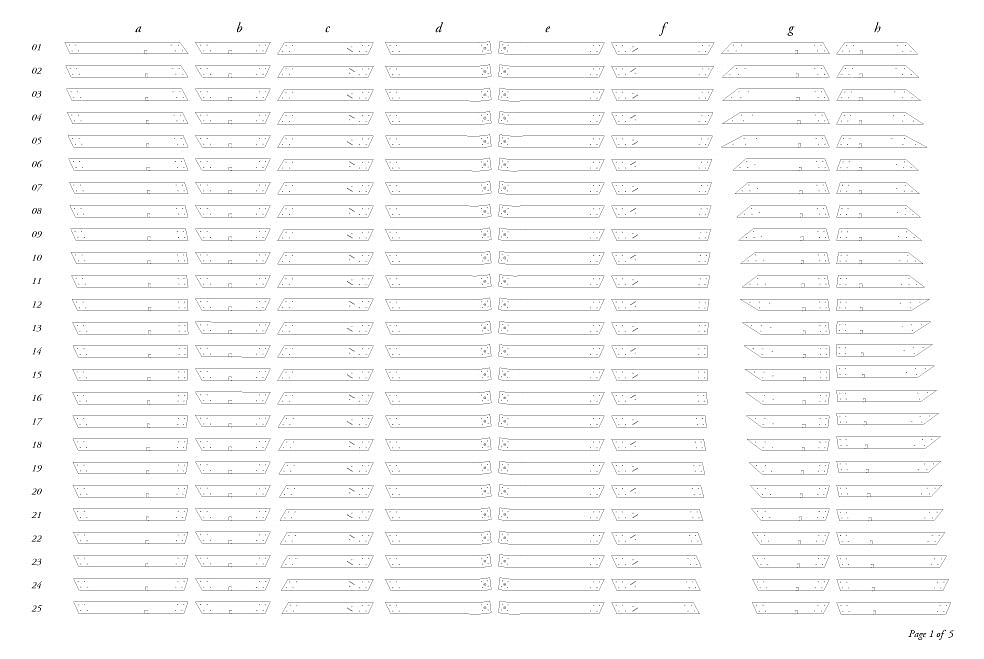
Each of the 119 sections is constructed from 8 segments, totalling 928 unique pieces.

Design

With an intent to be a truly interactive design, Polymorphic's transforming shape consists of six programs and an occupiable interior. These functions allow for new means of interaction, breaking away from the typical uses of a "bench". From the cave to the surfboard, users are encouraged to sit, lounge, climb, jump, rock, or push the installation.
Occupiable & Interactive Interior
The movement of each section transfers to its adjacent sections, allowing a fluid motion.
Two simple connections not only provide the stability of the bench, but moderate the movement of each individual section as it reacts to applied forces. The first is a sliding bolt connection, which acts as a restraint between sections, controlling the displacement allowed to be carried over from adjacent sections. The second is an elastic connection, which is a typical rubber band that gives the bench its "springy" quality while providing lateral stability to the installation as a whole.
Data Output, converted pieces to be milled.
Production, Milled Pieces on Plywood Sheet
Production, Sorting Facility

Project Details:

Design team: Charlie Able, Alexis Burson, Ivy Chan, Jennifer Chang, Aaron Harris, Trevor Hollyn-Taub, Brian Lee, Eliza Montgomery, Vernon Roether, and David Zhai

A product of Fast Pace/Slow Space, a course taught by Brigette Borders and Mark Bearak, at the Graduate School of Architecture, Planning and Preservation, Columbia University. For inquiries contact [email protected].

All photographs courtesy of Jennifer Chang.

Related

usa ● student ● school ● polymorphic ● new york ● kinetic ● installation ● furniture ● columbia gsapp ● cnc ● art

Share

  • Follow

    0 Comments

  • Comment as :

Polymorphic: A Kinetic Installation

Sign up for Bustler's Email Newsletters

Next page » Loading

Polymorphic: A Kinetic Installation

By Bustler Editors|

Wednesday, Sep 28, 2011

Share

Polymorphic, a kinetic installation.

Related

usa ● student ● school ● polymorphic ● new york ● kinetic ● installation ● furniture ● columbia gsapp ● cnc ● art

Polymorphic is a fascinating kinetic installation designed and produced by ten architecture students from Columbia University GSAPP in New York City. The installation was created within Fast Pace/Slow Space, a course taught by Brigette Borders and Mark Bearak. The team included Charlie Able, Alexis Burson, Ivy Chan, Jennifer Chang, Aaron Harris, Trevor Hollyn Taub, Brian Lee, Eliza Montgomery, Vernon Roether, and David Zhai.

Polymorphic in action at the Columbia GSAPP End of the Year Show 2011. (via Vimeo).

Project Description from the Students:

Polymorphic is a kinetic installation utilizing an innovative design and engineering solution inspired by the simple kinetic action of a see-saw and the reverberating motion of a Slinky. The design is comprised of a double-sided bench which transforms through a series of 119 unique and interconnected sections into a chaise lounge and finally an interactive balance board. These sections are connected via an inventive pivot and bolt system which allows the vertical movement of one section to be picked up by others down the line. Together, this motion allows the installation to transform from a series of leveled sections into an undulating form activated through interaction with its occupants.

While the overall form of the bench is realized as a continuous landscape, each seating condition was designed according to existing ergonomic profiles in order to maximize comfort and functionality. This is further realized by allowing the tolerance of its motion to conform to the postures of the occupants using simply their weight as a point of activation for the movement of the sections. Furthermore, a series of internal notches linked together by elastic bands and reinforced by couplings located on the central pivot rods prevent lateral movement and ensures safety during motion.

At its core, the design of the installation is not only an inventive solution to a design idea, but also a test of the limits and capabilities of digital fabrication and its role in advancing architectural and industrial design practices. While the installation had a designated scale and dimension, the developed system has the ability to grow much larger and wider depending on the availability of resources and materials. The form of the design can likewise be readily adjusted to suit the conditions and contextual requirements of various spaces and environments. The scalability of the joint system and design together creates a truly parametric system in which its use is not only for aesthetics, but for construction, functionality, and comfort as well.

The bench reacts to pressure exerted by the occupant.
Each of the 119 sections is constructed from 8 segments, totalling 928 unique pieces.

Design

With an intent to be a truly interactive design, Polymorphic's transforming shape consists of six programs and an occupiable interior. These functions allow for new means of interaction, breaking away from the typical uses of a "bench". From the cave to the surfboard, users are encouraged to sit, lounge, climb, jump, rock, or push the installation.
Occupiable & Interactive Interior
The movement of each section transfers to its adjacent sections, allowing a fluid motion.
Two simple connections not only provide the stability of the bench, but moderate the movement of each individual section as it reacts to applied forces. The first is a sliding bolt connection, which acts as a restraint between sections, controlling the displacement allowed to be carried over from adjacent sections. The second is an elastic connection, which is a typical rubber band that gives the bench its "springy" quality while providing lateral stability to the installation as a whole.
Data Output, converted pieces to be milled.
Production, Milled Pieces on Plywood Sheet
Production, Sorting Facility

Project Details:

Design team: Charlie Able, Alexis Burson, Ivy Chan, Jennifer Chang, Aaron Harris, Trevor Hollyn-Taub, Brian Lee, Eliza Montgomery, Vernon Roether, and David Zhai

A product of Fast Pace/Slow Space, a course taught by Brigette Borders and Mark Bearak, at the Graduate School of Architecture, Planning and Preservation, Columbia University. For inquiries contact [email protected].

All photographs courtesy of Jennifer Chang.

Share

  • Follow

    0 Comments

  • Comment as :

Archinect JobsArchinect Jobs

The Archinect Job Board attracts the world's top architectural design talents.

VIEW ALL JOBS POST A JOB

Architectural Designer / Architect (3-5 Years Experience)

Andrew Magnes Architecture

Architectural Designer / Architect (3-5 Years Experience)

Brooklyn, NY, US

Associate Designer - Architecture

IS Architecture

Associate Designer - Architecture

La Jolla, CA, US

Technical Designer

D L English Design Studio

Technical Designer

Pasadena, CA, US

Project Manager

The Brooklyn Studio

Project Manager

Brooklyn, NY, US

Project Manager

Payette

Project Manager

Boston, MA, US

Senior Architectural Planner

Payette

Senior Architectural Planner

Boston, MA, US

Marketing & Business Development Manager

KPB Architects

Marketing & Business Development Manager

Anchorage, AK, US

Project Architect

Fowlkes Studio

Project Architect

Washington, DC, US

Architectural Designer

7th Street Burger

Architectural Designer

New York, NY, US

Interior Designer

Fowlkes Studio

Interior Designer

Washington, DC, US

Next page » Loading