• Login / Join
  • About
  • •
  • Contact
  • •
  • Advertising
bustler logo
bustler logo
  • News
  • Competitions
  • Events
  • Bustler is powered by Archinect
  • Sign up for Bustler's Email Newsletters

  • Follow these Bustler feeds:

  • Search

    Search in

  • Submit

    What are you submitting?

    News Pitch
    Competition
    Event
  • Login / Join
  • News|Competitions|Events
  • Search
    | Submit
    | Follow
  • Search in

    What are you submitting?

    News Pitch
    Competition
    Event

    Follow these Bustler feeds:

  • About|Contact|Advertising
  • Login / Join
Tagged: st kilda triangle

The winning 2018 LAGI Melbourne public art proposals

By Justine Testado|

Thursday, Oct 11, 2018
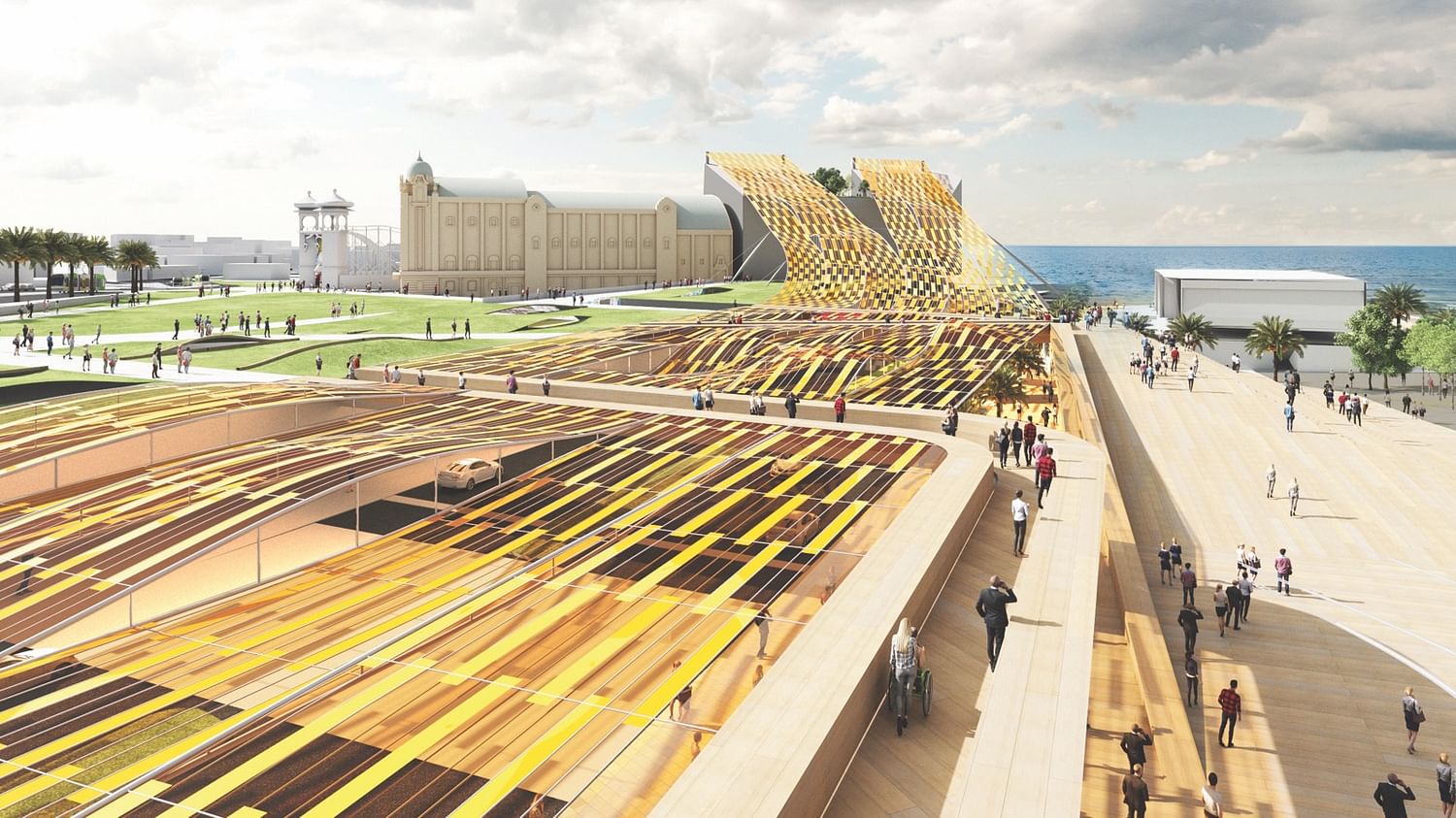
“Light Up”. TEAM: Martin Heide, Dean Boothroyd, Emily Von Moger, David Allouf, Takasumi Inoue, Liam Oxlade, Michael Strack, Richard Le; Mike Rainbow, Jan Talacko; John Bahoric; Bryan Chung, Chea Yuen Yeow Chong, Anna Lee, Amelie Noren. ENERGY TECHNOLOGIES

Land Art Generator has announced the winners of the 2018 LAGI Melbourne design competition! Out of the 25 shortlisted entries, “Light Up” by locally based NH Architecture won first place with a $16,000 cash prize. Second place went to “Night & Day, a Hydro-Solar Generator” by Seattle's Olson Kundig, who will receive $5,000. Finally, a third place/special mention went to “Swings” by Lu Chao and Weng Shenxia.

Taking place in cities worldwide, LAGI competitions seek inventive, large-scale works of public art that produce clean energy. In this latest edition, entrants had to design for St. Kilda Triangle in Melbourne. Although there is no guarantee that any of the projects will be realized, “public support may lead to their incorporation as a part of the larger co-design process currently underway for the St. Kilda Triangle site”, LAGI says. 

Check out the winning entries below.

First prize: “Light Up” by NH Architecture
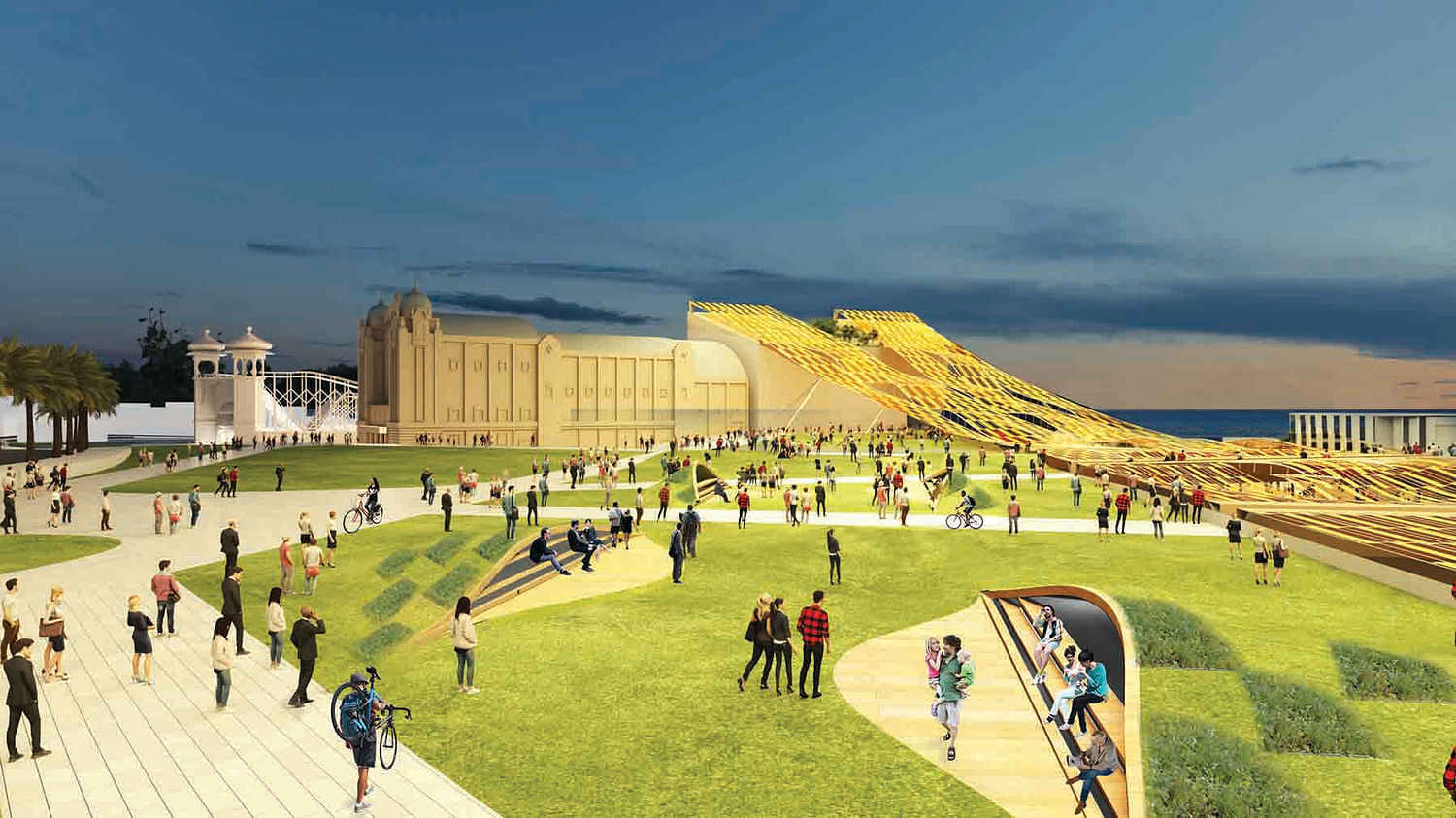
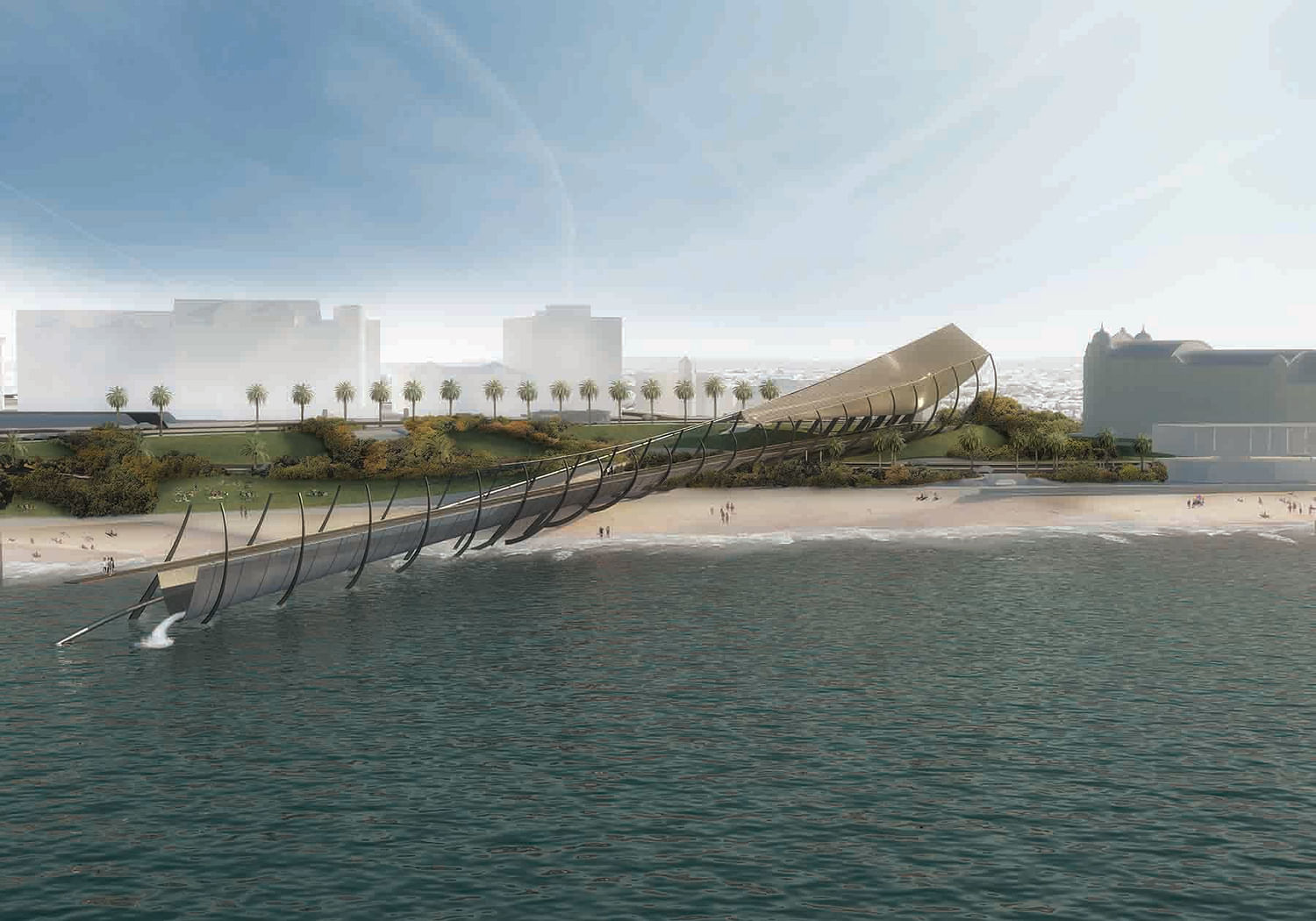
“Light Up”. TEAM: Martin Heide, Dean Boothroyd, Emily Von Moger, David Allouf, Takasumi Inoue, Liam Oxlade, Michael Strack, Richard Le; Mike Rainbow, Jan Talacko; John Bahoric; Bryan Chung, Chea Yuen Yeow Chong, Anna Lee, Amelie Noren. ENERGY TECHNOLOGIES: flexible mono-crystalline silicon photovoltaic, wind energy harvesting, microbial fuel cells. ANNUAL CAPACITY: 2,220 MWh. A submission to the 2018 LAGI design competition for Melbourne.

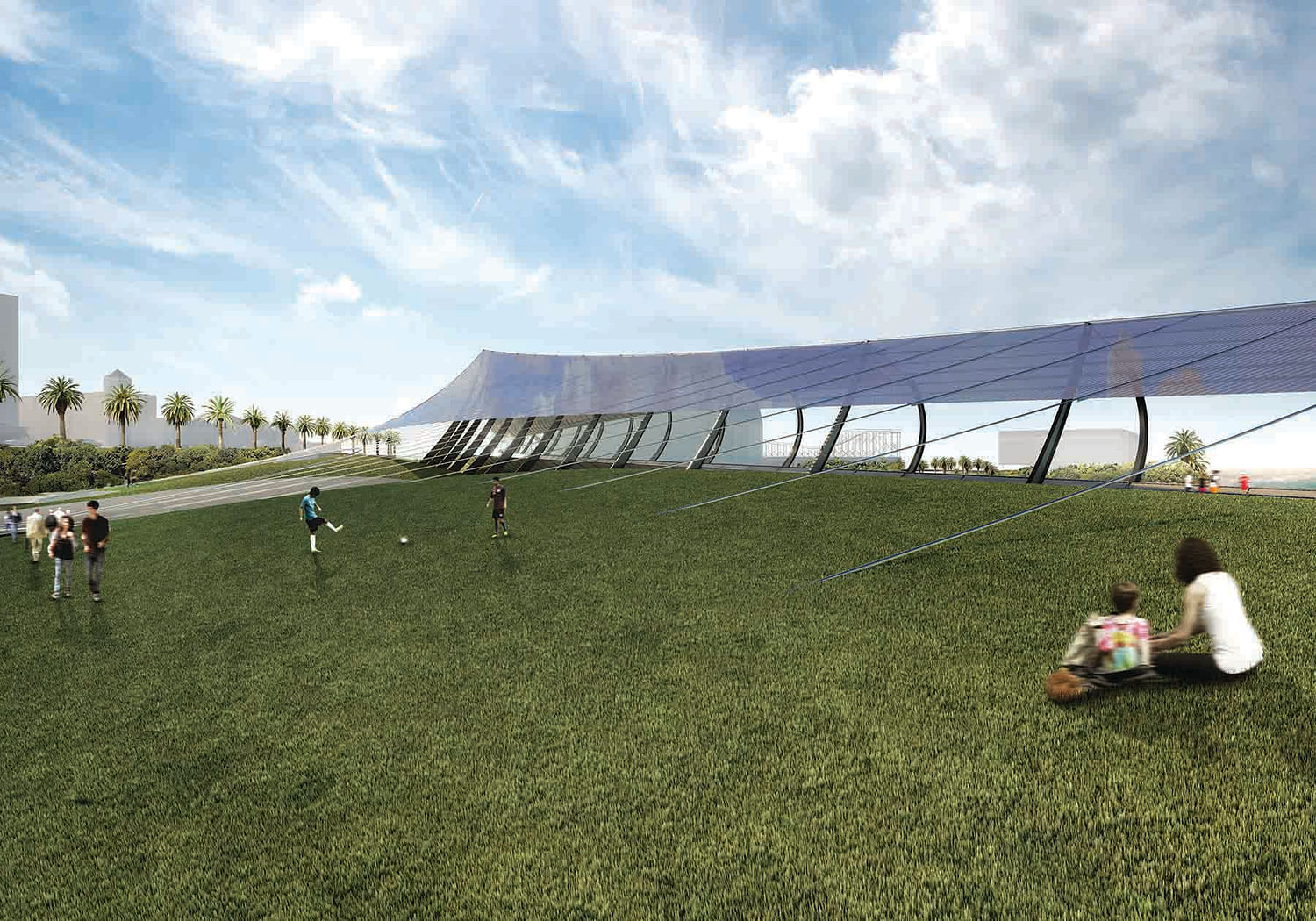
Project description: “‘Light Up’ is a lightweight tensile structure and urban planning scheme that captures energy from 8,600 efficient, flexible solar photovoltaic panels that create light-filtered shade over Jacka Boulevard. Additional energy is harnessed when the undulating structure waves in the wind and from the roots of plants with microbial fuel cells.

NH Architecture principal Dean Boothroyd says they sought to honor St Kilda’s longstanding creative tradition. They also wanted to ‘maximize the public realm’ without disturbing views. Team leader Martin Heide says that creating a buildable design with a high return on investment was central to their approach: ‘We used components that are on the market, that are tested, and which connect in a way that makes the design feasible’. He added that the team was particularly excited to join a project that enjoys such robust support from various stakeholders—including the local community, City of Port Phillip Council, and the State.”

Second prize: “Night & Day: St Kilda Hydro-Solar Generator” by Olson Kundig

“Night & Day: St Kilda Hydro-Solar Generator”. TEAM: Kevin Kudo-King, Annie Aldrich, James Juricevich, Evan Harlan, Vikram Sami, Erin Hamilton, Gabriela Frank, MacKenzie Cotters, Lauren Gallow, Jonathan Nelson (Olson Kundig). ENERGY TECHNOLOGIES: mono-crystalline silicon photovoltaic, pumped hydro storage. ANNUAL CAPACITY: 1,000 MWh. A submission to the 2018 Land Art Generator design competition for Melbourne.

Project description: “Olson Kundig partner Kevin Kudo-King says ‘Night & Day’ is a departure from the firm’s normal work in that visitors become part of the experience of generating renewables. Night & Day is designed to improve the connection between The Esplanade and Port Phillip Bay, in addition to providing a sophisticated educational amenity that is bound to draw scores of visitors.

During daylight hours, energy produced by a 5,400 m2 photovoltaic (PV) solar sail is used to directly power homes while also safely pumping bay water into a suspended hydro battery vessel. After sunset, water is released through two Pelton turbines, transforming the kinetic movement of water into electricity through a generator—a proven technology that is already used at the utility scale, according to Kudo-King.”

Third place/special mention: “Swings” by Lu Chao, Weng Shenxia

“Swings”. TEAM: Lu Chao, Weng Shenxia. ENERGY TECHNOLOGIES: thin-film photovoltaic, kinetic wind harvesting (with human assist). ANNUAL CAPACITY: 1,200 MWh. A submission to the 2018 Land Art Generator design competition for Melbourne.

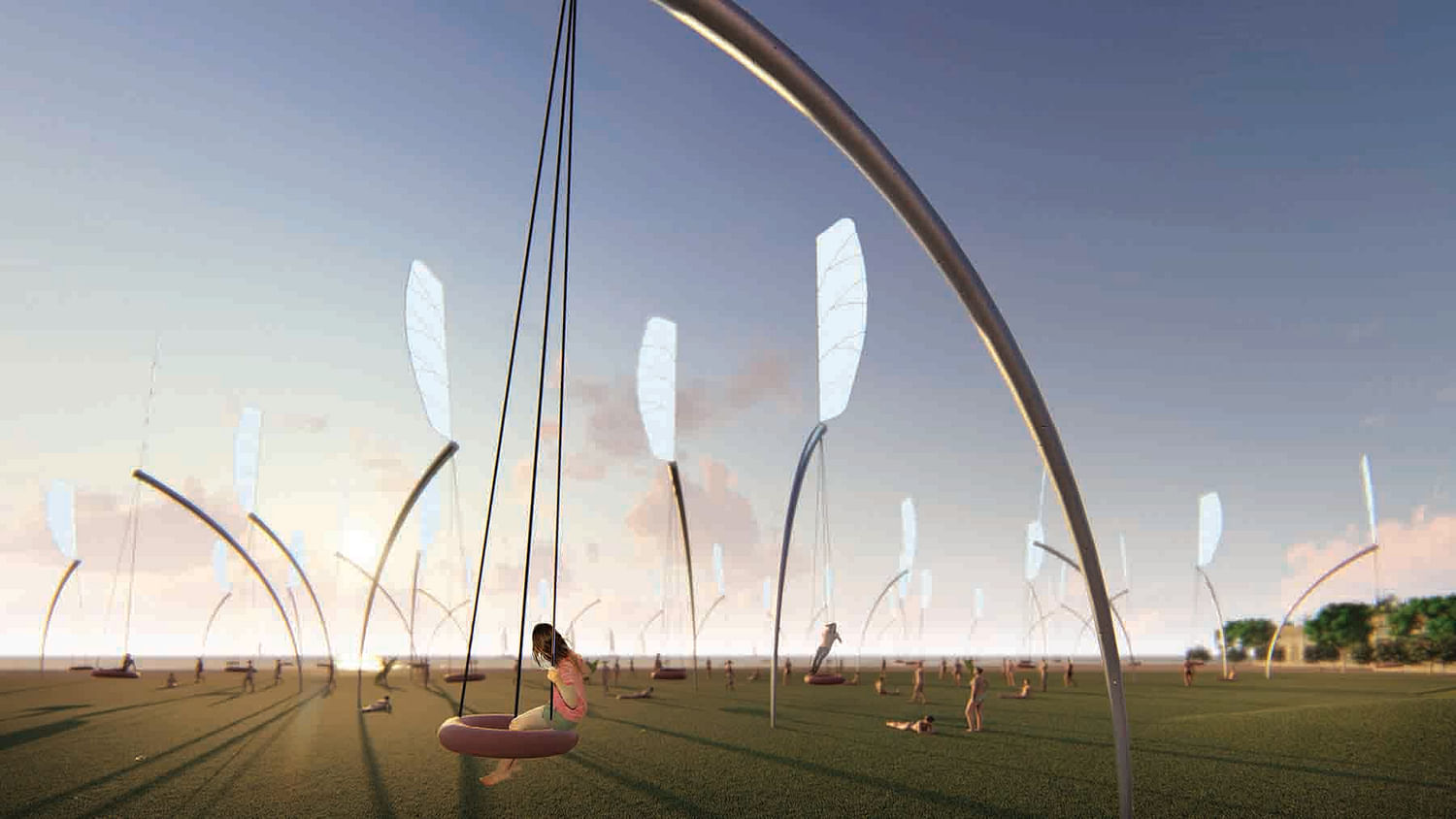
Project description: “When the sea breeze blows through the bustling Port Phillip Bay, it drives a group of huge swings into gentle sway. People come to watch and participate from the neighborhood, the beach, the Palais Theatre, and Luna Park.

During the day, the blades made of solar panels convert the sun’s energy into electricity, while wind and human energy collaborate to provide even more. When the sun has set and the visitors have gone home, the swings continue to sway gently in the sea breeze, glowing softly and providing a steady stream of electricity throughout the night.

Working in harmony with nature, Swings presents no threat to birds and takes up little ground space, allowing plenty of room  for people to engage in various activities throughout the site.

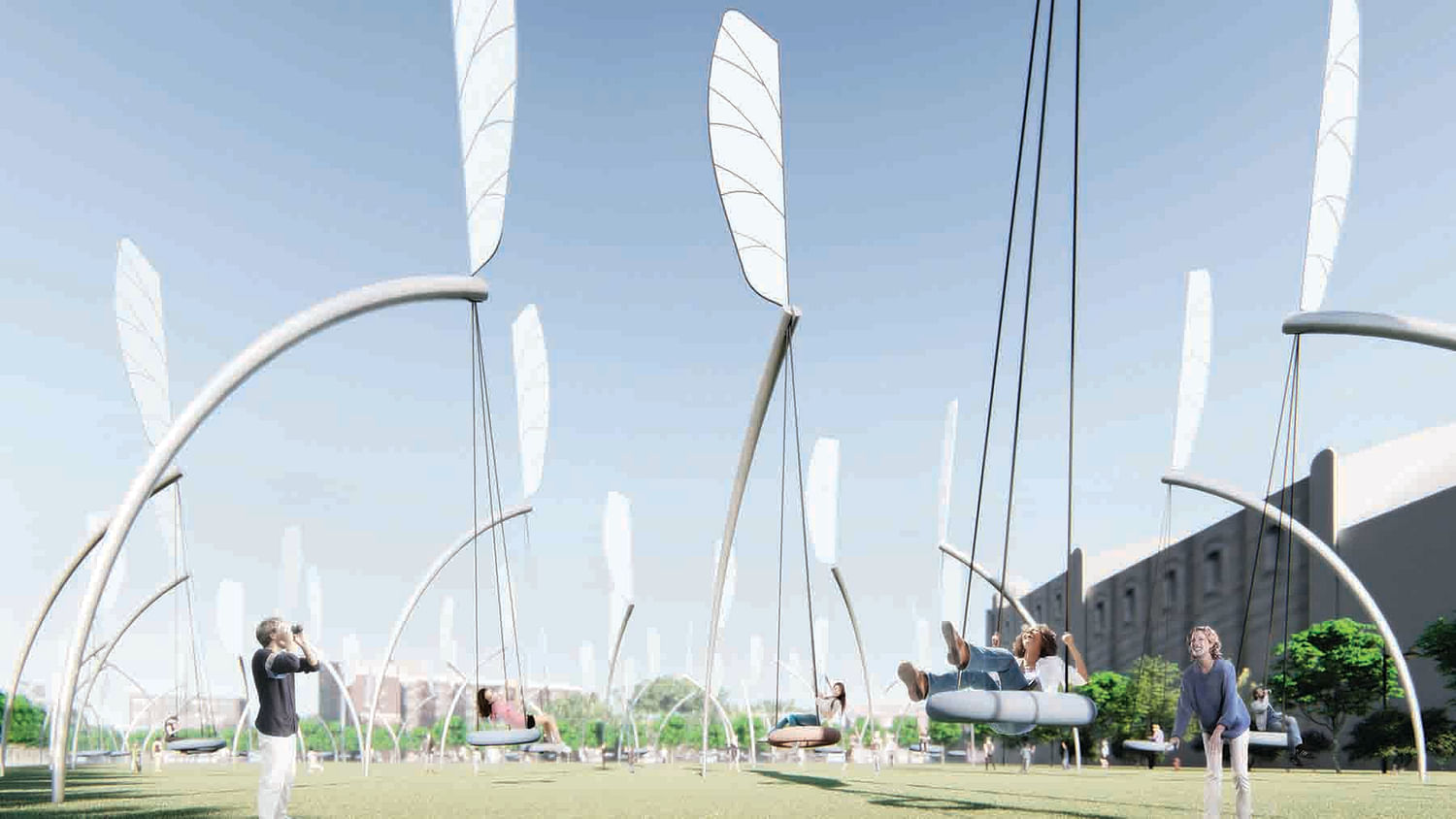
The top wing blade takes different positions as it generates power through movement. At first it sits perpendicular to the wind direction. As it catches the wind, the blade rotates and the soft rubber seat below sways to the side. With the seat at 15 degrees from center, the blade is rotated parallel to the wind direction, allowing it to slice through the wind and return the swing.

This movement can be generated by the wind alone or driven more quickly with human interaction. When the seat swings to the lowest point, the blade turns, receiving even more wind power. The blade’s rotation is managed by means of a repurposed mechanical recirculating ball system—like those used in the power steering assemblies of trucks and off-road vehicles—which is connected to a generator that converts mechanical energy into electricity.

As visitors contribute to producing a flow of electricity, Swings turns human activity and joy into a sustainable energy source.”

All images courtesy of 2018 LAGI Melbourne competition.

RELATED NEWS Twenty-five land art designs shortlisted for 2018 LAGI St. Kilda Triangle competition
RELATED NEWS Solar-powered arch announced as winner of the LAGI Willimantic design competition
RELATED NEWS 2016 LAGI Santa Monica winners artfully rethink clean-energy infrastructure
RELATED NEWS The “techno-boreal” Wind Forest wins the LAGI Glasgow competition

Related

land art generator initiative ● solar energy ● renewable energy ● public art ● landscape architecture ● st kilda triangle ● melbourne ● australia ● clean energy ● energy technology ● lagi ● competition
Olson Kundig Architects
Olson Kundig Architects Hiring!

Share

  • Follow

    0 Comments

  • Comment as :

The winning 2018 LAGI Melbourne public art proposals

Sign up for Bustler's Email Newsletters

Next page » Loading

The winning 2018 LAGI Melbourne public art proposals

By Justine Testado|

Thursday, Oct 11, 2018

Share

“Light Up”. TEAM: Martin Heide, Dean Boothroyd, Emily Von Moger, David Allouf, Takasumi Inoue, Liam Oxlade, Michael Strack, Richard Le; Mike Rainbow, Jan Talacko; John Bahoric; Bryan Chung, Chea Yuen Yeow Chong, Anna Lee, Amelie Noren. ENERGY TECHNOLOGIES

Related

land art generator initiative ● solar energy ● renewable energy ● public art ● landscape architecture ● st kilda triangle ● melbourne ● australia ● clean energy ● energy technology ● lagi ● competition
Olson Kundig Architects
Olson Kundig Architects Hiring!

Land Art Generator has announced the winners of the 2018 LAGI Melbourne design competition! Out of the 25 shortlisted entries, “Light Up” by locally based NH Architecture won first place with a $16,000 cash prize. Second place went to “Night & Day, a Hydro-Solar Generator” by Seattle's Olson Kundig, who will receive $5,000. Finally, a third place/special mention went to “Swings” by Lu Chao and Weng Shenxia.

Taking place in cities worldwide, LAGI competitions seek inventive, large-scale works of public art that produce clean energy. In this latest edition, entrants had to design for St. Kilda Triangle in Melbourne. Although there is no guarantee that any of the projects will be realized, “public support may lead to their incorporation as a part of the larger co-design process currently underway for the St. Kilda Triangle site”, LAGI says. 

Check out the winning entries below.

First prize: “Light Up” by NH Architecture
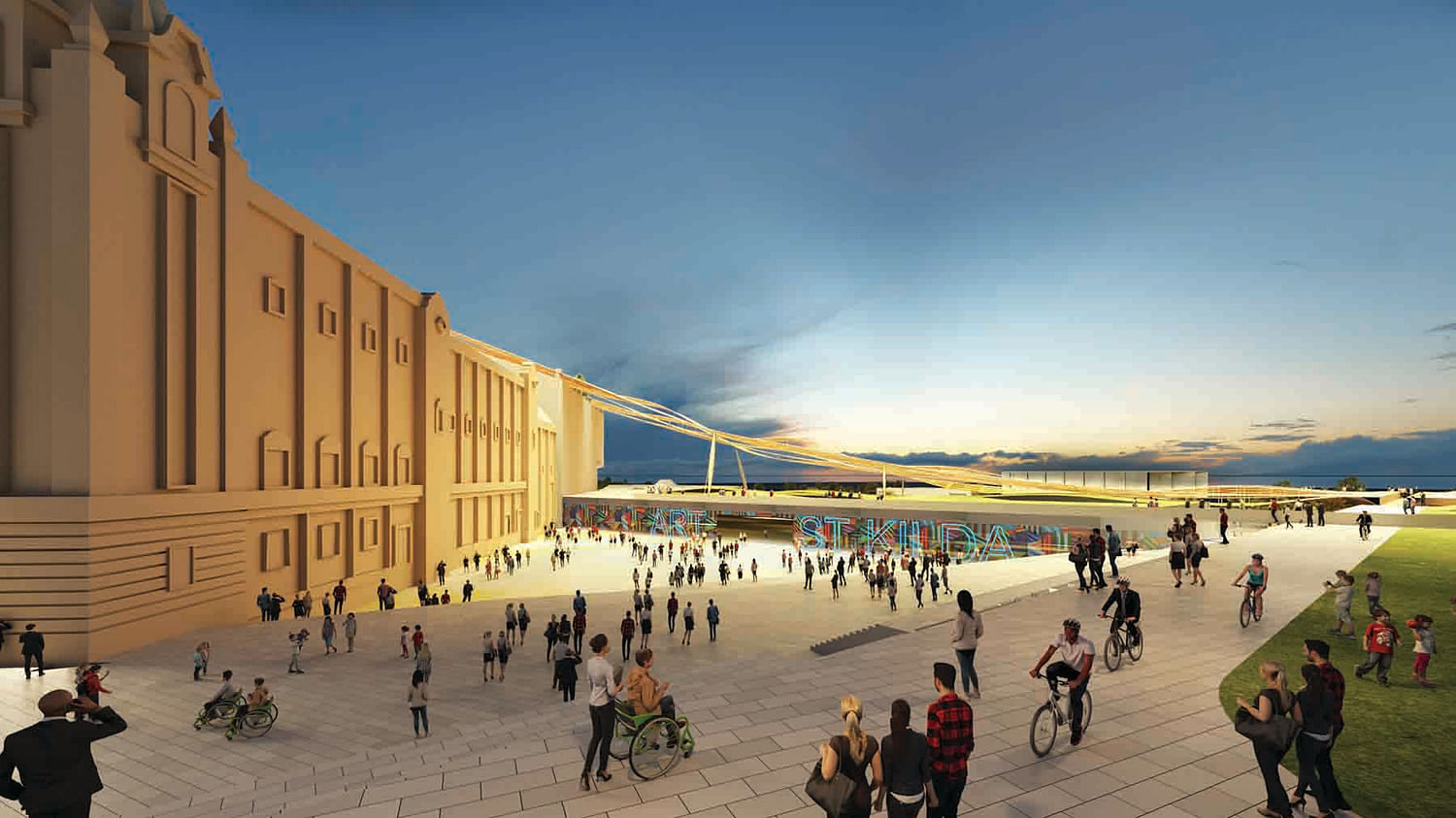
“Light Up”. TEAM: Martin Heide, Dean Boothroyd, Emily Von Moger, David Allouf, Takasumi Inoue, Liam Oxlade, Michael Strack, Richard Le; Mike Rainbow, Jan Talacko; John Bahoric; Bryan Chung, Chea Yuen Yeow Chong, Anna Lee, Amelie Noren. ENERGY TECHNOLOGIES: flexible mono-crystalline silicon photovoltaic, wind energy harvesting, microbial fuel cells. ANNUAL CAPACITY: 2,220 MWh. A submission to the 2018 LAGI design competition for Melbourne.

Project description: “‘Light Up’ is a lightweight tensile structure and urban planning scheme that captures energy from 8,600 efficient, flexible solar photovoltaic panels that create light-filtered shade over Jacka Boulevard. Additional energy is harnessed when the undulating structure waves in the wind and from the roots of plants with microbial fuel cells.

NH Architecture principal Dean Boothroyd says they sought to honor St Kilda’s longstanding creative tradition. They also wanted to ‘maximize the public realm’ without disturbing views. Team leader Martin Heide says that creating a buildable design with a high return on investment was central to their approach: ‘We used components that are on the market, that are tested, and which connect in a way that makes the design feasible’. He added that the team was particularly excited to join a project that enjoys such robust support from various stakeholders—including the local community, City of Port Phillip Council, and the State.”

Second prize: “Night & Day: St Kilda Hydro-Solar Generator” by Olson Kundig
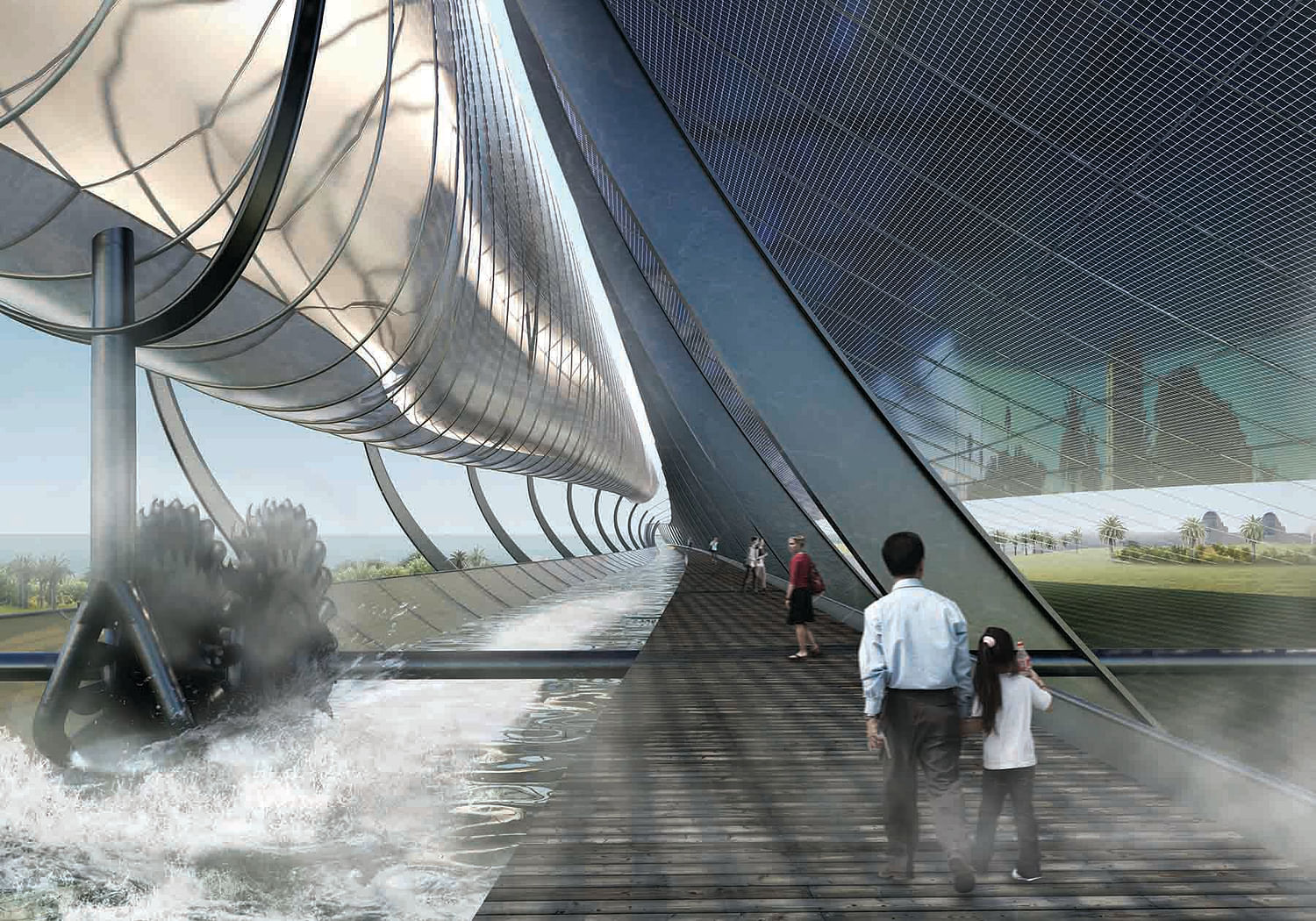
“Night & Day: St Kilda Hydro-Solar Generator”. TEAM: Kevin Kudo-King, Annie Aldrich, James Juricevich, Evan Harlan, Vikram Sami, Erin Hamilton, Gabriela Frank, MacKenzie Cotters, Lauren Gallow, Jonathan Nelson (Olson Kundig). ENERGY TECHNOLOGIES: mono-crystalline silicon photovoltaic, pumped hydro storage. ANNUAL CAPACITY: 1,000 MWh. A submission to the 2018 Land Art Generator design competition for Melbourne.

Project description: “Olson Kundig partner Kevin Kudo-King says ‘Night & Day’ is a departure from the firm’s normal work in that visitors become part of the experience of generating renewables. Night & Day is designed to improve the connection between The Esplanade and Port Phillip Bay, in addition to providing a sophisticated educational amenity that is bound to draw scores of visitors.

During daylight hours, energy produced by a 5,400 m2 photovoltaic (PV) solar sail is used to directly power homes while also safely pumping bay water into a suspended hydro battery vessel. After sunset, water is released through two Pelton turbines, transforming the kinetic movement of water into electricity through a generator—a proven technology that is already used at the utility scale, according to Kudo-King.”

Third place/special mention: “Swings” by Lu Chao, Weng Shenxia
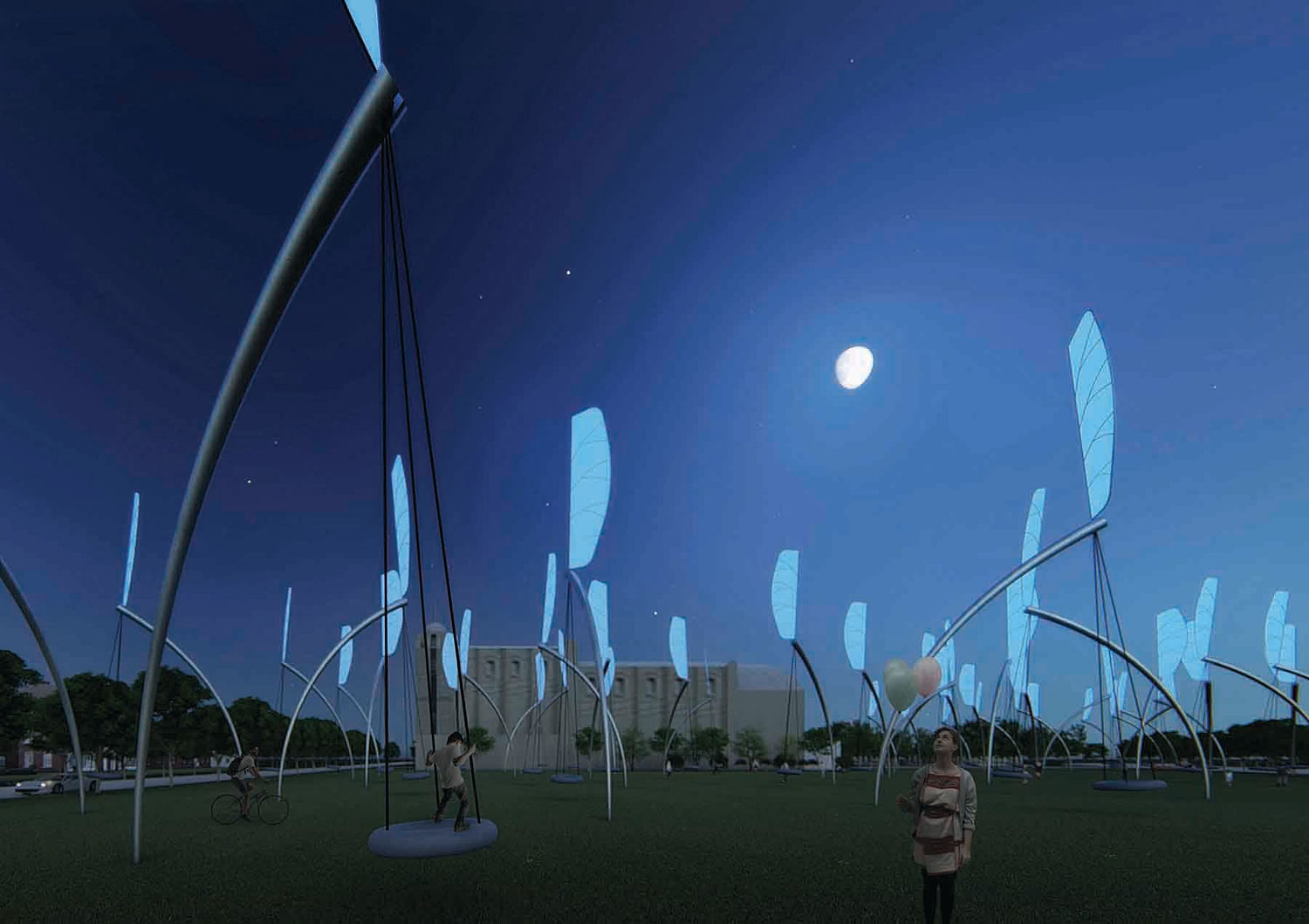
“Swings”. TEAM: Lu Chao, Weng Shenxia. ENERGY TECHNOLOGIES: thin-film photovoltaic, kinetic wind harvesting (with human assist). ANNUAL CAPACITY: 1,200 MWh. A submission to the 2018 Land Art Generator design competition for Melbourne.

Project description: “When the sea breeze blows through the bustling Port Phillip Bay, it drives a group of huge swings into gentle sway. People come to watch and participate from the neighborhood, the beach, the Palais Theatre, and Luna Park.

During the day, the blades made of solar panels convert the sun’s energy into electricity, while wind and human energy collaborate to provide even more. When the sun has set and the visitors have gone home, the swings continue to sway gently in the sea breeze, glowing softly and providing a steady stream of electricity throughout the night.

Working in harmony with nature, Swings presents no threat to birds and takes up little ground space, allowing plenty of room  for people to engage in various activities throughout the site.

The top wing blade takes different positions as it generates power through movement. At first it sits perpendicular to the wind direction. As it catches the wind, the blade rotates and the soft rubber seat below sways to the side. With the seat at 15 degrees from center, the blade is rotated parallel to the wind direction, allowing it to slice through the wind and return the swing.

This movement can be generated by the wind alone or driven more quickly with human interaction. When the seat swings to the lowest point, the blade turns, receiving even more wind power. The blade’s rotation is managed by means of a repurposed mechanical recirculating ball system—like those used in the power steering assemblies of trucks and off-road vehicles—which is connected to a generator that converts mechanical energy into electricity.

As visitors contribute to producing a flow of electricity, Swings turns human activity and joy into a sustainable energy source.”

All images courtesy of 2018 LAGI Melbourne competition.

RELATED NEWS Twenty-five land art designs shortlisted for 2018 LAGI St. Kilda Triangle competition
RELATED NEWS Solar-powered arch announced as winner of the LAGI Willimantic design competition
RELATED NEWS 2016 LAGI Santa Monica winners artfully rethink clean-energy infrastructure
RELATED NEWS The “techno-boreal” Wind Forest wins the LAGI Glasgow competition

Share

  • Follow

    0 Comments

  • Comment as :

Archinect JobsArchinect Jobs

The Archinect Job Board attracts the world's top architectural design talents.

VIEW ALL JOBS POST A JOB

Architectural Designer

Build Block Inc.

Architectural Designer

Los Angeles, CA, US

Intermediate Architect

FROM Architecture DPC

Intermediate Architect

New York, NY, US

Architect 10+

Standard Architects

Architect 10+

Long Island City, NY, US

Junior Architect

PRDG architecture + design

Junior Architect

New York, NY, US

Interior Designer | Education & Institutional Work

Berliner Architects

Interior Designer | Education & Institutional Work

Culver City, CA, US

Project Architect

Office JDY

Project Architect

Brooklyn, NY, US

Senior Architectural Project Manager (Systems Driven, Human-Centric) (Hourly)

Local Parti Architecture, PC

Senior Architectural Project Manager (Systems Driven, Human-Centric) (Hourly)

New York, NY, US

Professor/Associate Professor/Assistant Professor of Architecture

Harvard University

Professor/Associate Professor/Assistant Professor of Architecture

Cambridge, MA, US

Intermediate Architect

FAME Architecture & Interior Design

Intermediate Architect

Los Angeles, CA, US

Intermediate Architect (Advanced Revit User)

O'Neil Langan Architects

Intermediate Architect (Advanced Revit User)

New York, NY, US

Next page » Loading