• Login / Join
  • About
  • •
  • Contact
  • •
  • Advertising
bustler logo
bustler logo
  • News
  • Competitions
  • Events
  • Bustler is powered by Archinect
  • Sign up for Bustler's Email Newsletters

  • Follow these Bustler feeds:

  • Search

    Search in

  • Submit

    What are you submitting?

    News Pitch
    Competition
    Event
  • Login / Join
  • News|Competitions|Events
  • Search
    | Submit
    | Follow
  • Search in

    What are you submitting?

    News Pitch
    Competition
    Event

    Follow these Bustler feeds:

  • About|Contact|Advertising
  • Login / Join
Tagged: tiny house competition

Tiny House 2023 Architecture Competition winners selected

By Josh Niland|

Friday, Apr 5, 2024
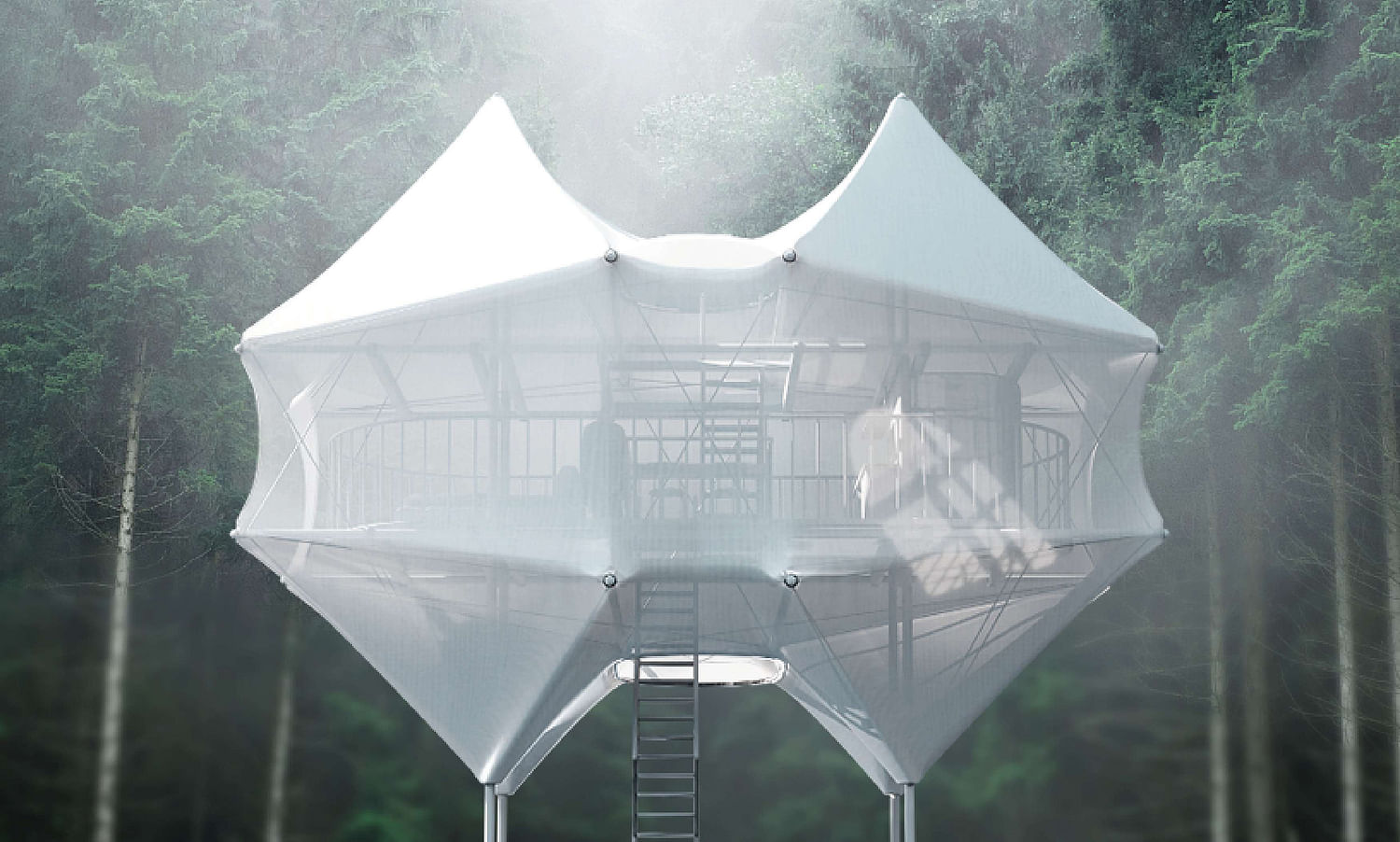
Detail from First Place winner Morph Bubble by Ruisi Sun and Jinyu Lu (China)

Competitions organizer Volume Zero has announced the winners for the 2023 edition of the Tiny House Architecture Competition. This year’s contest awarded three winners and Best Student entries, while another ten were listed as Honorable Mentions by the 13-member jury panel.

Organizers share: “In this architecture design competition, participants were tasked with designing a comfortable off-the-grid living accommodation for two people under 300 sq. ft. that not only caters to their present-day needs but also anticipates and fulfills needs from the unseen future. Participants from over 48 countries came up with their creative and sustainable design solutions to cater to this spatially challenging architectural problem.”

The winning entries can be viewed below.

First Place: Morph Bubble: A Tiny House with Autonomous Environmental Adaption by Ruisi Sun and Jinyu Lu (China)
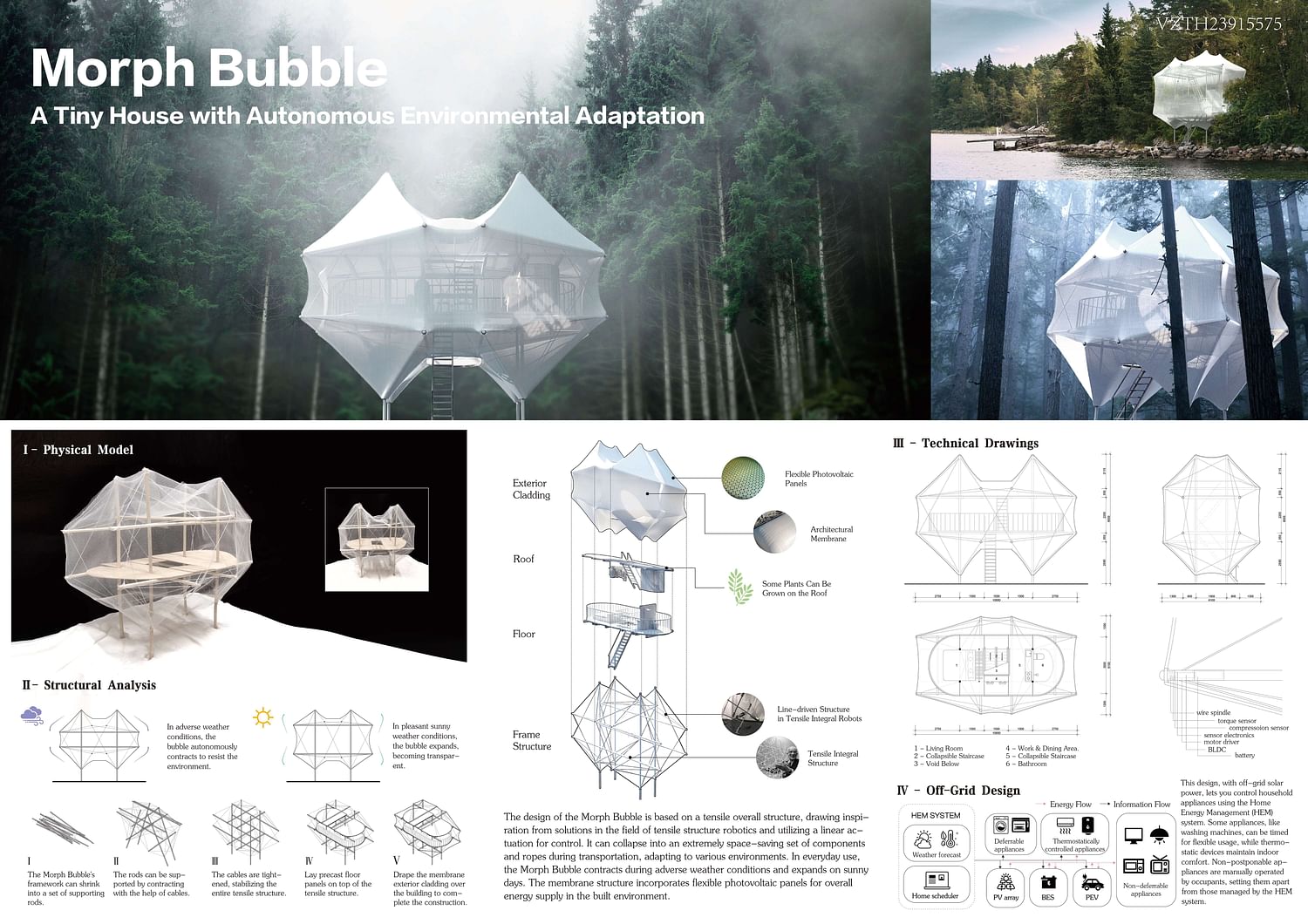
First Place winner Morph Bubble by Ruisi Sun and Jinyu Lu (China)

Project excerpt: "The design of the Morph Bubble is based on a tensile overall structure, drawing inspiration from solutions in the field of tensile structure robotics and utilizing a linear actuation for control. It can collapse into an extremely space-saving set of components and ropes during transportation, adapting to various environments. In everyday use, the Morph Bubble contracts during adverse weather conditions and expands on sunny days. The membrane structure incorporates flexible photovoltaic panels for overall energy supply in the built environment. This design, with off-grid solar power, lets you control household appliances using the Home Energy Management (HEM) system. Some appliances, like washing machines, can be timed for flexible usage, while thermostatic devices maintain indoor comfort. Non-postponable appliances are manually operated by occupants, setting them apart from those managed by the HEM system."

Second Place: Contemplation Spaces by Fernando Frank (Spain)
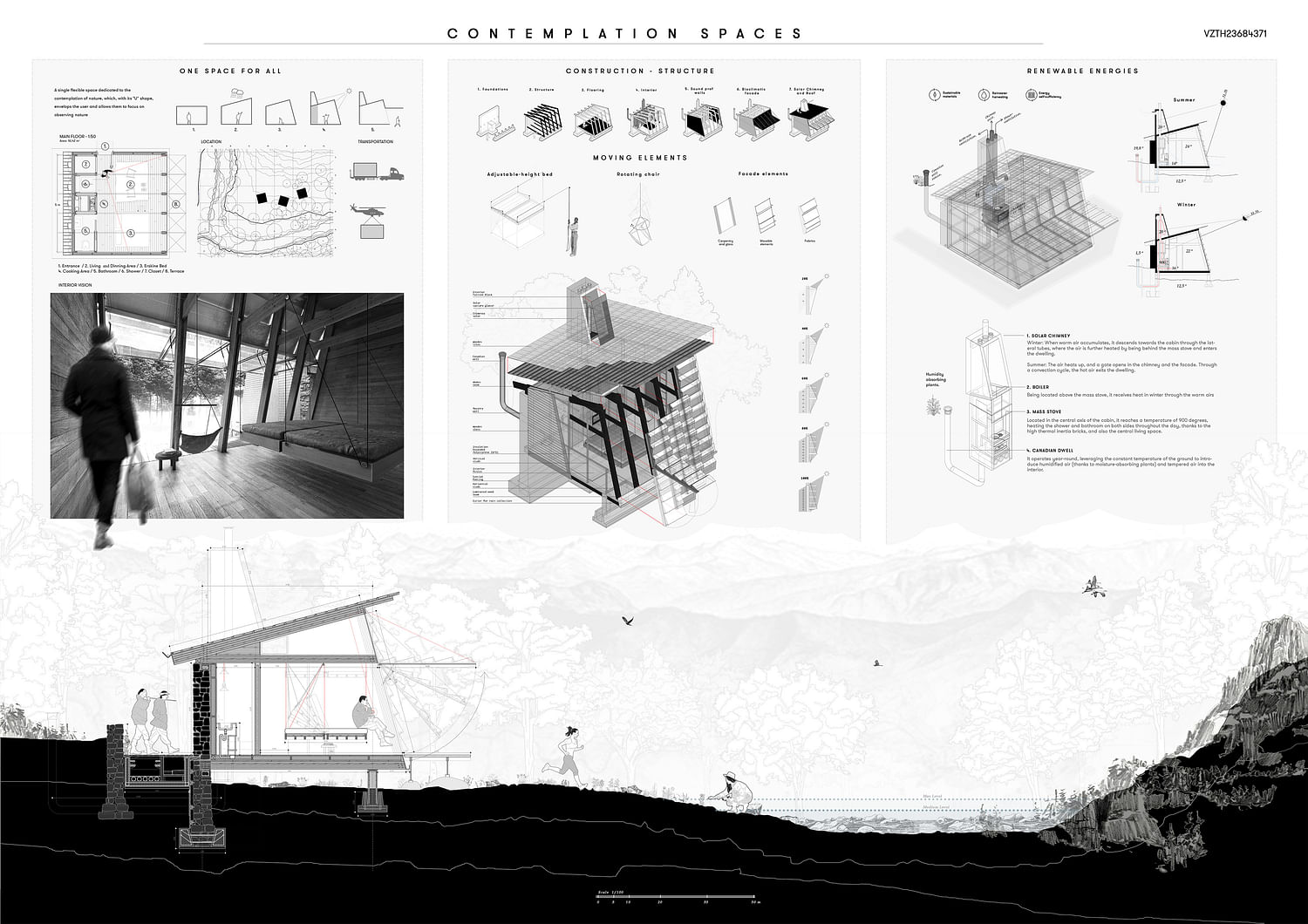
Second Place winner Contemplation Spaces by Fernando Frank (Spain)

Project excerpt: "Renewable energies are harnessed in various ways within this sustainable dwelling. A solar chimney facilitates both winter and summer climate control. In winter, as warm air gathers, it descends through lateral tubes, further heating behind a mass stove before entering the cabin. Conversely, in summer, the chimney and facade gates open, allowing hot air to escape via convection. A boiler positioned above the mass stove receives winter warmth from rising air. The mass stove itself, situated centrally, maintains a temperature of 900 degrees, providing consistent heat to the shower, bathroom, and central living space thanks to its high thermal inertia bricks. A Canadian wall operates throughout the year, utilizing the stable ground temperature to introduce humidified and tempered air into the interior, facilitated by moisture-absorbing plants."

Third Place: Cellule of Urban: Informal Spaces of Vernacular Urban by Duong Pham Ngoc Hoai, Uyen Nguyen Nha and Canh Nguyen Duc (Vietnam)
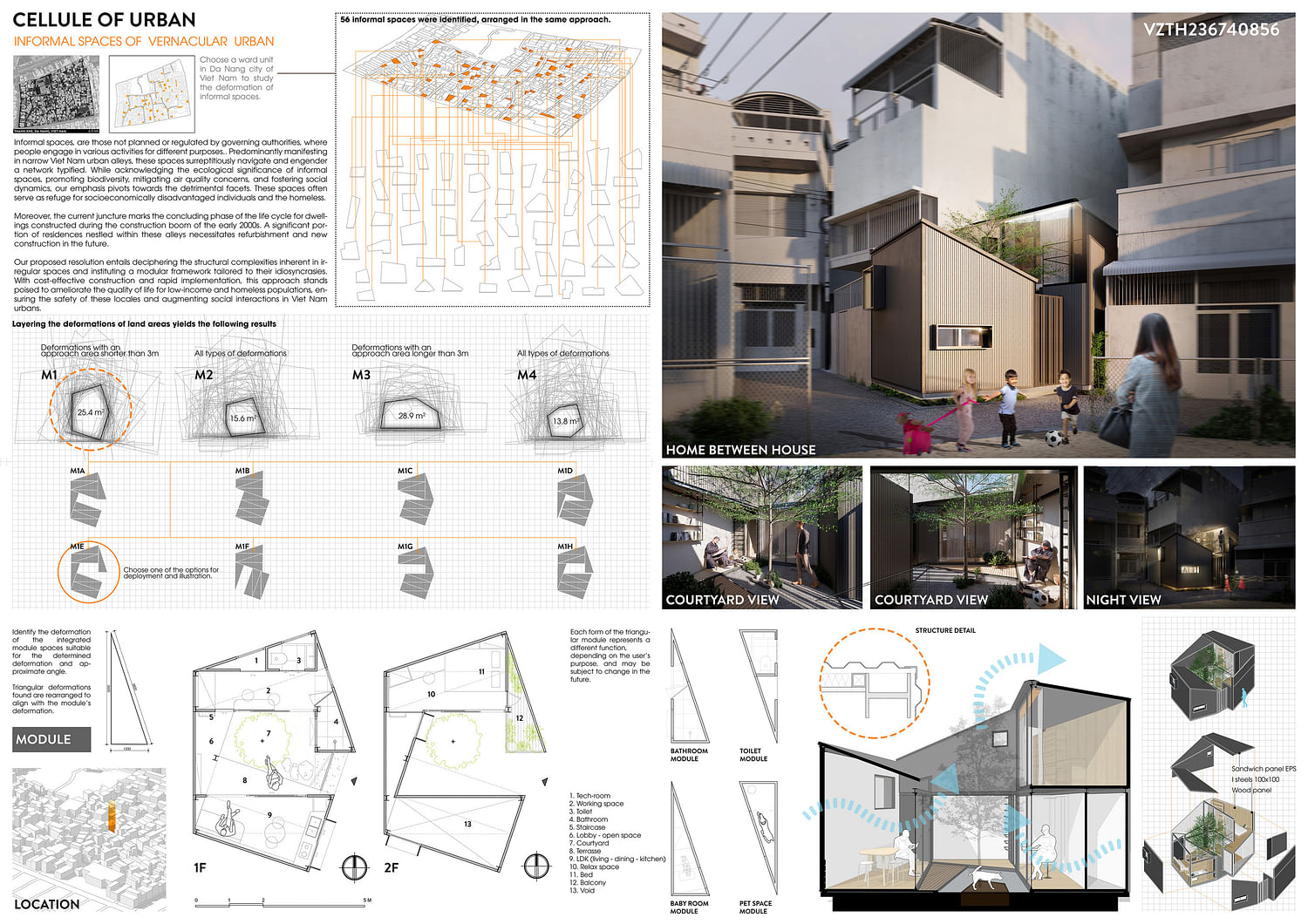
Third Place winner Cellule Of Urban by Duong Pham Ngoc Hoai, Uyen Nguyen Nha and Canh Nguyen Duc (Vietnam)

Project excerpt: "Informal spaces, are those not planned or regulated by governing authorities, where people engage in various activities for different purposes. Predominantly manifesting in narrow Vietnam urban alleys, these spaces surreptitiously navigate and engender a network typified. While acknowledging the ecological significance of informal spaces, promoting biodiversity, mitigating air quality concerns, and fostering social dynamics, our emphasis pivots towards the detrimental facet. These spaces often serve as refuge for socioeconomically disadvantaged individuals and the homeless. Moreover, the current juncture marks the concluding phase of the life cycle for dwellings constructed during the construction boom of the early 2000s. A significant portion of residences nestled within these alleys necessitates refurbishment and new construction in the future."

Student Award: Floating Lense House – Harmonizing modern housing with nature by Jeonguk Jang and Taeho Kim (South Korea)

STUDENT AWARD: winner FLOATING LENS HOUSE by Jeonguk Jang and Taeho Kim (South Korea)

Project excerpt: "Rapid urbanization and the expansion of residential areas have had serious environmental consequences, including deforestation, loss of biodiversity, and increased carbon emissions. In response, we set out to design a home that would minimize its impact on the environment and integrate with nature. First, we used only two pillars to float the building, allowing it to adapt to nature’s varied terrain while minimizing its land footprint, which in turn reduces its impact on nature. The building is divided into two spaces where the user’s main life takes place, with glass connecting them. In front of the bedroom windows, eye-level perforated blinds are installed to allow the user to control the view outside. In the central space, transparent walls, floors, and ceilings create an environment surrounded by nature, and a birdhouse on the elevation façade supports the local birds by providing habitat for them. Users can move between the spaces to enjoy the large and small views of nature, while a rainwater collection system and solar energy ensure a certain level of self-sufficiency."

RELATED COMPETITION Tiny House 2023 Architecture Competition
RELATED NEWS Winners unveiled for Volume Zero's Tiny House 2022 competition
RELATED NEWS Results of the Tiny Library 2023 Architecture Competition
RELATED NEWS 'Living in the lap of nature': Results of the Tree House 2021 Architecture Competition

Related

tiny house competition ● volume zero ● competition ● tiny house

Share

  • Follow

    0 Comments

  • Comment as :

Tiny House 2023 Architecture Competition winners selected

13 new mini residential designs selected as Tiny Home Awards 2023 winners

Small spaces, big living: results of the Tiny House 2020 Architecture Competition

Sign up for Bustler's Email Newsletters

Next page » Loading

Tiny House 2023 Architecture Competition winners selected

By Josh Niland|

Friday, Apr 5, 2024

Share

Detail from First Place winner Morph Bubble by Ruisi Sun and Jinyu Lu (China)

Related

tiny house competition ● volume zero ● competition ● tiny house

Competitions organizer Volume Zero has announced the winners for the 2023 edition of the Tiny House Architecture Competition. This year’s contest awarded three winners and Best Student entries, while another ten were listed as Honorable Mentions by the 13-member jury panel.

Organizers share: “In this architecture design competition, participants were tasked with designing a comfortable off-the-grid living accommodation for two people under 300 sq. ft. that not only caters to their present-day needs but also anticipates and fulfills needs from the unseen future. Participants from over 48 countries came up with their creative and sustainable design solutions to cater to this spatially challenging architectural problem.”

The winning entries can be viewed below.

First Place: Morph Bubble: A Tiny House with Autonomous Environmental Adaption by Ruisi Sun and Jinyu Lu (China)

First Place winner Morph Bubble by Ruisi Sun and Jinyu Lu (China)

Project excerpt: "The design of the Morph Bubble is based on a tensile overall structure, drawing inspiration from solutions in the field of tensile structure robotics and utilizing a linear actuation for control. It can collapse into an extremely space-saving set of components and ropes during transportation, adapting to various environments. In everyday use, the Morph Bubble contracts during adverse weather conditions and expands on sunny days. The membrane structure incorporates flexible photovoltaic panels for overall energy supply in the built environment. This design, with off-grid solar power, lets you control household appliances using the Home Energy Management (HEM) system. Some appliances, like washing machines, can be timed for flexible usage, while thermostatic devices maintain indoor comfort. Non-postponable appliances are manually operated by occupants, setting them apart from those managed by the HEM system."

Second Place: Contemplation Spaces by Fernando Frank (Spain)

Second Place winner Contemplation Spaces by Fernando Frank (Spain)

Project excerpt: "Renewable energies are harnessed in various ways within this sustainable dwelling. A solar chimney facilitates both winter and summer climate control. In winter, as warm air gathers, it descends through lateral tubes, further heating behind a mass stove before entering the cabin. Conversely, in summer, the chimney and facade gates open, allowing hot air to escape via convection. A boiler positioned above the mass stove receives winter warmth from rising air. The mass stove itself, situated centrally, maintains a temperature of 900 degrees, providing consistent heat to the shower, bathroom, and central living space thanks to its high thermal inertia bricks. A Canadian wall operates throughout the year, utilizing the stable ground temperature to introduce humidified and tempered air into the interior, facilitated by moisture-absorbing plants."

Third Place: Cellule of Urban: Informal Spaces of Vernacular Urban by Duong Pham Ngoc Hoai, Uyen Nguyen Nha and Canh Nguyen Duc (Vietnam)

Third Place winner Cellule Of Urban by Duong Pham Ngoc Hoai, Uyen Nguyen Nha and Canh Nguyen Duc (Vietnam)

Project excerpt: "Informal spaces, are those not planned or regulated by governing authorities, where people engage in various activities for different purposes. Predominantly manifesting in narrow Vietnam urban alleys, these spaces surreptitiously navigate and engender a network typified. While acknowledging the ecological significance of informal spaces, promoting biodiversity, mitigating air quality concerns, and fostering social dynamics, our emphasis pivots towards the detrimental facet. These spaces often serve as refuge for socioeconomically disadvantaged individuals and the homeless. Moreover, the current juncture marks the concluding phase of the life cycle for dwellings constructed during the construction boom of the early 2000s. A significant portion of residences nestled within these alleys necessitates refurbishment and new construction in the future."

Student Award: Floating Lense House – Harmonizing modern housing with nature by Jeonguk Jang and Taeho Kim (South Korea)

STUDENT AWARD: winner FLOATING LENS HOUSE by Jeonguk Jang and Taeho Kim (South Korea)

Project excerpt: "Rapid urbanization and the expansion of residential areas have had serious environmental consequences, including deforestation, loss of biodiversity, and increased carbon emissions. In response, we set out to design a home that would minimize its impact on the environment and integrate with nature. First, we used only two pillars to float the building, allowing it to adapt to nature’s varied terrain while minimizing its land footprint, which in turn reduces its impact on nature. The building is divided into two spaces where the user’s main life takes place, with glass connecting them. In front of the bedroom windows, eye-level perforated blinds are installed to allow the user to control the view outside. In the central space, transparent walls, floors, and ceilings create an environment surrounded by nature, and a birdhouse on the elevation façade supports the local birds by providing habitat for them. Users can move between the spaces to enjoy the large and small views of nature, while a rainwater collection system and solar energy ensure a certain level of self-sufficiency."

RELATED COMPETITION Tiny House 2023 Architecture Competition
RELATED NEWS Winners unveiled for Volume Zero's Tiny House 2022 competition
RELATED NEWS Results of the Tiny Library 2023 Architecture Competition
RELATED NEWS 'Living in the lap of nature': Results of the Tree House 2021 Architecture Competition

Share

  • Follow

    0 Comments

  • Comment as :

Archinect JobsArchinect Jobs

The Archinect Job Board attracts the world's top architectural design talents.

VIEW ALL JOBS POST A JOB

Project Manager/architect

MKNH Architects

Project Manager/architect

New York, NY, US

Project Manager

The Brooklyn Studio

Project Manager

Brooklyn, NY, US

Intermediate Architect

O'Neill Rose Architects

Intermediate Architect

Brooklyn, NY, US

Architect/Project Manager - Commercial

DAHLIN Architecture | Planning | Interiors

Architect/Project Manager - Commercial

Pleasanton, CA, US

Project Manager

Populous

Project Manager

San Francisco, CA, US

Architect

KieranTimberlake

Architect

Philadelphia, PA, US

Architect

Joe Serrins Studio

Architect

New York, NY, US

Architectural Project Manager - Residential

DAHLIN Architecture | Planning | Interiors

Architectural Project Manager - Residential

Pleasanton, CA, US

Landscape Architect

EDR - Environmental Design & Research

Landscape Architect

Syracuse, NY, US

Project Architect

Fowlkes Studio

Project Architect

Washington, DC, US

Next page » Loading