• Login / Join
  • About
  • •
  • Contact
  • •
  • Advertising
bustler logo
bustler logo
  • News
  • Competitions
  • Events
  • Bustler is powered by Archinect
  • Sign up for Bustler's Email Newsletters

  • Follow these Bustler feeds:

  • Search

    Search in

  • Submit

    What are you submitting?

    News Pitch
    Competition
    Event
  • Login / Join
  • News|Competitions|Events
  • Search
    | Submit
    | Follow
  • Search in

    What are you submitting?

    News Pitch
    Competition
    Event

    Follow these Bustler feeds:

  • About|Contact|Advertising
  • Login / Join
Tagged: tom wiscombe design

Moscow New NCCA Entry by Tom Wiscombe Design

By Bustler Editors|

Monday, Oct 7, 2013

New NCCA (National Center for Contemporary Arts) competition entry by Tom Wiscombe Design. Image courtesy of Tom Wiscombe Design.

Earlier today, we published the ten shortlisted firms which qualified to move on to stage 2 of the international architectural competition for the new National Center for Contemporary Arts (New NCCA) in Moscow, Russia. The entry by Los Angeles-based Tom Wiscombe Design didn't quite make the list, but we are happy to present it here to a wider audience.

Project Description from Tom Wiscombe Design:

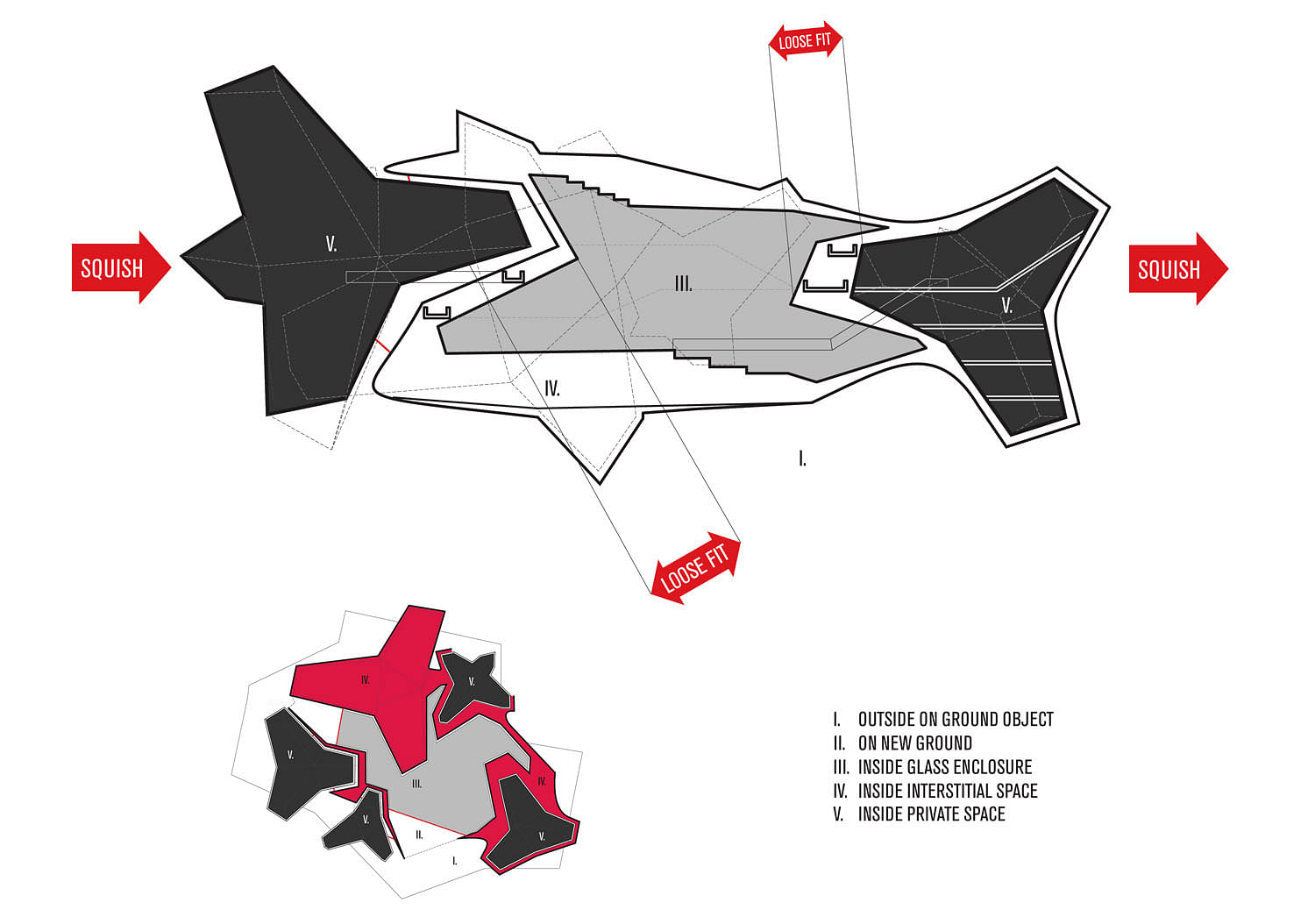
"This proposal is a continuation of a body of work we refer to as ‘objects wrapped in objects’, which deals with discrete, chunky objects gathered and squished together in a sack. This strategy creates complex interstitial spaces and deferred interiority, making the contemporary museum a space of surprises and discrete experiences rather than an endless continuum of paths."

Image courtesy of Tom Wiscombe Design

"Tristan Garcia, the object-oriented philosopher, talks about the infinite regress of things inside of things inside of things, except the world, which everything is inside of and therefore cannot itself be inside of something else. For him, the concept of a ‘sack’, literally, is a diagram of the conundrum of how things can simultaneously be autonomous from one another but also contain other things. This conundrum is the core of our proposal, in that the building should appear simultaneously as multiple autonomous objects but also as a larger, emergent object with its own properties. The vibration between these two ways of existing creates a visual indeterminacy that is alluring and durable."
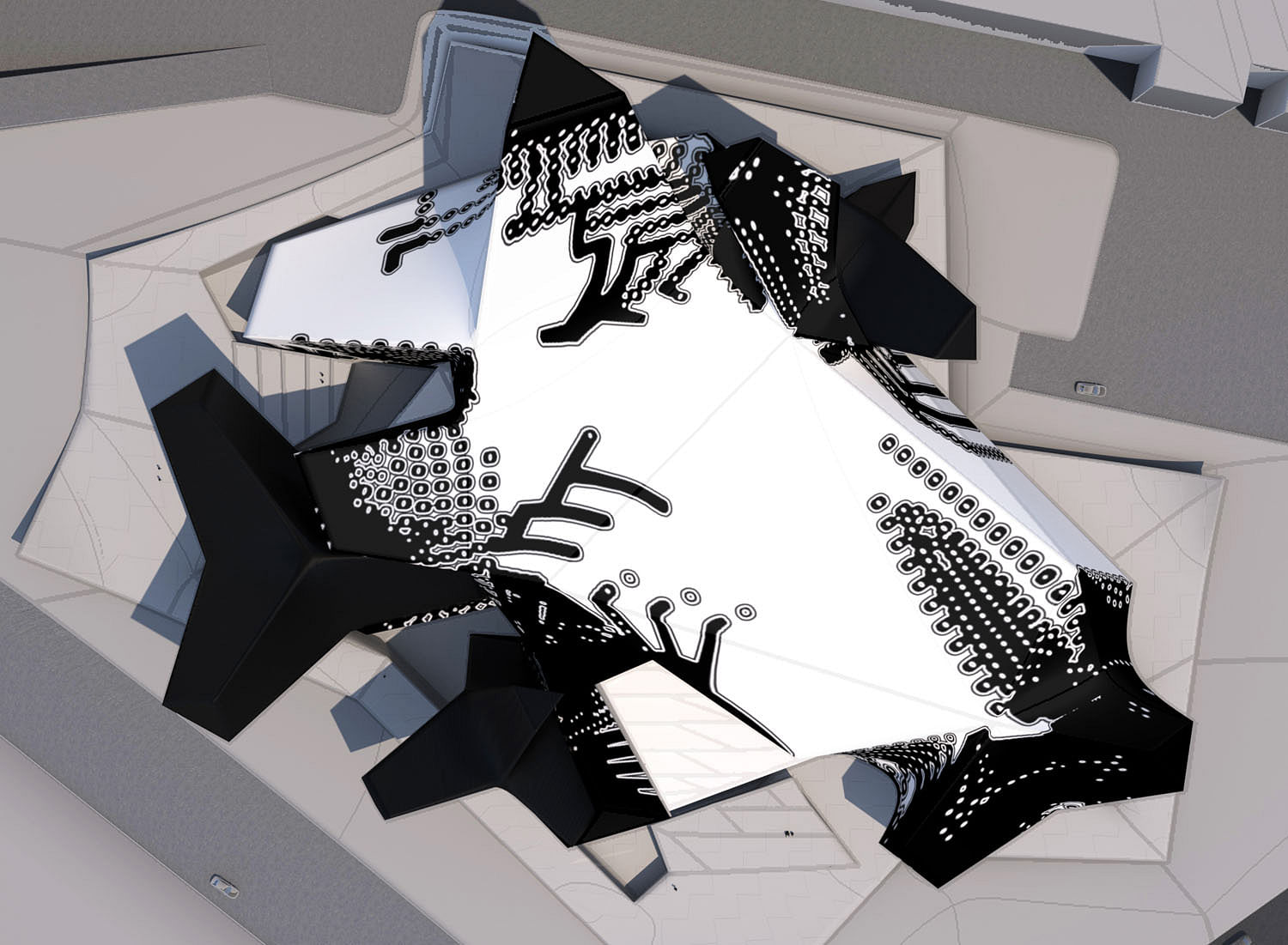
Image courtesy of Tom Wiscombe Design

"On the south side facing the Park, the sack is sliced open to reveal a public space nestled inside. An inner liner delaminates from the sack surface creating space for permanent and temporary gallery spaces in between. The building is re-enclosed with a glass membrane which is not coincident with the sack silhouette, creating an indeterminacy of enclosure and interiority."
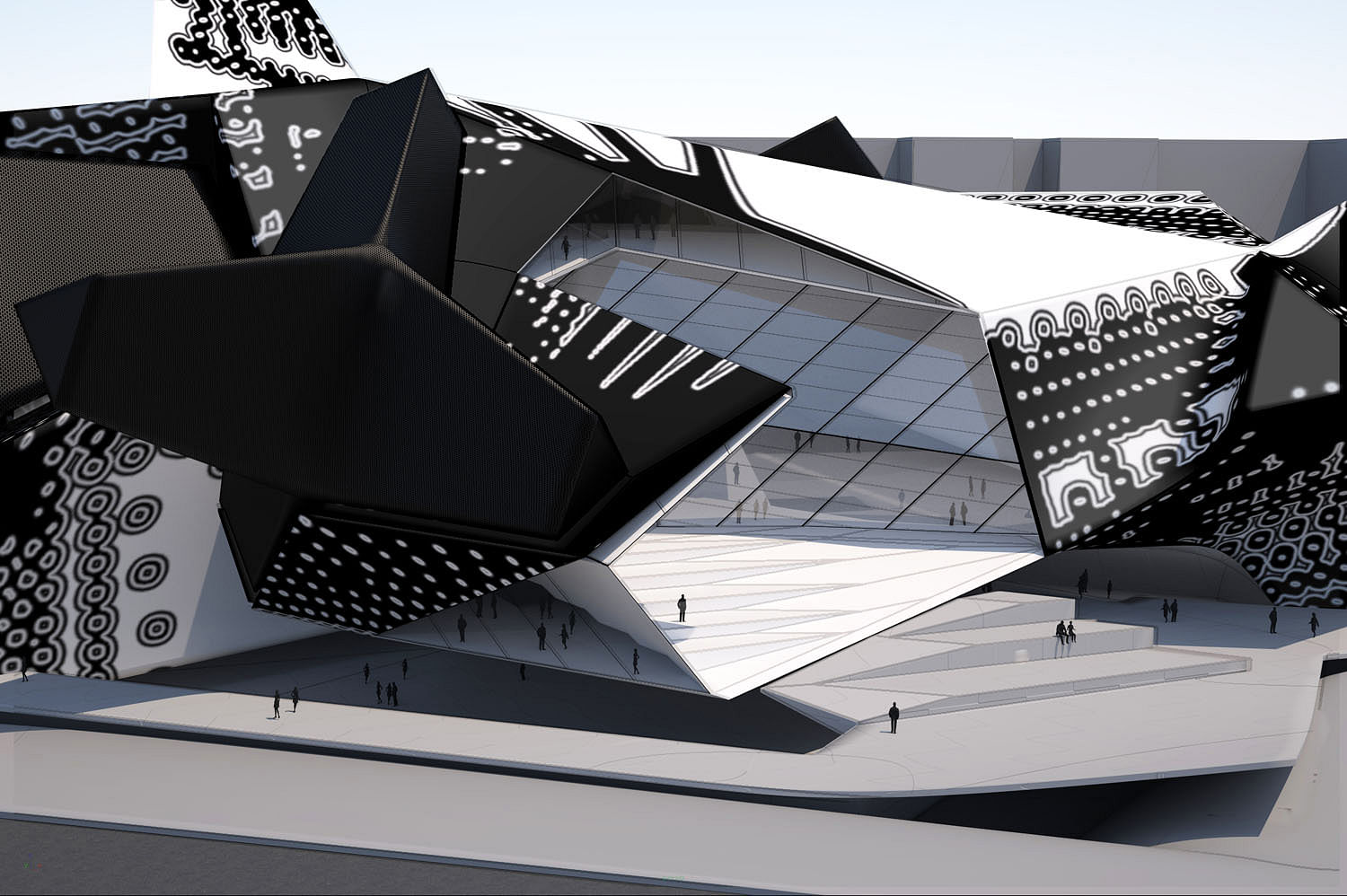
Image courtesy of Tom Wiscombe Design

"Black jack-like objects squish out into the sack from the inside or push into it from the outside. They are therefore either tucked between sack and liner, entirely outside the sack, or partially covered by the sack. One internal jack disappears altogether, opening up vast interior spaces between sack and liner. Interstitial spaces between discrete objects become the primary circulation of the building. The jacks house various support functions such as theaters, research area, library, and offices."
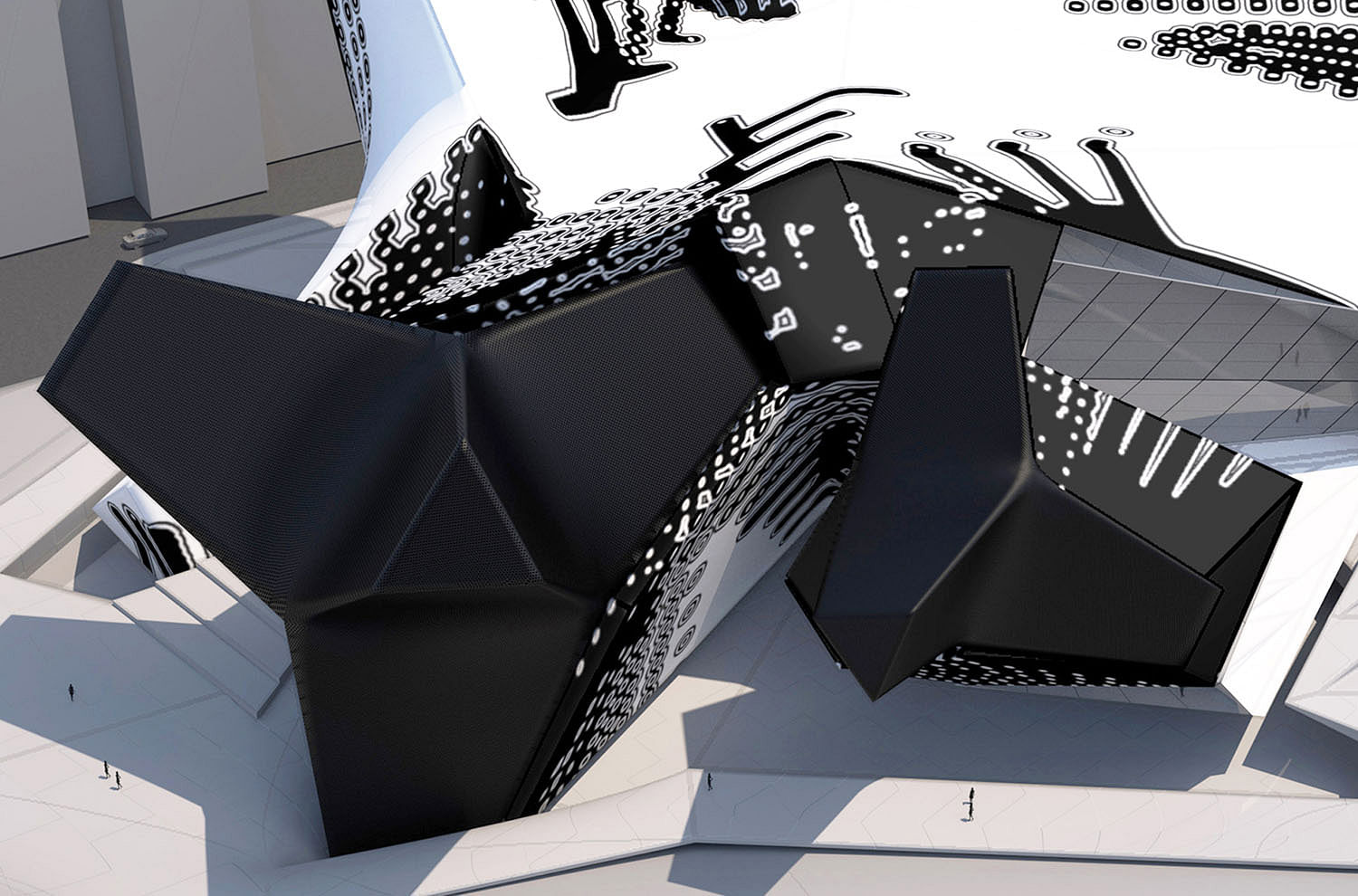
Image courtesy of Tom Wiscombe Design

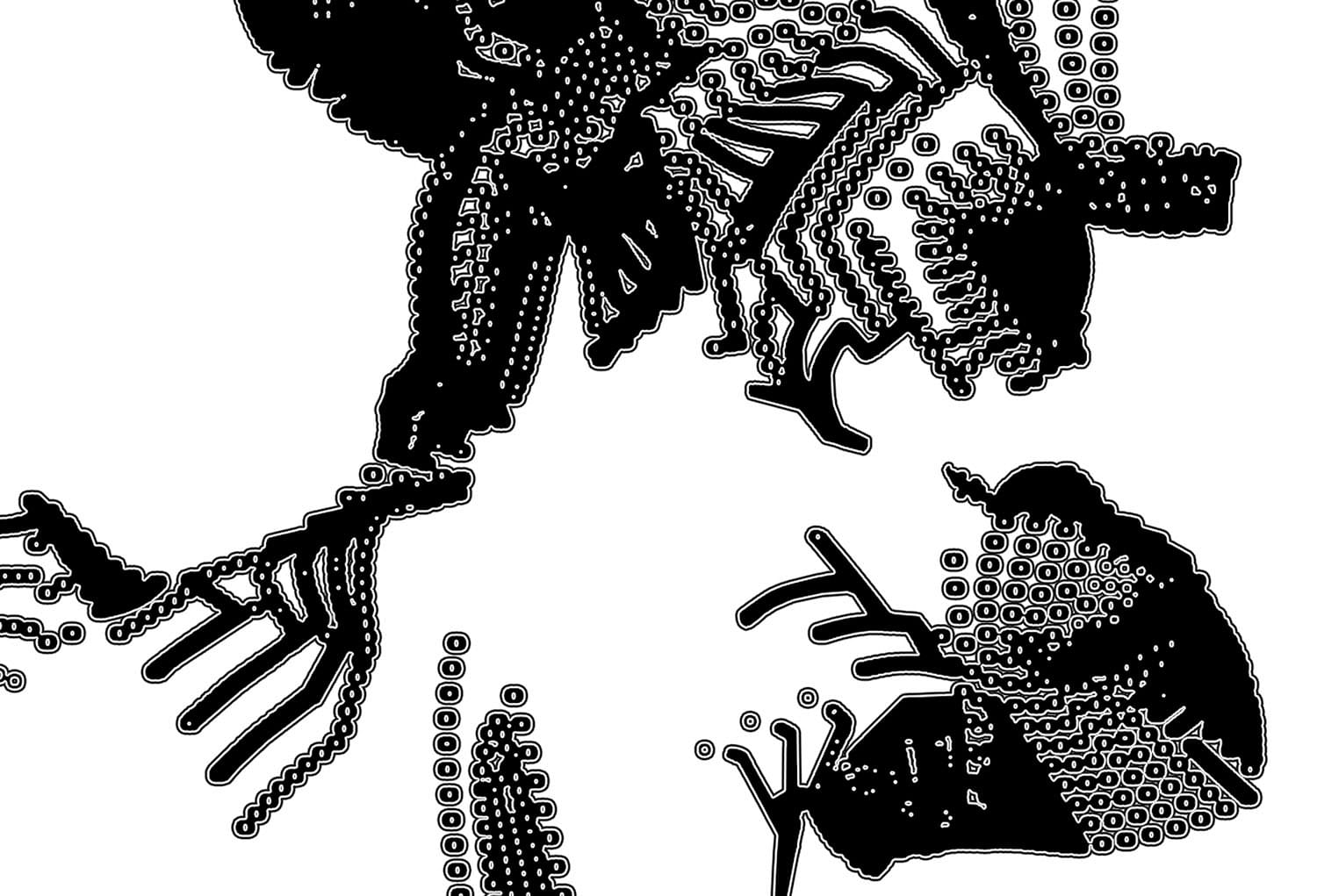
"The sack is articulated with architectural tattoos that subvert subdivision logics in favor of the freeform figuration allowed by composite construction. Tattoos are executed in such a way as to blur the edge between discrete objects and visually re-establish the larger object, as if qualities from the black objects begin to loosen and drift onto the sack."

Image courtesy of Tom Wiscombe Design

"Finally, the building is squished into a ‘ground object’ which is in turn squished into the land. The looseness between building and ground object allows for passage underneath the building. The looseness between ground object and land emphasizes the object-hood of the building complex. This move contrasts with exhausted ideas of buildings becoming landscape or otherwise disappearing into context."

Image courtesy of Tom Wiscombe Design

Find more diagrams in the image gallery below.

Related

tom wiscombe design ● russia ● new ncca ● national center for contemporary arts ● museum ● moscow ● europe

Share

  • Follow

    0 Comments

  • Comment as :

Moscow New NCCA Entry by Tom Wiscombe Design

Taichung City Cultural Center Entry by Tom Wiscombe Design

Sign up for Bustler's Email Newsletters

Next page » Loading

Moscow New NCCA Entry by Tom Wiscombe Design

By Bustler Editors|

Monday, Oct 7, 2013

Share

New NCCA (National Center for Contemporary Arts) competition entry by Tom Wiscombe Design. Image courtesy of Tom Wiscombe Design.

Related

tom wiscombe design ● russia ● new ncca ● national center for contemporary arts ● museum ● moscow ● europe

Earlier today, we published the ten shortlisted firms which qualified to move on to stage 2 of the international architectural competition for the new National Center for Contemporary Arts (New NCCA) in Moscow, Russia. The entry by Los Angeles-based Tom Wiscombe Design didn't quite make the list, but we are happy to present it here to a wider audience.

Project Description from Tom Wiscombe Design:

"This proposal is a continuation of a body of work we refer to as ‘objects wrapped in objects’, which deals with discrete, chunky objects gathered and squished together in a sack. This strategy creates complex interstitial spaces and deferred interiority, making the contemporary museum a space of surprises and discrete experiences rather than an endless continuum of paths."

Image courtesy of Tom Wiscombe Design

"Tristan Garcia, the object-oriented philosopher, talks about the infinite regress of things inside of things inside of things, except the world, which everything is inside of and therefore cannot itself be inside of something else. For him, the concept of a ‘sack’, literally, is a diagram of the conundrum of how things can simultaneously be autonomous from one another but also contain other things. This conundrum is the core of our proposal, in that the building should appear simultaneously as multiple autonomous objects but also as a larger, emergent object with its own properties. The vibration between these two ways of existing creates a visual indeterminacy that is alluring and durable."

Image courtesy of Tom Wiscombe Design

"On the south side facing the Park, the sack is sliced open to reveal a public space nestled inside. An inner liner delaminates from the sack surface creating space for permanent and temporary gallery spaces in between. The building is re-enclosed with a glass membrane which is not coincident with the sack silhouette, creating an indeterminacy of enclosure and interiority."

Image courtesy of Tom Wiscombe Design

"Black jack-like objects squish out into the sack from the inside or push into it from the outside. They are therefore either tucked between sack and liner, entirely outside the sack, or partially covered by the sack. One internal jack disappears altogether, opening up vast interior spaces between sack and liner. Interstitial spaces between discrete objects become the primary circulation of the building. The jacks house various support functions such as theaters, research area, library, and offices."

Image courtesy of Tom Wiscombe Design

"The sack is articulated with architectural tattoos that subvert subdivision logics in favor of the freeform figuration allowed by composite construction. Tattoos are executed in such a way as to blur the edge between discrete objects and visually re-establish the larger object, as if qualities from the black objects begin to loosen and drift onto the sack."

Image courtesy of Tom Wiscombe Design

"Finally, the building is squished into a ‘ground object’ which is in turn squished into the land. The looseness between building and ground object allows for passage underneath the building. The looseness between ground object and land emphasizes the object-hood of the building complex. This move contrasts with exhausted ideas of buildings becoming landscape or otherwise disappearing into context."

Image courtesy of Tom Wiscombe Design

Find more diagrams in the image gallery below.

Share

  • Follow

    0 Comments

  • Comment as :

Archinect JobsArchinect Jobs

The Archinect Job Board attracts the world's top architectural design talents.

VIEW ALL JOBS POST A JOB

Intermediate Architect

FROM Architecture DPC

Intermediate Architect

New York, NY, US

Marketing and Architectural Assistant

AGENCIE / Architecture & Engineering

Marketing and Architectural Assistant

New York, NY, US

Project Architect

AYON Studio

Project Architect

New York, NY, US

Architect 10+

Standard Architects

Architect 10+

Long Island City, NY, US

Project Architect

BuildingWork

Project Architect

Seattle, WA, US

AutoCAD Drafter/Architectural Designer

Kari Whitman Interiors

AutoCAD Drafter/Architectural Designer

Boulder, CO, US

Project Architect

Berliner Architects

Project Architect

Culver City, CA, US

Interior Designer | Education & Institutional Work

Berliner Architects

Interior Designer | Education & Institutional Work

Culver City, CA, US

Junior Designer

OLIVER FREUNDLICH DESIGN

Junior Designer

New York, NY, US

Project Designer (3-5 years)

Edmonds + Lee Architects

Project Designer (3-5 years)

San Francisco, CA, US

Next page » Loading