• Login / Join
  • About
  • •
  • Contact
  • •
  • Advertising
bustler logo
bustler logo
  • News
  • Competitions
  • Events
  • Bustler is powered by Archinect
  • Sign up for Bustler's Email Newsletters

  • Follow these Bustler feeds:

  • Search

    Search in

  • Submit

    What are you submitting?

    News Pitch
    Competition
    Event
  • Login / Join
  • News|Competitions|Events
  • Search
    | Submit
    | Follow
  • Search in

    What are you submitting?

    News Pitch
    Competition
    Event

    Follow these Bustler feeds:

  • About|Contact|Advertising
  • Login / Join
Tagged: domestic

Bureau Spectacular's "Five Normal Houses", from the A+D Museum's SHELTER exhibition

By Bustler Editors|

Saturday, Sep 12, 2015

Collage of "Five Normal Houses" by Bureau Spectacular.

What makes a house normal in Los Angeles? How is normality determined? Those are a few of the underlying questions that Bureau Spectacular/Jimenez Lai explores in their project "Five Normal Houses", part of the SHELTER exhibition currently at the A+D Museum. Co-curated by Sam Lubell and Danielle Rago, "SHELTER" has fun with the possibilities that Angelenos can live in their city, and it also addresses L.A.'s evolving cityscape.

"Five Normal Houses" explores five typologies of L.A. domestic architecture that Bureau Spectacular derived from their field research when they ventured out along the L.A. River.

Bureau Spectacular shared more project details with Bustler. Check it out below.

"Along the LA River, there is a language within the typologies of domestic architecture. This raises an important question: just  what makes a house normal in LA? If the word shelter suggests a lack of extravagance, what are some of the qualities of normal architectural languages in Southern California, and how does one constitute it? Is it possible to study the techniques of normal, and  find applications to the production of almost normal architecture?"

"Five Normal Houses" by Bureau Spectacular: Case Studies. Image courtesy of Bureau Spectacular.

"At the behest of a question, Bureau Spectacular embarked on a field research along the LA River. When we returned from our  journey,  we noted five particular normal conditions to further pursue. The wet and dry pool culture’s, fascination with vegetations on facade, the car culture and the dingbat, willingness for physical  decompartmentalization of  the domestic unit, and the asymmetrical mashup in Spanish Styles or Queen Anne Revivals. We propose five applications of normal vocabularies of domestic architecture, spoken with some sense of hyperbole."

Five Case Studies

Dingbat

"Five Normal Houses" by Bureau Spectacular: Dingbat. Image courtesy of Bureau Spectacular.
"Five Normal Houses" by Bureau Spectacular: Dingbat plan. Image courtesy of Bureau Spectacular.

"To an unsuspecting architecture  enthusiast, the Dingbat typology of Los Angeles marks striking similarities with the Le Corbusier masterpiece Villa Savoye (1931). There are several triggers: both domestic architectures, both with floating mass - es detached from the ground to  anticipate the stowing away of cars, both supported by a series  of slender columns - there are immediately comparable qualities that begs the question: Is Villa Savoye a Dingbat?

In most of the Dingbats we encountered, we are often able to identify two, if not three out of five points in the Five Points of Architecture postulated by Le Corbusier. This discovery compelled us to look further into this parallel. While it is not difficult to find an abundance of pilotis, what we found to be perhaps more stimulating is using the  Dingbat towards a misread of status of the Free Facade, Roof  Garden and the Ribbon Window..."

A House Apart

"Five Normal Houses" by Bureau Spectacular: A House Apart. Image courtesy of Bureau Spectacular.
"Five Normal Houses" by Bureau Spectacular: A House Apart plan. Image courtesy of Bureau Spectacular.

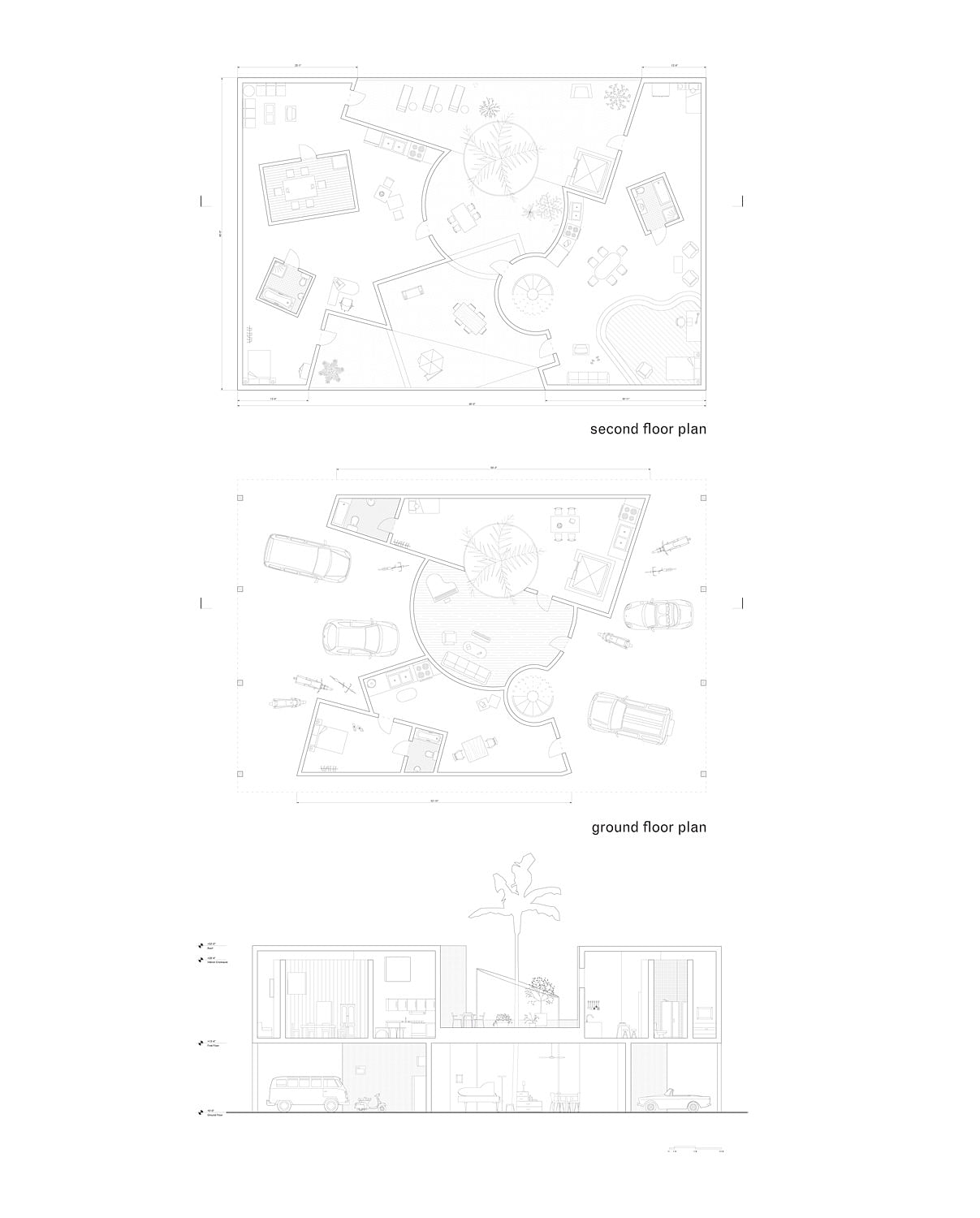
"There is a ready willingness in  the culture of Los Angeles to accept a house being comprised  of a series of detached architectural envelopes. In many cases,  we find separations of architectural programs away from the 'house' itself, yielding in other singular and complete envelopes such as garage, shed, cabin, guest house, out house,  greenhouse, and so forth. As long as this urbanism of scattered objects are inscribed inside of a single property line, they can still be considered an individual house...

In our proposal, we introduce a collection of architectural objects, where every enclosure contains one single architectural program. Because the objects are not parallel with one another, the gaps between the objects allows for contractions and expansions of spaces. The maagement of the larger and smaller gaps imply a set of domestic  stories. From a dog house facing directly at the garage in anticipation for its owner’s return home,  to the outdoor hearth that functions as a central piazza of a micro city, or the teenager’s room with a private entry and exit for in case of trouble, this proposal turns domestic architecture into  a canvas for a family portrait."

Healthy House

"Five Normal Houses" by Bureau Spectacular: Healthy House. Image courtesy of Bureau Spectacular.
"Five Normal Houses" by Bureau Spectacular: Healthy House plan. Image courtesy of Bureau Spectacular.

"Within the cultural ethos of Los Angeles, there is a great desire for its citizens to maintain a  healthy lifestyle. This obsession  is so strong that it compels peo - ple to drink their superfoods,  sweat in still poses in heated  rooms, or push on truck tires for  fitness.  Sometimes this  desire manifests itself physically: people make their houses green.  From foliage facades to greenhouses of plentiful gardens, the healthy aesthetics has become  a kind of urban hardware that  communicates a lifestyle choice...

At the end of the day, we also want to think about the surface appliqué of the color green. It is a signal for good health, but particularly in Los Angeles it also speaks about a transparency into an alternate reality. Perhaps there is a way to consider a misuse of the color, and what photographic wonders we may be able to accidentally produce."

Pool House

"Five Normal Houses" by Bureau Spectacular: Pool House. Image courtesy of Bureau Spectacular.
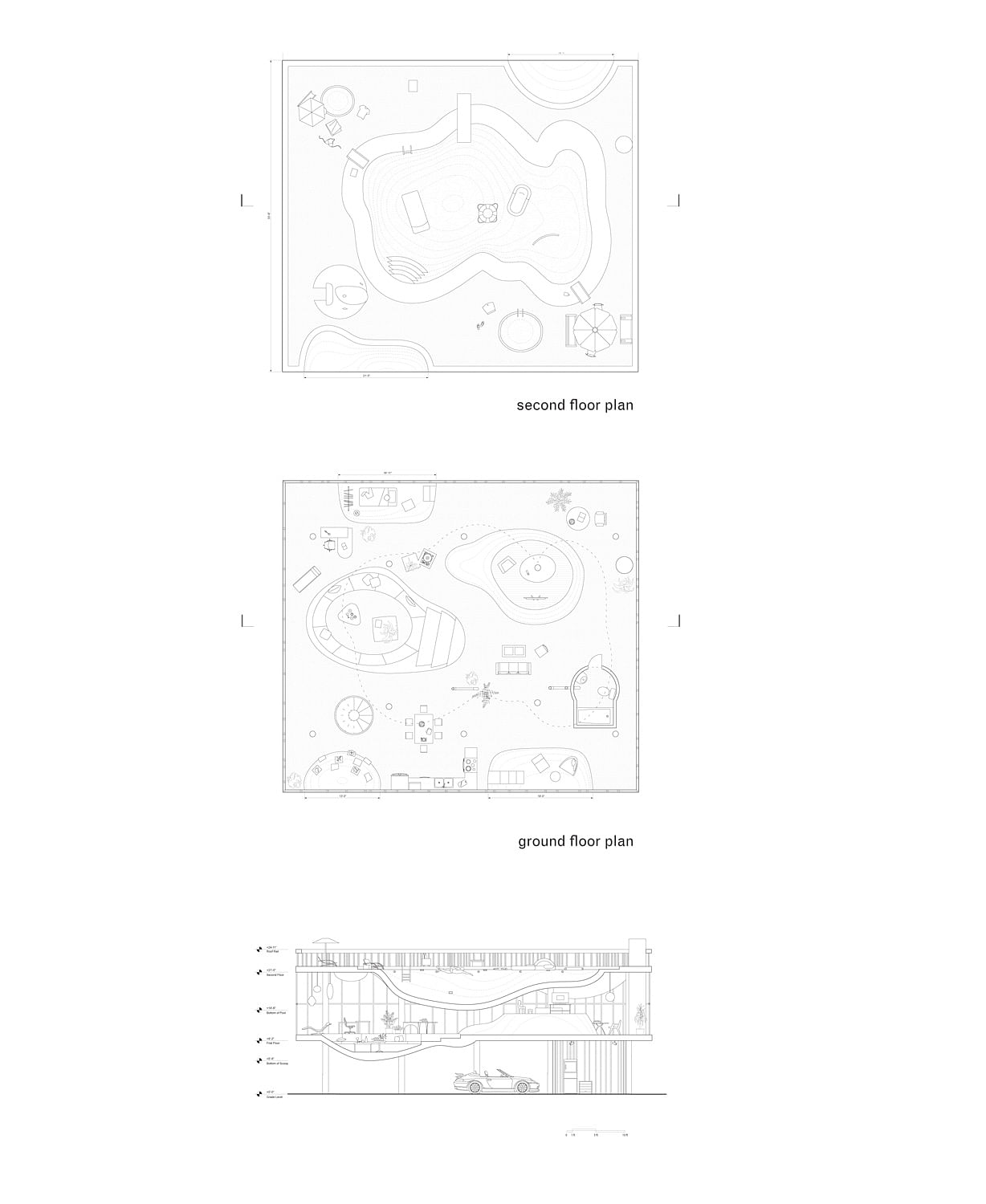
"Five Normal Houses" by Bureau Spectacular: Pool House plan. Image courtesy of Bureau Spectacular.

"Life around the pool is also very important to the development  of Southern Californian culture - a drought in the 20th Century  became the very foundation of  skateboarding as a sport here in California when a creative use  the dry pool took place in Dogtown. One could perhaps argue  that this event became the first  human interaction with an abstract geometry at a scale we  are able to perform actions onto. Skatepark in Dogtown Pool Shapes Index The pool, when wet, is the epi - center of romantic imaginations...

In the Pool House, we propose a roof pool that dips into the central living area to create a set of sectional contract ions and expansions. The inverse peaks and valleys provide a series of apt landscape conditions for interior actions. With some swales containing storage, some craters hosting conversation pits, no partitions are really needed to separate programmatic zones."

Queen Anne Revival

"Five Normal Houses" by Bureau Spectacular: Queen Anne Revival. Image courtesy of Bureau Spectacular.
"Five Normal Houses" by Bureau Spectacular: Queen Anne Revival plan. Image courtesy of Bureau Spectacular.

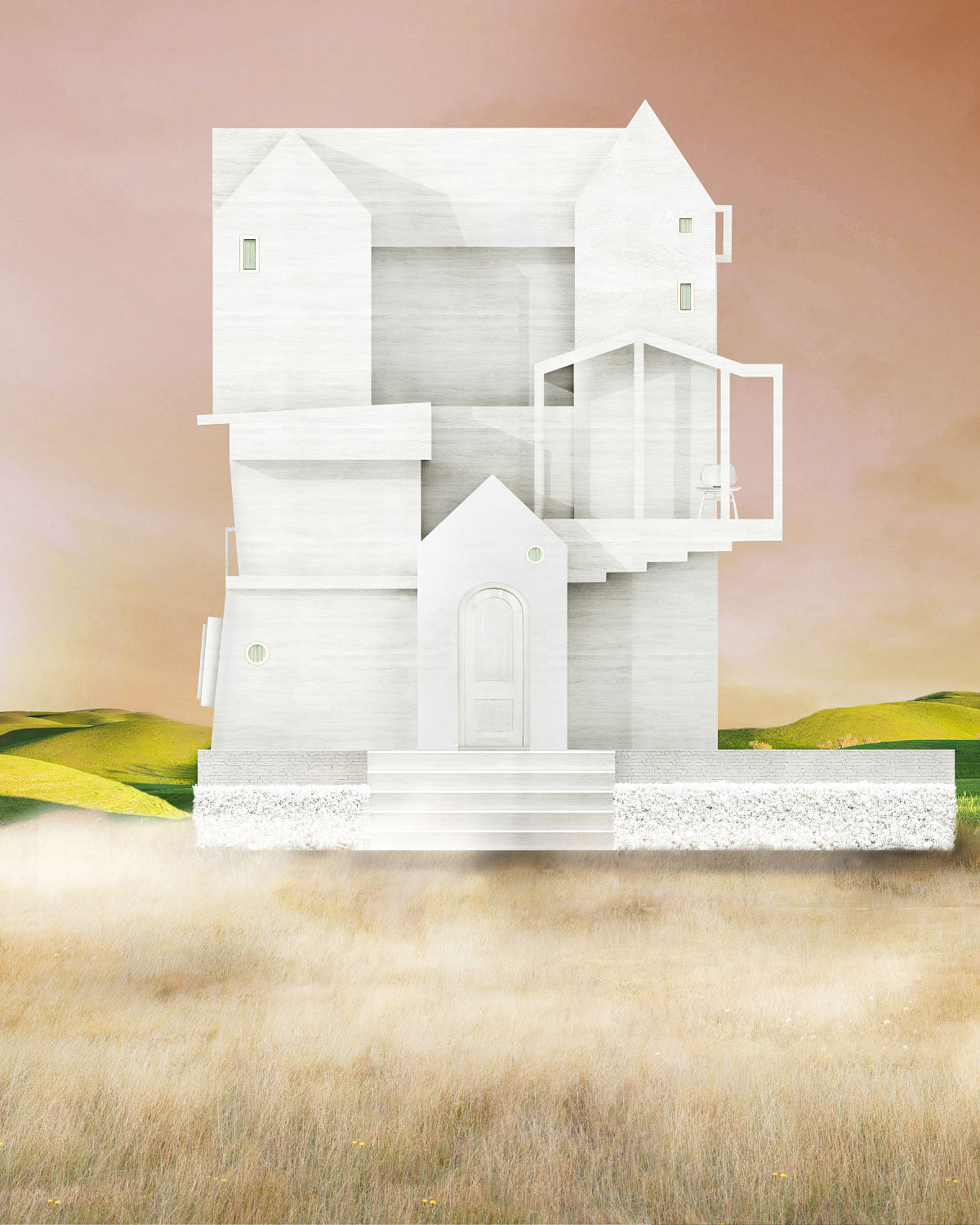
"From late 19th Century to the  early 20th Century, the Queen Anne style of American architecture was at its peak popularity. This time period was also during a population boom in Los Angeles, and today one can regard the Queen Anne Style a  common occurrence. One can often identify some consistent  compositional principles with this typology - asymmetrical  facades, dominant front-facing  gables, overhanging eaves, cantilevered planes, multiple towers with various spires, mixed in with mansard roof, Dutch gables, bay windows, and so forth. While there are other architectural imports to Los Angeles...the Queen Anne stands out as being one of the more fascinating techniques to study because it indiscriminately mashes up of any style from any source material, as long as the compositional logic is maintained.

In our proposal, we decided to stay within the discourse of normalcy by sourcing from architectural parts along the L.A. River (what), whilst painting a white austerity over the techniques of Dujardin (how) and keeping in the back of our minds the comedy of Hamilton and the cuteness of a Miyazaki anime. (why)"

Text and images courtesy of Bureau Spectacular.

Related

shelter ● los angeles ● la river ● jimenez lai ● housing ● houses ● exhibition ● domestic living ● domestic ● california ● bureau spectacular ● a+d museum ● a+d architecture and design museum

Share

  • Follow

    0 Comments

  • Comment as :

Bureau Spectacular's "Five Normal Houses", from the A+D Museum's SHELTER exhibition

A winning SukkahPDX 2014 design from pelizziarchitettura

A closer look at the winning Wynwood Greenhouse garden park to be built in Miami

Sign up for Bustler's Email Newsletters

Next page » Loading

Bureau Spectacular's "Five Normal Houses", from the A+D Museum's SHELTER exhibition

By Bustler Editors|

Saturday, Sep 12, 2015

Share

Collage of "Five Normal Houses" by Bureau Spectacular.

Related

shelter ● los angeles ● la river ● jimenez lai ● housing ● houses ● exhibition ● domestic living ● domestic ● california ● bureau spectacular ● a+d museum ● a+d architecture and design museum

What makes a house normal in Los Angeles? How is normality determined? Those are a few of the underlying questions that Bureau Spectacular/Jimenez Lai explores in their project "Five Normal Houses", part of the SHELTER exhibition currently at the A+D Museum. Co-curated by Sam Lubell and Danielle Rago, "SHELTER" has fun with the possibilities that Angelenos can live in their city, and it also addresses L.A.'s evolving cityscape.

"Five Normal Houses" explores five typologies of L.A. domestic architecture that Bureau Spectacular derived from their field research when they ventured out along the L.A. River.

Bureau Spectacular shared more project details with Bustler. Check it out below.

"Along the LA River, there is a language within the typologies of domestic architecture. This raises an important question: just  what makes a house normal in LA? If the word shelter suggests a lack of extravagance, what are some of the qualities of normal architectural languages in Southern California, and how does one constitute it? Is it possible to study the techniques of normal, and  find applications to the production of almost normal architecture?"

"Five Normal Houses" by Bureau Spectacular: Case Studies. Image courtesy of Bureau Spectacular.

"At the behest of a question, Bureau Spectacular embarked on a field research along the LA River. When we returned from our  journey,  we noted five particular normal conditions to further pursue. The wet and dry pool culture’s, fascination with vegetations on facade, the car culture and the dingbat, willingness for physical  decompartmentalization of  the domestic unit, and the asymmetrical mashup in Spanish Styles or Queen Anne Revivals. We propose five applications of normal vocabularies of domestic architecture, spoken with some sense of hyperbole."

Five Case Studies

Dingbat
"Five Normal Houses" by Bureau Spectacular: Dingbat. Image courtesy of Bureau Spectacular.
"Five Normal Houses" by Bureau Spectacular: Dingbat plan. Image courtesy of Bureau Spectacular.

"To an unsuspecting architecture  enthusiast, the Dingbat typology of Los Angeles marks striking similarities with the Le Corbusier masterpiece Villa Savoye (1931). There are several triggers: both domestic architectures, both with floating mass - es detached from the ground to  anticipate the stowing away of cars, both supported by a series  of slender columns - there are immediately comparable qualities that begs the question: Is Villa Savoye a Dingbat?

In most of the Dingbats we encountered, we are often able to identify two, if not three out of five points in the Five Points of Architecture postulated by Le Corbusier. This discovery compelled us to look further into this parallel. While it is not difficult to find an abundance of pilotis, what we found to be perhaps more stimulating is using the  Dingbat towards a misread of status of the Free Facade, Roof  Garden and the Ribbon Window..."

A House Apart

"Five Normal Houses" by Bureau Spectacular: A House Apart. Image courtesy of Bureau Spectacular.
"Five Normal Houses" by Bureau Spectacular: A House Apart plan. Image courtesy of Bureau Spectacular.

"There is a ready willingness in  the culture of Los Angeles to accept a house being comprised  of a series of detached architectural envelopes. In many cases,  we find separations of architectural programs away from the 'house' itself, yielding in other singular and complete envelopes such as garage, shed, cabin, guest house, out house,  greenhouse, and so forth. As long as this urbanism of scattered objects are inscribed inside of a single property line, they can still be considered an individual house...

In our proposal, we introduce a collection of architectural objects, where every enclosure contains one single architectural program. Because the objects are not parallel with one another, the gaps between the objects allows for contractions and expansions of spaces. The maagement of the larger and smaller gaps imply a set of domestic  stories. From a dog house facing directly at the garage in anticipation for its owner’s return home,  to the outdoor hearth that functions as a central piazza of a micro city, or the teenager’s room with a private entry and exit for in case of trouble, this proposal turns domestic architecture into  a canvas for a family portrait."

Healthy House

"Five Normal Houses" by Bureau Spectacular: Healthy House. Image courtesy of Bureau Spectacular.
"Five Normal Houses" by Bureau Spectacular: Healthy House plan. Image courtesy of Bureau Spectacular.

"Within the cultural ethos of Los Angeles, there is a great desire for its citizens to maintain a  healthy lifestyle. This obsession  is so strong that it compels peo - ple to drink their superfoods,  sweat in still poses in heated  rooms, or push on truck tires for  fitness.  Sometimes this  desire manifests itself physically: people make their houses green.  From foliage facades to greenhouses of plentiful gardens, the healthy aesthetics has become  a kind of urban hardware that  communicates a lifestyle choice...

At the end of the day, we also want to think about the surface appliqué of the color green. It is a signal for good health, but particularly in Los Angeles it also speaks about a transparency into an alternate reality. Perhaps there is a way to consider a misuse of the color, and what photographic wonders we may be able to accidentally produce."

Pool House

"Five Normal Houses" by Bureau Spectacular: Pool House. Image courtesy of Bureau Spectacular.
"Five Normal Houses" by Bureau Spectacular: Pool House plan. Image courtesy of Bureau Spectacular.

"Life around the pool is also very important to the development  of Southern Californian culture - a drought in the 20th Century  became the very foundation of  skateboarding as a sport here in California when a creative use  the dry pool took place in Dogtown. One could perhaps argue  that this event became the first  human interaction with an abstract geometry at a scale we  are able to perform actions onto. Skatepark in Dogtown Pool Shapes Index The pool, when wet, is the epi - center of romantic imaginations...

In the Pool House, we propose a roof pool that dips into the central living area to create a set of sectional contract ions and expansions. The inverse peaks and valleys provide a series of apt landscape conditions for interior actions. With some swales containing storage, some craters hosting conversation pits, no partitions are really needed to separate programmatic zones."

Queen Anne Revival
"Five Normal Houses" by Bureau Spectacular: Queen Anne Revival. Image courtesy of Bureau Spectacular.
"Five Normal Houses" by Bureau Spectacular: Queen Anne Revival plan. Image courtesy of Bureau Spectacular.

"From late 19th Century to the  early 20th Century, the Queen Anne style of American architecture was at its peak popularity. This time period was also during a population boom in Los Angeles, and today one can regard the Queen Anne Style a  common occurrence. One can often identify some consistent  compositional principles with this typology - asymmetrical  facades, dominant front-facing  gables, overhanging eaves, cantilevered planes, multiple towers with various spires, mixed in with mansard roof, Dutch gables, bay windows, and so forth. While there are other architectural imports to Los Angeles...the Queen Anne stands out as being one of the more fascinating techniques to study because it indiscriminately mashes up of any style from any source material, as long as the compositional logic is maintained.

In our proposal, we decided to stay within the discourse of normalcy by sourcing from architectural parts along the L.A. River (what), whilst painting a white austerity over the techniques of Dujardin (how) and keeping in the back of our minds the comedy of Hamilton and the cuteness of a Miyazaki anime. (why)"

Text and images courtesy of Bureau Spectacular.

Share

  • Follow

    0 Comments

  • Comment as :

Archinect JobsArchinect Jobs

The Archinect Job Board attracts the world's top architectural design talents.

VIEW ALL JOBS POST A JOB

Architectural Project Manager - Multifamily

DAHLIN Architecture | Planning | Interiors

Architectural Project Manager - Multifamily

San Diego, CA, US

Job Captain - Education

DAHLIN Architecture | Planning | Interiors

Job Captain - Education

San Diego, CA, US

Architectural Designer (5-7 Years) - Commercial & Hospitality Focus

Pfeffer Torode Architecture

Architectural Designer (5-7 Years) - Commercial & Hospitality Focus

Nashville, TN, US

Junior Architect / Architectural Designer

S20M

Junior Architect / Architectural Designer

New York, NY, US

Design Director or Sr. Architect

b.hills architecture, P.C.

Design Director or Sr. Architect

Boise, ID, US

Interior Design Project Manager

DAHLIN Architecture | Planning | Interiors

Interior Design Project Manager

Bellevue, WA, US

Architect

OBRA Architects

Architect

New York, NY, US

Architectural team Memeber

Meraki Architects, LLC

Architectural team Memeber

Middleburg Heights, OH, US

Project Architect/ Designer

Nandinee Phookan Architect, P.C.

Project Architect/ Designer

New York, NY, US

Project Architect

BuildingWork

Project Architect

Seattle, WA, US

Next page » Loading