• Login / Join
  • About
  • •
  • Contact
  • •
  • Advertising
bustler logo
bustler logo
  • News
  • Competitions
  • Events
  • Bustler is powered by Archinect
  • Sign up for Bustler's Email Newsletters

  • Follow these Bustler feeds:

  • Search

    Search in

  • Submit

    What are you submitting?

    News Pitch
    Competition
    Event
  • Login / Join
  • News|Competitions|Events
  • Search
    | Submit
    | Follow
  • Search in

    What are you submitting?

    News Pitch
    Competition
    Event

    Follow these Bustler feeds:

  • About|Contact|Advertising
  • Login / Join
Tagged: koreatown

Korean Diaspora by Carlos Zarco Sanz - 3rd-prize entry from Re-thinking The Future Thesis Award

By Bustler Editors|

Friday, Dec 6, 2013
Korean Diaspora by Carlos Zarco Sanz - 3rd Place in Public/Institutional category

Carlos Zarco Sanz from the University of Madrid recently sent us his proposal, "Korean Diaspora" from Re-thinking the Future's International Architectural Thesis Award we previously featured.  His design won 3rd place in the Public/Institutional category.

Sanz's "Korean Diaspora" reimagines Manhattan's Koreatown as a shifting social and commercial space built for the neighborhood's present and future.

Check out the details below.

Project intro

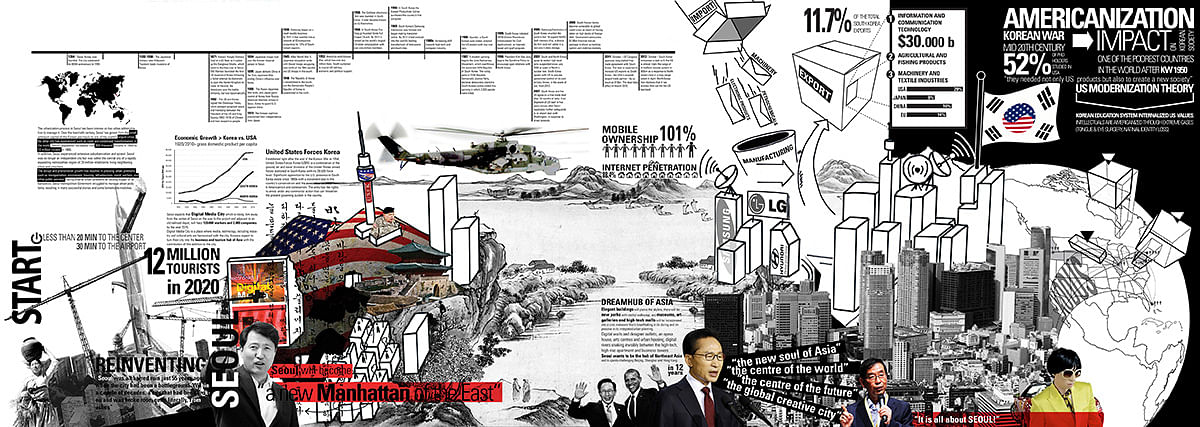
"The focus on Korean culture and multitude of social venues allows the space to be a site of social interaction connecting people together to form networks and cultivate the space. All the elements of the busy Korean street that apply to Manhattan’s 32nd street has the potential to act as more than just a commercialized recreation of Seoul, the KTown can also serve to support a community of Korean-Americans to connect with  American society while maintaining ties with Korea."
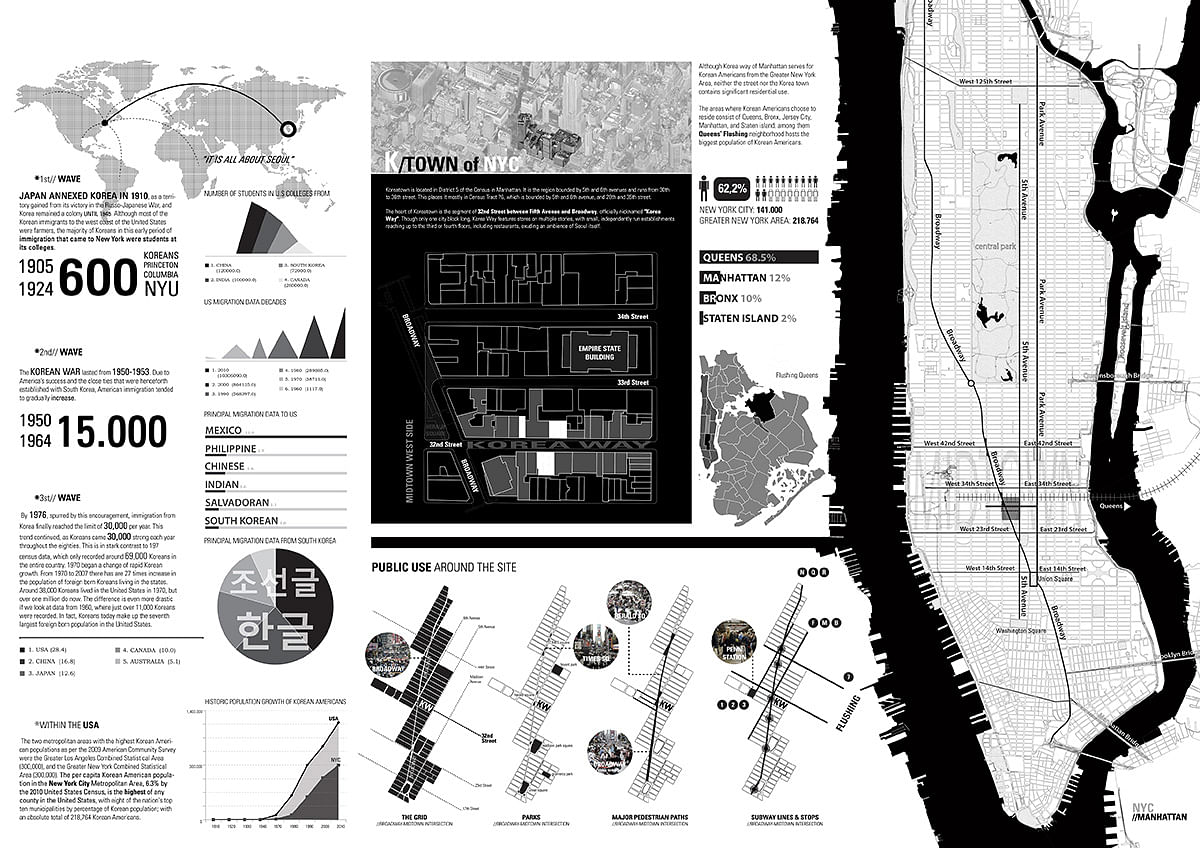
 

Image: Carlos Zarco Sanz

"The project, at this point, aims to empower this connection between differences not only through commercialism and consumerism but encouraging cultural exploration of the Korean Culture, which the project avoids to define but leaves room for it to be brought and change. Any attempt to define a specific program would foreclose on unforeseen developments and possibilities; therefore, the Korean Diaspora that inhabits incomings would acknowledge the inevitability of change, chance, and indeterminacy by incorporating uncertainties as integral to a continuously evolving process modeled after self-regulating organic processes."
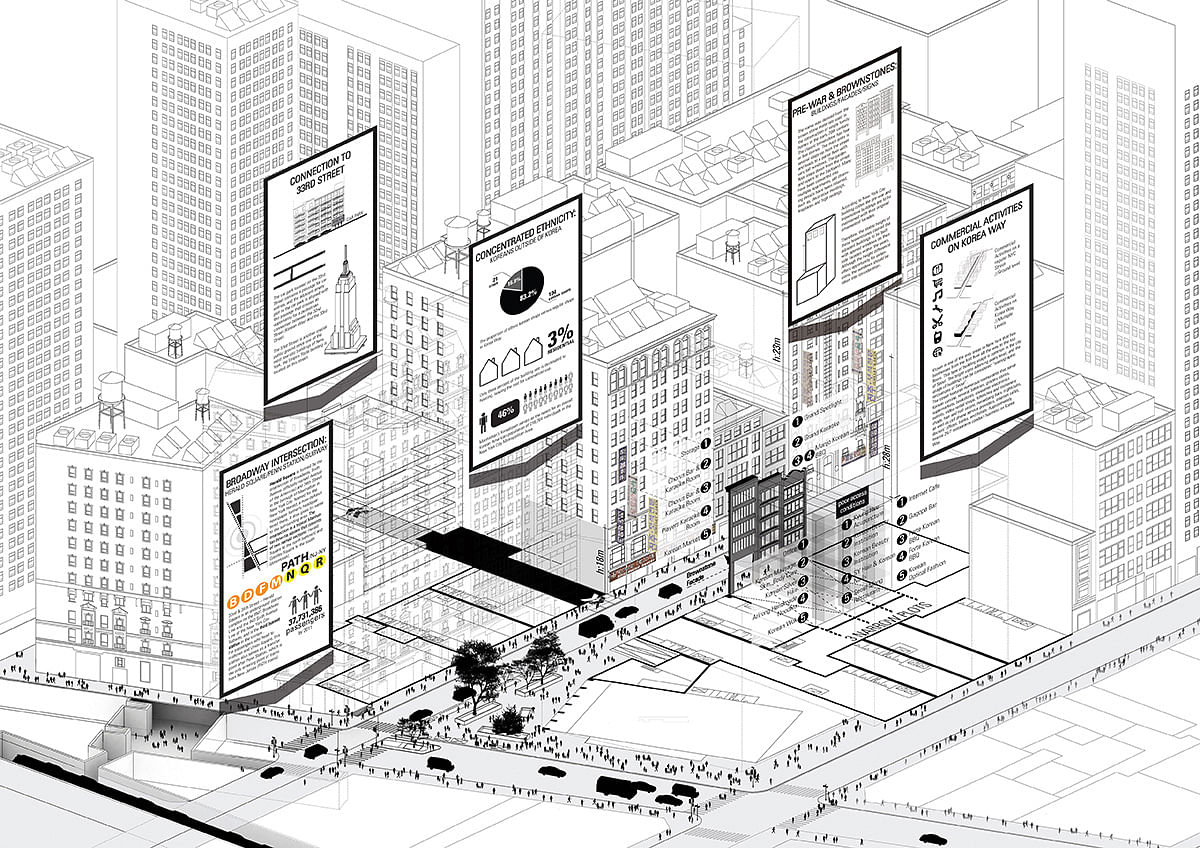
Image: Carlos Zarco Sanz

"Details about the project
Considering the potential voids at the site, the two identical Boxes are placed on top the two existing buildings of Korea Way. To feed these public programmed spaces, the main public realm of the Korea Way, the street/sidewalks in particular, was required to be physically extended; however, this brought a challenge since the flow of the public realm is horizontal and the accesses to the Boxes are only through verticality."

Image: Carlos Zarco Sanz

"In order to solve this problem, two connector DEVICEs are developed as mediators. Although the strategy remains the same for the connection of the two Boxes to Korea Way, the tactics of the design vary as the project considers the local features of the plots."
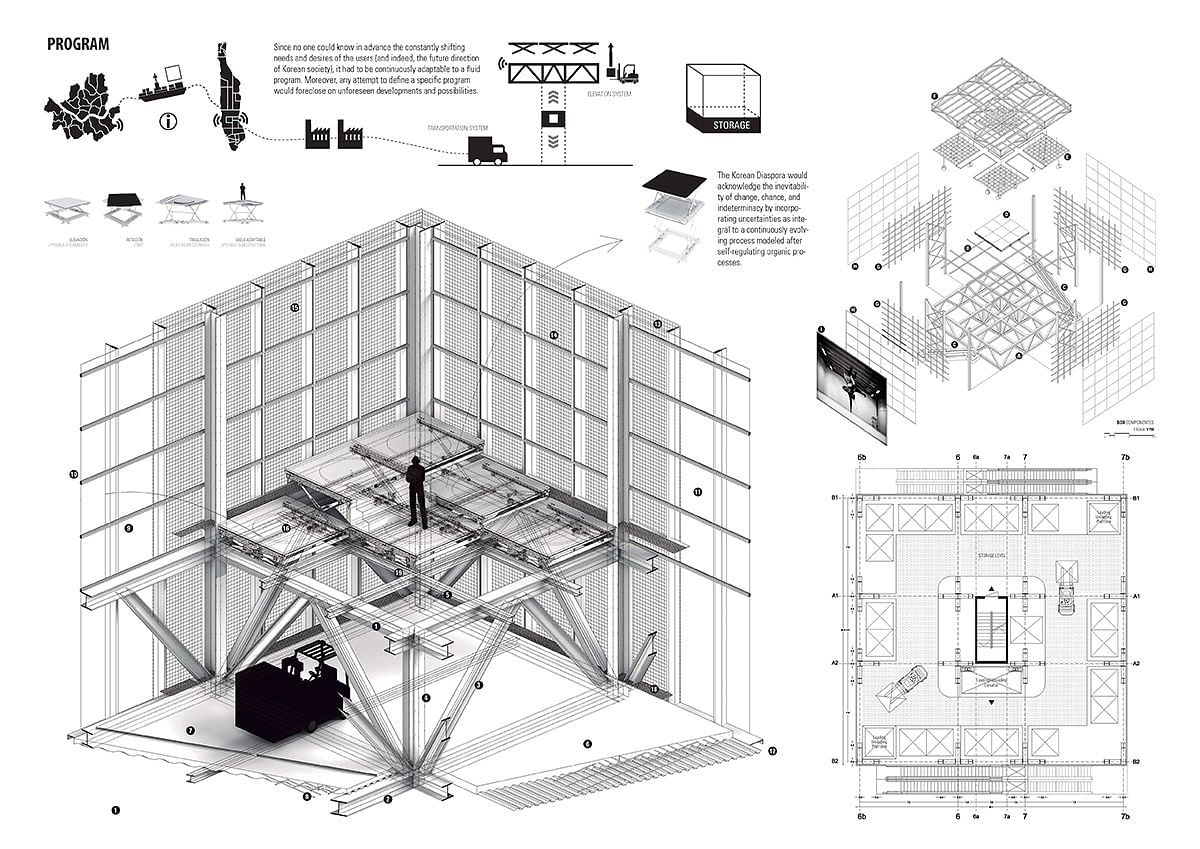
Image: Carlos Zarco Sanz

"The variable 'program' and form of the program are not conventional architecture but much closer to what we understand today as the computer program: an array of algorithmic functions and logical gateways that control temporal events and processes in a virtual device."
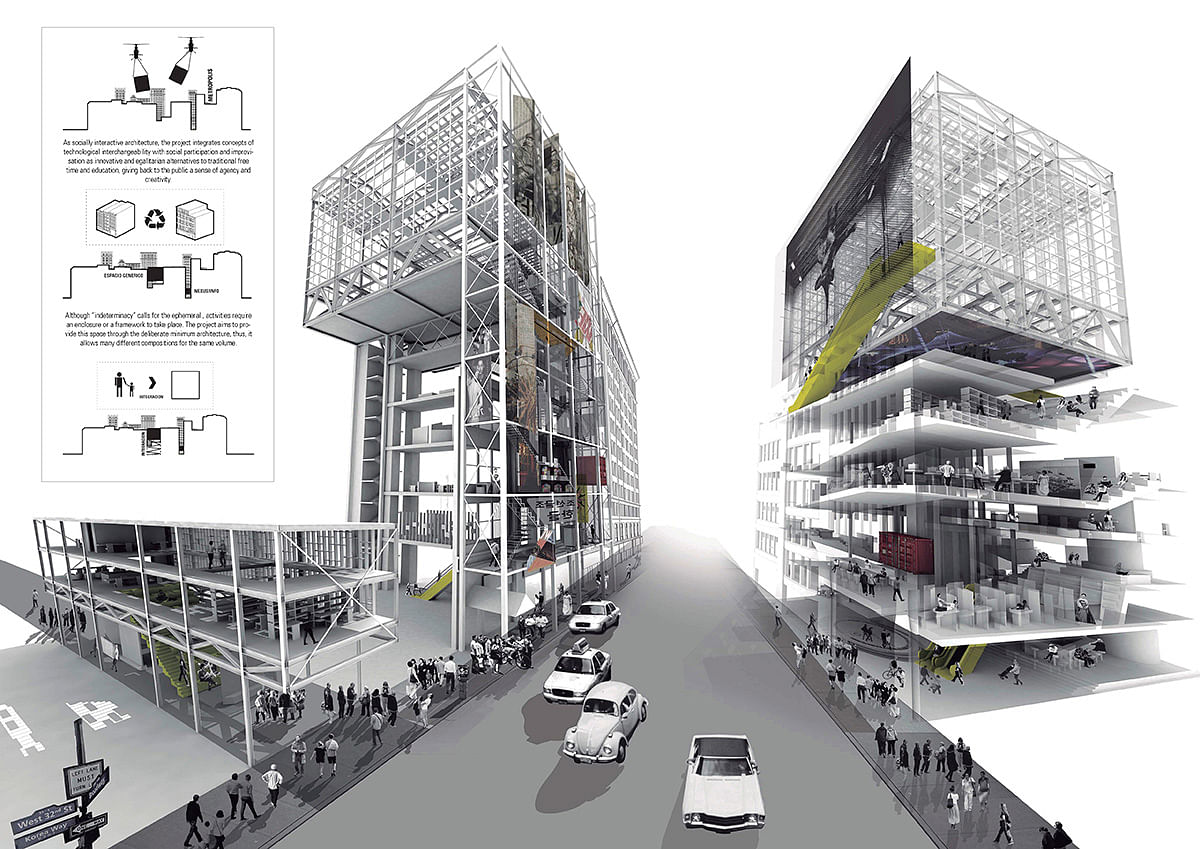
Image: Carlos Zarco Sanz

"As socially interactive architecture, the project integrates concepts of technological interchangeability with social participation and improvisation as innovative and egalitarian alternatives to traditional free time and education, giving back to the public a sense of agency and creativity. The three-dimensional structure of the BOX is the operative space-time matrix of a virtual architecture."
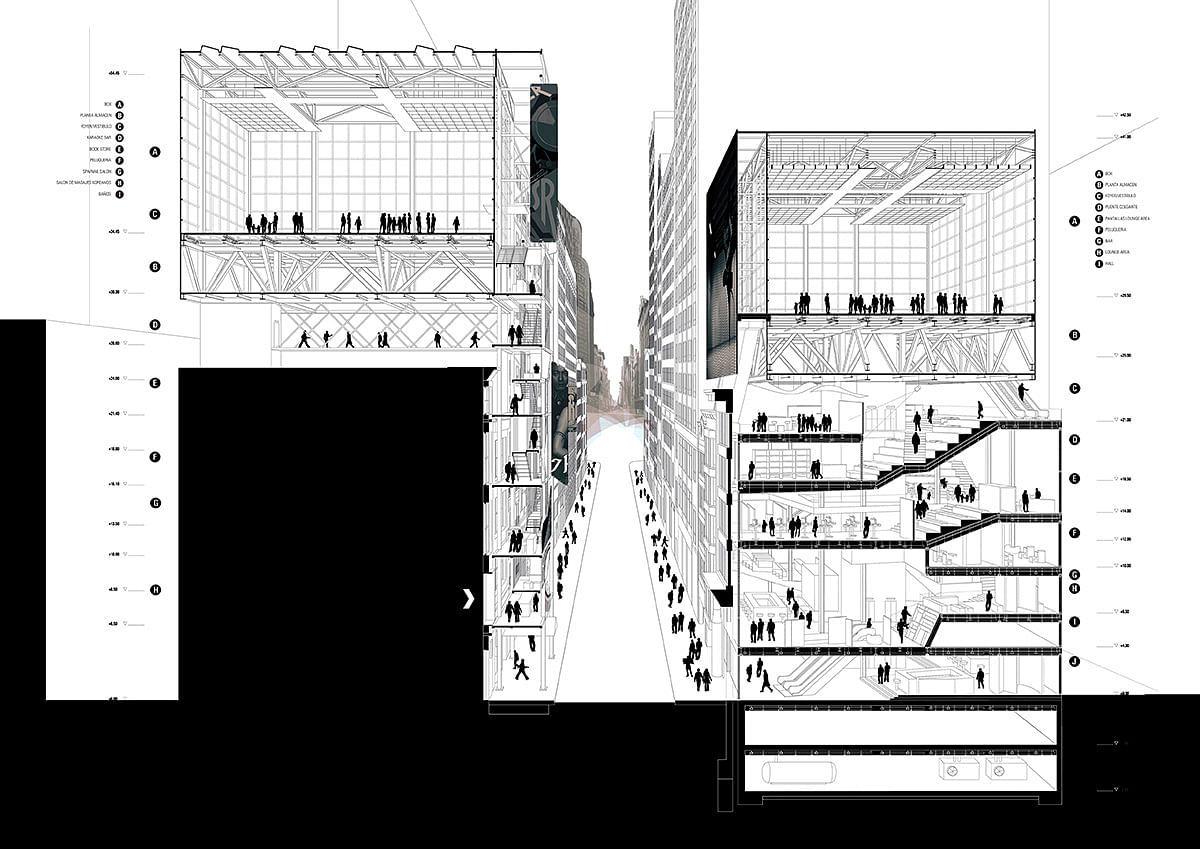
Image: Carlos Zarco Sanz

"The project does not really search for a building at all but a vast, socially interactive machine, an improvisational architecture, constantly changing in a ceaseless cycle of assembly, dismantling and shifting [...] It is primarily there to respond to the changing needs and desires of individuals, not to house prepackaged exhibits and events for a generalized public."
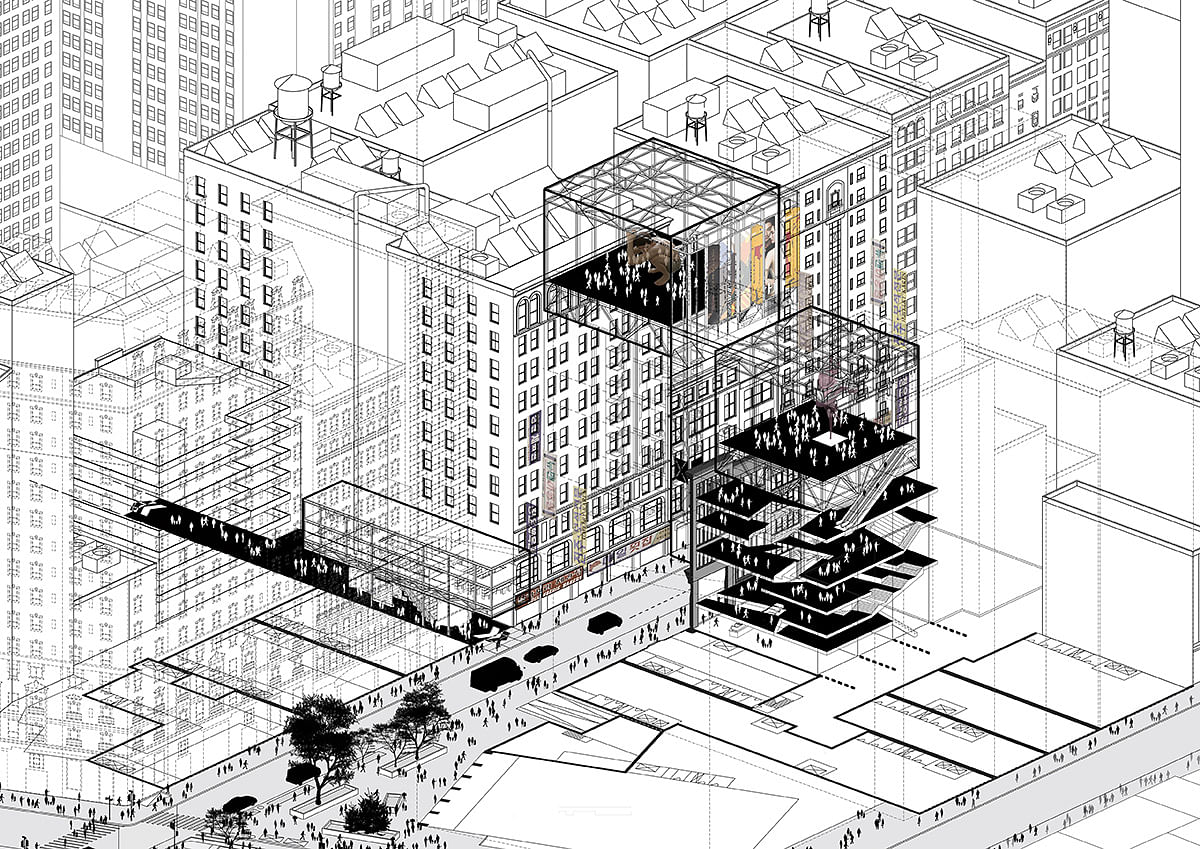
Image: Carlos Zarco Sanz

"Thus, the project can have a focus on communication rather than technology; or exchange rather than indoctrination. It can be a trading house rather than a trademark; an engine rather than an icon."

Data/Credits
Architect: Carlos Zarco Sanz
Location: New York City, NY, USA
Area: 8,000 sqm
Year: 2013
Project Advisor: Nestor Montenegro/ Universidad Europea de Madrid

Images courtesy of Carlos Zarco Sanz.

To see other winning entries, click here.

Related

thesis ● student ● social ● rtf ● re-thinking the future ● public ● proposal ● new york ● manhattan ● koreatown ● commercial

Share

  • Follow

    0 Comments

  • Comment as :

Korean Diaspora by Carlos Zarco Sanz - 3rd-prize entry from Re-thinking The Future Thesis Award

Sign up for Bustler's Email Newsletters

Next page » Loading

Korean Diaspora by Carlos Zarco Sanz - 3rd-prize entry from Re-thinking The Future Thesis Award

By Bustler Editors|

Friday, Dec 6, 2013

Share

Korean Diaspora by Carlos Zarco Sanz - 3rd Place in Public/Institutional category

Related

thesis ● student ● social ● rtf ● re-thinking the future ● public ● proposal ● new york ● manhattan ● koreatown ● commercial

Carlos Zarco Sanz from the University of Madrid recently sent us his proposal, "Korean Diaspora" from Re-thinking the Future's International Architectural Thesis Award we previously featured.  His design won 3rd place in the Public/Institutional category.

Sanz's "Korean Diaspora" reimagines Manhattan's Koreatown as a shifting social and commercial space built for the neighborhood's present and future.

Check out the details below.

Project intro

"The focus on Korean culture and multitude of social venues allows the space to be a site of social interaction connecting people together to form networks and cultivate the space. All the elements of the busy Korean street that apply to Manhattan’s 32nd street has the potential to act as more than just a commercialized recreation of Seoul, the KTown can also serve to support a community of Korean-Americans to connect with  American society while maintaining ties with Korea."
 

Image: Carlos Zarco Sanz

"The project, at this point, aims to empower this connection between differences not only through commercialism and consumerism but encouraging cultural exploration of the Korean Culture, which the project avoids to define but leaves room for it to be brought and change. Any attempt to define a specific program would foreclose on unforeseen developments and possibilities; therefore, the Korean Diaspora that inhabits incomings would acknowledge the inevitability of change, chance, and indeterminacy by incorporating uncertainties as integral to a continuously evolving process modeled after self-regulating organic processes."

Image: Carlos Zarco Sanz

"Details about the project
Considering the potential voids at the site, the two identical Boxes are placed on top the two existing buildings of Korea Way. To feed these public programmed spaces, the main public realm of the Korea Way, the street/sidewalks in particular, was required to be physically extended; however, this brought a challenge since the flow of the public realm is horizontal and the accesses to the Boxes are only through verticality."

Image: Carlos Zarco Sanz

"In order to solve this problem, two connector DEVICEs are developed as mediators. Although the strategy remains the same for the connection of the two Boxes to Korea Way, the tactics of the design vary as the project considers the local features of the plots."

Image: Carlos Zarco Sanz

"The variable 'program' and form of the program are not conventional architecture but much closer to what we understand today as the computer program: an array of algorithmic functions and logical gateways that control temporal events and processes in a virtual device."

Image: Carlos Zarco Sanz

"As socially interactive architecture, the project integrates concepts of technological interchangeability with social participation and improvisation as innovative and egalitarian alternatives to traditional free time and education, giving back to the public a sense of agency and creativity. The three-dimensional structure of the BOX is the operative space-time matrix of a virtual architecture."

Image: Carlos Zarco Sanz

"The project does not really search for a building at all but a vast, socially interactive machine, an improvisational architecture, constantly changing in a ceaseless cycle of assembly, dismantling and shifting [...] It is primarily there to respond to the changing needs and desires of individuals, not to house prepackaged exhibits and events for a generalized public."

Image: Carlos Zarco Sanz

"Thus, the project can have a focus on communication rather than technology; or exchange rather than indoctrination. It can be a trading house rather than a trademark; an engine rather than an icon."

Data/Credits
Architect: Carlos Zarco Sanz
Location: New York City, NY, USA
Area: 8,000 sqm
Year: 2013
Project Advisor: Nestor Montenegro/ Universidad Europea de Madrid

Images courtesy of Carlos Zarco Sanz.

To see other winning entries, click here.

Share

  • Follow

    0 Comments

  • Comment as :

Archinect JobsArchinect Jobs

The Archinect Job Board attracts the world's top architectural design talents.

VIEW ALL JOBS POST A JOB

Project Architect

jones | haydu

Project Architect

San Francisco, CA, US

Project Architect

BuildingWork

Project Architect

Seattle, WA, US

Intermediate Architectural Designer

David Smotrich & Partners LLP

Intermediate Architectural Designer

New York, NY, US

Project Manager - Civic/Community

DAHLIN ARCHITECTURE | PLANNING | INTERIORS

Project Manager - Civic/Community

Irvine, CA, US

Interior Designer | Education & Institutional Work

Berliner Architects

Interior Designer | Education & Institutional Work

Culver City, CA, US

AutoCAD Drafter/Architectural Designer

Kari Whitman Interiors

AutoCAD Drafter/Architectural Designer

Boulder, CO, US

Senior Interior Designer

IMC Architecture

Senior Interior Designer

Brooklyn, NY, US

Intermediate Architect

NDKazalas Architecture PC

Intermediate Architect

New York, NY, US

Associate - Interior Designer

FitzGerald Associates Architects

Associate - Interior Designer

Chicago, IL, US

Project Manager

Evan Raabe Architecture Studio

Project Manager

Los Angeles, CA, US

Next page » Loading